AI in procurement: Applications, Challenges, and Mitigation Strategies
Explore the impact of AI in procurement and read about real-world applications, key challenges, and practical strategies to overcome them.

Traditionally, procurement has been a process weighed down by manual tasks, fragmented systems, and endless paperwork. Today, procurement is undergoing a transformation.
While procurement teams have long worked to add strategic value, Artificial Intelligence (AI) amplifies their impact. Procurement AI enables teams to quickly process mountains of data, uncover hidden patterns, and automate repetitive tasks like invoice processing and supplier evaluations.
So, what does this transformation mean for businesses? And how can procurement leaders use procurement AI to address today’s inefficiencies and gain a competitive edge? Read on to explore key AI use cases in procurement, the challenges businesses face, strategies to overcome them, and the exciting opportunities AI brings for the future.
Here are the topics we’ll cover at a glance:
What AI in procurement means
AI use cases and capabilities in procurement
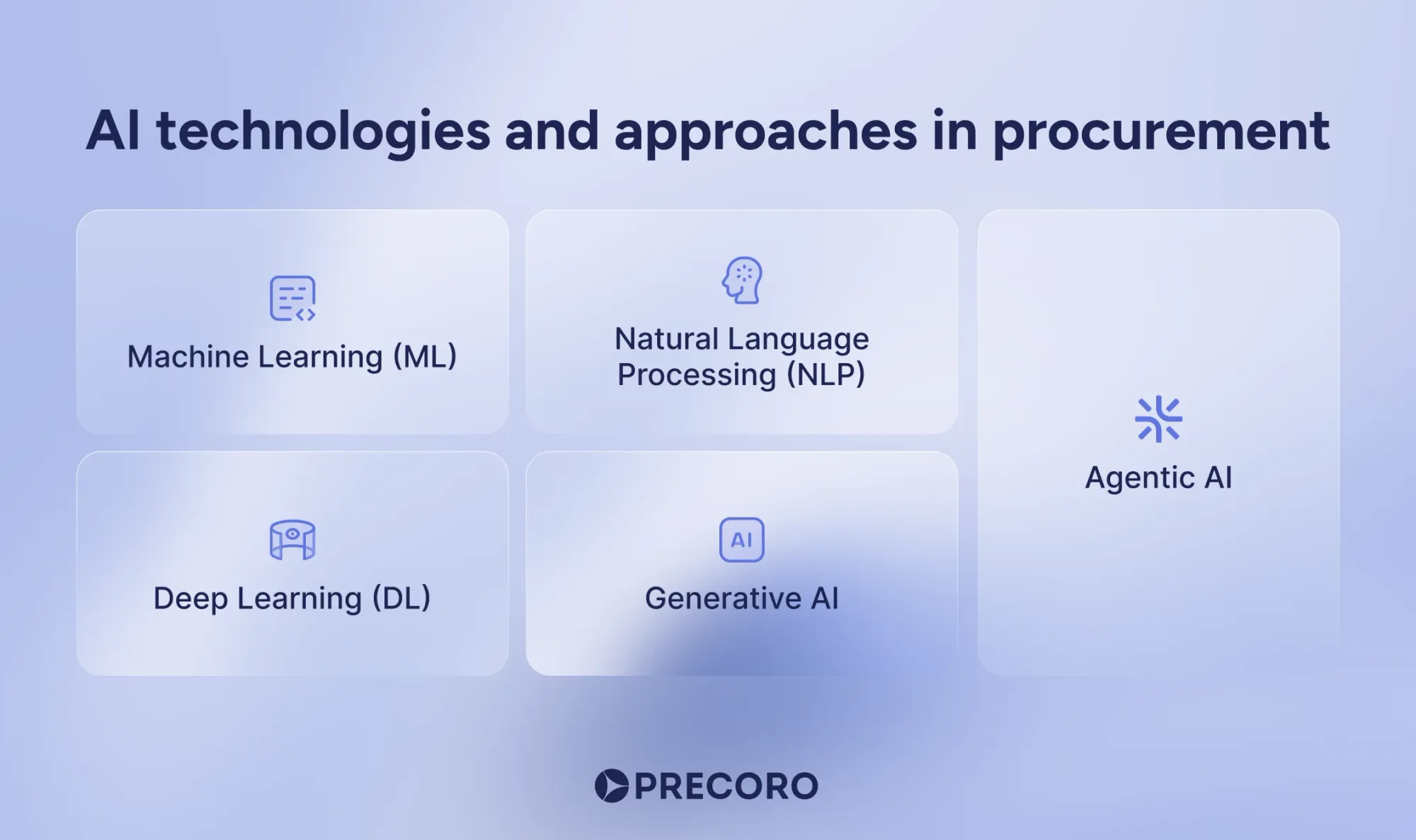
Types of AI technologies used in procurement
Benefits of AI in procurement
KPIs to track after adopting AI in procurement
Challenges of AI in procurement
Mitigation strategies for AI risks and challenges
Building an AI-ready procurement operating model
How Precoro uses AI to automate procurement
The future of AI in procurement
Frequently asked questions
Procurement AI in a nutshell
What is AI in procurement?
AI in procurement refers to applying advanced technologies that use artificial intelligence to make procurement processes faster, more efficient, and data-driven. Unlike traditional tools that often operate in isolation or rely on rigid workflows, AI connects the dots between disparate data sources, providing a more comprehensive view of procurement activities.
Procurement function is often plagued with inefficiencies that, using old-school methods like Excel and mail, require time-consuming reviews to identify — rogue spending, misclassified expenses, delayed approvals, and duplicate invoices are just the tip of the iceberg. Procurement AI shines here by quickly analyzing large amounts of data to identify patterns, flag anomalies, and uncover opportunities that might otherwise go unnoticed.
However, it’s important to remember that AI applications in procurement aren’t about replacing human expertise: AI won’t drive organizational change or deliver savings on its own. Instead, it’s a powerful tool that requires expert guidance and oversight to truly add value.
How does AI-based procurement differ from traditional procurement technologies?
Traditional procurement technologies like ERP modules, spreadsheets, or rule-based automation are all designed for generally fixed workflows, where a purchase request follows the same steps from requisition to approval every single time, regardless of circumstances, and analysis happens after the fact manually. AI-based procurement takes a different approach at almost every level, from how it acquires data to how and when it makes decisions.
| Traditional procurement tech | AI-based procurement | |
|---|---|---|
| Data handling | Manual entry and review; data often stays siloed across systems | Automatically connects and processes data across sources in real time |
| Decision logic | Fixed rules; the same input always produces the same output | Learns from patterns in historical and live data; output improves and adapts over time |
| Anomaly & risk detection | Relies on periodic manual review or audits | Flags anomalies, risks, and outliers continuously, as they occur |
| Scalability | Adding volume or complexity usually means adding headcount | Handles growing volume and complexity with little added manual effort |
| Role of human oversight | Humans execute and check every step | Humans set direction and review AI output, rather than performing the task itself |
This doesn’t mean that AI algorithms would end up replacing all these older tools completely. You’ll notice that some companies still use older ERP systems and leverage AI capabilities on top of that.
The difference is that an older system requires a person at the helm to manage every step; meanwhile, AI-based procurement may automatically execute many actions like processing, flagging, and even acting on information, which forces people to step in for judgment calls only.
AI for procurement use cases and AI capabilities
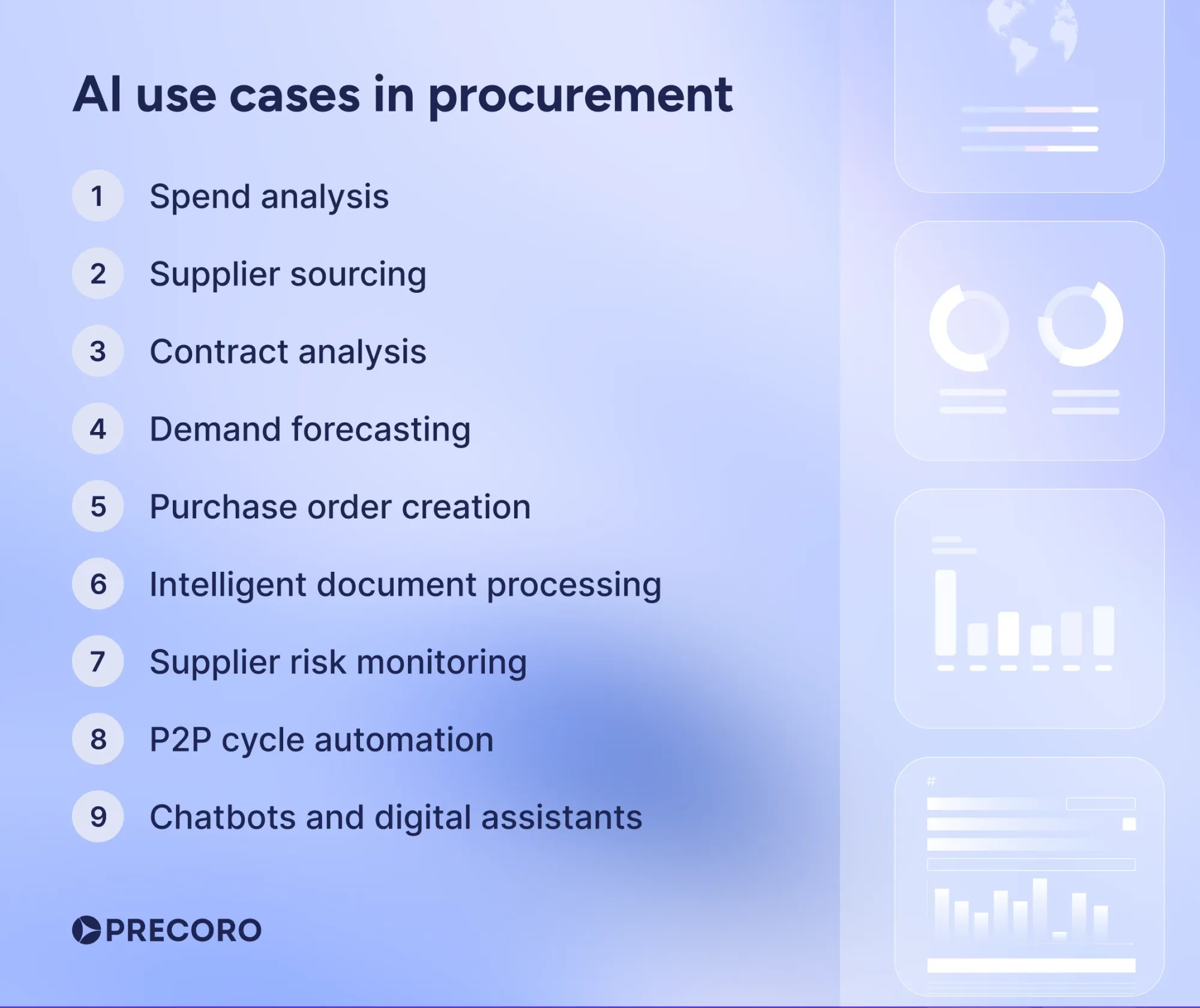
Here are the key AI in procurement examples that are transforming how teams work:
AI-powered spend analysis for identifying and reducing maverick spending
AI for procurement enhances spend analysis by efficiently processing and analyzing large volumes of data far beyond what a manual approach can handle. Traditional spend analysis methods often involve time-consuming manual data entry or reliance on basic software tools that can miss key patterns, discrepancies, or hidden opportunities.
Procurement AI, however, uses advanced algorithms to automatically categorize spending data, identify spending trends, and flag anomalies in real time. For example, AI can spot recurring or unnecessary costs, detect maverick spending (when employees purchase outside of approved channels), and identify opportunities for cost savings based on historical spending patterns.
Artificial intelligence sourcing for suppliers and supply chain optimization
Companies are increasingly using AI in sourcing and procurement tasks to analyze supplier data and identify the best-fit suppliers based on factors like price and quality of goods or services, as well as delivery performance. AI can process large amounts of historical supplier performance data across multiple metrics, allowing procurement teams to make more informed, data-driven decisions instead of relying solely on anecdotal evidence or subjective evaluations.
While AI in procurement is still evolving when it comes to supplier negotiations, it is already used to analyze historical procurement-related data and current market trends, and even consider external factors like geopolitical risks. AI can then offer insights into potential negotiation strategies, for example, identifying the best times to initiate price review or suggesting suppliers likely to offer favorable pricing or terms.
AI-powered strategic sourcing vs. traditional manual sourcing
If you ask a buyer doing sourcing by hand how they selected their last supplier, the honest answer would likely be some variation of “they were already on our list, and they got back to us faster than others.”
That’s not to say it’s criticism — that’s just what comes naturally when sourcing still relies heavily on a person’s memory and a spreadsheet of past vendors, plus whatever RFPs that someone has room in their schedule to manually generate and send out. There’s nothing in this setup that inspires any kind of over-the-fence type shopping. The shortlist rarely grows, and the underlying strategy (or lack thereof) is only revisited once a year at best, whenever the annual contracts are updated.
The introduction of artificial intelligence sourcing expands both the speed and the size of the decision a buyer can make. Why use a shortlist when you have a tool that analyzes the entire market at once? It also means that the timeframe for a sourcing decision becomes dynamic: the system can notice market changes and encourage a deviation in sourcing decisions well before the usual annual contract is up.
None of this makes human sourcing less substantial. If anything, it adds more stress and pressure on human judgment. You still need a human to make decisions on which AI-suggested supplier will be a good match in a partnership the organization is aiming for. What AI changes the most is the size of the market that a buyer can consider before making a decision.
AI-powered contract analysis
AI in sourcing and procurement is transforming contract management by automating key tasks like contract review, compliance tracking, and renewal alerts. AI can quickly scan contracts, flagging any areas that may need attention — such as clauses that deviate from standard terms or compliance issues. AI can also track key milestones, ensuring that renewals or renegotiations happen on time and minimizing the risk of missed opportunities or penalties.
However, relying solely on generative AI in procurement for legal or contractual tasks does come with risks. While AI can flag issues, it may not fully understand the context or nuances behind legal terms. Therefore, even though AI for procurement can speed up contract management, human control remains essential to properly address all legal aspects.
AI-powered demand forecasting
Procurement AI takes demand forecasting to the next level by analyzing past procurement data and using predictive analytics to make highly accurate forecasts for future needs. Modern technology solutions utilize AI to examine historical trends, seasonal patterns, and consumption behaviors, offering predictions that far surpass traditional methods.
What sets AI-powered analytics apart from traditional analysis is the ability to factor in multiple external influences, like market shifts, supply chain disruptions, or geopolitical risks. For example, if procurement AI notices a sudden increase in raw material prices or identifies potential disruptions due to geopolitical tensions, it can alert the procurement team immediately. With this advanced warning, procurement professionals can adjust their procurement strategies in time and prevent potential financial losses.
AI-powered purchase order creation
Generative AI in procurement streamlines the process of creating purchase orders (POs) from approved purchase requisitions. Once the requisition is approved, instead of manually inputting information into the order, purchasing agents can just witness the AI system automatically transfer key details like item descriptions, quantities, supplier names, and pricing from the PR to the PO. Such automation reduces the risk of human error, cuts down on administrative work, and accelerates the entire procurement cycle.
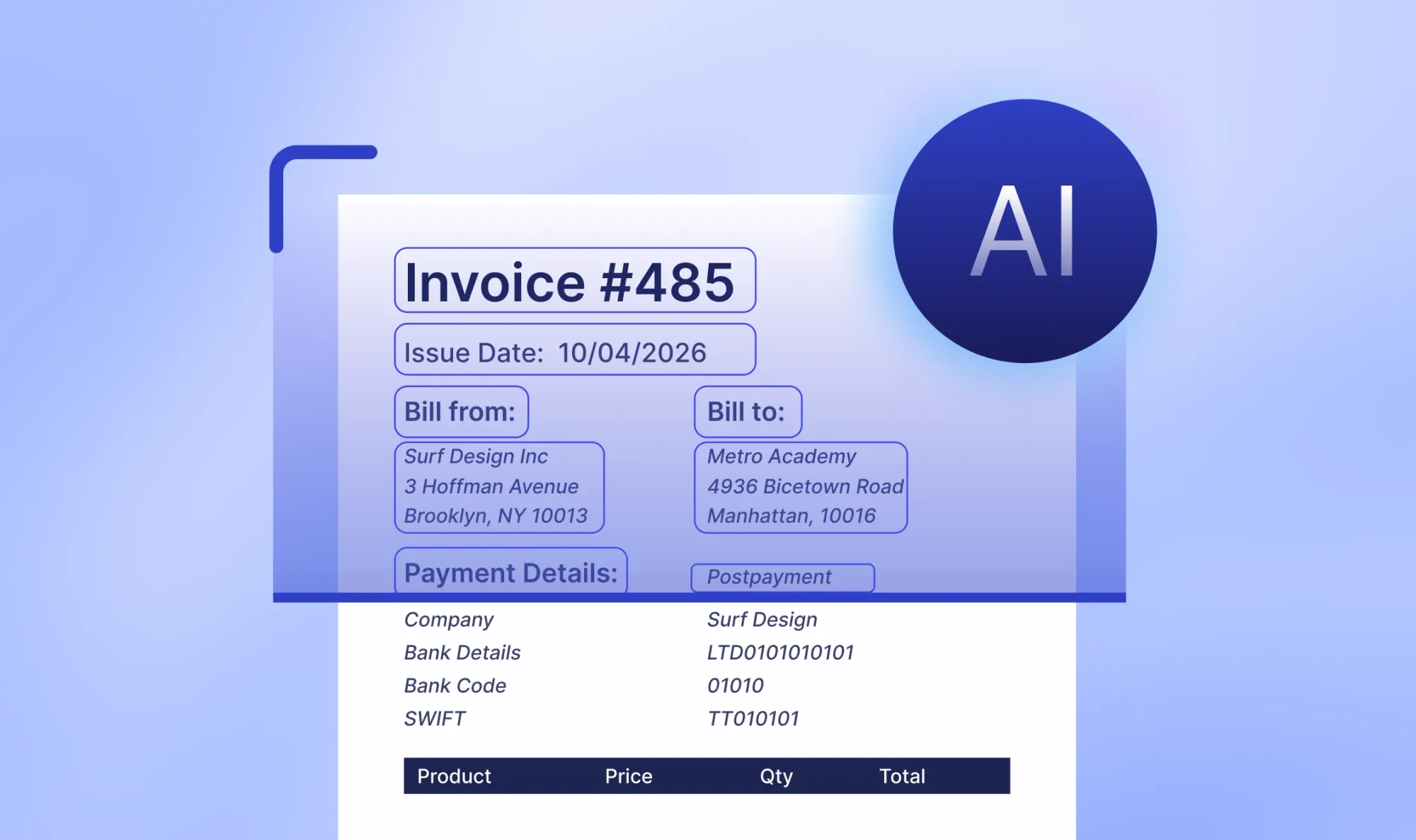
AI-powered intelligent document processing for invoices and procurement documents
Traditional Optical Character Recognition (OCR) systems needed documents to be more or less tidy and formulaic to operate properly. The system would work correctly with a standard scanned invoice, but even the slightest slant or note can cause OCR to falter and not grab your data properly. AI document processing in 2026 operates on a completely different level by allowing easy data extraction regardless of its original, messy scans and inconsistent layouts.
The bigger change, however, isn’t better reading, but reasoning off of what was read. Legacy systems were largely about extracting fields with PO numbers, vendor names, prices, and payment terms. Today’s modern procurement document AI can verify an invoice using corresponding purchase orders or contract terms, flagging a price discrepancy, an item quality mismatch, or a vendor data problem at the same time.
That’s why you get a tool like Precoro that actually leverages these AI-enhanced capabilities to handle PDFs, scanned documents, emails, and other data types. The extracted data is fed directly into the procurement system without the need for manual input. A pairing of reliable extraction and multifaceted validation sets document AI from the OCR tools it’s built on top of.

AI agents and agentic workflows for procurement professionals
The AI agents involved in procurement are different from the chatbots most people visualize when thinking of an “AI assistant.” When you ask a chatbot something, it will respond to the question. Whereas the agent sees that an action is required, determines what steps must be taken to execute it, and then carries those steps out. It will only pause when it needs a genuine human judgment.
All agents aren’t equal in the degree to which they can act autonomously, and clarification here is required because the term “agentic” is used loosely in many different cases. Certain agents are made to execute a defined process a single time after a trigger, akin to more intelligent automation. Other agents can adjust their plan mid-activity if, for example, a supplier fails to reply or a document isn’t complete.
Leading procurement agents of 2026 work in hybrid environments that support automated, unattended action on mundane tasks while routing any action about money, contract terms, or supplier relationships to a human before proceeding.
In procurement, agentic workflows are used for:
- Investigating and resolving flagged exceptions
- Following up with suppliers on notable issues and escalating if there's no response
- Reprioritizing approvals in abnormal situations
- Pulling together recurring spend or supplier reports on schedule
- Drafting a first-pass response to a routine supplier inquiry
Let us take a delayed shipment as a working example. A human who notices the delay would have to dig up relevant contract terms and draft a follow-up to the supplier manually. An agent can do all of these actions, as well:
- Noticing the delay
- Retrieving the specific contract terms for it
- Preparing a request to the supplier
In this case, a human would only have to review and send the request without assembling everything by hand.
AI for procurement in Procure-to-Pay (P2P) process automation
Procure-to-Pay, from requisition to payment, is historically the most cobbled-together area of procurement work. That is, one system creates the requisition, another tracks the PO, a dedicated human manually checks the goods receipt against an invoice, and then the finance team pays for the order once all else is lined up. Every stage mentioned before participates in this process in some way.
The impact of AI on P2P specifically is knitting together these disjointed stages so that information can carry forward on its own without having to re-enter it over and over again at every handoff. Yet, the specific role of AI differs depending on the stage:
| P2P stage | Traditional handling | AI's role |
|---|---|---|
| Requisition | Submitted and routed manually for approval | Auto-checks against budget and policy before routing. Flags exceptions upfront. |
| Purchase order | Manually created from the approved requisition | Generates the PO directly from requisition data. |
| Goods receipt | Manually logged and compared against the order | Matches received quantities against the PO automatically. Flags discrepancies. |
| Invoice matching | Manually checked against PO and receipt | Cross-references invoice, PO, and receipt in one pass. |
| Payment | Released once manual checks clear | Releases automatically once matching passes. Held and routed to a person only when it doesn't match. |
It’s not that there’s some stage that changes individually. It’s that the handoffs between stages stop relying on someone to manually carry information from one system to another. All the data in the requisition is funneled into the PO, all the data in the PO is funneled into the match, and a human is reintroduced only when something doesn’t add up.
AI-powered procurement for supplier risk and supply chain disruption monitoring
The vast majority of supplier risk assessments still only occur at specific points, like onboarding or contract renewal, as well as after some sort of issue. AI-driven surveillance, in contrast, operates in real-time by tracking multiple factors associated with certain suppliers.
Visibility outside of any one supplier is also an issue. A company can have a very good relationship with every supplier as individuals, but still face real risks when several of those suppliers operate in the same region, material, or shipping route. Risks like these can only be viewed when suppliers are seen as a connected network and not just a list.
AI can layer the dependencies across the supply chain, discovering risks that could’ve been missed otherwise, offering a chance for procurement teams to prepare for disruptions beforehand.
AI technologies and types of artificial intelligence in procurement
At its core, the term “AI” refers to any algorithm or system that exhibits behavior considered “intelligent.” AI for procurement, therefore, encompasses various technologies and techniques that can perform certain sourcing, purchasing, and operational tasks that would normally require human intelligence.
In general, AI is categorized into weak AI (or narrow AI) and strong AI (or general AI). Weak AI is designed to perform specific tasks, like automating processes or analyzing data. Strong AI, on the other hand, is capable of performing a wide range of tasks across various domains, mimicking human reasoning and decision-making.
AI used in procurement today still falls under weak AI — even the more autonomous, agentic systems covered later on are executed with a pre-defined scope instead of reasoning freely the way human intelligence would. That said, the scope of that “specific task” term has expanded significantly, leading to modern procurement AI in 2026 that can plan, act, and adjust across multiple workflow steps. It’s a step-up from how it used to only analyze data in isolation.
Below, we break down the key types of AI in procurement and show what each one brings to the table.
Machine learning (ML) for procurement
Machine learning (ML) is a subset of AI that focuses on algorithms that enable systems to learn from data and improve over time without explicit reprogramming. In procurement, ML is widely used for tasks in predictive analytics and optimization of various operational tasks.
For example, ML algorithms analyze historical procurement data to uncover emerging trends and forecast future demand, supplier performance, and price fluctuations. As these algorithms process more data, they “learn” from new inputs and refine their predictions to provide increasingly accurate outcomes.
AI in procurement use cases:
- Identifying spending patterns and uncovering cost-saving opportunities.
- Predicting potential supply chain disruptions or supplier performance issues.
- Anticipating future procurement needs based on historical data and emerging trends.
Natural language processing (NLP) for procurement
Natural language processing (NLP) enables machines to understand, transform, and generate human-like language. It’s especially useful in procurement when dealing with emails, contracts, and other forms of supplier communication.
NLP allows procurement systems to analyze and extract meaningful insights from the textual sources. For example, NLP can automate contract reviews, identifying key clauses, deadlines, and potential risks within legal documents. AI detectors can also help ensure that automatically generated procurement reports or supplier communications maintain authenticity and transparency by distinguishing between human-written and AI-generated text.
AI in procurement use cases:
- Automating contract analysis, flagging compliance issues, and managing renewals.
- Streamlining supplier communications by automating responses to inquiries and processing quotes.
- Extracting key data from invoices (for example, PO numbers and line items) to automate matching and approval.
Large language models (LLMs) and retrieval-augmented generation (RAG) in procurement
LLMs are a type of deep learning model trained for understanding and producing language; they can read legal documents, summarize email chains, reply to questions in everyday English, and keep a general conversation if necessary. That said, LLMs by themselves only have the data they were trained on, which isn’t your company’s specific contracts, suppliers, or spend history.
RAG addresses this knowledge gap by acquiring specific procurement information from a company’s own data before the model can provide an answer; this information replaces general-knowledge data to personalize LLM outputs for each company.
AI in procurement use cases:
- Answering questions about specific contracts, suppliers, or past orders using a company's own data as the source.
- Summarizing long or dense procurement documents into a few readable lines.
- Surfacing the exact clause or data point behind an answer, so a person can verify it rather than take it on faith.
Generative AI in procurement
Gen AI in procurement refers to a type of AI that not only analyzes existing data but also creates new, valuable outputs based on that data. Unlike traditional AI, which is designed to recognize patterns and make predictions, generative AI in procurement can generate unique outputs, such as text, images, or even sourcing or purchasing strategies.
To function, generative AI models are typically trained on large datasets, which can include historical purchasing data, supplier performance data, market trends, and more. Gen AI in procurement learns from discovered patterns within the datasets, developing the ability to produce unique content or solutions that align with those learned patterns.
Generative AI in procurement use cases:
- Automatically generating purchase orders from requisitions or contracts based on supplier information.
- Creating reports or insights from procurement data for better decision-making.
- Automating supplier communications, for instance drafting responses to inquiries or generating quotes.
- Assisting in demand forecasting by generating predictions based on historical data.
Generative AI vs. predictive AI in procurement
Both Gen AI and Predictive AI are based on the same core data but are intended to answer different kinds of questions. Predictive AI focuses on patterns in past and present data to speculate about what to expect in the future. Gen AI goes a step further and actually produces something new based on what it learned: a text draft, a set of recommendations, etc.
| Predictive AI | Generative AI | |
|---|---|---|
| Core question | What's likely to happen? | What should be created or drafted? |
| Typical output | A forecast, score, or flagged risk | A document, message, report, or recommendation |
| Procurement example | Forecasting demand or flagging a supplier likely to underperform | Drafting a purchase order or a supplier follow-up email |
| Depends on | Historical patterns in structured data | Historical data plus the ability to generate new content from it |
| Human's role | Reviewing the forecast and deciding what to do with it | Reviewing and editing the draft before it's used |
As with many other comparisons in this article, procurement teams use both these tools in tandem. For example, a predictive model notices a supplier trend toward a delay and flags it, while a generative model drafts the supplier follow-up message on the topic that addresses the issue.
Agentic AI for procurement and autonomous decision-making
An AI that simply performs a sequence of actions is fundamentally different from an AI that’s trusted to make an independent decision on something. Agentic workflows covered earlier can indeed execute a sequence of actions on their own: receive notification, investigate an exception, draft a follow-up, and prepare an action for review.
Autonomous decision-making implies taking another step — making the decision independently without prior human check. A person would only have to review the outcome after the fact.
That line moves depending on what’s at stake. More and more procurement teams are becoming increasingly comfortable with having AI make completely autonomous decisions for certain types of purchasing activities.
Any decision where a mistake would carry high financial costs or is difficult to rectify is going to route to a person, still, like contract terms negotiation or introducing an unvetted supplier. The system can prepare the entire groundwork for these decisions, but the sign-off would remain a human call at the end.
AI in procurement use cases:
- Auto-approving purchases falling within a pre-defined spend threshold.
- Selecting a supplier from a pre-vetted shortlist for repeated mundane orders.
- Auto-renewing low-risk contracts if the terms haven’t changed much.
- Adjusting reorder quantities or timing depending on live inventory and demand signals.
Prescriptive analytics and optimization algorithms for procurement decision-making
Forecasting can tell teams what may happen. Prescriptive analytics can do one better, telling you what should happen to achieve the desired goal by balancing several competing constraints at once.
For example, a sourcing team is likely deciding on the ideal supplier based on price, lead time, supplier risk, and sustainability targets that all pull in different directions. Optimization algorithms can evaluate possible sourcing combinations against all these objectives at the same time to identify the optimal answer.
AI in procurement use cases:
- Balancing cost and delivery speed when splitting an order to several suppliers.
- Allocating a fixed budget across categories to get the most value without going over risk tolerance limits.
- Setting inventory levels that avoid overstocking and stockouts at the same time.
- Weighing a cheaper supplier against a more sustainable one when both options are plausible.
AI tools for supplier intelligence in procurement
Sourcing, risk monitoring, and negotiation all require data about suppliers, but these processes were always responsible for forming their own, fragmented viewpoints: accumulating pricing history for one purpose while financial standing is pulled for another. Supplier intelligence tools consolidate partial views into one profile per supplier that is constantly updated with relevant data, such as:
- Performance history
- Financial health
- Capacity
- Compliance status
- Sustainability data, and more
All this information is refreshed automatically, and there’s no need to rebuild everything from scratch every time someone new needs access to supplier data. Data collection isn’t even the biggest value here — it’s what it enables elsewhere. A centralized data source with up-to-date information is instrumental for improving the quality and effectiveness of risk flagging, sourcing, negotiations, and many other processes in the field.
Robotic process automation (RPA)
Robotic Process Automation (RPA) is straightforward, rule-based software bots. They never learn anything based on data, and there’s no intelligence to make decisions, which is why it isn’t considered AI even when it’s often bundled into AI-driven procurement conversations. When thinking about procurement and common RPA use cases, most people envision invoice matching and data transfer between systems, among others.
That territory is also receding with time. Many of the tasks that RPA used to perform are getting automated by those AI-based document processing and agentic workflows discussed earlier. They can even catch exceptions and adapt, too. RPA does still appear in procurement stacks, but in 2026, it’s rarely used outside of small, high-volume tasks with a fixed rule.
Overall, this broadly describes where we are today with implementing AI in procurement: it’s a toolset consisting of everything from strictly rule-based automation to autonomous environments that plan, verify, act, and decide on their own within the borders of their pre-defined scope. None of it can be considered general intelligence still, though, and the shrinking footprint of RPA should be a reminder of how not everything sold as “AI” actually is one. The ceiling on what the AI can be trusted to do on its own is also moving constantly, as well.
Benefits of AI in procurement
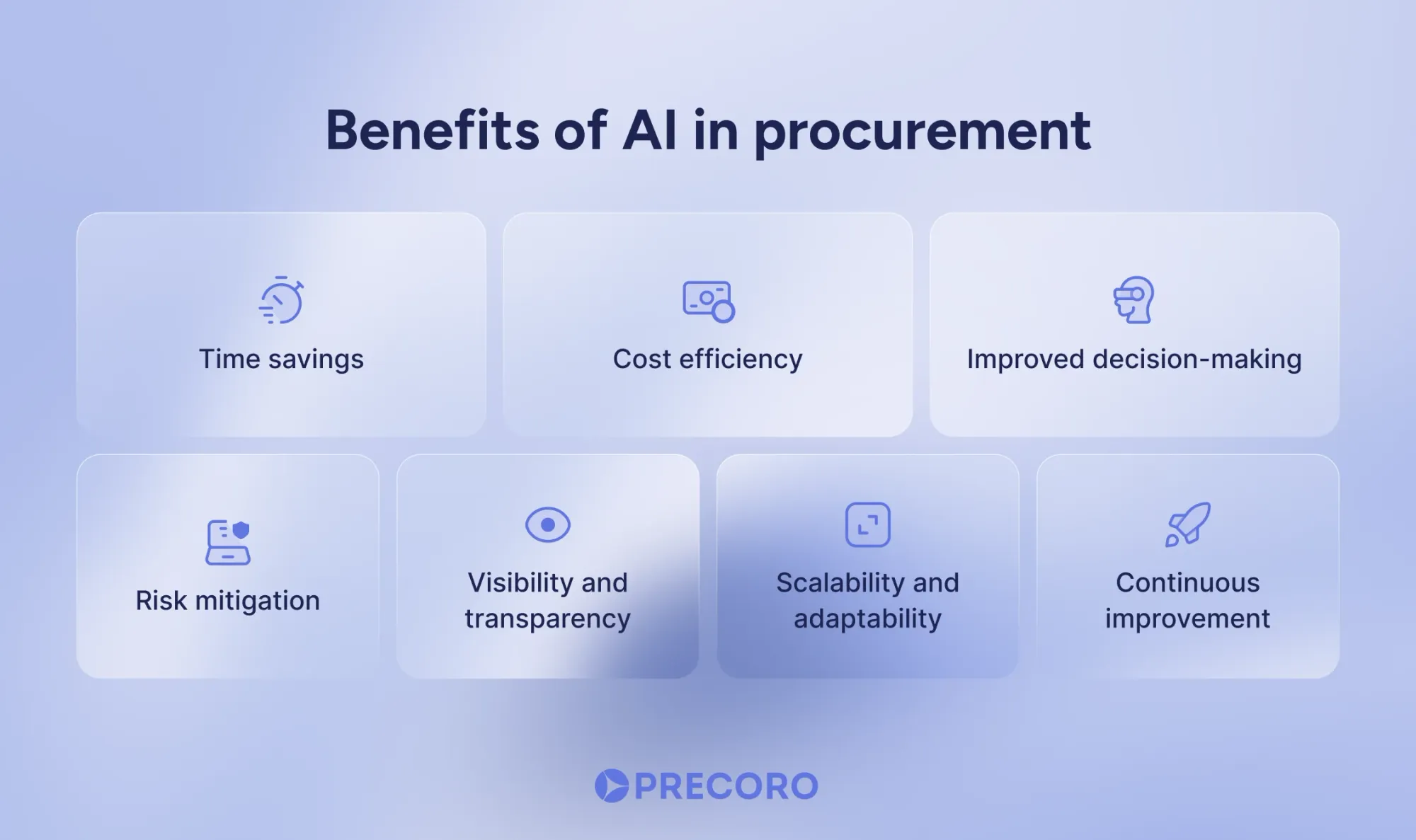
From saving time to making smarter decisions, here are the key benefits of AI and procurement teams working together:
Time savings with AI for procurement
The use of AI in procurement brings a whole new level of efficiency by slashing the time spent on repetitive, manual tasks like data entry, vendor comparisons, and invoice matching. What might take a human hours (or even days) can be completed by AI in a matter of minutes.
Moreover, generative AI in procurement not only speeds up tasks but also creates tailored workflow solutions, customized reports, and more. It’s not just about speed but also about making the procurement team’s life easier. By cutting out bottlenecks, AI for procurement ensures faster approvals, quicker payments, and smoother workflows. That means your team can spend less time on administrative work and dive into what really matters: building stronger supplier relationships, nailing better deals, and uncovering cost-saving opportunities.
Cost efficiency with procurement AI
AI for procurement helps teams reduce operational costs by automating repetitive tasks like data entry, invoice processing, and spend analysis. This automation not only cuts down on manual labor but also minimizes human error, leading to fewer costly mistakes.
AI also helps ensure informed financial decisions by analyzing vast amounts of data and identifying cost-saving opportunities. For example, AI for procurement can detect maverick spending, optimize supplier selection, and highlight areas for better negotiation based on historical performance data. These insights allow procurement teams to make more cost-effective choices that reduce expenses across the board.
According to Deloitte’s 2025 Global Chief Procurement Officer Survey, the recent advancements in procurement AI are showing tremendous results:
“GenAI and agentic AI adoption are helping streamline processes, and these big bets are paying off, with Digital Masters achieving an average 3.2x investment return on GenAI, while Followers saw a projected slightly above 1.5x increase in ROI.”
Improved AI-powered decision-making
AI transforms procurement decision-making from guesswork to precision. Instead of sifting through endless spreadsheets or relying on gut feeling, teams can use procurement AI to quickly analyze vast amounts of data for valuable insights — patterns, trends, and opportunities that might otherwise go unnoticed. This mirrors how AI marketing tools analyze consumer behavior, predicting trends and optimizing campaigns based on real-time data.
Take supplier selection, for example. AI doesn’t just look at the prices of goods — it can examine historical supplier performance, delivery reliability, and even factors like customer service. This allows procurement AI to recommend the most reliable suppliers, offering the procurement team a solid, data-backed foundation for making a decision. Then, generative AI in procurement can draft contracts based on real-time data.
But it doesn’t stop there. AI for procurement can also help teams anticipate future purchasing needs by forecasting market demand based on past trends, helping companies stay ahead of potential supply shortages or overstocking. However, it’s important to remember that predictions of procurement AI aren’t perfect and can be impacted by unexpected supply chain disruptions or anomalies in the market.
AI-powered procurement risk mitigation
AI is like a radar system for potential risks in procurement, constantly scanning both historical data and real-time external factors to detect early warning signs before problems snowball. For instance, if a supplier shows signs of financial instability or drops in performance metrics, AI for procurement can flag these issues early, allowing procurement teams to take proactive steps to find alternative suppliers before any disruptions occur.
Additionally, AI can help companies track compliance with supplier contracts, ensuring that terms like pricing, delivery schedules, and product quality are being met. This way, procurement teams can avoid overspending due to contract violations or overlooked terms.
Moreover, AI in procurement enhances a company’s risk mitigation capabilities that extend beyond individual suppliers. Artificial intelligence can analyze broader patterns in supply chain data, stemming both from internal sources like inventory levels and external factors such as weather events, political instability, or market volatility. This allows companies to stay ahead of potential supply chain disruptions, minimize costly delays, and keep operations running smoothly.
Greater procurement visibility and transparency
AI for procurement offers a practical, real-time window into spending, giving teams a crystal-clear picture of where their money is going. By analyzing supplier invoices, purchase orders, and contracts, AI can quickly flag areas where expenses may be higher than expected, identify opportunities for consolidating purchases, or even spot missed discounts. This helps procurement teams act fast to optimize their spending and improve cost efficiency.
Additionally, AI bridges the gap between procurement and finance. By providing a unified view of procurement data, AI for procurement helps ensure that both teams are aligned on budgeting and spending forecasts. It also simplifies budgeting processes and helps predict future costs based on past spending patterns, making it easier to stay within budget and achieve financial goals.
Scalability and adaptability with AI
As businesses grow, their procurement needs naturally become more complex. AI in sourcing and procurement supports this growth by automating repetitive tasks and allowing procurement teams to manage an increased volume of purchases without sacrificing efficiency.
Whether your business is expanding into new markets, onboarding more suppliers, or adjusting to shifting demand, AI can handle the heavy lifting. Machine learning can automate supplier assessments, while generative AI in procurement can streamline purchase order creation, adapting to new challenges and opportunities as they arise.
Continuous procurement improvement with AI
Procurement AI systems aren’t static — they get smarter over time. As AI tools process more data and receive feedback, they continuously refine their algorithms, becoming more accurate and efficient. This means AI for procurement can identify high-performing suppliers with increasing success, predict demand with greater precision, and uncover inefficiencies in processes that might have gone unnoticed earlier.
Take supplier selection, for example. Early in its use, AI might highlight suppliers considering just basic criteria like cost and delivery times. However, as the system learns more about each supplier’s performance, it can factor in nuances like quality consistency or customer service reliability, providing even more precise recommendations.
Similarly, generative AI in procurement improves over time by learning from past data. Initially, it may draft basic documents like purchase orders or supplier contracts using standard templates.
As gen AI in procurement processes more data, it becomes capable of generating more complex, customized documents, such as contract clauses that reflect updated pricing models, supplier performance, or changing procurement conditions. To better leverage these capabilities, some teams are turning to ChatGPT courses to upskill procurement professionals in prompt engineering and AI-assisted document generation.
KPI improvements to track after AI adoption in procurement
Early stages of AI implementation in procurement are often all about quick dopamine hits: faster processing, less friction on a daily basis, and a significantly smaller dependency on manual labor. The thing is, “seems faster” isn’t a specific number you can bring to leadership, and it’ll be challenging to provide evidence of whether those gains were of any significance if there were no pre-defined KPI sets to track before and after adoption.
The key metrics below have been broken down into four separate categories, forming the foundation for your ROI analysis later.
Efficiency:
- Cycle time from requisition to purchase order
- Time to process and approve an invoice
- Percentage of purchase orders touched by a human before completion
Accuracy:
- Invoice-to-PO match rate on the first pass
- Rate of duplicate or erroneous payments caught in time
- Forecast accuracy against actual demand
- Rate of contract or compliance flags confirmed as genuine issues
Financials:
- Spend under active management vs maverick spend
- Savings identified and realized via AI-flagged opportunities
Supplier performance:
- On-time delivery rate
- Supplier risk score trend over time
- Percentage of suppliers with continuously updated performance profiles
- Time to onboard a new supplier from start to finish
How to measure the ROI of AI in procurement
Once the KPIs are in place, ROI calculation becomes a matter of comparing the cost of AI against its benefits over a certain period of time. The cost side covers licensing and implementation fees but should also add a few of the less obvious values like data cleanup, integration work, ongoing maintenance, and training time.
As for the benefits, some advantages are easy to price: hours saved on manual invoice matching that translate to labor cost, or a lower rate of duplicate payments. Others rely a bit more on human judgment.
For example, faster cycle times might not be a line-item saving, but they do reduce the possibility of missed early payment discounts or rushed shipping fees. A reasonable stance would be to measure hard, directly-priced savings and then estimate the indirect value, so that the final ROI figure won’t overstate the reality.
Also important to keep an eye on: the return on investment for artificial intelligence in procurement is often compounding instead of staying linear. One of the easiest ways to underestimate ROI is to measure too early. A system that’s six months in and is still being tuned doesn’t always reflect the long-term value of any changes: accuracy does improve over time after all, and so does adoption.
Challenges of artificial intelligence in procurement
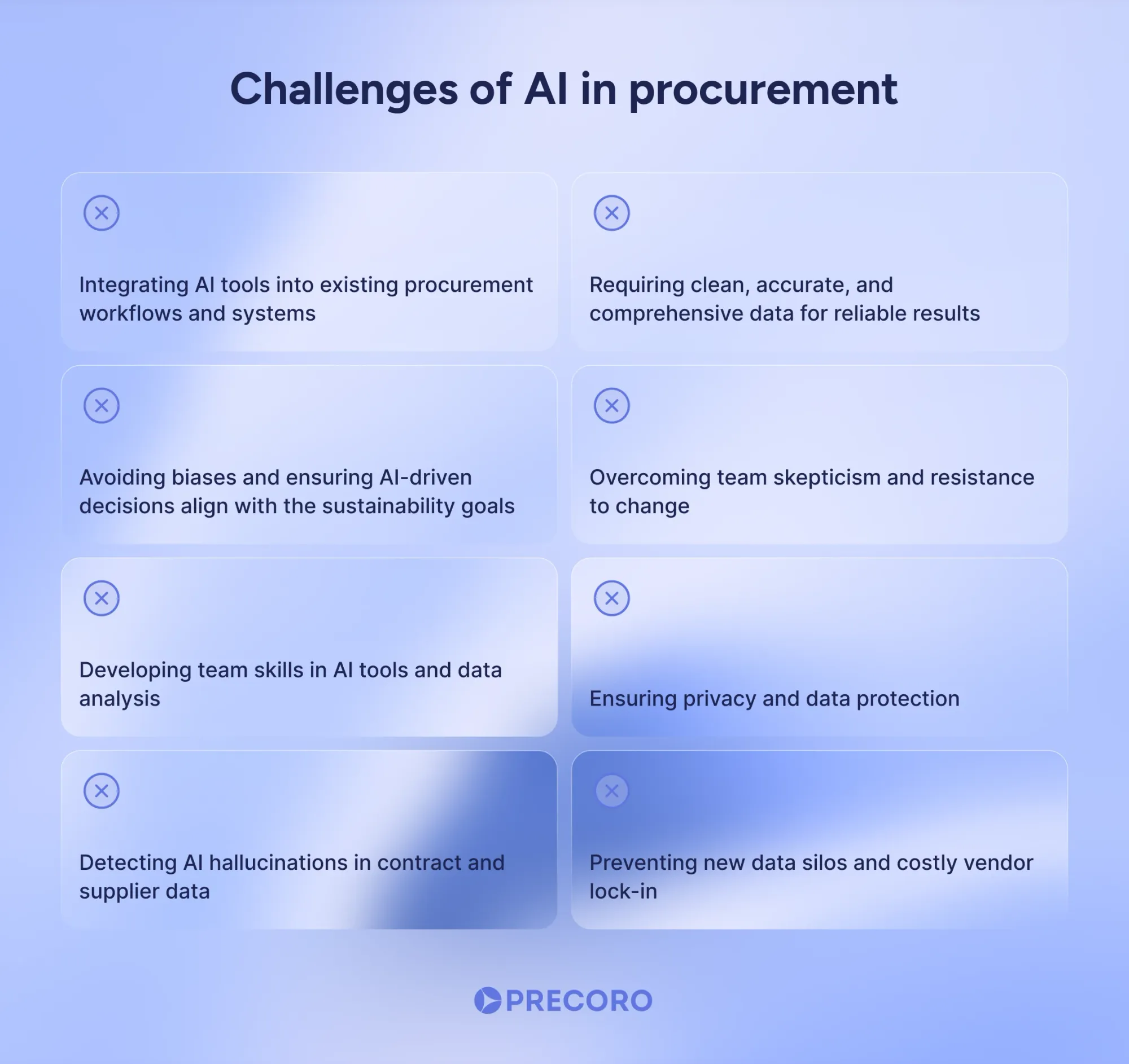
AI offers significant potential to improve procurement, but its adoption comes with challenges and risks that organizations must navigate carefully.
AI adoption and integration
One of the biggest challenges businesses face when implementing AI for procurement is integrating it with their existing systems. Many procurement operations still rely on legacy ERP platforms that were never built to support modern AI tools. These older systems often operate in silos, with limited flexibility, which makes it difficult to align AI solutions without disrupting established processes.
Additionally, procurement processes themselves can add another layer of complexity. The need for simultaneous management of multiple suppliers, contracts, and compliance requirements leads to vast amounts of data that often exist in scattered or inconsistent formats. Procurement AI tools struggle to deliver value when they aren’t provided with clean, structured, and coherent data.
The combination of outdated systems and fragmented workflows creates a significant barrier for businesses looking to smoothly implement AI.
AI data dependency
AI for procurement is only as good as the data it can access. Think of it as looking for directions with a map full of missing roads and mislabeled cities. If the data is incomplete, inconsistent, or riddled with errors, the AI’s outputs will be unreliable. For example, flawed historical data about purchases might lead AI to paint an inaccurate expense picture and completely miss key spending trends.
The challenge gets even bigger when procurement data comes in a chaotic mix of formats. Invoices, supplier contracts, and emails often exist in unstructured forms, with inconsistent details and messy inputs. Generative AI in procurement is built to handle distorted data, but when the noise gets too loud — think scattered formats, duplicate entries, and gaps — AI struggles to provide valuable insights. This makes it hard for organizations to trust AI-generated recommendations and predictions, limiting its real value in procurement.
Ethical concerns with procurement AI
Generative AI in procurement, while powerful, introduces ethical concerns that need careful consideration. Like other AI systems, it carries the risk of perpetuating or amplifying biases, especially in areas like supplier selection. If generative AI in procurement is trained on historical data that includes biased decision-making — such as favoritism toward larger suppliers or certain geographic regions — it may unintentionally prioritize those same suppliers. This could result, for example, in overlooking smaller, minority-owned businesses or suppliers with better higher prices but ethical practices.
Moreover, generative AI could create procurement models or contracts that are heavily influenced by profit-driven factors without accounting for ethical considerations like sustainability and social responsibility. Without proper management, gen AI in procurement might design strategies that prioritize efficiency and cost savings over the broader values a company upholds, such as supporting diverse suppliers or addressing environmental impact. Therefore, businesses need to implement measures to ensure generative AI not only supports financial business goals but also aligns with ethical and social standards of the company.
Resistance to AI adoption
Procurement teams often resist the adoption of artificial intelligence because they see it as a threat to their job security and undermining their expertise. These professionals have honed skills over the years, managing supplier relationships and navigating the complexities of negotiations, risk management, and procurement compliance. The idea that a machine could handle some of their tasks makes them think that the use of AI in procurement undermines the value they’re bringing to the table through human experience and judgment.
Furthermore, procurement professionals often question whether AI can truly grasp the human elements of procurement, such as supplier reliability during crises or navigating cultural differences. These nuanced factors are tough for algorithms to capture, creating a gap between AI’s potential and the real-world, relationship-driven nature of procurement.
AI skills and expertise
The use of AI in procurement isn’t just about having the latest tech — it’s about ensuring your team has the right skill set to make the most of it. Investing in procurement AI tools without the expertise to operate them effectively can be like buying a high-end sports car but never learning how to drive.
This challenge is even more urgent because the use of AI in procurement isn’t a “set it and forget it” solution. Unlike simpler automation tools, AI requires ongoing attention and training. Your team needs to understand not just how to operate the software, but how to interpret the data it generates, adjust algorithms as needed, and use correct AI-driven insights to make more informed decisions.
Privacy and data protection risks of AI in procurement
It might not seem so at first, but procurement data is usually more sensitive than expected. After all, the AI system that you’re running your supplier’s pricing through doesn’t always mean it was designed with the sensitivity of that data in mind. The act of feeding such data into any external AI tool opens up serious questions about access permissions and vendor AI training beyond the scope that was agreed upon.
Adding another issue to the mix is cross-border data transfer, with procurement AI often using suppliers and AI vendors that work in different jurisdictions and specific data protection rules. A clean internal policy won’t save the business if the AI tools it relies on don’t meet the same standard.
Vendor lock-in and interoperability risks of procurement AI
Committing to an AI vendor’s tool often means using their data formats, workflows, and integrations. Unwinding that connection later is often far more difficult than just switching software. If you build a procurement process according to one AI vendor’s structure for supplier information, for instance, you’ll have to remap data, retrain teams, and rebuild integrations that took months to finish the first time around.
And then there’s interoperability. AI software hasn’t yet standardized the way it handles information exchange with ERPs or with each other. So if your company runs multiple AI tools in procurement and finance departments, your system would technically work, but the solutions won’t talk to each other cleanly, questioning the efficiency that AI was meant to provide.
AI hallucinations in contract and supplier data
The problem with generative AI is that it can be very convincing and speak fluently while being absolutely wrong: inventing a clause that isn’t in the contract or subtly misquoting a vendor’s payment terms in a completely plausible manner. That difference creates a much more significant risk in procurement than a formatting error or a typo, considering how a hallucinated output looks correct on the outside.
Let’s take a supplier contract summary as an example. When asked to summarize payment terms across several contracts, a generative AI tool could confidently state that all the terms are “net 30” even though the actual contract states “net 45” — simply because the former is a more common term within AI’s own database. There’s nothing about the output that could reveal this information as an educated guess. It’s simply an incorrect piece of information stated with the same level of certainty as any other detail in the summary.
To ensure that you can catch these issues consistently, AI-produced summaries and analyses should only be treated as rough notes worth comparing with the original, and definitely not conclusive answers, especially anywhere a legal term or a supplier commitment is involved. NIST’s AI Risk Management Framework and Generative AI Profile are specifically designed for such purposes, to incorporate “trustworthiness considerations into the design, development, use, and evaluation of AI products, services, and systems.”
Mitigation strategies: addressing AI for procurement risks and challenges
Successfully integrating AI in sourcing and procurement is like navigating a tricky but exciting journey. Here are some strategies to help you overcome the above-mentioned risks, make the most of AI’s potential, and keep things human-centered while exploring AI in procurement examples.
Smooth AI adoption and integration
To ensure a smooth implementation of AI in sourcing and procurement, start by assessing your current procurement infrastructure — ERP systems, databases, and workflows — to spot gaps that could hold back AI adoption. Look for limitations around data accessibility, integration, and automation.
If legacy systems are too outdated or inflexible, consider moving to modern, cloud-based platforms. These offer better scalability, integration capabilities, and compatibility with today’s AI tools, many of which are built to work seamlessly with leading ERPs and procurement software.
Instead of overhauling everything at once, take a modular approach. Start with procurement AI tools that solve specific problems, like invoice matching, supplier performance analysis, or spend forecasting. By introducing AI in smaller steps, you can test its value in real workflows and achieve quick wins while avoiding disrupting day-to-day operations. This phased approach also helps teams adapt gradually and refine processes as they go.
Finally, create a clear integration plan and involve key stakeholders (like IT, procurement, and finance) from the start. By aligning goals, timelines, and technical requirements across all involved departments, you can ensure a smoother rollout and set the stage for maximizing AI’s impact on procurement.
Improving data quality for procurement AI
Evaluate your current procurement data. Look for inconsistencies, gaps, and duplicates, and pinpoint key sources of unstructured data — such as invoices, supplier contracts, and emails. This audit will highlight problematic areas and give you a clear starting point for further improvements.
Next, focus on data cleansing: remove duplicates, fix errors, and fill in missing information. Standardize data formats to ensure that supplier names, price currencies, and order or delivery dates follow consistent patterns. If this process feels overwhelming, consider using automated data-cleaning tools to streamline the work.
It’s also a good idea to implement a procurement platform with AI-enhanced Optical Character Recognition (OCR) or Intelligent document processing like Precoro to convert unstructured data from invoices and other documents into standardized formats. This improves the accuracy and quality of data fed into AI systems, enhancing the model’s successful training and excellent performance.
Remember, ensuring high data quality is an ongoing process. Set up smart data governance practices to keep your procurement data fresh, accurate, and consistent. Simple measures, like automated inspections to validate invoices or supplier details, can prevent mistakes from happening before they mess things up, keeping your AI working at its best.
Using AI for sustainable procurement
To tackle bias in AI-driven procurement, companies need to train their AI systems on a diverse mix of data. This means considering all kinds of suppliers — large, small, local, minority-owned — instead of sticking to the usual options. When setting up your models, remember to factor in important ethical criteria like sustainability and social responsibility.
Regular “bias checks” are also a must. Think of it like a routine “health check-up” for your AI. By reviewing how the system is performing and making sure it’s not favoring certain suppliers or overlooking others, you can catch any biases early on. This might mean tweaking the data or algorithms to keep things balanced. Explainable AI (XAI) can help here by making the decision-making process transparent so your team can understand why certain choices are made and spot any hidden biases.
Finally, remember that even generative AI in procurement should be a trusty sidekick, not the boss. Procurement teams need to stay involved in the company’s agenda and bring the human touch to decisions. Sometimes it’s necessary to go beyond the bare data and consider factors like ethics and social impact. By blending AI’s smart insights with human judgment, businesses can make procurement decisions that are not only financially beneficial but also responsible.
Embracing AI in procurement
To address resistance to procurement AI adoption, businesses should focus on creating a clear understanding of AI’s role as an enabler, not a replacement. Generative AI in procurement is designed to take over time-consuming and data-heavy tasks, freeing procurement professionals to focus on higher-value activities.
A key step is involving procurement teams early in the AI integration process. Showcasing early success stories (for example, faster invoice processing, reduced errors, or more efficient spend analysis) can also help build momentum for AI adoption. Demonstrating tangible benefits from the outset encourages teams to embrace the technology and see it as a valuable asset.
Building the right procurement AI skill set
To make sure your team has the right skills to handle AI for procurement, start with figuring out what these skills are. Generative AI in procurement takes things up a notch compared to traditional AI, so your team will require more specialized expertise. They’ll have to understand data science and machine learning, especially for fine-tuning AI systems.
Strong skills in data analysis are also a must to make sense of the AI’s output and ensure it aligns with procurement goals. Plus, a solid understanding of procurement processes is key to help AI generate useful company-tailored solutions, like picking the right suppliers or drafting contracts.
It’s a good idea to provide the procurement team with training programs or workshops focused on AI fundamentals, as well as offer them hands-on experience with the tools they will be using to integrate AI and procurement. This can help employees feel more confident in using AI effectively and encourage a culture of continuous learning. As AI technology evolves rapidly, staying updated on the latest trends and tools is essential.
In addition, consider bringing in AI experts or consultants to guide the initial stages of AI adoption and help bridge any knowledge gaps. You can also create cross-functional teams with both procurement experts and data scientists to ensure a blend of domain knowledge and technical expertise.
Alternatively, if training your team on complex procurement AI tools feels daunting, you can opt for systems that implement AI in areas where it provides significant value without requiring special skills. Precoro, for example, offers AI-powered OCR for invoice scanning and digitization. All you need to do is upload the invoice or set it to be automatically redirected to the accounts payable inbox, and Precoro will handle the rest — making AI accessible and efficient without the need for deep technical expertise.
Implementing controls and audits for procurement AI model transparency
Taking AI output at face value and passing it through is how you get a hallucinated contract term or a false invoice match. Regular audits that spot-check what AI generates against the actual source documents, to catch those before they can become an actual problem for the whole business.
Knowing what triggered a flagging or a recommendation from an AI system is also of importance: the data behind a decision improves the chances of spotting mistakes early on, and it’s easier to tell a one-off error from a pattern worth deeper investigation.
Risks and consequences of incorrect AI supplier recommendations
It’s not just a minor inconvenience when an AI system suggests the wrong supplier. The impact of an incorrect match can range from a delayed delivery to a quality issue that a buyer notices weeks after the shipment. Or it could be a partnership that the business has to dismantle and restart with someone else, after all the time and cost that went into onboarding.
Protect against this by framing the AI recommendation as a really good starting point that has to be explicitly validated, especially in critical purchasing areas where the consequences of an issue are more severe.
For example, let’s say an AI recommends a supplier based almost exclusively on cost and previous delivery speed because those are the simplest and most statistically relevant metrics available within its dataset. Less quantifiable factors are probably weighed less heavily, like early signs of financial strain or a pattern of quality complaints that never escalated into a formal dispute.
The recommendation isn’t wrong according to what it was trained to measure; rather, it’s incomplete on the ones it wasn’t. Someone who treats AI output as an infallible gospel won’t catch that gap until the relationship is already underway.
The prerequisite of a documented reason behind an AI-recommended supplier makes a gap of that nature readily apparent when the initial decision is made, and provides a trail to trace the issue when something goes wrong. Combined with a plan to back out of such engagements, a team will know what to do when a bad choice emerges.
AI for supplier risk monitoring and performance management
After you’ve on-boarded a supplier, their performance could decline significantly over a long period before it gets on your radar again during your next quarterly check-in or annual review. AI-driven scorecards provide a constant stream of information instead of waiting for quarterly or annual results, so a supplier’s negative trends on delivery or quality can show up while there’s still time to address them directly.
What gets tracked on an ongoing basis is:
- Delivery consistency against agreed timelines
- Quality trends across deliveries
- Responsiveness to issues or requests
- Financial health signals that could affect future reliability
Building an AI-ready procurement operating model
A procurement team can only go so far when armed with knowledge about when things can and have gone wrong with AI in procurement, as well as the information on how to deal with those issues. In fact, realizing the ongoing value of AI isn’t just about reacting well after the fact, but also setting things up correctly beforehand. It comes down to preparing data and systems on which AI needs to run first. Next, it’s all about sequencing and having someone who’s clearly accountable for how AI actually works in procurement.
Data and integration requirements for deploying AI in procurement systems
To have AI contribute positively anywhere within the procurement sphere, several core elements have to be present, confirmed from the beginning of the process.
| Requirement | Why does it matter? |
|---|---|
| Clean, structured historical data | AI trained on incomplete or inconsistent data inherits all of its errors |
| A system of record all tools can pull from | Prevents AI tools from operating conflicting versions of the same data |
| API or integration compatibility with existing ERP | Determines if AI can connect to core systems or needs a workaround |
| Defined data ownership | Accountability for data accuracy before AI might need it |
This is a readiness checklist above all else. An issue with even one of these requirements might appear later on as a delay in deployment or an AI tool not performing in the way you’d hoped for.
Prioritizing procurement AI use cases and building an implementation roadmap
Forcing every AI use case into the first phase of implementation isn’t recommended in most cases. Rolling out contract negotiation support and full agentic decision-making at the same time as basic invoice processing would simply overwhelm a team before any of these features have a chance to prove themselves. A roadmap that starts focused and then evolves tends to do better than an attempt to implement all features at once.
A reasonable sequence of events to build from includes:
- Beginning with the high-volume, low-risk kinds of tasks: things like matching invoice documents or categorizing spend fit the best here, where failures are cheap and the immediate advantages of time savings are really obvious.
- Moving into decision-support use cases as the team’s trust in tooling is established: supplier risk scoring, demand forecasting, or prescriptive recommendations that a person still reviews before acting.
- Lastly, layer in higher-stakes, more autonomous use cases like agentic workflows or autonomous approvals with a defined scope once there’s data to support the added trust.
Jumping to the very last stage while bypassing the first two is riskier — and that’s often where AI adoption hits a ceiling because a team without a history of trusting AI to do something with predictable results doesn’t naturally lend it to anything particularly important.
Governance structures for responsible AI in procurement
Someone has to be directly responsible for artificial intelligence in procurement: responsibility not just for the tool but also for what it’s allowed to do without manual sign-off. Without that, systems can slowly grow in scope over time: giving the tool the authority to do something specific over time means it could be doing more as time goes on because there’s nobody to explicitly define its boundaries.
Good governance implies that a company defines that boundary proactively in the first place before it can start evolving unintentionally. There should be one person who would say yes to a new use case before it goes live, and that person should also know who’s ultimately accountable for when an AI-guided decision turns out wrong. All the audit logs and decision justifications discussed earlier are useless without someone responsible for actually reviewing them.
How Precoro uses AI to automate procurement processes
Everything you've seen above — document management, spend visibility, supplier data, approval automation — is easier to picture as one connected system than as separate features. Precoro offers five AI Crews that cover different stages of the procure-to-pay process.
Instead of separate AI tools, Crews bring together the agents, AI Assistant capabilities, and document processing. Work and context flow from one step to the next without your team having to re-enter information.
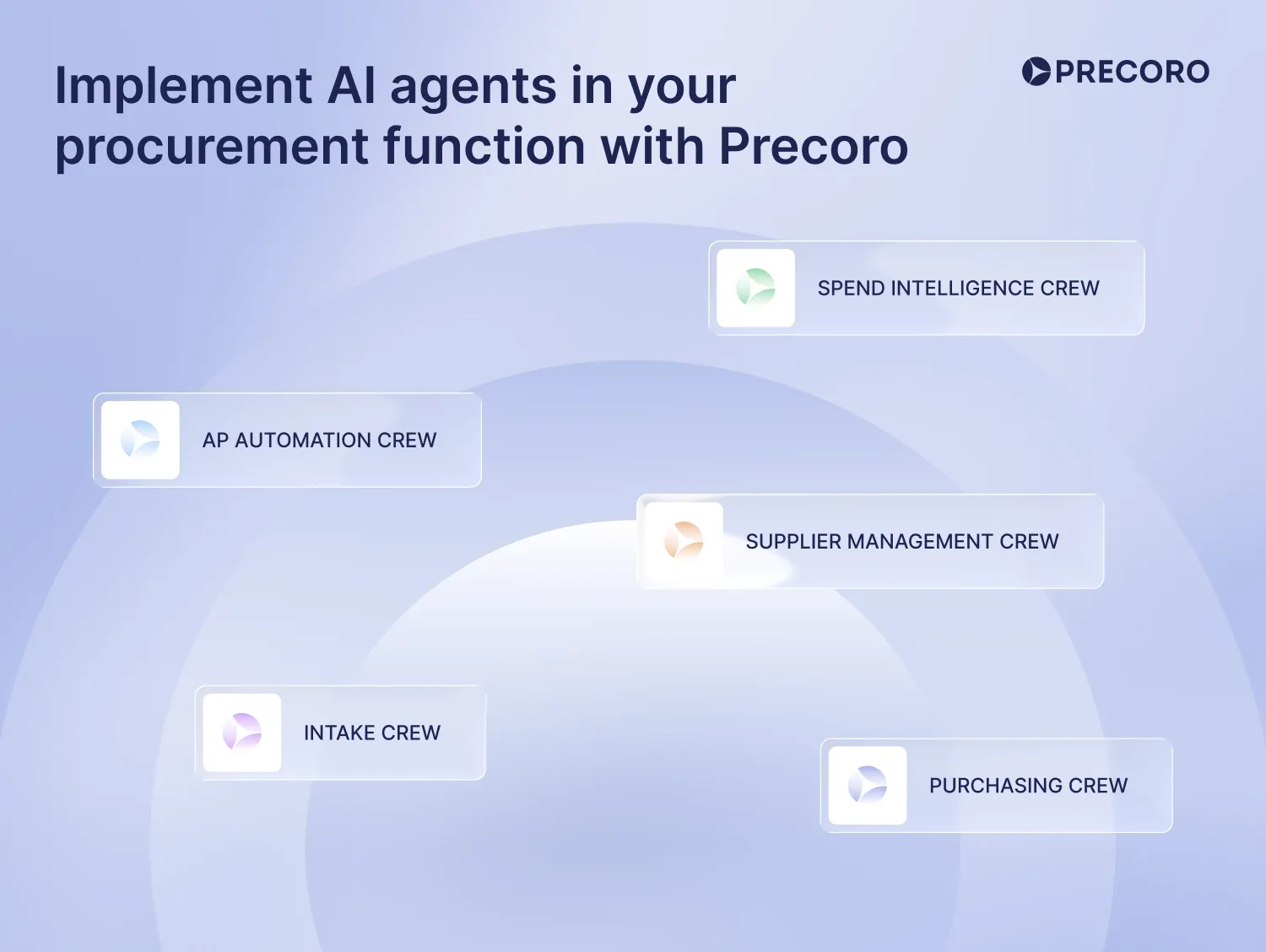
- Intake Crew makes spending visible and controlled from the first request. Employees get a simple way to write what they need and get a ready-made request, while finance gains visibility before money is committed.
- Purchasing Crew takes the manual work out of turning approved demand into orders. It consolidates routine requests, checks pricing, and routes purchases to preferred suppliers, while PO and receipt processing keep orders moving without repetitive data entry.
- AP Automation Crew helps teams process more invoices without adding AP headcount. AI extracts and verifies data from invoices, expenses, and credit notes, matches bills to the right purchase orders, and moves clean invoices toward payment while people focus on exceptions.
- Supplier Management Crew covers the ongoing relationship, not just a single transaction. It analyzes contracts for key terms and risks, keeps upcoming renewals visible, and evaluates supplier performance so teams can catch issues early and negotiate with better information.
- Spend Intelligence Crew turns raw data into clear insights and next steps. AI Assistant helps companies uncover savings opportunities, pinpoint process bottlenecks, surface risks and anomalies, and understand where future spend is heading.
Most teams don’t start using every Crew at once. Document processing is usually the starting point, with more added as the team gets comfortable, the same phased approach outlined in the implementation roadmap. Precoro AI Crews is what that looks like in practice: agents, an AI Assistant, and document processing working inside one interface to complete procurement work end-to-end, instead of as separate, disconnected tools.
The future of AI and procurement
As AI continues to streamline procurement, some of what once looked like a distant future is now considered standard practice already. Agentic, autonomous capabilities covered before are good proof of that. What follows is a look at what’s still in the future for procurement intelligence and the teams working with it.
Multi-agent orchestration across procurement workflows
That agentic AI we touched upon earlier in the article is really all about one agent doing one company’s tasks in isolation. Multi-agent orchestration comes one level higher: several specialized agents that coordinate and operate as a team without one agent attempting to do everything.
One sourcing agent can provide context directly to a separate risk agent that may then pass it on to a compliance agent when something triggers the pre-defined threshold. Each agent in such environments is not a do-everything individual but a dedicated AI that is narrow in scope and highly capable in its own field of work.
This type of internal coordination is already starting to work its way into production at larger, more established organizations. What’s still genuinely ahead is coordination outside of company lines — a buyer’s procurement agent communicating with a supplier’s own AI system directly. They could exchange pricing or contract data without a person having to relay information between the two sides.
There’s still a lot of work to be done when it comes to creating industry-wide standardization for agent-to-agent communication. It’s a large part of why cross-company coordination with AI is considered more cutting-edge than internal orchestration.
AI-driven contract negotiation
Autonomous contract negotiation has entered reality for some of the largest procurement operations in the world.
Walmart uses an AI negotiation system to handle supplier contract terms directly. This includes the actual back-and-forth conversation and not basic drafting suggestions for a human to send. They reported measurable results from this feature, like improved payment terms that were secured without a person having to manage each negotiation individually.
How is this different from a human on the line interacting with AI-authored talking points? For one thing, the system manages the entire cycle: analyzing supplier positions, adapting terms if necessary, and closing out an agreement.
For routine, high-volume contracts, this is already a reality instead of a fantasy. The better question now is not about whether this works, but “How much negotiation volume can we comfortably handle for AI?”
Increasing autonomy in sourcing and supplier negotiations
Sustainability has always been considered an afterthought for sourcing decisions, while cost and performance were addressed first. Sourcing, if powered by AI, can incorporate its considerations from the beginning, instead of weighing multiple criteria at once rather than a single, isolated element considered post-decision:
- Price and delivery performance
- Carbon footprint and resource use tied to production and shipping
- Labor practices and ethical sourcing standards
- Long-term supply resilience
The tension is at its most obvious when two suppliers land very close on paper — one is more expensive, and the other one is significantly more sustainable — and someone under a deadline would default to price, because price is a lot easier to defend than sustainability. Putting price and sustainability in the same evaluation process allows for the two numbers to lie plainly in front of the decision at the same time, which is a meaningful change from sustainability results appearing too late to influence anything (the way it was before).
Redefining procurement roles
The rise of autonomous AI procurement software is already changing what procurement professionals do, moving them from task operators to strategists and relationship owners. This has allowed procurement professionals to spend a good part of their days considering long-term strategy and market dynamics while spending only a small fraction of those same days performing tasks that a certain AI system can handle on its own within a defined scope. It’s not a far-off notion, but the real-world consequence of the autonomy boundary we covered before. What AI leaves to people is decision-making, like the relationships that matter or the calls that are too expensive to get wrong.
Frequently asked questions
It's not just the data-intensive part of procurement that AI is permeating now. While it still covers some of the basics, like demand forecasting and contract analysis, the major change AI is ushering in is autonomy: from an agentic AI being able to probe into an exception, follow up on a query, or resolve a simple contract negotiation, to an autonomous system that can go through to purchasing an item or choosing a supplier as per the preset criteria. It all began with chatbots answering basic questions; now there are AI agents planning and acting across workflow actions in procurement.
AI and procurement will evolve together to transform the sourcing, purchasing, and supplier management processes. Thus, AI will not replace procurement as a function but will work alongside procurement professionals and simplify rule-based, data-laden, and repetitive tasks for them.
Generative AI in procurement is a type of AI that can create content and solutions based on the data it’s trained on. For example, it can draft supplier contracts, suggest alternatives to meet sustainability goals, or simulate purchasing scenarios. Instead of just analyzing data, gen AI in procurement produces helpful outputs, making it faster and easier for procurement teams to complete their tasks while improving decision-making.
Companies use machine learning in procurement to analyze large amounts of data and identify patterns. AI is used, for example, for predicting demand, evaluating supplier performance, detecting fraud, and automating tasks like invoice processing. Machine learning helps procurement teams save time, reduce costs, and improve accuracy.
Procurement AI in a nutshell
The days of AI doing nothing but streamlining data-intensive tasks are now in the past. Those tasks might still make up a significant portion of the workload, like supplier evaluation and demand forecasting. However, 2026’s real shift has been autonomy: agentic systems that can actively chase and resolve issues with suppliers or make purchasing decisions or even choose a supplier based on predetermined parameters. No human oversight in any of these cases.
Still, that shift comes with its own issues. To this day, there’s plenty of skepticism about giving more decision-making power in the hands of AI, and the need for clean, well-integrated data underneath is also as prevalent as ever. Neither of those is a reason to pause, though, as these are not insurmountable mountains but simply challenges that should be approached with clear governance and careful rollout, combined with a team that actually believes in the tool and its capabilities.
In time, as AI absorbs more and more responsibilities, its value will no longer be derived solely from the technology. Its value will come from how well that technology works with human judgment. Knowing when AI can decide and when a decision needs human involvement is a delicate balance, and that balance should be used to build supplier relationships and long-term outcomes that last.
Looking for a procurement platform with built-in AI agents?
Book a demo to see Precoro's AI at work.