









 Explore Precoro's features




















How do we protect margins while doing more with less? When it comes to procurement excellence, everyone speaks about it all the time. We all want world-class performance, yet margins are thinner, forecasts are tighter, and the procurement excellence journey feels more demanding than ever.
In 2025, procurement teams are handling 9.8% more work, while staffing has grown by just 1.0% and budgets by 0.9%. That gap alone creates major productivity and efficiency strain. Well, it’s no surprise that 72% of procurement leaders now cite talent shortages as one of their biggest challenges.
As a result, nearly three-quarters of leaders are increasing their technology investments, recognizing that manual savings and traditional approaches are no longer enough.
Read our guide about what procurement excellence is, its framework, pillars, benefits, and challenges.
What is procurement excellence?
Procurement excellence is the achievement of high-level, strategic performance in sourcing and supply management. It aligns people, processes, data, and technology to drive value beyond cost savings and supports the full procurement excellence journey. Spanning the entire purchasing lifecycle — from contract negotiation to delivery and implementation — it transforms procurement into a proactive, innovative partner that strengthens agility, manages risk, and drives sustainable business growth.
What operational excellence in procurement looks like:
- R&D comes to procurement before designing a new product to understand supplier capabilities
- Your category managers identify market trends that influence business strategy
- Supplier partnerships deliver innovation that competitors can't access
- Procurement decisions factor in total cost of ownership, risk, sustainability, and strategic value — not just price
- Executives view procurement as a competitive advantage, not a cost center
What procurement excellence is NOT
It’s not procurement optimization, where you’re just fixing inefficiencies in existing processes. Operational excellence in procurement changes the whole approach to procurement’s role in the business on a deeper level.
And it’s not procurement transformation either, which usually means ripping everything out and starting over with new org structures, new strategies, and new systems. Instead, it follows practical procurement excellence steps that build on what already works, strengthen what’s weak, and steadily raise the level of your capabilities.
Finally, it’s definitely not only about cutting costs. While procurement analytics excellence delivers savings, it also sparks product innovation, anticipates supply chain risks, supports growth, and pushes sustainability forward.
Pillars of the procurement excellence framework
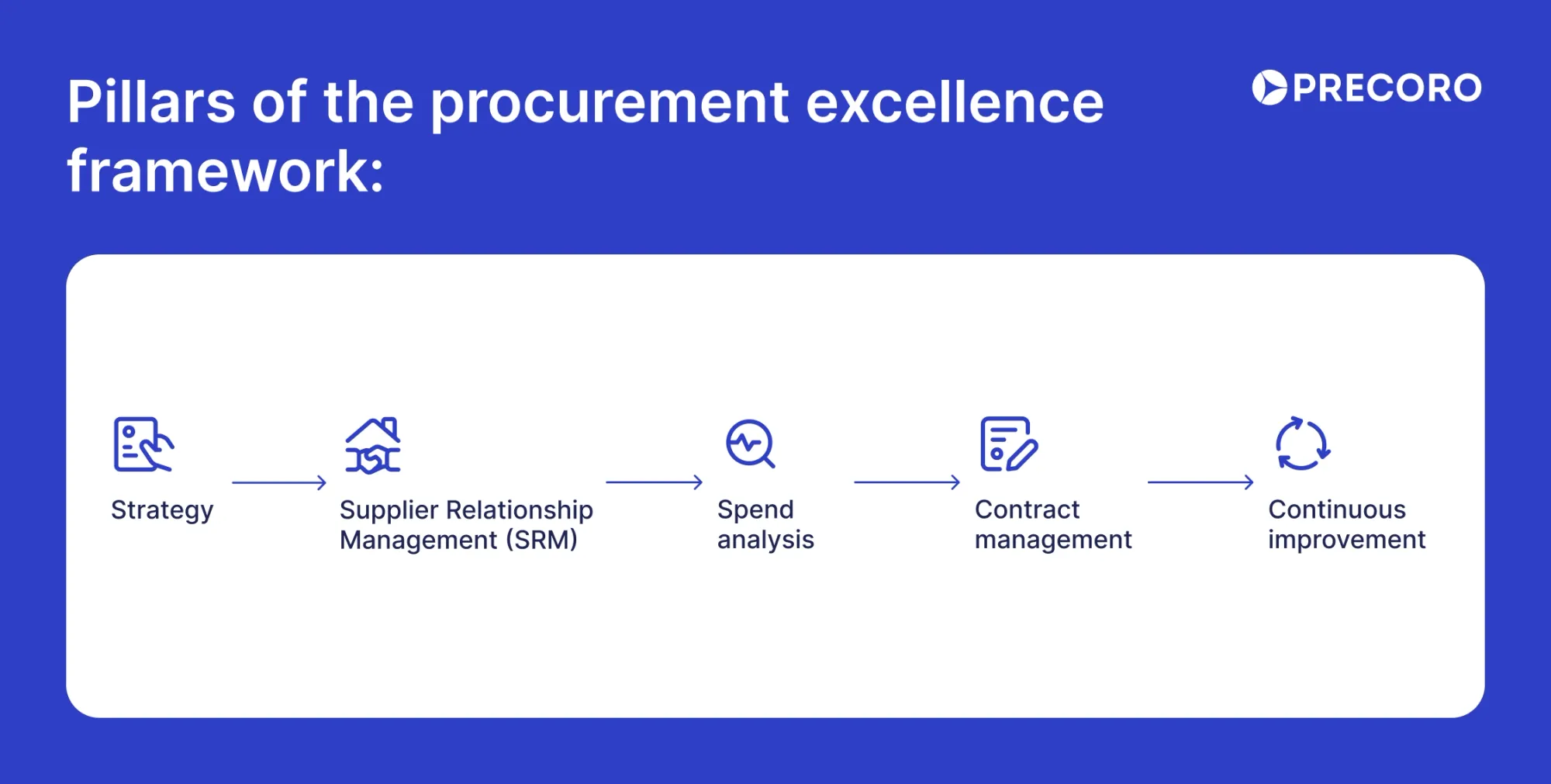
There are five pillars of procurement excellence. All parts work together. If one is weak, overall performance suffers.
Strategy → Supplier Relationship Management (SRM) → Spend analysis → Contract management → Continuous improvement
Pillar 1. Strategy
Strategy is the foundation of procurement excellence. Instead of just chasing the lowest bid, strategic sourcing focuses on long-term value, sound decision-making, and alignment with the overall business strategy.
Why it matters: Without a strong strategy and leadership, procurement remains reactive rather than strategic.
Key components:
- Supplier selection and evaluation
Choosing a supplier isn't a one-and-done process. You've got to look at capabilities, capacity, values, and compliance — not just cost. And you need a clear framework for evaluating and re-evaluating performance over time. - Data-driven decision making
Gut feeling doesn't cut it anymore. With procurement analytics excellence, data reveals hidden risks, savings opportunities, and more sustainable options. From spend patterns to supplier scorecards, the insights are already there — it’s just about putting them to work.
Pillar 2. Supplier Relationship Management (SRM)
Great supplier relationships don't just happen — they're built. When there's trust, transparency, and shared goals, suppliers are more than just service providers. They become partners. And that makes your entire supply chain stronger.
Core practices:
- Collaboration and communication
Procurement is at its best when it’s not working in a vacuum. Open, honest communication with suppliers and internal teams makes it easier to solve problems, hit targets, and innovate together. A good procurement excellence manager helps create the structure and consistency that make this collaboration actually work. - Performance reviews and feedback
Regular reviews based on the right KPIs help suppliers stay on track and give you visibility into where improvements are needed. It’s about accountability, not micromanagement. - Collaborative innovation
Suppliers often have insights and capabilities you haven't tapped into yet. Bringing them into the innovation process — early and often — can unlock serious competitive advantage. This is one of the most overlooked considerations in procurement excellence.
Pillar 3. Spend analysis
You can’t fix what you can’t see. Spend analysis shows all your spend categorized by supplier and department. It helps you spot hidden waste, duplicate vendors, off-contract spending, and missed savings opportunities. As a result, you can make faster, smarter decisions and support real sourcing excellence.
How to implement:
- Modern analytics tools
The best procurement software for excellence combines dashboards, machine learning, and real-time reporting to turn complex data into clear, actionable insights. Instead of drowning in spreadsheets, teams can quickly spot anomalies, predict trends, and identify risks or opportunities they might otherwise miss. Let dashboards, machine learning, and real-time reports do the heavy lifting.
Pillar 4. Contract management
Contracts set the tone for how work gets done. When managed right, they protect the business and make sure everyone delivers what they said they would. This is one of the core pillars behind any strong procurement excellence network, where consistency and accountability really matter.
Essential elements:
- Centralized contract repository
If contracts are scattered across inboxes and desktops, you're asking for trouble. A central, organized system makes it easier to track terms, stay compliant, and respond quickly when something goes wrong. For a procurement excellence manager, this level of clarity is what turns daily operations from reactive to fully controlled. It creates a single source of truth for all contract-related information. - Strategic negotiation
Negotiation isn't just about holding firm on price. It's about knowing your leverage, understanding the market, and crafting agreements that work for both sides.
Pillar 5. Performance monitoring and complianceExcellence is never static. Ongoing reviews and automated alerts help teams spot missed obligations before they become major issues, keeping the procurement process on track and in control. This process includes tracking deliverables, service levels, renewal dates, and compliance requirements.
These five pillars don't stand alone — they reinforce each other to create procurement excellence:
- Strategic sourcing identifies and selects the right suppliers.
- Supplier relationship management builds and maintains strong partnerships.
- Spend analysis provides visibility and insights for better decisions.
- Contract management protects value and ensures accountability.
- Performance monitoring and compliance help spot missed errors.
When all five pillars of sourcing excellence are strong and work together, procurement transforms from a transactional function into a strategic driver of competitive advantage.
The maturity model: Define where you stand
To achieve excellence, organizations must assess where they stand on the maturity curve:
- Transactional: Reactive buying, fragmented spend, manual processes.
- Operational: Centralized teams, basic compliance, focus on price reduction.
- Strategic: Category management implementation, total cost of ownership (TCO) focus, cross-functional collaboration.
- World-class: Predictive analytics, supplier-led innovation, fully integrated ESG goals, and automated ecosystems.
How to build procurement excellence without breaking what works
Excellence doesn't happen overnight. Rushing toward transformation without planning creates chaos: disrupted operations, frustrated stakeholders, and failed initiatives. A methodical approach builds capabilities systematically without derailing day-to-day purchasing.
1. Start with an honest assessment
Map how procurement actually works — not what documents say, but what your people do. Within a well-connected procurement excellence network, you can pinpoint:
- Where do approvals stall?
- Where does maverick spend occur?
- Where do manual processes create bottlenecks?
- Which suppliers consistently underperform?
- Where does the team waste time on administrative tasks?
Interview stakeholders across the business. Survey employees about their procurement experience. Analyze spend data for patterns. Within a strong procurement excellence network, this kind of assessment gives a clear view of processes, people capabilities, technology, supplier relationships, data quality, and strategic alignment. These are all the insights every procurement excellence manager needs to drive meaningful change.
2. Don’t rebuild from scratch, enhance (not everything at once)
Probably, you'll identify dozens of issues. Don't try to fix everything at once — that's how initiatives fail. Prioritize based on business impact and implementation feasibility, especially in the early stages of your procurement excellence journey.
Focus on high-frequency pain points employees hit daily: intake and requisitioning where requests lack required information, purchase order creation that takes days instead of hours, 3-way matching done manually, and supplier performance with zero visibility.
Pick 2-3 high-impact areas. Fix them completely and show measurable results to build momentum. Then tackle the next set.
3. Phase your improvements
Don't try to implement all five pillars of procurement excellence simultaneously. That's a recipe for chaos, resistance, and eventual failure. Instead, phase your improvements strategically. Here’s a practical phasing approach:
Phase 1 (Months 1-6): Quick wins
- Centralize contract storage without changing contract processes.
- Implement basic spend analysis dashboards.
- Standardize supplier scorecards into 1 or 2 categories.
- Train team members on existing tools they're underutilizing.
Phase 2 (Months 7-12): Build capabilities
- Roll out strategic sourcing methodology to key categories.
- Formalize supplier relationship management for top suppliers.
- Automate routine approval workflows.
- Develop cross-functional collaboration practices.
Phase 3 (Year 2): Scale and optimize
- Expand strategic sourcing across all categories.
- Implement advanced analytics and predictive insights.
- Establish innovation partnerships with strategic suppliers.
- Create centers of excellence for key capabilities.
💡 Note: Don’t roll changes out everywhere at once. Start with one team that’s open to testing new ways of working. Try the process, see what actually saves time, fix what breaks, and prove that it works before expanding it. This approach keeps risk low, avoids expensive mistakes, and builds real confidence as part of your procurement excellence journey.
4. Users know where it breaks (ask them)
The employees who process requisitions, negotiate with suppliers, and manage contracts know exactly where processes fail. They have better insights than external consultants who've never actually used your systems.
Involve end users in the planning. Run changes by them before rollout. That’s how you can catch problems early, build real buy-in, and ensure solutions actually support operational excellence in procurement. People support what they help create.
5. Invest in your team
Don’t expect your team to become strategic sourcing experts overnight. Building real sourcing excellence takes training, coaching, and time to develop new capabilities. Pair experienced team members with those learning new skills, and bring in external expertise when it truly adds value. Over time, this steady investment in people becomes one of the most sustainable drivers of your procurement excellence journey.
6. Fix data before adding AI
AI-powered analytics and automation depend entirely on data quality. If workflows are inconsistent and data lives in scattered systems, AI produces unreliable insights that nobody trusts.
First, establish basic processes and centralize data in one system. Clean supplier master data and standardize category classifications to create consistent data capture for every transaction. Then layer in advanced capabilities. Trying to do AI first wastes money and destroys credibility.
7. Build a procurement center of excellence (not bureaucracy)
Procurement CoE can increase strategic headcount by 20% without hiring. How? By building capabilities that multiply across the organization.
A procurement center of excellence is a small team — typically 2-3 procurement experts — providing leadership, training, and support. It's NOT a control function that creates bottlenecks. It's an enablement function that makes everyone better.
What CoE does:
- Develops category strategies and sourcing playbooks
- Maintains market intelligence and supplier insights
- Provides training and capability building
- Supports complex negotiations
- Establishes standards and best practices
- Leverages technology across the organization
- Tracks performance and shares insights
Procurement excellence means making this expertise available to everyone, not locked in a central team that becomes a bottleneck.
8. Manage categories like a business (not commodities)
Category management treats each spend category as a distinct business requiring its own strategy, expertise, and approach. Equipment, IT services, marketing spend, and raw materials can't all be managed the same way.
Excellence means:
- Analyzing spending patterns and grouping them into logical categories
- Assigning category managers who become subject matter experts
- Developing category strategies covering objectives, sourcing approach, preferred suppliers, contract terms, risk mitigation, and innovation opportunities
- Aligning category strategies with business needs and priorities
- Regularly reviewing and refining based on performance and changing requirements
Even the basics make a huge impact. A procurement center of excellence defines who is involved in decisions, which suppliers are preferred and why, who approves at each threshold, and what information requests must include. It prevents maverick spend, speeds up approvals, and strengthens accountability across the wider procurement excellence network.
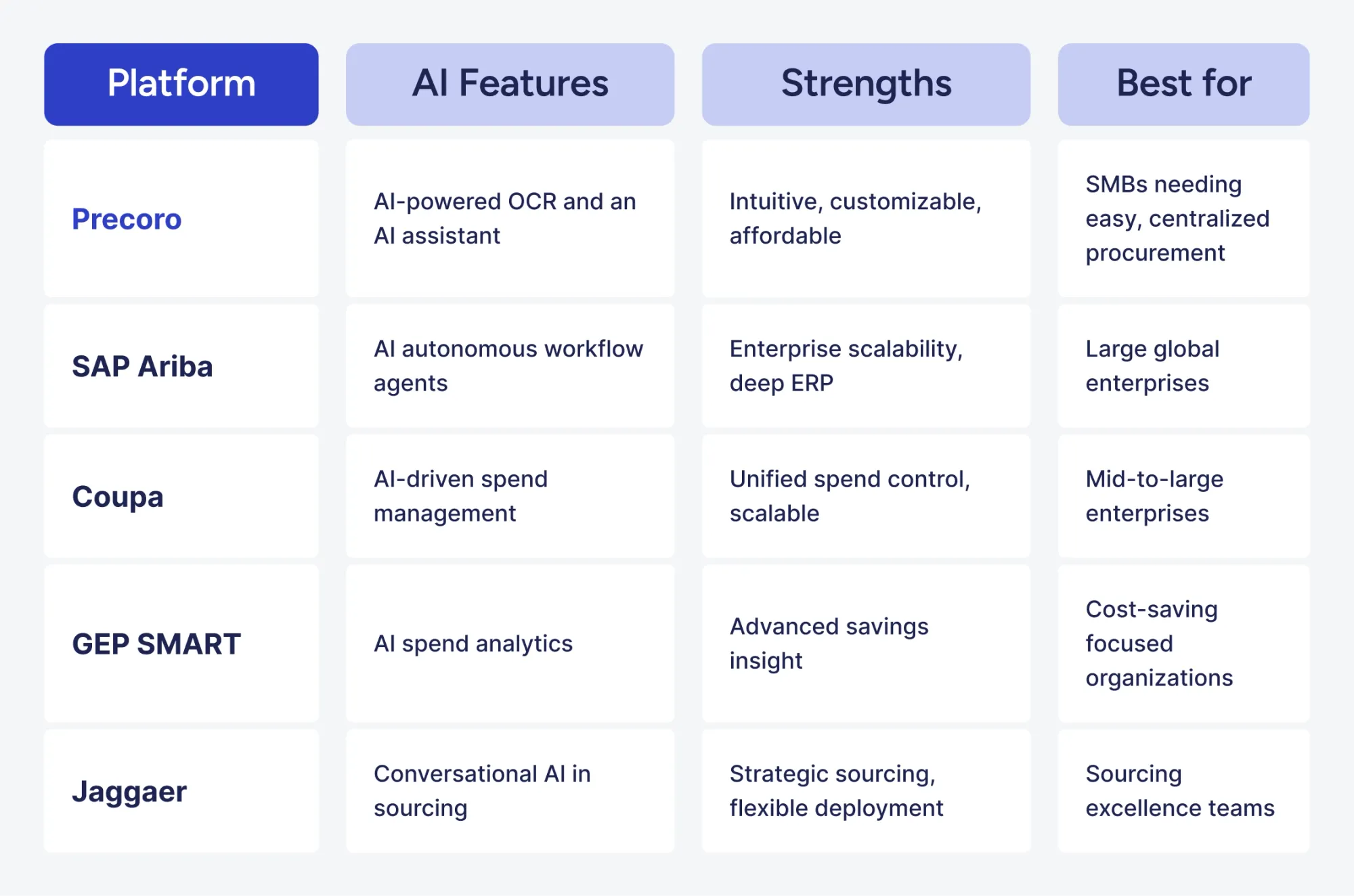
Top 5 best procurement software for excellence
It's never too late to start with better procurement tech. These are the platforms driving real control, real speed, and real savings:
1. Precoro
Precoro is a centralized platform that automates procurement processes, ensures visibility, and delivers control — without the complexity and cost of ERP or heavy platforms. Packed with AI-powered OCR technology for scanning invoices, matching purchase orders in seconds, and logging expenses with a single photo of receipts, the platform consistently receives high user satisfaction ratings. It’s praised for its responsive customer support, which proactively helps users maximize its value — one of the reasons it’s often considered among the best procurement software for excellence.
Best for: Mid-sized, and multi-entity companies seeking an intuitive solution for centralized procurement control.
2. SAP Ariba
SAP Ariba leads the enterprise procurement software market and is advancing AI-powered procurement through autonomous agents that execute workflows across sourcing, contracting, invoicing, and supplier onboarding. For any procurement excellence manager operating at scale, its cloud-based architecture and deep ERP integration offer the control and visibility needed to run complex operations confidently. With enterprise-grade scalability and full source-to-pay coverage, it’s widely regarded as one of the best procurement software for excellence in large, global organizations.
Best for: Large enterprises requiring comprehensive, scalable procurement.
3. Coupa
Coupa's AI architecture, Navi, launched in early 2025, powers autonomous spend management, using extensive community spend data. The platform delivers full visibility and control across procurement, invoicing, expense management, and supplier collaboration, making it a strong fit for any procurement excellence manager looking for a complex, unified system.
Its depth and scalability are key reasons it’s often positioned among the best procurement software for excellence, especially within growing or global teams.
Best for: Mid-to-large enterprises focused on spend management excellence.
4. GEP SMART
GEP SMART is a cloud-native, AI-powered procurement platform built on Microsoft Azure that integrates all source-to-pay functions into a unified solution. Its advanced analytics make it especially valuable for a procurement excellence manager looking to uncover savings opportunities across both direct and indirect spend categories.
Best for: Organizations seeking maximum cost savings through AI-powered analytics.
5. Jaggaer
Jaggaer ONE is being rearchitected as a composable agentic platform where sourcing, scoring, and negotiation processes leverage conversational AI interfaces. This end-to-end solution delivers advanced automation and strong strategic sourcing capabilities, making it especially valuable for teams pursuing real sourcing excellence without adding process complexity.
Best for: Organizations requiring sophisticated sourcing and supplier management.
Benefits of procurement excellence
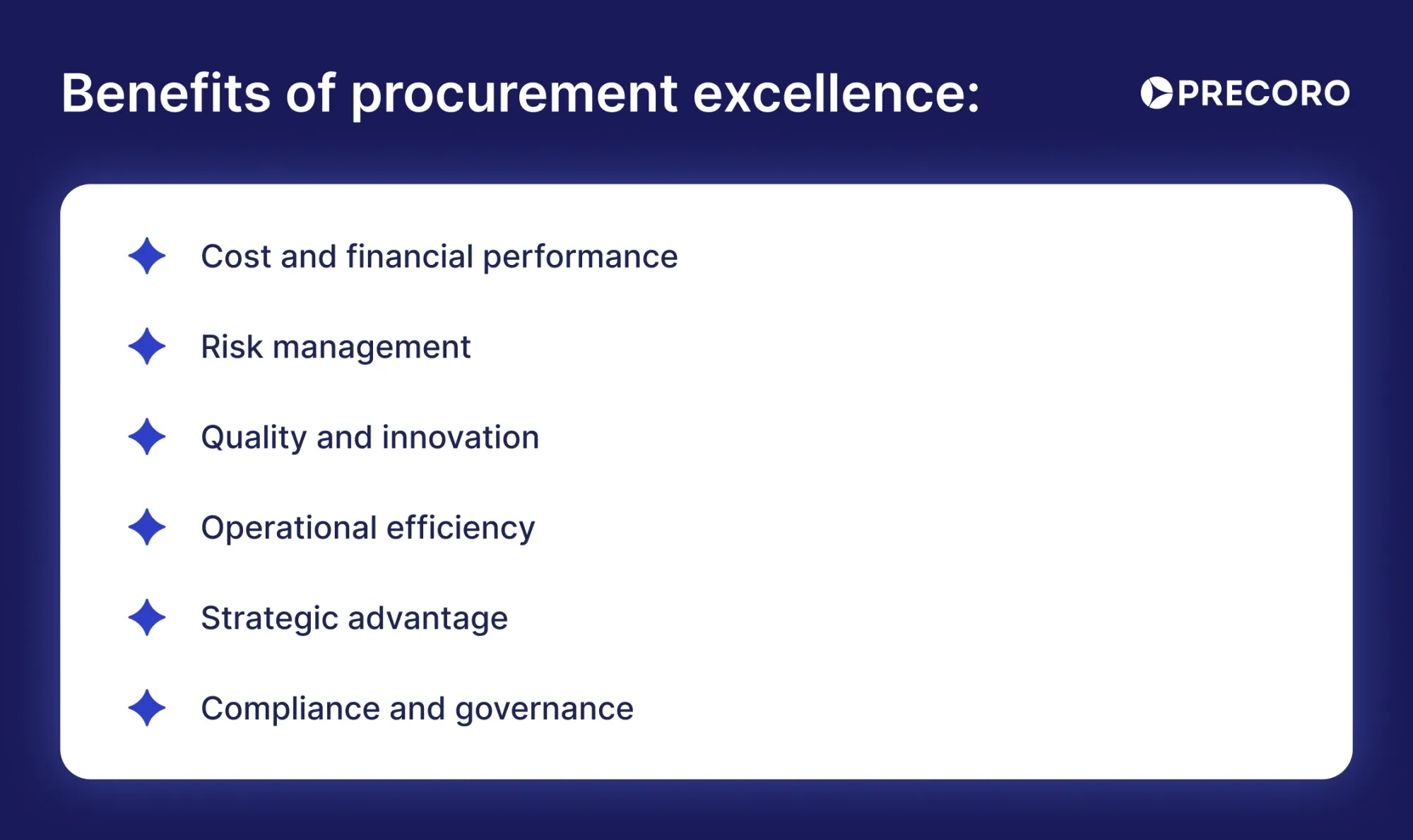
There are several benefits to achieving procurement excellence. They include:Cost and financial performance
Nearly half of Chief Procurement Officers worldwide — 46% — still rank cost reduction as their top priority. When procurement is done well, organizations save money through stronger negotiation, smarter sourcing decisions, and better buying power. As part of a long-term procurement excellence journey, mature procurement teams also improve cash flow, reduce money tied up in operations, and bring more predictability to financial planning.
Risk management
Procurement excellence means better supply chain resilience. Organizations develop diversified supplier bases, implement robust contingency planning, and maintain visibility into potential disruptions. The importance of risk management became especially clear during recent supply chain crises when companies with mature procurement functions adapted more quickly to shortages and logistics challenges.
Quality and innovation
Efficient procurement excellence managers don't just buy cheaper — they buy smarter. They work closely with suppliers to improve product quality, access cutting-edge technologies, and co-develop innovative solutions. This supplier relationship management often leads to competitive advantages that pure cost reduction can't achieve.
Add AI into the mix, and everything accelerates — productivity jumps, insights get sharper, and supplier partnerships turn into innovation engines. Since AI-powered contract management, often built into the best procurement software for excellence, can increase productivity by 44%, it unlocks innovation through truly data-driven supplier partnerships.
Operational efficiency
Procurement excellence speeds up processes through automation, standardization, and clear policies. It reduces cycle times from requisition to delivery, minimizes maverick spending, and frees up staff to focus on strategic activities rather than transactional paperwork. This is what real operational excellence in procurement looks like in practice.
Strategic advantage
As part of a broader procurement excellence journey, procurement stops being a back-office function and starts acting like a true business partner. Procurement teams provide market intelligence, identify emerging trends, support sustainability goals, and align spending with organizational strategy. They can influence product design decisions early to optimize the total cost of ownership.
Compliance and governance
Excellence also means having strong controls, clear audit trails, and ethical sourcing practices built into everyday work. A mature procurement excellence network protects the organization from fraud, ensures regulatory compliance, and supports ESG commitments that matter more than ever to customers, investors, and employees. AI and automated controls reduce compliance and fraud risks by up to 45%, ensuring alignment with evolving regulations and ethical sourcing practices.
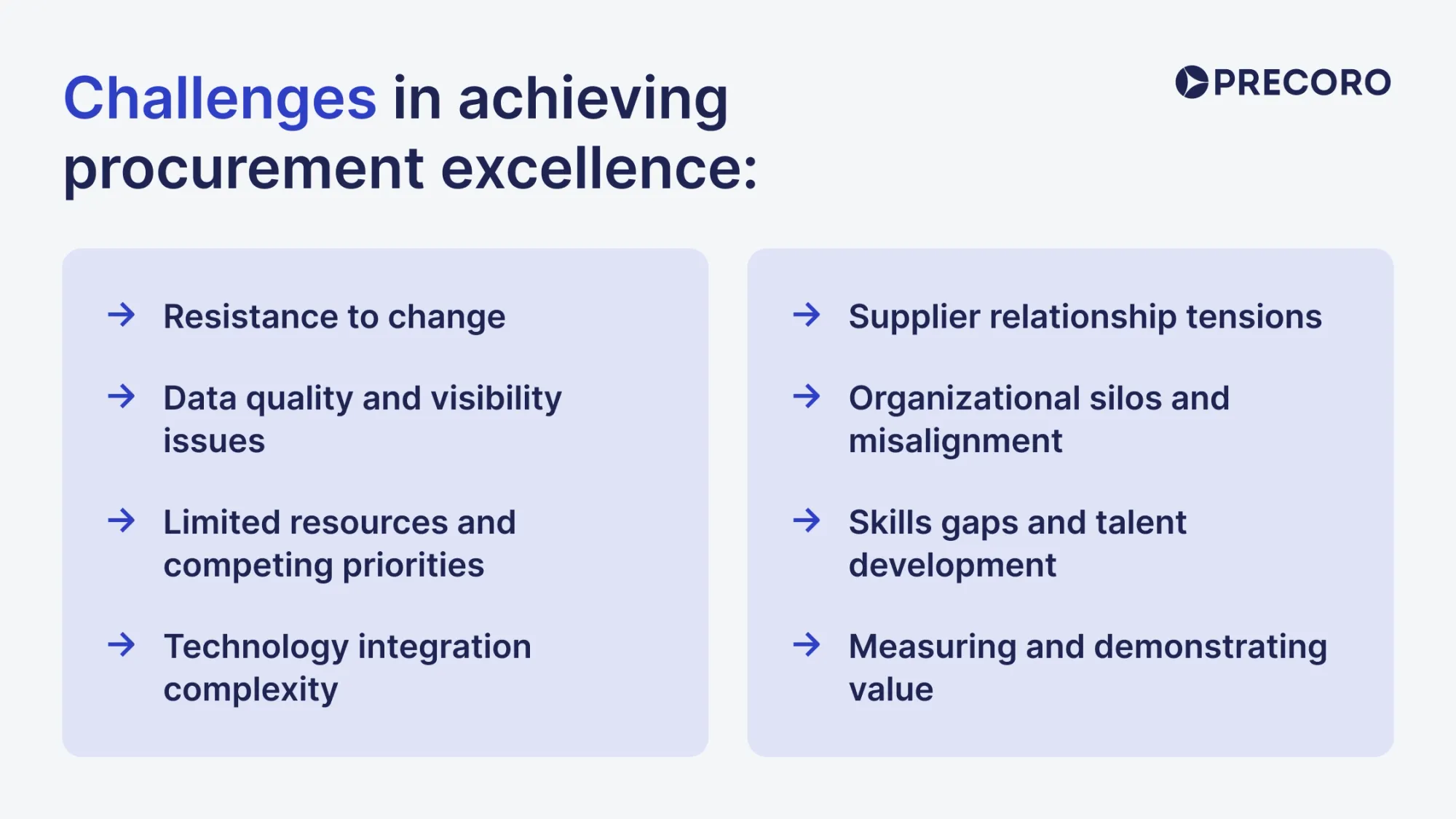
Challenges in achieving procurement excellence
While procurement excellence delivers peace of mind, the path of implementation is filled with complex challenges, including:
1. Resistance to change
Procurement transformation often disrupts long-standing processes and power structures. Employees may fear job loss, increased scrutiny, or added workload, while stakeholders may resist losing control over purchasing decisions. These factors can hinder the overall procurement excellence journey.
How to solve:
- Implement a structured change management program.
- Communicate benefits clearly and frequently to all levels of the organization.
- Engage employees early through workshops and feedback sessions.
- Demonstrate visible leadership commitment and accountability.
- Provide support and training to ease transition anxiety.
2. Data quality and visibility issues
Many organizations struggle with fragmented, inconsistent, or unreliable procurement data spread across multiple systems. Without strong procurement analytics excellence, poor data quality undermines spend visibility, weakens supplier performance tracking, and limits confident decision-making. Inside a connected procurement excellence network, this lack of reliable insight directly reduces the organization’s ability to drive real savings and long-term value.
How to solve:
- Centralize procurement information into an integrated platform or data warehouse.
- Establish data governance policies and accountability for accuracy.
- Invest in data cleansing and standardization processes.
- Use analytics tools to improve spend visibility and monitor supplier performance.
- Regularly audit and update procurement data.
3. Limited resources and competing priorities
Procurement teams frequently operate under tight budgets and staffing constraints, while also competing with other business functions for investment. Even inside a strong procurement excellence network, this issue can slow transformation initiatives and limit the ability to focus on strategic activities instead of transactional work.
How to solve:
- Focus on procurement projects that support the main business goals.
- Automate routine tasks to free up your team’s time.
- Show clear ROI to secure budget and staff support.
- Work closely with other teams to share skills and resources.
- Outsource basic tasks when it makes financial sense.
4. Technology integration complexity
Implementing and integrating new procurement technologies — such as ERP systems, e-sourcing tools, or supplier platforms — often presents technical, operational, and adoption challenges. Legacy systems, poor integrations, and weak user training can easily slow progress, even when organizations invest in the best procurement software for excellence. Without the right support and rollout strategy, these hurdles can stall momentum across the broader procurement excellence journey.
How to solve:
- Conduct a thorough needs analysis before technology selection.
- Choose solutions with proven integration capabilities and flexible APIs.
- Involve IT early and ensure alignment on architecture and security.
- Develop a phased rollout plan with pilot tests.
- Provide comprehensive user training and ongoing support.
5. Supplier relationship tensions
Organizations must balance aggressive cost-reduction targets with the need to maintain strong, collaborative supplier relationships. Within a mature procurement excellence journey, this balance becomes essential: too much pressure can erode trust, limit innovation, and raise supply risk, while being overly cautious can leave valuable savings untapped.
How to solve:
- Adopt a supplier segmentation strategy based on value and risk.
- Engage in collaborative negotiation focusing on mutual gains.
- Maintain open communication and transparency with key suppliers.
- Establish joint innovation initiatives and continuous improvement programs.
- Balance cost targets with supplier sustainability and risk criteria.
6. Organizational silos and misalignment
Procurement can’t operate in isolation from finance, operations, and business units. In organizations without a connected procurement excellence network, misaligned goals, weak communication, and conflicting incentives create inefficiencies. Over time, they slow down decision-making and undermine enterprise-wide sourcing strategies.
How to solve:
- Create a cross-functional procurement team to guide decisions.
- Align procurement goals with finance, operations, and business units.
- Set shared KPIs and incentives to encourage teamwork.
- Use shared communication tools to improve information flow.
- Build a culture focused on company-wide sourcing and value.
7. Skills gaps and talent development
Modern procurement excellence requires advanced skills in analytics, negotiation, digital tools, category management, and risk management. Many teams lack these capabilities, making continuous training, reskilling, and talent acquisition critical for long-term success.
How to solve:
- Conduct a skills assessment to identify critical gaps.
- Implement continuous learning programs focused on analytics, digital tools, and category management.
- Encourage professional certification and external training opportunities.
- Develop internal mentorship and knowledge-sharing networks.
- Incorporate modern procurement competencies in hiring criteria.
8. Measuring and demonstrating value
Proving procurement’s contribution beyond cost savings — such as risk reduction, innovation, sustainability, and resilience — remains a major challenge. Weak performance metrics of operational excellence in procurement make it difficult to justify investments and gain executive support.
How to solve:
- Develop a balanced scorecard including cost, risk, innovation, sustainability, and resilience metrics.
- Use advanced analytics to quantify procurement’s impact on business outcomes.
- Regularly communicate success stories and case studies to leadership.
- Tie procurement KPIs to broader corporate objectives and report transparently.
- Build dashboards accessible to stakeholders showing real-time value delivery.
See how Precoro can turn your procurement excellence on
As we look toward the future, the trajectory of procurement excellence is clear. It’s moving toward an autonomous, sustainable, and highly strategic function.
The procurement teams that will succeed are those that embrace agility. They will use AI not to replace humans, but to augment their intelligence, freeing them to focus on what people do best: building relationships, negotiating complex deals, and driving innovation.
Achieving procurement excellence requires a commitment to continuous improvement. It also demands the courage to challenge the status quo, the discipline to implement rigorous processes, and the vision to see suppliers not as vendors, but as partners in success.
This is exactly where Precoro fits — not as “another tool,” but as a system that delivers quick wins right after implementation and long-term value over time.
With Precoro:
- Manual work is automated with one system — meaning fewer Full-Time Equivalent or FTEs needed for procurement ops.
- Invoice capturing and approvals are automated, cutting errors and delays.
- Maverick spending is stopped at the source.
- Consolidated demand strengthens buying power, unlocking better supplier discounts.
- Only approved invoices get paid, preventing fraud and duplicate payments.
- Forecasting improves, giving finance real control over cash flow.
- ERP licenses and dependencies shrink.
- And over time, supplier performance tracking helps optimize spend strategy year after year.
For the CPO of tomorrow, the mandate is simple: Don't just buy better. Build a better business.