10 Procurement Trends in 2026: What’s Changing and What to Do
Discover the most important procurement trends for 2026, covering AI accountability, regional resilience, procurement orchestration, and more.

Most of 2026 is behind us, and it’s time to reflect on what shaped this year and what changes are looming ahead.
Though there are many trends in the procurement industry, most of them have an overarching theme: build a comprehensive, connected process instead of automating isolated steps. That’s because teams can get faster approvals and more invoices processed, but still lack proactive controls and centralized visibility across the procure-to-pay (P2P) cycle.
And that’s what companies should pay attention to in order to protect their margins. Let’s consider the top 10 procurement trends and what they have changed this year.
Keep reading about:
What are the top procurement trends in 2026??
How to turn these procurement industry trends into an actionable roadmap
How Precoro helps you prepare for procurement trends in 2026
Frequently asked questions about trends in procurement
What are the top procurement trends in 2026?
Since the world is still brimming with geopolitical turmoil and increasing financial pressure, businesses nowadays prioritize decisions that actually contribute to measurable business results.
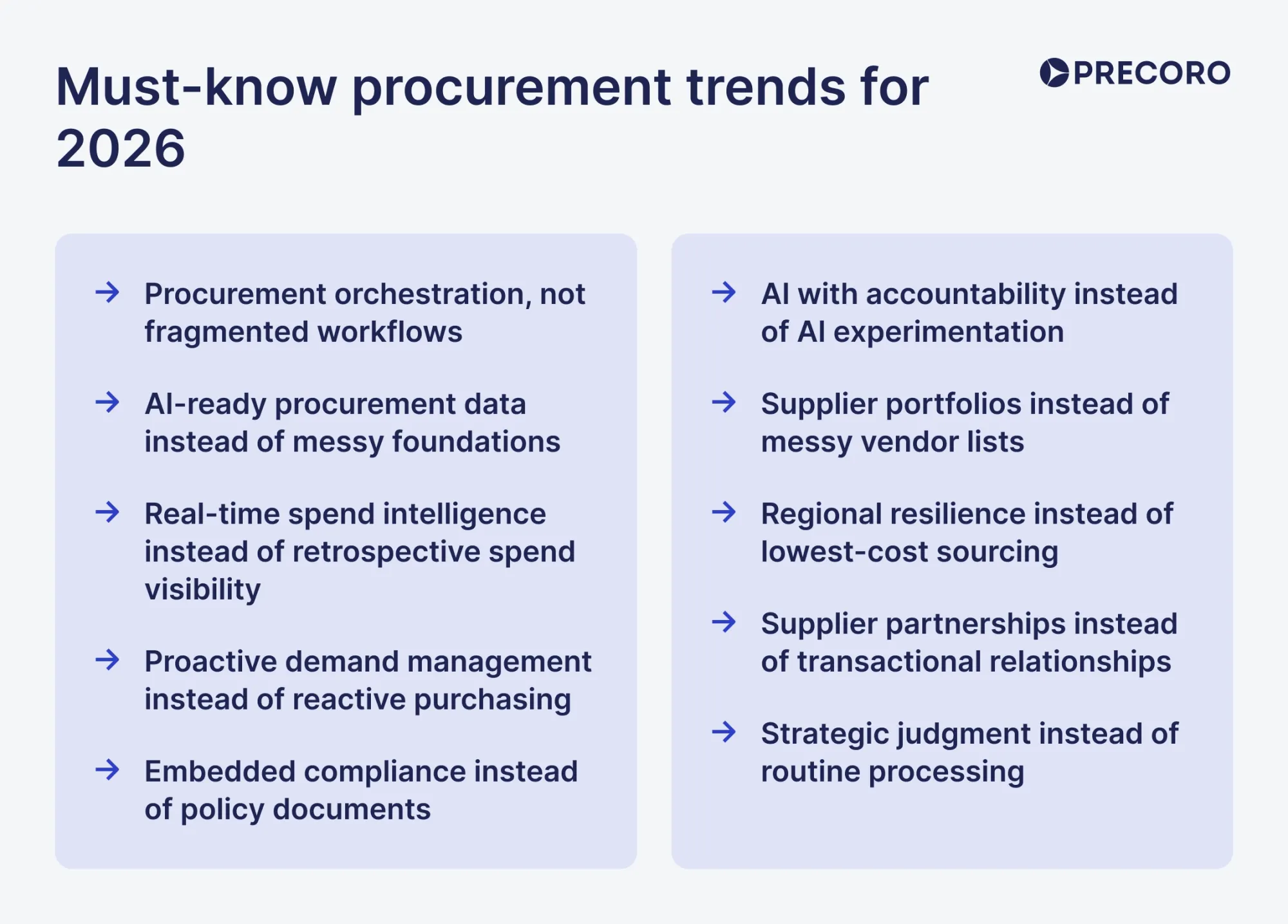
1. Procurement orchestration instead of fragmented workflows
Nowadays, companies look at the bigger picture: instead of treating requests, POs, supplier communication, invoices, and payments as separate workflows, they regard them as part of a connected process.
The problem with fragmentation isn’t even inefficiency. It’s just impossible to influence a purchasing decision in time if requests sit in Slack, approvals happen over emails, POs are tracked in spreadsheets, and invoices arrive in a separate accounts payable (AP) system.
Procurement orchestration is a fix that designs the request-to-pay process in a way that connects people, policies, systems, and data into one connected flow. That changes procurement’s role.
Instead of correcting mistakes after the fact, teams see and control purchases from the get-go and then can use the full data for more productive supplier negotiations, category strategy, and cost efficiency.
The market momentum reflects this shift. The global procurement orchestration platform market was valued at $8.4 billion in 2025 and is projected to expand to $18.7 billion by 2033, which signals strong demand for coordinated, end-to-end control.
It’s important to note, though, that orchestration doesn’t come down to adding another layer of technology. It actually involves changing the usual approach to procurement in order to give people enough context to make the right decision at the right time.
2. AI-ready procurement data instead of messy foundations
Artificial intelligence (AI) can automate a large share of procurement work, but the foundation for good results is still missing in many scaling companies because some procurement data is incomplete, scattered, duplicated, or altogether missing.
Of course, AI can be implemented even on top of a messy setup, but it will inherit its problems, which come down to two words: incomplete context. The result is more errors, more exceptions, and more outputs that people still need to review and correct.
This problem is especially prevalent in mid-sized companies that have outgrown simple purchasing operations but haven’t introduced the structure to match. More people, suppliers, locations, and transactions make it increasingly difficult to understand what is happening across the business. That’s why data and process maturity should be treated as prerequisites for serious AI adoption, not as a separate project that can be fixed later.
Before scaling AI, start with some basic questions:
- Are purchase requests and POs standardized?
- Are approvals actually documented?
- Can purchases be connected to the original request and PO?
- How much spend is covered by POs?
- Do you have duplicate suppliers?
Once that foundation is there, AI can actually produce a measurable result. The biggest risk of skipping this step isn’t only wasting money on an AI project, but concluding that AI doesn’t work when the real problem was the data you gave it.
3. Real-time spend intelligence instead of retrospective spend visibility
This is one area where procurement terminology sometimes hides a very simple problem. If you only see spending after the invoice arrives, you don’t really have much control over it, so visibility comes only through after-the-fact reporting.
Looking backward at spend is useful for analysis, but it doesn’t help much when the business has already placed the order. That’s why visibility is finally moving earlier in the purchasing cycle during 2026.
Leading organizations increasingly track spending across several layers:
- Pending demand: Requests that have been submitted but not yet approved
- Committed spend: Approved purchase orders and contracts
- Actual spend: Invoices, expenses, and completed purchases
- Forecasted obligations: Expected future costs from ongoing projects, recurring commitments, and contract renewals
When you can actually see these layers together, you get a chance to act. Think about combining demand to place a bulk order with better pricing, blocking duplicate purchases, or proactively negotiating for renewals.
Ardent Partners’ 2026 research provides context for the gap between average and top-performing teams. The study found that the average organization has 69.3% of spend under management, compared with 90.2% among best-in-class organizations.
So, the more useful question is no longer, “How much did we spend?” It’s, “What are we about to spend, and do we still have time to change it?”
4. Proactive demand management instead of reactive purchasing
In the past, the procurement team entered the buying process after the business decided what it needed to purchase.
At that point, the conversation is usually about suppliers, price, and terms. But much of the opportunity to reduce costs may already be gone.
What we see more in 2026 is procurement moving further upstream and focusing on the demand itself.
Before asking, “How do we buy this at a better price?” teams are asking:
- Do we need to buy it at all?
- Does another team already have the same requirement?
- Can several requests be combined into one order?
- Does an existing contract, subscription, or inventory already cover the need?
- Can the purchase wait until demand from other locations is consolidated?
- Is the requested specification more expensive than the business actually needs?
- Could a lower-cost alternative deliver the same outcome?
That changes procurement’s role because the team can actually shape the demand before money is committed.
Consider three locations planning to order the same equipment separately over the next couple of months. Traditional procurement may negotiate each order well and still miss the bigger opportunity. If the demand is visible early enough, those purchases can be combined, with volumes supporting better pricing. Also, duplicate or unnecessary orders can be challenged before they happen.
The same principle applies to software, professional services, spare parts, and other recurring categories. The goal now goes beyond getting the best deal on the purchase the business asks for and also covers helping the business make a better purchasing decision in the first place.
5. Embedded compliance instead of policy documents
For years, procurement compliance depended on policy documents, approval matrices, training, and people remembering which rule applied. That approach becomes difficult to scale across multiple departments, locations, entities, and countries.
The thing is, employees shouldn’t have to memorize lengthy rules or sift through a multi-page document to make a compliant purchase. The purchasing process should embed compliance as a built-in mechanism.
That’s why in 2026, more organizations are moving those rules directly into the purchasing process:
- Approved products are easily available in catalogs
- Employees are guided toward preferred suppliers
- Approval thresholds are applied automatically
- Requests are checked against available budgets
- Purchases are connected to the relevant contracts
- There’s a clear approval and audit history
The result is a different type of compliance. Instead of catching policy violations after a purchase is made, guide employees toward approved suppliers and the right approval path from the start.
The 2026 Ardent Partners research shows a meaningful difference between average and best-in-class organizations: average companies keep 78.2% of spend contract-compliant, compared with 92.8% among top performers.
That gap reinforces why upstream controls matter. Good procurement control shouldn’t depend on every employee becoming a procurement expert.
6. AI with accountability instead of AI experimentation
For the last few years, procurement teams have mostly asked, “What can we automate with AI?” and “What new features are out there?” Now the question is shifting to “What should AI be allowed to decide on its own?” and “What does actually drive results?”
Gartner calls this the “trough of disillusionment” for GenAI in procurement. In practical terms, people are more selective and careful about what AI tools actually deserve investment, looking beyond unsubstantiated claims and demonstrations.
This is where procurement AI is heading after the experimentation phase. Full autonomy isn’t the ultimate goal. Instead, companies should think about maximum safe autonomy for each type of decision.
We know that AI is well-suited for repetitive tasks that come with low risks. For example, data extraction, purchase classification, summaries of supplier data, etc. But a $150 request for new chairs is vastly different from approving a $150,000 supplier decision.
That means the next step isn’t simply “human in the loop.” Companies should focus on different levels of autonomy based on two dimensions: financial impact and potential risks. Then, the decision on where AI can act independently and where it should only provide the data becomes much clearer.
7. Supplier portfolios instead of messy vendor lists
For years, companies tolerated poorly maintained supplier records, duplicates, inconsistent pricing, contracts with risky terms, and multiple departments buying similar things from different suppliers.
That’s increasingly difficult to justify. According to 2025 NPI research, 82% of enterprises were actively trimming supplier lists and simplifying vendor management, often starting with IT and related spend categories.
However, supplier rationalization shouldn’t be reduced to another “lower the vendor count” exercise. The useful question is: “Which suppliers actually add value, and where are we creating unnecessary cost or complexity?”
That means looking at things like:
- Which departments buy the same category from different vendors?
- Are locations paying different prices for the same item?
- Do duplicate supplier records still exist?
- How much total spend goes to each supplier?
- Could volume be consolidated?
- Which suppliers consistently perform well, and what don’t?
Ultimately, the goal of a good vendor procurement strategy isn’t fewer suppliers for the sake of having fewer suppliers. It’s a more deliberate supplier portfolio.
8. Regional resilience instead of lowest-cost sourcing
In stable times, companies often prioritize buying from the market with the lowest costs. However, nowadays, the lowest-cost sourcing option often happens to be the most fragile one.
It doesn’t mean that cost efficiency isn’t important compared to resilience. What makes the difference is looking at cost over the long term and accounting for disruptions and potential delays.
There’s no single one-size-fits-all approach. For building resilience, it’s best to develop a category-by-category strategy: source globally where the cost advantage justifies it, move closer to home where lead times and continuity matter more, and diversify suppliers where dependence on a single source creates too much risk.
As the Boston Consulting Group highlights, resilience is an integral part of supply networks and isn’t just added only after something goes wrong.
9. Supplier partnerships instead of transactional relationships
In 2026, the relationship with suppliers goes beyond mere transactions. Instead, both the buyer and the supplier increasingly engage in forecasting, resistance planning, sustainability, and product development.
Supplier portals and ecosystems reflect this shift. They used to be just places for uploading documents and responding to requests for proposal (RFPs), and now they became a shared environment for exchanging information, coordinating forecasts, monitoring performance, and working on new initiatives.
Research suggests that co-developing products with suppliers can support stronger new-product performance. In industries such as automotive and fast-moving consumer goods (FMCG), supplier collaboration is an important factor in innovation.
But there’s a prerequisite that gets overlooked. It’s difficult to manage a supplier strategically when you don’t know how much the company buys from them, which contracts apply, how consistently they perform, or whether several business units are dealing with the same supplier separately.
That’s why supplier partnerships depend on good procurement data as much as they depend on good relationships.
10. Strategic judgment instead of routine processing
AI and automation are changing which parts of a procurement professional’s job require human attention.
Tasks such as creating purchase orders (POs), matching invoices, routing approvals, capturing document data, and moving information between systems increasingly require less manual intervention.
That makes judgment more valuable.
In 2026, procurement professionals are spending more attention on areas such as:
- Strategic category management: Deciding where supplier consolidation or longer-term agreements make sense
- Supplier collaboration: Working with suppliers on lead times, pricing, risk, and sustainability
- Exception and risk management: Deciding what to do when software flags an anomaly or a policy exception
- Business partnering: Helping finance, operations, and other teams balance cost, timing, quality, and risk
Digital fluency matters here, but not because every buyer has to become an AI expert. People need to understand enough about the information in front of them to question it.
If AI spots unusual vendor pricing, someone still has to decide whether to renegotiate, accept the increase, source an alternative, or investigate the reason.
McKinsey reports that procurement teams working alongside AI in a hybrid model can become 25–40% more efficient.
The procurement skill gap is therefore changing. Operational knowledge still matters, but teams increasingly need people who can interpret data, challenge recommendations, understand business context, and decide what action makes sense.
How to turn these procurement industry trends into an actionable roadmap
With only a few months left in 2026, don't try to respond to all 10 trends before year-end.
Instead, use this point in the year to look at what actually happened inside your procurement process:
- Where did employees bypass procurement?
- Where did finance discover costs too late?
- Where did your team spend hours on work that software could have handled?
- Where did you invest in technology without seeing a measurable result?
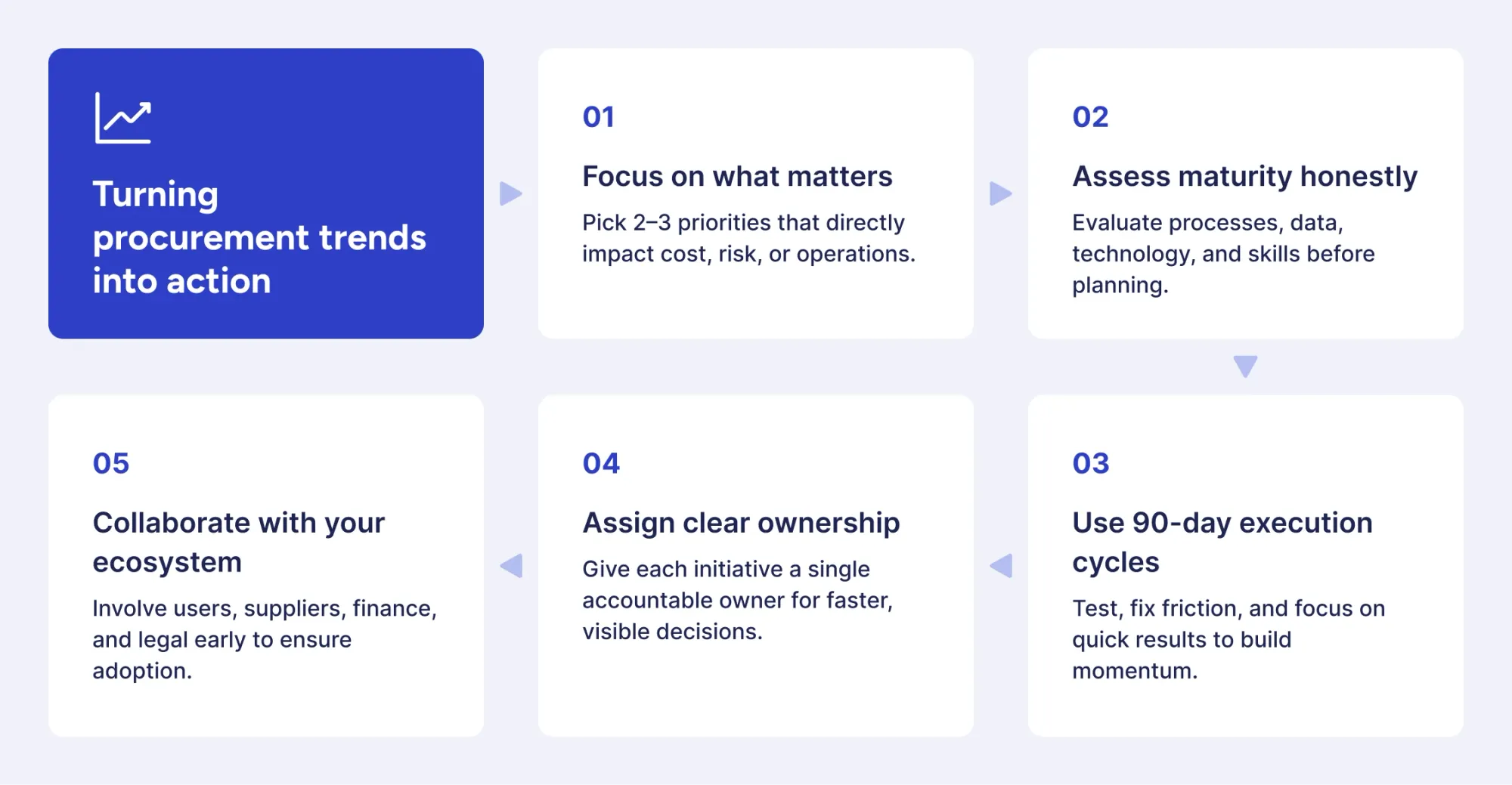
1. Pick a small number of priorities that truly matter
Start with the business problem, not the technology. Instead of saying, “We need AI in procurement,” ask: “What procurement problem would AI help us solve?”
Instead of saying, “We need better analytics,” ask: “What decision can’t we make today because the purchasing data is missing?”
Good priorities are specific. For instance, you might want to:
- Increase the percentage of purchases that start with an approved request
- Improve PO coverage
- See committed spend before invoices reach finance
- Reduce duplicate supplier records
- Consolidate suppliers in a high-volume category
- Move another business unit into the standard purchasing process
- Reduce manual invoice processing
Two or three focused priorities will usually produce more value than ten transformation projects with vague purpose and no trackable outcome.
If you’ve already spent part of 2026 testing new technology, now is also a good time to ask whether those projects have actually improved cost control, visibility, compliance, or productivity.
2. Assess maturity based on what actually happened this year
Don’t evaluate procurement maturity only by looking at which systems you own. Look at how purchasing actually worked during 2026.
Assess four areas:
- Process: How many purchases still bypass the standard process?
- Data: Can you trust the supplier, contract, budget, and purchasing information?
- Technology: Are systems genuinely connected, or do people still move data manually between them?
- Skills: Can your team interpret the information those systems provide and decide what to do next?
When the goal is to look mature on paper, real problems get buried. Instead, try to understand which weaknesses still prevent procurement from controlling costs and risks. That gives you a much more useful starting point for 2027.
3. Translate priorities into 90-day execution cycles
Avoid launching another large-scale transformation program late in the year. Instead, ask one question for each priority: “What will be noticeably better in 90 days?”
Not what software will you implement or what maturity level will you reach. What will actually work better?
For example:
- Current problem: Five locations purchase the same supplies independently.
- 90-day objective: Bring those requests into one process and establish a company-wide view of demand.
- Measure: Track the percentage of relevant requests submitted through the standard process and the number of suppliers used for the category.
The next cycle can focus on consolidating demand or negotiating a better supplier agreement.
4. Make ownership explicit
Cross-functional procurement projects often involve procurement, finance, AP, IT, legal, and business users. However, multiple stakeholders don’t mean responsibility should be shared equally.
Every priority needs one clearly named owner who has the authority to make decisions, coordinate teams, and report results. Whether you’re working on AI adoption or supplier consolidation, if everyone owns the project, nobody really owns the outcome.
5. Build the process around the people who actually buy
Procurement only gets visibility when employees use the purchasing process, which means that adoption is a control issue, not just a change management issue.
The most effective procurement changes involve the people who actually create demand. Ask business users:
- Can they easily tell where to submit a request?
- Can they see approved products and suppliers?
- Can field workers submit requests without sitting at a desktop computer?
- Does a routine $100 request require the same effort as a $100,000 purchase?
- Do employees understand why something requires approval?
Bring finance and legal teams in early when budgets, governance, or compliance rules are involved. Work with suppliers when better data, onboarding, risk management, or sustainability reporting depends on them.
Centralization works when the company can maintain common controls without forcing every team into an unnecessarily rigid process.
How Precoro helps you prepare for procurement trends in 2026
A lot of the trends above come down to the same issue: you can’t control purchasing that you can’t see early enough.
That’s one of the problems we’ve focused on at Precoro, an agentic procurement and AP centralization platform.

Centralize purchasing without centralizing every decision
Companies with multiple locations, departments, projects, or legal entities usually need local teams to keep some purchasing autonomy. The problem starts when every team also creates its own process.
Precoro brings requests, approvals, budgets, suppliers, catalogs, contracts, purchase orders, receipts, invoices, and payments into one connected environment while allowing different parts of the business to tailor workflows to their specific needs.
That gives procurement and finance a company-wide view without requiring every location to work identically.
See spend before the invoice arrives
If finance sees a purchase for the first time when the invoice arrives, most of the important decisions have already been made.
As all purchases and transactions are initiated in a compliant way, Precoro helps teams see pending and committed spend earlier.
That gives procurement time to question a purchase, consolidate demand, use an existing contract, choose a preferred supplier, or stop a budget problem before the order is placed.
Use visibility to actually influence purchases
Visibility by itself doesn’t save money. The value comes from what you can do with it.
If several teams repeatedly buy the same items separately, you can combine demand and use the volume in negotiations.
If people keep purchasing the same goods from different suppliers at different prices, you can guide them toward approved catalogs and preferred vendors.
If employees end up using corporate funds for entertainment during travel, you can block certain categories on Precoro spending cards and prevent overspending with caps.
The platform gives teams the controls to adjust purchasing rules, catalogs, budgets, suppliers, and approvals as those patterns become visible.
Use AI where it removes cumbersome work
Precoro uses AI for practical procurement and AP tasks. Its five AI Crews combine specialized AI agents, AI Assistant capabilities, and document processing to support intake, purchasing, AP automation, supplier management, and spend intelligence.
What makes Precoro different is that its AI operates inside a structured intake-to-pay process, with access to the context behind each transaction. Instead of working with isolated inputs, AI Crews draw on procurement data, documents, suppliers, budgets, and established rules to complete routine work and support better decisions.
That context matters because AI is only as useful as the processes and data it has to work with.
Add procurement control without replacing your ERP
Many growing companies already use NetSuite, Sage, Microsoft Dynamics, QuickBooks, Xero, or another financial system.
They don’t necessarily need another enterprise resource planning (ERP) system. The problem often sits before the transaction reaches it.
Precoro adds a structured purchasing layer for requests, approvals, sourcing, budgets, POs, receiving, and invoices, then connects approved procurement data with the finance system. Unlike many alternatives, Precoro syncs the full procure-to-pay document flow with systems like NetSuite, Xero, and QuickBooks Online.
Most Precoro implementations take around 2–8 weeks, which lets companies start improving procurement without turning the project into a multi-year ERP replacement.
Frequently asked questions about trends in procurement
One of the biggest shifts this year has been the move from process automation toward earlier and more informed control. AI, cloud platforms, and automation continue to remove repetitive work, but the conversation is increasingly revolving around the quality of the underlying data, where controls sit in the purchasing cycle, and whether technology produces measurable results.
Companies are pushed beyond purely price-based sourcing due to supply disruptions, geopolitical risks, trade restrictions, and regulatory changes. Procurement teams increasingly balance cost against reliability, lead time, supplier concentration, regulatory exposure, and continuity risk. That makes centralized supplier and purchasing data more important because you need to understand your total exposure before deciding how to change the supplier base.
The role continues to shift from process execution toward judgment and strategic thinking. Important skills include:
- AI and digital fluency
- Spend and supplier analysis
- Negotiation
- Category strategy
- Risk and resilience management
- Business partnering
- Cross-functional decision-making
Technology can find information or highlight a problem. Procurement professionals still need to decide what the business should do about it.
Pick two or three problems with a measurable effect on cost, risk, or operations. For each one, define what should be noticeably different within 90 days, assign one owner, and choose a metric that shows whether the change worked. With only a few months left in the year, focus on projects that can produce evidence for your 2027 roadmap rather than starting another broad transformation initiative.
Several ideas deserve more scrutiny after seeing how the year has developed:
- Fully autonomous AI buying: Most organizations still need human oversight for high-value approvals, risk, compliance, and supplier decisions.
- Automation as a savings strategy by itself: Faster workflows don’t automatically reduce purchase prices or prevent fragmented demand.
- AI without procurement data readiness: Applying AI to fragmented supplier records and inconsistent processes limits what it can reliably do.
- “Global lowest-cost sourcing” at all costs: Resilience, availability, and geopolitical risk continue to complicate pure price-based sourcing decisions.
- Procurement outsourcing without internal control: Outsourcing work doesn’t fix poor data, unclear purchasing rules, or weak accountability.
Key takeaways: Procurement trends in 2026
- Procurement is moving from isolated workflow automation toward connected, end-to-end purchasing control.
- AI adoption increasingly depends on structured procurement data, clear governance, and appropriate human oversight.
- Spend visibility is moving upstream, so procurement and finance can see demand and commitments before invoices arrive.
- Supplier strategies increasingly balance price with resilience, concentration risk, performance, and collaboration.
- Automation is reducing routine processing while increasing the importance of procurement professionals’ analytical and strategic judgment.
- For the remainder of 2026, procurement leaders should prioritize two or three measurable improvements that can inform their 2027 roadmap.
Achieve your procurement and spend control goals more easily with Precoro