AI Agents in Procurement: How Is Agentic AI Reshaping the Future of Procurement?
Discover how AI agents transform procurement with autonomous sourcing, supplier management, spend control, and supply chain optimization.

Think of tasks that consume most of your team’s time. Something that doesn’t bring any real strategic value to the company but stalls the procurement process if left uncompleted. For many companies, that’s routine approvals or the copy-paste of data into another system.
Typical procurement automation promises to relieve you of that work, but AI agents can automate additional decision-based tasks than that.
We’ve broken down everything there is to know about AI agents: their impact on different procurement areas, potential issues companies might encounter, and various types of agents.
- AI agents can plan and execute multi-step procurement tasks using connected systems and defined policies.
- Common procurement use cases include intake, supplier monitoring, purchase orders, contract analysis, invoice matching, and spend analysis.
- Agent autonomy should depend on transaction risk, permissions, and explicit human-approval thresholds.
- Reliable procurement data and system integration are prerequisites for dependable agent performance.
- AI agents are most useful for automating routine and judgment-adjacent work; people should retain responsibility for strategic and high-risk decisions.
- Organizations should measure agent accuracy, exception rates, processing time, cost, and auditability before expanding autonomy.
Keep reading to find out:
What AI agents are and why procurement needs them
AI agents vs. Traditional automation
AI agents vs. Agentic AI
Core capabilities of AI agents in procurement
How autonomous decision-making works
Procurement functions AI agents can transform
Real-world benefits of AI agents for procurement teams
Types of AI agents used in procurement
Challenges to expect when adopting AI agents
Implementing AI agents with Precoro
AI agents in procurement FAQs
What are AI agents and why do they matter for procurement?
AI agents are autonomous software systems that complete multi-step tasks within procurement workflows. They understand the objective of the task, decide what steps to take, and execute them without being explicitly programmed for every step.
Agents matter for procurement primarily because they handle time-consuming administrative work and give your team more time for strategic tasks like sourcing, supplier management, or cost control. As a function, procurement has several characteristics that suit AI-agent deployment, including document-heavy workflows, which agents can use as context to make informed decisions.
AI agents in procurement at a glance:
| Question | Answer |
|---|---|
| What is an AI procurement agent? | Software that reasons through a procurement task, decides the next action, and executes it inside your existing systems. |
| What can AI agents automate in procurement? | Supplier discovery and selection, purchase order creation, contract analysis, budget and spend control, and invoice reconciliation. |
| Can it approve purchases? | Yes, within the agent's governance and policy limits. |
| Does it replace procurement staff? | It augments procurement staff, automating routine tasks while people keep responsibility for negotiation, risk, and higher-stakes decisions. |
| What does implementation require? | Structured data, system access, a written governance policy, continuous monitoring, and clear escalation rules for exceptions. |
What exactly is an AI agent?
An AI agent is an autonomous software tool that evaluates the objective, plans a series of steps, and acts on them with little to no human input. It can use tools, analyze context, and adjust its next move based on the outcome to achieve that goal.
Unlike a standard chatbot or assistant, an agent doesn’t need a detailed prompt to begin and acts on its own within the predefined policy. For instance, if the procurement team wanted to hand over its intake process to an agent, the process would look like this:
- An agent reads the requisition.
- Checks it against the budget and policy.
- Checks if there’s no existing inventory, so the team doesn’t order excess stock.
- Evaluates best-fit suppliers and items from pre-approved catalogs.
- Automatically approves the purchase if it’s routine.
- Creates a PO and sends it to the vendor.
All of that is done without any effort on the procurement team's part. Your employees still see everything the agent is doing, but they don’t need to prompt and complete every action themselves.
How do AI agents differ from traditional automation tools?
AI agents adapt to changing situations and make decisions based on context. Traditional automation, which is mostly powered by Robotic Process Automation (RPA), only follows predefined rules and stops working in scenarios not covered by them. That’s the primary difference: agents rely on reasoning, while automation is constrained by strict rules.
Traditional automation tools, such as RPA, workflow automation platforms, and rule engines, execute the same sequence of steps and work best with structured data and predictable processes. If your workflow changes or an unexpected situation occurs, you need to add new rules or intervene manually.
With that said, AI agents are essentially built on traditional automation. Many of the agentic workflows include a combination of automation tools you’re already familiar with, such as:
- Optical character recognition (OCR)
- Intelligent document processing (IDP)
- Machine learning (ML)
- Computer vision
- Natural language processing (NLP)
Agents perceive the objective and coordinate automation tools to carry out their part of the task within each step.
| Category | Traditional automation | AI agents |
|---|---|---|
| Workflow | Follows fixed, hardcoded steps | Reasons through a goal and adjusts as conditions change |
| Data | Mostly structured data with a fixed format | Structured and unstructured data across systems |
| Exception handling | Can stop and require manual intervention | Adjusts the task sequence or flags it for review |
| Decision authority | Doesn't make autonomous decisions; every action is predefined | Acts within governed limits, escalates exceptions to employees |
| Best fit | High-volume, repetitive, unchanging tasks | Judgment-adjacent tasks spanning multiple systems or counterparties |
What is the difference between AI agents and agentic AI?
An AI agent handles one defined task on its own. Agentic AI is the broader system-level capability where multiple agents plan, coordinate, and pursue a shared goal with little human input.
An AI agent is a single software entity that perceives its environment, decides on an action, and executes it within a defined scope, such as matching an invoice to a purchase order.
Agentic AI describes what happens when a network of agents works together on a goal instead of one agent executing one task. A goal is broken into sub-tasks, which are then delegated to specialized agents. The plan adjusts based on outcomes as agents work, without your team prompting.
| AI agent | Agentic AI | |
|---|---|---|
| Scope | A single entity handling one defined task | A system of multiple agents working toward a broader goal |
| Autonomy | Applies judgment to complete one step or action | Reasons across multiple steps, adjusting the plan as outcomes come in |
| Coordination | Operates on its own | Multiple agents coordinate as a multi-agent system |
Why is procurement well-suited to agentic AI?
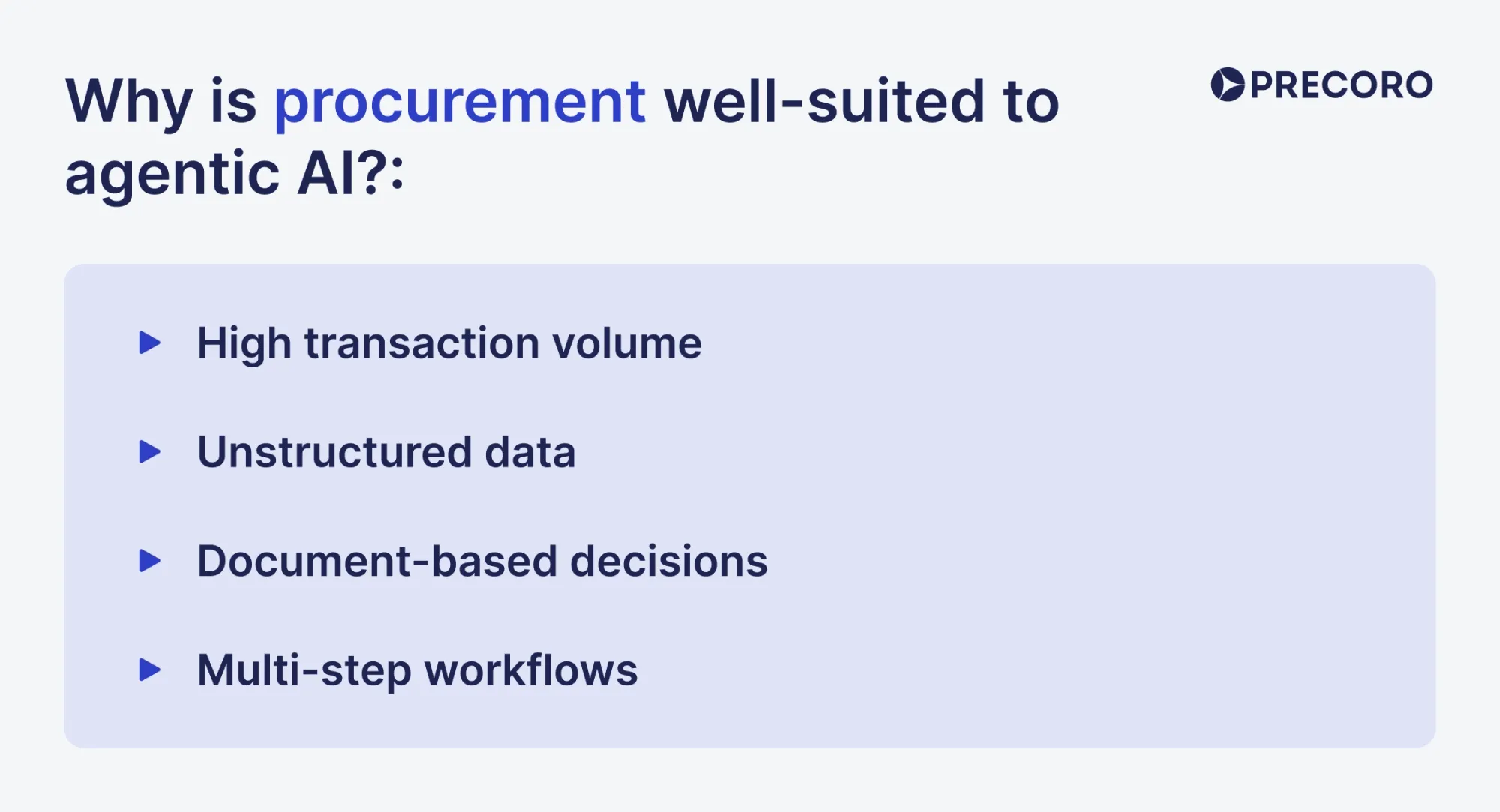
Procurement suits agentic AI primarily because it has the conditions that support agent deployment for AI to operate in: high transaction volume, unstructured data, document-based decisions, and multi-step workflows.
These factors generate a lot of valuable documented context, which an agent can handle at a scale a single person can't match. Here's how agentic AI puts each of these conditions to work for a procurement team:
- High transaction volume: Software agents can process procurement transactions concurrently, subject to system capacity and workflow controls.
- Unstructured data: Besides formatted documents, AI agents understand contracts, emails, and supplier records and can analyze them.
- Document-based decisions: Agents can gain valuable context for future decisions by automatically cross-referencing documents.
- Multi-step workflows: Agents can complete a complex task from start to finish and coordinate steps across systems.
Some companies are still cautious, but adoption of agentic AI in procurement is already happening. The survey Next-Gen Supply Chains by Economist Enterprise reports that roughly 40% of companies already use agentic AI in their supply chain. Primary use cases include supplier onboarding and performance monitoring.
What makes current procurement processes suitable for AI transformation?
Procurement processes are ideal for AI automation because of the growing workload, unpredictable external factors, and limitations of existing procurement systems that teams face today. AI agents can process large amounts of data, understand unstructured information, coordinate work across multiple tools, and adapt when conditions change. These capabilities make them a natural fit for many procurement processes.
Why are procurement workloads increasing?
The volume of work procurement teams handle has outgrown headcount. According to McKinsey’s article Transforming procurement functions for an AI-driven world, procurement spend per full-time employee is 50% higher today than it was five years ago. With the adoption of AI, teams are expected to do more with the same or even fewer resources. Intelligent automation is one way procurement teams can increase transaction capacity without proportionally increasing headcount.
How do economic and supply chain disruptions increase procurement pressure?
The pressure only increases with the macroeconomic environment. Geopolitical disruptions, supplier issues, inflation, and changing regulations simply can’t be managed through an outdated manual process. Even a partially automated workflow might not be enough to handle the pressure, so your team needs a system that can adjust on its own in real time.
How do disconnected procurement systems limit automation?
Digital procurement solutions have been available for years, but many teams still rely on disconnected procurement systems or inefficient workarounds. Even if they have a procure-to-pay (P2P) solution, they’re not using it to its full potential. For instance, most haven’t implemented generative AI, with only 40% doing so, according to McKinsey. In this case, for organizations with existing systems and APIs, adding AI capabilities to the current technology stack may be more practical than replacing the entire platform.
What are the key capabilities of AI agents in procurement?
AI agents stand out because of their ability to make decisions autonomously within set limits and to learn from feedback. Additional capabilities also include natural language understanding and the coordination needed to run a multi-step workflow end-to-end.
How do AI agents enable autonomous decision-making?
AI agents make autonomous decisions within limits set by the procurement team. Although agents work independently, all the actions they carry out comply with the policy and thresholds you’ve outlined.
When working on a task, the agent uses a set of interconnected capabilities to make decisions, including perception, reasoning, planning, memory, system access, and feedback evaluation. Their decision-making often isn’t linear and more iterative: an agent might reason, use a tool, encounter an error, and step back to consult memory, restarting the process.
- Perception: Agents pull real-time data from connected systems such as the enterprise resource planning (ERP), contracts, and market feeds, so they have enough information to complete the task.
- Reasoning: Agents analyze that context, weigh options, and apply judgment to situations.
- Planning: An agent breaks a goal into a sequence of steps and selects the tools or systems it needs for each step.
- Memory: Short-term memory holds the current task in context, while long-term memory stores past interactions that the agent can use for future decisions.
- Tool and system access: Agents connect directly to external data and application programming interfaces (APIs), and if permitted, can act immediately.
- Feedback loop: After acting, an agent evaluates the result, adjusts the plan if the outcome misses the goal, and uses that knowledge for the next task.
For example, a procurement agent can flag a price variance on an invoice, check it against contract terms, and approve the invoice or route it for additional review.
How is AI agent autonomy governed in procurement?
AI agent autonomy in procurement is governed through permission levels set by internal teams. Each agent gets only as much decision authority as its level allows. Anything outside that goes to a person.
According to Gartner’s forecast published in May 2026, 40% of teams will decommission autonomous agents by 2027 because of governance oversights discovered after production. The same rules won’t apply to every agent. Group them into four tiers:
| Tier | What the agent can do | Example |
|---|---|---|
| Observe | Read-only access; output is visible only to the person who requested it | Document summarization, data retrieval, and code explanation |
| Advise | Drafts a recommendation; a human reviews and executes it manually | Email drafting, report generation, and decision support |
| Act-with-approval | Can write data or send communications, but only after explicit sign-off | PO issuance, supplier record updates |
| Fully autonomous | Executes within defined guardrails; humans review exceptions and outcomes, not individual action | Routine invoice approval, policy-compliant payment execution |
When should humans stay involved?
Involve a person in any task that requires human judgment and carries high stakes for the company or the partnership, such as strategic sourcing, exceptions, or purchases outside policy. Defined high-volume tasks, such as routine approvals or renewal tracking, can be safely handled by an agent.
| Task | Human and agent involvement |
|---|---|
| Invoice matching | An agent can execute |
| Routine POs | An agent can execute |
| Spend classification | An agent can execute |
| Contract renewal tracking | An agent can execute |
| High-value payments | Human approval recommended |
| Disputed invoice resolution | Human approval recommended |
| New supplier onboarding | Human approval recommended |
| Supplier replacement | Human decision required |
| Strategic negotiation | Human decision required |
| Contract exceptions | Human decision required |
| Emergency purchase outside policy | Human decision required |
Can AI agents learn and adapt to your procurement patterns?
Yes, AI procurement agents adapt to your procurement patterns by using both current and historical procurement data. They continuously incorporate new information and recognize patterns, then use past transactions to improve recommendations over time.
During multi-step workflows, they can also adjust their actions as new information comes in. However, to accurately adapt to your patterns, agents need clean data. Scattered records will only make agents unreliable and might lead to recommendations built on an incomplete picture of the business.
Centralizing spend data into one connected system gives an agent a single source to learn from. Most procurement organizations aren't there yet. In their report, The Path to AI-First Procurement: Closing the Gap between AI Ambition and Execution, Ardent Partners revealed that 40% of teams still work with fragmented systems and no centralized solution.
What role does natural language processing play in procurement AI?
Natural language processing (NLP) is the technology that lets an AI agent read, understand, and generate human language. It turns unstructured text, such as contracts, emails, invoices, and supplier documents, into structured fields that agents’ tools can work with. In a procurement agent, NLP handles the language side of the job, while the agent’s reasoning, planning, and memory use information extracted by NLP to complete a task.
Here are key procurement use cases that require NLP:
- Spend classification: NLP automatically organizes unstructured procurement data, such as supplier names, item descriptions, and free-text line items, into standardized spend categories.
- Contract and PO analysis: AI extracts key details from contracts and purchase orders, including pricing, payment terms, renewal dates, and obligations, without manual review.
- Natural language search: Procurement teams can ask questions about spend data in plain language and don’t have to search through reports or dashboards.
- Supplier and risk evaluation: AI analyzes supplier performance records, product specifications, and customer feedback to assess supplier capabilities and identify potential risks.
How do AI agents handle complex multi-step procurement workflows?
AI agents can handle multi-step procurement workflows by planning a sequence of actions, using connected tools, evaluating results, and escalating exceptions. In multi-agent systems, an orchestrator can also assign individual steps to specialized agents.
AI agents decompose a complex procurement task into smaller steps and assign each one to the most suitable agent that focuses specifically on that task. The specialized agents complete their assigned tasks while working together across the entire workflow. Finally, the orchestrator adjusts the workflow as needed, changing the order of tasks or assigning additional work based on new information or emerging risks.
Which procurement functions can artificial intelligence agents transform?
Artificial intelligence agents can support tasks across many procurement functions by automating the repetitive parts of them. Areas that can benefit include supplier discovery and selection, purchase order creation, contract analysis, spend and budget control, and invoice reconciliation.
How can AI agents improve supplier discovery and selection?
AI agents improve supplier discovery and selection by making both stages faster and automating supplier performance monitoring and follow-up activities. They can evaluate larger volumes of supplier data than manual review typically allows, then continue to check on those suppliers after they're onboarded.
- Quicker supplier discovery: According to McKinsey’s article With artificial intelligence, find new suppliers in days, not months, a single supplier search today takes about three months and more than 40 hours of a sourcing professional's time. AI-powered discovery tools scan hundreds of supplier profiles, certifications, and performance signals in a fraction of that time.
- Continuous supplier monitoring: Once you select the supplier, purpose-driven agents can analyze vendor data on an ongoing basis and cross-reference it against set service-level agreements (SLAs). You won’t have to wait for the end of the quarter to find out the vendor is underperforming.
- End-to-end execution: AI agents automatically hand work from one stage to the next, from initial sourcing to supplier monitoring. The team doesn’t need to step in after each step, only after exceptions.
What questions should AI agents ask when evaluating suppliers?
An AI agent evaluating a supplier should ask about financial stability, compliance, geopolitical exposure, delivery capacity, total cost of ownership, and the extent of visibility into that supplier's supply chain.
- Is the supplier financially stable enough to fulfill this contract without disruption? — Agents continuously monitor financial health indicators to answer this question.
- How exposed is this supplier to a tariff change or customs disruption? — An agent tracks trade policy shifts against the supplier's location and flags when too much order volume concentrates in one region.
- Does the supplier meet compliance and regulatory requirements? — Risk agents could monitor for any warning signs of non-compliance.
- What does delivery performance and capacity look like? — It’s important to assess whether there are any dependencies that could affect order completion.
- Which components come from a single region or a single source? — An agent maps the info given by the supplier to spot where a disruption could halt the order.
- What is the total cost of ownership of this supplier? — Make sure the agent doesn’t compare vendors only based on upfront cost, since maintenance or scaling quickly adds up.
- If this supplier fails to deliver, what would be the cost of switching to an alternative? — An agent models that trade-off up front, comparing alternative suppliers alongside the primary one.
First, don't rely only on historical scorecards. AI agents should combine past performance with real-time data to identify new risks and opportunities.
Second, look beyond your direct suppliers. New regulations, such as the EU's Corporate Sustainability Due Diligence Directive (CSDDD), require companies to assess environmental, social, and governance (ESG) and human rights risks deeper in the supply chain. If sourcing is in your agentic AI plan, make sure the agents monitor sub-tier suppliers as well.
Can AI agents automate purchase order creation and management?
Yes. AI agents can automate a lot of tasks across the purchase order lifecycle, from creating a purchase order to identifying issues that require human review. AI agents analyze purchasing history, inventory levels, and demand forecasts to determine when to place a purchase order. They then generate the PO and populate it with the required information. If policy requires it, the agent routes it for approval.
How do AI agents improve contract analysis and negotiation?
AI agents improve contract analysis by automatically extracting and flagging risks in a contract. During negotiations, they answer questions and recommend next steps in seconds. AI reduces the time spent on gathering information and gives negotiators faster access to relevant contract and supplier information.
Here are the key capabilities agents have that improve contract analysis and negotiation:
- Automatic extraction: Employees no longer need to read each line of the contract. An agent parses the agreement to identify parties, obligations, deadlines, and specific clauses.
- Risk flagging: A contract agent reviews the contract and notes any missing or unusual terms that differ from the typical pattern of your company. Your team avoids unnecessary costs that they would have suffered.
- Contract-to-spend reconciliation: Check actual spend against contracted clauses with an agent to catch early-payment discounts and rebates.
- Renewal and expiration tracking: An agent detects an upcoming renewal or expiration well in advance, making sure no unwanted auto-renewal happens without your approval.
- Cross-contract comparison: An agent searches the whole database to find which vendor offers the best payment terms or which agreements renew next quarter.
- Conversational access: Agent responds to any plain-language request, retrieves the relevant contract terms, and provides a quick analysis.
- Contract summarization: A long agreement can be quickly summarized in a short response.
- Answering negotiation questions on demand: Once the agent has analyzed the contract, it can answer a direct question, such as what the penalty is for late delivery or whether the contract can be terminated before renewal. Some solutions also provide counter-arguments a negotiator can use if they’re under time pressure.
The agentic impact can already be seen. According to Deloitte’s 2026 report, Capitalizing on AI: How Automated Agreement Workflows Drive ROI, 61% of organizations still review signed agreements by hand to find insights. Companies running AI-powered processes see a 36% improvement in efficiency from reduced cycle time and 29% cost savings from lower labor costs.
What role can AI agents play in spend analysis and budget control?
AI agents automate spend analysis and budget control by categorizing spending, monitoring budgets, identifying opportunities for savings, and flagging financial risks in real time.
Agent use cases for spend analysis
- Spend categorization: Automatically sorts transactions and supplier records into the correct spend categories, down to individual line items. That cuts uncategorized and misclassified spend.
- Savings and variance detection: Continuously flags price differences and duplicate suppliers. It also catches off-contract purchases and other spending patterns that increase costs.
- Contract compliance: Checks invoices and purchase prices against contract terms. It flags pricing errors and contract leakage, then catches any purchase that doesn't comply with the agreement.
Agent use cases for budget control
- Budget validation: Verifies available budget before a purchase is approved, preventing overspending before it occurs.
- Unified budget visibility: Combines budget, committed spend, actual spend, and forecasts from multiple systems into a single view.
- Continuous budget monitoring: Tracks spending against budgets in real time, flags unusual activity, and automatically generates financial reports and alerts.
How do AI agents enhance invoice processing and reconciliation?
AI agents enhance invoice processing by automatically capturing invoices, expenses, and credit notes; matching each to the purchase order and confirmed receipt; reconciling credits to the correct invoice; and timing payments to capture an early-payment discount. According to the AP Metrics That Matter in 2025 report from Ardent Partners, 75% of accounts payable (AP) teams already use some form of AI. Here are key ways AI agents can improve their work:
How can AI automate invoice data capture?
Invoices, expenses, and credit notes arrive in many formats. AI automatically extracts the data, creates a structured record, and sends only documents with errors for human review.
How can AI agents automate three-way matching?
An agent checks an invoice against its purchase order and the confirmed receipt. It catches any mismatches immediately, without sending the invoice to a person for manual review.
How can AI agents reconcile credit notes?
A credit note usually arrives as a separate document, disconnected from the invoice or payment it's meant to offset. Someone in AP has to notice it and adjust the payment by hand. An agent reads the credit note, matches it to the right invoice, and applies the adjustment.
How can AI agents optimize payment timing?
Payment terms often vary by supplier and invoice. An agent can consider available discounts, penalties, and cash flow, and then schedule payment on the optimal date rather than following a fixed rule.
What are the real-world benefits of implementing AI agents for procurement teams?
AI agents help procurement teams reduce and avoid costs, improve supplier management, and make better purchasing decisions. Organizations that have adopted AI are already seeing measurable results, while those that haven't may face a productivity or capability gap.
How much time can organizations save with AI-powered procurement?
Organizations can save 25% to 40% of procurement time with agentic AI and AI-powered procurement solutions, according to McKinsey’s article Transforming procurement functions for an AI-driven world. Agents can essentially act as digital teammates who work alongside your team and take over repetitive tasks. However, those savings only compound into organization-wide gains once the process is redesigned around the agent. If it’s kept the same, the result might be less effective.
With AI-powered procurement, the same team can process more work without adding headcount. A five-person AP team, for example, can handle a growing volume of invoices and PO because an agent handles the repetitive steps in the background. Output increases while team size stays the same, which eventually results in measurable savings.
What cost reductions can companies expect from agentic AI?
Companies can expect most of their cost reduction from automating repetitive workflows and reducing process time. A faster process means less labor and resource cost per transaction. Agentic AI can boost productivity by 5%–10% on a single automated task, while rebuilding an entire process around AI can deliver 60%–90% faster resolution, as stated in McKinsey’s Seizing the agentic AI advantage report.
Key areas where agentic AI can reduce procurement costs:
- Spend categorization and data cleanup: A human can easily spend hours sorting and grouping spend data. An agent, on the other hand, automatically tags each piece of information to the correct category and supplier. That process is also continuous: as the data comes in, agentic AI categorizes it.
- Category sourcing and negotiation prep: Buyers normally gather supplier pricing, past contract terms, and market data by hand before a negotiation. An agent collects it much quicker, giving you enough context to build your case during negotiations.
- Invoice and AP matching: An agent checks each invoice against the PO and receipt. AP only has to handle exceptions outlined in the policy.
- Contract term extraction and monitoring: If you track renewals or any price changes solely in spreadsheets, you can miss when that change happens. An agent scans the contract, extracts the pricing terms and commitments, and monitors them on an ongoing basis.
How do AI agents reduce human error in procurement processes?
AI agents reduce human error by checking documents against a fixed set of rules. This is especially apparent in document matching, supplier screening, contract review, and omission flagging.
Agents detect invoice and PO mismatches
An invoice, purchase order, and receipt may be stored or processed separately before anyone compares them. An agent matches all three as soon as they’re available, so quantity or price mismatches are apparent well before payment.
Agents screen suppliers and transactions
Many supplier onboarding and payment processes require checks against sanctions lists, though requirements vary by organization, jurisdiction, supplier, and transaction. An agent can monitor them automatically and route any alerts that need human review to those in charge of risk management.
Agents review contracts for risks or missing clauses
With a manual review of a contract, you might miss a clause that changes liability or payment terms, especially under tight deadlines. An agent reads the full contract and flags clauses that need closer review.
Agents catch omissions
Large documents can span hundreds of pages, and reviewers might not notice missing details or pricing inconsistencies when assessing a huge volume of paperwork. An agent reviews each bid in full and flags missing information, gaps, and pricing errors.
Can AI agents improve supplier relationships and communication?
Yes, but indirectly. AI agents improve supplier relationships by reducing the administrative work around them. It in no way replaces actual human conversations or the trust you build between people on both sides.
- Less administrative work: AI agents handle the routine of supplier management, such as status updates, document collection, or follow-ups. Procurement teams can spend less time on repetitive tasks and more time on work that moves the partnership forward, like negotiations or strategic planning.
- Continuous supplier monitoring: AI agents monitor supplier performance and compliance year-round, along with financial health and external risk signals. Teams get an alert as soon as something changes.
- Faster issue resolution: AI agents identify any warning signs or supplier issues early, which means teams can address problems before they affect the relationship.
- More time for strategic suppliers: By automating routine supplier management tasks, AI agents give procurement teams more capacity to focus on supplier development, contract negotiations, and long-term partnerships.
AI agents improve the work around supplier relationships, but they don’t replace the relationship itself. Procurement professionals still have to build trust and consider business strategy when entering a partnership.
What impact do AI agents have on procurement compliance and risk management?
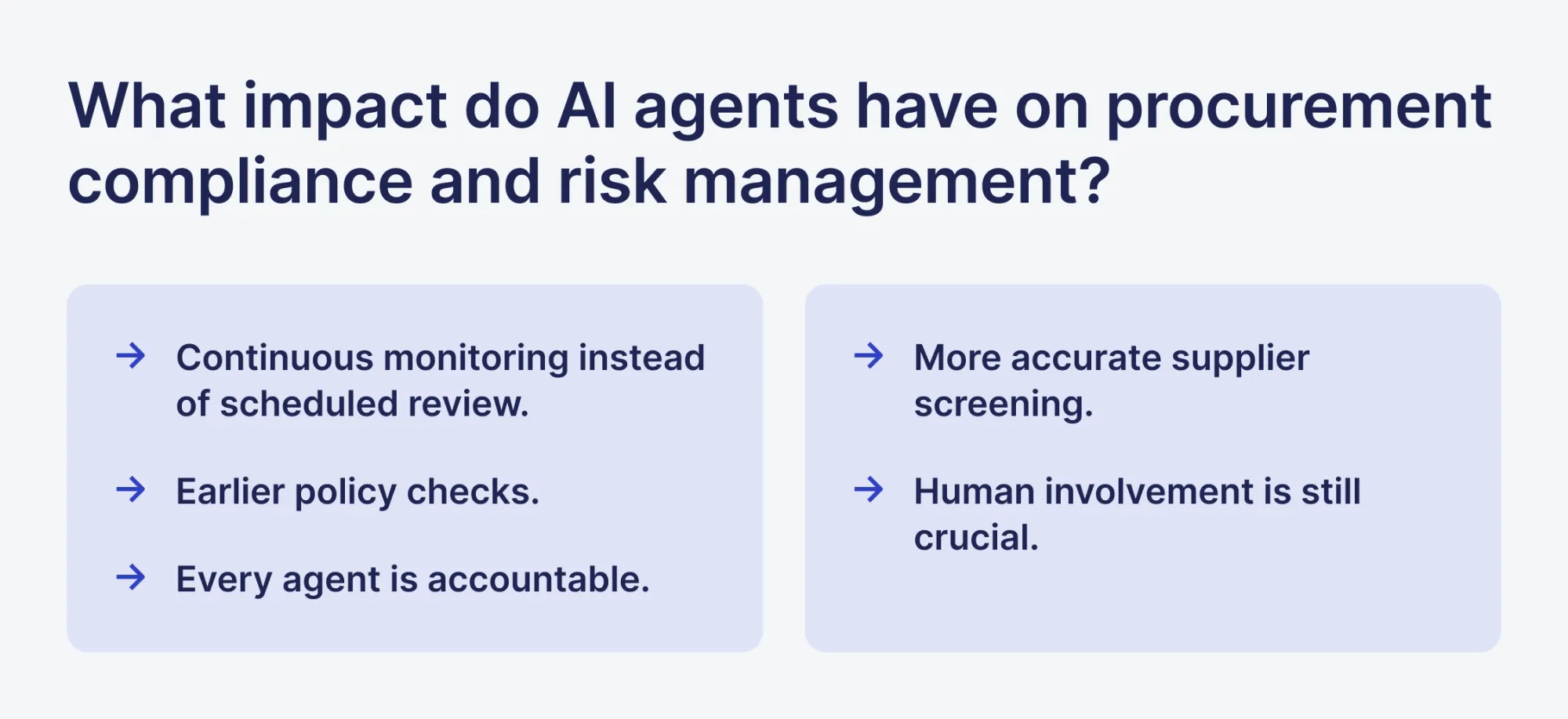
AI agents strengthen procurement compliance and risk management by identifying issues earlier, monitoring risk continuously, and involving human expertise for high-risk transactions.
Continuous monitoring instead of scheduled review. An agent tracks external signals such as news and financial data around the clock. It raises a flag the moment something changes, well ahead of a scheduled audit.
Earlier policy checks. An agent reviews a contract against organizational standards while it's still being drafted or renewed. It extracts terms such as payment schedules and termination conditions and flags anything that deviates from policy at that stage.
More accurate supplier screening. Agents check suppliers against sanctions, watchlists, and other risk data and distinguish genuine matches from similar names or unrelated records. Compliance staff spend more time on cases that actually need further investigation.
Every agent action should be attributable and auditable. Name a specific person and function that is held accountable for outcomes. Each record should be linked back to a specific agent and decision, so you can trace the reasoning behind any action.
Human involvement is still crucial. Organizations set limits on what an agent can approve on its own, based on transaction size and sensitivity. Anything above that threshold is routed to a person for a final decision.
What are the different types of AI agents used in procurement?
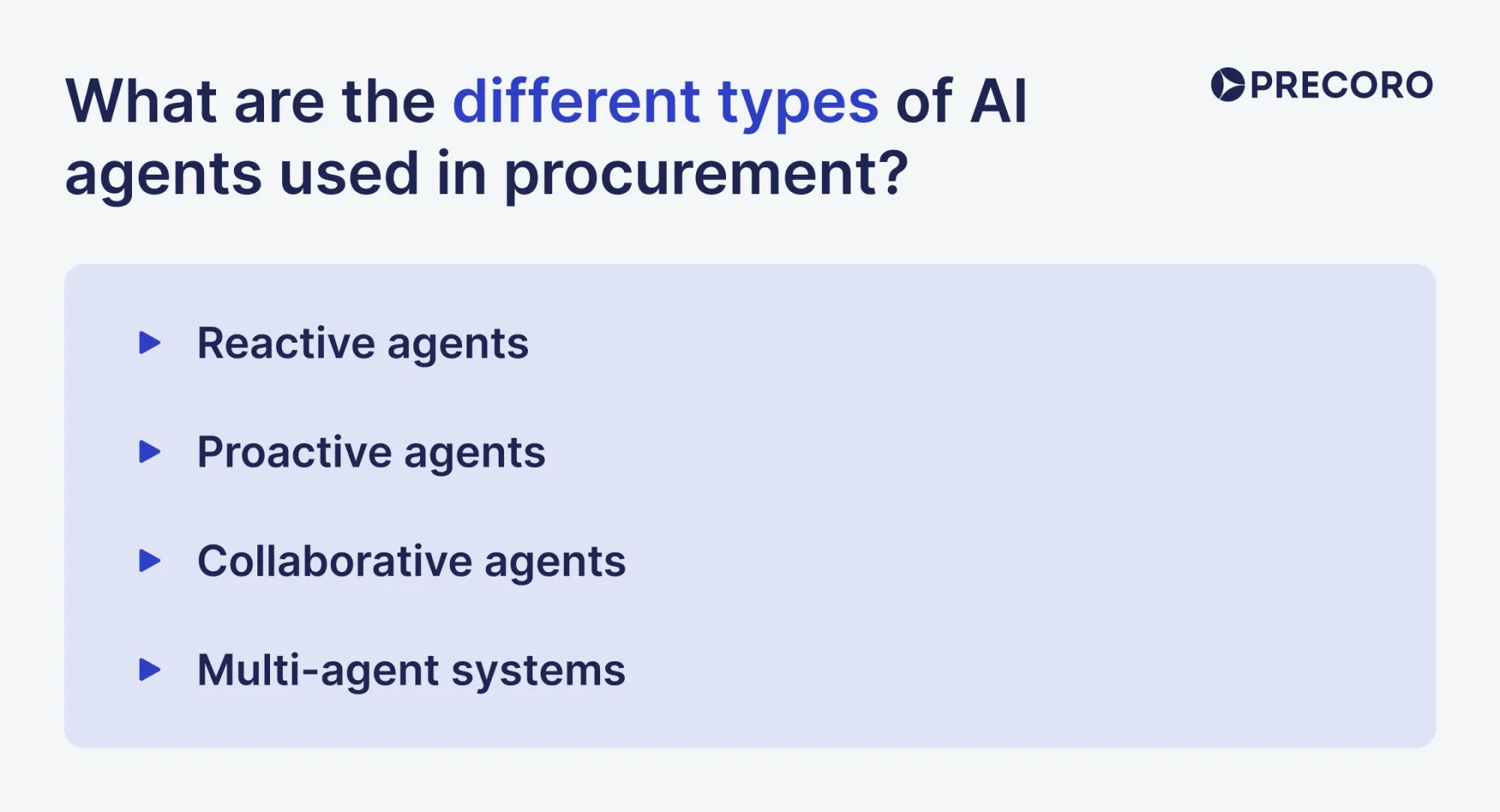
AI agents used in procurement fall into four types: reactive, proactive, collaborative, and multi-agent systems. Each type differs in how much initiative it takes and how many agents work together:
- Reactive agents act only when triggered by a specific event or query, following a defined rule without memory across sessions.
- Proactive agents continuously ingest live data and generate a recommendation or action before anyone asks for one.
- Collaborative agents are multiple specialized agents that coordinate directly with each other toward a shared goal, each handling its own piece of the same task.
- Multi-agent systems split a workflow into sub-tasks handled by specialized agents, coordinated by an orchestrator that keeps them working from shared data.
What are reactive AI agents, and when should you use them?
A reactive agent responds to a specific condition (a so-called trigger) and immediately performs a predefined action. Typically AI-driven, it reads an input, checks it against that rule, and acts, typically with no memory of past events and no planning ahead. Use them for tasks with clear, unambiguous rules, such as document matching, approval routing, or duplicate detection.
Reactive agents need the full picture available at the moment they act, since they can't reference history or context outside of what's in front of them. They're also only as reliable as the rules you wrote, so outdated ones can cause errors.
Use reactive agents to:
- Perform three-way matching: Compare the purchase order, invoice, and goods receipt, then flag mismatches.
- Route approvals: Send purchase orders (POs) to the correct approver based on predefined approval rules.
- Detect duplicate invoices: Compare incoming invoices against existing records and flag duplicate submissions.
- Validate invoice fields and pricing: Check tax fields, currencies, and prices against contract terms or predefined rules.
Reactive agents aren’t ideal when a task requires context from earlier steps, weighing trade-offs, or scenarios outside of established guidelines. Tasks such as supplier negotiation or contract risk scoring need either memory of prior interactions or the ability to plan toward a goal, which a reactive agent typically doesn't have.
Use a reactive agent when a procurement task follows a clear rule. Send tasks that require judgment to a person or a more capable agent.
How do proactive AI agents anticipate procurement needs?
A proactive agent, on the other hand, doesn’t need a specific trigger to work. It uses a model of its goal and environment to predict what will happen and takes action before a problem occurs.
A reactive agent checks whether an input matches a rule. A proactive agent identifies what needs to happen to meet a goal. It predicts what may happen next and, in more advanced cases, compares different options to choose the one most likely to meet the goal.
Use proactive AI agents to:
- Forecast demand and trigger reorders: Analyze historical usage patterns to predict demand and generate a sourcing scenario before shortages.
- Flag supply disruption risk: Compare forecasted demand with known disruption risks to identify potential shortages before they affect supply.
- Monitor supplier risk: Track a supplier's financial health and regulatory status and flag changes before they lead to missed shipments or contract issues.
Proactive agents work best when there's enough reliable historical or market data to create an accurate forecast.
What are collaborative AI agents, and how do they work with teams?
A collaborative agent is part of a group of specialized agents that work together toward a shared goal instead of operating alone. Each agent has its own scope and skill set, but the agents track what the others are doing and coordinate, typically through shared data.
In procurement, a team of these agents might work a single invoice together: one extracts the data, a second matches it against the PO and receipt, and a third routes any mismatches to a person.
A single agent might only see its own step of a process. A team of agents shares context across steps, so each of them has the information it needs, and the group can handle complex workflows one agent can’t handle alone.
Use collaborative AI agents to coordinate multi-step procurement processes, with different agents handling specific tasks such as intake, approval, matching, purchasing, or payment. Assign the owner to each step, whether an agent or a person, and limit each agent's system access to what it needs.
How do multi-agent systems coordinate complex procurement tasks?
A multi-agent system splits a complex workflow into subtasks and assigns each to a specialized agent. An orchestrator manages these assignments and shares the same context with every agent, so the information doesn't change as work passes from one agent to the next.
Most procurement workflows coordinate agents in a fixed sequence, while some use a central orchestrator to route work based on the type of procurement request. In both cases, governance defines who owns each decision and when an agent must stop and involve a person.
Use multi-agent systems to run a full intake-to-pay cycle. Hand a request from an intake agent to a purchasing agent, and so on, with each picking up where the last one left off. You only handle the exceptions from policy.
Multi-agent systems are especially useful when a process has enough distinct steps that no single agent could reasonably run the whole thing. They also require clear policies and governance for each agent from the start, so organizations can control how agents act as the system grows.
How do the four types of AI agents compare?
| Agent type | Definition | Best use cases | Tradeoffs |
|---|---|---|---|
| Reactive agents | Responds to a trigger using a fixed rule, without memory or planning. | Three-way match, threshold-based approval routing, duplicate invoice detection, and field validation | Poor fit when a task needs context from earlier steps, human judgment, or a response to a situation that the rule didn't cover. |
| Proactive agents | Understands the goal and situation, predicts what will happen, and acts. | Demand forecasting, supply disruption alerts, continuous supplier risk monitoring | Needs reliable data to make accurate predictions. A person should confirm any prediction before the agent takes a costly action. |
| Collaborative agents | Several specialized agents work toward a shared goal. | Complex, multi-step workflows | Needs clear ownership and access limits for each step; unnecessary for a single task. |
| Multi-agent systems | An orchestrator breaks a complex task into subtasks and assigns each one to the specialized agent. | Full intake-to-pay cycle | Needs governance from the start. Without central coordination, adding more agents can create new risks. |
What challenges should you anticipate when adopting AI agents for procurement?
Adopting AI agents for procurement introduces major hurdles like legacy-system integration, data quality gaps, privacy and security exposure, and resistance from procurement staff who don't trust the output. Organizations also face ethical questions around automated supplier decisions and the transparency of the agent's actions.
What are the main technical barriers to AI agent implementation?
The main technical barriers to AI agent implementation are legacy, fragmented systems, unreliable execution in high-stakes tasks, and procurement data not structured for agent use.
Integration with legacy and fragmented systems
Legacy systems and fragmented software make integration difficult. Most procurement and ERP systems rely on scheduled syncs and manual entry. Agents need real-time data access across these systems, which is harder to achieve if you’re using several agents from different vendors. Each tool may have its own platform and governance, making it difficult to coordinate them. Before implementing, test new agents with current tools.
Unreliable execution at high-stakes steps
Unreliable execution in high-stakes tasks creates a major risk. Keep in mind: this is only an issue if your policy doesn’t have clauses to prevent it. Without strict instructions, an agent can approve a transaction based on a wrong interpretation of a document. It can also make changes directly in a live system without the required human review. Set clear access limits and exceptions that require human approval at key steps.
Scattered data
Disorganized procurement data limits your agent use. AI agents can read unstructured procurement data, but they still need clear access to it. Before adopting agentic AI, consider going through your data and organizing it by categories or deleting outdated records. Some agentic platforms like Precoro use an internal agent to classify spend data before other agents start working with it.

How do you address data quality and availability issues?
Fix data quality and availability issues before an agent goes live: clean the data, fill in gaps, and put monitoring in place so the organization can catch new issues as they arise. Gartner found that 63% of organizations either lack the right data management practices for AI or aren't sure they have them. Here are several ways you can address data issues.
Data normalization
Data normalization uses AI trained on procurement terminology to automatically clean and standardize records. It corrects inconsistent entries such as units of measure and currency, and removes duplicate catalog or spend records.
Data imputation
Data imputation fills a missing value, such as a blank catalog price or category, using a model trained on historical purchase patterns and market data. An agent receives a complete record to work from as a result.
Data augmentation
Data augmentation generates synthetic data to model a scenario before it happens, such as a supply disruption or a demand spike. This method essentially gives an agent enough example cases to plan a response before the real event.
Master data consolidation
Master data consolidation synthesizes supplier data from multiple internal and external sources into a single profile. It standardizes naming conventions, resolves duplicate records, and maps the relationship between a parent company and its subsidiaries.
Consistent spend classification
Consistent spend classification applies natural language processing to map every transaction onto one spend taxonomy. It replaces category tags that vary by region or business unit with a single, shared structure that an agent can query directly. Global taxonomies like the United Nations Standard Products and Services Code (UNSPSC) are typically used at this stage.
What privacy and security concerns arise with AI agents?
The main privacy and security concerns with AI agents are unsanctioned agent proliferation, prompt injection, unsupervised execution, inference-based privacy exposure, and hallucinated outputs.
- Unsanctioned agent proliferation: A procurement analyst can create an agent with a low-code tool to speed up a task, giving it access that security teams haven’t reviewed. Low-code and no-code tools make it easy to create new agents faster than security teams can track and govern them.
- Prompt injection: When an agent can access external tools, it can read emails, documents, and web content created by other people. An attacker can use malicious instructions in that content to make the agent misuse its authorized access. In procurement, this could mean a manipulated invoice that causes an agent to approve a payment it should have rejected.
- Unsupervised execution: An agent can make changes directly in a live system, such as a procurement database, without human approval. Be sure that unsupervised actions can only be made towards tasks that have a strictly governed policy and escalation paths.
- Sensitive information inferred from data: An agent can analyze ordinary spend or supplier data and infer sensitive information, such as a supplier's financial distress, even when that information isn’t stored directly.
- Hallucinated outputs: An agent can generate a plausible but false answer, such as approving a payment based on a fabricated interpretation of a contract term.
Three controls address most of these risks: give each agent only the access it needs, define clear policies for what it can and cannot do, and keep a clear, auditable record of every action and who or what took it.
How do you handle resistance from procurement professionals?
Address resistance by redesigning roles, training, and incentives around the agent. Don’t necessarily fight the pushback. Instead, use it to find issues in the current and future processes. Procurement professionals are often reluctant to adopt AI because they’re uncertain if it’ll work and are anxious about its impact on their role.
- Redesign roles and processes around the agent: Separate tasks that require human skills, such as negotiation and supplier relationships, from tasks that agents can handle well, such as three-way matching and data entry. You can’t simply give someone an agent without changing their responsibilities. Agents take over a significant amount of work, so the expectations for the role won’t be the same.
- Invest in targeted training: People are more likely to use AI tools when they understand how they work and what they can do. Tailor training to each group instead of using one generic session: add sessions for early adopters, one-on-one sessions for senior staff, and self-guided training for independent learners.
- Protect psychological safety: Encourage experimentation and make it clear that AI use isn’t a performance-monitoring tool. If employees think their AI activity will affect performance reviews, they may avoid using the tool or use it only to appear productive.
- Name the human capabilities staff keep: Clearly define the parts of the job that remain human, such as judgment or critical thinking. You need to emphasize that agents are tools that handle routine work, while human expertise is still essential.
What are the ethical considerations of using AI in procurement decisions?
The main ethical considerations are supplier fairness, explainability, accountability for mistakes, and resistance to manipulation.
How can AI agents introduce bias into supplier selection?
An agent trained on historical purchasing data can repeat existing bias at scale. A sourcing or scoring model may favor suppliers you’ve used in the past simply because the training data reflects those decisions. Test the agent against smaller and newer suppliers before it goes live, and review it regularly as new data comes in.
Why does AI explainability matter in procurement?
Any action the agent makes deserves a clear explanation. Require any agent that makes or influences a purchasing decision to provide a plain-language reason for that specific decision. Build this requirement into the system before launch.
Who is accountable for an AI agent's procurement decisions?
Someone on your team still has to be responsible for a decision the agent makes. Assign a specific person to own the outcome of any automated procurement workflow and outline escalation paths for instances when something goes wrong.
How should procurement teams secure AI agents?
A procurement agent can be manipulated; remainers can identify and exploit its rules. Test agents against deliberate attempts to bypass or manipulate their decision rules before they make live procurement decisions.
How do you ensure transparency and explainability in AI agent actions?
To make AI agent actions transparent, use systems that keep concrete records of what the agent did, what information it used, what tools it accessed, and why it made a decision. For example, when an agent approves a purchase order, the record should show the original request, the data reviewed, the actions taken, and the reason behind the final decision.
Some models can show their reasoning directly, while more complex ones need additional tools to explain why they reached a decision. Companies should consider how easy a model is to explain before using it for important procurement decisions.
Clear ownership and ongoing review are also required. Each agent should have a unique identity, every action should be logged, and a named person should remain responsible for the outcome. Monitor agent performance over time, tracking factors such as accuracy, speed, quality, cost, and trust.
Implement AI agents in your procurement function with Precoro
As an agentic procurement and AP centralization platform, Precoro introduces Precoro AI Crews—an interconnected AI workforce that supports every stage of your intake-to-pay cycle.
Procurement teams typically spend 80% of their time on routine, repetitive work and only 20% on decisions that require human expertise, such as sourcing or negotiations. Precoro AI Crews flip the 80/20 equation, taking over time-consuming operational tasks so procurement professionals can focus on strategic work that drives business value. Your team gets more done with the same headcount.
Each Crew has these AI-driven components, coordinated to automate and speed up your procurement cycle.
- AI Agents take an action on their own within a written policy. No need for step-by-step instructions.
- Document processing can reduce manual data entry for supported documents from your team’s workload. It reads a quote, invoice, credit note, or receipt and turns it into structured data that a Crew can act on.
- AI assistant capabilities answer a question or surface an insight in seconds, without you digging through reports.
Learn more about the five Precoro AI Crews and how they change each stage of the intake-to-pay cycle.
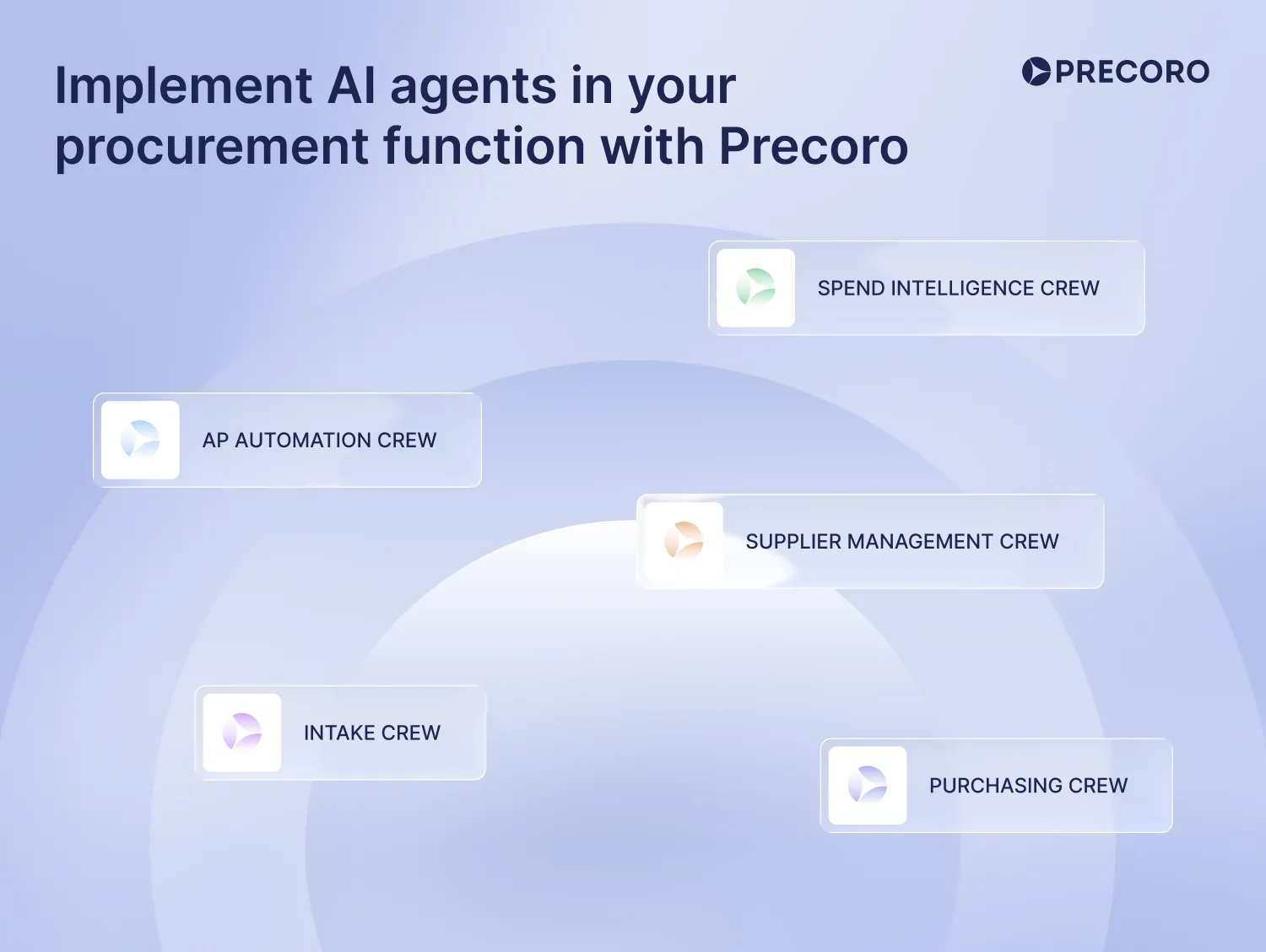
Intake Crew
You control spend the moment an employee submits a purchase request (PR), not when an invoice arrives.
Here's what makes that possible:
- Intake Agent matches a plain-language request to your catalog, contracts, policy, and best price on its own.—Coming soon.
- Quote Processing turns an uploaded supplier quote into a structured requisition draft.
Whether you simply typed the request into Slack or the supplier sent a quote, every PR is automatically compliant and priced accordingly.
Purchasing Crew
Save your team hours of manual purchasing work. POs are built, consolidated, and routed automatically, with people stepping in only when their judgment is needed.
Two components of the Crew are already available, while agents are on the way:
- Approval Agent clears routine requisitions and escalates only the exceptions that need your judgment.—Coming soon.
- Purchasing Agent consolidates approved requests into one PO and verifies pricing and supplier details before submitting.—Coming soon.
- PO Processing extracts PO data and builds a structured order in Precoro.
- Receipt Processing converts an incoming file into a receipt linked to the right PO and line items.
With both agents and processing capabilities combined, your team spends less time processing orders and more time on sourcing and negotiation.
AP Automation Crew
Your team handles more invoices in less time, with early discounts captured before they expire.
Here’s what AP Automation Crew runs on:
- AI Agent for Invoice Extraction captures non-standard bills and converts them into one consistent format, ready for matching.
- Invoice Processing pulls data from an emailed or uploaded invoice and creates a pre-filled draft.
- Matching Agent finds the right PO match even when some details don’t completely align.
- Payment Agent times and batches outgoing payments to capture early discounts and favorable terms.—Coming soon.
- Expense Processing fills in expense fields automatically from a receipt photo or file.
- Credit Note Processing extracts credit note data and drafts it against the original invoice.
An invoice lands in an inbox, and the system reads, matches it to the right PO automatically, and pays it on schedule. Your team only steps in for exceptions.
Supplier Management Crew
Stay ahead of renewals and contract obligations. The Crew ensures your team buys within terms and identifies supplier risks before they cost you.
Here’s what powers it:
- Contract Agent extracts key terms from an uploaded agreement, summarizes the contract, and answers direct questions with the source cited.
- Supplier Analysis via AI Assistant scores supplier reliability and pricing consistency, and tracks delivery timing.
Procurement teams can prepare for renewal negotiations with the relevant contract and supplier information already summarized.
Spend Intelligence Crew
Get instant answers to your questions based on your spend data.
The Crew runs entirely on AI Assistant capabilities:
- Spend Analysis shows a breakdown of spend by department or vendor.
- Bottleneck Detection points to the exact step holding up the process.
- Spend Forecasting provides an overview of cash flow and any budget or vendor risks.
- Risk Insights flags duplicates or mismatches before the issue affects the process.
As soon as you ask, Precoro delivers in-depth insights into risks, bottlenecks, and predictions for your spend.
More agentic capabilities and other features are on the way. See them on Precoro's open product roadmap, upvote what matters to your workflow, or submit a request of your own.
FAQ about AI agents
Yes. Agents can also support sourcing tasks, such as drafting supplier proposals and comparing category strategies. They can handle smaller, fragmented purchases that teams often don't prioritize. With agents, procurement teams have more time to focus on supplier negotiations and long-term sourcing decisions that require human judgment.
AI agents detect supply disruptions in real time and resolve lower-risk issues, such as rerouting shipments or adjusting inventory, without human input. Higher-risk decisions, such as replacing a supplier, still require human approval. This approach helps teams respond faster to routine issues while keeping people responsible for decisions with greater impact.
AI agents support procurement professionals rather than replace them. By handling routine tasks such as purchase order processing and invoice matching, agents give procurement teams more time for work that requires human judgment, including supplier negotiations and risk management. The teams that get the most value from agents keep people involved to review and guide decisions, rather than allowing the system to operate without oversight.
Give your procurement team back its time
See what AI agents can do for your procurement process—book a demo with Precoro.