36 min read
Machine Learning in Procurement: Proven Strategies and Use Cases
Discover how machine learning is revolutionizing procurement and explore practical strategies to use it for savings and better resource allocation.

Machine learning (ML) is revolutionizing procurement by shifting organizations from reactive operations to strategic intelligence. This guide explores how ML automates classification, forecasts demand, assesses supplier risk, and detects fraud. It also covers practical implementation strategies and data requirements that help procurement teams achieve savings while freeing resources for strategic work.
Scroll down to find out:
Introduction to machine learning in procurement
Understanding the benefits of using ML in procurement
Machine learning models used in procurement
Applying ML for procurement optimization
Practical applications of AI and machine learning in procurement
Key performance indicators to measure ML procurement success
Open source vs. proprietary tools for procurement ML
How Precoro supports machine learning in procurement
Future trends of AI and machine learning in procurement
Key takeaways
Frequently asked questions
Introduction to machine learning in procurement
Machine learning transforms procurement from reactive task management to a strategic function. ML capabilities span basic automation to advanced predictive analytics that forecast demand and identify cost reduction opportunities.
How machine learning enhances modern procurement systems
Machine learning analyzes historical procurement data patterns in order to inform future decisions. The technology can be separated into four core capabilities:
- Automated classification
- Predictive forecasting
- Intelligent recommendations
- Anomaly detection
Traditional systems execute fixed instructions. ML systems improve as they process more data. ML is tasked with invoice categorization en masse, as well as demand fluctuation predictions and the flagging of unusual spending situations.
The technology processes procurement data (purchase orders (POs), invoices, supplier records) to identify correlations humans can’t detect at scale. Then, it applies insights automatically.
Where machine learning fits in the procurement workflow
Machine learning improves upon human decision-making using five stages of procurement:
- Strategic sourcing uses supplier discovery, risk assessment, and spend analysis.
- Tactical procurement applies ML to classify requisitions, route approvals, and monitor budgets.
- Transactional processing uses ML for invoice matching, fraud detection, and payment optimization.
- Supplier management applies ML for performance monitoring, relationship scoring, and compliance tracking.
- Analysis uses ML for spend analytics, demand forecasting, and opportunity identification.
Organizations implement ML incrementally: first, they select one stage, then validate results, and expand to other areas.
Understanding the benefits of using ML in procurement
Machine learning offers operational, financial, and strategic benefits that extend well beyond simple automation. The technology delivers measurable improvements in efficiency, accuracy, and decision quality across procurement functions.
To understand these benefits fully, let’s examine three interconnected areas: how ML reduces manual work and errors, how it compares to traditional procurement methods, and what cost savings organizations can actually achieve. The following sections detail specific value propositions that organizations realize when implementing ML systems in procurement workflows.
How machine learning reduces manual work and gets rid of spreadsheet errors
Procurement teams often spend a large portion of their time purely on data entry, classification, and reconciliation tasks. Manual spreadsheet management is the primary reason for version control issues, formula errors, and inconsistent categorization that compounds across departments.
Machine learning tackles these inefficiencies through automated data processes:
- Spend classification systems process thousands of line items in minutes.
- Data normalization algorithms standardize vendor names across systems.
- Duplicate detection identifies redundant entries automatically.
- Validation rules flag anomalies for review.
The impact on productivity is substantial. A procurement team manually categorizing 10,000 monthly transactions might spend 80 hours on the task, while ML would reduce this workload to 10 hours spent reviewing exceptions.
Error reduction offers an equally compelling advantage. ML classification consistency has shown the capability to achieve a very high accuracy rate compared to the average human error rate when it comes to manual data entry. The technology is also processing structured data without fatigue and maintains consistent logic across millions of transactions while flagging uncertain classifications for human review. This way, low-confidence decisions are filtered out early.
Machine learning vs. traditional procurement methods
Understanding ML’s value requires comparing it with traditional approaches. Traditional procurement relies on rule-based systems with fixed logic, manual data analysis, reactive problem-solving, and periodic review cycles. These methods struggle when volume and complexity increase.
ML-powered procurement operates differently. It employs pattern recognition and predictive modeling, continuous analysis, proactive risk identification, dynamic vendor assessments, and instant insights paired with automated alerts.
The contrast becomes clear across four dimensions:
- Scalability — Traditional methods break down with volume; ML scales to millions of records.
- Adaptability — Rules remain static; ML learns automatically from new data.
- Speed — Manual analysis takes days; ML provides instant insights.
- Complexity — Traditional methods handle simple logic; ML processes multifaceted relationships.
The most effective procurement strategies combine ML automation with human expertise for decisions requiring contextual judgment and nuanced understanding.
What cost savings can ML offer in procurement?
The efficiency gains from ML translate into measurable financial returns. Machine learning delivers cost savings through both direct and indirect channels.
Direct savings appear as a result of:
- better pricing via predictive market analysis
- supplier consolidation opportunities
- reduced maverick spending through automated compliance
- optimization of early payment discounts
Indirect savings amplify these direct benefits through labor cost reduction, improved working capital management, reduced stockouts and rush orders. They also lower fraud losses as anomaly detection catches issues early.
A hypothetical implementation example illustrates the potential: an organization with $100M annual spend implementing ML for spend classification, demand forecasting, and supplier risk management might realize $3-7M in direct savings. It could also achieve 40% reduction in administrative workload. Organizations typically recover initial investment within 6-18 months.
These figures represent potential results based on industry implementations. Actual savings vary based on procurement maturity, data availability, and the specific use cases selected.
Machine learning models used in procurement
Procurement applications rely on four primary ML model categories, each suited for specific types of problems. Understanding these models helps organizations choose the right technical approaches for their procurement challenges.
Most procurement ML applications rely on supervised learning, meaning that the systems are trained on historical data with known outcomes. The following sections go over each model type using practical applications that demonstrate how these algorithms aim to solve real procurement problems.
Classification models for supplier risk detection
Classification models represent supervised learning systems that categorize data into predefined classes. These models train on historical examples with known outcomes, learning which patterns correspond to specific categories. Common algorithms include:
- Decision Trees
- Random Forests
- Logistic Regression
- Support Vector Machines (SVM)
The output combines a probability score with a classification label, which allows systems to express confidence levels.
Risk assessment is inherently categorical — suppliers and vendors fall into high, medium, or low risk categories. Classification models excel at this task because they can weigh and combine multiple risk indicators. They not only process both quantitative data, such as financial metrics, and qualitative data, such as news sentiment, but also improve accuracy as more supplier outcomes are observed.
Practical application: Consider a company managing 500 suppliers that wants to proactively identify financial instability risk. The training data includes historical supplier information, such as payment terms, delivery performance, and quality issues, as well as financial indicators covering credit scores and revenue trends. It also incorporates external signals, such as industry trends and news mentions, as well as known outcomes showing which suppliers failed or caused disruptions in the past.
During model training, the algorithm learns which combinations of factors preceded supplier issues. Example pattern: suppliers with declining revenue combined with late deliveries and negative news coverage demonstrate 70% probability of disruption within six months. In production, new suppliers are automatically scored based on their profile. Risk scores update as new data arrives, such as monthly financials or delivery metrics. Alerts trigger when a supplier moves into a higher risk category.
Organizations implementing classification models for supplier risk typically identify at-risk suppliers several months before issues manifest. They dramatically reduce the number of emergency sourcing situations, enabling proactive relationship management with struggling suppliers before relationships deteriorate.
Regression models for cost and demand forecasting
Regression models represent supervised learning systems that predict continuous numerical values rather than categories. These models learn relationships between input variables and outcomes, producing specific numerical predictions with confidence intervals. Common algorithms include Linear Regression, Polynomial Regression, Ridge and Lasso Regression, and Gradient Boosting.
Procurement planning requires numerical predictions for costs, quantities, and timing. Regression models handle this effectively, as they capture complex relationships between multiple factors, account for seasonal patterns, and provide probability ranges rather than single-point estimates.
Practical application for demand forecasting: Consider a manufacturing company predicting raw material needs for the next quarter. Training data includes historical consumption patterns covering 3–5 years of purchase orders, production schedules, and seasonal factors. It also incorporates leading indicators, including sales forecasts, and external factors, such as economic indicators.
During training, the algorithm identifies which factors correlate with demand changes. It learns seasonal patterns, such as “Q4 demand typically runs 20% higher,” and recognizes leading indicators — for example, new contracts predict demand spikes about two months in advance.
In production, the system generates rolling forecasts with weekly updates. Predictions include confidence intervals such as “10,000 units needed, plus or minus 15 percent.” Organizations implementing demand forecasting models reduce stockouts, decrease emergency purchases, and improve inventory turns.
Cost forecasting application: Models predict future commodity prices based on historical prices, currency rates, and supply indicators. Example: a model that predicts steel prices rising by 12% in Q2 prompts procurement to accelerate purchasing decisions.
Implementation requires clean historical data covering a minimum of two years, though 3–5 years produces better results. Models need retraining quarterly to adapt to changing conditions.
Recommendation models for smart supplier selection
Recommendation models represent ML systems that suggest the best options from many alternatives. Two main approaches exist:
- Collaborative filtering, which bases recommendations on similar users or situations
- Content-based filtering, which focuses on attribute matching
Hybrid models combine both approaches for superior results. Common implementations use Matrix Factorization, Neural Collaborative Filtering, and Content-Based Filtering algorithms.
Procurement involves choosing among hundreds of potential suppliers for each purchase category. Decision criteria span price, quality, reliability, payment terms, capacity, and location. Historical purchasing patterns contain implicit ratings — repeat orders signal satisfaction while avoided suppliers indicate problems. The models surface non-obvious alternatives that match specific need profiles and reduce reliance on limited buyer knowledge or cognitive biases.
Practical application: Consider a procurement analyst sourcing specialized components for a new project. The system analyzes historical patterns to determine which suppliers were selected for similar purchases and outcomes and examines buyer behavior to identify which vendors other teams chose for similar requirements. It also evaluates supplier attributes, including capabilities, certifications, pricing tiers, lead times, and quality ratings.
For example, the user inputs requirements: “Need 5,000 units of specified component, delivery in 6 weeks, quality certification required.” The model scores all potential suppliers and presents a ranked list with explanations:
- Supplier A scores 92, driven by peer selection and excellent delivery performance, but costs 5% more.
- Supplier B scores 88 with the best pricing but typically requires 8–week lead times.
- Supplier C scores 85 as an emerging supplier with limited history but strong certifications.
Organizations that use recommendation systems discover qualified suppliers that regular buyers might not even know about, massively reduce supplier evaluation time, standardize selection, and improve decision quality.
Advanced features let the system automatically filter suppliers by must-have requirements, balance multiple goals like cost, speed, and sustainability, and improve recommendations over time based on buyer feedback.
Implementation requires a rich supplier database with attributes and historical performance data. Effectiveness improves substantially, as more transaction history becomes available.
Anomaly detection for fraud and non-compliant spend
Anomaly detection represents ML systems that identify unusual patterns that deviate from normal behavior. Models can be supervised (trained on known fraud examples) or unsupervised (finding outliers without labeled data). Common algorithms include Isolation Forest, One-Class SVM, Autoencoders, and z-score analysis. Output includes an anomaly score with flagged transactions for human review.
Fraudulent and non-compliant transactions are extremely rare. However, fraud patterns evolve continuously, causing rule-based systems to become outdated. ML systems process 100% of transactions in real time to detect both known fraud patterns and novel anomalies.
Common procurement fraud patterns that ML detects include:
- Split orders where a single large purchase is divided into smaller transactions to avoid approval thresholds
- Ghost suppliers involving payments to vendors with no delivery history
- Duplicate invoices submitted multiple times with slight variations
- Price manipulation showing prices significantly above market rates
- Phantom employees creating purchase orders using terminated user credentials
- Round number fraud with suspiciously round amounts, like exactly $5,000
The detection methodology involves learning normal transaction patterns for each category, supplier, and requester. Analysis considers transaction amount, timing, approver identity, vendor relations history, and item description simultaneously. Anomalies receive scores that indicate either high risk, which requires immediate investigation, or low risk, which represents legitimate exceptions.
Policy compliance detection flags tail spend, off-contract purchases, and non-approved suppliers before they lead to contract breaches or budget overruns.
Practical workflow: Transactions are scored in real time. High anomaly scores trigger auto-flagging and notifications, such as “This purchase is 3.2 standard deviations above normal for this category and requester.” Teams then investigate the flagged transactions, approve or reject them, and provide feedback to improve future scoring.
Organizations implementing anomaly detection systems detect fraud cases much more frequently compared to the results of manual auditing. They safeguard a portion of total spend that would’ve been lost to fraud or waste while achieving a significant reduction in policy violations.
Getting the system up and running usually takes a few months of transaction data to establish the baseline normal behavior. At first, it may flag a lot of false positives, but accuracy improves quickly as the system learns and is fine-tuned.
Applying ML for procurement optimization
Understanding ML models is the first step toward effective implementation. Successful deployment demands strategic planning to address the topics of data requirements, organizational readiness, and change management. The following sections cover the strategic perspectives relevant to chief procurement officers, as well as tactical considerations for procurement analysts. The guidance can be applied to organizations of all sizes with different resource levels.
What data is required for machine learning in procurement?
Machine learning systems require three core data categories to function effectively.
Transactional data forms the foundation, including purchase orders with items, quantities, prices, dates, and requesters. Invoices provide amounts, payment terms, and dates. Requisitions capture approval workflows and timing. Payment records document dates, methods, and discounts. A minimum of two years of historical data is needed, though 3–5 years produce better results.
Supplier and vendor data represents the second category. Supplier master data includes names, addresses, categories, and contacts. Performance metrics track delivery times, quality scores, and responsiveness. Contract terms document pricing, volumes, and expiration dates. Risk indicators assess financial health and certifications.
Catalog and item data completes the core requirements. Product and service descriptions allow categorization. Category classifications enable spend analysis. Unit of measure and specifications support demand forecasting.
Data quality requirements establish minimum thresholds for ML effectiveness:
- Completeness: Core fields populated for at least 80% of transactions
- Accuracy: Normalized supplier names instead of multiple variations (like 15 versions of “ABC Corp”)
- Consistency: Standardized formats for dates, currencies, and classifications
- Timeliness: Regular updates with daily or weekly feeds for transactional data
- Accessibility: Data extractable from source systems
Perfect data is not required to start — ML can help improve data quality over time — but systems need baseline threshold quality.
External data sources represent optional but valuable additions. Market indices and commodity prices enhance cost forecasting. Supplier financial data or credit reports can improve risk assessment, while news and sentiment data provide early warnings. These external sources contribute to the improvement of total model accuracy.
Organizations should audit current data availability before selecting ML use cases. Start with applications that match available data quality. Implement data governance processes alongside ML initiatives.
Machine learning for CPO procurement strategy
Chief procurement officers face pressure to deliver greater value with constrained resources. Machine learning enables a shift from operational efficiency to strategic value creation. Organizations with mature ML capabilities regularly achieve better procurement outcomes.
The strategic framework begins with defining objectives before selecting technology. CPOs should identify the top three procurement challenges — cost reduction, risk management, or supplier innovation — with measurable KPIs.
Prioritizing ML use cases by strategic impact determines resource allocation. High-impact and feasible use cases include spend classification, demand forecasting, and supplier risk assessment. Quick wins include anomaly detection and invoice matching.
Building organizational capabilities requires an assessment of internal data science skills versus vendor solutions. Invest in data infrastructure as the foundation. Then, create cross-functional teams combining procurement, IT, and analytics. Finally, establish governance for model ownership and decision-making.
Managing stakeholder expectations prevents disappointment. ML requires data, time, and iteration. Start with pilots, demonstrate ROI, then scale.
Balance innovation with risk by addressing ethical considerations such as bias. Transparency ensures teams can explain ML-driven decisions. Human-in-the-loop processes maintain oversight.
Measure success by tracking efficiency metrics such as time saved and costs reduced, plus strategic metrics including supplier innovation. Monitor adoption rates and assess the quality of insights.
CPOs should champion ML as a strategic initiative rather than an IT project. Allocate a specific budget — typically 12–15% of procurement budget — for digital transformation.
How to use machine learning for supplier risk assessment
Traditional risk assessment relies on annual supplier audits, manual scorecards, and reactive problem-solving. Machine learning enables continuous monitoring, predictive early warnings, and automated data integration from multiple sources that humans cannot track manually.
ML systems assess four primary risk categories:
- Financial risk includes credit score changes, payment delinquencies, and revenue trends from credit bureaus.
- Operational risk covers delivery performance degradation, quality issues, and capacity constraints.
- Compliance risk identifies certification expirations, regulatory violations, and geographic risks.
- Reputational risk analyzes negative news sentiment, covering labor issues and environmental violations.
Implementation proceeds through four phases:
Phase 1 integrates internal data, covering delivery, quality, and payment from ERP systems, plus external feeds such as credit scores and news databases, with two years of historical data.
Phase 2 develops risk scoring by defining tiers — critical, high, medium, low — and training the classification model on historical supplier issues.
Phase 3 establishes continuous monitoring with automated updates, alerts when suppliers move to higher risk tiers, and dashboards showing exposure.
Phase 4 creates action workflows, including mitigation plans for high-risk suppliers, diversification strategies for critical dependencies, and relationship manager notifications.
Organizations implementing ML for supplier risk assessment gain significant advantages. They reduce supply disruptions and identify at-risk suppliers several months earlier than with manual methods. ML also supports supplier negotiations or terminations and strengthens supply chain planning by revealing potential vulnerabilities.
How to use machine learning in procurement for a small business
Small businesses often believe ML is only for large enterprises with substantial budgets and dedicated data science teams. Cloud-based tools and procurement platforms with embedded ML make the technology accessible to small- and medium-sized businesses through high-impact, low-complexity use cases.
SMB-appropriate ML applications include automated spend classification, which provides the most immediate ROI by reducing manual data entry from hours to minutes. Duplicate invoice detection prevents payment errors without hiring additional accounts payable staff.
Meanwhile, budget monitoring alerts provide predictive warnings before overruns occur. Supplier performance tracking automates scoring based on delivery times and quality metrics, which is particularly valuable when small teams cannot manually track all vendors.
Start with procurement software that has built-in ML features, such as Precoro or similar platforms. Organizations don’t need to hire data scientists — vendor-embedded ML provides capabilities without requiring technical expertise. Start with one use case, prove value through measurable results, then expand.
Success factors include choosing software with intuitive ML that requires no coding and ensuring integration with existing systems, such as accounting tools or ERPs. Focus on time savings rather than just cost savings, because small teams are capacity-constrained.

What steps should organizations take to integrate AI?
Organizations should follow a six-step roadmap to integrate AI in finance and procurement.
Step 1 assesses the current state through a data availability and quality audit, a review of procurement processes and pain points, and a benchmarking of procurement maturity.
Step 2 defines objectives by selecting 1–2 initial use cases with clear ROI. Set measurable success criteria, such as time saved or cost reduced, and determine whether to build or buy a system. Then, establish realistic timelines with pilot phases lasting 3–6 months.
Step 3 secures stakeholder buy-in through building business cases with projected ROI. Identify an executive sponsor, such as CPO, CFO, or CIO. Address common concerns, including job displacement, privacy, and cost. Create cross-functional teams and allocate budgets for software, consulting, and training.
Step 4 prepares data infrastructure with governance policies, cleaned data, established pipelines, and quality checks. This stage may require investment in a data warehouse or integration tools.
Step 5 pilots on a limited scope, such as one category or region. Validate model accuracy before deployment. Gather feedback, refine processes, document learnings, and adjust models based on performance.
Step 6 scales by expanding to additional categories and use cases. Train broader teams, integrate insights into workflows, establish maintenance schedules, and monitor performance continuously.
How can data quality impact AI implementation?
ML models detect patterns in historical data, so data quality forms the foundation of successful implementation. Common data issues include incomplete records (when many transactions lack categories), inconsistent data (the same supplier appears 15 different ways), inaccurate classifications, and systemic bias embedded in past decisions.
Low data quality causes the following:
- Inaccurate predictions (forecasts miss dramatically)
- Failed model training (models cannot learn from noisy data)
- Low user trust (teams stop using obviously wrong results)
- Wasted investment (most of the effort goes to data cleaning)
High data quality delivers a substantial improvement to accuracy, faster time to value, higher user adoption, and better ROI.
Four improvement strategies:
- Establish data governance by assigning ownership, defining standards, and implementing validation rules to prevent bad data entry.
- Adopt gradual improvement — use ML to clean data through fuzzy matching, prioritize cleaning for initial use cases, and implement ongoing monitoring.
- Leverage technology, including data quality tools, master data management systems, and procurement platforms with built-in validation.
- Drive cultural change by training teams, rewarding good behaviors, and demonstrating how clean data enables better insights.
Data quality is not a one-time project but an ongoing discipline. Organizations with strong data governance tend to achieve better ML outcomes. Invest in data quality infrastructure before or alongside ML implementation.
What role do change management and training play?
Machine learning represents a fundamental shift in how procurement operates. Common resistance includes concerns that ”AI will replace my job,” distrust of ”black box decisions,” and feelings that ”this is too complex.” Research shows 73% of digital transformation projects fail due to people issues rather than technology problems. Without change management, even the best ML tools are useless.
Key change management strategies begin with communicating early and often. It is important to explain why ML is implemented to begin with. Emphasize ML’s focus on repetitive tasks, share various success stories, and be transparent about potential issues.
Try to involve the procurement team in the process by soliciting their input in terms of pain points. Include end-users in pilot tests, appoint champions to advocate adoption, and gather feedback for iteration.
Manage expectations realistically. ML requires a learning curve, and early predictions may need validation. Emphasize that humans remain critical for judgment and frame ML as an augmentation rather than a replacement.
Training requirements vary by role. Procurement teams require instruction on ML outputs, decision-making between ML and human judgment, feedback, basic concepts, and workflows. Leadership needs to understand capabilities and limitations, vendor claims evaluations, and governance. Technical teams need model maintenance, pipeline management, and integration knowledge.
Success depends on dedicated training time (10–20 hours per user), ongoing support, celebrating wins, and tracking adoption metrics.
Practical applications of AI and machine learning in procurement
Previous sections covered ML models and implementation considerations. The following sections detail specific, actionable use cases with real-world application context. Each use case demonstrates how organizations apply ML to solve concrete procurement challenges. Organizations typically start with 2–3 use cases and expand over time as capabilities mature and confidence builds.
What are the most common use cases for AI in procurement?
The top 10 ML use cases by adoption rate demonstrate where organizations find the most value.
Spend classification and categorization represents the most common starting point — most of the organizations with ML begin here. Supplier risk monitoring offers continuous assessment of the financial and operational health of the supplier. Demand forecasting predicts future procurement needs in order to reduce stockouts and excess inventory.
Fraud and anomaly detection identifies suspicious transactions using automated compliance monitoring. Invoice processing and matching connects invoices to POs automatically and accelerates the accounts payable (AP) cycle.
Contract analysis uses NLP to extract key terms and alert on renewals. Supplier performance scoring creates automated vendor scorecards based on delivery, quality, and pricing. Price optimization predicts optimal purchase timing and identifies negotiation opportunities. Sourcing recommendations suggest suppliers for new purchases. Budget monitoring and forecasting predicts budget consumption and alerts on overruns.
Organizations choose use cases based on four criteria:
- Data availability: Does historical data exist for this process?
- Impact potential: What is the ROI through time and cost savings?
- Complexity: Can you start simple and expand?
- Pain points: Where does the team spend most time?
Most organizations prioritize spend classification plus one strategic use case, such as risk monitoring or forecasting.
How machine learning automates invoice matching and fraud detection
Traditional invoice reconciliation presents significant challenges. AP teams manually match invoices to POs and process hundreds (sometimes thousands) of documents monthly. The process is error-prone with missed discrepancies and duplicate payments — approximately 31% of invoices require manual review.
ML-powered invoice matching transforms this process. Algorithms extract data from invoices using OCR and NLP, then auto-match invoice fields to purchase order data, including amounts, quantities, dates, and line items. Fuzzy matching handles variations where an invoice says “ABC Corp” but the PO says “ABC Corporation.” Confidence scoring determines routing — high confidence triggers auto-approval, while low confidence flags items for review.
The fraud detection layer identifies suspicious patterns:
- Duplicate invoices with the same amount and vendor but different invoice numbers
- Price discrepancies where invoice amounts exceed PO prices significantly
- Invoices from non-approved suppliers
- Round number anomalies, such as invoices for exactly $10,000
Organizations achieve substantial reduction in manual processing time. Automatic matching rates reach 90% or more, compared to traditional optical character recognition. Fraud detection catches 90–97% of problematic invoices. Additionally, payment cycles are reduced to 3–5 days, improving supplier relationships.
Implementation requires invoice digitization through a scanner or email integration. ML accuracy improves as systems learn vendor patterns.
How can I use Python libraries for procurement spend analysis?
Python is free, open-source, and the most popular language for data analysis and ML. Mature libraries handle complex ML tasks, though implementation requires programming knowledge or data science support.
Core Python libraries serve distinct procurement ML functions:
- Pandas handles data manipulation, loading spend data from Excel, CSV, or databases, then cleaning, filtering, and aggregating transactions.
- Scikit-learn provides pre-built ML algorithms for classification, regression, clustering, and anomaly detection — users can train supplier risk classification models in 20 lines of code.
- NumPy provides efficient mathematical operations as the foundation for other libraries.
- Matplotlib and Seaborn create charts to explore spending patterns and visualize ML model results.
- NLTK and spaCy process text fields, including supplier names, item descriptions, and contract clauses.
- Prophet, developed by Facebook, specializes in time series forecasting and excels at demand and spend forecasting with seasonal patterns.
The following five-stage workflow demonstrates automated spend classification using scikit-learn:
- Data preparation: Export spend data, including transaction date, amount, vendor, description, and current category. Load into Pandas DataFrame and clean text fields by removing special characters and standardizing formats.
- Feature engineering: Convert text descriptions to numerical features using TF-IDF (term frequency-inverse document frequency). Include other features such as vendor, amount range, and department.
- Train classification model: Split data as 80% for training and 20% for testing. Train a Random Forest classifier on historical correctly categorized purchases. The model learns patterns such as ”Transactions with words like laptop, computer, hardware plus tech vendors belong in IT Equipment category.”
- Evaluate accuracy: Test model on 20% holdout data. Check the accuracy score and review misclassifications to identify improvements.
- Deploy for new transactions: Load uncategorized purchases. Model predicts category plus confidence score. Auto-categorize high-confidence predictions and flag low-confidence items for manual review.
If your team lacks Python skills, consider alternatives, including procurement software with built-in ML, such as Precoro or Coupa, or no-code ML platforms, like Google AutoML or Microsoft Azure ML Studio. You could also hire consultants for initial setup or train teams through online courses.
To get started, explore free resources, such as Python courses on Coursera, DataCamp, and Kaggle. Procurement-specific datasets for practice are available on Kaggle. Start simple with spend classification before advanced forecasting. Expect a learning curve to span at least several months for analysts new to Python.
How can predictive analytics transform procurement strategies?
Predictive analytics uses historical data and ML models to anticipate future outcomes. Therefore, predictive procurement has the ability to anticipate needs, risks, and opportunities before they arise. Such capabilities create a solid foundation for procurement to transition from a cost center to a strategic value driver.
Key predictive applications include:
- Demand prediction: Forecasts material needs several months ahead for better inventory management and reduced rush orders. Example: “Model predicts 15% increase in component demand next quarter.”
- Price forecasting: Predicts commodity price movements for optimal purchase timing. Example: “Steel prices expected to drop 8% in 60 days — delay purchases.”
- Supplier disruption prediction: Forecasts which suppliers face financial troubles, enabling proactive mitigation. Example: “Supplier X shows 70% probability of cash flow problems within 90 days.”
- Spend forecasting: Predicts future spend by category for accurate budgeting. Example: “Marketing predicted to exceed Q4 budget by 12%.”
- Contract opportunity identification: Predicts which expiring contracts offer the best renegotiation opportunities. Example: “Logistics renewal forecasted to yield 8–12% savings.”
Implementation begins with one use case aligned with a strategic priority. Predictive procurement requires multiple years of high-quality historical data. Validate predictions, integrate into planning processes, and use data as input to human decision-making.
Machine learning for spend classification and category mapping
Large organizations process millions of transactions annually, each requiring category assignment for reporting, analysis, and sourcing. Manual classification proves inconsistent, as different people categorize the same item differently. It’s also time-consuming and difficult to scale. Poor classification creates hidden spend, missed savings opportunities, and inaccurate reporting.
ML solves this through supervised learning. During training, the algorithm learns from historical transactions that have been correctly categorized. Pattern recognition identifies signals:
- Text descriptions: “laptop” + “computer” → IT Hardware
- Vendor patterns: Staples → Office Supplies
- Amount ranges: $50–500 → Small equipment vs $5000+ → Capital equipment
- General ledger (GL) codes and cost centers: GL 5400 + Marketing Dept → Advertising Spend
In production, new transactions receive auto-classification with confidence scores. High confidence (above 90%) triggers auto-approval. Medium confidence (70–90%) results in auto-classification with periodic review. Low confidence transactions (below 70%) go to category experts. The model learns from corrections and improves over time.
Automated classification transforms procurement by replacing subjective, manual effort with consistent, high-accuracy results. This shift to real-time processing does more than just save time; it provides the immediate spend transparency necessary to move from reactive tracking to proactive, strategic sourcing.
Implementation requires a well-defined category taxonomy, such as UNSPSC or custom hierarchy. Training data needs a minimum of 10,000 transactions with correct categories. More complex taxonomies with 100+ categories require even more data. Plan for ongoing model maintenance as categories evolve.
How does ML support real-time budget monitoring?
Traditional budget monitoring lags: month-end close reveals overages after they occur, and reactive approaches discover problems too late to course-correct.
ML-enabled proactive monitoring offers real-time tracking. ML processes transactions continuously and provides instant visibility of current spend versus budget for every department, category, and project.
Predictive budget alerts use regression models to forecast consumption based on the current run rate. Early warnings emerge, such as ”IT department tracking to exceed annual budget by 18% based on Q1 patterns.” Alerts surface several months before actual overages, considering seasonality.
Anomaly detection flags unusual spending spikes — ”Facilities spending up 200% this week” — while distinguishing legitimate variation from problems.
Intelligent recommendations suggest corrective actions and identify optimization opportunities based on historical patterns.
Business benefits include:
- Preventing budget overruns before they happen
- Enabling proactive adjustments
- Improving forecasting accuracy
- Decreasing emergency requests
- Aligning finance and procurement on real-time data
Specialized systems offer dashboards showing budget health, automated alerts via email or Slack, mobile access for approvers, and no manual report generation.
What innovations are emerging in supplier selection and evaluation?
Traditional supplier scorecards rely on static manual quarterly ratings. Emerging approaches use dynamic, ML-powered continuous supplier intelligence to shift from backward-looking ratings to predictive capability assessments.
ML-powered innovations include:
- Predictive supplier performance scoring: Models predict future performance based on leading indicators. Example: “Supplier capacity metrics indicate a potential bottleneck — delivery risk expected to increase 40% next quarter.”
- Automated ESG and sustainability assessment: NLP scans news, reports, and certifications for ESG compliance. Instead of annual audits, continuous monitoring scores suppliers on carbon footprint, labor practices, and diversity.
- Network intelligence: ML analyzes supplier ecosystems to identify risks and map hidden dependencies. Example: “Your tier-1 supplier relies heavily on tier-2 suppliers facing financial distress.”
- Cognitive sourcing assistants: Chatbots answer natural language queries like “Find me suppliers for [product] with [specifications] in [region],” replacing complex sourcing tools.
- Blockchain plus ML integration: Supplier credentials are immutable and verified on the blockchain. ML then analyzes the supply chain data for risk signals and automates compliance checks.
- Market intelligence automation: ML monitors market conditions and recommends optimal supplier switching or contract negotiation timing. Example: “Market analysis suggests a 10% cost reduction opportunity for Category X next quarter.”
Basic ML for scorecards is available already. Predictive performance and ESG automation are expected to handle most B2B procurement actions within five years. Organizations should pilot emerging technologies to maintain a competitive advantage.
Using natural language processing (NLP) for invoice analysis
NLP represents a branch of ML focused on understanding human language. Procurement deals with massive unstructured text, including invoices, contracts, and supplier communications. Traditional systems require structured database fields, while NLP extracts structure from unstructured text, enabling automation of document-heavy processes.
Core NLP techniques for procurement include:
- OCR (Optical Character Recognition) — converting images and PDFs to machine-readable text
- Named Entity Recognition (NER) — identifying and extracting key information such as vendor names, amounts, dates, and invoice numbers
- Text classification — categorizing documents by type and routing them to appropriate workflows
- Sentiment analysis — inspecting the tone of supplier communications to identify escalations
- Information extraction — pulling specific data points from lengthy documents
Traditional invoice processing relies on manual data entry, which requires 10+ minutes per invoice and has a 5–10% error rate due to typos and missing fields.
NLP-powered automation transforms this workflow in four steps:
- Document capture processes invoices arriving through email, scanner, or supplier portal using OCR.
- Data extraction uses NER to identify key fields automatically: Vendor,
Invoice #, Date, Amount, and line items with descriptions, quantities, and unit prices. - Validation matches extracted data against POs and contracts, flagging discrepancies like “Invoice amount $3,456.78 vs. PO amount $3,400.00 — $56.78 variance.”
- Auto-approval workflow routes high-confidence matches for payment, while low-confidence or discrepancies go to AP specialists.
Processing time drops from 10+ minutes per invoice to 3 minutes or less. Straight-through processing handles up to 95% of invoices with less than 1% error rate. For organizations processing 10,000 invoices monthly, this saves 1,2002,000 hours.
Advanced NLP applications include:
- Contract analysis that extracts key terms and compares them across suppliers (e.g., “Supplier contract: 90–day payment terms vs. standard 30 days — renegotiate”).
- Supplier communication analysis that identifies escalating issues before they become critical.
- Spend description enrichment that turns vague GL descriptions into detailed, actionable information.
Implementation considerations: NLP accuracy improves with training on your specific documents. It requires thousands of sample invoices for effective training. Cloud-based NLP services from Google Cloud, AWS, and Azure reduce technical barriers.
Key performance indicators to measure ML procurement success
ML investments require ROI justification through measurable outcomes, tracked via KPIs that highlight progress, identify issues, and guide optimization. Different stakeholders focus on different metrics: CFOs prioritize cost savings, while CPOs emphasize strategic value creation.
Efficiency KPIs measure operational improvements:
- Time savings track hours saved on manual tasks.
- Process cycle time measures days from requisition to payment.
- Straight-through processing rate reflects the percentage of transactions that are automated end-to-end.
- Exception rate tracks transactions that require manual intervention.
Financial KPIs quantify economic impact:
- Cost savings measure direct savings from procurement.
- Cost avoidance counts prevented overages and emergency purchases.
- ROI measures the net financial gain of the project relative to the initial investment.
- Working capital improvement monitors the costs of reduced inventory carrying.
Strategic KPIs assess long-term value:
- Risk mitigation counts supplier disruptions avoided.
- Forecast accuracy measures demand and spend prediction.
- Supplier diversity tracks spend with diverse suppliers.
- Sustainability metrics include carbon footprint reduction and ESG score improvement.
- Data quality improvement measures increased completeness and accuracy.
Challenges and risks of implementing ML in procurement
ML offers significant benefits, but implementation also presents challenges. Knowledge of various obstacles helps organizations prepare better and mitigate risks more efficiently. Most challenges here are organizational and process-related, not technical, and working on them proactively increases implementation success rates, while accelerating time to value.
What are the common barriers to ML adoption in procurement?
Organizations face six primary barriers:
- Data challenges represent the most common ones — insufficient historical data (minimum 2–3 years required), poor data quality, and data trapped in legacy systems.
- Organizational resistance includes fear of job displacement and a lack of ML understanding.
- Resource constraints involve budget limitations and a lack of technical skills.
- Integration complexity arises from disconnected systems and legacy platforms lacking APIs.
- Unclear ROI often creates hesitation, as stakeholders struggle to quantify benefits against payback periods that can span several years.
- Vendor landscape confusion stems from too many options and the fear of vendor lock-in.
Mitigation strategies include starting with pilot use cases to prove value and investing in data quality upfront. Organizations should also implement strong change management, secure executive sponsorship, partner with experienced vendors, and set realistic timeline expectations.
How can organizations address privacy and ethical concerns?
Procurement ML presents three key ethical concerns:
- Bias and fairness risks occur when models perpetuate historical biases. To mitigate risk, organizations should audit decisions for bias, track diversity metrics, and provide human review for high-stakes cases.
- Transparency addresses “black box” concerns where users do not understand ML recommendations. Mitigation involves using interpretable models, providing decision explanations, and relying on human oversight for major decisions.
- Data privacy concerns arise because procurement data includes sensitive information. Mitigation requires encryption, access controls, privacy regulation compliance, and vendor security audits.
Best practices include:
- Establishing AI ethics guidelines that define fairness, transparency, and accountability with regular audits
- Implementing human oversight with override capability
- Documenting model operations and including diverse perspectives in implementation
- Continuously monitoring decisions for unintended consequences
Responsible AI is a business asset. It builds the institutional trust necessary to secure the best partnerships and recruit the industry’s best minds.
What should be considered when evaluating AI vendors?
Key evaluation criteria include:
- ML capabilities depth — verify what models are actually implemented beyond vague ”AI-powered” claims. Ask for algorithms, training methods, and accuracy metrics.
- Data requirements determine what the solution requires and whether it works with your data quality and volume.
- Integration covers APIs for ERP and procurement systems and pre-built connectors for common platforms.
- Explainability ensures users see why ML made recommendations and can override decisions.
- Customization determines whether models train on your specific data and configuration options for your workflows.
- Vendor stability assesses financial health, customer support quality, and product roadmap.
- Pricing transparency covers per-user versus per-transaction fees and realistic ROI payback.
Critical questions include “Show me a demo with my data,” “What are your model accuracy rates in production?” “How do you handle bias?” “What if I want to switch vendors?” and “Can I see references from similar organizations?”
Open source vs. proprietary tools for procurement ML
Organizations that want to use ML in procurement need to make a fundamental choice between two completely different options:
- A custom solution made with open-source tools
- A proprietary platform with built-in ML capabilities
This choice affects the overall implementation timeline, as well as project costs, technical requirements, and even strategic outcomes. The optimal path differs depending on a number of factors, including technical maturity, resource availability, and ML objectives.
Open source approach: Build custom ML models using Python, scikit-learn, TensorFlow, and pandas to achieve maximum strategic value. This way, you can create proprietary algorithms competitors cannot replicate, maintain complete control over model logic, and avoid vendor lock-in. Organizations can tailor models precisely to their taxonomy and workflows.
However, the investment necessary is substantial. You need data science talent, infrastructure for training, and multiple months to reach production. 70% of custom ML projects fail due to technical complexity or data quality issues. Models require continuous maintenance: retraining, monitoring, and improvement.
Proprietary platform approach: Platforms like Precoro, Coupa, and SAP Ariba embed ML directly into software. This approach prioritizes speed, as you deploy proven ML in weeks, require no data science expertise, and benefit from continuous vendor improvements with predictable costs and fast ROI.
The tradeoff is standardization. Proprietary ML delivers excellent results for common use cases but offers limited customization. You are constrained by vendor roadmaps, and competitors using the same platform access similar features.
Hybrid strategy: Sophisticated organizations increasingly adopt hybrid approaches. They use proprietary platforms for operational ML (invoice automation, spend classification) and develop custom models for strategic differentiation (proprietary forecasting, unique risk models).
Most organizations should start with proprietary platforms to establish capabilities quickly, then selectively invest in custom models as priorities become clear.
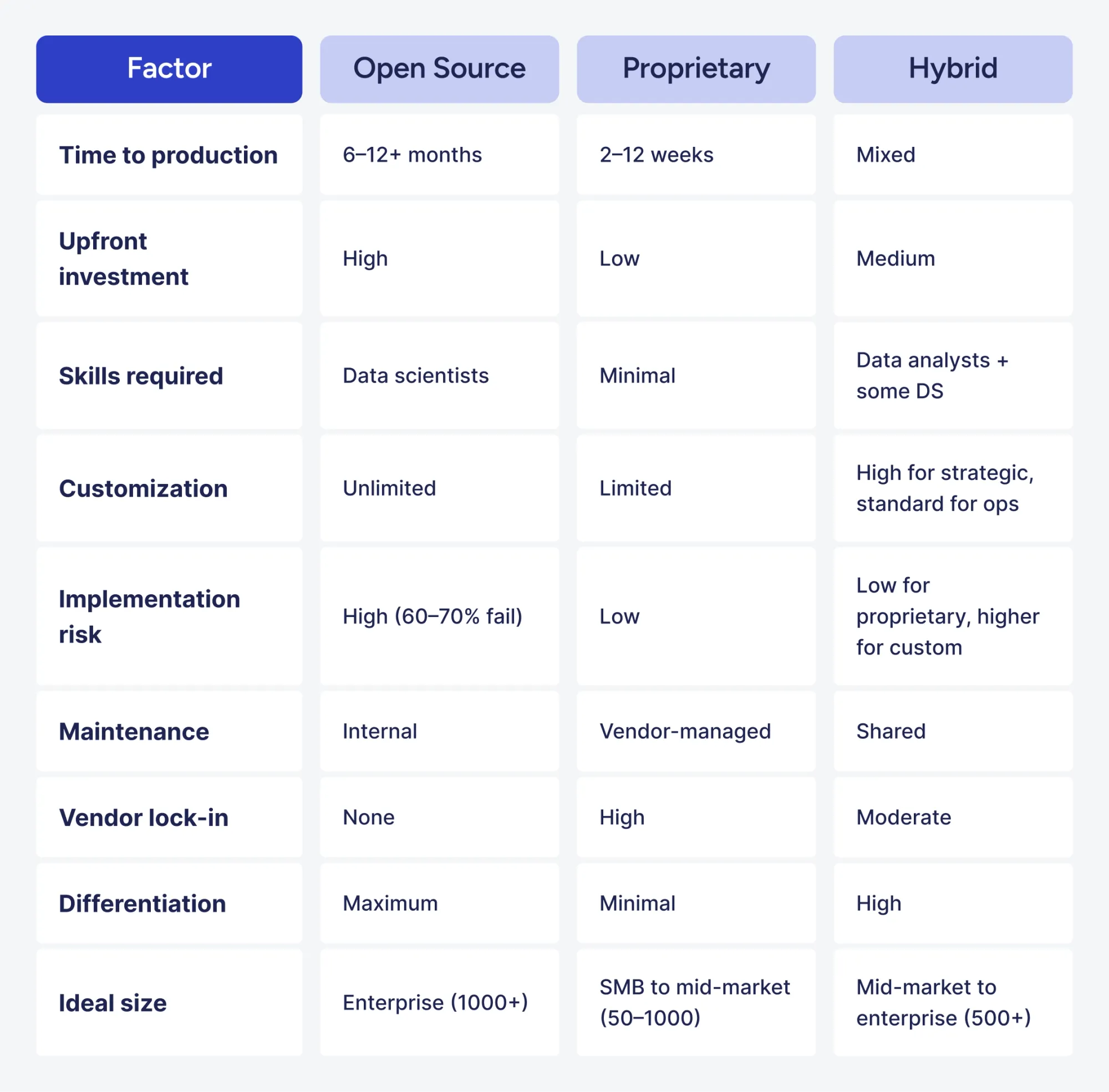
Quick comparison: Key decision factors
The following table summarizes critical factors when choosing your ML approach. Use it to assess which path aligns with your organization’s capabilities and objectives.
When to choose:
- Open source: Suitable if you have a data science team, unique requirements, ML as a differentiator, and a 12–month timeline.
- Proprietary: Best if you lack data science expertise, need results in 3–6 months, and require proven ROI.
- Hybrid: Ideal when you have some technical resources, want quick wins, seek selective differentiation, and have a 3–5 year roadmap.
Recommended: Begin with a proprietary platform to demonstrate value
within 3–6 months. Once ML demonstrates ROI, evaluate which use cases justify custom development.
How Precoro supports machine learning in procurement
Precoro demonstrates how modern procurement platforms integrate ML to solve real operational challenges. Rather than attempting to be all things to all teams, Precoro uses ML for high-impact areas where automation delivers immediate ROI: invoice processing, conversational data analytics, and intelligent workflow automation.
Three pillars of Precoro’s ML approach include:
- Proven ML deployment in invoice automation using Google AI-powered OCR technology.
- Conversational AI for procurement insights via the AI Assistant, enabling natural language queries without technical expertise.
- A robust data foundation for advanced ML, with a centralized procurement data structure and API access for custom model training.
Organizations using Precoro deploy AI-powered invoice capture and automated matching immediately, while the platform’s centralized architecture structures all procurement transactions into ML-ready formats. This foundation scales with your data, evolving from basic automation to advanced capabilities of spend analysis queries, duplicate payment detection, and real-time anomaly identification.
Automated spend classification and budget tracking
Precoro centralizes all procurement transactions in a single platform, providing instant visibility into spending patterns across departments, categories, projects, and locations. Therefore, you don’t have to deal with the fragmented data that prevents ML implementation.
Key features include automated spend aggregation from requisitions, purchase orders, and invoices, as well as real-time dashboards showing budget utilization and spending trends. The platform also offers customizable reporting by any dimension and historical spend data structured for pattern analysis.
Unlike with spreadsheet-based tracking, where data is scattered, Precoro captures every transaction with standardized fields and creates the clean data foundation ML algorithms require.
Precoro's AI Assistant brings predictive capabilities to budget management. Rather than discovering overages at month-end, teams receive proactive alerts when spending patterns indicate future budget risks. The system analyzes historical patterns, seasonal variations, and current spending velocity to generate forecasts. As a result, you can take corrective action before problems occur rather than reacting to budget overruns.
Predictive insights through real-time procurement data
In October 2025, Precoro launched its AI Assistant — a natural language chatbot that transforms how procurement teams interact with data. Instead of building complex reports, users simply ask questions in plain English and receive instant answers.
The AI Assistant requires zero coding knowledge, works out-of-the-box with no setup, and is available to all Precoro users. They can ask questions in natural language, apply filters to narrow analysis, and drill deeper with follow-up questions.
Supported queries include spend analysis (“What did we spend on software last quarter?”), supplier performance (“Which suppliers have the longest delivery times?”), payment management (“Which invoices are overdue?”), and forecasting (“What’s our projected spend next month?”).
The system relies on natural language processing to understand intent, pattern recognition across historical data, predictive analytics for forecasting, and anomaly detection to flag unusual trends. Procurement professionals spend
10–15 hours weekly on reporting — the AI Assistant reduces this to seconds
per query.
Workflow automation without spreadsheets
Many procurement teams rely on Excel spreadsheets for purchase requests, approvals, and budget tracking. As a result, they have to deal with version control chaos, formula errors, no audit trail, and data silos that prevent ML implementation.
Precoro replaces spreadsheets with intelligent, automated workflows, including digital requisitions with structured data fields, automated approval routing, purchase order auto-generation, and complete audit trails.
Precoro’s most advanced ML implementation is invoice automation powered by Google AI technology. OCR scans invoices in any format — PDFs, images, emails — extracting key fields with high accuracy. Processing time is measured in minutes, compared to the multi-day turnaround required for manual entry.
Precoro’s intelligent 3-way matching automatically compares purchase orders, invoices, and receipts to ensure you pay only valid invoices. Additionally, anomaly detection identifies duplicate invoices, price variances, unusual spending patterns, and payments to non-approved vendors.
Organizations using Precoro’s ML-powered invoice processing report 80% reduction in manual AP work, 95%+ straight-through processing rates, and near-elimination of duplicate payments.
Integrations that enable advanced analytics and ML models
ML accuracy improves when combining procurement data with financial records from ERP systems, sales data, supplier intelligence, and inventory levels. Precoro's integration architecture connects procurement with broader business systems.
Precoro offers native integrations with major platforms, including ERP and accounting systems (NetSuite, QuickBooks, Xero), analytics platforms (Power BI), and payment systems (Bill.com). Pre-built integrations reduce implementation from months to weeks.
For organizations with data science capabilities, Precoro provides API access with standard HTTP methods and JSON data exchange for custom ML development.. Use cases include exporting data for model training, connecting to external ML services like AWS SageMaker and Google Cloud AI, and feeding ML insights back into Precoro.
Example: An organization exports purchase history, trains a demand forecasting model, generates predictions, feeds them back via API, and procurement sees forecasted needs alongside current orders.
Precoro provides both immediate ML value through embedded features and flexibility for custom ML development.
Future trends of AI and machine learning in procurement
Near-term trends (1–2 years) include generative AI with ChatGPT-style assistants for procurement queries, automated RFP generation, and contract drafting. ESG and sustainability ML will provide automated carbon footprint calculation and sustainability scoring. Additionally, autonomous procurement will handle routine purchasing with human oversight for strategic decisions.
Medium-term trends (3–5 years) feature the convergence of blockchain and ML with immutable supply chain data and smart contracts that are triggered by predictions. Advanced capabilities will evolve to include geopolitical risk modeling and demand forecasting, reaching near-perfect accuracy.
Long-term vision centers on fully cognitive procurement where AI handles end-to-end processes and global supplier networks, while humans focus on strategy and relationships.
What are the predicted future developments in ML for procurement?
Specific emerging developments include conversational AI with voice-activated commands and natural language queries replacing complex dashboards.
Prescriptive analytics will move beyond predicting what will happen to recommending actions. For example, ”Supplier X is at risk — switch 30% of volume to Supplier Y by next month.”
Real-time market intelligence will be able to continuously monitor global markets, supplier ecosystems, and geopolitical developments, generating instant alerts when it comes to potential supply chain risks or opportunities.
Autonomous negotiations will enable AI to negotiate routine contracts within human-set parameters, already emerging in freight and logistics.
Procurement professionals now focus more on strategy and supplier partnerships rather than just processing transactions. New required skills include data literacy, ML fluency, and ethical AI governance. Organizations that invest in ML now will lead their industries, while those who delay risk falling behind competitors.
Key takeaways
- Machine learning transforms procurement from reactive operations to predictive strategy using automated classification, forecasting, risk detection, and fraud prevention.
- Four primary ML models that serve procurement include: classification for supplier risk, regression for demand forecasting, recommendation systems for supplier selection, and anomaly detection for unusual transactions.
- Data quality is important: 2–3 years of clean historical data with 80%+ completeness is a necessity for effective implementation.
- Change management is what drives success. Most projects fail due to human-related issues, which is why strong communication, training, and executive sponsorship are needed.
- Start small and scale — begin with spend classification plus one strategic use case, proving ROI before expanding.
Frequently asked questions
- Assess readiness: Audit data availability and quality, identify procurement pain points, and set objectives.
- Choose the first use case: Start with spend classification or invoice automation. Ensure data availability and define success metrics.
- Select approach: Use procurement software with embedded ML like Precoro (easiest), build custom ML with data science resources, or hire consultants.
- Pilot (3–6 months): Start small with just one department. Validate accuracy, gather feedback, and document lessons.
- Scale (6–12 months): Expand pilot, add use cases, and establish governance.
Primary success factors include executive sponsorship, a dedicated team, budget allocation, and a 12–18 month timeline. It’s important to celebrate early wins and work with clean data.
It depends on the approach. Using ML-embedded software is easy. Building custom models is harder but doable. Most analysts do not need to become data scientists.
For analysts using ML software: Difficulty is low with no coding required. Learn to interpret outputs like confidence scores and predictions. Training requires 10–20 hours.
For analysts building ML models: Difficulty is medium. Learn Python programming, data analysis fundamentals, and ML libraries like scikit-learn. Training takes 3–6 months through online courses.
Recommended path: Start with ML-embedded software to understand concepts. If interested in technical work, pursue Python training. Many organizations hire data scientists for advanced ML.
Natural Language Processing (NLP) uses Named Entity Recognition to extract key data points, like parties, dates, and amounts. It also relies on text classification to categorize contract types and sentiment analysis to flag unfavorable clauses using BERT and spaCy algorithms.
Anomaly detection identifies terms deviating from standards and flags unusual liability limits using One-Class SVM and Isolation Forest.
Recommendation systems suggest templates based on supplier and contract value.
Practical applications include contract review automation, where ML extracts terms and flags high-risk clauses, speeding review from days to hours. ML also supports renewal management by sending alerts before contracts expire. Obligation tracking extracts commitments with automated reminders.
Contract ML requires a large corpus of existing contracts and standardized formats. Vendors include Icertis, Sirion, and Evisort.
This guide targets organizations with data science resources.
- Define objective: Identify what you are forecasting, the forecast horizon, the level of detail, and the success metric (for example, ±10% accuracy).
- Collect data:To ensure model accuracy, aggregate at least 2 years of historical demand and transaction data, supplemented by contextual variables like production schedules. Clean the dataset by removing outliers.
- Feature engineering:Create time-based features (month, quarter), lag features (previous month demand), trend indicators, and event markers.
- Select algorithm:Use Prophet for seasonal patterns (easiest) or Random Forest for external features.
- Train and validate:Split data so that 80% of it goes to training, while 20% remains for testing purposes. Evaluate model performance using MAPE, targeting an error rate of less than 10–15%.
- Deploy:Generate forecasts, share them with procurement, compare predictions to actuals monthly, and retrain models quarterly.
- Expected outcomes: Achieve 85–90% forecast accuracy, 30–50% stockout reduction, 20–30% inventory reduction.
An alternative option would be to use procurement software with built-in forecasting.
From invoices to insights, Precoro applies ML where it matters. See it live. Book a demo.