

Chief Procurement Officer (CPO) — Meaning and Their Role in Procurement
Learn what a Chief Procurement Officer (CPO) does, their key responsibilities, role in procurement, and essential skills.

All the functions within a large company eventually have senior management supervision: finance has a CFO, technology a CTO, and procurement a Chief Procurement Officer to manage the procurement strategy, oversee sourcing and supplier management, and drive a wider business impact.
Deloitte’s 2025 survey of more than 250 chief procurement officers across 40 countries shows that CPOs have become key advisers to the C-suite. Their role has grown because procurement now affects areas that are critical to business resilience, including supply chain risk, sustainability, technology, and cash flow.
Read on to find out what a CPO does, how the role differs from other procurement positions, and its key responsibilities.
Keep reading to find out more about the CPO:
Key takeaways
What is a Chief Procurement Officer?
CPO vs. other procurement and supply chain roles
What does a Chief Procurement Officer do?
How a CPO shapes procurement strategy
Why is a Chief Procurement Officer important?
How a CPO manages supply chain risk and disruption
Challenges and trends changing the CPO role
Which companies need a Chief Procurement Officer?
Skills that make a successful Chief Procurement Officer
How technology is changing the CPO's role
How Precoro helps CPOs improve spend visibility and control
Chief Procurement Officer role at a glance
FAQ
- A Chief Procurement Officer (CPO) leads procurement strategy, supplier management, purchasing governance, and overall procurement performance.
- CPO responsibilities typically include strategic sourcing, supplier relationships, risk, compliance, cost management, technology, and team development.
- A CPO may report to the CEO, CFO, or COO, depending on the organization’s structure and procurement’s strategic role.
- Unlike managers and buyers, the CPO focuses on enterprise strategy, governance, risk, transformation, and executive decisions rather than individual transactions.
- Organizations often add dedicated CPO leadership as spend, supplier risk, purchasing volume, or organizational complexity increases.
- Modern CPOs use analytics, automation, and artificial intelligence (AI) to improve spend visibility, supplier decisions, risk monitoring, and efficiency.
What is a Chief Procurement Officer?
A Chief Procurement Officer (CPO) is a senior executive responsible for overseeing an organization's sourcing, purchasing, and supply chain strategy. The role focuses on driving cost savings, managing risk, fostering innovation, and aligning procurement activities with broader business objectives. CPOs lead the entire procure-to-pay lifecycle while ensuring efficiency and compliance.
How does a Chief Procurement Officer differ from other C-suite roles?
A Chief Procurement Officer focuses specifically on procurement strategy, supplier relationships, and efficiency across the supply chain, while other C-suite executives own broader company-wide responsibilities — overall strategy for the Chief Executive Officer (CEO), capital and financial control for the CFO, end-to-end operations for the Chief Operating Officer (COO), or market demand and brand for the Chief Marketing Officer (CMO).
| Role | Primary domain | What they own | How the CPO interacts |
|---|---|---|---|
| Chief Executive Officer (CEO) | Overall company direction and performance | Sets vision, strategy, capital allocation, and stakeholder relations; ultimately accountable for results. | The CPO reports supply health, major sourcing risks, and strategic supplier issues to the CEO; procurement strategy must align with enterprise priorities. |
| Chief Financial Officer (CFO) | Financial strategy, capital, and control | Owns financial planning, budgeting, treasury, reporting, and risk management; ensures financial discipline and transparency. | The CPO partners with the CFO on cost-saving targets, spend visibility, CAPEX/OPEX planning, and supplier financial risk. |
| Chief Operating Officer (COO) | Day-to-day operations and execution | Runs internal operations, process efficiency, quality, and delivery; ensures the business executes the strategy. | The CPO supplies the materials, services, and capacity the COO needs; they co-own supply continuity, inventory strategy, and operational risk. |
| Chief Marketing Officer (CMO) | Market demand, brand, and customer growth | Leads brand strategy, demand generation, customer acquisition, and market positioning. | The CPO procures marketing services, media, agencies, and campaign materials; they collaborate on vendor selection, contract terms, and performance metrics. |
| Chief Technology/Information Officer (CTO/CIO) | Technology strategy and infrastructure | Owns product/platform technology (CTO) or enterprise IT systems, security, and data (CIO). | The CPO sources software licenses, cloud services, hardware, and IT outsourcing; they work with the CTO/CIO on vendor evaluation, SLAs, and total cost of ownership. |
Is the CPO responsible for all purchasing activity?
No. A Chief Procurement Officer doesn’t process every purchase personally. The CPO builds procurement strategy, sets policy, and oversees compliance, while procurement managers, buyers, and category leads handle daily purchase orders and vendor communication within their teams.
What does Chief Procurement Officer mean in procurement?
A Chief Procurement Officer (CPO) is the senior executive responsible for an organization's overall procurement and sourcing strategy — essentially, the person who oversees how a company buys the goods, services, and materials it needs to operate.
Core aspects of the role typically include:
- Strategic sourcing — deciding which suppliers to work with, negotiating contracts, and setting purchasing policies across the organization rather than just approving individual purchases.
- Supplier relationship management — building and maintaining relationships with vendors, assessing supplier risk, and driving supplier performance and innovation.
- Cost management — controlling spend, finding savings, and ensuring the organization gets value for money on everything it buys, from raw materials to IT services.
- Risk and compliance — managing supply chain risk (disruptions, geopolitical issues, single-source dependencies) and ensuring purchasing complies with regulations, ethics standards, and increasingly ESG/sustainability requirements.
- Cross-functional leadership — working closely with finance, operations, legal, and IT, since procurement touches nearly every part of a business.
- Team leadership — managing the procurement department, including category managers, buyers, and sourcing specialists.
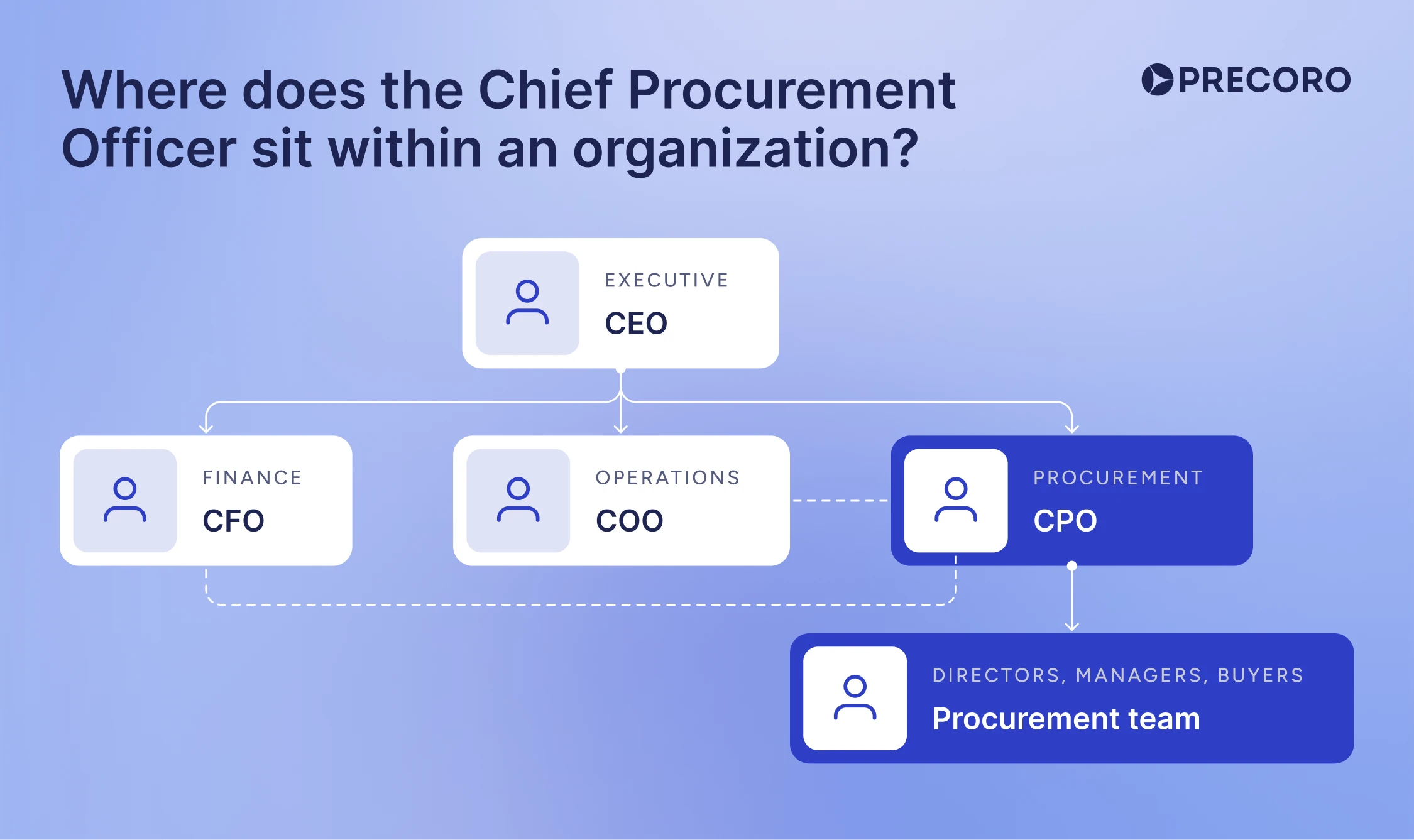
Where does the Chief Procurement Officer sit within an organization?
The Chief Procurement Officer (CPO) usually reports directly to the Chief Financial Officer (CFO) or the Chief Operating Officer (COO), depending on the industry, the company’s executive structure, and its strategic priorities.
A manufacturing company with heavy supply chain risk often places the CPO under the CEO, giving procurement equal standing with Finance and Operations. A company treating procurement mainly as a cost center might place the CPO under the CFO instead. Regardless of the reporting line, the CPO typically leads a team of procurement directors, category managers, and buyers while supporting broader supply chain management efforts. The CPO also sits on cross-functional committees for budgeting, risk, and vendor strategy.
Where the CPO sits on the org chart signals how much strategic weight the company gives to procurement.
Chief Procurement Officer vs. other procurement and supply chain roles
The CPO is accountable for procurement as an enterprise function, including its strategy, governance, financial impact, supplier risk, technology, and ability to support broader business goals. Whereas other procurement and supply chain roles handle the tactical execution and physical logistics of that strategy.
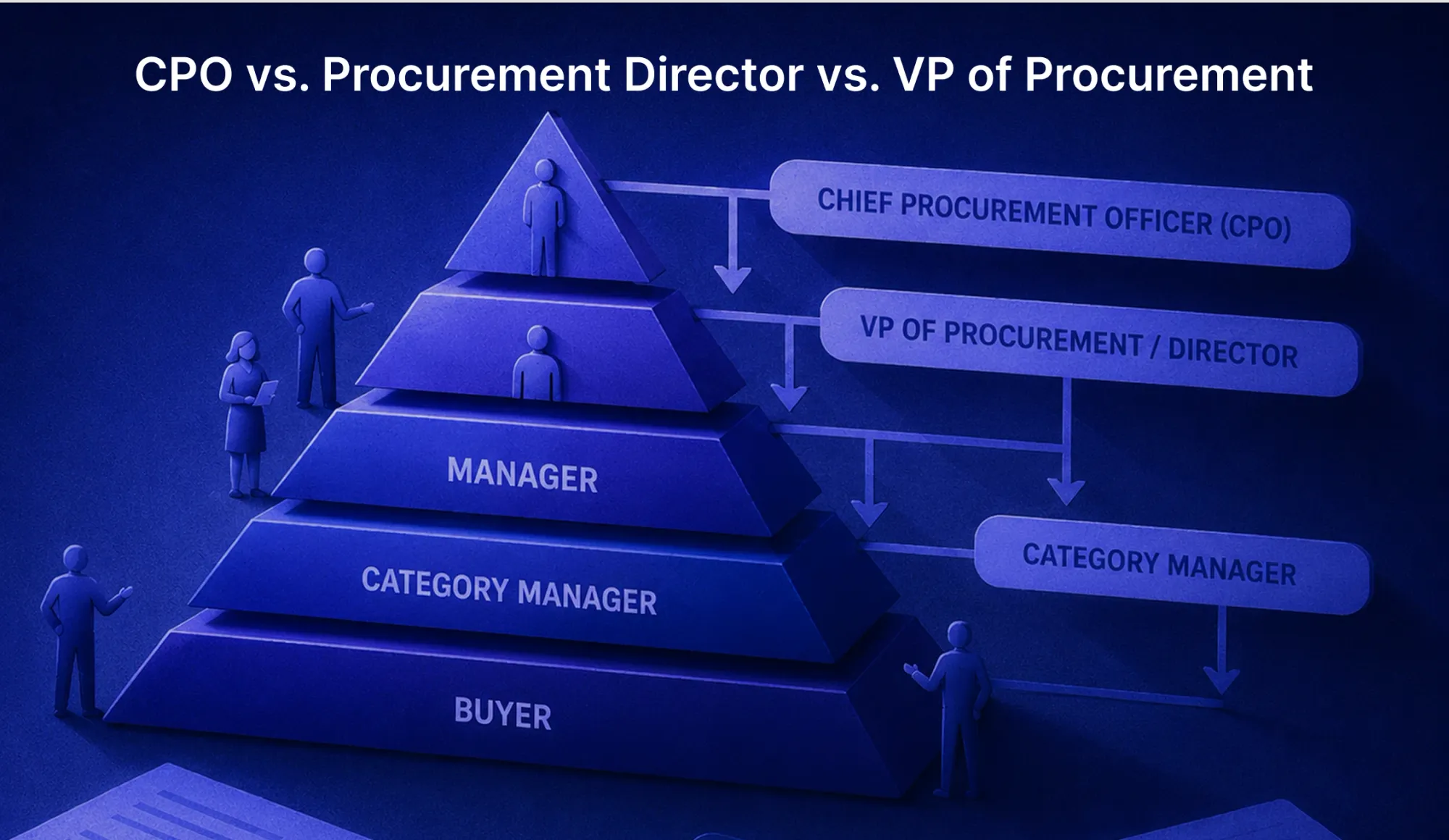
Within the procurement function, the category managers and sourcing specialists deal with particular types of assets and negotiate contracts, whereas the buyers and purchasing agents deal with the day-to-day activities, such as purchase order processing. In the context of the supply chain as a whole, the supply chain directors are responsible for the whole process cycle from start to finish, the logistics managers deal with transport and storage of goods, and the inventory planners and analysts work with data to improve inventory levels and remove operational obstacles. Together, these roles support effective supply chain management across the organization.
CPO vs. other procurement roles
Procurement roles can overlap, but each typically operates at a different level of responsibility.
| Role | Primary focus | Typical responsibilities |
|---|---|---|
| Chief Procurement Officer | Enterprise procurement | Strategy, governance, spend, supplier risk, transformation, executive leadership |
| VP / Head of Procurement | Procurement function | Functional strategy, team leadership, major suppliers, performance |
| Procurement Director | Function, region, or business unit | Procurement programs, teams, category performance, supplier management |
| Procurement Manager | Procurement execution | Team management, purchasing processes, policy compliance, supplier coordination |
| Category Manager | Specific spend category | Category strategy, market analysis, sourcing, negotiation, supplier performance |
| Strategic Sourcing Manager | Sourcing initiatives | RFPs, supplier evaluation, negotiations, contracts, cost reduction |
| Buyer / Purchasing Manager | Purchasing activity | Purchase orders, quotes, order follow-up, delivery coordination |
| Procurement Specialist | Procurement processes | Supplier records, purchase requests, reporting, systems, sourcing support |
CPO vs. Procurement Director vs. VP of Procurement
These three roles are the ones most often confused, since responsibilities can shift between them depending on company size.
| Dimension | Chief Procurement Officer | VP of Procurement | Procurement Director |
|---|---|---|---|
| Scope | Enterprise-wide procurement function | Procurement function, often across multiple categories | A region, business unit, or set of categories |
| Reports to | CEO, CFO, or COO | CPO, or directly to the CEO/CFO where no CPO exists | VP of Procurement or CPO |
| Decision authority | Sets enterprise policy, owns budget and risk posture | Executes strategy set by the CPO; owns major supplier decisions | Manages programs and teams within an assigned scope |
| Typical presence | Large or complex organizations | Mid-size to large organizations, sometimes in place of a CPO | Organizations of most sizes with a structured procurement function |
What does a Chief Procurement Officer do?
A Chief Procurement Officer plans procurement strategy, manages supplier relationships, controls procurement budgets, mitigates supply chain risk, and reports procurement performance to company leadership.
The role has grown well beyond negotiating with vendors. A modern CPO builds the procurement roadmap, hires and develops the procurement team, and sets policy for how the company sources goods and services.
Daily tasks range from reviewing supplier contracts to approving major purchases and resolving disputes. Strategic tasks include forecasting future procurement needs, evaluating new procurement technology, and preparing the function for supply chain disruption. The sections below break down each core responsibility area of the CPO role in detail.
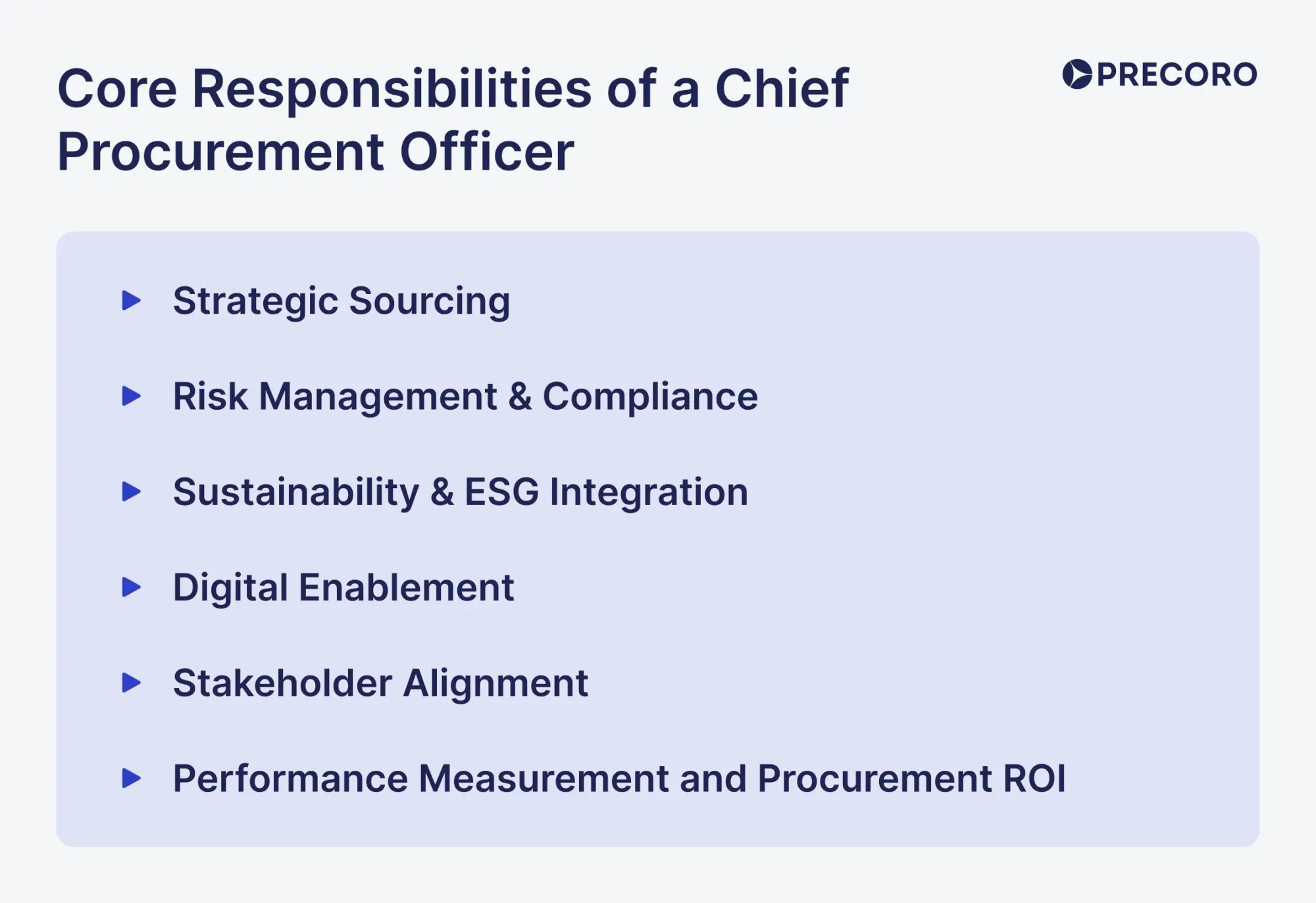
CPO responsibilities checklist:
- Determine procurement strategy and sourcing priorities
- Control supplier selection, classification, and performance management
- Establish procurement policy and approval processes
- Control procurement budgets and savings
- Assess, manage, and track supply chain risks
- Ensure compliance and adherence to regulatory and ESG requirements from suppliers
- Choose and control procurement systems
- Develop and lead procurement staff
- Report procurement performance to the executives and the board
What does a CPO career path typically look like?
Career paths can differ by organization and industry, but a typical progression is buyer or procurement analyst, category manager, procurement director/vice president of procurement, and CPO. There is also usually room for lateral movement into other functions, such as supply chain management, operations, and finance. After becoming a CPO, professionals may also move into COO or CEO positions, especially in manufacturing and other industrial sectors.
How much does a Chief Procurement Officer earn in 2026?
On average, a Chief Procurement Officer in the United States makes about $162,000 annually, which comes to $78 per hour or $3,100 per week according to ZipRecruiter. The range for salaries reported is very wide, from as little as $64,000 to as much as $238,000; however, most people fall into the middle salary range of $130,000 to $194,000 (the 25th and 75th percentile), and the highest-paid 10 percent make $217,500 or more. That wide spread points to real room for growth, largely driven by experience level, location, and specialized skills.
How involved is the Chief Procurement Officer in contract negotiation and compliance?
CPOs rarely negotiate everyday purchases. Instead, they set negotiation policies, handle high-stakes or high-value vendor contracts directly, and delegate smaller contracts to category managers within defined limits.
For strategic suppliers and large contracts, the CPO joins negotiations directly or reviews terms before signature — including pricing structures, SLAs, liability terms, and renewal conditions.
For lower-value purchases, the CPO sets negotiation guidelines and approval thresholds, then delegates execution to the procurement team. As part of effective supply management, the CPO also makes sure every contract follows company policy and relevant regulations, from data protection rules to industry-specific requirements. Legal often reviews contracts alongside procurement, but the CPO holds final accountability for contract quality and compliance across the function.
How does a Chief Procurement Officer shape procurement strategy?
A CPO shapes procurement strategy by setting sourcing priorities, choosing between centralized and decentralized models, and connecting every purchasing decision to company goals.
Strategy work starts with understanding what the business needs now and in the next few years. The CPO studies spending patterns, supplier markets, and business growth plans to build a procurement roadmap that sets priorities such as which categories to consolidate, which suppliers to develop, and where automation delivers the most value. Strategy also covers organizational design — whether procurement should operate as one centralized team, smaller teams embedded in each business unit, or a hybrid of the two.
How does a CPO align procurement strategy with corporate objectives?
A CPO aligns procurement with corporate objectives by translating company goals into sourcing priorities, supplier requirements, budgets, and procurement key performance indicators (KPIs).
That translation happens in a few concrete ways. First, the CPO and other executives map business priorities to sourcing decisions: if the company plans to expand into a new market, procurement builds supplier relationships in the target region ahead of time; if the company targets margin improvement, procurement focuses on cost reduction and contract renegotiation.
Second, the CPO builds supplier partnerships that support those priorities and adjusts sourcing as market conditions shift.
Third, the CPO sets procurement KPIs that mirror company-wide metrics, so procurement performance ties directly to business results. Regular reporting keeps this alignment visible to the rest of the leadership team, which reduces the risk of procurement operating separately from the overall company strategy.
Should a Chief Procurement Officer use a centralized or decentralized procurement model?
There’s no one-size-fits-all answer; the right model depends on your organization’s size, complexity, and strategic priorities. Many organizations — particularly large, multinational, or highly diversified ones — use a center-led (hybrid) model that centralizes what needs to be standardized and decentralizes what needs to be fast and local. Smaller or single-site companies may find pure centralization sufficient.
Center-led procurement refers to a hybrid model: a central team sets policy, negotiates strategic and high-spend contracts, and owns enterprise-wide data and reporting, while local or business-unit teams retain authority over smaller, region-specific, or fast-moving purchases within that policy framework.
Pure centralization maximizes savings, compliance, and visibility, but can slow decisions and miss local nuances. Pure decentralization maximizes speed and local relevance, but can increase unmanaged or off-contract spending — often called maverick spend (purchases made outside approved procurement processes) — duplicate effort, weaken supplier leverage, and raise compliance risk. A center-led model is designed to capture the upsides of both while limiting their downsides.
| Dimension | Centralized procurement | Decentralized procurement | Center-led (hybrid) procurement |
|---|---|---|---|
| Decision authority | A single corporate team controls sourcing, contracts, and policy. | Business units/regions decide locally. | The central team sets policy and owns strategic/high-spend contracts; local teams execute within that policy. |
| Spend leverage | High — aggregated volume drives better pricing and terms. | Low — fragmented buying loses scale. | Moderate to high — volume is aggregated for key categories while local flexibility is preserved elsewhere. |
| Speed & responsiveness | Slower — central queue, standardized steps. | Faster — local decisions, no hand-offs. | Faster for local/low-risk purchases; slower for strategic categories requiring central sign-off. |
| Control & compliance | Strong — one policy, consistent enforcement, fewer maverick purchases. | Variable — harder to enforce; higher maverick-spend risk. | Strong for centrally managed categories; depends on local governance for the rest. |
| Local fit | Weaker — risk of a "one-size-fits-all" mismatch. | Stronger — tailored to site/region needs. | Balanced — local units retain input on categories that need it. |
| Function cost | Lower — no duplicated teams. | Higher — capability replicated per unit. | Moderate — some central overhead, less duplication than full decentralization. |
| Spend visibility | High — central data and reporting. | Low — data scattered across units. | High — central reporting layer, even where execution is local. |
How does a Chief Procurement Officer balance cost savings with long-term value creation?
A CPO balances cost savings with long-term value by measuring supplier decisions against both immediate price and future factors like quality, innovation, and supply continuity.
Chasing the lowest price alone often damages supplier relationships and increases risk down the line. A CPO instead builds evaluation criteria weighing the total cost of ownership, not only the purchase price. This includes supplier reliability, product quality, innovation potential, and switching costs. Some savings initiatives get delayed or scaled back if they threaten supplier stability or product quality.
The CPO also tracks value delivered over multiple years, not only in the current budget cycle, which keeps procurement decisions focused on the company's long-term position rather than short-term savings targets alone.
How should a Chief Procurement Officer approach sustainable and ethical sourcing?
A CPO approaches sustainable and ethical sourcing by setting supplier standards for environmental, social, and governance (ESG) practices, then auditing suppliers against those standards.
Sustainable sourcing starts with clear supplier criteria covering labor practices, environmental impact, and ethical business conduct — an approach broadly aligned with frameworks such as the International Organization for Standardization's ISO 20400 guidance on sustainable procurement and the OECD's guidance on responsible business conduct in supply chains. The CPO builds these criteria into procurement policies, supplier selection, and contract processes, so new suppliers meet the required standards before onboarding. For existing suppliers, the CPO runs regular audits and requests documentation such as certifications or third-party assessments. Where forced labor or other labor-rights risks are a concern, many organizations also reference the International Labour Organization's guidance on supply chain due diligence.
Many CPOs also set targets tied to specific supplier diversity dimensions — for example, spend with certified minority-owned, women-owned, veteran-owned, or small businesses — alongside carbon-reduction goals across the supply base. Clear procurement policies help turn these goals into measurable requirements and consistent supplier expectations. This work supports the company's reputational and regulatory risk management, and can be a meaningful part of a procurement leader's career path, as sustainability and responsible sourcing become more central to how customers, investors, and regulators evaluate a business.
What should a CPO do when business units refuse to follow procurement policy?
When the business units don't follow procurement policy, the Chief Procurement Officer has to get an executive sponsorship from either the CEO or CFO to ensure accountability and audit the internal processes to remove process roadblocks and complicated tools that lead to noncompliance. The CPO can create guided procurement channels for low-risk purchases, utilize data analytics to identify and report any maverick spending done by various departments, and include compliance performance metrics in the performance evaluations of the business unit heads.
When should a Chief Procurement Officer prioritize supply continuity over cost savings?
A CPO should prioritize supply continuity when a disruption threatens core operations, revenue, customer commitments, or brand reputation. This matters most for mission-critical items, sole-source components, and high-risk materials with limited substitutes.
During geopolitical conflicts, trade disruptions, extreme weather, or material shortages, the cost of downtime can far exceed short-term procurement savings. In regulated industries such as aerospace, healthcare, and automotive, supplier reliability and compliance also take priority because failures can create safety risks, legal liabilities, and regulatory penalties.
In these situations, the CPO may accept higher costs to protect supply continuity by adding backup suppliers, increasing inventory buffers, or moving production closer to key operations. These decisions require close coordination between the CPO, supply chain manager, and other business leaders to balance resilience, cost, and operational risk.
How can a Chief Procurement Officer prevent savings targets from damaging supplier relationships?
A Chief Procurement Officer can achieve cost savings without damaging supplier relationships by focusing on collaboration, strategic engagement, and evidence-driven processes.
The CPO can collaborate with strategic suppliers on joint cost-reduction projects and negotiate longer-term contracts that give suppliers room to invest in efficiency. Supplier segmentation also helps, with closer collaboration for strategic suppliers and more automated processes for transactional suppliers.
Technology supports this approach through supplier dashboards, performance analytics, and digital collaboration tools. Alongside cost reduction, the CPO should track supplier satisfaction, innovation, risk reduction, and sustainable savings.
Clear communication, shared contingency planning, and data-driven scenario analysis help the CPO set realistic savings targets without putting unnecessary pressure on suppliers. This approach protects supplier relationships while improving long-term cost efficiency and resilience.
How does a Chief Procurement Officer develop a strategic procurement plan?
A CPO develops a strategic procurement plan in four steps:
- Gathering business priorities from company leadership.
- Forecasting procurement needs against those priorities.
- Building a purchasing plan with targets and timelines.
- Reviewing that plan regularly as business conditions change.
The process starts with close communication between the CPO and company leadership to understand business priorities and needs. The CPO then forecasts procurement needs — increasingly using AI-powered systems to analyze historical spend data — and builds a purchasing plan around those forecasts. The plan is reviewed on a regular basis so the procurement department’s activities stay aligned with the broader business strategy as conditions change.
How does a Chief Procurement Officer manage strategic sourcing?
A CPO manages strategic sourcing by defining supplier criteria, analyzing the global supply market, and identifying suppliers that offer the best-quality materials, products, or services within an established price range and acceptable terms.
Strategic sourcing starts when the CPO defines what the company needs from a category, including quality standards, delivery requirements, and an acceptable price range. The team then researches the supply market, often issuing a Request for Quotation (RFQ) or Request for Proposal (RFP) to compare options. Selection weighs price against quality, reliability, and long-term fit, not price alone.
For major categories, the CPO joins negotiations directly. For smaller categories, the CPO can delegate specific supply chain management and planning processes to selected employees, but as a manager, the CPO bears responsibility for the results.
What is the CPO’s role in procurement operations?
CPO is the executive who defines the procurement vision and strategy of the organization, which ensures that the procurement processes have an impact on the overall objectives of the business. CPO drives the transformation of procurement within the enterprise by developing policies, governance, and procurement operating models.
How does a Chief Procurement Officer manage procurement budgets and cost savings?
A Chief Procurement Officer manages procurement budgets by setting spend targets for each category, tracking actual spend against those targets, and identifying where costs can drop without hurting quality or supply continuity. The CPO reviews contracts regularly to catch pricing errors, missed discounts, or terms that no longer match current volume.
Negotiating with suppliers on price, payment terms, and volume commitments forms a core part of this work. The CPO also builds forecasts based on historical spend and market pricing trends to help finance teams plan budgets accurately, and reports cost savings to executive leadership on a regular schedule.
How does a Chief Procurement Officer manage supplier relationships?
The Chief Procurement Officer is also responsible for maintaining strong relationships with key vendors and suppliers on behalf of the company. This includes establishing trustworthy and convenient communication channels, agreeing on regular performance reviews, facilitating feedback sessions, and introducing transparent contract management principles.
The CPO can also promote long-term cooperation with suppliers, which helps negotiate favorable contract terms and special offers. In general, the Chief Procurement Officer acts on behalf of the company to build business partnerships that encourage suppliers to continuously improve the quality of their products and services and contribute to product innovations.
What is the CPO’s role in supplier and procurement risk management?
The Chief Procurement Officer is responsible for identifying possible risks associated with procurement processes and preparing mitigation strategies. Depending on the company’s industry, size, structure, and ownership model, these risks can range from external supply chain disruptions to internal operational issues.
In some cases, a dedicated risk manager is in charge of risk management instead, with the CPO overseeing their work and ensuring that relevant practices are implemented into sourcing and procurement processes.
How does a CPO ensure procurement compliance?
A CPO ensures procurement compliance by setting clear procurement policies, requiring approval workflows for every purchase, and auditing procurement activity against company and legal standards.
Compliance covers two layers: internal procurement policies and external regulation. Internally, the CPO sets rules for approval limits, competitive bidding thresholds, and conflict-of-interest disclosure, then builds these rules into the procurement system so purchases outside policy get flagged automatically. Externally, the CPO ensures the procurement organization follows relevant laws, such as data protection rules, labor regulations, and industry-specific requirements, often working with Legal to interpret changes.
Regular audits confirm actual purchasing behavior matches policy. Consistent compliance protects the company from fines, contract disputes, and reputational damage tied to supplier misconduct.
Which procurement KPIs does a Chief Procurement Officer monitor?
The CPO measures procurement performance against selected key performance indicators (KPIs) to notice unsettling tendencies in time and identify areas for improving the procurement process. A CPO typically monitors core procurement KPIs such as cost savings, cost avoidance, supplier performance, contract compliance, and cycle time.
| KPI | What the KPI tracks |
|---|---|
| Cost savings | Reduction in price paid compared to a baseline |
| Cost avoidance | Spend prevented through negotiation or demand management |
| Supplier on-time delivery | Percentage of orders delivered on schedule |
| Contract compliance | Percentage of spend under managed contracts |
| Purchase order cycle time | Average time from requisition to order approval |
| Supplier defect rate | Percentage of goods failing quality checks |
These metrics give leadership a clear view of procurement's financial and operational impact. Most CPOs report on a mix of financial KPIs, such as savings and cost avoidance, and operational KPIs, such as cycle time and supplier performance. The specific mix depends on company priorities, but cost savings and supplier performance remain the two most common metrics tracked across procurement functions of every size. Regular performance monitoring also highlights the strengths of the company’s procurement function, showing which practices should be reinforced.
How does a Chief Procurement Officer report procurement performance to stakeholders?
A CPO reports procurement performance through regular dashboards, scheduled business reviews, and updates tied to company-wide KPIs leadership already tracks.
Most CPOs build a recurring reporting cadence, such as monthly or quarterly updates to the executive team and board. These reports cover savings delivered, budget performance, supplier risk, and progress on major initiatives. Dashboards give real-time visibility into spend and compliance between formal reviews.
The CPO tailors the level of detail to the audience, giving the CFO detailed financial breakdowns while giving the broader leadership team a higher-level summary tied to business outcomes. Consistent, transparent reporting builds trust in the procurement function and keeps stakeholders informed before problems become urgent.
Why is a Chief Procurement Officer important?
The CPO applies their expertise to organize and oversee the company’s sourcing, procurement, and supplier management activities. A primary goal is cost-efficient purchasing that gets the best value for money without compromising supply continuity or quality.
How does a CPO improve procurement efficiency?
The Chief Procurement Officer assesses the company’s procurement needs and, in collaboration with department heads, puts together a list of what these departments need in order to function and successfully fulfill their tasks. These needs can include anything from small stationery items to large production machinery or team reskilling courses. When the “what” is clear, the CPO gathers information on “when” these goods or services should be delivered or provided.
The CPO is responsible for assembling a professional team and implementing transparent workflows to ensure that orders are fulfilled accurately, on time, and in compliance with internal or external regulations. If company objectives change, the CPO has to adjust the workflows accordingly.
The chief procurement officer also oversees the process of supplier selection. This includes evaluating and selecting vendors and suppliers through requests for proposals (RFPs) or quotations (RFQs) and sometimes also competitive bidding. The CPO can either join negotiations with supplier representatives directly or approve the team’s selection as the final step. Some CPOs also choose to give their employees complete autonomy to negotiate contracting terms themselves — typically up to a specific financial threshold.
If any issues or disputes arise within the source-to-pay cycle, the CPO intervenes to resolve them. They might have to communicate with suppliers or logistics partners to smooth over potential conflicts and find common ground. They might also need to negotiate with other external partners, such as banks, financing institutions, or contractors, if either party commits misconduct or breaches the contract.
How does a Chief Procurement Officer support tactical decision-making?
On a tactical level, the chief procurement officer helps the company to stay ahead of market changes. This executive conducts market research in different situations, either in preparation for a specific purchase or while developing a long-term procurement plan. The CPO leverages knowledge of the supply market, competition, and global political and economic tendencies to predict possible market trends and supply chain risks. This is especially important for materials that are required for production.
The CPO also develops risk mitigation strategies and ensures the business is prepared for possible negative events. At the same time, qualified CPOs can be among the first ones to recognize windows of opportunity within the company’s supply chain, such as the development of new materials or technology. As a result, the CPO can make informed procurement decisions.
How does a Chief Procurement Officer increase procurement’s strategic value?
The CPO increases the total value of a business by promoting procurement sustainability, ESG (environmental, social, and governance) compliance, and adherence to ethical principles. A large part of a company’s environmental and social impact stems from the quality of its vendors and suppliers. By ensuring that the business sources from responsible vendors and suppliers, the chief procurement officer makes an extremely valuable contribution to the organization’s image and brand.
The CPO is also responsible for assembling a highly professional and value-oriented procurement team, mentoring them, and organizing training to maximize performance. When the CPO is a good leader, they foster a culture of continuous improvement and encourage learning. Supporting procurement team members in their professional growth pays off in the long run, as employees become better problem-solvers and strive to innovate, ultimately saving the company time and money.
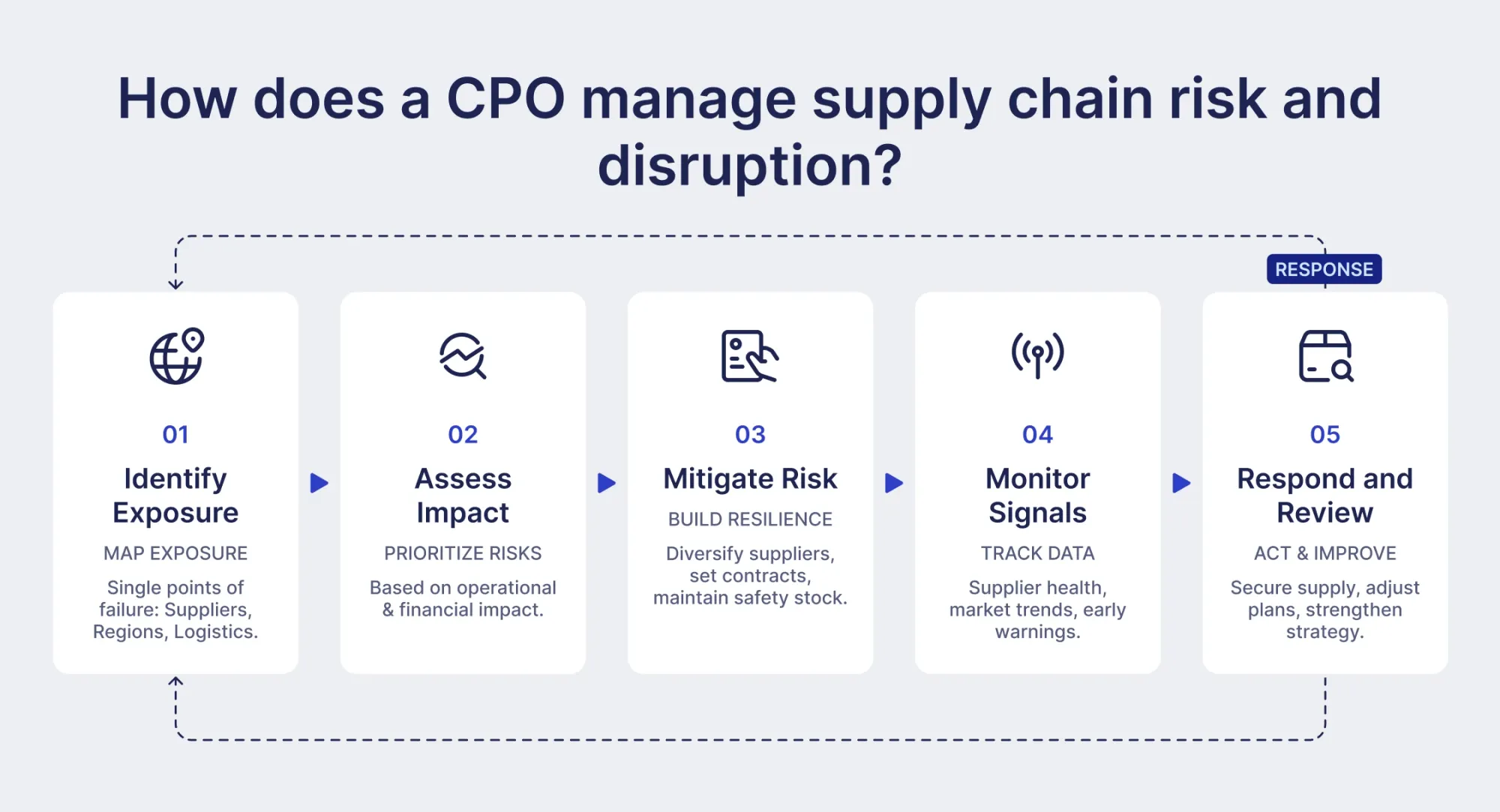
How does a CPO manage supply chain risk and disruption?
CPOs manage supply chain risk and disruption in five stages: identify exposure, assess impact, mitigate through diversification and contracts, monitor ongoing signals, and respond when disruption occurs.
Identify. The CPO maps where the business is most exposed — dependence on a single supplier, region, raw material, or logistics route.
Assess. The CPO prioritizes the risks that could have the greatest impact on operations, revenue, costs, or customers.
Mitigate. To reduce exposure, the CPO may diversify suppliers, qualify backup sources, negotiate stronger contract terms, and maintain appropriate safety stock for critical materials.
Monitor. The CPO tracks supplier financial health, delivery performance, capacity, geopolitical conditions, and other early-warning signals — supported by data analytics and predictive modeling — so teams can act before disruptions occur rather than after.
Respond and review. When disruption occurs, the CPO coordinates with suppliers, operations, finance, logistics, and other stakeholders to secure alternative supply, adjust purchasing plans, control costs, and protect business-critical operations. Afterward, the CPO assesses what happened and strengthens the procurement strategy to reduce the chance and impact of a similar event.
Supply disruption response checklist:
- Identify which suppliers, regions, or materials the disruption affects
- Assess the impact on revenue, operations, and customer commitments
- Activate backup suppliers or safety-stock reserves where available
- Communicate status and timelines to operations, finance, and affected customers
- Adjust purchasing plans and reallocate budget as needed
- Document the event and update the risk-mitigation plan afterward
What challenges and trends are changing the CPO role?
CPOs now face major challenges like supply chain disruptions, inflationary pressures, and strict ESG (Environmental, Social, and Governance) regulations. At the same time, new trends like AI automation and geopolitical risk management are reshaping their daily priorities. Here’s the detailed overview of challenges and trends that are changing the Chief Procurement Officer role:
AI is moving from pilot to core infrastructure.
A Deloitte survey found that 92% of Chief Procurement Officers are planning and assessing generative AI capabilities, with 22% planning to invest more than $1 million annually in GenAI. The shift in 2026 specifically is from experimental pilots to enterprise-wide deployment, and the differentiator is no longer who uses AI but who can source, integrate, and scale it across the enterprise. This is pulling CPOs into much closer collaboration with IT on cloud, data, cybersecurity, automation, and advanced analytics.
The CPO is becoming a broader enterprise leader, closer to the CEO track.
Procurement now shapes decisions that influence margins, quality, risk exposure, and growth potential, and as these responsibilities expand, the CPO role increasingly mirrors the leadership agenda of a CEO. Relatedly, CPOs are increasingly viewed as "chief value officers" driving business partnering, digital adoption, sustainability outcomes, supply chain resilience, and innovation through supplier partnerships — a big expansion beyond classic cost-savings sourcing.
Value beyond cost-cutting.
Margin growth, product quality, innovation, and revenue are now firmly on the CPO agenda, with supplier innovation becoming a critical engine of growth as companies prepare for the next economic upturn. Procurement is playing a central role in scouting new materials and enabling early supplier involvement in design, rather than just negotiating price.
Supply chain resilience amid volatility.
Rapid policy shifts create pricing volatility, longer lead times, and supplier instability, making global sourcing a high-stakes balancing act. In response, investment in AI-driven forecasting, digital models of supply chains, and scenario planning is giving procurement teams clearer visibility of risk. At the same time, 2026 is seeing a shift toward nearshoring, multi-sourcing, and regional supplier networks to support resilience and stabilize margins.
A "do more with less" squeeze.
Procurement leaders face a paradox where responsibilities are expanding while budgets stay stagnant — new regulations spanning sustainability mandates to cybersecurity requirements are adding pressure alongside the need for stronger supply chain oversight. CPOs are pushed to navigate complex regulatory landscapes, manage volatile markets, and drive innovation and sustainability, all while keeping costs under control.
Compressed timelines for impact.
The role is being reshaped by demands for data-driven speed and measurable results — executives now expect procurement's impact within months or weeks, not years, as multi-year implementation timelines are no longer acceptable.
Talent and new skill sets.
New roles and skills are emerging to help procurement teams work more closely with suppliers and improve value, reflecting a broader shift toward relationship management, data fluency, and strategic thinking over pure transactional buying.
Which companies need a Chief Procurement Officer?
Any organization that strives for financial efficiency can benefit from hiring a CPO. From smaller tech companies to manufacturing giants, businesses need to acquire goods and services strategically in order not to waste their resources.
Chief procurement officers are more commonly needed by larger companies, where the number of purchases requires a separate procurement department and an executive manager to organize the procurement processes.
In large organizations, the CPO usually answers directly to the chief executive officer (CEO), although the reporting line may vary depending on the company’s structure. Some CPOs report to the chief financial officer (CFO) or chief operating officer (COO) instead. The CPO may lead a procurement department consisting of procurement directors, purchasing officers, assistants, and other specialists.
Smaller companies might also have a CPO, but they might serve as the organization’s only procurement professional. This means they may act alone or oversee just a small team of purchasing professionals. Also, at organizations with a simpler structure and fewer senior roles, the position might be named differently. For instance, the CPO may instead be called the procurement director.
When does a company need a CPO? A quick reference
| Company profile | Likely fit |
|---|---|
| Large, multinational, or high supply chain risk | Dedicated, full-time CPO |
| Mid-size, growing procurement complexity | Procurement director or fractional CPO |
| Small, low purchasing volume | Owner, controller, or operations lead handling procurement part-time |
| Regulated industry (aerospace, healthcare, pharma) | Dedicated CPO or senior procurement leader, regardless of company size |
When should a company hire its first CPO?
A company should hire its first CPO when procurement has grown complex enough that it needs dedicated executive leadership. The strongest signs include employees bypassing POs, slow or unclear purchasing processes, poor visibility into spend, fragmented indirect spending, weak spend analytics, and heavy reliance on supplier contracts.
Here are 10 signs it’s time to hire a seasoned CPO:
- Employees bypass the PO processInvoices arriving without a matching purchase order signal a process staff find too slow or unclear. This creates blind spots in spend tracking and weakens budget control. A CPO redesigns the requisition process to fix it.
- PO cycle times run long with no clear causeLong cycle times often trace back to legal review backlogs or too many approval steps for small purchases. A CPO maps the workflow, sets time targets, and removes redundant approvals.
- Requesters can’t track their own requisitionsWhen staff can't see where a requisition sits in the approval chain, trust in procurement drops. A CPO selects contract lifecycle software that gives real-time status updates.
- Spend has never been reviewed through the 80/20 ruleTwenty percent of vendors often drive eighty percent of spend. A CPO separates high dollar strategic sourcing from tail spend and applies different tactics to each.
- Spend analytics are weak or missingWithout robust analytics, spend is only considered by vendor name, overlooking duplicate spending and lost savings. A CPO solves this by segmenting spend into categories, departments, and suppliers to reveal patterns – and opportunities.
- Most agreements use vendor-supplied contracts instead of company templatesVendor-supplied contracts increase legal review workload. A CPO works legally to build standard templates for terms and order specifications, which most vendors will accept.
- Indirect spend stays fragmented across departmentsDepartments tend to purchase the same items from multiple vendors without realizing that they are eligible for volume discounts. A CPO brings together all the demand and secures blanket purchasing contracts, thus reducing the number of vendors and unit costs.
- Every decision comes down to the lowest pricePrice alone ignores vendor reliability and long-term cost. A CPO trains staff to weigh the total cost of ownership instead, reducing hidden costs from underperforming vendors.
First 90 days for a new CPO:
- Weeks 1–2: Meet key stakeholders (finance, operations, legal, top suppliers); review existing contracts, spend data, and procurement policy.
- Weeks 3–4: Identify quick wins (compliance gaps, obvious savings, process bottlenecks) and communicate an initial assessment to leadership.
- Weeks 5–8: Set short-term priorities, assign ownership within the team, and begin addressing the highest-risk gaps (supplier risk, policy non-compliance, missing analytics).
- Weeks 9–12: Present a procurement roadmap to leadership with clear KPIs, timelines, and resourcing needs for the next 6–12 months.
We’ve also created a practical checklist for CPOs to help you prioritize the right initiatives and make an impact in your first 6 months in the new role.
Do small and mid-sized companies need a Chief Procurement Officer?
Small and mid-sized companies don’t always need a full-time CPO, but most benefit from someone owning procurement strategy, even on a part-time or fractional basis.
For a smaller business with a relatively small purchasing volume, a procurement role may not be necessary as this can be done through the owner/ controller or operations manager. However, as a company expands, these unstructured buying practices lead to blind spots — like maverick spend, failure to take volume discounts, and inconsistent supplier terms.
Most medium-sized businesses have a procurement director or a fractional CPO to fill this gap. It helps them get senior-level expertise in procurement without having to pay the high salaries that an executive earns. This is a step towards hiring a full-time CPO in the future when there will be more work for them.
What skills make a successful Chief Procurement Officer?
A successful CPO needs strategic thinking, commercial and financial acumen, deep sourcing, contracting and negotiation skills, data and digital/AI literacy, strong stakeholder influence and communication, change leadership, risk and ESG judgment, and people leadership. Most have 10+ years in procurement or supply chain, often with a business or finance degree.
The key skills that distinguish a good CPO from a mediocre one are:
- Strategic thinking helps the CPO align procurement with business goals, anticipate market trends, and build a long-term vision for the function.
- Data analytics and digital fluency help the CPO evaluate supplier performance, market conditions, costs, and risks. Knowledge of AI, automation, and cloud technologies also helps improve efficiency and drive innovation.
- Stakeholder management and collaboration help the CPO work effectively with finance, operations, legal, suppliers, and other key stakeholders. Strong communication and influencing skills help create alignment and build supplier relationships.
- Adaptability and agility help the CPO respond to technological changes, geopolitical shifts, and economic uncertainty. The CPO must adjust procurement strategies quickly and lead the procurement team through transformation.
Why are analytical skills important for a Chief Procurement Officer?
CPOs need strong analytical skills to turn spend and supplier data into clear decisions — where to cut costs, which suppliers to consolidate, and how to reduce risk. They collect data on category spend, supplier performance, and market prices, then surface trends and report them in a way leaders can act on. Good analysis also uncovers hidden savings, like duplicate spending across suppliers or opportunities to shift to products that match predicted demand.
Which communication skills does a Chief Procurement Officer need?
Key skills include strategic communication, negotiation, persuasion, stakeholder management, team leadership, cross-cultural communication, crisis communication, and strong writing skills.
Strategic communication and negotiation. The CPO explains procurement strategies, goals, and policies while turning complex supply chain data into clear business insights, and uses negotiation and persuasion to secure favorable supplier contracts and manage trade-offs.
Cross-functional collaboration. The CPO works across finance, operations, legal, and R&D, reconciling competing priorities and building consensus.
Team leadership. Within the procurement team, clear communication supports coaching, feedback, role clarity, and performance management.
Global and crisis communication. For global operations, the CPO adapts communication to different cultures, regions, and time zones. During supply disruptions, concise, precise communication helps maintain operational stability and stakeholder confidence.
Writing. Strong writing skills matter for contracts, RFPs, policies, and executive reports.
Why does a CPO need negotiation experience?
Strong negotiation skills help the CPO secure favorable pricing, contract terms, service levels, delivery timelines, quality standards, and compliance requirements. They also help build long-term supplier relationships based on trust, collaboration, and innovation.
Negotiation also supports strategic sourcing by helping the CPO use supplier capabilities, market intelligence, and competitive information to make better decisions. Internally, the CPO uses these skills to manage trade-offs, gain stakeholder support, and align procurement decisions with business goals.
How important is adaptability for procurement leadership?
A CPO needs adaptability because procurement operates in a constantly changing environment shaped by market volatility, geopolitical events, regulations, technology, and changing business priorities.
An adaptable CPO can quickly adjust sourcing strategies, supplier relationships, and risk plans when disruptions occur. This includes responding to supply shortages, trade conflicts, natural disasters, and regulatory changes. Adaptability also helps the CPO adopt technologies such as AI, automation, and analytics while aligning procurement with changing goals such as cost optimization, sustainability, and innovation.
Most importantly, an adaptable CPO builds a procurement function that can respond quickly, manage uncertainty, support innovation, and maintain business continuity.
Why does a Chief Procurement Officer need a strategic mindset?
Strategic thinking helps the CPO align procurement with business goals, anticipate market changes, evaluate supplier capabilities, and reduce costs without compromising quality. It also helps the CPO balance cost efficiency with innovation, sustainability, and supplier collaboration.
A strategic CPO also manages supply risks by diversifying suppliers, preparing contingency plans, and protecting operational continuity. At the executive level, this mindset helps the CPO influence other functions, gain support for long-term initiatives, and integrate procurement into the company’s broader strategy.
Ultimately, a strategic mindset allows the CPO to move procurement beyond transactions and use it to drive resilience, innovation, and sustainable business value.
Which leadership skills are essential for a Chief Procurement Officer?
Essential leadership skills for a CPO include team communication, coaching and talent development, delegation, accountability, and personal integrity. The CPO leads the whole procurement agenda of the company, and thus typically has several employees or even teams working under them, so it’s absolutely crucial for a CPO to establish trustful and respectful relationships with the procurement team, if there is one. This includes fostering honest communication within the team, recognizing and maximizing employee potential, defining clear objectives for everyone in the team, and setting an example for personal growth and integrity.
Which technology skills should a modern Chief Procurement Officer have?
A modern CPO needs working knowledge of e-procurement platforms, data analytics tools, and emerging AI applications relevant to sourcing and supplier management.
Procurement technology has moved well past basic purchase order systems. Today's CPO evaluates and adopts tools such as Enterprise Resource Planning (ERP) integrations, spend analytics platforms, and Robotic Process Automation (RPA) for repetitive tasks like invoice matching.
A CPO doesn't need to write code, but needs enough technical fluency to evaluate vendor claims, ask the right questions during a technology selection process, and understand how new tools fit into existing systems. As AI tools become more common in supplier risk scoring and demand forecasting, CPOs who understand these tools can make faster, better-informed technology decisions.
How is technology changing the Chief Procurement Officer’s role?
Advanced analytics, artificial intelligence, and automated platforms remove manual bottlenecks, allowing leadership to focus on enterprise-wide risk management, value creation, and sustainability.
Which procurement technologies should a Chief Procurement Officer prioritize?
A CPO should prioritize e-procurement and spend management platforms first, since these tools create the data foundation every other procurement technology depends on.
Before adding advanced tools, a CPO needs clean, centralized data on spend, suppliers, and contracts. This makes an e-procurement or spend management platform the natural starting point, since this system captures purchase orders, approvals, and invoices in one place. From there, priorities often include contract management software, supplier risk monitoring tools, and Electronic Data Interchange (EDI) connections with key suppliers for faster order processing.
Analytics and reporting tools come next, turning the data captured in these systems into insight. AI-powered tools for forecasting or risk scoring deliver the most value once this foundation exists, since these tools depend on quality data to perform well.
CPO procurement technology stack, in build order
- Intake — structured purchase requests
- Sourcing — RFP/RFQ management, supplier evaluation
- Contracts — CLM software, approval workflows
- Purchasing — purchase orders, budget checks
- Supplier management — performance tracking, risk monitoring
- Analytics and AI — spend analytics, forecasting, risk scoring
These capabilities don’t necessarily require separate tools. An integrated procurement platform can cover multiple stages of the process while keeping data and workflows connected. Larger or more complex organizations may add specialized solutions where needed, but they should complement the core platform rather than create another silo.

How can AI and analytics improve procurement decisions?
AI and analytics improve procurement decisions by spotting patterns in spend and supplier data a person would take far longer to find manually.
Analytics tools flag spend fragmented across suppliers, price increases breaking historical patterns, and contracts approaching renewal without a review. AI models take this further, predicting supplier risk based on financial signals, forecasting demand from historical and seasonal data, and scoring supplier performance across dozens of factors at once. GenAI tools now also draft contract language, summarize supplier proposals, and answer procurement policy questions for employees, cutting the time category managers spend on routine tasks.
How should a CPO manage technology adoption and organizational change?
A CPO manages technology adoption by piloting new tools with a small group first, training the team thoroughly, and tying adoption to a clear business case.
Rolling out new procurement technology company-wide without testing first often leads to poor adoption and wasted budget. A CPO typically pilots a new platform or AI tool with one category or team, gathers feedback, and fixes problems before a wider rollout. Training matters as much as the technology itself, since a strong tool delivers little value without proper user training.
The CPO also builds a clear business case for each new tool, tying the investment to specific outcomes such as reduced cycle time or improved supplier visibility. This approach makes future budgets easier to secure and results easier to measure.
How can Precoro help Chief Procurement Officers improve spend visibility and control?
Precoro gives CPOs visibility and control over spend by bringing every step of the procurement process — requests, approvals, purchase orders, budgets, suppliers, receipts, invoices, and payments — into one connected system, rather than leaving it scattered across email, spreadsheets, and disconnected departmental workflows.
Control starts before money is committed. Structured purchase requests, live budget checks, approved supplier catalogs, and configurable approval workflows let CPOs enforce policy at the point of request, not after the fact. Approvals can be routed automatically based on department, entity, request type, or spend level, so low-risk purchases move quickly while high-value or high-risk requests get the scrutiny they need. Approval SLAs keep requests from stalling with unavailable approvers — a common source of maverick spend when people route around a slow process.
Visibility becomes real-time rather than retrospective. Because every transaction — from initial request through receipt and invoice — flows through a single structured system, CPOs get a live, organization-wide view of spend instead of reconciling data after the quarter closes.
Precoro AI Crews extend that control layer with advanced automation. Rather than operating as isolated AI tools, Crews work across the intake-to-pay process using the clean, structured data already captured in Precoro. They handle routine tasks, carry context between steps, and reduce the manual data entry and handoffs that typically create gaps in spend visibility.
It works alongside your existing ERP, not instead of it. Approved procurement data flows into the company's financial system while Precoro retains the full audit trail from request to payment, cutting down on the manual reconciliation that often obscures true spend.
Where the visibility and control actually come from
- Guided intake workflows — every requester follows the same step-by-step process, so nothing starts as a rogue email or an unclear ask outside the system.
- Centralized requests — all purchase requests are logged in one platform and instantly categorized by department, project, or cost center, giving CPOs clear oversight from the first click.
- Pre-approved catalogs and vendors — teams can only select from approved products and suppliers, which sharply reduces off-contract spend and compliance risk.
- Automated approvals — dynamic workflows route requests to the right approver instantly, removing bottlenecks and confusion while preserving a full audit trail.
- Real-time spend tracking — procurement and finance see committed spend before it hits the budget, supporting accurate forecasting and preventing overspend.
- ERP and accounting sync — only approved data flows into the ERP, eliminating duplicates, errors, and unapproved invoices from polluting financial records.
- Dashboards & reports — live insight into who's buying what, when, and for how much, giving CPOs the data foundation for real spend control and decision-making.
Chief Procurement Officer role at a glance
A chief procurement officer is a C-suite executive who plays a pivotal role in all kinds of organizations, whether it's a construction business, the renewable energy sector, hospitality, healthcare, or other industries.
Through strategic procurement management, CPOs contribute to production stability and drive cost savings. By understanding the comprehensive nature of procurement and leveraging their experience, CPOs can help organizations achieve long-term sustainability, operational efficiency, and a strong competitive advantage in the market.
The role of chief procurement officer is not only about managing purchases but rather about strategic procurement planning, mitigating risks, and searching for ways to improve the source-to-pay process. CPOs with impeccable analytical skills and strong leadership can significantly contribute to the organization's long-term value. Aspiring CPOs should focus on developing hard and soft skills to stay abreast of industry trends and excel in this executive role.
Chief Procurement Officer FAQs
CPO stands for Chief Procurement Officer — a senior executive responsible for developing and implementing a company's procurement strategy, policies, and procedures.
The CPO ensures the company gets what it needs for operations on time and cost-efficiently, while setting the long-term procurement strategy. The role has evolved significantly: historically, CPOs mainly negotiated supplier contracts and oversaw purchasing transactions; today, they also help shape long-term business strategy as organizations become more global and adopt new technologies.
The main responsibilities of a CPO include setting procurement strategy, managing supplier relationships, controlling procurement budgets, mitigating supply chain risk, ensuring compliance, and reporting procurement performance to company leadership. The CPO also builds and develops the procurement team, and adopts new technology to keep the function efficient as the company grows.
To become a chief procurement officer, you need relevant education and experience. Specific requirements vary by company, but most employers look for strong soft skills, including analytical thinking, communication, negotiation, and leadership. You also need to be ready to adapt to changes, have a strategic mindset, and be technologically proficient.
A CPO may have internal accountability for supplier selection and risk oversight, but personal legal or financial liability depends on applicable law, contractual arrangements, corporate governance, and the individual's conduct — it can't be generalized across organizations or jurisdictions.
Most CPOs report to the Chief Financial Officer or Chief Operating Officer, and in some organizations directly to the CEO. The reporting structure often reflects how the company positions procurement: a CPO reporting to the CEO or COO frequently has a broader strategic mandate, while one reporting to the CFO may focus more on cost management and financial performance.
No. It depends on the organization's scale, supplier dependence, risk, and the strategic role of procurement. A dedicated C-suite procurement executive typically fits for large enterprises with complex, high-volume global supply chains or heavy manufacturing needs.
The CPO oversees the full procurement function, including sourcing, purchasing, contracts, supplier management, risk, compliance, sustainability, and procurement talent. In contrast, the Chief Sourcing Officer (CSO) focuses mainly on sourcing strategy, supplier selection, negotiations, and supplier costs. In simple terms, the CPO manages the broader procurement function, while the CSO focuses on sourcing and supplier selection.
Ready to boost your procurement operations?









%20%E2%80%94%20Meaning%20and%20Their%20Role%20in%20Procurement)