Invoice Automation: How It Works
Learn how invoice automation works, from data capture and validation to approval and payment. Compare costs, benefits, software, and implementation steps.

What is invoice automation, and how does automated invoice processing work?
Invoice automation removes manual work from data entry, matching, and approval routing. It helps companies avoid delays and errors in traditional invoicing.
According to Ardent Partners’ 2025 AP benchmarks, the average organization still sees an invoice exception rate of 22%, while best-in-class teams bring that down to just 9%. The performance gap is just as striking for processing speed: top-performing teams process invoices in 3.1 days, compared with 17.4 days for other organizations.
And automation alone doesn’t guarantee smooth processing. Medius’ 2026 Financial Census found that 85% of finance teams already use some level of AP automation, yet approval bottlenecks, invoice disputes, data mismatches, understaffing, and poor visibility into deadlines continue to delay payments.
But the question is, what's to be done?
Keep reading to find out about:
What is invoice automation?
Core steps in an automated invoice workflow
Manual invoice processing challenges automation solves
Manual vs. automated: cost, speed, and accuracy
Managing invoices across entities, currencies, and tax
Benefits of invoice automation
What to consider before implementing invoice automation
5 best invoice automation software
Implementation roadmap
FAQ
Conclusion
What is automated invoice processing?
Automated invoice processing is the use of software to scan, extract, match, and validate invoice data, then input it into your enterprise resource planning (ERP) or accounts payable system without manual data entry.
AP automation software handles this process end-to-end, involving people only for exceptions that need a human review.
ERP is software that integrates essential business processes, such as finance and manufacturing.
Here is an example of automated invoice processing steps:
- Capture the invoice: Extract invoice data automatically, generate an invoice from an existing purchase order, or create one from scratch.
- Match the documents: Automatically perform three-way matching against the purchase order and receipt.
- Resolve exceptions: Flag and address issues such as incorrect PO numbers, line-item mismatches, or other discrepancies.
- Route for approval: Send the invoice to the appropriate manager or executive based on predefined approval rules.
- Approve the invoice: Review and approve it directly in the software or via email.
- Process payment: Pay the vendor once the invoice has been approved.
- Sync and record: Update invoice records for reporting and sync the data with the ERP system.
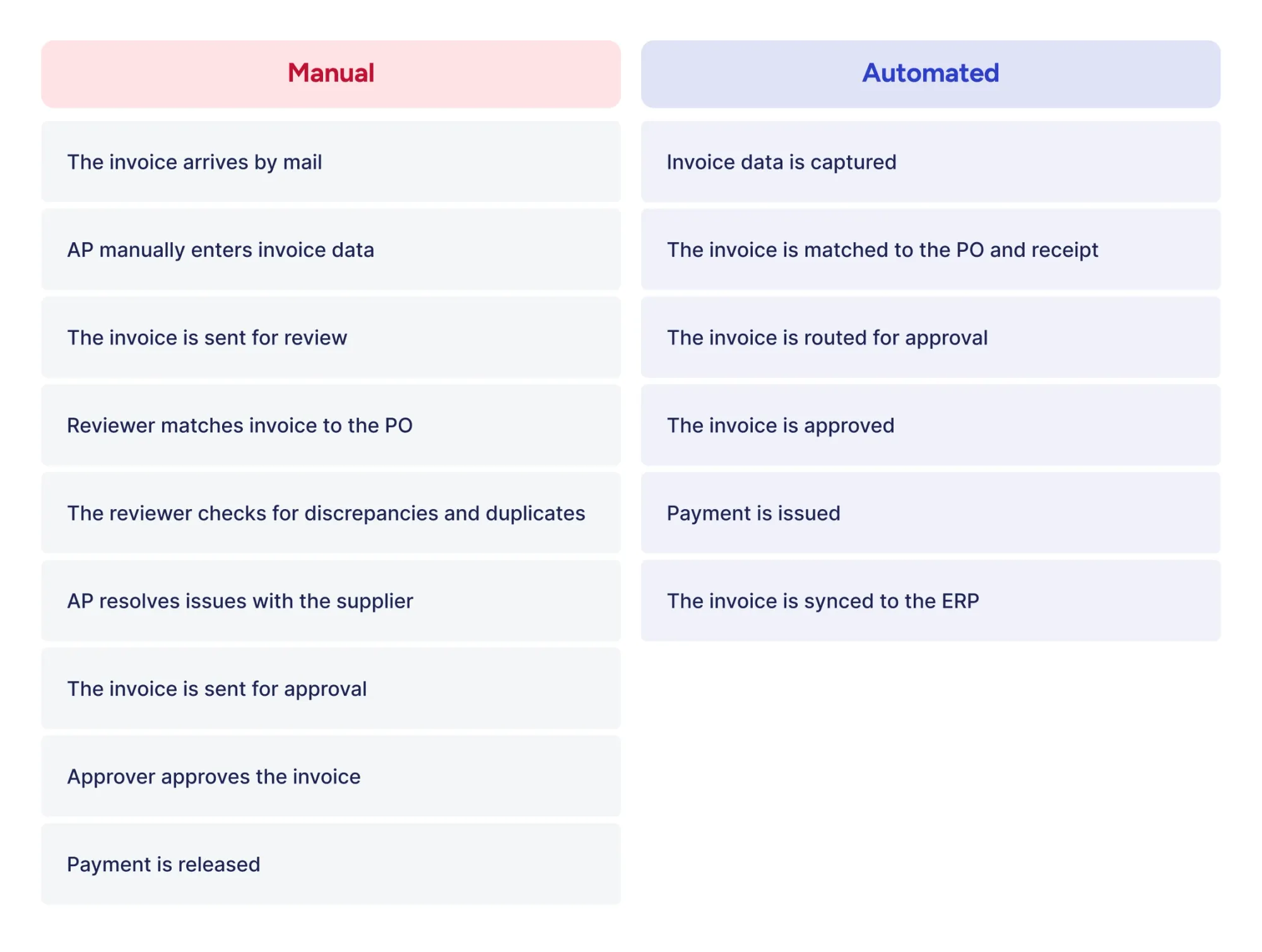
These steps may vary depending on how the workflow is configured. However, the impact of automation is clear: Best-in-Class AP teams process invoices in 3.1 days, compared with 17.4 days for other organizations, according to Ardent Partners’ 2024 research. They also have 59% fewer invoice exceptions, reducing the time teams spend resolving issues manually.
| Aspect | Invoice automation | AP automation | E-Invoicing |
|---|---|---|---|
| What it covers | Capturing, extracting, matching, and routing invoice data | The full accounts payable cycle: invoicing plus approvals, payments, and reporting | Sending and receiving invoices in a structured digital format instead of paper or PDF |
| Scope | One part of the AP process | Broadest: includes automated invoice processing as one component | Narrowest: focused on invoice transmission, not processing |
| Primary goal | Eliminate manual data entry and matching errors | Streamline the entire pay cycle from receipt to payment | Standardize and speed up invoice exchange between buyer and supplier |
| Typical tools | Optical character recognition (OCR), AI capture, and three-way matching software | Accounts payable automation platforms (e.g., Precoro, Tipalti) | Government and other e-invoicing networks |
| Example | Scanning a PDF invoice and automatically matching it to a purchase order | Routing that matched invoice for approval and issuing payment | A supplier's system transmitting a structured invoice file directly into the buyer's enterprise resource planning (ERP) system |
Automated invoice validation for detecting missing or incorrect data
Automated validation checks a captured invoice against a valid purchase order, a matching receiving record, correct tax calculations, and duplicate detection. Then, it shows anything that doesn't line up before the invoice reaches a human approver.
As a rule, two- or three-way matching is required for this. Namely, the invoice gets compared against the purchase order (two-way). Or it gets compared against the purchase order and receiving confirmation (three-way).
Three-way matching is a stronger control because it confirms goods or services arrived before payment processing moves to the next step.
Validation also reveals simpler but costly errors, such as a missing tax identification number or an invoice number already paid.
Automated invoice exception handling and approval routing
Invoice automation routes invoices that fail predefined validation rules to the appropriate reviewer and records the reason why they were marked as exceptions.
Exception handling separates real automation from a document-capture system. Specifically, when an invoice doesn’t pass through validation or doesn’t meet normal parameters, the system routes it to a specific person with a specific reason. So, this invoice is routed to a designated reviewer.
The artificial intelligence systems configured for learning and associated with routing get smarter over time based on the data processed. It learns which exceptions are resolved by a given approver quickly and which ones need further steps.
When exceptions are handled successfully, you distinguish between different exception types. For instance, a price under 5% might get auto-routed to a manager for quick invoice approval. Or an invoice missing a purchase order might get routed back to the requester first.
Approval routing is based on amount, category, department, or vendor risk level. For example, a $200 recurring subscription invoice needs a different level of attention than a $50,000 capital purchase.
Core steps in an automated invoice workflow
The invoice process moves through five stages handled by software, eliminating the need for in-person data re-typing between systems. Here are these five stages:
- Capture
- Validation
- Coding
- Approval routing
- Payment
Capture
When the invoice arrives, the cycle starts, and the system extracts the data automatically. The invoice can be sent via email, supplier portal, or electronic data interchange (EDI) feed. This is the way organizations automatically exchange business documents.
Validation
Then, the invoice gets validated against purchase orders and receiving records.
Coding
Next, the invoice gets coded to the correct general ledger (GL) account, which is the financial category that records the monetary value of invoices. Coding is based on historical patterns.
Approval Routing
Then, these patterns get routed to the right approver based on the amount and category.
Payment
Finally, they get scheduled for payment once approved.
This entire chain is logged, so every invoice features a complete, timestamped audit trail from arrival to payment. And when this is done through manual processing, extra effort is required.
The mentioned stages run largely without human intervention. Human review is required for patterns that aren’t normal, such as a missing payment order, an unusual price, or a new vendor.
Invoice capture with OCR and AI-powered invoice data extraction
Invoice automation starts with invoice capture. Specifically, optical character recognition (OCR) reads the invoice image or PDF.
Then, artificial intelligence models interpret that raw text into structured fields, such as vendor name, invoice number, line items, totals, and due date. Can operate without manual entry when confidence and validation requirements are met in this process.
Modern platforms use optical character recognition and machine learning (ML) that improves over time. Specifically, machine learning learns a specific vendor invoice layout, which improves accuracy.
Machine learning is a part of computer science and artificial intelligence, enabling computers to learn from data and make predictions without using hard rules.
Automation helps organizations reduce invoice errors by up to 80%, according to a recent study regarding manual invoice processing costs. Thus, ML eliminates the annual data entry problems caused by early OCR tools that struggled with scanned, handwritten, or inconsistently formatted invoices.
Today, more sophisticated AI-powered data extraction helps with complex formats much more reliably. Specifically, companies use AI-powered automation software for invoices embedded in emails or arriving as photos from a mobile device.
Thus, there is no need for manual data entry that historically took the largest share of an accounts payable clerk's day.
Example: Hypothetically, a logistics company receiving differently designed invoices from more than 400 carriers uses AI to train it for capturing. This way, the company enables the system to recognize new vendors' formats after a few submissions instead of manually creating a template for each one.
Manual invoice processing challenges automated invoice processing can solve
Without the proper accounts payable technology, organizations struggle to maintain an efficient invoicing process. According to Levvel Research, manual AP workflows lead to excessive data entry, missing bills, and duplicate payments. Modern procurement and AP automation software resolves these bottlenecks.
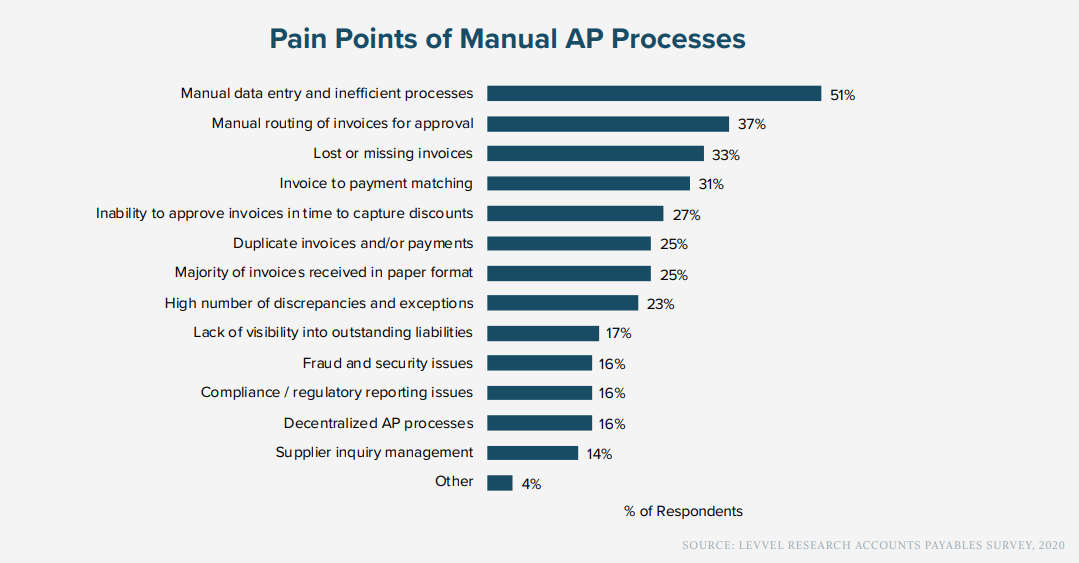
Here is how automation addresses the top five AP challenges:
Reducing manual data entry with invoice automation
The Problem: Manual entry consumes hours of staff time and leads to errors. According to a 2024 Gartner survey, 18% of accountants make financial errors at least daily, with a third making errors every week, and 59% admitting to several errors per month.
The Impact: Overpaying, underpaying, and wasting labor on repetitive administrative tasks.
The Solution: Invoice processing software automatically extracts, validates, and synchronizes data into systems like QuickBooks, NetSuite, and Xero, cutting most manual entries. Precoro goes a step further by controlling spend before the invoice arrives. Purchase requests and orders go through predefined budgets and approvals upfront, so by the time an invoice comes in, it can be matched against an already approved purchase rather than reviewed from scratch.
Preventing missing and lost invoices
The Problem: Invoices routed via physical paper or cluttered email inboxes frequently get misplaced. Moreover, they often get misdirected and caught in spam filters or accidentally deleted.
The Impact: Damaged vendor relationships, disrupted cash flow, and wasted time restarting billing cycles from scratch. Lost invoices can cause serious problems with vendors and hurt your cash flow or even force you to start the invoice processing over again.
The Solution: Centralized AP software routes bills directly to assigned stakeholders and tracks current invoice statuses. Then it sends alerts when bills are pending review, approved, or ready for payment.Using Precoro, you always have all the important information available in the system. You can track bills by their status and use real-time reporting to ensure that no invoice is lost.
Automating invoice approval routing
The Problem: Invoice approvals remain a major source of AP delays. 2024 Ardent Partners research found that the average AP organization takes 9.2 days to process an invoice, while 41% of AP leaders report bottlenecks and lost value because invoice and payment approvals take too long. Complex approval chains make the problem worse when ownership and status aren’t clear.
The process can take even longer if multiple approvers are involved. It isn't clear who is responsible for the approval or at which stage of the accounts payable workflow the invoice is currently in.
The Impact: Extended payment cycles, workflow bottlenecks, and administrative gridlock.
The Solution: With invoice approval software, like Precoro, invoices are automatically routed to the right approvers based on predefined rules. Approval SLAs set clear deadlines for each step, while notifications help prevent requests from sitting unattended. Approvers can also review and approve invoices from the Precoro mobile app, so the process keeps moving even when they’re away from their desks.
Improving invoice matching and payment processing
The Problem: Manually verifying purchase orders, receiving documents, and invoices (2-way and 3-way matching) requires much effort and leads to errors.
The Impact: Higher risk of duplicate payments, vendor fraud, non-compliance, and payment inconsistencies.
The solution: With Precoro, the Matching Agent automatically finds the related purchase order, even when some names or details differ, and matches it against the invoice. Precoro can also match the invoice with the corresponding receipt for three-way verification. This helps ensure you pay exactly what you owe, no more and no less.
Reducing invoice processing time and approval delays
The Problem: Hand-off delays and manual document handling compound cycle times across the AP pipeline.
The Impact: Late payment penalties, supplier friction, delayed product shipments, and damaged company credit ratings.
The solution: Eliminating piles of paper invoices and manual data entry can greatly reduce processing time and error rates.
According to Business Insider, enterprises using procurement automation can speed up the processing cycle by 73%, allowing you to focus on more strategic tasks.
How does it work:
- You don't have to re-enter the invoice data into your ERP or accounting system. Procurement software automatically transfers it.
- No need to send emails or wait for the team meeting to approve documents.
- Three-way matching is automated and takes a couple of minutes.
- You always have access to the current status of your bills.
- Fewer errors — less time spent fixing them.
Manual vs. automated invoice processing: Cost, speed, and accuracy
Manual and automated invoice processing differ most in the areas finance teams feel every day: cost, processing time, accuracy, and workload. While the impact may seem small on a single invoice, the difference becomes much more significant as invoice volume grows.
Here’s how the two approaches compare:
| Metric | Manual processing | Automated processing |
|---|---|---|
| Average cost per invoice | $12–$15+ | $2–$4 |
| Average processing time | 8–10 days | 1–3 days |
| Data entry error rate | 1–5% of invoices | Under 1% with AI capture, according to Invoice Management Statistics 2026 |
| Duplicate payment risk | Higher: relies on manual cross-checks | Lower: automatic duplicate detection |
| Staff time per invoice | 10–15 minutes | Under 2 minutes (exceptions only) |
| Scalability | Requires more staff members as volume grows | Scales without many staff members |
| Audit trail | Manual, often incomplete | Automatic, timestamped, complete |
The biggest difference is how each approach handles growing invoice volumes. With manual processing, more invoices typically mean more data entry, checks, follow-ups, and staff time. Automation handles much of this routine work in the background, allowing teams to process higher volumes without increasing the workload at the same rate.
However, automation also comes with its own requirements and trade-offs. Here’s a closer look at the pros and cons:
Pros and cons of invoice automation
| Aspect | Pros | Cons |
|---|---|---|
| Cost | Lower cost per invoice at scale | Upfront software and implementation cost |
| Speed | Faster approval cycles, fewer late payments | Requires clean data and defined workflows for successful operation |
| Accuracy | Fewer duplicate and misclassified payments | AI extraction needs early spot-checking |
| Team impact | Staff focus on analysis instead of data entry | Requires change management and training |
| Visibility | Current status of invoices | Some platforms require ERP integration upfront |
Volume enlarges the gap between manual and automated invoice process performance. Specifically, a company processing 200 invoices monthly doesn’t put in the same effort as a company processing 5,000.
However, the difference between their per-invoice costs compounds fast in both cases. And today, the way AI handles inconsistent invoice formats without human review plays a critical role in creating this gap.
| Aspect | Manual | Automated |
|---|---|---|
| Data capture | Manual entry | Optical character recognition (OCR)/artificial intelligence extraction |
| PO matching | Manual comparison | Rule-based/automated matching |
| Exceptions | Email/manual follow-up | Rule-based routing |
| Approval | Email/manual routing | Configured workflows |
| Duplicate detection | Manual check | Automated rules |
| Audit trail | Distributed records | Centralized event log |
| Payment | Manually initiated | Integrated/scheduled where supported |
Managing high invoice volumes across multiple entities, currencies, and tax requirements
As companies expand across entities and markets, invoice processing gets more complicated. Different subsidiaries may have their own approval rules, currencies, GL structures, and tax requirements.
Automation helps manage these differences within one AP process instead of leaving finance teams to track every local requirement manually.
Entity-specific invoice workflows
How does automated invoice processing solve multi-entity complexity? It applies several elements automatically in a single invoice-processing workflow.
Specifically, invoice automation applies entity-specific approval workflows, such as currency limits and operational structures. Also, it applies chart-of-accounts mappings, such as different general ledger coding and segment structures.
Finally, automating accounts payable invoices applies tax rules based on the legal jurisdiction of the receiving entity. Thus, invoice automation doesn’t require a single global finance team to manually track rules for each subsidiary.
Currencies
What about currencies? Platforms automatically convert and reconcile invoices based on the applicable exchange rate. This helps eliminate time-consuming manual lookups and wire-transfer coordination.
Tax requirements
Tax handling follows a similar pattern. Namely, automated systems apply the correct value-added tax (VAT), which is a consumption tax applied to products and services at production and sales.
Goods and services tax (GST) is also applied. This is a single consumption tax applied to the price of most goods and services. Finally, automated systems apply sales tax treatment by jurisdiction.
Then, they produce electronic invoices in the specific formats required in the European Union, Latin America, and parts of Asia. This way, they bring local compliance into the standard accounts payable process without requiring a separate manual review for every region.
Benefits of invoice automation solutions and AP automation
We've already discussed some of the advantages of AP automation in the last section. But let's dive deeper into how your company can benefit from it.
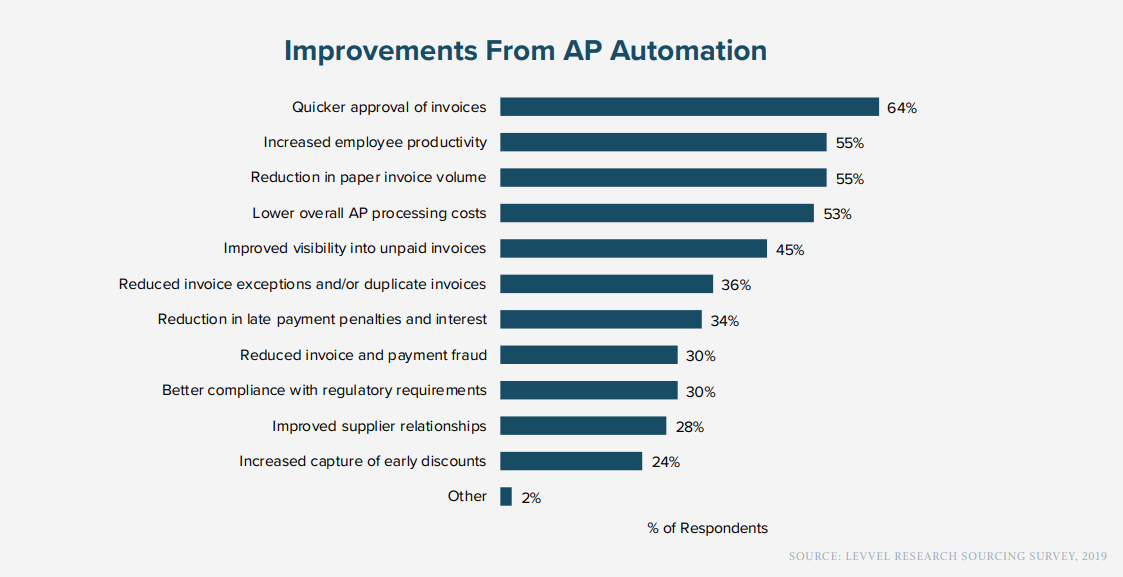
Lower AP invoice processing costs
By switching to e-invoicing, you can reduce labor expenditures, printing and mailing overhead, and interest and late fees.
For context, Ardent Partners reports that the average AP organization spends $9.40 to process a single invoice. At 500 invoices per month, that represents $56,400 in annual processing costs—creating significant room for savings when routine AP work is automated.
Faster invoice processing and time savings
Invoice processing can still take days, even before payment is made. According to Ardent Partners’ 2025 research, the average AP team takes 8.2 days to process an invoice, while best-in-class teams complete the process in just 2.9 days.
With an AP automation solution, you can approve an invoice and do a three-way match in minutes without human intervention.
Improved invoice data accuracy
When working with bills manually, you can expect various errors, such as entering an incorrect price, sending out the wrong invoice, duplicating it, and more.
But with invoice automation, you can streamline business processes and cut down on these costly errors.
According to a survey by the Shared Services Outsourcing Network, companies that automate their accounts payable processes can expect to reduce costs and errors by 70– 85% during primary invoice processing tasks.
Improving cash flow and capturing early payment discounts with invoice automation
Faster processing helps with early payment discount windows before they expire. Many suppliers offer 1-2% off for payment within 10 days. Accounts payable teams taking manual steps regularly miss discounts because invoice approval requires 12 days.
Current visibility into payments improves cash forecasting. Finance teams see upcoming obligations without falling behind.
Automated approval routing cuts the invoice-to-payment cycle. Treasury gains more control over when to pay without merely focusing on paying whatever comes due next.
Fewer late payments contribute to better supplier relationships. This helps companies enjoy better terms later or overcome supply shortages.
Measuring the ROI of invoice automation
Return on investment (ROI) is a financial metric that evaluates the efficiency of an investment.
Lower cost per invoice provides the most direct and measurable return. The gap between manual and automated invoice processing often falls from $12-15 to $2-4, respectively. And this gap is linked to the number of invoices passing through the accounts payable process monthly.
Reduced staff vs volume increase. Accounts payable teams absorb 2-3 times more invoice volume without adding staff members. Accounts payable automation eliminates lots of manual steps associated with data entry and document matching.
Fewer duplicate payments and fraud losses cause hard dollar recovery. Companies catch duplicate payments through automation, which can’t often be said about manual cross-checks.
Faster close cycles allow finance staff to focus on higher-value analysis. Automation eliminates manual data entry and invoice chasing.
Capturing early payment discounts lets companies improve overall cash flow. Capturing early payment discounts helps organizations improve cash flow by avoiding unnecessary software-related costs.
Improving audit readiness and recordkeeping with invoice automation
Automation improves the digital trail associated with invoices. This complete, time-stamped trail starts from capture and ends with payment approval. Automation helps easily reconstruct invoice-related history from email threads during audit season.
Consistent system-enforced approval allows auditors to test the control itself. Automation doesn’t automatically eliminate control testing. The testing of sample transactions accounts for a meaningful compliance advantage.
Centralized document storage enables teams to find invoices easily. Thus, internal teams and external auditors avoid frustration. Finance leaders handle invoice management more easily, staying away from scattered inboxes.
Automated matching provides built-in evidence of three-way verification. Auditors often need to test this when they sample accounts payable transactions. Such evidence enables teams to meet broader regulatory compliance requirements, such as purchase order verification and invoice verification, as transaction volume grows across jurisdictions.
Better supplier relationships through faster invoice processing
Automated invoice processing helps your business make timely or even early payments and improve supplier relationships.
This is beneficial because:
- You can reduce the number of suppliers needed and thus simplify the buying and budgeting processes, creating significant potential savings.
- If any order issues arise, the strong relationship between the organization and supplier will make it simpler to solve them.
- Effective feedback between the two parties will improve operations and streamline the supply chain.
- It reduces issues with availability, quality, and delays in supply.
Increased accounts payable productivity
Invoice automation solutions increase your employees' productivity by boosting accuracy and reducing the time spent processing invoices. Since the process is optimized, they can focus on more important tasks.
Better employee productivity also contributes to lower overheads and higher revenue. In short, automating the invoicing process is a great way to boost your bottom line.
How Precoro's invoice automation system helps automate AP processes
Precoro brings invoice processing into one connected AP workflow, from the moment a document arrives to matching, approval, and payment. The AP Automation Crew combines AI-powered document processing and specialized AI Agents to take repetitive work off the AP team’s plate, while exceptions that need human judgment stay visible for review.
Here’s how Precoro automates the key stages of invoice processing.
Simplified invoice creation and data capture
Create an invoice from scratch, generate one from an existing purchase order, or simply upload the document and let Precoro handle the data entry.
Invoice Processing extracts data from emailed or uploaded invoices and creates pre-filled drafts. For invoices that arrive in less standard formats, such as raw text, external links, or spreadsheets, the AI Agent for Invoice Extraction converts the information into a consistent format ready for further processing.
You can also use the Precoro catalog to add items with the correct names and SKU numbers instead of entering them manually. Attachments, notes, and comments stay connected to the relevant documents, making it easier for AP, procurement, and approvers to work with the same information.
From there, other AP Automation Crew capabilities can take over the next steps: the Matching Agent finds the relevant PO even when some details are missing or inconsistent, while Invoice Processing, Expense Processing, and Credit Note Processing help structure incoming financial documents for the workflow.
Using automated workflows to process invoices and recurring bills
Suppose you have a $100 monthly software subscription under a one-year contract. Instead of manually creating the same invoice every month, you can set up a recurring invoice in Precoro once and let the system handle the rest.
Set it to recur monthly for one year, and Precoro reserves the full $1,200 commitment in your budget. As each $100 invoice is processed, that amount moves from Reserved to Used.
On each scheduled date, Precoro automatically creates the invoice and sends it through the approval workflow.
This means less repetitive work, better visibility into committed spend, and less risk of recurring invoices slipping through the cracks.
Automated invoice approval workflows
To see what invoices need to be approved, you can open the Dashboard or Invoices tab and filter results by the Approve indicator.
You can approve or reject bills anytime and anywhere through the specific Invoice page, Preview, email, Slack, or a mobile app. If you're going on a vacation, you can set up a backup approver and enjoy your time off.
Add as many steps as needed to your approval process, get smart notifications, and create custom workflows.
Automated three-way matching for invoices and purchase orders
Although a three-way match is labor-intensive when done manually, it's still a vital business practice to prevent duplication, fraud, and inaccurate information.
But with Precoro software, you not only free yourself from the tedious process of three-way matching but also take all the benefits from it.
No human intervention, just automated matching subject to configured controls.
Have your Purchase Order, Receipt, and Invoice all matched in real time, with the tolerance rate helping you see if there are any discrepancies.
If the Invoice to PO difference % is greater than the allowed Tolerance rate, the PO initiator will receive an email notification regarding required approval changes.
Invoice reporting and spend visibility
Precoro real-time reporting tools give you an idea of the current status of your invoices, so you know exactly what, when, and where an invoice was generated.
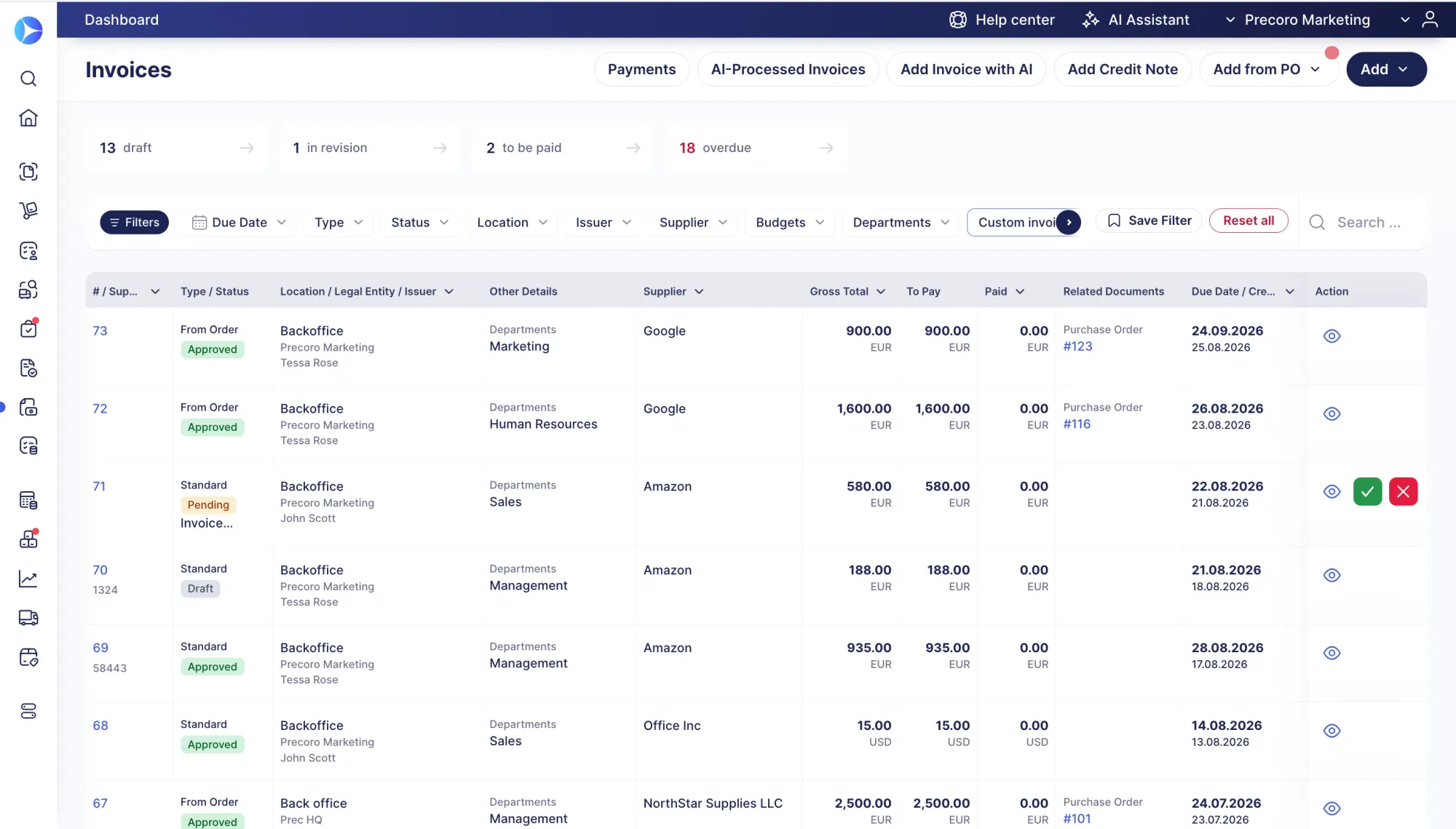
By using the Dashboard or Invoice module page, you can see what actions are required from you and what your invoice's progress is, for example:
- Draft
- Pending
- Matching
- Approved
- Rejected
- Partly paid
- Paid
You can also filter invoice reports by status, date, requester, location, budget, and more.
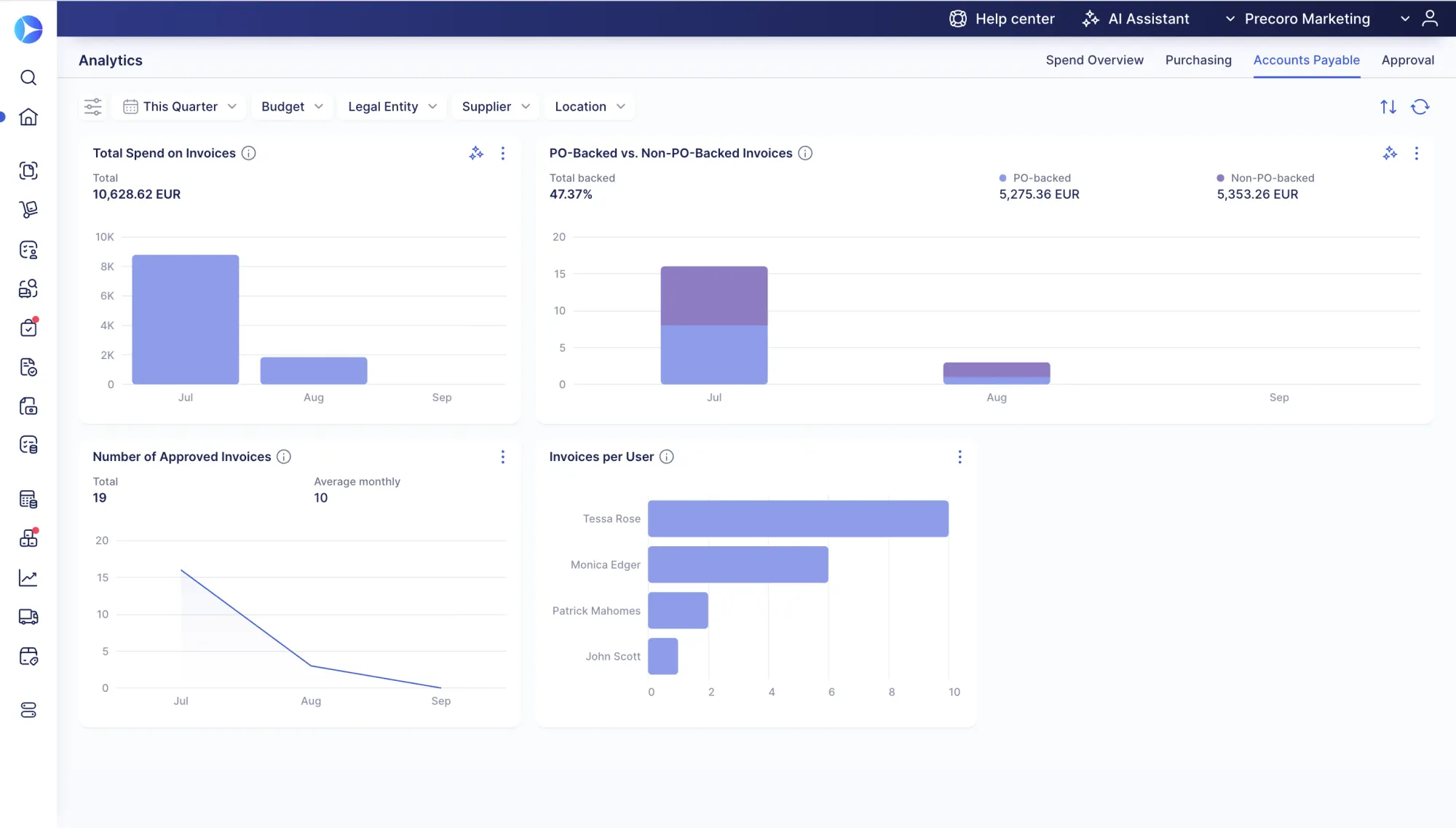
In addition, the Accounts Payable dashboard gives you a real-time view of invoice activity in one place. Track total invoice spend, compare PO-backed and non-PO-backed invoices, monitor approved invoice volumes, and see how many invoices each team member handles. Filter the data by period, budget, legal entity, supplier, or location to quickly spot trends and areas that need attention.
Invoice payments
Once an invoice is matched and approved, you can pay it directly in Precoro instead of switching to a separate banking portal. This keeps the entire process, from purchase request and approval to invoicing and payment, connected within a single workflow.
Precoro supports ACH, same-day ACH, and wire transfers, so you can choose the right method for each supplier. You can also mark multiple invoices as paid at once, while every payment remains linked to the original purchase and approval history.
Most importantly, payment controls start before money leaves the business. Only invoices that have gone through the required matching and approval steps move forward for payment, helping finance teams prevent unauthorized or incorrect payments while maintaining a complete audit trail.
Invoice automation integrations with ERP and accounting software
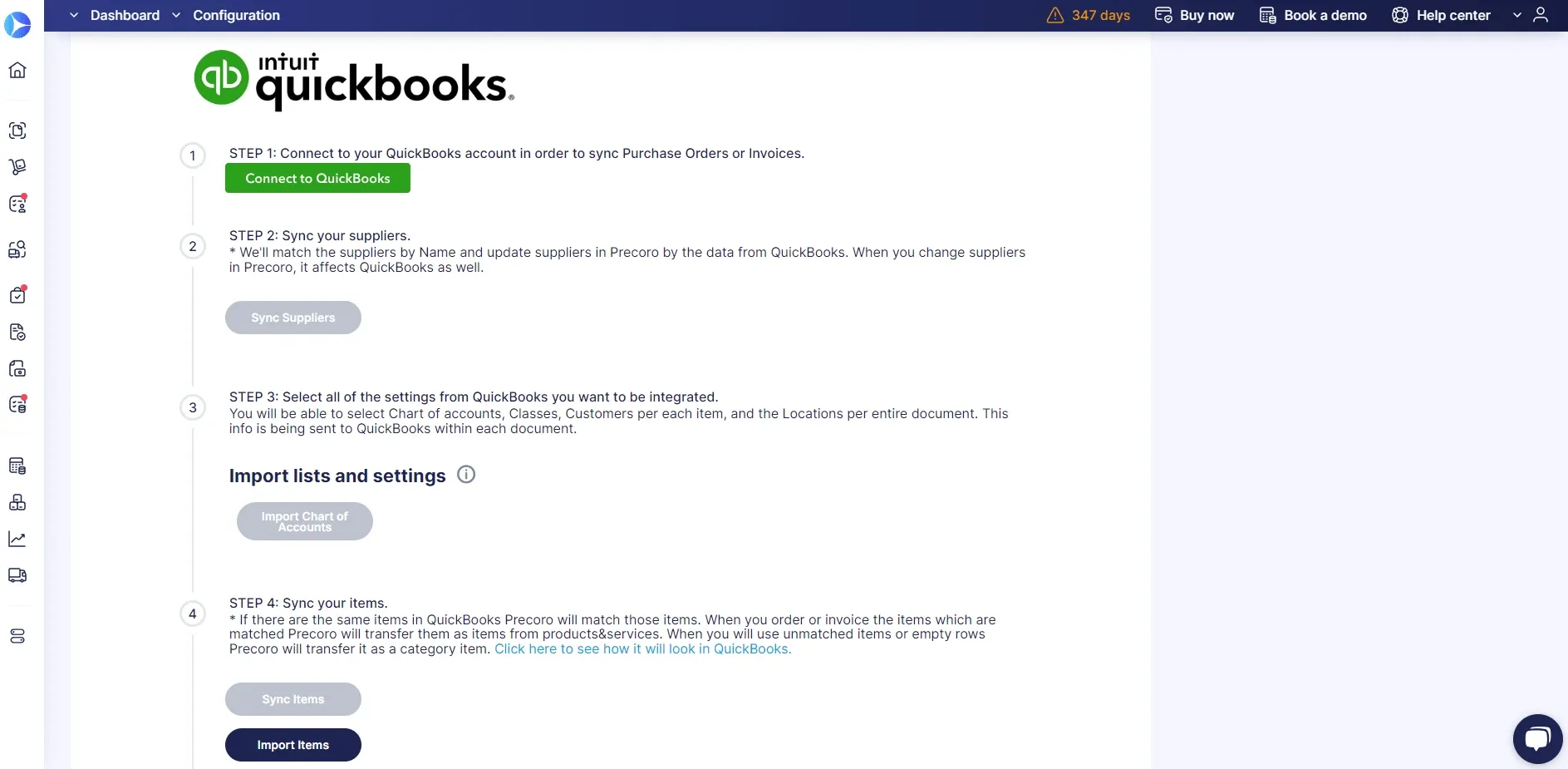
Integration tools help reduce the double-entry of data, improve communication between procurement and accounting teams, and optimize business processes.
With Precoro, you can integrate your invoice processing workflows with any accounting software or ERP, such as QuickBooks, Xero, or NetSuite.
It will allow you to reduce manual entry of invoices, synchronize supplier data, and speed up month-end.

What to consider before implementing automated invoice processing software
We have already discussed how automation helps cope with common accounts payable pain points, the advantages of automated invoice processing, and what features the best process automation solutions have.
Let's also see how you can get the most out of your automated invoice processing implementation.
Analyze your current invoice processing workflow
Before moving to your company's implementation of automation, you should also review what went wrong in the past.
Analyze your invoice handling process and see where inconsistencies, errors, or bottlenecks occurred.
It may also help to answer these questions:
- Who receives bills, and how are they verified?
- In what form do they come in (electronic or paper invoices)?
- How long does it take to process invoices, and who is responsible for that?
- Did you have delays in the invoice payment process? Why did that happen?
Make sure to get a complete picture of your payable process so that you can find the right tool for your business needs.
Centralize and standardize invoice management before automation
Ask your suppliers to send invoices to a single central location or email address.
Also, ensure you capture the invoice data and index bills as soon as they are received.
Then, try to develop clear policies on bill handling:
- What are the matching criteria and tolerances?
- When do you want to take and not take early payment discounts?
- Who may approve invoices within the company, and what is the approvers' hierarchy?
- What happens when discrepancies between incoming invoices and corresponding purchases occur, and what's the resolution workflow?
Knowing exactly how bills should be processed within your company will help you outline processes that the accounts payable automation solution will then automate and streamline.
5 best invoice automation software
How to choose AP automation software? Here is an invoice processing software comparison table. Pricing is as of August 2026.
| Platform | G2 rating | Best for | Key strength | Main limitation | Starting price |
|---|---|---|---|---|---|
| Stampli | 4.6/5 | Mid-market AP teams | Invoice-centric communication and approvals | Limited advanced reporting and data extraction | Custom quote |
| Ramp | 4.8/5 | Companies combining AP and spend management | Corporate cards, expenses, and bill payments in one platform | Less suited to complex AP workflows | Free plan; $15/user/month for Ramp Plus |
| Tipalti | 4.5/5 | Global businesses | International payments and tax compliance | Higher starting cost for smaller teams | About $99/month |
| Precoro | 4.7/5 | Growing mid-market companies | Procurement, AP automation, and budget control for businesses with multiple entities | Fewer native integrations than major enterprise platforms | $499/month |
| Coupa | 4.2/5 | Large enterprises | Comprehensive spend management and analytics | More complex and costly for smaller teams | Custom pricing |
Stampli
Customer ratings
4.6/5 (nearly 1,900 verified reviews), according to several sources, including G2. Named a G2 Summer 2026 Leader in both Procure-to-Pay and AP Automation.
Advantages
Keeps all communication, documentation, and approvals attached to the invoice. Handles purchase orders with reported 97-100% accuracy. Features 70+ pre-built ERP integrations. Easy to use.
Shortcomings
Some users report spending a long time on phone support. Doesn’t allow editing invoices after they’re sent to an approver. Reporting and data extraction are more limited for deep financial analysis. Some ERP sync integrations, like QuickBooks Online, can cause disruptions.
Pricing
Custom quote. Monthly payment without a forced annual contract.
Customer reviews
According to a G2 reviewer, Stampli significantly improved its accounts payable workflow by clearly tracking and automating routing. Based on other reviews, reporting and data extraction are slower than larger finance teams need.
The author's note
Stampli's invoice-centric design solves the "who said what about this invoice" problem. The tool is a go-to option for mid-market teams, as it enables fast adoption without a heavy tech lift. However, larger finance teams looking for deep custom reporting may find it limiting.
Ramp
Customer ratings
4.8/5, according to several sources, including G2 (2,400+ reviews).
Advantages
Fast AI-powered auto-categorization and receipt matching. Combines corporate cards, expense management, and bill payments in a single place. Offers a free tier and initial setup featuring low friction.
Shortcomings
Basic accounts payable and bill-pay functionality. According to some reviewers, workflows are rigid for complex approval chains. Some complain about customer support response times.
Pricing
Free plan for basic automated invoice processing and approvals. Ramp Plus at $15/user/month. Custom enterprise pricing.
Customer reviews
According to a G2 reviewer, invoices sync effortlessly through the Bill Pay service. Based on a Gartner Peer Insights review, transactions needed occasional editing when payment information was entered incorrectly.
The author's note
Excellent for companies looking for spend management and accounts payable combined with corporate cards on a single platform. Teams with complex, high-volume accounts payable should consider whether their bill-pay depth can match a dedicated AP specialist.
Tipalti
Customer ratings
4.5/5 based on several sources, including G2;
4.6/5 on Capterra.
Advantages
Available in 120+ currencies, 190+ countries. Offers a self-service supplier portal for onboarding and payment tracking. Features built-in tax compliance with automated W-9/W-8 collection and solid multi-entity support for subsidiaries.
Shortcomings
Starting price isn’t a good fit for smaller teams. Based on a documented case, implementation required longer time than the vendor's original estimate, which undervalued the importance of early onboarding.
Pricing
The starter plan is about $99/month. The advanced plan is about $199/month.
Customer reviews
According to a review, Tipalti streamlines payment processing for businesses, automating many of the manual tasks.
The author's note
Tipalti comes with global payments and tax-compliance depth. Thus, the tool is great for companies paying international suppliers or contractors at scale. Importantly, your accounts payable should be domestic, where the extra complexity may not pay for itself.
Precoro
Customer ratings
4.7/5, according to several sources, inlcuding G2;
4.8/5 on Capterra.
Advantages
Easy-to-learn interface with strong spend controls built into the purchasing and AP process. Precoro’s AI Crews automate routine work across the invoice-to-pay cycle, including invoice processing, matching, approvals, and payments, so teams can focus on exceptions and higher-value tasks. Budget controls help prevent overspending before invoices arrive, while responsive customer support makes adoption easier.
Shortcomings
Offers fewer native third-party integrations than the largest enterprise platforms. Precoro is designed to work on top of your ERP as a procurement and spend-control layer, rather than replace it.
Pricing
The annual Core plan starts at $499/month, while the Automation plan starts at $999/month. Custom Enterprise pricing is also available. Companies that only need accounts payable automation can choose a standalone AP plan starting at $499/month.
Customer reviews
Based on a G2 review, everything is organized in predictable places. Thus, invoices can be easily recorded, tracked, matched, approved, and paid without extensive training.
The author's note
Precoro is a strong fit for growing mid-market companies that want to automate AP while controlling spend earlier in the purchasing process. Instead of starting control when an invoice arrives, Precoro connects requests, budgets, approvals, purchase orders, invoices, and payments in one workflow. Its AI Crews take on routine invoice-to-pay work, helping teams process invoices faster, spend less time on manual checks, and focus on strategic priorities.
Coupa
Customer ratings
4.2/5 based on several sources, including G2 (560+ reviews);
4.0/5 on Capterra.
Advantages
Comprehensive spending management, invoicing, expenses, and payments on a single platform. Strong three-way matching automation. Mobile approvals. Detailed spend analytics for big companies.
Shortcomings
Interface navigates between modules slowly. Some vendors find the supplier portal confusing, which sometimes delays transactions. Some complain about support response times. Designed for enterprise scale. Pricing isn’t the best fit for smaller teams.
Pricing
Developed for custom enterprises. No published pricing tiers.
Customer reviews
According to a G2 reviewer, the tool is valuable because it allows tracking purchase approvals, invoices, and expenses in a single place. However, switching between modules can be slow.
The author's note
Coupa is suited to large enterprises looking for a single, comprehensive spend-management system. Smaller or mid-market teams should opt for a lighter platform.
Step-by-step invoice automation software implementation roadmap
The invoice automation cycle from selection to full deployment usually takes 6-12 weeks. Specifically, the timeline depends on ERP complexity and the number of entities involved. Here are the steps of automating accounts payable invoice software implementation:
- Document your current workflow. Map the steps from invoice arrival to payment. Document who is associated with each step and what delays happen.
- Identify approval tiers and exception rules. Define auto-approval limits, manager sign-off, and escalation prior to software configuration.
- Clean up vendor and general ledger data. Automation is directly associated with data quality. Thus, messy vendor records lead to messy matching results.
- Select the most suitable platform. Consider transaction volume, entity/currency complexity, and existing ERP to make the right choice.
- Start with one department or entity. See whether the implementation is successful in one department before using the system across the company.
- Integrate with your ERP or accounting system. Apply two-way synchronization for vendor data, general ledger codes, and payment status before going live broadly.
- Train approvers and accounts payable staff. Short onboarding is necessary for any type of software before real adoption.
- Keep exception rates and adjust rules under control. If the first month shows a high exception rate, you need to tune the rules.
- Move on to the other entities or departments. Use lessons learned and the results gained for the remaining departments.
Prerequisites:
Before implementation, ensure documented workflows, clean vendor data, defined approval rules, ERP access, integration resources, stakeholders, and baseline performance metrics.
Measurable success:
Success means faster processing, fewer exceptions, higher straight-through processing, accurate data synchronization, shorter approval times, and measurable AP cost reductions.
FAQ
The answer depends on whether you automate invoice processing or not. Most companies that operate with manual processes spend around $12 per bill. With workflow automation, the cost is $5 or less.
In order to choose the best platform, you must first determine the needs of your business and outline your processes. You can also read product reviews, take advantage of the free trial, or book a demo. The best decision would be to look for a cloud-based platform that provides a transparent pricing policy, regular updates, security features, and excellent customer support.
Non-PO invoices should follow a dedicated approval workflow rather than being blocked or processed without review. The requester can provide supporting information, such as a contract, prior approval, or expense description, and the invoice is routed to the appropriate approver. This creates a clear audit trail even when three-way matching isn't possible.
Automated duplicate detection checks incoming invoices based on vendor name, invoice number, and dollar amount. It reveals near-matches even when a slightly changed invoice is resubmitted. The best systems also check across payment channels to detect duplicates, even if the second copy comes through a different portal or email address.
Conclusion
Automated invoice processing involves a platform scanning, extracting, matching, and validating relevant invoice data and inputting it into your ERP or accounts payable system.
By automating the invoicing process, you eliminate inefficient processes, strengthen regulatory compliance, and significantly reduce the burden on the accounts payable and the finance department.
To see all the workflow automation for yourself, book a personalized demo call with our experts. No commitment, no hidden fees, no credit card required. Just a chance to see why Precoro is so loved by our customers: