









 Explore Precoro's features




















The disruptions and financial volatility of the past few years made procurement the critical frontline that protects your company’s resilience. Third-party management carries far greater pressure than before. Regulations tighten their noose each year, the inflation pendulum swings between high and low rates, and geopolitical ties grow tenser as new conflicts shake the globe.
Companies now have to balance three priorities:
- Make sure purchases are cost-effective
- Ensure supply chains are continuous and have contingency plans
- Maintain control over third-party relationships
These pressures have completely changed how companies think about governance. What once looked like only an internal checkbox now demands more attention. Procurement teams have to meet both internal and external regulations and anticipate disruptions that could derail operations. In other words, they must manage compliance vs. risk management across an increasingly complex supplier ecosystem.
Both should work together, not against each other. Compliance enforces controls; risk management identifies and prevents threats that require these controls. If kept in silos, all warning signs will be hidden and can resurface as far more damaging financial losses or disruptions.
Key takeaways:
- Compliance is binary: procurement must follow required rules and document every purchase and supplier decision.
- Risk management mitigates vulnerabilities that aren’t always covered by existing policies, so procurement can plan for any disruptions.
- GRC connects governance, risk, and compliance in a single framework, but it often becomes rigid and stops at checklists and internal audits.
- IRM builds on GRC with an integrated risk view, continuous monitoring, and technology-driven workflows across teams.
- Compliance KPIs reflect past and current performance, while risk management KRIs serve as early warnings to prevent future incidents.
Below, we break down what separates compliance vs. risk management, where they overlap, and why the GRC framework falls short when compared to an IRM system.
What is compliance?
Compliance is a process that ensures the organization meets required rules and can provide documentation or other evidence as proof. These rules can depend on the industry or country in which the company operates, as well as the size of the business. Mainly, they’re enforced by regulators, industry bodies, the internal leadership team, and by customers themselves, who require certain standards before buying from the business.
Procurement compliance primarily revolves around purchasing and asks one simple question:
Did we follow the requirements we agreed to when making this purchase?
The answer to this is always either “yes” or “no”, which also makes compliance inherently binary. You either followed the regulations or you didn’t; there’s no in-between.
Most regulatory compliance is mandatory. You can’t opt in only when it feels convenient. If a law applies to your company, it must be incorporated into your purchasing and supplier partnership policies.
Some see adherence to policies as reactive, which isn’t entirely true. In a way, procurement compliance primarily responds to rules set by external parties, such as leadership or regulatory bodies. Certain obligations are imposed on the company both as a customer and as a vendor (if it provides goods), and it responds by enforcing controls to ensure they’re followed.
The scope and types of compliance
The general definition of compliance basically means following and enforcing obligations. But the approach and the main focus depend entirely on the rules your team should comply with. This function covers:
- Legal and regulatory compliance: Rules set by governments and regulators. This category includes obligations that apply to most businesses, regardless of industry. For example, the General Data Protection Regulation (GDPR) or the LGPD (Lei Geral de Proteção de Dados Pessoais) applies to any organization that handles personal data in the EU or Brazil, or sells goods or services to people there. Similarly, the Securities and Exchange Commission (SEC) imposes certain financial reporting requirements on companies operating in the US.
- Industry compliance: Standards that apply because of your sector or the type of data you process. Key industry players or regulatory compliance bodies often enforce these regulations. Examples include the Payment Card Industry Data Security Standard (PCI-DSS) and the Health Insurance Portability and Accountability Act (HIPAA). PCI-DSS isn’t a law, but it’s an industry standard set by payment brands like Visa and Mastercard. HIPAA, on the other hand, is a federal law, but it’s mainly used in sectors that process personal health information.
- Corporate compliance: Obligations set in your organization. Any procurement policies, segregation of duties, code of conduct, approval thresholds, and vendor onboarding rules fit in this category. These requirements define how your organization expects people to work.
- Contractual compliance: Requirements your company agrees to in a contract with another party. The country’s laws set some of these rules, such as employees’ PTO, minimum wage, and invoice mandates, but contracts are negotiated between the parties.
- Environmental and sustainability compliance: Rules that apply to how the company’s operations and sourcing impact the environment and the community. They’re often related to emissions, waste disposal, chemical use, and environmental reporting. All stakeholders now expect organizations to demonstrate that their supply chains follow responsible practices through frameworks like ISO 20400 and the Corporate Sustainability Reporting Directive (CSRD). The first is a standard for organizational sustainability practices, while the second requires disclosure of sustainability and environmental data.
What is risk management?
Risk management is a strategic practice used to identify and mitigate potential disruptions that could harm the company’s assets or goals. Leadership, together with key stakeholders, such as department heads or specialized teams, develops a contingency plan or risk mitigation strategy.
Governmental or regulatory bodies aren’t involved in the process; it’s typically internal. However, established frameworks such as ISO 31000 can help organizations unfamiliar with risk mitigation establish their first workflow.
ISO 31000 is an international risk management standard that gives organizations a practical set of principles and guidelines for how to identify, assess, treat, monitor, and communicate risk. It’s broad by design, so any organization can use it to build a consistent process and embed risk into governance, strategy, planning, and daily operations.
Procurement risk management essentially comes down to one simple question:
What issues could derail our plans for this period, and what can we do to prevent them?
The team identifies anything that could interrupt the purchasing process (price spikes, supplier bankruptcy, inflation, geopolitical unrest), assesses the likelihood and criticality of each, and develops a plan to mitigate them. Because there’s no straightforward answer and the success of mitigation depends on the likelihood of disruption, risk management is by nature probabilistic.
Certain threats require immediate attention, while others can be shelved. Risk mitigation is strategy-based: whatever your main goal is, whether it’s savings or supply continuity, it’s going to define how you treat the issue your company encountered.
Trade-offs are inevitable when dealing with risks, since almost every transaction carries some potential issues. Eliminating them isn’t the final goal; mostly, businesses focus on those that could cause the most damage or provide the biggest benefits if managed.
What is Enterprise Risk Management (ERM)?
Enterprise risk management (ERM) is an organization-wide approach to assessing and managing risks strategically across all entities and functions within the company. Contrary to the traditional approach, where each department handles its own bottlenecks, this framework aligns them with the organization's strategy.
Enterprise risk management begins at the executive level, where leadership sets the overall direction for the program, the risk types, and thresholds of disruptions the company is willing to accept.
The gold standard for ERM is the COSO framework, an enterprise risk management approach that helps organizations connect risk to strategy and performance. It recommends defining risk appetite, identifying and assessing major exposures, and monitoring them, so risk management supports business objectives. The COSO framework essentially builds potential disruptions directly into the company’s goals and decision-making.
What is risk appetite and risk tolerance?
Risk is inevitable. Companies can’t prevent every disruption, but they can decide which risks they can reasonably accept and to what extent.
Risk appetite is a concept that determines the type and amount of risk a business is willing to accept to achieve its goals. For instance, a company may accept higher supply risk to launch faster, or accept higher cost to protect continuity.
Risk tolerance, on the other hand, sets boundaries on how much risk the business can undertake. In the same continuity scenario, the procurement team can accept an unexpected price hike for critical supplies but not for non-essential ones.
7 key differences between compliance and risk management
Compliance vs. risk management may sound similar on paper, but they follow a different logic. Compare how each works in everyday operations based on their purpose, scope, and operating model.
| Aspect | Compliance | Risk management |
|---|---|---|
| Primary driver | Mostly driven by external requirements such as laws, regulations, and stakeholder expectations. | Usually starts internally based on strategy and priorities. |
| Approach | Prescriptive. Follows defined rules; controls are updated when regulations change. | Predictive. Anticipates possible disruptions and prepares in advance. |
| Objective | Preserve value by avoiding fines, penalties, and legal exposure. | Protect and support value by reducing disruptions and maintaining stable operations. |
| Measurement | Binary. Requirements are either met or not met. | Probabilistic. Success depends on likelihood, impact, and preparation. |
| Timing | Periodic. Often tied to audits, reviews, or renewals. | Continuous. Requires ongoing monitoring because risks change quickly. |
| Operating model | More often centralized under a dedicated compliance team. | More often distributed, with ownership spread across functions. |
| Scope | More tactical in day-to-day work, with some strategic input. | More strategic, but also includes tactical monitoring and response. |
1. Motivation: External vs. internal
Compliance is primarily driven by external influence, meaning regulatory compliance bodies or stakeholders outside the organization dictate the requirements you must comply with. Companies also introduce internal policies, but most obligations originate outside the business.
Risk management, on the other hand, usually starts inside the organization. The company looks at its business strategy, evaluates potential risks, and prioritizes them. Stakeholders can join from the outside, like suppliers or investors, and work together on a solution.
2. Approach: Prescriptive vs. predictive
Compliance programs tend to follow a prescribed playbook. If a new law is introduced or changes, the company updates its policies and controls to align with them. All regulations that apply to the business should be followed—you can’t pick and choose which ones to comply with.
Risk management, on the other hand, looks ahead and anticipates potential disruptions to the market, the economic climate, and the supply chain. It estimates which risks are more likely to hit your company and which ones are inevitable. The function essentially asks: if something did happen, even if it’s unlikely, does the organization have enough guardrails to soften the blow?
Scenario analysis and procurement forecasts are often used during this stage. The team evaluates different possibilities, such as whether the supplier can deliver the goods if certain shipping routes become unavailable.
3. Objective: Protect value vs. create value
Both compliance and risk management aim to protect the business. Compliance shields the organization from legal and reputational damage and prevents violations that lead to fines or regulatory action.
Risk management safeguards the operational part of the business from disruptions, financial losses, and any other failures. Its goal is to make sure operations remain stable even with risks involved. Organizations then understand exactly the degree of exposure and risk they’re facing and don’t have to halt approvals or any other function to investigate a new bottleneck. All risks are mapped out, and you only need to follow the correct procedure to prevent them.
4. Measurement: Binary vs. probabilistic
You can easily determine whether you’re staying compliant. Any audit or due diligence check will produce one of two results, positive or negative. Compliance is binary because certain requirements are either met or not. Even if you meet most requirements, one missed obligation still means you’re not fully compliant.
When you compare compliance vs. risk management, measuring the latter isn’t as straightforward. Instead of a yes-or-no answer, risk teams estimate likelihood and impact. They assess how probable an event is and how severe the consequences might be. For example, a supplier disruption might have a low probability but a catastrophic impact, leading the company to still develop a contingency plan.
5. Timing: Periodic vs. continuous
Compliance checks often occur at specific moments and are scheduled throughout the company’s processes. Think about internal audits, onboarding reviews, vendor due diligence checks, and certification renewal—all of them happen on defined dates set either by the regulator or leadership.
Risk management, on the other hand, doesn’t follow a calendar. If it’s well developed within the company, it should have regular assessment sessions and specialists who continuously monitor the market environment and its suppliers. Conditions and risks change quickly, so a review once every two months won’t be enough.
6. Operating model: Centralized vs. decentralized
Almost 67% of organizations follow a centralized compliance model: they have a dedicated team that enforces controls under regulations and monitors for violations. Around 23% prefer a decentralized approach, with specialized compliance programs within each department that handle specific areas.
The latter approach is more common in risk management, with KPMG reporting that 52% of companies manage their risk and resilience through a decentralized structure. That said, only 36% are coordinated across most functions, leaving silos in the others. That means most risk mitigation initiatives are typically spread across the organization with multiple stakeholders on the board, leadership, and operational levels. However, risk management is also centralized in 48% of organizations, so opinions on the best operating model are divided.
Because compliance relies on clear rules and defined obligations, it’s easier to centralize under one team. When separate departments manage compliance independently, they may overlook cross-functional requirements or make changes without informing others.
Risks occur in different departments, across procurement, IT, and production, so ownership is naturally more distributed. Even with a centralized team, risk still has to be managed close to the source where it appears.
7. Scope: Tactical vs. strategic
While both compliance and risk management have their tactical and strategic features, at its core, compliance is mainly tactical. It has a pre-planned structure of regulations, each of which has defined requirements, scope, and enforcement controls.
Its strategic side comes into play when the company considers expanding into new markets, opening a new entity, or sourcing from a new supplier. In these situations, compliance teams must analyze and inform stakeholders which regulations will be enforced on the business after the fact.
A fair share of mitigation work is strategic. Each risk prevented has to help the company achieve its objectives, with executive-level approaches like enterprise risk management (ERM) embedding disruptions directly into strategy. Such frameworks consider the entire vendor landscape and external factors beyond the company walls, such as the market, global cyber threats, climate issues, and fraud risk.
Where compliance and risk management overlap
Despite clear differences between compliance and risk management, they rely on the same foundation: to protect operations and ensure stability, so the business can continue working towards its key objectives. Here are the three biggest areas where these two intersect.
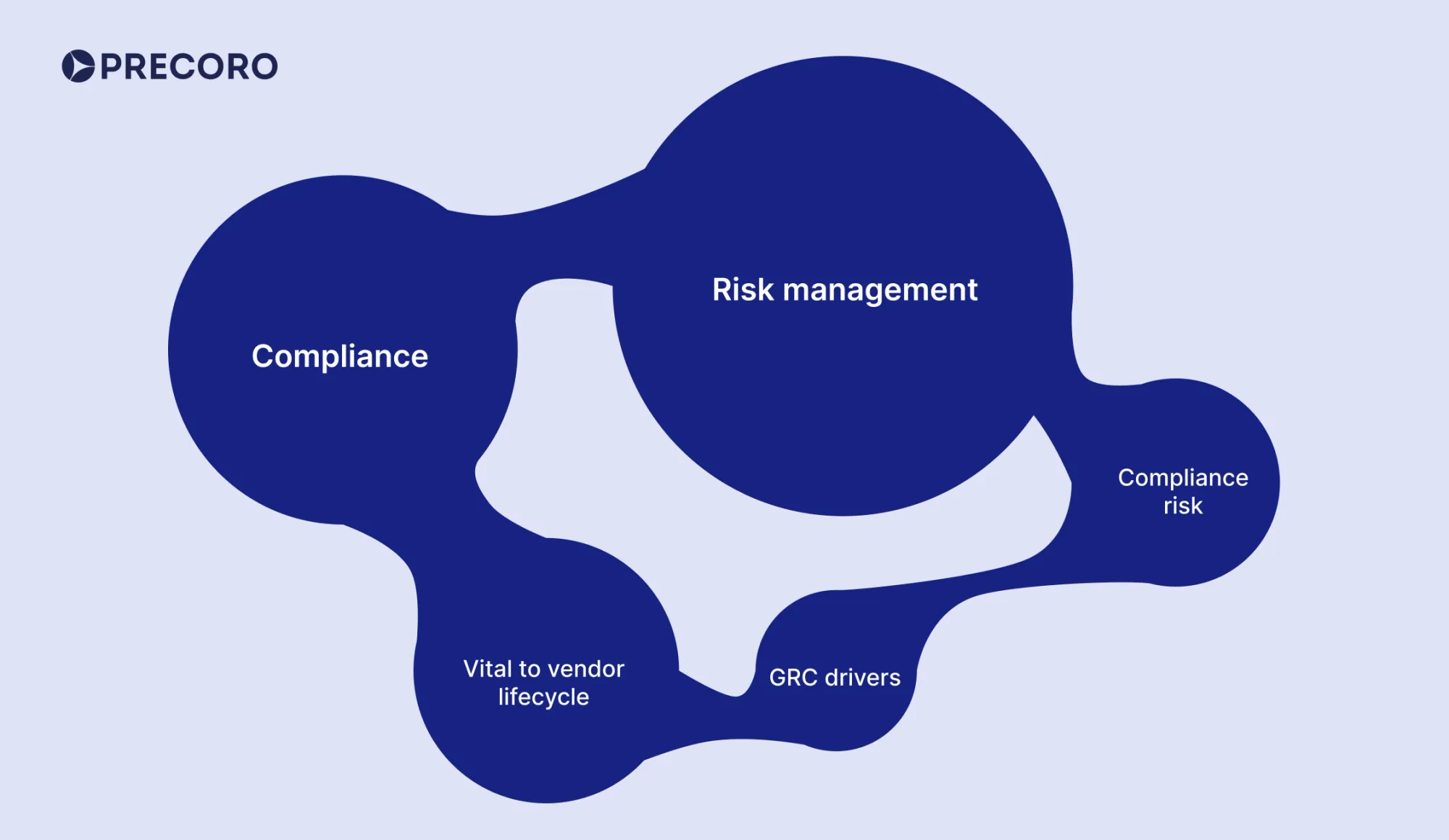
1. Both are GRC drivers
GRC (Governance, Risk, and Compliance) is an integrated management approach that embeds compliance, risk management, and governance into processes across the organization. Its purpose is to address any uncertainty while helping achieve objectives, which is a core part of what is risk and compliance in practice. This system breaks down organizational silos by giving teams visibility into what happens across other functions.
A GRC framework relies on three key branches:
- Governance establishes a framework of rules and standards that the company relies on in its operations.
- Risk management identifies potential disruptions and actively develops solutions to prevent them or minimize their impact.
- Compliance ensures that the business follows the rules it’s required to follow, both externally and internally.
Both compliance and risk management turn rules set by governance bodies into an actionable framework. Compliance enforces controls across the company’s operations in line with the governance guidelines. For instance, if vendor due diligence is required, it ensures the right checks and documentation are completed before onboarding.
Risk management, in turn, prioritizes uncertainties based on those same objectives. If the company aims for complete supply continuity, it evaluates which suppliers, regions, or logistics routes carry the highest risk and plans contingency plans around them.
2. Compliance risk management as a subset
Compliance risk management is the mitigation of any regulatory and legal repercussions or financial and reputational damage due to non-compliance. Financial penalties are especially harsh and have nearly quadrupled in the first half of 2025, with global fines costing companies $14 billion.
Compliance risks behave no differently than other risks. They also have triggers, a likelihood of occurrence, and an impact on business operations. As with other disruptions, they can escalate quickly into long-standing legal disputes or costly fines without controls.
Vendor relationships are especially vulnerable to violations, since they involve a third party that you can’t necessarily control (but can verify beforehand). Examples of compliance risk include:
- A missed approval violates internal policy and results in an unsanctioned purchase.
- Unorganized documentation causes gaps in reporting.
- The supplier didn’t update the necessary certification during your partnership.
- Either the company or the supplier violates contractual obligations.
Most of these issues trace back to weak compliance risk management practices. The biggest culprit is the siloed environment that companies unwillingly build. Scattered documents and tools accessible only to select teams increase the risk of violations of the defined rules.
Let’s review an example of compliance risk. Before implementing Precoro, Riverstone Logistics had to deal with fragmented purchasing across NetSuite and in-house tools, which created gaps in the internal audit trail and confusion among employees. With Precoro, they removed these silos and centralized procurement across 80+ locations.
3. Both are vital to the vendor lifecycle
Compliance and risk management also share a home: the vendor lifecycle. The overlap starts long before a contract is signed and doesn’t end after onboarding. Here’s what role both play in each step of the vendor management lifecycle.
- Needs assessment: Compliance defines any regulatory or policy requirements the supplier must meet from the start. Risk management identifies potential disruptions to the procurement of supplies.
- Vendor research: Compliance checks whether potential vendors meet requirements, while risk mitigation reviews whether the vendor shows signs of financial, operational, geopolitical, or other threats.
- Vendor selection: Compliance confirms that the selection process follows internal policies and that required checks are complete. Risk management compares suppliers based on the degree of exposure.
- Contract negotiation: Compliance makes sure the contract includes required legal and regulatory terms. Risk mitigation uses the contract to build protections, such as audit reviews, incident-reporting obligations, and SLAs.
- Vendor onboarding: Compliance collects and verifies the documents needed to approve the supplier. Risk management assigns the supplier a risk level and sets the right degree of oversight based on that profile.
- Performance management: Compliance checks that the supplier continues to meet contractual and policy requirements over time. Risk management monitors service quality, delivery issues, and other indicators of potential operational risk from the supplier.
- Offboarding or renewal: Compliance ensures the company follows the correct process for contract closure, renewal, recordkeeping, and any remaining obligations. Risk management decides whether the supplier is still safe and viable to keep, or whether the company should exit the relationship.
The vendor lifecycle shows that these two concepts are connected by design. That goes beyond supplier management and extends into procurement, supply chain, and legal. Split compliance vs. risk management into silos and you get even more gaps that increase violations and risks. The best way to combat fragmented structure is through Integrated Risk Management (IRM), an upgraded version of GRC.
How IRM brings risk and compliance together
Integrated risk management (IRM) is an organizational discipline that provides a company with an integrated view of risk across the entire organization, supported by connected processes, best practices, and technological solutions.
Contrary to a similar framework, enterprise risk management (ERM), which is typically positioned as a top-down approach, IRM begins at the operational level and provides centralized visibility of risk across all levels.
The table below showcases best practices in integrated risk management and the core benefits companies see after implementing them.
| Key IRM practice | Benefits |
|---|---|
| Use one risk taxonomy and scoring method across teams | Standardized categorization allows departments to exchange insights and compare risks without debate or misinterpretation. |
| Set risk appetite and add decision thresholds | Teams know when to accept risk, escalate it, or block a decision based on defined tolerance. |
| Create an integrated view of exposure across departments | Leaders gain full visibility into risks across functions without blind spots. |
| Monitor key risk indicators (KRIs) continuously | Teams detect early warning signals and act before small issues escalate into incidents. |
| Link risk signals to workflows with clear ownership and deadlines | Risks move into action: owners are assigned, actions tracked, and remediation deadlines enforced. |
What is the difference between IRM and GRC frameworks?
In theory, traditional GRC is positioned as a unified framework of governance, risk management, and compliance; however, in practice, it’s often policy-first. GRC focuses on checklists, internal audits, and proving that your company actually stays compliant both internally and in its supply chain.
That approach still has weight, but in a world where risks are everywhere, from suppliers to cyber threats, simply following a prescribed playbook isn’t enough to prevent potential issues. In fact, 69% of companies find that their current GRC frameworks won’t support their future objectives. They need a more holistic model that would ensure overall compliance and also prepare all departments for unexpected risks.
GRC typically falls short in two areas: technology and strategic foresight. 42% of leaders report that their use of GRC solutions needs improvement. Most solutions of this kind primarily promise targeted risk assessments and compliance tracking, but overlook features that would help forecast and prevent disruptions. In contrast, integrated risk management often relies on insights from predictive analytics or AI-powered monitoring across entities or departments.
Tools like scenario planning and stress testing are also underused in GRC frameworks since their main focus is on present regulations. IRM aims to tackle existing risks but also forecast future ones to prevent them from snowballing into bigger issues.
Should I replace GRC with IRM?
GRC is still an effective framework that could deliver a lot of value, especially if you’re struggling with compliance. It standardizes how the company sets rules and ownership and proves employees are staying compliant. Since GRC is primarily compliance-focused, IRM can be an upgrade to the risk component of the GRC framework. The latter can provide connected, technology-driven data with continuous monitoring across teams, while the former serves as a governance and compliance structure.
Compliance KPIs vs. risk management KRIs
Whether you’re relying on GRC, implementing IRM, or mixing both, evaluate each practice on its own and measure performance with clear indicators. Compliance relies on KPIs that show how effectively the company follows its policies and whether current efforts are achieving the desired results. Risk management, however, gets more use out of key risk indicators (KRIs), which can point you to vulnerable areas in the organization.
10 key performance indicators (KPIs) to measure compliance
Policies alone can’t prove you’re compliant, but certain KPIs can. Instead of focusing on theory, they show what worked or didn't in practice. We’ve narrowed the list of metrics to those that apply to most companies, regardless of size or industry.
| KPI | What it measures | Formula |
|---|---|---|
| Mean Time to Issue Discovery (MTTD) | The time it takes to detect a compliance issue after it occurs. | MTTD = Total detection time / Number of incidents |
| Mean Time to Resolve (MTTR) | The time it takes to fully resolve a compliance issue after detection. | Mean Time to Resolve = Total resolution time / Number of issues resolved |
| Mean Time to Respond (MTTR) | The time it takes to begin responding once an incident is identified. | Mean Time to Respond = Total response time / Number of incidents |
| Compliance training completion rate | The percentage of employees who complete required compliance training. | Compliance training completion rate = (Employees who completed training / Employees assigned required training) × 100 |
| Policy implementation rate | The percentage of policies implemented to align with regulatory compliance or internal updates. | Policy implementation rate = (Number of implemented policies / Total required policies) × 100 |
| Policy read rate | The percentage of employees who formally acknowledge required policies. | Policy read rate = (Employees who read policies / Employees required to read them) × 100 |
| Post-training policy violations | The number or percentage of violations that continue after employees complete training. | Policy violations post-training rate = (Number of violations after training / Total trained employees or total post-training violations reviewed) × 100 |
| Audit pass rate | The percentage of audits completed without non-compliance findings. | Audit pass rate = (Audits passed / Total audits conducted) × 100 |
| Processes with up-to-date documentation | The percentage of processes that have current and accurate documentation. | Processes with up-to-date documentation = (Processes with updated documentation / Total processes requiring current documentation) × 100 |
| Total regulatory compliance expense | The funds spent on non-compliance, including fines, legal fees, and settlement costs. | The sum of all compliance-related costs for that period. |
10 Key Risk Indicators (KRIs) for risk management
Compliance KPIs help you run a disciplined program, but they can also create a false sense of safety. Even if your training completion rate is 95%, your company can still suffer from off-contract spend or supplier delays. Enter key risk indicators (KRIs), which help detect risk before it turns into a disruption or a compliance incident. Regularly measure the following metrics to see warning signs just in time.
| KRI | What it measures | Formula |
|---|---|---|
| Phishing click rate | The percentage of users who click a phishing email or fail a phishing simulation. | Phishing click rate = (Number of users who clicked / Total number of users who received the phishing email) × 100 |
| Liquidity ratio | The organization’s short-term payment capacity against current obligations. | Liquidity ratio = Current Assets / Current Liabilities |
| Unresolved Corrective and Preventive Actions (CAPAs) | The total number of CAPAs that are open at a point in time. | Unresolved CAPAs = Number of CAPAs still open at the end of the reporting period |
| System downtime rate | The amount of time systems are unavailable due to outages or disruptions. | System downtime rate = (Total downtime / Total scheduled system time) × 100 |
| Supplier delay rate | The percentage of deliveries that arrive late versus the agreed delivery date. | Supplier delay rate = (Number of late deliveries / Total number of deliveries) × 100 |
| Percentage of vendors without assessments | The share of third parties that haven’t completed a required risk or compliance review. | Percentage of vendors without assessments = (Number of vendors without a completed assessment / Total number of vendors) × 100 |
| Certification expiry lead time | The number of days before a required certification expires. | Certification expiry lead time = Certification expiration date − Today’s date |
| Days of Inventory (DoI) | The number of days current inventory can cover expected demand, indicating risk of stockouts or overstock. | Days of Inventory (DoI) = (Ending Inventory × Number of Days in Period) / Total Units Used |
| Budget variance | The gap between budgeted and actual spending in a given period. | Budget variance = Actual Amount − Budgeted Amount Percentage = (Actual − Budget) / Budget × 100 |
| Supplier concentration rate | The share of total spend tied to a single supplier, or a small group of suppliers. | Supplier concentration rate = (Spend with one supplier / Total supplier spend) × 100 |
Here’s an example of where KRIs and KPIs intersect. A growing backlog of unresolved CAPAs can warn the company before its audit pass rate worsens. If corrective actions remain open for too long, known issues are more likely to show up again during an internal audit.
3 steps to IRM: How to integrate risk management and compliance
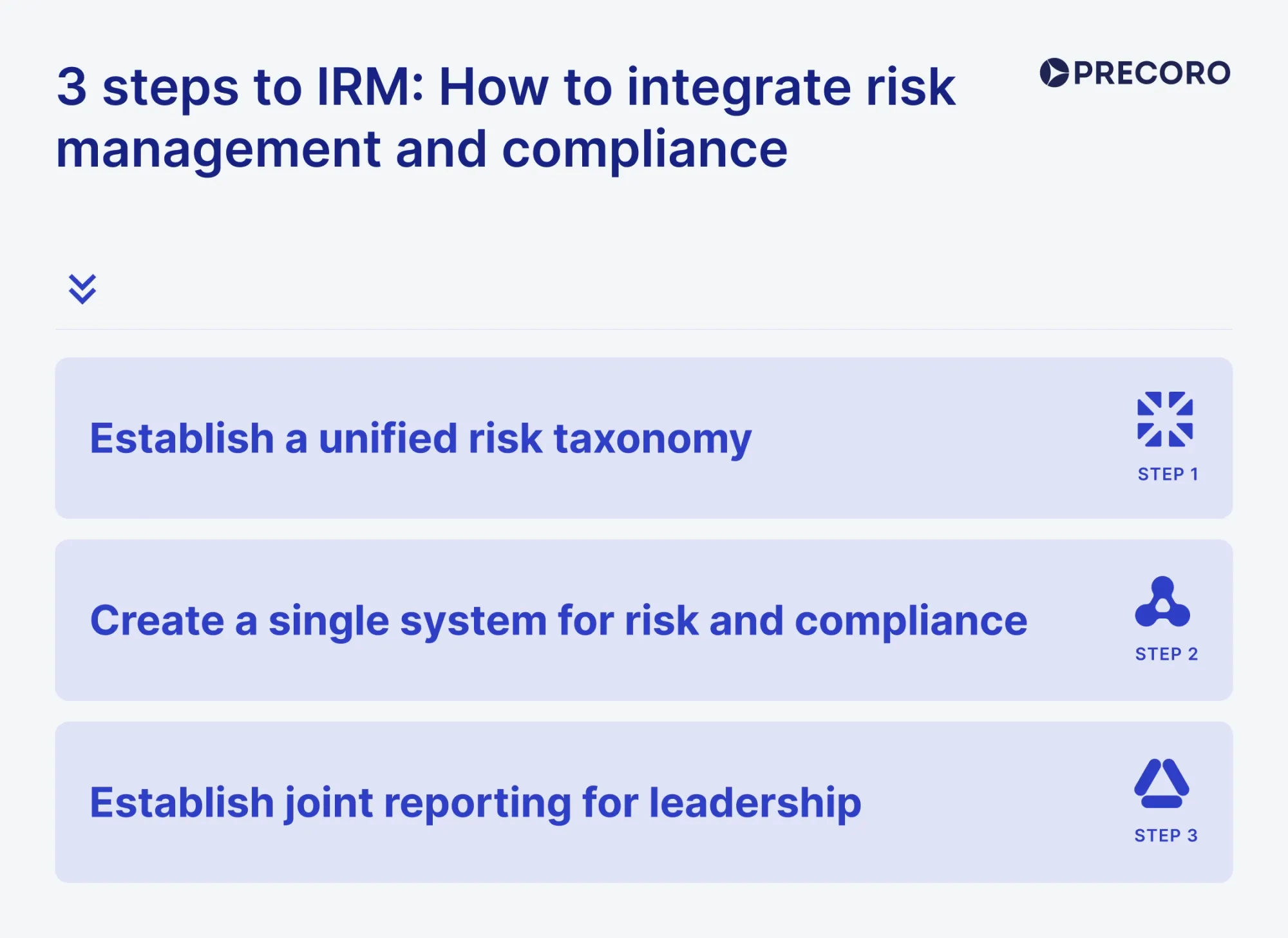
To bring compliance and risk management together, you need a solid centralized structure that both teams can work with. Before adding software like Precoro or your own in-house solution, establish standardized guidelines and reporting lines for both functions, along with collaboration opportunities. The goal is to give both the same terminology, visibility, and decision-making framework. Below are three key steps you can take on a path to integrated risk management:
1. Establish a unified risk taxonomy
In many organizations, compliance and risk teams use different terms for similar incidents. One team may classify a supplier data issue as a policy violation, while the other sees it as an operational risk. Both functions prioritize the threat differently and will take their own course of action.
To solve this problem, create a unified risk taxonomy—a single classification source that defines key risk categories, the threats under them, criticality ratings, general ownership, and escalation rules. For example, both teams should agree on what counts as regulatory or operational risk, on compliance risk management, and on the criteria for low- and high-critical disruptions. With this approach, compliance and risk mitigation stay aligned on the correct course of action even without directly collaborating.
2. Create a single system for risk and compliance
If compliance risks are filed in one spreadsheet and supplier disruptions are recorded in another, you’re bound to see some gaps in monthly reports or even the mitigation strategy. Set up a shared register for both teams to document potential threats and upcoming compliance obligations, and align on them.
What that system should look like depends on the size and workflow of your company. Small teams will manage with a single spreadsheet or a project management platform. Fast-growing organizations, however, might benefit from specialized tools like IRM software or, if their goal is to target procurement-related risk, centralization and automation platforms like Precoro.
That doesn’t mean that risk and compliance become the same function. They simply work from the same record, so any threat or policy breach has enough context. Leadership can also spot patterns across business units, suppliers, or locations instead of reviewing fragmented updates.
3. Establish joint reporting for leadership
If ERM is your main mitigation framework, board-level reporting should include all required context from both functions, not position it as a compliance vs. risk management debate. Leaders set risk appetite, thresholds, and overall direction the company will take to avoid disruption, so reports should show how regulatory compliance obligations, controls, vendor exposure, and operational risks connect.
Executives increasingly favor joint dashboards or real-time reports that clearly show KPIs, KRIs, open issues, overdue actions, and emerging risks. Rather than staying static, these tools give directors a clearer picture of where risk is rising and where management must respond.
Want more practical advice? Join our tips and tricks email series for helpful guidance and proven procurement strategies.
Final thoughts
Procurement now carries the weight of resilience. Cost pressure, disruption, and tighter rules force teams to control spend, protect continuity, and keep third parties in check at the same time. Compliance vs. risk management should work together, not against each other. Compliance provides a baseline of required steps and clear guidelines for employees to follow. Risk management goes further and reviews multiple external and internal factors that could harm the business.
Gaps in reporting, compliance, and operations quickly grow when these two functions are separated. That’s why integrated risk management is a natural upgrade path for most companies. It gives a single view of exposure, shared ownership, and KRIs that warn you before compliance KPIs drop.