AI Procurement Software: How to Find the Best AI Procurement Solutions
Learn what AI procurement software is, how it works, and how to choose the right tools. Explore leading AI procurement solutions for modern businesses.

In the current business world, where speed and efficiency are critical to being successful and staying competitive, the traditional approach to procurement is gradually becoming less effective.
As companies begin to scale and procurement becomes more complex, there is a growing need for a more structured and efficient system that helps to manage purchasing, suppliers, and spending more effectively, with minimal manual effort.
This is where Artificial Intelligence (AI) comes in. In recent times, there have been several developments in AI-driven procurement systems that automate procurement workflows, improve decision-making, and enhance the overall efficiency of businesses.
In this article, we’ll give a comprehensive overview about AI procurement software and how to find the best AI procurement solutions for your specific business needs.
Keep reading to find out:
What AI procurement is, and why it matters for modern procurement systems
Core features to look for in AI tools for procurement
Leading AI procurement tools and platforms on the market today
Top AI procurement leaders in 2026
How to evaluate and compare the best AI procurement software
How do you implement AI procurement software successfully?
Costs, ROI, and pricing models
Security, privacy, and compliance considerations in AI-driven procurement
Key takeaways
FAQ
What is AI procurement, and why does it matter for modern procurement systems?
What is AI procurement, and how does it differ from traditional procurement?
AI procurement can be described as the use of artificial intelligence (AI) technology to improve and automate procurement processes, making them faster, more accurate, and more efficient.
Unlike traditional procurement, which is dependent on manual input and reactive decision-making, AI procurement makes use of data, machine learning, and automation to direct how businesses source, purchase, and manage suppliers. Its use, therefore, helps organizations create a more strategic and proactive system of handling their procurement activities.
AI procurement is important because it helps to improve visibility, reduce inefficiencies, and support better decision-making. As organizations scale, processes such as managing suppliers, controlling costs, and maintaining efficiency can become complex and challenging. AI procurement systems help businesses to simplify these activities by processing large amounts of data, identifying patterns, and providing actionable insights in real time.
What are AI procurement solutions, and how do they transform procurement processes?
AI procurement solutions are software tools and platforms that use artificial intelligence to automate, optimize, and improve procurement activities such as supplier sourcing, purchase approvals, spend analysis, contract management, and vendor communication across an organization.
These solutions work to transform procurement processes by reducing the reliance on manual tasks and introducing more intelligent, data-driven workflows. For instance, instead of handling activities such as supplier selection, purchase approvals, and spend analysis manually, AI procurement solutions can automate and carry out these tasks faster and with better accuracy.
AI procurement solutions also help to improve how decisions are made during procurement through data analysis. Depending on the procurement activity, AI procurement solutions can analyze historical data, identify patterns, and provide businesses with insights that help them choose more reliable suppliers, control costs more effectively, and plan procurement activities with better precision.
Additionally, these solutions help procurement teams to improve their overall efficiency by simplifying workflows that usually require large human input and reducing delays that are common in traditional procurement systems. This advantage also allows procurement teams more time to focus on more strategic activities rather than the routine administrative tasks.
Essentially, AI procurement solutions transform how procurement is managed by making the workflow more structured, efficient, and aligned with the overall goals of the organization.
How do procurement AI tools improve procurement workflows and operations?
Procurement AI tools improve procurement workflows and operations significantly by making the activities run faster in a more precise and consistent way.
One of the main ways that these tools achieve this is through automation. It works by handling procurement tasks such as purchase requests, approvals, invoice processing, and supplier communication with minimal manual input, reducing delays and improving overall workflow efficiency.
Procurement AI tools also improve accuracy by reducing human errors. AI tools are built to rely on data and predefined rules, which enable them to ensure that the procurement activities follow consistent standards. As a result, they minimize mistakes in pricing, order quantities, supplier selection, and other important procurement areas where human error is more likely to occur.
Additionally, procurement AI tools improve visibility across their different operations. They achieve this by centralizing data and providing real-time insights that allow businesses to monitor their spending, keep track of supplier performance, and identify inefficiencies more easily.
Why are organizations adopting AI in procurement now?
Organizations are increasingly adopting AI in procurement because the demands of modern procurement have become too complex for traditional methods to efficiently handle.
As businesses expand and supply chains become more dynamic, the processes involved in managing suppliers, controlling costs, and maintaining efficiency require faster and more informed decision-making.
Another major reason for the adoption of AI in procurement by organizations is the increasing availability of data. Organizations now generate large volumes of procurement data, and AI can analyze it, identify patterns, and extract insights that can improve their decision-making. With manual approach, this would result in placing additional workload on procurement teams or requiring the long hours that usually come with manual data processing.
Additionally, organizations are now adopting AI in procurement because there is a growing need for automation. Almost all businesses are actively looking for better ways to reduce their operational costs, minimize errors, and improve their efficiency. AI helps with this by providing organizations with a practical solution that automatically carries out their most repetitive and time-consuming tasks.
Essentially, organizations are turning to AI procurement systems to build more efficient, data-driven, and scalable procurement processes that can support their long-term growth.
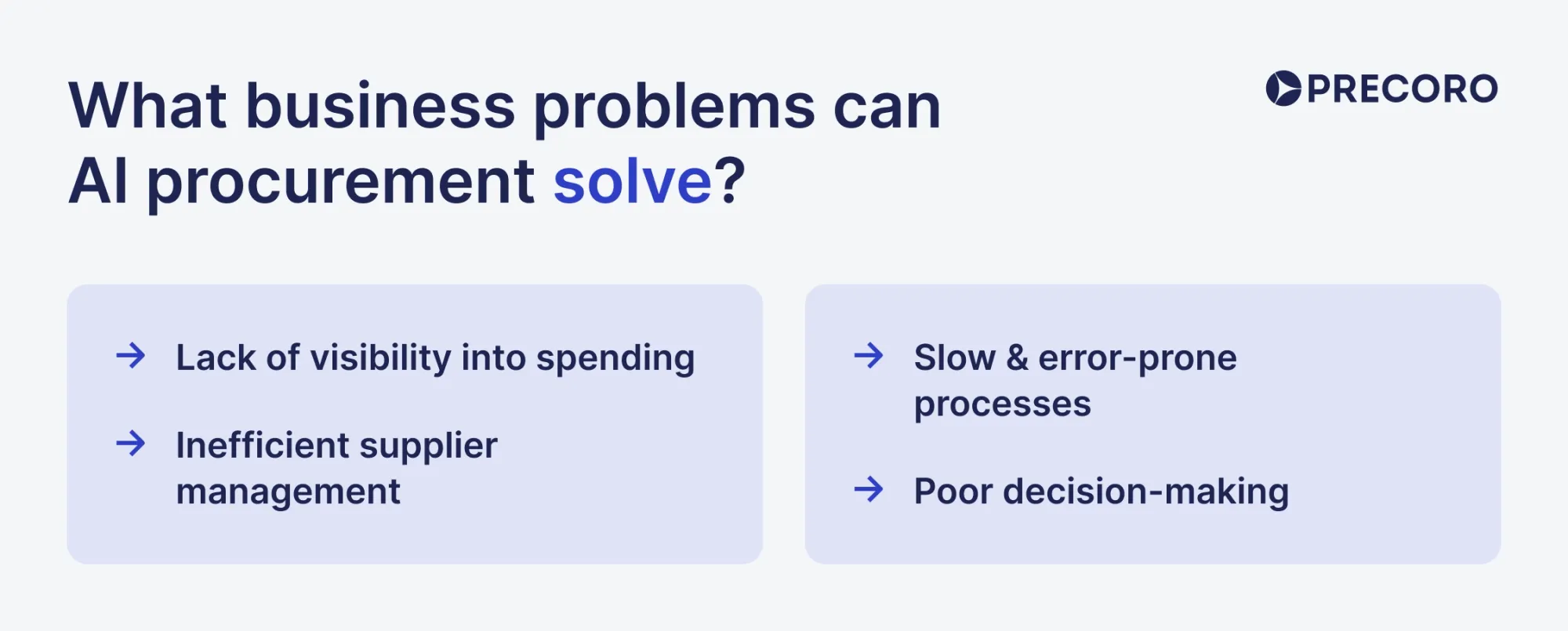
What business problems can AI procurement solve?
AI procurement can solve several important business problems, including a lack of visibility into spending, inefficient supplier management, slow and error-prone processes, and poor decision-making. One thing that is consistent across all these problems is that they are often caused by unstructured systems and manual processes that limit efficiency and control.
Lack of visibility into spending: Many organizations operate within systems that aren’t connected or centralized, and this makes it difficult for them to track where money is going. AI procurement tools help to tackle this problem by centralizing data and providing real-time insights into spending patterns.
Inefficient supplier management: Without proper tracking, businesses can continue working with suppliers that are costly or underperforming. AI procurement helps with this by analyzing supplier data, monitoring performance, and supporting better supplier selection.
Slow & error-prone processes: AI procurement also helps to solve the delays, approval bottlenecks, and mistakes that come along with manual workflows. The AI-optimized tools automate these processes, reducing delays and improving accuracy.
Poor decision-making: When decisions are based on incomplete or outdated data, businesses are more likely to overspend or make inefficient choices. AI procurement tools address these issues by providing data-driven insights that support better planning and cost control.
What procurement data is required to successfully use AI in procurement?
To use AI effectively in procurement, organizations need accurate, structured, and consistent data, covering spend, suppliers, and transactions.
Spend data: This type of data includes information about what the organization is purchasing, how much is being spent, and which departments are responsible for the spending. The availability of this information enables AI systems to identify patterns, detect inefficiencies, and support better cost control.
Supplier data: The supplier data usually includes vendor details, pricing agreements, performance metrics, and delivery history. This information makes it possible for AI systems to evaluate suppliers, compare options, and recommend better sourcing decisions.
Transactional data: It includes purchase orders, invoices, approvals, and payment records. Transactional data makes it possible for AI systems to understand how procurement processes currently operate and identify areas for improvement.
Contract data: This includes information such as terms, conditions, and renewal timelines. AI systems make use of this data to monitor compliance, manage risks, and ensure that agreements are followed properly.
It’s important to note that this data must be clean, well-organized, and regularly updated. Without quality data, AI systems may produce inaccurate insights, which can affect their decision-making.
How does AI procurement impact procurement roles and workflows?
AI procurement impacts roles and workflows by shifting the focus from manual execution to more strategic and decision-driven activities.
Using the traditional method, the procurement teams usually spend a significant amount of time handling routine tasks such as data entry, purchase approvals, supplier communication, and report generation. With the introduction of AI, many of these tasks can now be automated, reducing the need for constant manual involvement.
This advantage enables procurement professionals to focus more on strategic responsibilities such as supplier relationship management, cost optimization, and long-term planning, improving both their productivity and the overall value that they bring to the organization.
In terms of workflows, AI brings about more structure and efficiency into procurement processes. It transforms operations that were previously slow and fragmented into ones that are faster, more consistent, and easier to manage. In addition to this, AI systems help to provide real-time insights that allow teams to make quicker and more informed decisions.
Overall, AI procurement doesn’t replace procurement roles. Rather, it improves them by reducing human involvement in repetitive tasks and allowing teams to operate more efficiently and strategically.
What are the core features to look for in AI tools for procurement?
The key features to look for in AI tools for procurement are those that improve your efficiency and decision-making process while also allowing for much better control over your procurement activities.
As the number of AI procurement solutions continues to grow, it becomes very important for organizations to understand the features that provide the best results. Not all tools offer the same capabilities, and selecting the right one is highly dependent on how well it aligns with the specific needs of your business.
What AI capabilities differentiate basic tools from advanced procurement AI solutions?
The AI capabilities that differentiate the basic tools from advanced procurement AI solutions include predictive analysis, machine learning, data-insight automation, and real-time decision support.
The basic procurement tools usually focus on automating routine tasks such as purchase requests and approvals. While the use of these tools helps to improve efficiency, they do not provide deeper insights or strategic value.
Advanced AI procurement solutions, on the other hand, extend beyond automation. They use machine learning to analyze historical data, identify patterns, and predict future procurement needs. This allows businesses to make proactive and informed decisions.
Additionally, advanced AI solutions provide intelligent automation where systems can adapt to changing conditions and optimize workflows without requiring constant manual input. They can also provide real-time insights and recommendations that help procurement teams respond quickly to changes in demand, pricing, or supplier performance.
Essentially, the difference between the basic AI tools and advanced procurement AI solutions is in the level of intelligence and adaptability. While the basic tools help to automate tasks, advanced AI procurement solutions actively support decision-making and improve overall procurement strategy.
How do AI features improve procurement intelligence and decision-making?
AI features improve procurement intelligence and decision-making by enabling organizations to analyze large amounts of data more effectively and make more informed choices.
Better procurement intelligence can be achieved through data analysis. AI tools can process large volumes of procurement data, identify patterns, and generate insights that would be difficult to detect manually. This feature helps businesses to understand their spending behavior, suppliers’ performance, and potential risks.
AI solutions also support predictive decision-making by analyzing historical data to forecast demand, anticipate price changes, and recommend the best time to make purchases. This capability allows organizations to plan more effectively and avoid unnecessary costs.
Additionally, AI features provide real-time insights that help procurement teams respond quickly to changes in the market or supply chain. These insights are quick and therefore reduce delay while also improving the overall efficiency of decision-making.
Can AI procurement platforms automate complex procurement tasks and workflows?
Yes, AI procurement platforms can automate complex procurement tasks and workflows by using intelligent systems that extend beyond basic rule-based automation.
The traditional automation handles simple, repetitive tasks, but the AI-driven platforms are capable of managing more complex processes, such as supplier selection, demand forecasting, and spend analysis. They can process large amounts of data, apply predefined rules, and adapt based on recognized patterns and past outcomes.
AI procurement platforms can also manage multi-step workflows that involve approvals, compliance checks, and supplier interactions. As a result, procurement processes are carried out consistently while reducing delays and manual intervention.
Additionally, AI procurement platforms can handle exceptions by identifying unusual patterns or deviations and providing recommendations on how to address them. This capability makes the automation process more flexible and reliable than when compared to traditional systems.
Does the software provide automated supplier discovery and onboarding?
An effective AI procurement software should provide automated supplier discovery and onboarding to simplify how businesses find and manage vendors.
Supplier discovery can often be time-consuming, especially when it’s done manually. AI, however, analyzes market data, identifies potential suppliers, and recommends options based on pricing, performance, and reliability.
Automated onboarding also makes it easier to bring new suppliers into the system. Rather than handling processes such as documentation, verification, and setup manually, AI tools can help to standardize and automate these steps, ensuring that all the required information is collected and validated efficiently. This not only reduces the time that is required to onboard suppliers but also improves the procurement team’s level of consistency and accuracy across the different processes.
Can it perform spend analysis and category management using AI?
An effective AI procurement tool should be able to perform spend analysis and category management to help businesses gain better control over their procurement activities.
Spend analysis usually involves examining the businesses’ expenditure data to understand where money is being spent, how often purchases are made, and which suppliers are involved. AI improves this process by analyzing large volumes of data, identifying patterns, and highlighting the areas where costs can be reduced.
AI also supports category management by grouping purchases into specific categories and providing insights into how each category performs. That way, businesses can identify high-cost areas, optimize sourcing strategies, and make more informed purchasing decisions.
Does the tool support intelligent contract management and clause extraction?
AI procurement tools support intelligent contract management and clause extraction to improve how businesses handle their agreements.
The process of contract management usually involves reviewing large volumes of documents, which can be time-consuming and prone to errors when they are done manually. AI helps to simplify this process by automatically analyzing contracts, extracting important clauses, and organizing important information such as terms, obligations, and renewal dates.
The AI optimization of contract management makes it easier for organizations to track their compliance, identify risks, and ensure that contractual agreements are properly followed.
AI also helps to optimize clause extraction, which allows businesses to quickly compare contract terms across different suppliers, making it easier to identify inconsistencies and negotiate better agreements.
How advanced are the sourcing and bid analytics capabilities?
The value of an AI procurement tool in sourcing comes down to how well it supports supplier selection and competitive decision-making.
Traditional sourcing often relies on manually comparing supplier bids, which is time-consuming and prone to errors. AI changes that by analyzing multiple bids at once and comparing key factors like price, delivery terms, contract conditions, and supplier performance with greater speed and accuracy.
Some AI procurement platforms can also provide scenario analysis, which allows businesses to evaluate different sourcing strategies before making a final decision.
Does the platform offer predictive analytics and forecasting?
An effective AI procurement solution should include predictive analytics and forecasting to support better planning and decision-making.
Predictive analytics uses historical procurement data to identify patterns and anticipate future needs, such as demand, price changes, and potential supply risks. As a result, organizations have the insight to plan ahead, avoid last-minute purchases, and reduce unnecessary costs.
Forecasting complements this by helping teams maintain the right inventory levels, ensuring resources are available when needed without overstocking or shortages.
What workflow automation and integration capabilities does it have?
An effective AI procurement solution should provide workflow automation and integration capabilities that help to simplify procurement activities and improve the organization’s overall efficiency.
Workflow automation is what makes it possible for the AI system to handle routine procurement tasks such as purchase requests, approvals, invoicing, and supplier communication with little to no manual input. This feature helps to reduce delays, improve consistency, and ensure that the procurement processes are carried out in accordance with pre-established standard rules.
Additionally, integration capabilities are very important for connecting the procurement system with other business tools such as ERP (Enterprise Resource Planning), accounting software, and inventory management systems. This ensures that the data flows seamlessly across different departments, improving both their visibility and coordination.
Overall, with proper automation and integration, procurement workflows become more structured, efficient, and much easier to handle.
How strong are the reporting, dashboards, and self-service analytics?
The strength of reporting, dashboards, and self-service analytics in an AI procurement tool is determined by the system’s ability to provide clear, accurate, and accessible insights into procurement processes.
For instance, a strong reporting system should provide clear and detailed insights into spending patterns, supplier performance, and procurement efficiency. These reports help organizations to understand how their procurement processes are performing over time.
Dashboards help make this information more accessible by presenting it in a visual and easy-to-understand format. This way, procurement teams and decision-makers can quickly identify trends, track performance, and respond to issues as they arise.
Additionally, self-service analytics enables users to generate their own reports and insights without having to rely heavily on technical teams. This not only improves their accessibility but also allows for faster and more flexible decision-making.
It’s important to periodically evaluate the strength of these capabilities because they determine how well organizations can monitor, analyze, and control their procurement activities.
Which AI procurement tools and platforms are leading AI procurement solutions today?
As of 2026, there are several AI procurement tools and platforms available. Now, some of these tools only focus on specific areas of procurement, such as spend analytics, supplier intelligence, or onboarding, while others provide end-to-end procurement solutions covering almost every activity, including supplier sourcing, onboarding, contract management, and spend analysis.
There is also another category of AI procurement solutions that are designed for enterprise-level operations, which provide advanced features such as predictive analytics, complex workflow automation, and deep system integrations.
As the number of available tools continues to grow, it becomes very important for organizations to understand the strengths of each platform and how they align with their specific procurement needs.
Which vendors are recognized for end-to-end AI procurement suites?
Several vendors are widely recognized for providing end-to-end AI procurement suites that cover the entire procurement lifecycle from sourcing to payment.
These platforms typically provide a detailed set of features, including spend analysis, supplier discovery and onboarding, purchase management, contract management, spend analysis and workflow automation. Their ability to centralize all these procurement activities in a single system helps organizations improve their visibility, control, and efficiency.
End-to-end AI procurement suites are especially beneficial for organizations that require a unified solution instead of managing multiple tools for different procurement functions. They reduce system fragmentation and ensure that the information flows seamlessly across all stages of the procurement process.
Which procurement AI software platforms offer end-to-end automation?
There are several procurement AI software platforms that provide the full source-to-pay (S2P) process within a single system. Great examples of this category of solutions include Precoro, SAP, Ariba, Coupa, Ivalua, and Zycus, all of which provide integrated capabilities such as supplier sourcing, contract management, spend analysis, and workflow automation.
There are also platforms such as GEP SMART and Oracle Procurement Cloud that extend these capabilities with advanced analytics, predictive insights, and deep integration with enterprise systems, making them suitable for large-scale procurement operations.
As a result, these platforms are often preferred by organizations that want to simplify their procurement operations, reduce manual effort, and create a more efficient, scalable, and fully integrated procurement system.
Which niche tools excel at spend analytics and insights?
The niche tools that excel at spend analytics and insights include platforms such as Suplari, Fairmarkit, and Sievo, which are specifically designed to analyze procurement data and provide spend intelligence.
These tools focus on analyzing expenditure data to identify spending patterns, detect inefficiencies, and highlight areas where costs can be optimized. They process large volumes of data to gain insights that could have been difficult to uncover if the analysis were conducted manually.
Additionally, they often provide advanced features such as category-level analysis, supplier comparison, and anomaly detection. These features make it possible for organizations to better understand how their money is being spent and make more informed financial decisions.
This is why niche tools are very useful for organizations that want to improve their financial visibility and strengthen their procurement intelligence without needing to opt for a full end-to-end procurement suite.
Which platforms lead in contract intelligence and CLM with AI?
The platforms that lead in contract intelligence and contract lifecycle management (CLM) with AI include tools such as Ironclad, Icertis, and ContractPodAi, which are designed to manage contracts more efficiently using automation and data-driven insights.
These platforms usually focus on analyzing contract data, extracting key clauses, and organizing important information such as terms, obligations, and renewal dates. They help organizations to track compliance, manage risks, and ensure that the contractual agreements are properly followed.
Additionally, these platforms offer features such as automated contract creation, approval workflows, and version control, which help simplify the entire contract lifecycle from creation to renewal.
AI also enables faster document review and improving the accuracy of contract analysis. This particular feature helps to reduce the time that teams spend on manual contract management and the risk of errors.
As a result, platforms such as Ironclad, Icertis, and ContractPodAI are especially useful for organizations that manage large volumes of contracts and require a more structured and efficient approach to contract management.
Which AI procurement solutions are best for enterprise procurement systems?
The AI procurement solutions that are best suited for enterprise procurement systems include platforms such as SAP Ariba, Coupa, Ivalua, and Oracle Procurement Cloud, all of which are designed to handle large-scale and complex procurement operations.
These platforms provide advanced features, such as end-to-end procurement management, predictive analytics, complex workflow automation, and deep integration with enterprise systems like ERP and financial software. This is what makes them suitable for organizations with multiple departments, large supplier networks, and high transaction volumes.
Enterprise-level procurement solutions also provide strong scaling capability, which allows organizations to manage the increasing procurement demands without compromising their performance or efficiency.
Additionally, they provide improved security, compliance, and governance features, which are essential for large organizations that operate across different regions and regulatory environments.
What AI tools for procurement specialize in procurement analytics and intelligence?
The AI tools that specialize in procurement analytics and intelligence include platforms such as Suplari, Sievo, and SpendHQ, which are designed to provide deep insights into procurement data.
These tools focus on analyzing expenditure data, supplier performance, and procurement trends to help organizations gain a clearer understanding of their procurement processes. They process large volumes of data to uncover patterns and insights that support better planning and cost control.
Additionally, they provide features such as advanced dashboards, real-time reporting, and predictive analytics, which enable organizations to monitor performance and make more informed decisions.
These tools are best suited for businesses that want to strengthen their procurement intelligence, improve financial visibility, and drive more data-driven strategies.
What are the top AI procurement leaders in 2026?
There are several AI procurement platforms that stand out for their capabilities, performance, and overall impact on procurement operations.
These tools provide a wide range of features, from automation and analytics to supplier management and contract intelligence, depending on the needs of the organization.
Moving forward, we will look at some of the leading AI procurement solutions along with their key advantages, limitations, and overall performance.
Coupa
Coupa is a cloud-based Business Spend Management (BSM) platform that provides end-to-end procurement capabilities across sourcing, purchasing, invoicing, and expense management. Its key strengths lie in its ability to centralize all spend-related activities into a single system, which gives organizations real-time visibility and control over their financial operations. It is widely used by large enterprises due to its scalability, strong integrations, and robust analytic capabilities.
Customer ratings:
- Capterra: 3.9/5
Advantages:
- Comprehensive end-to-end procurement and spend management solution
- Strong spend visibility and real-time analytics
- A user-friendly interface
- Easy integration with ERP and financial systems
- Scalability for large and growing organizations
Shortcomings:
- Expensive, especially for small and mid-sized businesses
- Has a steep learning curve for beginners
- Limited customization options in certain workflows
- Some users report UI and performance issues
- Inconsistent level of customer support responsiveness
Pricing:
- Coupa uses a custom, enterprise-based pricing model that varies based on company size, selected modules, number of users, and transaction volumes. As a result, the pricing isn’t publicly disclosed and can differ significantly across organizations.
- Additionally, Coupa’s supplier-side tools range from free basic features to about $4800/year for advanced capabilities. There may also be additional costs for implementation and support.
Customer reviews (original spelling):
"Great for controlling spend
Honestly, my feelings on Coupa are a bit of a mixed bag, but mostly positive in the end. We moved from a messy system of emails and spreadsheets, so having everything in one place is a huge relief. I finally know who is spending what before the bill actually arrives, which makes my job way easier. That said, getting there wasn't fun. The implementation took longer than we expected, and getting our non-techy staff to actually use it correctly was a struggle. It’s not something you "pick up" in an afternoon. But now that we are over the hump, I can’t imagine going back to the old way. It works, but you have to be patient with it."_ Sergi F. (Customer Service Administrator, Packaging and Containers)
"COUPA is a breeze!
Overall, it has been a true asset and a helpful tool with very specific clients who are incredibly important to my small business!_ Mai M. (Managing Director Hospitality)
The author’s note:
Coupa stands out as one of the most mature end-to-end procurement platforms, especially for enterprise environments. Its strength lies in spend visibility and integration capabilities; however, its cost and complexity make it better suited for larger organizations rather than smaller teams.
Pactum AI
Pactum AI is an AI-powered procurement platform that focuses primarily on autonomous negotiations with suppliers. What sets this platform apart is its ability to use AI agents to negotiate with vendors at scale, helping organizations enhance their cost savings, payment terms, and overall supplier agreements without requiring any manual intervention.
Advantages:
- AI-driven autonomous supplier negotiations
- Helps to reduce procurement costs through optimized terms
- Allows for scalable negotiations across larger supplier bases
- Reduces manual workload for procurement teams
- Enhances supplier engagement and response rates
Shortcomings:
- Limited functionality outside negotiation use cases
- Requires high-quality data to perform optimally
- Does not always fully replace human negotiations, especially in complex scenarios
- Integration with existing systems may require effort.
Pricing:
- Pactum AI uses a custom pricing model that is based on business size, usage, and scope of implementation.
The author’s note:
Pactum AI stands out for its unique focus on autonomous negotiations, making it a strong complementary tool for organizations that are looking to optimize supplier agreements. However, it works best when it’s integrated with broader procurement systems rather than as a standalone solution.
Cognilix
Cognilix is an AI-powered procurement platform that was developed from a large-scale B2B network (Moglix), which is designed to bring data-driven intelligence and automation into procurement and supply chain operations. Cognilix’s uniqueness lies in its strong focus on data processing, spend analytics, and sourcing intelligence, all of which help organizations to transform fragmented procurement data into actionable insights for better decision-making.
Customer ratings:
Cognilix is a relatively new platform, so there are no reviews online yet
Advantages:
- Strong AI-driven spend analytics and data intelligence
- Advanced supplier and RFQ (request-for-quote) analytics
- Helps to clean and standardize procurement data to gain better insights
- Supports end-to-end procurement through modules such as sourcing, vendor management, and auctions
- Enhances visibility and decision-making across different procurement operations
Shortcomings:
- Provides limited public user reviews and third-party ratings
- Less widely adopted compared to established enterprise platforms
- Has a low pricing transparency (requires direct inquiry)
- It can require onboarding and data preparation to perform optimally
Pricing:
- Cognilix’s pricing is usually customized based on the organization’s requirements, modules, and scale of deployment.
- To get pricing, the organization is required to request a demo or contact their team directly.
The author’s note:
Cognilix is reputable for its strong focus on procurement data intelligence and analytics, which makes it a valuable tool for organizations that are looking to improve their visibility and decision-making process. However, its limited public reviews and lower market visibility might prompt businesses to evaluate it more carefully before adopting it.
Precoro
Precoro is the agentic procurement and spend centralization platform that brings requests, approvals, purchasing, accounts payable, and supplier management into one connected workflow. It helps mid-sized companies gain full visibility and control over company-wide spending. Unlike complex enterprise systems, Precoro is designed to introduce structure without disrupting existing operations.
Precoro uses Gemini AI to extract line-item data from invoices and reconcile it against POs with near-perfect accuracy. The platform simplifies the intake process by turning supplier quotes into purchase requests, while AI expense scanning enables employees to capture receipts on the go for immediate processing.
Central to procurement intelligence is the Precoro AI Assistant, a natural language interface that allows users to query spend data, summarize complex reports, and identify budget risks simply by asking questions.
Customer ratings:
Advantages:
- Easy-to-use and intuitive interface
- A fast implementation and onboarding process
- Strong approval workflow automation and budget control
- Multi-entity management for centralized control across business units
- Centralized procurement with real-time visibility into spending
- Good integration support with ERP and accounting systems
- A dedicated mobile app
Shortcomings:
- Has limited advanced customization for complex enterprise needs
- Some users request more integrations
- Reporting customization can be limited in certain cases
Pricing:
- Precoro offers transparent pricing with plans starting at $499/month for core features and $999/month for more advanced automation capabilities.
- For larger organizations with more complex needs, Precoro also provides enterprise-level plans with custom pricing.
- To get the exact pricing that is optimized to your business, you can always request a quote or demo directly from Precoro.
Customer reviews (original spelling):
“Overall, this software is extremely easy to use and very user-friendly, making it simple for anyone to navigate and accomplish tasks efficiently. The staff are absolutely wonderful, always friendly, approachable, and ready to assist whenever we need help. Their prompt support and willingness to guide us have made the entire experience enjoyable. In particular, [sensitive content hidden]handled our onboarding process, and everything went incredibly smoothly thanks to her professionalism and attention to detail. She ensured that every step was clear, that all our questions were answered, and that we felt completely comfortable using the platform. From start to finish, the experience has been positive, seamless, and reassuring, making this software and its team a pleasure to work with.” _shayan J. (Financial and Operation Analyst International Affairs)
“Procure-to-pay review
Previously, we were a ControlHub customer and with CH abruptly getting shut down, we moved over to Precoro. Overall, the experience was fairly smooth. We went from signing the contract to go-live in 15 days. Integrations are easy to setup, the implementation consultant [sensitive content hidden] helped us get bulk data imported into our account in time for go-live and made sure our go-live was a success.”_Anthony S. (Head of IT Mechanical or Industrial Engineering)
The author’s note:
Precoro is a very practical procurement solution that is especially well-suited for mid-sized companies that require structure without additional complexity. The platform’s focus on procurement centralization makes it a good choice for companies that want transparency and control across business units, entities, and projects.

Keelvar
Keelvar is an AI-driven sourcing and procurement optimization platform focused on advanced sourcing, supplier negotiations, and automated procurement events. Its core strength lies in helping organizations run complex sourcing processes more efficiently and achieve stronger supplier outcomes.
Unlike traditional sourcing tools, Keelvar uses AI to evaluate multiple supplier bids, constraints, and scenarios at once, recommending the best possible sourcing strategy based on defined goals and conditions.
Customer ratings:
- G2: 4.7/5
Advantages:
- Powerful AI-driven sourcing optimization capabilities
- Supports complex bidding and supplier evaluation scenarios
- Automation of sourcing events
- Helps to improve negotiation outcomes and cost savings
- Scalability for enterprise procurement operations
Shortcomings:
- Keelvar is primarily focused on sourcing and not the full procurement lifecycle
- It requires expertise to fully leverage optimization features
- Has limited public pricing transparency
- Can require integration with other procurement tools
Pricing:
- Keelvar uses a custom pricing model where each organization is billed according to its size, usage, and required features.
Customer reviews (original spelling):
“User friendly sourcing tool, providing powerful analytical insights for logistics
What do you like best about Keelvar?
The tool is quite intuitive for the most part and once you know how to use it, can give you really powerful insights into the different sourcing options you have and what cost difference they would mean for your company.Review collected by and hosted on G2.com.
What do you dislike about Keelvar?
Some more advanced settings are difficult to figure out without an analyst from Keelvar being dedicated to your tender.
Some features (for example the traffic light feedback system) can be set up via different places in the tool, which gets a little confusing over time.” _Verified User in Chemicals
The author’s note:
Keelvar is renowned for its sophisticated sourcing and optimization capabilities, which make it a strong choice for organizations that want to improve their supplier negotiations and sourcing outcomes. However, it works best when it is combined with broader systems for full lifecycle management.
Zip HQ
Zip HQ is an AI-powered procurement orchestration platform that is designed to simplify all the procurement workflows from intake to payment. The platform uses an “intake-to-procure” approach, which provides an easy entry point for purchases and vendor requests, making procurement activities faster, more structured, and easier to manage.
Unlike the traditional procurement systems, Zip focuses heavily on workflow orchestration and automation, making use of AI to route approvals, enforce policies, and provide real-time visibility into spending patterns.
Customer ratings:
Advantages:
- Strong workflow automation and approval orchestration
- Intuitive interface with high user adoption
- Centralized procurement intake and visibility
- AI-powered automation and insights
- Flexible integrations with ERP and finance systems
Shortcomings:
- The platform’s reporting capabilities can be limited in certain cases
- The pricing transparency is limited
- It might require integration with other systems for full functionality
Pricing:
- Zip uses a subscription-based pricing system that varies based on the number of users, features, and level of deployment.
- To get the pricing for the services you want for your organization, you have to request a custom quote.
Customer reviews (original spelling):
“ I use ZIP for procure to pay process. Use of ZIP will start from onboarding vendors up to payable processing. 1. ZIP helped us to eliminate manual processes such as uploading vendor invoices. It was able to pick up all the vendor invoices in our designated email. 2. ZIP also aide us in eliminating the manual process in our endorsement for approval and to treasury. Through ZIP, there is an automated notification for the users and approvers through email and slack.’_Paul Erik C (Tax Accountant Financial Service)
The author’s note:
Zip HQ is a platform that has a strong focus on workflow orchestration and ease of use, making it a great pick for businesses that are seeking to simplify their procurement activities. However, it works best when it is integrated into a broader procurement ecosystem.
Tonkean
Tonkean is an AI-powered orchestration platform that is designed to help automate and coordinate procurement workflows across different teams and systems. It makes use of the “intake and orchestration” approach, where it acts as a central layer that connects people, processes, and existing tools, making procurement more structured, automated, and user-friendly.
Tonkean focuses on process orchestrations rather than replacing existing systems, which allows organizations to build automated workflows on top of their current procurement stack.
Customer ratings:
Advantages:
- Offers powerful workflow orchestration and automation capabilities
- Easy to build and customize procurement workflows
- Integrates with 200+ enterprise tools
- Improves process adoption and compliance across teams
- Centralizes procurement intake and request handling
Shortcomings:
- It does not offer a full end-to-end procurement suite
- Requires setup and process design for optimal use
- It can be complex for teams without technical/process experience.
Pricing:
- Tonkean uses a custom pricing model that is based on usage and deployment needs, which is often measured by monthly tracked users (MTUs).
- For accurate pricing, organizations are encouraged to request a quote or demo directly from Tonkean
Customer reviews (original spelling):
"Loving the product
Excellent experience overall. From the product, we are working on optimizing our internal operations overall. Sales pipeline, Operations management, Delivery management. Each area with different needs, all being fullfilled by tonkean. Metrics are also a powerhouse for us, that allow us to track how we are doing"_ Marcelo Alejandro R. (Head of Accounts Information Technology and Services)
"Solid AI automation
What do you like best about Tonkean?
Very useful in easily utilising AI automation in porcurement uses.
What do you dislike about Tonkean?
Takes a little time to get used of it and learning how to use effectivly." _ Verified User in Telecommunications
The author’s note:
Tonkean is a great platform that is reputable for its strong orchestration and automation capabilities. This makes it a great choice for organizations that want to simplify procurement workflows without replacing their existing systems. However, Tonkean is best used as a complementary layer rather than a standalone procurement solution.
Oro Labs
Oro Labs is an AI-driven procurement orchestration platform that focuses on coordinating how requests move across systems, teams, and workflows, from initial intake through supplier engagement and purchasing. It helps standardize how requests are captured, routed, and managed across different departments, reducing friction in cross-functional collaboration. The platform emphasizes guided intake, intelligent routing, and a user-friendly interface, making it easier for employees to submit requests and for teams to handle them efficiently.
Customer ratings:
- G2: 4.7/5
Advantages:
- The platform has powerful orchestration capabilities
- Has a user-friendly interface that improves adoption
- Centralized intake and workflow management
- Has flexible integration with existing procurement and ERP systems
- Improves compliance and procurement process consistency
Shortcomings:
- Oro isn’t a full end-to-end procurement suite
- Might require integration with other tools for full functionality
Pricing:
- Oro Labs uses a custom pricing model that is based on metrics such as company size, usage, and required features.
- To get the pricing for the services you want for your organization, you have to request a custom quote.
Customer reviews (original spelling):
"Instant Data Visualization That Keeps Progress and Avoid any process delays
What do you like best about ORO Labs?
I found the greatest value in the ability to instantly visualize data from various perspectives.
This not only helps me grasp the overall progress, but also allows me to quickly identify any delays. As a result, we can clearly understand what is lacking within the organization and take actions to improve it.
What do you dislike about ORO Labs?
The search function for campaigns can be somewhat difficult to use. For example, after applying filters, performing another search sometimes clears them. Currently, we work around this by searching first and then applying filters."_ sato o. (IT Staff)
The author’s note:
Oro Labs is a great platform that is renowned for its strong orchestration capabilities and user-focused design, which makes it a great option for organizations that are looking to improve their procurement workflows and adoption. However, the platform works best when it is included as part of a broader procurement ecosystem instead of a standalone solution.
Levelpath
Levelpath is an AI-driven procurement platform that is designed to simplify procurement processes, such as sourcing, supplier management, and procurement workflows. Its strength as a platform resides in its ability to help organizations manage their supplier relations, track agreements, and improve decision-making across the procurement lifecycle.
Unlike traditional procurement tools, Levelpath focuses on centralizing procurement data and workflows, making it possible for teams to manage sourcing events, contacts, and vendor interactions within a single system while maintaining visibility and control.
Customer ratings:
- G2: 4.8/5
Advantages:
- Provides a centralized procurement system and supplier management
- Supports sourcing, contract tracking, and vendor visibility
- Helps improve decision-making through AI-driven data analysis
- Simplifies procurement workflows
- Suitable for organizations that are in search of structured procurement systems
Shortcomings:
- Has lower market visibility when compared to other established platforms
- Might require onboarding and integration for full use
Pricing:
- Levelpath uses a custom pricing model that is based on organization size, features, and deployment scope.
- To get a more accurate price, you can request a custom quote
Customer reviews (original spelling):
"Seamless Contract Management and Purchasing with Easy Implementation and Phenomenal Support
What do you like best about Levelpath?
Levelpath's seamless tracking of contract dates, fields, and important clauses makes my company's management of contracts much easier. We also had a phenomenal implementation and have fantastic customer support from their staff. We communicate on a weekly basis with Levelpath with changes to our workflows, discuss product updates, and overall bring any bugs or issues to the table and they are quickly resolved. All in all there is a level of technical sophistication and hands on support that I have not experienced before.
What do you dislike about Levelpath?
An iterative product like Levelpath can make it challenging to keep employees abreast of updates, but my team and I hold office hours meetings to troubleshoot and assist our user base." _ Zach M. (IT Operations Analyst)
The author’s note:
Levelpath focuses specifically on combining procurement automation with data-driven insights, making it a useful option for organizations to improve their visibility and simplify their procurement processes. However, the platform’s limited public reviews may require further evaluation before adoption.
Ivalua
Ivalua is a cloud-based procurement platform that provides a complete source-to-pay solution that covers everything from sourcing, supplier management, contract management, and spend analysis. The platform is mainly known for its flexibility and depth, which allows organizations to customize procurement workflows to match their exact business requirements. Ivalua is renowned for its ability to handle complex and large-scale procurement operations.
Customer ratings:
- G2: 4.4/5
Advantages:
- Ivalua is highly flexible and customizable
- Provides end-to-end source-to-pay capabilities
- Provides strong supplier and spend management features
- Suitable for complex enterprise needs
- Integrates well with ERP systems
Shortcomings:
- The implementation stage can be complex and time-consuming
- Requires technical expertise to fully customize
- Some users report bugs and system performance issues
- The user interface may not be as intuitive as other simpler tools
Pricing:
- Ivalua uses a subscription-based pricing model that varies based on the number of users, selected modules, and deployment scope.
Customer reviews (original spelling):
"All-in-One Solution with Configurable Processes
What do you like best about Ivalua?
I really like Ivalua for having good overview pages, which makes it easy to manage tasks. The integration with SAP ECC is also very helpful for our operations. I appreciate the possibility to configure processes, as it allows us to tailor the platform to our needs. Having all functionalities in one platform is a big advantage, as it simplifies our workflows by having everything centralized.
What do you dislike about Ivalua?
History data are missing in PR/PO. It should be possible to see which changes are done by whom and when. Also for changes of profile assignment the change history should be available. Yes, it would be great if the workflow could be checked before the PR is sent. Currently it is only visible after sending." _ Gabriele R. (IT Process Manager Material)
The author’s note:
Ivalua is a strong and highly flexible procurement platform that makes it a great choice for large organizations that have complex procurement needs. However, the complexity of the platform and its implementation requirements make it best suited for enterprises with the resources to fully benefit from its capabilities.
SpecLens
SpecLens is an AI-powered procurement tool designed to enhance specification management and sourcing accuracy by helping organizations to standardize requirements and make better supplier comparisons. SpecLen’s main strength lies in its ability to bring clarity and structure to procurement specifications, which are often a major source of inefficiencies in sourcing processes.
Unlike traditional procurement tools that focus mainly on transactions, SpecLens focuses on the quality and consistency of procurement specifications to ensure that organizations are comparing suppliers based on accurate and standardized requirements. As a result, businesses can reduce ambiguity, improve supplier responses, and achieve better sourcing outcomes.
Advantages:
- Improves specification clarity and standardization
- Improves supplier comparison accuracy
- Reduces sourcing errors that might have been caused by unclear requirements
- Supports better decision-making during the sourcing process
- Helps to optimize procurement outcomes
Shortcomings:
- It focuses only on specification management
- It doesn’t offer a full procurement suite
- It might require integration with other procurement tools
Pricing:
SpecLens uses a custom pricing model based on the business needs and deployment scope.
The author’s note:
SpecLens is a great platform for improving specification quality. It’s used by organizations that want to improve their sourcing accuracy; however, it works best as a complementary solution rather than a standalone procurement platform.
Ironclad
Ironclad is an AI-powered contract lifecycle management (CLM) platform that is designed to help organizations create, manage, and analyze their contracts more efficiently. The platform combines legal workflows with AI-driven contract intelligence, making it easier for procurement teams to handle large volumes of contracts with accuracy and speed.
Ironclad focuses majorly on workflow automation and collaboration. As a result, both the legal and procurement teams simplify contact creation, approvals, and tracking.
Customer ratings:
Advantages:
- Has powerful contract automation and workflow management
- Uses AI-powered contract analysis and clause extraction
- User-friendly interface with high adoption rates
- Centralized contract repository
- Improves collaboration between legal and procurement teams
Shortcomings:
- Primarily focused on contract management and not full procurement
- The platform can be expensive to use for smaller businesses
- Ironclad usually requires setup and customization for optimal use
Pricing:
Ironclad uses a custom pricing model based on company size, features, and usage.
Customer reviews (original spelling):
"This is the Best Professional Admin Software
This software made my office task very easy, and I loved that I could integrate with my email so i can share with colleagues
Pros
I love that I can manage all my documents & contracts. electronically sign them in my absence and it is super easy to use
Cons
the cost, in as much as it is great value for money, it is very costly and I do not recommend it for small businesses" _Anonymous (User Administrative Director Research)
The author’s note:
Ironclad is a top contract management solution that has powerful automation and AI capabilities. It is particularly suitable for organizations that want to improve their contract workflows. However, the platform works best when it is paired with broader procurement systems.
Zycus
Zycus is an AI-powered procurement platform that provides a comprehensive source-to-pay (S2P) solution that covers sourcing, supplier management, contract management, purchasing, and spend analysis. The platform’s AI-driven procurement automation, which is powered by its Merlin AI suite, helps organizations improve their efficiency and make more data-driven decisions.
Zycus places a strong focus on cognitive procurement, using AI to automate routine tasks, enhance supplier discovery, and provide intelligent insights across their procurement activities.
Customer ratings:
G2: 3.6/5
Advantages:
- It offers full end-to-end procurement capabilities
- Has strong AI-driven automation
- Has advanced supplier management and sourcing tools
- Enhances efficiency through automation and insights
- Scalable for enterprise procurement needs
Shortcomings:
- The platform’s implementation can be complex
- The platform’s user interface may not be intuitive for new users
- The platform requires the team to have training to fully utilize its features
Pricing:
Zycus uses a custom pricing model based on the business needs and deployment scope.
Customer reviews (original spelling):
"Best version
What do you like best about Zycus Source-to-Pay?
The best part in zycus source to pay is the solution that's provided or exhibited to improve performance
What do you dislike about Zycus Source-to-Pay?
About zycus, it's not a negative side or dislike from my end. Happy with the solution techniques."- Shashi D (Software Engineer)
The author’s note:
Zycus is a great solution that is known for its strong AI capabilities and end-to-end procurement coverage, making it a solid choice for enterprises looking to automate procurement processes. However, its complexity means it’s best suited for organizations with the resources to manage implementation and adoption.
Omnea
Omnea is an AI-optimized procurement platform that is designed to simplify purchasing processes and improve visibility across different procurement operations. The platform combines intake management, workflow automation, and supplier coordination.
Omnea specializes in providing a clean and intuitive user experience, making it easier for employees to submit requests, track approvals, and manage procurement activities without friction.
Advantages:
- Has a simple and user-friendly interface
- Has strong intake and workflow automation
- Helps to increase adoption across teams
- Has a centralized procurement request management
Shortcomings:
- Doesn’t have a full end-to-end procurement suite
- Can require integration with other systems
Pricing:
Omnea uses a custom pricing model based on the business needs and deployment scope.
The author’s note:
Omnea works well for teams that struggle with messy intake processes and low adoption of procurement tools. Its strength is making it easy for employees to submit requests and follow a clear, structured flow without needing much training. That said, it’s not built to replace a full procurement stack. If you need deeper functionality like advanced purchasing, inventory, or end-to-end spend control, you’ll likely need to connect it with other systems. Omnea fits best as a lightweight layer to organize and standardize how procurement requests enter and move through your operations, rather than as a complete procurement solution.
SAP Ariba
SAP Ariba is a top cloud-based procurement platform that provides a comprehensive source-to-pay solution that covers sourcing, supplier management, procurement, invoicing, and contract management. The platform has a global supplier network that connects millions of buyers and suppliers, making it easy for organizations to discover, manage, and collaborate with vendors at scale.
SAP Ariba combines procurement automation with a large digital marketplace. This makes it possible for businesses to not only manage procurement internally but also to engage directly with a vast supplier ecosystem.
Customer ratings:
Advantages:
- Provides strong end-to-end procurement capabilities
- Have access to a large global supplier network
- The platform is scalable for enterprise-level operations
- Strong compliance and governance features
Shortcomings:
- SAP Ariba has a complex complementation process
- It can be expensive for smaller organizations
- The user interface may not be very intuitive
- The platform usually requires training for effective use
Pricing:
SAP Ariba uses a custom pricing model based on company size, features, and usage.
Customer reviews (original spelling):
" Best Supplier Relationship Management and Contract management product
Amazing product with amazing features like Ariba Risk, Ariba sourcing suite etc. Most powerful is SAP Business Network: This is the platform’s "crown jewel." It connects you to over 5 million suppliers globally, making supplier discovery and onboarding significantly faster than manual processes.
Pros
I have worked on Ariba and found it really well with Industry requirement. Ariba has fantastic features like SBN, Ariba Risk, Ariba Sourcing suite, all features make it perfect one shop for all Supplier relationship and Contract Management
Cons
It is great product by SAP. I would say one of the best when it comes to utility and purpose. Although, it is sometime difficult to navigate and all products dont have similar UI but functionality trumps it."_ Nishant J. (Solution Architect)
The author’s note:
SAP Ariba is a reputable platform that is optimized especially for large enterprises that require global supplier access and deep integration capabilities.
However, the platform’s complexity and cost make it more suitable for organizations with the resources to support their full-scale implementation.
Fairmarkit
Fairmarkit is an AI-powered procurement platform that is designed to automate sourcing processes, especially for small spending and non-strategic purchases. It has an autonomous sourcing capability that makes it possible for AI to help organizations identify suppliers, collect bids, and award contracts with minimal manual input.
Furthermore, Fairmarkit depends heavily on emails and manual RFQs. It uses AI to automate the entire source-to-award workflow, making it possible for procurement teams to handle more sourcing events efficiently while improving their cost savings and decision-making.
Customer ratings:
Advantages:
- Fairmarkit has a strong AI-driven autonomous sourcing
- Great for managing tail spend and low-value purchases
- Helps to automate RFQs, supplier discovery, and bid comparison
- Helps organizations achieve cost savings
- Improves efficiency by reducing manual sourcing workload
Shortcomings:
- The platform is primarily focused on sourcing and not a full procurement lifecycle
- It requires integration with existing procurement systems
Pricing:
- Fairmarkit uses a custom pricing model based on company size, features, and usage.
Customer reviews (original spelling):
"Increased Functionalities
Fairmarkit has shown its value since day one. We have developed a solid collaborative relationship that has helped our team to improve and use the tool at its full capacity.
Pros
The consistent growth of the platform is of great value to us customers. The customer-focused approach Fairmarkit uses to develop the new tools and functionalities resonates with our specific needs, and made every improvement valuable in our day to day operations.
Cons
I can't think of anything that is my least favorite." _Gaston A. Director of Procurement (Mining and metals)
The author’s note:
Fairmarkit is a procurement tool that is focused on autonomous sourcing, and it is great for organizations that are looking to optimize tail spend and improve their sourcing efficiency. However, the platform works best as a specialized solution rather than a complete procurement platform.
| Platform | Type / focus | Key strength | Best for | Pricing model |
|---|---|---|---|---|
| Coupa | End-to-end S2P | Spend management & visibility | Large enterprises | Custom / quote |
| Pactum AI | AI negotiation | Autonomous supplier negotiations | Tail spend optimization | Custom / quote |
| Cognilix | Procurement intelligence | Data analytics & sourcing insights | Data-driven teams | Custom / quote |
| Precoro | Procurement automation & centralization | Ease of use & workflow automation | SMBs & growing teams | Starts ~$499/month |
| Keelvar | Sourcing optimization | Advanced bid optimization | Complex sourcing | Custom / quote |
| Zip HQ | Procurement orchestration | Intake-to-procure workflows | Workflow automation | Custom / quote |
| Tonkean | Orchestration (no-code) | Workflow automation & integrations | Process automation | Custom / enterprise |
| Oro Labs | Procurement orchestration | Intake & workflow management | Mid-large orgs | Custom / quote |
| Levelpath | Procurement platform | Supplier & sourcing visibility | Structured teams | Custom / quote |
| Ivalua | End-to-end S2P | Flexibility & customization | Enterprise procurement | Custom / enterprise |
| SpecLens | Specification management | Requirement standardization | Sourcing accuracy | Custom / quote |
How do you evaluate and compare the best AI procurement software?
Selecting the right AI procurement software requires much more than simply reviewing the features that each software offers. It’s important to understand how well a platform aligns with your organization’s needs, workflows, and long-term procurement goals.
With so many tools providing different capabilities, it becomes important for individuals to evaluate each solution based on a pre-established and clear set of criteria that helps determine the solution’s overall suitability and effectiveness for your procurement operations.
What evaluation criteria should procurement teams use?
Procurement teams should evaluate AI procurement solutions based on how well they fit their operations, improve efficiency, and deliver clear, measurable value.
A key factor is how effectively the software supports core procurement activities, such as sourcing, supplier management, approvals, and spend tracking. The system should handle these processes in a structured way, helping teams run procurement consistently and efficiently rather than relying on ad hoc workflows.
Another important factor to consider when choosing a procurement solution is usability. A procurement tool that is difficult to use may slow down adoption and reduce its overall impact, even if it has strong features.
Scalability is also very important, especially for growing organizations. The software should be able to adapt to the increasing procurement demands that are needed by your business without requiring constant system changes.
Additionally, procurement teams should consider how well the platform integrates with existing systems, as this affects the data flow, visibility, and overall efficiency.
By considering all of these aspects during their selection process, organizations can choose a solution that not only meets their current needs but also supports their long-term procurement goals.
How do you weigh functionality against ease of use and adoption?
Balancing functionality with ease of use and adoption means choosing a procurement tool that is powerful enough to meet your needs, but still simple enough for your team to use effectively in day-to-day work.
While the advanced features are important, they only deliver value if the users can understand and use them effectively. A highly functional system that is difficult to use may lead to low adoption, delays in processes, and reliance on manual workarounds.
On the other hand, a procurement tool that is easy to use but lacks essential functionality may not fully support procurement needs, especially as the organization grows.
The most important goal is to select a procurement solution that provides the right level of functionality while maintaining a user-friendly experience. It not only ensures that the procurement team can adopt the system quickly, but it also helps them to use it consistently and achieve the intended benefits without any unnecessary complexity.
How important is integration with ERP, e-procurement, and SSO systems?
The integration of your procurement tool with systems such as ERP, e-procurement, and SSO (Single Sign-On) is very important because it determines how well the solution fits into your organization’s existing workflows and technology infrastructure.
A procurement tool that integrates smoothly with ERP systems allows for better data flow between departments, such as finance, accounting, and operations. As a result, your procurement information remains accurate, consistent, and up to date across the organization.
Integration with e-procurement systems helps to further improve efficiency by connecting purchasing activities with supplier management and order processing, reducing duplication and manual work.
Additionally, SSO integration improves user experience and security by allowing employees to access the system using a single set of credentials, making the adoption process easier and more secure.
Essentially, procurement solutions with strong integration capabilities help organizations to maintain better visibility, improve coordination, and ensure that their procurement processes run smoothly without any disruptions.
What performance metrics should a proof-of-concept measure?
A proof-of-concept (POC) for AI-procurement software should evaluate performance metrics that show how well the solution improves their efficiency, accuracy, and overall procurement outcomes. These metrics, when evaluated, help organizations to better understand the real value of procurement solutions before fully implementing them.
- Process efficiency: Shows how much time is saved across activities like sourcing, approvals, and supplier management, and whether the tool reduces delays and keeps workflows moving.
- Cost impact: Captures savings from better supplier selection, optimized spending, and fewer errors.
- Accuracy: Reflects how reliable the system is in areas like data processing, forecasting, and supplier evaluation. Consistent, trustworthy outputs are key.
- User adoption and ease of use: Indicates how quickly teams can start using the tool in their daily work and how smoothly it fits into existing processes.
How should the total cost of ownership and ROI be estimated?
Estimating the total cost of ownership (TCO) and return on investment (ROI) involves looking beyond the initial cost of the software and considering the overall value it delivers over time.
The total cost of ownership isn’t only determined by the subscription or licensing fees, but it also includes the addition of the extra costs involved in carrying out processes, such as implementation, integration, training, maintenance, and ongoing support. All these factors incur costs that can significantly impact the overall investment required.
On the other hand, ROI should be evaluated based on the benefits that the software brings, such as cost savings from better supplier management, reduced manual work, improved efficiency, and fewer errors.
Additionally, when evaluating ROI, it’s important to consider long-term gains, including scalability, improved decision-making, and enhanced process control.
When the total cost of a procurement solution is compared against the value it generates, it helps organizations determine whether the investment is worthwhile and aligned with their procurement goals.
How do you implement AI procurement software successfully?
What preparatory steps should organizations take before implementation?
Before implementing AI procurement software, organizations should take a few key steps to set the rollout up for success, including the following:
- Assessing current procurement processes: Involves helping organizations to identify inefficiencies, gaps, and areas where automation can deliver the most value. This step helps to ensure that the new system is implemented with clear objectives.
- Defining goals and expectations: Organizations should clearly outline what they want to achieve, whether it is cost reduction, improved efficiency, better visibility, or improved decision-making.
- Data readiness: Procurement data should be cleaned, organized, and standardized to ensure that the AI system can function effectively and deliver accurate insights.
- Key stakeholders Involvement: Organizations should involve key stakeholders early in the implementation process, including procurement teams, IT departments, and management, to ensure alignment and support throughout the implementation.
How do you manage data readiness, quality, and governance?
Data readiness, quality, and governance can be measured by ensuring that procurement data is clean, consistent, well-structured, and governed by clear data policies.
It’s important to prepare data before implementation by removing duplicates, correcting errors, and standardizing formats across suppliers, transactions, and spending categories. Clean and organized data should allow AI systems to function effectively and produce accurate insights.
In terms of governance, organizations need to clearly define how data is collected, stored, accessed, and maintained. This step helps always ensure data integrity, security, and compliance across the procurement process.
Additionally, maintaining data quality requires continuous monitoring and regular updates to ensure that the data remains accurate over time. When these aspects are managed properly, organizations can improve the reliability of AI-driven insights and achieve better procurement outcomes.
What change management strategies promote user adoption?
The change management strategies that promote user adoption usually involve properly preparing teams, simplifying the transition process, and ensuring that users clearly understand the value of the new procurement system.
- Clear communication: Organizations need to explain why the new system is being introduced and how it improves existing procurement workflows. When users understand the purpose, they are more likely to accept and use it.
- Training: This involves providing practical hands-on training that helps users become familiar with the system while reducing the resistance that may come from uncertainty or lack of knowledge.
- Involvement of key users: The involvement of key users early during the implementation process helps to create a sense of ownership. This approach makes it easier for teams to adapt to the system and encourages a much wider adoption across the organization.
- Ongoing support & feedback: Receiving both ongoing support and feedback is important as they help to identify challenges and improve the overall user experience over time.
How should procurement, IT, and vendor partners collaborate?
Procurement, IT, and vendor partners should collaborate by aligning their roles, maintaining clear communication, and working together throughout the implementation process.
Procurement teams are responsible for defining requirements, workflows, and expected outcomes, ensuring that the solution meets the operational needs. The IT teams, on the other hand, focus more on system integration, data management, and technical support to ensure that the platform functions properly within the existing infrastructure.
Vendors also play a major role in implementation by providing hands-on support, system configuration, and guidance based on industry best practices.
An effective collaboration requires regular communication, shared goals, and clearly defined responsibilities. When all parties are aligned, it becomes easier to resolve challenges, ensure smooth deployment, and achieve a successful adoption of the procurement solution.
What timelines and milestones are realistic for deployment?
Realistic timelines and milestones for deploying AI procurement software depend mainly on the complexity of the system, the size of the organization, and the level of integration that is required.
In most cases, the implementation process of AI procurement software can take anywhere from a few weeks to several months. Simpler solutions with minimal integrations may be deployed faster, while enterprise-level systems with complex workflows and integrations usually require a longer period of time.
The important milestones organizations use to track their deployment process include system setup, data preparation, integration with existing tools, user training, and final deployment. Each of these stages should be clearly defined and tracked to ensure their steady progress.
It’s equally important to allow time for testing and adjustments before fully rolling out, as it helps to identify and resolve potential issues early. By setting realistic timelines and well-defined milestones, organizations can manage expectations, reduce implementation risks, and ensure a smooth deployment process.
What are the costs, ROI, and pricing models?
Having an understanding of the costs, ROI, and pricing models of AI procurement software is essential for making informed investment decisions. While the initial cost is important, organizations should also consider the overall value that the solution delivers over time, including efficiency gains, cost savings, and improved decision-making.
What pricing models do AI procurement vendors use?
AI procurement vendors make use of different pricing models depending on the type of solution, its features, and the scale of deployment.
Subscription-based pricing: This pricing model involves a process where organizations pay a recurring fee based on different factors, including the number of users, selected modules, or level of usage. This is widely used for cloud-based procurement platforms.
Usage-based pricing: The costs in this pricing model are determined by transaction volume, spend under management, or the number of sourcing events that have been processed through the system.
Tiered pricing: The tiered pricing model offers different plans that provide different levels of functionality and support, allowing organizations to select a package that fits their needs.
Custom pricing: This model is mostly used for enterprise environments, and it usually involves the cost being tailored based on the organization’s size, requirements, and complexity of implementation.
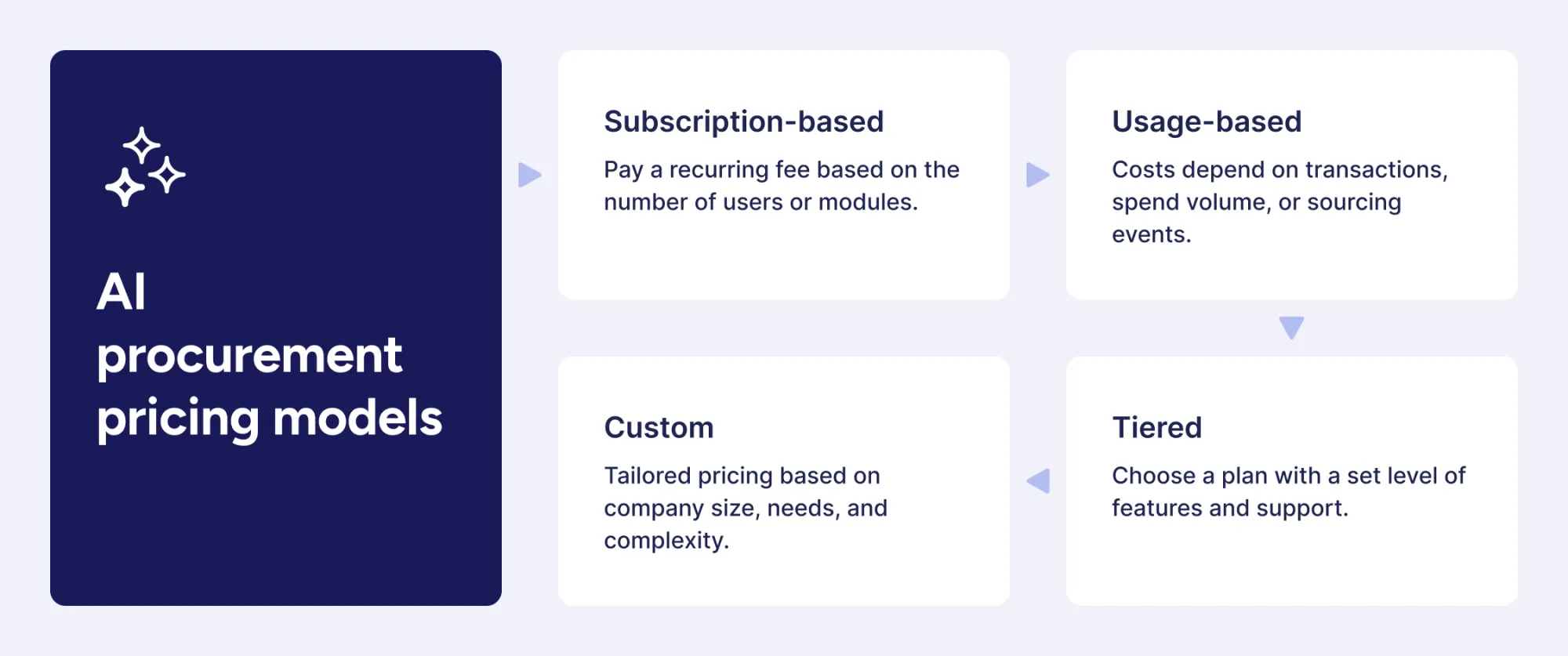
How can you estimate ROI from automation, savings, and risk reduction?
ROI from AI procurement software can be estimated by evaluating how much value the system generates through automation, cost savings, and risk education. Through automation, organizations save time and improve their operational efficiency by reducing different manual tasks such as data entry, approvals, and supplier communication.
Cost savings also have significant value, and they usually come from better supplier selection, improved negotiation outcomes, and more effective spend management. There is also risk reduction. AI tools help organizations to identify potential supplier risks, compliance issues, and spending anomalies, all of which can prevent costly errors and disruptions.
When these benefits are compared with the total cost of the procurement software, the organization can clearly determine whether its investment delivers meaningful and measurable returns.
What hidden costs (integration, training, data work) should be anticipated?
The hidden costs in AI procurement software usually includes expenses that are related to integration, training, and data preparation, all of which aren’t immediately obvious during the initial evaluation process.
Integration costs can arise when connecting the procurement system with existing tools such as ERP, finance, or supplier management systems. These may require additional technical work, time, and resources.
Training is another important factor to consider. Procurement teams need to be properly trained to use the software solution effectively, and this may involve onboarding sessions, documentation, and ongoing support.
There is also data work. The process of preparing data for AI systems often requires cleaning, organizing, and standardizing procurement data to ensure accuracy and reliability. When these hidden costs are anticipated, organizations can plan more effectively and avoid unexpected costs during implementation.
When is custom development worth the additional investment?
Custom development is worth the additional investment when an organization has highly specific procurement needs that cannot be fully met by standard software solutions. This is usually the case for large or complex systems with unique workflows, strict compliance requirements, or specialized procurement processes that require personalized functionality.
Custom development can also be valuable when existing tools cannot integrate properly with internal systems or when there is a need for deeper automation and customization. However, it’s important to consider the added costs, time, and maintenance involved. Personalized solutions usually require ongoing support and updates to remain effective.
In most cases, organizations should only consider custom development after evaluating available solutions and confirming that standard platforms cannot adequately meet their requirements.
What security, privacy, and compliance concerns arise with AI-driven procurement?
How does AI procurement software handle sensitive supplier and contract data?
AI procurement software protects sensitive supplier and contract data through a combination of security controls, access management, and structured data handling.
Most platforms store data in secure cloud environments and use encryption to prevent unauthorized access, protecting critical information such as supplier records, pricing agreements, and contract terms.
They also include audit trails that log user activity and changes, improving transparency and accountability across the system. Together, these capabilities allow organizations to manage sensitive data safely while staying compliant with relevant regulations.
What regulatory compliance issues should buyers consider?
Regulatory compliance in AI procurement means making sure both procurement processes and data handling follow relevant laws, industry standards, and internal policies. One key area is data protection. Organizations need to ensure that sensitive supplier and financial data is stored, processed, and shared securely and in line with applicable regulations.
There are also requirements tied to the procurement process itself, such as maintaining clear documentation, ensuring transparency, and following established approval workflows. For organizations operating in multiple regions, compliance becomes more complex, as different countries may have different rules for data management and procurement practices.
By addressing these areas, organizations can reduce legal risk, maintain trust, and keep procurement operations aligned with required standards.
How can bias and fairness in AI models be detected and mitigated?
Bias and fairness in AI procurement systems can be detected and mitigated by monitoring data inputs, evaluating model outputs, and applying clear governance controls.
Bias usually occurs when the data that is used to train AI systems is incomplete, unbalanced, or reflects existing inequalities. To detect this, organizations need to regularly review how the systems make decisions, especially in areas such as supplier selection, risk scoring, and evaluation outcomes.
Mitigation involves the process of improving data quality by ensuring that datasets are diverse, accurate, and representative. Additionally, organizations can implement oversight mechanisms such as human review and validation to ensure that AI-driven decisions remain fair and consistent.
When organizations combine data quality, continuous monitoring, and governance, they can reduce bias and ensure that their AI systems support fair and objective procurement decisions.
What auditability and explainability features are necessary?
Auditability and explainability in AI procurement systems are necessary to ensure that the decisions made by the system can be tracked, understood, and verified.
Auditability refers to the system’s ability to record and track activities, such as approvals, supplier selections, and data changes. It makes it possible for organizations to review actions, ensure compliance, and maintain accountability.
Explainability, on the other hand, ensures that the reasoning behind AI-driven decisions is clear and understandable. It’s especially important in areas like supplier evaluations or risk scoring, where stakeholders need to know why certain outcomes were generated.
To support auditability and explainability, procurement systems should provide clear logs, decision trails, and transparent insights into how recommendations or predictions are made. When organizations have strong auditability and explainability features, they can build trust in AI systems, improve transparency, and ensure better governance of their procurement processes.
Key takeaways
- AI procurement software helps to improve efficiency, visibility, and decision-making across procurement operations.
- Choosing the right AI procurement solution requires that you consider alignment with your workflows, systems, and long-term goals.
- Different tools serve different purposes, from end-to-end suites to niche solutions like sourcing or contract management.
- The successful implementation of AI solution software depends on data readiness, user adoption, and cross-team collaboration.
- The real value of AI procurement software lies in reducing costs, improving control, and enabling better business outcomes.
FAQ
Organizations can start to see benefits from AI procurement from a few weeks to a few months, depending on the complexity of the systems and how well it’s implemented. In the early stages, improvements are often seen in terms of faster approvals and reduced manual work. Over time, more advanced benefits like cost savings, better decision-making, and improved supplier management become more noticeable.
The speed at which the benefits of AI procurement can be seen largely depends on data readiness, user adoption, and how effectively the system is integrated into existing workflows.
Evaluating an AI procurement process involves reviewing how well the system fits into existing workflows, improves performance, and supports day-to-day operations. It starts with understanding the current procurement process and then assessing how the AI system handles key steps like request intake, approvals, sourcing, and tracking. Organizations then measure outcomes such as cycle time, cost savings, and data accuracy to see whether the tool delivers real improvements.
User adoption is also critical, as the system only creates value if teams actually use it effectively. Finally, evaluation should include transparency and control, ensuring decisions can be tracked, understood, and aligned with internal policies and compliance requirements.
Yes, AI is suitable for small and mid-sized businesses’ procurement operations, especially as many modern tools are designed to be scalable and easy to use. For smaller organizations, AI can help to automate routine tasks, improve visibility into spending, and reduce errors without requiring large procurement teams.
Also, many AI procurement solutions provide flexible pricing and modular features, allowing businesses to adopt only what they need. What matters when choosing a procurement solution is to ensure that your selection matches the organization’s size, budget, and level of complexity to ensure effective implementation and adoption.
The right choice between best-of-breed and integrated suite approaches depends on your organization’s needs, complexity, and existing systems.
Best-of-breed solutions focus on specific procurement functions and usually provide advanced capabilities in those areas. They are especially suitable for organizations that require specialized tools and are willing to manage multiple systems.
Integrated suites, on the other hand, provide end-to-end procurement capabilities within a single platform. They are great for organizations that want a unified system with better data flow and less system fragmentation.
Understanding both approaches, your decision should be based on whether your priority is specialized functionality or having a centralized, all-in-one procurement solution.
Procurement teams require a healthy combination of analytical, technical, and operational skills to effectively manage AI tools.
They should be able to understand and interpret data, as AI systems mainly depend on data for insights and decision-making. There is also a need for basic technical awareness, especially when working with integrations and system configurations.
Additionally, procurement teams need strong procurement knowledge to ensure that AI-driven outputs align with business goals and procurement strategies. There is also a need for adaptability, as it is important for procurement team members to always be willing to learn and adjust to new tools and workflows.
Book a demo with Precoro to see how AI procurement works beyond theory
Reading about AI procurement is one thing—seeing how it actually fits into your workflows is another. If you're evaluating tools and want to understand how automation, approvals, and spend visibility come together in a real system, it’s worth taking a closer look.