14 min read
Procurement Change Management: How to Implement Without Disruptions
Learn how to master procurement change management with proven strategies for smooth transitions and cost savings. Get practical, actionable insights.

Procurement has changed. Teams already spend up to 40% less time on manual work. New apps, tools, and platforms launch monthly, introducing new technologies, processes, and constant regulatory shifts. Yet, without a plan, innovation becomes disruption, and automation won’t fix it all.
Procurement excellence demands continuous improvement and strong change management. Practical training and consistent communication make system adoption easier for teams and drive iterative gains.
Experts agree: people come first, processes second, and technology last. Reverse that order, and even top tools fail.
Want to get it right? Read our guide on procurement change management to learn how to plan change, drive adoption, and make improvements that actually stick.
What is procurement change management?
Signs your procurement calls for change management
Framework of procurement change management
8 steps of procurement change management
3 effective methodologies for procurement change management
Key challenges of procurement change management
Precoro’s case studies of best-in-class procurement change management
Nail procurement change management with Precoro
Frequently asked questions about procurement change management
What is procurement change management?
Procurement change management is the process of planning, managing, and supporting changes that affect how an organization buys goods and services. These changes can include:
- New procurement technology (e‑procurement, P2P, S2P platforms)
- Updated policies or compliance requirements
- New sourcing strategies
- Process redesign or automation
- Organizational restructuring
The goal of change management in procurement is to reduce confusion and resistance, improve adoption of new systems or processes, and increase efficiency and compliance. Plus, it helps deliver cost savings, boost performance, and ensure the change sticks in the long term.
Signs your procurement calls for change management
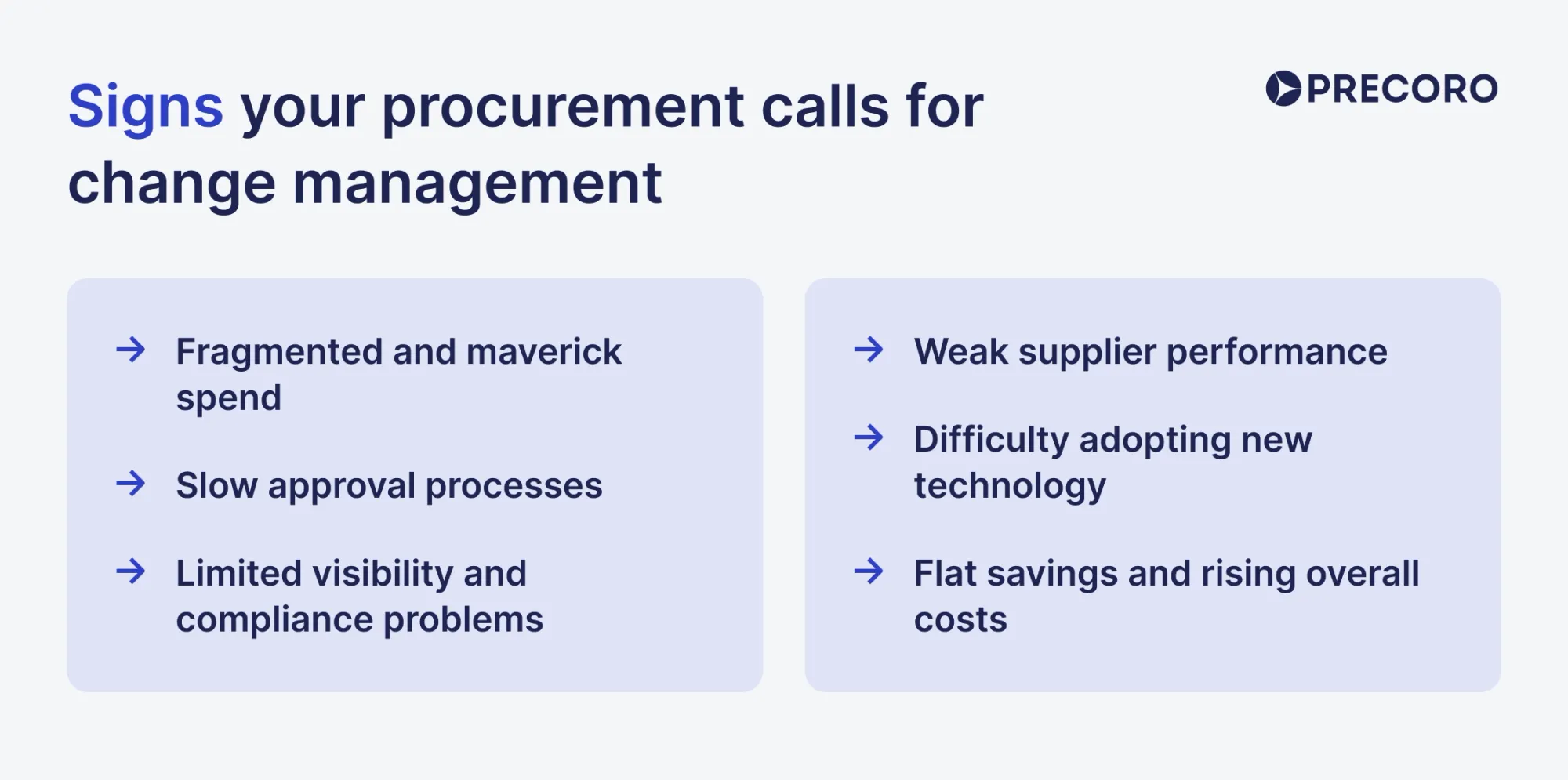
Technically, there might be nothing broken in your procurement, yet budgets creep higher, orders duplicate, and suppliers get frustrated. That’s the trap — without proactive change management, hidden costs quietly mount. We’ve listed common signs for immediate procurement change management:
Fragmented and maverick spend
Off-contract purchases dominate total spend. Supplier counts grow unchecked. Duplicate and rogue buying create leakage without oversight.
Slow approval processes
Purchase orders face repeated delays. Bottlenecks slow operations. Cash flow suffers from extended waits.
Weak supplier performance
Deliveries arrive late. Quality issues persist across vendors. Compliance with terms falls short regularly.
Limited visibility and compliance problems
Contracts go unenforced. Budget overruns appear unexpectedly. Rebates and savings go unnoticed.
Difficulty adopting new technology
Teams relying on spreadsheets or email resist new software tools or SaaS solutions. Change management in procurement ensures smooth adoption, minimizes disruption, and captures full value.
Flat savings and rising overall costs
Cost reductions fail to appear year-over-year. Total ownership costs rise steadily. Siloed processes block ROI gains.
Framework of procurement change management
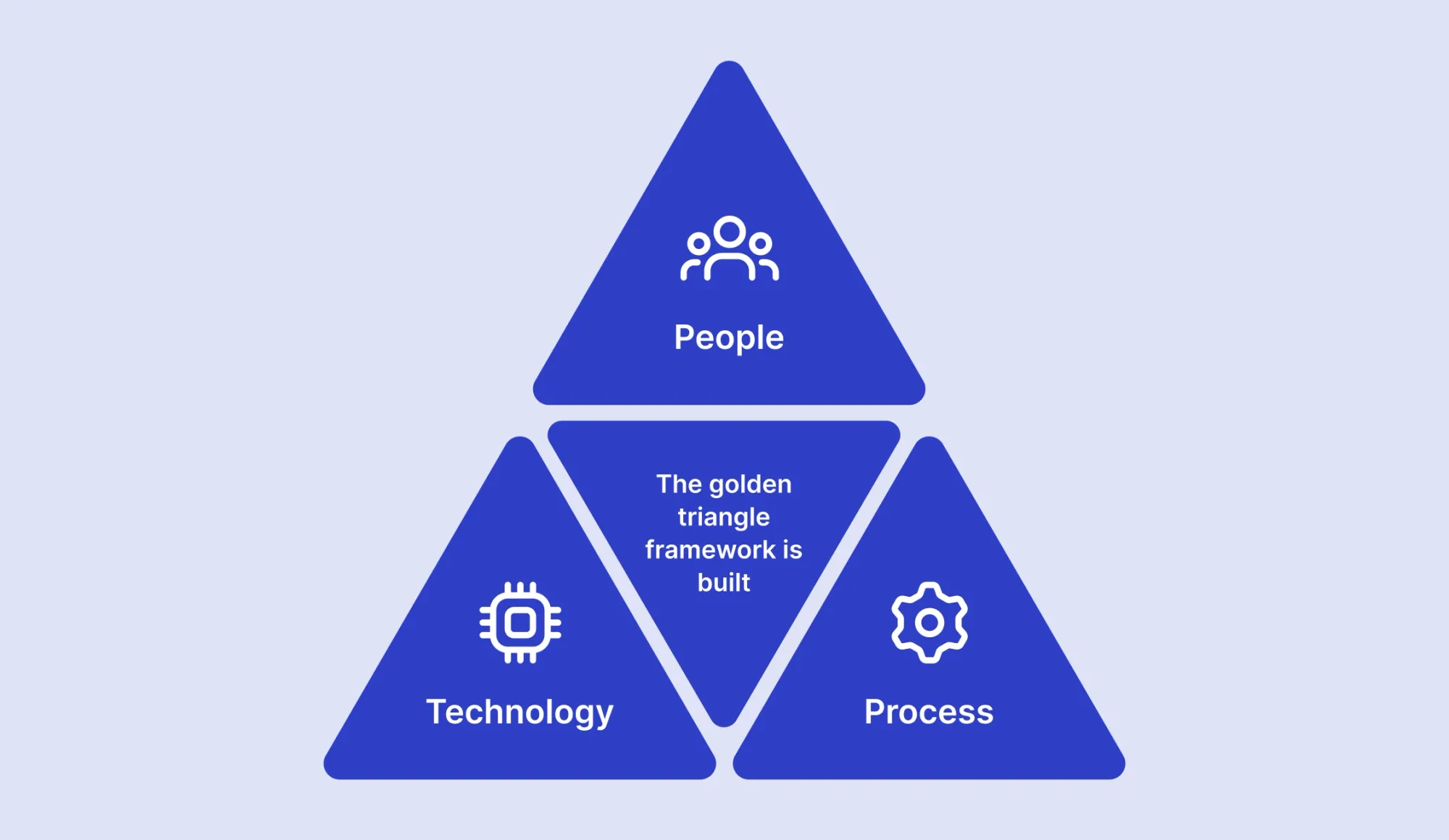
At this point, procurement automation might look like the perfect solution for change management, but it’s just one piece of the puzzle. True transformation change management relies on three key elements of the golden triangle: people, processes, and technology. None can be strengthened in isolation; lasting results come from balancing all three.
People
Automation helps, but a strong procurement strategy ultimately depends on people. Employees, suppliers, and stakeholders must be fully engaged throughout the journey, which is why successful procurement transformation change management focuses on clear communication, targeted training, and ongoing support. Addressing resistance early ensures adoption and helps sustain long-term results.
Processes
People need a clear set of processes that define how procurement works, from sourcing to contract management and regulatory control. When you change processes, aim to speed up workflows, cut inefficiencies, and improve transparency to make controls and savings repeatable.
Technology
When teams are aligned with business aims and processes, it’s time for digital procurement tools, automation, AI, and analytics. This way, you can improve decision-making and let them consolidate spending to gain leverage in supplier negotiations. When you roll out new software or a SaaS platform, provide focused training and fast answers to user questions to minimize disruption and maximize ROI.

8 steps of procurement change management
Change is easier when you have a plan. In procurement, these key steps guide you through the process:
Step 1. Determine your “why”
Before making any changes, procurement leaders should define the business drivers and expected outcomes by reviewing current processes, gaps, and potential benefits. A clear understanding of the “why” strengthens the case for stakeholder and leadership support.
Step 2. Develop a change management map
Once the need for change is established, develop a clear and structured change management plan. It should outline the scope and goals, identify key stakeholders and how to engage them, define communication approaches, specify training and support needs, and set a timeline with key milestones.
A well-designed roadmap ensures systematic change management in e-procurement, reduces confusion, and keeps the organization aligned throughout the transition.
Step 3. Bring key stakeholders into the process early
Get stakeholders involved as soon as possible. Because procurement change management affects many parts of the business, it’s important to know who will be impacted and include their input in the process. Be open and clear about what is changing, when it will happen, and why it matters. When people feel informed and listened to, they are much more likely to support the change.
Step 4. Build a change management team
Change management in procurement works best with a dedicated team. When procurement, HR, and communication specialists are on board, they oversee progress, address issues, and make sure the initiative stays on course.
Step 5. Communicate clearly and frequently
Keep communication at the center of change management in procurement. Explain the reason for the change, highlight its benefits, clarify impacts on roles, and share available support. Reach employees through meetings, newsletters, and online updates to ensure smooth adoption.
Step 6. Give instructions and assistance
For change to stick, employees need the right skills and confidence to adopt new ways of working. Offer tailored training — like system demos, hands-on workshops, or one-on-one mentoring — to suit each group’s needs.
Keep the support going with resources, such as help desks, FAQs, and peer mentors to help people navigate the transition smoothly.
Step 7. Measure performance and gather insights
Track how well employees are adopting the change through performance metrics, usage rates, and feedback. Use this information to make timely adjustments and fix issues before they escalate. Regular feedback loops help continuously improve the process and demonstrate leadership's commitment to supporting employees.
Step 8. Support and uphold the new way of working
The real challenge comes after implementation: sustaining the change. Reward early adopters, mark key milestones, and continuously communicate benefits. Integrating new behaviors into the procurement culture ensures the change becomes permanent.
Read on how to set up procurement change management with Precoro in our guide.
3 effective methodologies for procurement change management
There are many ways to manage change, but three of the best-known and most useful for procurement are ADKAR, Kotter's 8-Step Process, and Prosci's change management model.
ADKAR model
The ADKAR model outlines five building blocks — Awareness, Desire, Knowledge, Ability, and Reinforcement — that are essential to successful change. In procurement, it ensures buyers, approvers, and stakeholders adopt and use new processes and tools effectively.
| Stage | Focus | Procurement application |
|---|---|---|
| Awareness | The need for change. | Explain why the new e-procurement system or process is necessary. For example: "Maverick spend is costing us 10%" or "Manual PO creation causes 3-week delays." |
| Desire | The motivation to participate and support the change. | Address the "What's In It For Me" (WIIFM): Show the buyer they'll save time or the budget owner they'll have better budget visibility. |
| Knowledge | How to change. | Provide targeted, hands-on training for the new system, SOPs, and required skills (e.g., how to run a sourcing event, how to approve a requisition). |
| Ability | The skill to implement new behaviors. | Give employees time to practice, use pilot programs, and offer in-the-moment support (e.g., desk-side coaching or on-screen guidance). |
| Reinforcement | Sustaining the change. | Celebrate early successes, update performance reviews (KPIs) to reflect the new processes, and audit to ensure no one slips back into old habits. |
Kotter's 8-step process
John Kotter's process offers a clear, step-by-step approach to leading big changes in an organization. It works especially well for major procurement projects, like switching to digital systems or centralizing operations.
| Step | Description | Procurement Example |
|---|---|---|
| 1. Create a sense of urgency | Establish a "why now" for the procurement organization and its stakeholders. | "We must automate 50% of our transactional spend within 12 months to remain competitive." |
| 2. Build a guiding coalition | Assemble a powerful, cross-functional team of credible leaders to champion the change. | SVP of Procurement, key IT/Finance leaders, and influential category managers. |
| 3. Form a strategic vision and initiatives | Define a clear, inspiring future state for the procurement function. | "Our vision is to be a strategic business partner, not just a PO processor." |
| 4. Enlist a volunteer army (communicate the vision) | Communicate the new vision frequently and with passion, using all available channels to get buy-in from the masses. | Use emails, town halls, and dashboards to rally procurement staff. |
| 5. Enable action by removing barriers | Identify and minimize obstacles, such as legacy systems, rigid policies, or resistant managers, that block the new procurement processes. | Upgrade outdated systems and revise approval workflows. |
| 6. Generate short-term wins | Plan and communicate quick, tangible wins to build momentum and demonstrate progress. | "The pilot team achieved 30% faster approval times in their first month using the new platform!" |
| 7. Sustain acceleration (don't let up) | Build on early successes to tackle larger challenges, sharpen your vision, and keep moving forward. Hold off on celebrating too soon. | Scale pilots to a full range of product categories while addressing emerging challenges. |
| 8. Institute change (anchor new approaches) | Integrate new procurement processes, systems, and behaviors into the organizational culture, job descriptions, and training programs to ensure lasting change. | Update KPIs, onboarding, and performance reviews to reinforce new standards. |
Prosci's change management process
Prosci is one of the most widely used change management methodologies in the world, known for its research‑based, people‑centered approach. Their process is built around two core frameworks:
- The Prosci 3‑phase process
- The ADKAR® model (focused on individual change)
Together, they guide organizations through planning, implementing, and sustaining change.
The Prosci 3‑phase process
Prosci’s organizational change process is structured into three phases that help leaders prepare, manage, and reinforce change.
Phase 1: Prepare the approach
This phase focuses on building the foundation for successful change:
- Define the change and its objectives.
- Assess organizational readiness.
- Identify impacted groups.
- Develop a change‑management strategy tailored to the project and culture.
Phase 2: Manage change
This is where the plan becomes action:
- Create and execute communication plans.
- Develop sponsor roadmaps.
- Build training and coaching plans.
- Manage resistance.
- Support managers and supervisors.
Phase 3: Sustain outcomes
The goal is to ensure the change sticks:
- Measure adoption and usage.
- Identify gaps and implement corrective actions.
- Celebrate successes.
- Transfer ownership to operational teams.
Key challenges of procurement change management
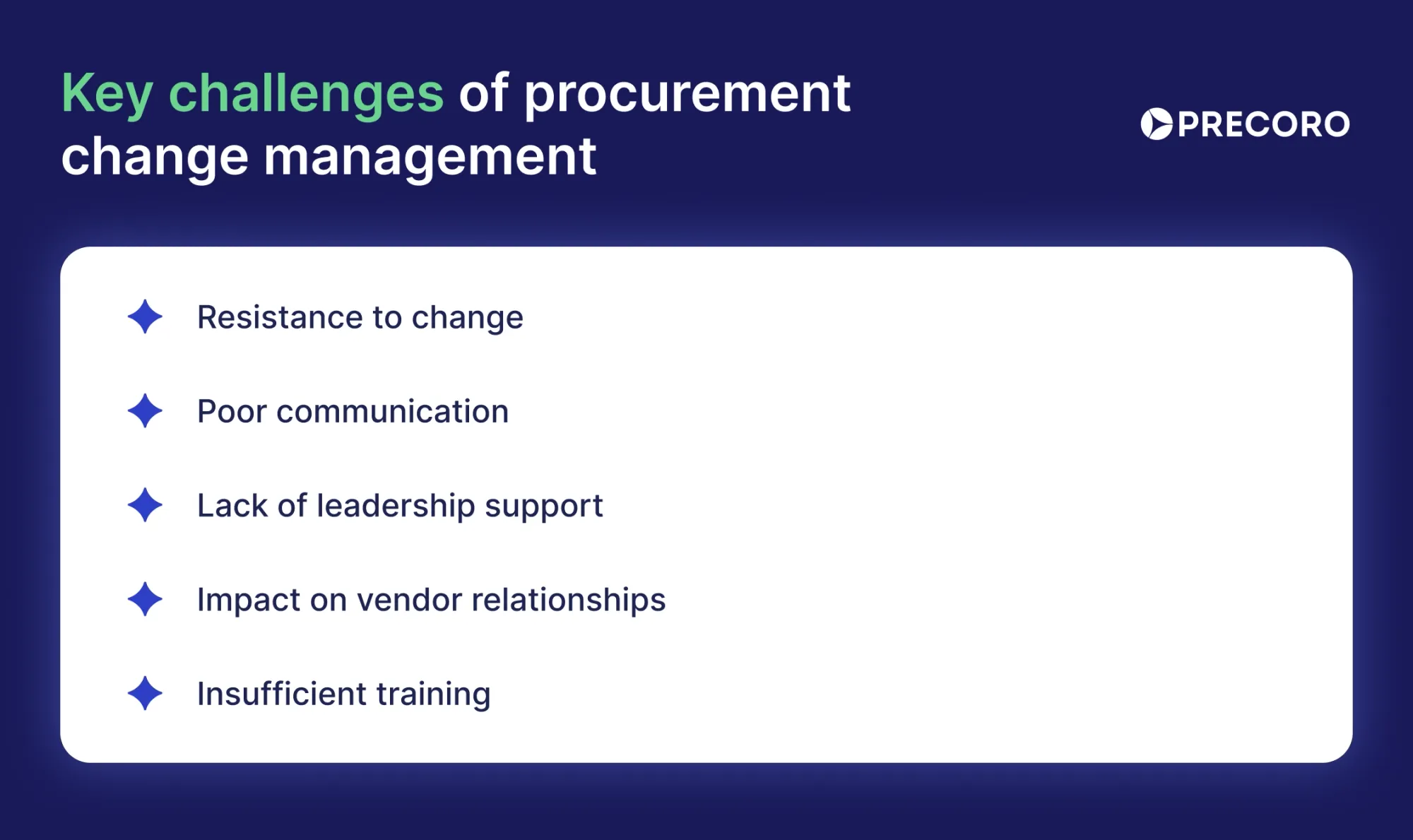
Changing how procurement works was never easy. Read on for the most common challenges of procurement change management and solutions:
1. Resistance to change
Change can be unsettling. Employees may worry about losing control, taking on more work, or even losing their job security. The key is to involve them early, explain why the change matters, and give them space to ask questions. This is exactly what makes change management in e-procurement work well — guiding teams through new systems while keeping daily operations running smoothly.
2. Poor communication
Poor or inconsistent communication often creates confusion, mistrust, and rumors, which can derail change initiatives. To ensure success, communicate frequently and transparently through multiple channels, so everyone — from frontline staff to senior leaders — understands what is changing, why it matters, and how it affects them.
3. Lack of leadership support
Without visible commitment from senior leaders, employees may not take the change seriously or may revert to old habits. Leadership support goes beyond verbal endorsement. Managers should act as sponsors and champions to reinforce the importance of the change and demonstrate accountability for results.
4. Impact on vendor relationships
If you don’t assess how changes affect suppliers, you can strain relationships, disrupt supply continuity, and create compliance risks. Before implementing any change in procurement or supply chain operations, consider how your suppliers will respond. Are they informed about the new processes? Do they have the resources to adapt? Evaluating these factors beforehand helps maintain strong supplier relationships and ensures a smoother transition.
5. Insufficient training
Even the best systems fail without proper guidance. By integrating training into every stage of procurement change management, organizations build confidence, reduce errors, and ensure consistent application of new processes across teams and suppliers.
Precoro’s case studies of best-in-class procurement change management
Since you know how procurement change management works in theory, see how Precoro has made it a practice.
Solar power producer
This multi-entity solar power producer operated across many locations with decentralized procurement. The company relied on spreadsheets and paper-based processes that fragmented data and hindered oversight.
- Challenge: Slow approval cycles, frequent budget overruns from poor tracking, and manual errors delayed operations and limited scalability.
- Achievement: Precoro centralized purchasing and reduced procurement cycle time by 50% with streamlined multi-level approvals and automated 3-way matching. Dedicated onboarding support from Precoro ensured quick adoption once a procurement manager was assigned, enabling better spend control and compliance.
Electra
Electra, a fast-growing French EV charging network startup, started with basic manual operations but quickly outpaced its tools as expansion demanded agility.
- Challenge: Spreadsheets created approval delays, invoice errors, supplier mismanagement, and zero visibility into spend, leading to chaotic workflows and lost opportunities.
- Achievement: With a focus on supplier change management and internal process optimization, Precoro simplified supplier negotiations, automated PO generation, and provided end-to-end visibility. As a result, Electra transformed daily operations into efficient, scalable processes. The Head of Procurement praised it as a game-changer for speed and accuracy.
Green Cell
Green Cell, an electromobility company, outpaced its rudimentary four-step Google Sheets process for POs and approvals.
- Challenge: Surging PO volumes caused bottlenecks, human errors, a lack of central control, and opaque cost tracking. As a result, the company faced risks to compliance and efficiency during rapid scaling.
- Achievement: With Precoro, Green Cell achieved 76% growth. The platform delivered automated procurement centralization, custom workflows, and analytics, saving hundreds of hours of manual work annually. It also got rid of errors, provided granular cost visibility, and supported hyper-growth with robust reporting for strategic decision-making.
Nail procurement change management with Precoro
Procurement change stalls without the right tools and people who know how to use them. At Precoro, we understand that successful procurement transformation change management goes beyond technology. Itʼs just as much about people, processes, and making sure your team feels confident every step of the way.
Thatʼs why we focus on a structured, people-centered approach to change management in e-procurement. With the right plan in place, you can expect stronger compliance, better cost control, less manual work, and a procurement process thatʼs finally built to scale.
Precoro drives procurement change management with measurable results. It starts with 2-8 week rollouts. Next, guided intake standardizes requests across sites, and approved supplier and item catalogs prevent maverick spend upfront.
Custom workflows then enforce compliance, while real-time dashboards track team spend and enable vendor consolidation for the supplier change management process that secures discounts and stops fraud.
Finally, Precoro sends only approved invoices to the ERP, preventing duplicate or incorrect payments. Pilots and metrics lock in long-term change management in procurement. Skip the IT roadblocks and focus on procurement change management you can trust. Request a Precoro demo today and take control of your procurement.
Frequently asked questions about procurement change management
Procurement needs change management any time people must change how they buy, approve, or work with suppliers. For example, when new systems are introduced, processes or policies change, supplier strategies shift, the procurement organization is restructured, or cost‑reduction, risk, or ESG programs require new behaviors.
Change management is only successful if its impact can be measured. In practice, this means you need to constantly monitor adoption and compliance rates, cycle time and error reductions, cost savings or cost avoidance, stakeholder satisfaction, and long‑term adherence to the new processes.
Assess your procurement team's size, the change's complexity, and required stakeholder engagement. Kotter’s method suits cultural and leadership-driven changes, while Prosci’s approach is better for process and technology adoption.
Turn procurement change into real adoption.
See how Precoro helps teams roll out new processes faster, enforce policies by default, and keep everyone aligned—without slowing the business down.