
Supply Chain Diversification: How Can You Build Supplier Options for Greater Resilience?
Learn about the nature of diversification in supply chains, using multiple supplier options to build up business resilience.

A diversified supplier base is an important procurement risk-management tool that’s frequently undervalued and underinvested in. In this guide, we provide the strategies, metrics, and governance structure needed to shift the supplier base from a planning tool to a metric-driven competitive advantage.
- Supplier diversification is one dependency; full diversification also covers geography, transport, inventory, and production capacity.
- Diversify at the dependency level, not just the supplier level. A single transport route or production site can be as big a risk as a single supplier.
- Start before a disruption forces it. Qualifying a new supplier for a critical component can take six to eighteen months.
- Match the number of alternative suppliers to a component's risk and value. Adding more alternatives than the risk justifies raises cost without adding real resilience.
- Measure success with concentration ratios, alternative-supplier activation rates, and disruption recovery time, tracked by category.
Read more about:
Why supply chain diversification matters now
Does diversification go beyond adding suppliers?
When to start diversifying your supply chain
Key benefits of diversifying your supplier base
Strategies to diversify your supplier network
How to identify and evaluate alternative suppliers
Which regions to consider for supplier diversification
Assessing and managing risk across multiple suppliers
Technology that supports supply chain diversification
Common challenges in implementing supplier diversification
Building strong relationships with multiple suppliers
Metrics to measure diversification success
FAQ
Why is supply chain diversification critical in today's global economy?
Supply chain diversification reduces dependence on any one supplier, region, transport route, or production site. Nowadays, it’s the de facto standard of business continuity.
The single-source dependencies that once felt like an efficiency tool can now be identified and quantified as business risks. Below, we explain what creates this risk and what it actually takes to build resilience.
What are the main risks of single-source dependency?
The main risks are operational disruption, weaker negotiating leverage, quality stagnation, and geographic or geopolitical concentration:
- Operational disruption — any supplier-side failure becomes yours.
- Price vulnerability — no other options make negotiating price increases difficult.
- Quality stagnation — lack of competition weakens incentives for improvement.
- Geopolitical exposure — any instability or political problems can affect the whole supply relationship.
Likewise, if you only depend on one source, you might underestimate the real qualification time of the substitute vendor.
What does supply chain resilience mean for your business?
Supply chain resilience is the ability to withstand disruptions and recover from them without major loss of revenue or reputation. Besides a list of active vendors, resilience involves building active relationships, tested procedures, and visibility across the entire supplier network.
Resilience means:
- Shorter recovery times
- Continued operation during service disruption
- Lack of reliance on a single point of failure
Truly resilient organizations treat diversification as an ongoing operational discipline. For instance, according to the fifth annual McKinsey Global Supply Chain Leader Survey, conducted in 2024, 73% are seeing progress in their dual-sourcing strategies.
However, some firms who claim to be resilient only address the most obvious risks. Real resilience and vendor risk management require diversifying contingency plans, logistics networks, and inventory buffers across different threat categories.
Does supply chain diversification go beyond adding suppliers?
Yes, supply chain diversification doesn’t end at simply adding suppliers. Companies can also diversify their production locations, transport routes and modes, inventory locations, and distribution footprint. These initiatives still count as diversification since their aim is to make the supply chain as a whole more resilient and diverse. In fact, companies that changed transport routes, modes, or distribution locations reduced transportation costs by about 25%, according to McKinsey.
For example, a company can source from suppliers in different regions but still depend on the same route. At the end of the day, that route remains a single point of risk, and the company should adjust its strategy accordingly.
Look out for these dependencies when diversifying your supply chain.
- Geographic footprint: Source or produce goods across different countries or regions to reduce exposure to local disruptions.
- Transport: Use different carriers, routes, ports, or transport modes to avoid dependence on one logistics option.
- Inventory: Hold critical stock in different locations or increase buffers for products with high supply risk.
- Production: Maintain flexible production capacity across multiple facilities or regions.
- Supplier tiers: Assess dependencies beyond tier-1 suppliers, including critical tier-2 and tier-3 suppliers.
When should companies start diversifying their supply chain?
Companies should start diversifying before they face a supply disruption. They need to plan ahead since starting the search for alternatives at the last minute only pressures firms to choose more costly options. Businesses that postpone diversification to a future project often end up reacting to crises instead of preparing for them. Single-source dependency becomes progressively more expensive and difficult to fix the longer it’s neglected.
What early warning signs indicate over-reliance on a single supplier?
Overdependence develops over time as supplier ties grow closer and switching costs rise. By the time problems emerge, the dependency is already difficult to fix.
The warning signs of supply chain crises include:
- A single supplier accounts for more than 50% of a critical input — such a high concentration limits choices in a crisis.
- Lead times have kept increasing without a clear reason — longer delivery schedules point to financial and operational pressure.
- Price increases go unchallenged — with no substitute supplier available, you’re losing negotiation power.
- Supplier audits are being deferred or avoided — supplier avoidance is often a signal of instability or unreliability.
- Geographic concentration mirrors the supplier's region — a natural disaster, political event, or regulatory change affects the entire supply relationship at once.
A business that identifies these trends early on can take its time to qualify alternatives properly. Those who wait for too long, on the other hand, usually have to deal with shorter deadlines and increased onboarding costs.
Why should you diversify suppliers before a disruption?
Reactive diversification costs more than proactive diversification. When a supply disruption forces action, procurement has less time to negotiate, assess suppliers, and control onboarding costs.
According to 24 Chemical Research, qualifying a new supplier for a specialized component under normal circumstances takes six to eighteen months in total (including factory audits, sample tests, regulatory compliance, and initial production). In a crisis, companies often skip or shorten this process dramatically, creating both quality and reliability risks at the most critical moment.
Through proactive diversification, a company can gradually develop relationships with secondary and tertiary suppliers before they need them. They can also keep volumes low to maintain the capability without the added costs of dual sourcing. The goal is to be able to choose the backup option beforehand instead of conducting sourcing under pressure.
What are the key benefits of diversifying your supplier base?
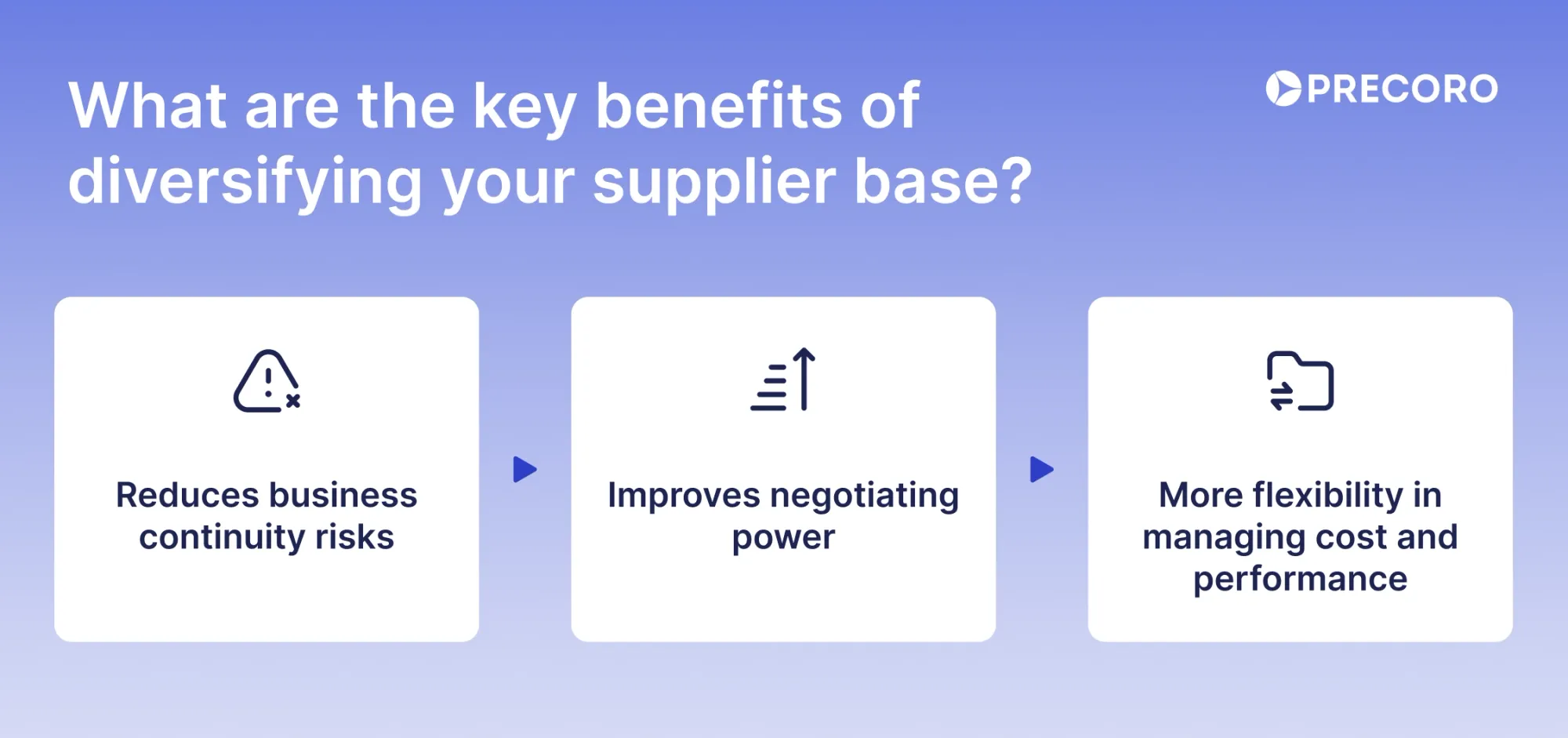
Supplier diversification reduces business continuity risks, improves negotiating power, and gives companies more flexibility in managing cost, capacity, and performance. While supplier diversification is commonly discussed as a strategy for risk mitigation, the business and operating advantages are actually far more significant. Diversified supplier networks inherently give companies more leverage on price, quality, and competition than single-source models.
How does diversification reduce business continuity risks?
By design, supplier diversity helps maintain a continuous operation when one source can no longer perform. A production line shut down, a logistics interruption, or a supplier bankruptcy that would cripple a single-source supply chain now results in a manageable capacity relocation.
Over time, this setup also benefits suppliers. When they know they share business with competitors, they’re more motivated to perform, deliver on time, and invest in their capabilities. As a result, the overall supplier base becomes more reliable.
Can multiple suppliers help you negotiate better pricing?
Yes. One of the most reliable sources of cost reduction in procurement is supplier competition. Even without constantly reallocating orders, the option to move business to another supplier can encourage better pricing and contract terms. Companies that manage multiple suppliers consistently secure better contract prices, stronger renewal terms, and more cooperative suppliers willing to share the cost burden.
However, spreading orders across multiple suppliers can reduce volume-based discounts. Find the right balance between the negotiating leverage and the savings from supplier concentration.
What competitive advantages does supplier diversification offer?
The advantages of diversification extend well beyond the supply chain. A strong supplier base results in faster speed to market, lower regional risk, stronger customer trust, and less impact when a supplier fails:
- Speed to market — independence from a single supplier's production schedule or capacity constraints allows faster response to demand changes.
- Regional insulation — geographic diversification reduces exposure to disruptions that affect competitors sourcing from the same concentrated region.
- Resilience as competitive advantage — supply chain robustness is increasingly evaluated in enterprise sales cycles, procurement audits, and ESG (Environmental, Social, and Governance) assessments.
- Reduced contagion risk — a quality or compliance failure at one supplier doesn’t automatically affect the customer.
What strategies can you use to diversify your supplier network?
Simply finding alternate vendors isn’t a diversification strategy. Businesses need a well-defined process for supplier evaluation, segmentation, and management. For sustained success, the strategies have to strike a balance between mitigating risk and containing costs, instead of assuming that adding more suppliers automatically increases resilience.
Should you diversify suppliers or redesign the product?
It depends on whether the at-risk component is essential to the product. If it is critical, finding an alternative supplier may be the better option; if it is non-essential or is one of several ways to perform the required function, a simple redesign can reduce potential risks without another vendor.
However, product redesign isn’t a replacement for supplier diversification in every case. Changes to core components can affect product performance, compliance, quality, and customer expectations. They can also require new testing or approvals.
| Aspect | Diversify suppliers | Redesign the product |
|---|---|---|
| Best when | The component is essential and must stay in the product | The component is non-essential, or the product has unnecessary complexity |
| Main action | Qualify alternative suppliers or regions | Change, simplify, postpone, or remove product features |
| What it reduces | Dependence on a specific supplier or region | Dependence on specific components and supply sources |
| Typical effort | Supplier search, qualification, testing, and onboarding | Product development, testing, and possible customer validation |
| Main benefit | Keeps the existing product and specifications | Can reduce supply risk without adding suppliers |
| Main risk | More suppliers can increase procurement and quality-management costs | Changes can affect product quality, compliance, or customer expectations |
| Consider first when | The component is critical to product performance | The component adds limited customer value or can be replaced |
| Key question | "Who else can supply this component?" | "Do we need this component in its current form?" |
How do you identify and evaluate alternative suppliers?
To identify alternative suppliers, first identify where existing dependencies create unacceptable risk. Diversification should target critical parts, costly items, or single-source areas that are most exposed to geopolitical threats.
Common evaluation criteria for supplier reliability include:
- Financial stability — audited financials, credit ratings, and payment behavior indicate whether a supplier can sustain operations under stress.
- Production capacity — confirmed ability to scale to required volumes, not just sample or pilot quantities.
- Quality certifications — ISO (International Organization for Standardization), industry-specific, or customer-mandated standards that indicate process maturity.
- Geographic and logistical profile — proximity to ports, exposure to regional risks, and lead time variability.
- References and track record — performance history with comparable customers in similar volume ranges.
Think of the assessment as a continuous qualification pipeline where suppliers are evaluated and approved. Update and check it regularly rather than wait until the main supplier encounters problems.
Should you consider geographic diversification vs. supplier type diversification?
Use both when the risks justify it. Geographic diversification addresses regional disruption; supplier-type diversification reduces dependence on suppliers with similar capacity or operating characteristics.
Geographic diversification protects against disruptions that are likely to impact one or more regions. They include natural disasters, political upheavals, port closures, or trade barriers that impact a whole region. If suppliers are dispersed across various geographic regions, it’s unlikely that one geographic event could shut down the entire supplier base.
Supplier type diversification (mixing large, established manufacturers with smaller, niche, or local suppliers) helps mitigate another kind of risk. Large manufacturers offer stability and capacity, while smaller suppliers bring flexibility, faster response times, and a willingness to handle custom production. Relying only on large suppliers can make the supply base surprisingly fragile when demand fluctuates.
The pragmatic approach is to map all suppliers across two dimensions, see where they’re concentrated, and focus attention on the targets that fall into both gaps at the same time.
Supplier base mapped by region and type
Each dot represents one supplier, positioned by region and supplier type. Use the filters to see where your supplier coverage is weakest.
What is the optimal number of suppliers for each critical component?
There’s no exact rule for how many suppliers a company should have, but common practices can offer some guidance. For most critical components, a rule of thumb is to have a primary supplier handle 70–80% of the volume and a secondary supplier cover 20–30%. This approach provides protection but still keeps vendor management simple.
For some high-criticality inputs, a third qualified supplier can provide additional capacity if the additional management cost is justified:
| Supplier role | Typical volume share | Primary purpose |
|---|---|---|
| Primary | 60–70% | Cost efficiency, relationship depth |
| Secondary | 20–30% | Active backup, competitive tension |
| Tertiary | 5–15% | Innovation testing, emergency capacity |
Each additional supplier adds qualification and management costs, so the benefit should be evaluated category by category. Each additional supplier requires ongoing qualification, communication, and contracting, which adds costs whether or not the supplier is actively used.
How can you balance cost efficiency with diversification goals?
Balance cost and resilience by diversifying only critical items and keeping secondary suppliers active at low volume. That way, you’re not paying additional costs for maintaining multiple vendors for all supplies, but still have enough alternatives to cover when a critical partnership fails.
Dual- or multi-sourcing typically costs more. Smaller order volumes reduce economies of scale, and each additional supplier carries their own management costs. The key issue then is whether these higher expenses are worth the decreased risk.
Compare the investment in diversification against the potential impact of a disruption. For example, a secondary supplier that raises unit prices by 3% is easy to justify if a failure could halt production for weeks. By contrast, diversifying a low-criticality component is harder to justify, especially when many readily available alternatives exist.
Practically, cost efficiency and diversification can be reconciled by:
- Consolidating volume with the main supplier to maintain negotiation strength.
- Engaging secondary suppliers for innovation, speed, or specialty requirements.
- Establishing long-term agreements with secondary suppliers, committing to minimum volumes at favorable prices.
How should procurement teams govern a diversified supplier base?
A large supplier base only adds value if it’s properly managed. Procurement teams should set clear supplier selection and approval rules, assign ownership, and regularly review supplier performance and risk. These measures prevent supplier sprawl (an unnecessarily large, unmanaged vendor base) and keep diversification focused on resilience.
How do sourcing policies support supplier diversification?
A governed supplier base begins with establishing sourcing policies. They serve as guidelines that specify which categories to multi-source, the volume limits for each supplier, and the rules for onboarding and offboarding.
Effective sourcing policies that support diversification typically address:
- Category segmentation — separating critical input for active dual-sourcing from standard purchases where single sourcing will suffice.
- Volume allocation rules — setting target percentages of volume for a primary, secondary, and tertiary supplier for each critical category.
- Requalification schedules — determining frequency of formal assessment for each supplier on quality, financial health, and compliance.
- Escalation triggers — specifying the conditions (a supplier's financial distress, a geopolitical event, a quality failure) that automatically initiate diversification action.
If policies leave out these specifics, business units may interpret them differently, letting supplier concentration creep back despite prior efforts.
How can you prevent supplier sprawl?
Supplier sprawl is the opposite of over-concentration. It’s an unmanaged vendor proliferation that raises the administrative cost, fragments the volume, and impedes consistent quality control processes. Approval frameworks are designed to prevent both extremes. A functional approval framework helps define the following factors:
- Who can onboard new suppliers?
- What criteria must be met before approval?
- Which stakeholders must sign off at each stage? (procurement, finance, legal, quality)
Without addressing these topics, individual business units might add suppliers opportunistically, bypassing any qualification processes that make diversification useful to begin with. Centralized supplier master data provides a proper enforcement mechanism in such cases.
When all supplier records, approvals, and performance data are managed in the same system, unauthorized additions become visible, and gaps in governance are easier to identify and fix. Procurement platforms that consolidate approval workflows, supplier scorecards, and contract status in one place turn this framework from theory into practice.
Which geographic regions should you consider for supplier diversification?
The right geographic region for supplier diversification depends on:
- Trade agreements
- Infrastructure quality
- Political stability
- Labor market conditions
What are the pros and cons of nearshoring vs. offshoring?
The decision between nearshoring vs. offshoring depends on the industry, product type, and risk tolerance. Neither approach is inherently better; it's about what type of risk the business faces the most. Key factors are compared below:
| Factor | Nearshoring | Offshoring |
|---|---|---|
| Lead times | Shorter, more predictable | Longer, higher variability |
| Labor costs | Higher | Lower |
| Transportation costs | Lower | Higher |
| Cultural/language alignment | Stronger | More variable |
| Geopolitical exposure | Lower for US/EU companies | Higher for Asia-concentrated supply |
| Flexibility | Faster response to demand changes | Slower reallocation |
| Infrastructure quality | Generally higher | Varies significantly by region |
For many companies, the most beneficial option is a hybrid approach: nearshoring for high-criticality time-sensitive components, and offshoring for stable, high-volume, and low-cost inputs.
How can regional trade agreements impact your supplier selection?
Trade agreements have a direct impact on the landed cost of goods, which can change the profitability of supplier relationships in any region. A supplier may seem cost-competitive based on unit price alone, but become less viable after accounting for tariffs, rules of origin, and customs compliance costs.
Key agreements that currently shape supplier geography include:
- USMCA (United States–Mexico–Canada Agreement) — regulates trade between the US, Mexico, and Canada; critical for North American nearshoring strategies, particularly in automotive and electronics sectors.
- CPTPP (Comprehensive and Progressive Agreement for Trans-Pacific Partnership) — regulates eleven Asia-Pacific economies, including Japan, Vietnam, and Malaysia, as well as the United Kingdom; relevant for companies aiming to diversify from China.
- European Union (EU) trade agreements — preferential trade agreements with over 70 countries, which materially affect sourcing economics for European operations.
- RCEP (Regional Comprehensive Economic Partnership) — the world's largest trade bloc by gross domestic product (GDP), covering fifteen Asia-Pacific nations, it shapes intra-regional supply chain economics across manufacturing-heavy countries.
Trade agreements can change through reclassifications, withdrawals, tariff updates, and renegotiations, often faster than supplier qualification processes. Procurement teams that monitor these changes can act early instead of reacting under pressure.
Which emerging markets offer the best opportunities for diversification?
| Region | Strengths | Considerations |
|---|---|---|
| Vietnam | Strong electronics and apparel manufacturing, CPTPP member | Infrastructure bottlenecks, rising labor costs |
| India | Large labor pool, growing tech and pharma base, government incentives | Logistics complexity, regulatory variability |
| Mexico | USMCA access, proximity to US market, automotive strength | Security concerns in some regions, wage inflation |
| Poland/CEE (Central and Eastern Europe) | EU membership, skilled workforce, nearshore for European operations | Smaller scale, higher costs than Asian alternatives |
| Morocco | Growing automotive and aerospace sector, EU trade access | Limited scale outside core industries |
| Indonesia | Large manufacturing base, competitive labor costs, RCEP member | Infrastructure gaps, regulatory complexity |
How do you assess and manage risks across multiple suppliers?
Use a consistent risk assessment framework to assess risks across suppliers. Monitor existing suppliers for changes in financial health and other risk indicators, and apply deeper due diligence when onboarding alternative suppliers. Assess country and regional risks separately, then combine supplier and geographic risk scores to identify the highest-priority diversification needs.
What risk assessment framework should you use for new suppliers?
Assess new suppliers against the same criteria required for long-term stability, not simply by price and capability. If there’s no common framework in place, assessments would vary greatly by teams and by urgency, with high-risk suppliers finding their way into the base undetected.
A functional framework typically evaluates suppliers across four dimensions:
| Dimension | Key assessment criteria |
|---|---|
| Financial risk | Credit ratings, profitability trends, debt levels, payment behavior |
| Operational risk | Production capacity, quality systems, redundancy, lead time consistency |
| Geopolitical risk | Country stability, trade agreement exposure, regulatory environment |
| Compliance risk | Labor standards, environmental certifications, data security, sanctions screening |
Each dimension should produce a scored value that contributes to a single supplier risk score. This score then determines how often the supplier is monitored, the level of ongoing due diligence required, and the priority for identifying alternatives.
The system works best when applied at onboarding and reviewed at regular intervals, rather than being used only during a crisis.
How can you monitor supplier financial health and stability?
Constant monitoring (instead of periodic audits) can reveal changes between formal reveals. Annual evaluations may catch issues only after they’ve affected operations, and suppliers rarely announce financial trouble early.
Watch for more obvious signs, such as requests for faster payments or larger deposits: both suggest genuine liquidity issues. With large suppliers who are subject to rating agency coverage, a falling credit rating is a formal leading indicator that’s likely to slip by internal monitoring.
What due diligence is required when onboarding alternative suppliers?
Due diligence for onboarding alternative suppliers is very similar structurally to the primary supplier qualification process, but with a different risk tolerance level. An alternative that fails when it’s needed the most (under pressure) is worse than having no alternative.
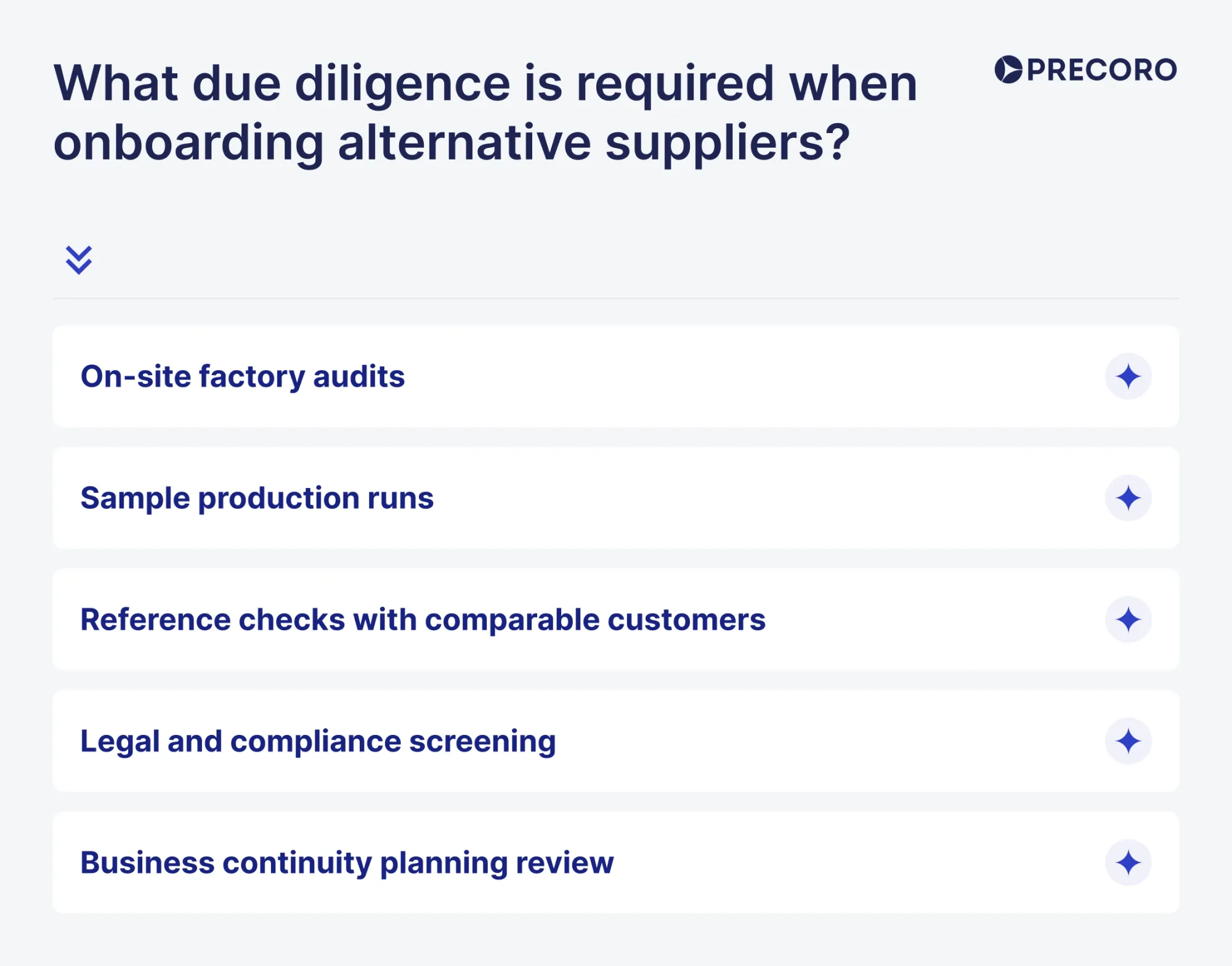
Due diligence, which consistently predicts alternative supplier reliability, includes:
- On-site factory audits — remote assessments may miss issues with production that materially affect quality and capacity.
- Sample production runs — a limited sample doesn’t capture the process variability associated with larger volume orders.
- Reference checks with comparable customers — high performance at low volume isn’t always a precursor of sustained quality when demand grows.
- Legal and compliance screening — sanction lists, beneficial ownership reviews, and labor audits protect against potential reputational and regulatory risk.
- Business continuity planning review — a supplier's ability to maintain operations during a disruption is important to its value as an alternative supplier.
The due diligence process should end with a formal decision to approve, conditionally approve, or reject the supplier, with a documented justification for future review.
How do you evaluate political and economic risks by region?
Political and economic risk should be assessed at the country or regional level, separately from supplier-level risk. Such assessment typically uses external factors that aren’t controlled or reported by the supplier.
Established frameworks for country risk assessment include:
- Political stability indices — World Bank Governance Indicators and the Economist Intelligence Unit country risk ratings allow structured country-by-country comparisons.
- Trade policy monitoring — tariffs, export controls, and sanctions that can affect supplier feasibility and landed costs.
- Currency risk assessment — exchange rate fluctuations that can change the cost of overseas sourcing, especially under fixed-term agreements.
- Infrastructure and logistics ratings — the World Bank's Logistics Performance Index assesses customs timeliness, infrastructure quality, and shipment tracking reliability.
However, the challenge is translating these analyses into procurement choices. An effective approach would be to give each supplier a country risk score and an operational risk score, then weight the blended score by that supplier's share of critical input volume. Low-country risk and high-volume suppliers should become the highest-priority diversification candidates, regardless of individual operational capabilities.
What technology solutions support supply chain diversification?
Technology supports supply chain diversification by centralizing supplier data, automating onboarding and approvals, and providing visibility into supplier performance and risk. AI and analytics can also help identify potential disruptions early and support better sourcing and volume-allocation decisions.
How can supply chain management software help track multiple suppliers?
Modern supply chain systems centralize contracts, performance metrics, and communications in one place, replacing emails and spreadsheets.
The operational advantages that consolidated supplier tracking delivers include:
- Real-time visibility into order status, delivery performance, and capacity across active suppliers
- Automated alerts for contract renewals, certification expirations, and performance issues
- Consolidated spend analysis to support volume allocation decisions
- Audit trails for supplier approvals, qualification decisions, and compliance documentation
If your company manages suppliers across multiple regions and categories, relying on manual processes instead of dedicated supplier management software only hinders the process. It just spreads the same tasks across siloed business units, which is exactly how supplier sprawl and compliance gaps arise.
Can artificial intelligence (AI) and machine learning predict supply chain disruptions?
AI and machine learning in supply chain risk combine internal supplier performance data with external information, such as weather, geopolitical news, port congestion, and financial updates. This wealth of data can help identify potential disruptions before they impact operations.
It’s important to acknowledge the limitations. AI predictions are probabilistic — they highlight potential risks, not guaranteed disruptions. False positives can cause alert fatigue, and models based on past events may miss new types of disruptions.
AI works best as an early warning tool to support human decision-making. Teams should treat AI signals as one input among many rather than rely on them as the sole basis for action.
How do digital platforms facilitate supplier discovery and onboarding?
Sourcing suitable alternative suppliers has always been a tedious, long, and difficult part of diversification. Luckily, the identification phase is now reduced from months to weeks by digital supplier discovery platforms that can create vendor profiles with a logical structure across different countries and categories.
Onboarding automation extends that speed through qualification. Document collection, compliance screening, and preliminary risk scoring are performed simultaneously to reduce timelines without sacrificing the process depth.
The additional benefit is data quality. When suppliers are onboarded digitally, their information integrates directly into an existing system of structured records.
How can Precoro centralize supplier data and approvals?
The challenge of managing supplier diversification across numerous business units, regions, and categories requires a platform that can dictate consistency without hindering the process. Precoro centralizes supplier master data, approval workflows, and procurement activities in one platform, giving procurement teams the visibility and control they need to manage multiple suppliers.
Supplier onboarding in Precoro is built on a multi-stage approval workflow where numerous qualification criteria are verified before the vendor becomes active in the system. Purchase orders, invoices, contract terms, and spending data from all suppliers and vendors are consolidated in one place, so teams can manage volume allocation, performance, and requalification without manual data consolidation.
Precoro AI Crews take supplier management to the next level. The Supplier Management Crew combines Contract Agent and Supplier Analysis through AI Assistant. Contract Agent compares multiple contracts, flags risky clauses, and identifies missing data. Supplier Analysis gives teams quick answers about supplier delivery, reliability, and pricing.
For companies with complex, multinational supplier bases, the value lies in having a consistent process no matter where purchasing occurs. Whether a business unit is sourcing in Southeast Asia or Eastern Europe, it adheres to the same approval workflows and supplier quality standards, while central procurement teams maintain complete visibility.

What are the common challenges in implementing supplier diversification?
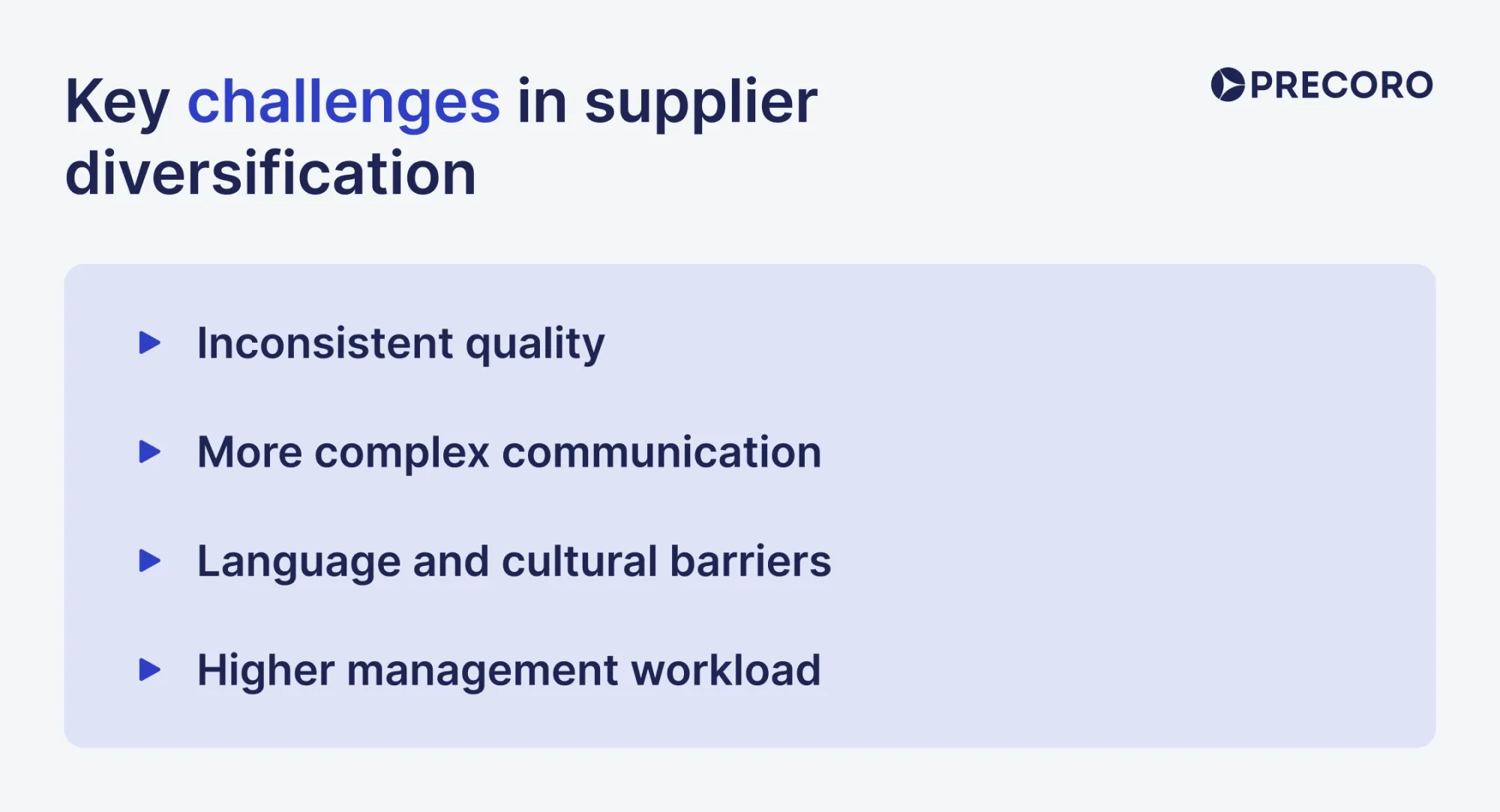
While supplier diversification sounds simple in theory, it’s difficult to put into practice. The operational, financial, and organizational challenges of moving away from single-sourcing are significant, and underestimating them is a main reason many diversification efforts stall during the supply chain planning stage.
What quality control issues arise with multiple suppliers?
Inconsistencies across a varied supplier base are a serious operational challenge. Differences in manufacturing techniques, material origins, and quality control across suppliers create variations absent in a single-source model.
This risk is at its highest during transition. A backup supplier brought in during a primary supplier's failure may not meet the same quality standards as the primary supplier. Rushed onboarding can then lead to quality problems later in the vendor management lifecycle.
Prevent such issues at the qualification stage with:
- Detailed specifications — quality requirements, tolerances, and testing needs you can use between multiple vendors.
- Pre-production sample approval — formal sign-off on samples before full production helps identify quality differences before they reach the customer.
- Regular supplier audits — scheduled and unannounced assessments that verify process compliance.
- Incoming inspection protocols — especially important with new or newly-reactivated suppliers until there’s a consistent quality track record.
How can you maintain consistent communication across a diverse supplier base?
Maintain consistent supplier communication with regular contact, clear escalation paths, and standardized templates. All these tools help make sure all suppliers receive the same information at the same time, regardless of which procurement team manages them.
Suppliers who receive unclear or sporadic information about volume forecasts, specification changes, or performance requirements are left to guess. As a result, a company faces the lead time variability and quality issues that diversification is meant to prevent.
What cultural and language barriers might you encounter?
It’s rarely possible to move into geographical diversification without some language and culture complexity. These factors are certainly not insurmountable, but they can’t be ignored either. Underestimating them often leads to disputes in international supplier relationships, especially during quality issues, contract renegotiations, or urgent capacity increases.
Language discrepancies don’t merely affect conversation. Technical requirements, quality parameters, and contract terms may take on different meanings across languages — especially for sensitive matters like tolerances, tests, or duties. Genuine ambiguity is usually the most significant risk here (as opposed to malicious misinterpretation).
Cultural differences can also affect how cross-border supplier relationships function. Communication norms, decision-making processes, contract interpretation, and expectations around business relationships can vary between suppliers. Procurement teams should validate these factors supplier by supplier and account for them when assessing reliability, negotiating terms, and managing potential disruptions.
Practical risk mitigation involves several steps:
- Build relationships with local procurement representatives who understand both business needs and the local environment.
- Invest in accurate translation of documentation, especially critical specifications.
- Incorporate relationship development time into supplier onboarding.
- Use procurement or supplier management software that supports international operations and localization.
How do you build and maintain strong relationships with multiple suppliers?
A diversified supplier base, however large it may be, is only as useful as the relationships between the supplier and the consumer. Splitting volume across suppliers without building those relationships creates a list of vendors, not a reliable supplier network. A distinction between the two becomes apparent during capacity shortages, disruptions, or quality problems, when resolution requires genuine collaboration efforts.
What communication protocols should you establish?
Most supplier relationship failures don't result from confrontation but from indifference — infrequent contact, inconsistent feedback, or unclear expectations. All these issues can cause misalignments in the partnership over time. Formal communication procedures establish a pace and framework of supplier contact.
A functional protocol establishes:
- Regular business reviews — quarterly with strategic suppliers and twice a year with secondary ones; with a set agenda that focuses on performance, forecast, and future needs.
- Escalation paths — named contacts on both sides for operational issues, quality disputes, and commercial negotiations, so problems reach the right people without delay.
- Forecast sharing cadence — regular demand visibility helps plan supplier capacity and limit unexpected lead time variance.
- Performance feedback loops — structured scorecard results that show suppliers how they’re measured, and what improvements are expected.
What contractual terms protect both parties in a diversified network?
The role of a contract within a diversified supplier network is quite different from the same role in a single-source supply chain. The agreement should enforce clear terms while allowing for volume changes.
Terms which are particularly important in diversified supplier contracts include:
- Volume commitment ranges — minimum and maximum purchasing that give suppliers planning visibility while preserving the buyer's flexibility for any changes.
- Performance SLAs — quantifiable standards for delivery, quality, and response times with penalties for repeated shortfalls.
- Force majeure definitions — explicit treatment of disruption scenarios that affect the supplier's ability to perform, including notification and remediation obligations.
- Audit rights — contractual access to supplier facilities, financials, and quality systems for ongoing due diligence and a smaller probability of renegotiation.
- Termination and transition provisions — terms for ending the relationship and managing data, inventory, and the transition.
Fixed-volume contracts are a common source of disputes in diversified supplier networks. When a disruption forces the buyer to reallocate volume, these contracts can impose restrictions, originally designed for single-source arrangements.
How often should you review and adjust your supplier mix?
Supplier mix reviews should be scheduled regularly rather than triggered by problems. Otherwise, the process becomes reactive, with companies having to reshape the vendor base after disruptions instead of managing it proactively through diversification.
A practical review cadence has three levels:
- Ongoing monitoring handles the continuous layer — automated tracking of supplier performance, financial health, and delivery data to identify issues as they emerge.
- Annual strategic reviews assess the supplier base as a portfolio — evaluation of the supplier base as a whole, including category concentration, supplier performance, and geographic or regulatory risks.
- Triggered reviews respond to specific events — reviews after events such as supplier financial distress, regional disruptions, significant demand changes, or new market conditions.
The output of each review should come in a set of actions, not a mere observation. There’s no purpose in a review that identifies concentration risk but doesn’t define reallocation or a qualification timeline.
What metrics should you track to measure diversification success?
Diversification without measurement can’t be objectively evaluated. The supply chain metrics that matter most track whether the supplier base is genuinely more resilient.
How do you calculate your supply chain resilience score?
The supply chain resilience score is a metric used to identify the vendor’s level of resilience and ability to withstand adversities. The score typically combines:
| Component | What it measures |
|---|---|
| Supplier concentration index | Percentage of critical input volume controlled by the top supplier in each category |
| Geographic diversification ratio | Distribution of suppliers across regions, weighted by spend |
| Supplier financial health average | Aggregated financial risk ratings across the active supplier base |
| Recovery time objective (RTO) | Estimated time to restore full supply capacity following a primary supplier failure |
| Qualification pipeline depth | Number of fully qualified alternative suppliers per critical category |
Treat this score as a trend indicator rather than a definitive figure. Even if it’s not up to your predefined benchmark, consistent improvement over four metrics indicates that diversification efforts have a positive impact on the internal structure.
What KPIs indicate effective supplier diversification?
Resilience scoring captures the overall state of concentration and risk exposure, but operational KPIs track whether the diversified supplier base is performing as intended on a day-to-day basis.
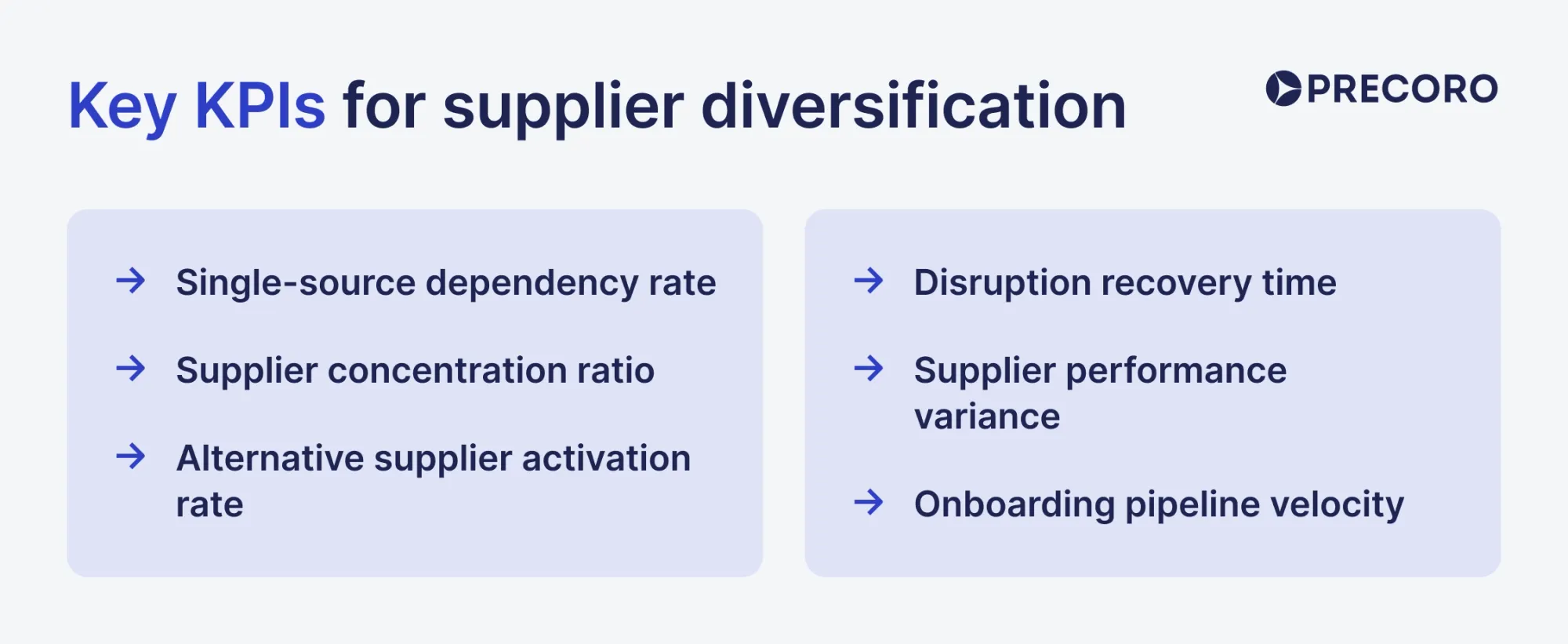
The KPIs that most reliably indicate effective diversification include:
- Single-source dependency rate — the percentage of critical components still sourced from a single supplier; the primary target metric for any diversification program.
- Supplier concentration ratio — the share of total spend allocated to the top three suppliers in each category, which should decline as diversification matures.
- Alternative supplier activation rate — how frequently secondary suppliers are actually used.
- Disruption recovery time — time to restore normal supply after a primary supplier failure, which tests whether the diversified base delivers on its expected benefits.
- Supplier performance variance — performance scores across the supplier base; high variance indicates that diversification has introduced inconsistency.
- Onboarding pipeline velocity — supplier qualification completion rate, which determines how quickly the base can be expanded.
Track these KPIs at the category level rather than the aggregate level. Category-level metrics reveal where diversification is working and where concentration risk is still present.
How should manufacturers diversify critical components?
For manufacturers, supply chain diversification is most consequential at the component level, particularly for technically complex inputs, with long qualification timelines or a single point of failure in the production process.
The most effective diversification often starts during product design rather than during procurement. When engineering teams avoid proprietary components and design products to support interchangeable parts from multiple suppliers, they give procurement the flexibility to diversify later.
If true dual sourcing isn’t possible, companies typically rely on strategic inventory buffers and keep higher safety stock for critical single-source components while qualifying an alternative supplier.
How should retailers and distributors diversify suppliers?
Retailers and distributors face a different diversification challenge than manufacturers. The inputs are finished, or near-finished goods rather than components, which means qualification timelines are shorter, but volume commitments are larger. That’s why switching costs mainly manifest through assortment consistency, brand standards, and customer expectations.
For retailers, there are three effective types of diversification:
- Supplier diversification — maintaining multiple sources for the same or equivalent products, particularly for private label and high-volume categories with significant revenue concentration risk.
- Geographic diversification — introducing multi-regional sourcing to reduce exposure to the tariff changes, logistics disruptions, and production capacity constraints that affect single-region sourcing.
- Category diversification — avoiding over-reliance on any single supplier across multiple categories, which can create leverage imbalances that affect pricing and service terms.
How can service companies reduce vendor concentration risk?
Service companies — professional services firms, technology businesses, financial institutions — don’t manage physical supply chains. However, they still deal with significant vendor concentration risk in the platforms, infrastructure, and specialist services on which their operations depend.
For service companies, diversification happens at the vendor category level. Cloud and infrastructure providers are the most visible example: with a multi-cloud architecture, the workload is divided between providers to prevent single points of failure and preserve negotiating leverage.
Specialist service vendors (such as legal, consulting, recruitment, and facilities) are harder to diversify because relationship depth and institutional knowledge are part of the value. In such cases, it’s best to maintain qualified alternatives instead of typical dual sourcing: vendors that have been evaluated and tested at low volumes, ready to step in if a primary vendor relationship fails.
Frequently asked questions about supply chain diversification
Yes, poorly executed diversification often causes more harm without proper planning. Unqualified suppliers are used at a critical juncture, and excessive spend fragmentation. The most common failure is diversification purely on paper: adding suppliers to the approved list without building active relationships, testing processes, or ensuring they can scale when needed. Without strong governance, diversification can make your vendor network seem resilient with the same dependency gaps.
If the supplier volume falls below the level at which the relationship is strategically important, you might experience spend fragmentation and less pricing leverage during renegotiation. A strategic vendor with low volume can deprioritize orders and respond more slowly. Set concentration guidelines (minimum and maximum volumes for each supplier tier) to keep enough purchasing volume to remain important to the supplier.
Diversification protects your company against localized and regional disruptions, the vast majority of supply chain failures in normal operating conditions. Global systemic events, like the early months of COVID-19, make it less effective because they affect all regions, so no supplier base is fully immune. However, diversification is still valuable as it speeds up the recovery after such systemic disruptions. Companies with qualified alternative suppliers and distributed inventory can restore operations faster than those rebuilding networks from scratch.
Book a demo to see how Precoro supports scalable supplier diversification. Centralize supplier data, standardize approvals, and gain full visibility across regions and business units.