How Procurement Technology Is Reshaping Enterprise Purchasing Decisions in 2026
Discover how enterprise procurement technology is transforming purchasing in 2026. Learn about the latest trends and must-have software capabilities.

Enterprise purchasing decisions no longer take too long to review, and modern procurement technology isn’t limited to automating administrative tasks. Integrated platforms now connect sourcing, purchasing, supplier intelligence, spend analytics, and real-time insights to help organizations make better decisions, control costs, and respond quickly to supply chain changes.
The shift is possible thanks to AI (artificial intelligence), integration between procurement and finance, and growing expectations from leadership. The goal across nearly all of it is the same: streamline the purchasing process enough that decisions happen at the speed the business actually needs.
AI adoption in procurement is moving from experimentation toward broader operational use. Organizations that have scaled beyond pilot programs see benefits in areas like spend analysis, workflow automation, and supplier management. However, many companies still face challenges when moving from testing AI tools to deploying them across the enterprise.
This blog article covers procurement technology from A to Z and examines changes reshaping enterprise purchasing, the factors driving increased investment, and how these developments affect procurement teams.
Keep reading to find out:
What's changed in procurement technology by 2026
Emerging technologies creating measurable business value
Core components of a modern procurement technology platform
From systems of record to systems of decision intelligence
How analytics-driven decision-making is shaping procurement strategy
Procurement data advantages competitors can't easily replicate
How AI is transforming sourcing and negotiations
How close is autonomous procurement execution
Procurement platforms as supplier intelligence networks
Risk, compliance, and sustainability in the age of procurement tech
How procurement technology is shifting supplier power dynamics
Reorganizing procurement teams and skills
Business operations and cost savings outcomes
How to evaluate and adopt procurement technology
How Precoro connects procurement, invoices, ERP, and supplier management
A 7-step procurement technology adoption framework
FAQ
What has changed in procurement technology by 2026?
In the last few years, procurement technology has shifted from standalone point solutions to connected systems that support procurement decisions. Sourcing, purchasing, and payment used to be three separate software functions, but now they form a continuous digital workflow, and the intelligence behind them has moved from static rules to adaptive learning systems.
The difference with 2026 is the pace of that shift. Procurement leaders aren’t debating if they should embrace these tools anymore. Now it is more about how quickly they can close the gap with companies that already have.
Which major innovations emerged between 2023 and 2026?
Generative AI has become part of the regular procurement operations to help teams analyze spend, support sourcing decisions, and improve contract management, rather than a separate tool for experimentation between 2023 and 2026. Agentic AI-advanced procurement automation enables systems to execute connected, multi-step workflows rather than simply generating recommendations.
In parallel with these developments, blockchain-based supplier verification technologies continued to mature. At the same time, cloud-native, API-first procurement platforms made it much easier to connect procurement systems with ERP (enterprise resource planning), accounting, and supplier platforms. As a result, organizations can now share data across systems without relying on complex custom integrations.
How have AI, automation, and blockchain matured for procurement use?
AI, automation, and blockchain have significantly transformed modern procurement. Here's how each technology is shaping procurement processes today:
- AI has moved from experimental projects to real-world applications, helping organizations automate tasks such as spend classification, invoice processing, and supplier risk assessment.
- Automation has evolved beyond simple, rules-based workflows. Modern procurement systems can now trigger actions automatically when predefined conditions are met, reducing manual work and improving process speed.
- Blockchain adoption remains focused on specific procurement use cases, particularly supply chain traceability and contract verification, where transparency and data integrity are critical.
What role did cloud-native and API-first platforms play?
Cloud-native, API (application programming interface)-first procurement platforms provide the foundation needed to scale AI, automation, and real-time analytics across the enterprise. It connects procurement systems to ERP, finance, and accounting applications, enabling continuous data exchange, greater spend visibility, and more automated workflows.
Which emerging technologies in procurement are creating measurable business value today?
Though some of the new technologies are still proving their worth, a handful of those procurement tools yield measurable results.
- AI-driven procurement analytics are delivering real savings by identifying overspending and off-contract purchases that manual reviews missed.
- McKinsey’s research on the AI-led transformation of procurement finds that autonomous category agents deliver 15–30% efficiency gains in non-value-added category management work.
- Intelligent document processing and automated three-way matching are among the most measurable sources of ROI in procurement. By automating invoice handling, purchase order matching, and exception management, these technologies reduce manual work while improving process efficiency and control.
What are the core components of a modern procurement technology platform and procurement software ecosystem?
Modern procurement technology operates as an integrated source-to-pay ecosystem. It connects sourcing, purchasing, supplier intelligence, finance, and ERP systems in a single data environment. This connectivity improves spend visibility, enabling workflow automation and offering procurement teams the insights they need to make better strategic decisions.
| Technology component | What it does |
|---|---|
| Intake and requisitioning | Captures purchase requests through guided forms and standardized workflows. |
| Approval workflow engine | Routes requests automatically based on factors such as amount, department, or internal policies. |
| Supplier management | Centralizes supplier records, contracts, performance data, and risk information. |
| Spend analytics | Provides real-time visibility into committed, approved, and actual spend. |
| Invoice and AP automation | Matches invoices with purchasing documents and automates accounts payable processes. |
| ERP and accounting integrations | Synchronizes procurement and financial data across business systems. |
| Compliance and audit tools | Enforces procurement policies and maintains a complete audit trail of procurement activities. |
Why are procurement technology platforms becoming systems of decision intelligence rather than systems of record?
A system of record stores what happened, while a system of decision intelligence gives you the required information on what to do next. Procurement platforms are shifting toward the latter, using historical spend, supplier performance, and market data to actively recommend actions rather than passively logging transactions.
This is a move from traditional reporting-based procurement to decision intelligence. Rather than requiring buyers to pull and analyze data, today’s procurement platforms provide contextual insights directly into sourcing, purchasing, and supplier management workflows.
How are procurement and technology converging to create competitive advantages?
As procurement technology evolves, organizations are adopting different approaches. The value of procurement platforms depends on how businesses use them. While some companies focus on operational efficiency, others use advanced capabilities such as spend intelligence, supplier analytics, and decision intelligence to improve sourcing outcomes.
By analyzing purchasing data and supplier information, these platforms help teams identify savings opportunities and negotiation advantages earlier than traditional manual approaches.
How are analytics-driven decision-making influencing procurement and supply chain strategies?
Modern procurement analytics enables a shift from reactive management to proactive decision-making. Analyzing spend patterns, supplier performance, and market signals allows procurement teams to identify potential cost increases or supply risks earlier and take action before they affect business operations.
What types of data are procurement teams using today?
Procurement teams now draw on a wider data set than ever:
- Internal spend history
- Supplier performance and delivery data
- Market pricing indices
- Geopolitical and tariff signals
- Supplier-side sustainability and financial health data
How does real-time analytics change supplier selection and risk assessment?
Real-time analytics provides ongoing supplier intelligence, giving procurement teams continuous visibility into supplier performance and risk. Instead of periodic reviews, organizations can monitor supplier reliability, financial metrics, compliance status, and operational changes as they happen.
Can predictive analytics reduce cost volatility and supply disruptions?
Predictive analytics isn’t going to remove volatility, but it will cut it way down when it comes to catching procurement teams by surprise. Teams use predictive tools to model historical price patterns, seasonal demand, and known risk factors to provide a forecast to plan against rather than react purely to spot market conditions. Organizations that use this type of forecasting often have buffer strategies, such as diversified suppliers and flexible contracts, to identify disruptions early, rather than scrambling once they are already underway.
Why has intelligence become a competitive advantage for procurement leaders?
With spend intelligence, procurement teams can move beyond simply processing purchases and may use spend data to make better sourcing, supplier, and cost management decisions.
Leaders with strong spend intelligence can identify consolidation opportunities, negotiate with better data, and show the C-suite the business impact of procurement decisions. Instead of focusing only on line-item savings, they can demonstrate how procurement contributes to overall margins, cost control, and business performance. This level of visibility helps procurement become a more strategic partner in executive decision-making.
What procurement data and spend analysis advantages are hardest for competitors to replicate?
Access to spend analytics tools is no longer the main barrier for procurement teams. The competitive advantage comes from the quality of the underlying procurement data.
Clean, well-classified historical spend data improves AI model performance, strengthens spend intelligence, and helps organizations identify cost-saving opportunities, supplier trends, and purchasing patterns that newer systems cannot immediately replicate.
In what ways is AI technology transforming sourcing and negotiations
AI-powered sourcing combines data analysis with human expertise to improve strategic procurement decisions. Instead of spending hours collecting supplier information and market data, sourcing teams can use AI-driven insights to compare options, identify negotiation opportunities, and evaluate trade-offs. Human negotiators remain responsible for relationship building, strategy, and final decisions, while AI accelerates the analysis behind those choices.
How are generative models being used to draft contracts and RFIs?
Generative AI can create an initial draft of procurement documents, such as RFIs (requests for information) and contracts, using category requirements, previous agreements, supplier data, and company-approved legal language as inputs. This greatly shortens the time required to prepare documents for internal review or supplier negotiations and allows for greater consistency across procurement processes.
Generative AI doesn’t replace human oversight, but it does change the role of procurement and legal teams. They won’t be writing documents from scratch but will be reviewing, refining, and approving drafts generated by AI. This means a quicker, more efficient workflow with fewer manual errors and a more standardized jumping-off point for negotiations.
Can AI facilitate dynamic pricing and automated negotiations?
AI-assisted negotiation tools already automate simple, rules-based negotiations, such as offering volume discounts or matching a pre-approved pricing band. The fully autonomous negotiation of complex, high-value contracts remains limited, as such deals often involve trade-offs that current models handle less reliably. Most organizations are using AI to provide negotiators with data and scenario modeling, not to replace human conversation entirely.
What safeguards are needed to prevent bias and ensure transparency?
Bias in AI-driven sourcing creeps in through historical data if past purchasing favored certain suppliers for reasons unrelated to performance, a model trained on that data can quietly repeat the pattern.
Safeguards need to include:
- Regular bias audits of supplier recommendations
- Clear documentation of how a model reached a given recommendation
- A human review step for any decision above a defined risk or dollar threshold
How close are organizations to autonomous procurement process execution?
Autonomous procurement has not yet become the standard operating model for most enterprises. Instead, organizations are adopting a more balanced approach in which AI automates repeatable procurement workflows while people remain responsible for strategic sourcing, supplier relationships, governance, and complex decisions.
Applying AI and automation to structured processes where speed, accuracy, and efficiency are measurable is the best result achieved by 2026.
Which manual processes are being automated most effectively?
The most successfully automated processes are those that have clear, repeatable logic:
- PO (purchase order) generation
- Invoice-to-PO matching
- Routine approval routing
- Requisition intake
These tasks aren’t judgmental, which is why they are perfect for automation and are always the first areas organizations target. This progression is covered in more detail in Precoro’s breakdown of procurement automation processes, from initial automation targets through to more complex workflow changes.
How do workflow automation and event-driven triggers reduce cycle times?
Event-driven workflows make procurement automation faster and more reliable by automatically triggering the next action when specific conditions are met. For example, the system can move a process forward after a requisition is approved or send reminders when a contract milestone is approaching, while people maintain full visibility and control.
This removes delays caused by manual follow-ups, where employees have to notice pending tasks and decide what happens next. By automating these handoffs, organizations can reduce cycle times and keep procurement processes moving without sacrificing governance.
What governance frameworks ensure controls remain intact with automation?
Without effective procurement governance, automation can accelerate processes without ensuring proper control. Strong governance systems:
- Keep a detailed log of all automated activities for auditing purposes.
- Implement procurement policies consistently.
- Review workflows periodically to ensure they remain aligned with evolving business goals, regulatory standards, and internal controls.
How are procurement platforms becoming supplier intelligence networks?
The procurement platform is evolving from an internal software tool to a network that connects a company to a much wider pool of supplier data, competition, and performance history than any one organization could build on its own.
How do digital marketplaces change supplier discovery and competition?
Digital marketplaces embedded in procurement platforms enable buyers to discover and compare suppliers beyond their existing vendor list, introducing competitive pressure that a closed, relationship-based sourcing process doesn't generate. This tends to surface better pricing and terms, particularly in categories where a company has historically defaulted to the same one or two familiar suppliers out of convenience rather than genuine comparison.
Can supplier networks improve visibility across extended supply chains?
Supplier networks offer visibility beyond the direct tier-one vendors to sub-suppliers and raw material sources further up the supply chain. This is especially important from a risk and compliance perspective.
Better end-to-end visibility also enables procurement teams to identify potential vulnerabilities early and make better sourcing decisions.
How are enterprises balancing marketplace speed with supplier consolidation?
Access to the marketplace is fundamentally at odds with supplier consolidation strategies, which are typically intended to preserve negotiated volume pricing and reduce vendor management overhead. Enterprises are not viewing marketplace access as a wholesale replacement for their existing supplier strategy. Instead, they are using marketplaces for exploratory or low-risk categories and maintaining consolidated, negotiated relationships for strategic or high-volume spend.
How is procurement technology reshaping risk management, compliance, and sustainability decisions?
Risk, compliance, and sustainability have become continuously monitored, technology-driven functions, rather than periodic manual review cycles. This is because the regulatory and reputational stakes have risen faster than a manual process could keep pace with. This evolution also mirrors a wider shift in expectations, with boards and regulators alike increasingly expecting to see evidence of risk actively managed in real time, not simply recorded in hindsight.
Which tools enable real-time ESG and compliance monitoring?
Real-time ESG (environmental, social, and governance) monitoring tools constantly track supplier disclosures, certifications, and third-party risk databases. They alert stakeholders to changes as they occur rather than waiting for an annual audit cycle.
Modern procurement platforms will directly connect to regulatory databases to flag any changes to sanctions or compliance that affect a supplier as soon as they are published.
These tools also tend to automatically centralize documentation, greatly reducing the scramble to pull documentation together prior to an external audit. This kind of continuous monitoring is quickly becoming a standard expectation of any modern procurement technology platform, rather than an optional add-on.
How do tech platforms quantify supplier sustainability performance?
Modern platforms quantify sustainability performance by combining supplier self-reported data with third-party verification, emissions estimates, and scorecard methodologies that weight factors like labor practices and environmental impact. This is still an evolving area: a meaningful share of procurement organizations admit they don't yet have a clearly defined set of internal ESG metrics, even as more of them measure suppliers on sustainability to some degree.
As reporting standards mature, expect scoring methodologies to become more standardized across platforms rather than varying as widely as they do today. Standardization will likely also make supplier sustainability scores more directly comparable across industries, which isn't reliably possible yet.
What capabilities help procurement teams respond to regulatory changes faster?
Automated regulatory tracking tools flag when a new law or standard affects a specific category, region, or supplier relationship. Platforms with configurable compliance settings can also update sourcing requirements centrally and apply them automatically across every relevant purchase, which matters increasingly as e-invoicing and reporting mandates expand across jurisdictions.
How are supplier risk monitoring platforms evolving beyond annual assessments?
Annual supplier assessments are increasingly viewed as insufficient given how quickly financial and operational risk can change. Modern risk monitoring platforms pull the following continuous signals to flag emerging risk between formal review cycles:
- Financial health indicators
- News mentions
- Delivery performance
This shift means procurement teams can act on a supplier's declining reliability weeks or months before the next scheduled review would have caught it, closing a gap that has historically left organizations exposed for extended stretches between audits. Continuous monitoring also makes it easier to document a defensible risk-management process if a supplier failure is ever scrutinized after the fact.
Can AI-powered supplier scoring improve resilience and compliance?
AI-powered scoring models can analyze large supplier datasets and identify risk patterns that manual reviews may overlook. By providing more comprehensive risk signals, these models help organizations strengthen supplier resilience, improve compliance, and make more informed decisions. However, their effectiveness depends on having accurate, complete, and consistently maintained supplier data.
AI-generated scores should be used to support procurement decisions, not make them independently. Combining automated analysis with human expertise will allow teams to investigate supplier risks, validate recommendations, and make better-informed decisions about the procurement lifecycle.
How is procurement technology changing supplier power dynamics?
Technology is shifting the balance of information between buyers and suppliers, generally in buyers' favor, since procurement teams now have far greater visibility into market pricing, alternative suppliers, and performance benchmarks than they did even a few years ago.
Are relationships becoming more collaborative or transactional with technology?
Depending on the category, the relationship can be both collaborative and transactional.
- For strategic, high-value relationships, better data makes collaboration more productive. This is because both sides negotiate from a shared, accurate picture of performance and market conditions.
- For lower-value, commoditized categories, technology is pushing relationships toward being more transactional.
How do digital contracts and smart clauses change contract management?
Digital contracts can include smart clauses that automatically respond when predefined conditions are met. For example, a contract may trigger a price adjustment, send a renewal reminder, or apply a penalty when agreed-upon terms aren’t met. This reduces the need for teams to manually monitor every obligation.
This results in fewer contract obligations left unfulfilled simply because no one thought to address them, which has traditionally been a common and expensive gap in manual contract management. As more organizations implement this capability, it’s becoming a standard capability in supplier negotiations rather than a differentiator.
For example, Precoro offers users a Contract Agent that scans supplier agreements, highlights risky clauses, helps procurement managers prepare for renegotiations, and compares terms across contracts.

Can continuous supplier performance scoring replace periodic reviews?
Continuous scoring is becoming more common because it helps organizations identify supplier performance changes in real time instead of waiting for scheduled reviews. While periodic reviews remain valuable for strategic discussions, relationship management, and long-term planning, day-to-day performance tracking is increasingly handled through continuous monitoring.
This hybrid approach gives both buyers and suppliers a more accurate view of performance over time. It shifts conversations away from isolated issues and toward ongoing improvement based on shared data and clear expectations.
How are organizations reorganizing procurement teams and skills?
As more routine procurement tasks become automated, teams are shifting their focus toward higher-value activities such as strategic sourcing, supplier collaboration, and data-driven decision-making. This transformation is changing both procurement roles and the skills required to succeed in them. Organizations that have already invested in procurement technology are moving faster because automation frees up time and resources that can be redirected toward more strategic work.
What new roles are emerging within procurement organizations?
New roles include AI strategists who prioritize where automation gets deployed, risk and ethics specialists who monitor AI-driven decisions for bias and transparency, and orchestration roles that manage a growing number of automated workflows and agents rather than executing tasks directly.
These roles didn't exist in most procurement organizations even a few years ago. Their emergence reflects how much of the day-to-day function has shifted from execution to oversight.
Which skills are most critical for procurement leaders in 2026?
Here are the most critical skills for procurement leaders:
- Strategic thinking: Procurement leaders need to look beyond individual transactions and understand how purchasing decisions affect broader business goals. Strong strategic thinking helps them identify opportunities, manage risks, and create long-term value.
- Technical fluency: Procurement professionals don’t need to become data scientists, but they need enough technical understanding to work effectively with modern tools. This includes knowing how systems generate recommendations, when to rely on automated insights, and when additional analysis is needed before making decisions.
- Communication skills: As procurement becomes more data-driven, the ability to translate insights into clear recommendations becomes increasingly important. Leaders must explain the business impact of procurement decisions and align stakeholders around actions they can support.
How should organizations approach training and change management?
Training should address both the technical skills gap and the trust gap. Many procurement professionals are skeptical about trusting AI-driven recommendations until they have seen the reasoning behind them enough times to trust the pattern. Successful change management combines technical training with concrete, early wins that demonstrate the technology’s value and do not require adoption before the team has a hard reason to trust the new workflow.
What business operations and cost savings outcomes can modern procurement technology deliver?
The outcomes procurement technology delivers extend well beyond the direct cost savings. A well-implemented procurement technology platform produces compounding value across speed, accuracy, and risk reduction simultaneously.
How are cost savings being quantified beyond price reductions?
Modern ROI (return on investment) calculations increasingly account for avoided costs, such as fewer duplicate payments, fewer missed early-payment discounts, reduced maverick spend, and labor savings from reduced manual processing.
These categories are often larger in aggregate than the savings from direct price negotiation, but they've historically been harder to quantify, which is part of why the full value of procurement technology has often been underreported to leadership. Building a consistent measurement methodology from the start makes it much easier to demonstrate this value credibly later.
Can improved speed and agility be translated into revenue impact?
Faster sourcing and procurement cycles can directly influence revenue growth. For example, if a company can onboard a new supplier or launch a product line faster than competitors, it can capture market opportunities that might otherwise be lost due to procurement delays.
This impact is more difficult to measure than direct cost savings, but it’s becoming an increasingly important part of how mature organizations evaluate procurement technology investments. Some companies now track time-to-market as a procurement KPI (key performance indicator) to measure how effectively procurement supports business growth.
What KPIs should executives track to evaluate procurement tech ROI?
Executives should track cycle time from requisition to PO, cost per purchase order processed, percentage of spend under managed control, supplier onboarding time, and policy compliance rate.
How should organizations calculate procurement technology ROI beyond cost savings?
A complete ROI calculation should weigh direct cost savings against the value of labor reallocation, risk reduction (fewer compliance violations or supplier failures), and the strategic capacity freed up for higher-value work.
Full source-to-pay transformations typically take longer to show payback than narrower point solutions. However, it tends to generate substantially stronger returns once fully scaled, which is worth factoring into the way a multi-year business case is built. Framing ROI as a multi-year curve, rather than a single-year snapshot, produces more accurate expectations from the outset.
How should enterprises evaluate and adopt procurement technology?
Choosing the right procurement technology isn’t just a comparison of feature lists. It must match the platform's depth and complexity to an organization's real operational maturity and change capacity. Better to get IT, finance, and legal involved early on in the evaluation process rather than leaving the decision to a vacuum in procurement.
What questions should buyers ask vendors during procurement tech selection?
Buyers should ask which ERP and accounting systems a platform natively integrates with, how quickly data syncs between systems, which specific automations are rules-based vs. AI-driven, and how the vendor handles model updates and bias monitoring over time.
You can also inquire about how the vendor's roadmap addresses emerging technologies in procurement to gauge whether the platform is likely to remain current or will need replacing in a few years.
How can pilots and proof-of-value programs de-risk adoption?
A focused pilot helps organizations test procurement technology in a controlled environment before expanding it across the enterprise. The pilot should define success criteria upfront, such as cost savings, reduced cycle times, user adoption, or process improvements. However, the scope needs to be broad enough to reveal challenges that may appear during a larger rollout, including system integration, data quality, and workflow issues.
What integration, security, and vendor management concerns must be prioritized?
Security concerns should also include compliance certs, role-based access controls, and clear data ownership terms in the vendor contract. Integration issues focus on whether the platform supports true two-way data sync with existing systems, rather than a one-way push that still requires manual reconciliation.
Support, onboarding, and transparency on the long-term product roadmap should also be part of vendor management. A platform that doesn't continue to evolve can quietly become a liability a few years down the line in the relationship.
What implementation mistakes cause procurement technology projects to fail?
Many implementation mistakes cause procurement technology to fail. Here are some mistakes that happen too often.
- Copying an existing broken process into new software rather than designing the workflow around what the technology is truly capable of.
- Not investing enough in change management and training.
- Skipping a clearly scoped pilot phase and not defining success metrics before deployment.
How does Precoro connect procurement software, invoice workflows, ERP systems, and supplier management?
Precoro creates one control layer across the entire procure-to-pay cycle, from intake and approvals to purchase orders, receipts, invoices, and payments, while working on top of your ERP.
Instead of reconciling data across disconnected tools, teams get one traceable workflow, centralized supplier and purchasing data, and native ERP integrations that keep financial records in sync.
For multi-entity businesses, Precoro brings every location, team, and supplier into one system while preserving the budgets, workflows, currencies, and controls each entity needs.
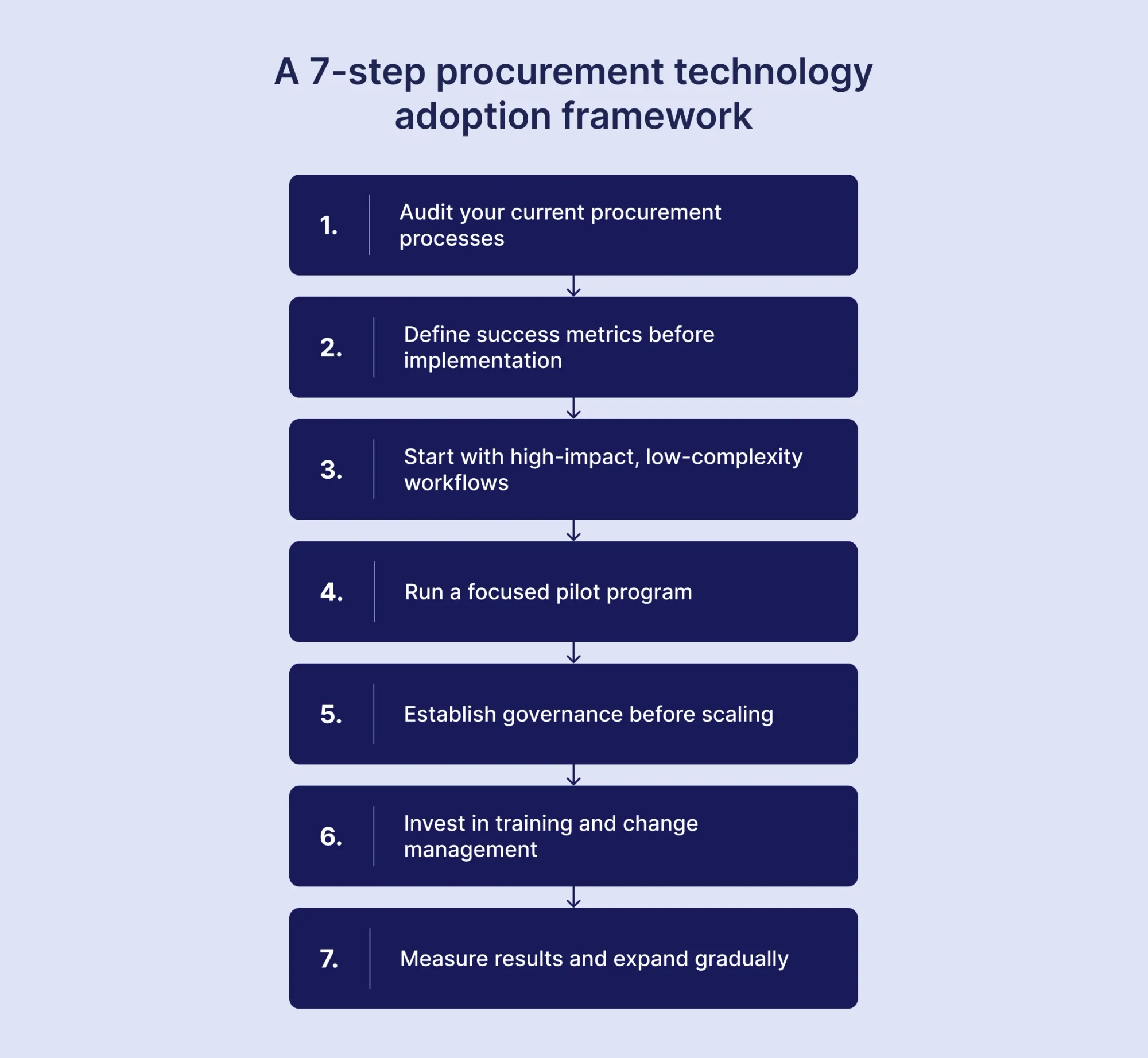
A 7-step procurement technology adoption framework
1. Audit your current procurement processes
Before choosing a platform, document your existing workflows and identify where manual handoffs, disconnected systems, or unclear responsibilities create delays, errors, or compliance risks.
2. Define success metrics before implementation
Set clear goals before deployment begins. Measure outcomes such as procurement cycle time, cost savings, process adoption, compliance rates, and reduction in manual work to evaluate the platform’s impact.
3. Start with high-impact, low-complexity workflows
Prioritize processes where automation can deliver quick value without requiring major organizational changes. Requisition intake, approval workflows, and purchase order creation are often strong starting points because improvements are easy to measure.
4. Run a focused pilot program
Test the platform within a specific category, department, or business unit before expanding company-wide. Compare results against your predefined metrics to identify gaps, collect user feedback, and refine processes.
5. Establish governance before scaling
Define approval rules, access controls, audit requirements, and monitoring processes before expanding automation. Strong governance ensures that increased efficiency does not come at the expense of compliance or control.
6. Invest in training and change management
Successful adoption depends on more than implementing new technology. Provide users with practical training, clearly communicate the benefits, and highlight early successes to build confidence and encourage adoption.
7. Measure results and expand gradually
Compare performance against your initial benchmarks and industry standards. Use these insights to optimize workflows, address bottlenecks, and gradually extend automation to additional procurement processes and categories.
FAQ
Yes. Any competitor can buy similar technology, but the years of clean, well-categorized spend and supplier data that make that technology effective take much longer to build and can't be purchased directly.
Human judgment should remain the final decision-maker, especially for strategic, high-value, or complex procurement decisions. AI recommendations are based on available data and historical patterns, but they may not account for important context that procurement professionals understand, such as supplier relationships, market conditions, or potential risks that aren't captured in the system.
The best approach is to use AI as a decision-support tool: let it surface insights and patterns, while procurement experts apply their experience and business knowledge to make the final call.
Regular bias audits of AI-driven recommendations and human review thresholds for high-risk or high-value decisions help catch cases where a model is repeating a flawed historical pattern rather than genuinely optimizing the decision.
Fragmented systems make procurement decisions slower than they should be. Book a demo to see how Precoro connects purchasing, invoices, and ERP data into one system.