How to Build a Supplier Selection Process That Reduces Risk and Improves Performance
Learn how to build a supplier selection process that reduces risk, improves supplier performance, and strengthens supply chain resilience. Includes evaluation criteria, scorecards, RFI/RFP/RFQ guidance, risk assessment frameworks, and best practices.

On the surface, the supplier seems like the right choice: the price is competitive, the proposal looks promising, and the first call went well. But once you enter an actual partnership, your team might find that the vendor can’t meet delivery timelines or isn’t financially stable. By the time that happens, it’s your company that has to deal with the damages caused by that situation.
That supplier didn’t just suddenly fail. There were likely real warning signs that were overlooked during selection. The team skipped a few steps or rushed the contract—either way, it disrupted your process, and now you need to source a new vendor.
A supplier selection process is how procurement teams identify, evaluate, and choose suppliers before any of that has a chance to develop. Building a real supplier selection process protects two things at once: the continuity of the business and the return on every dollar spent with a supplier. According to Gallagher, 91% of business owners reported fears of supply chain disruptions in 2026. A structured vendor selection process, one of the few steps a company fully controls, can help ease that risk.
Below, we've outlined key criteria, controls, and a step-by-step framework that procurement teams need to consistently choose suppliers.
Read on to find out:
Why supplier selection matters for risk and performance
Core principles of an effective supplier selection framework
How to define requirements and evaluation criteria
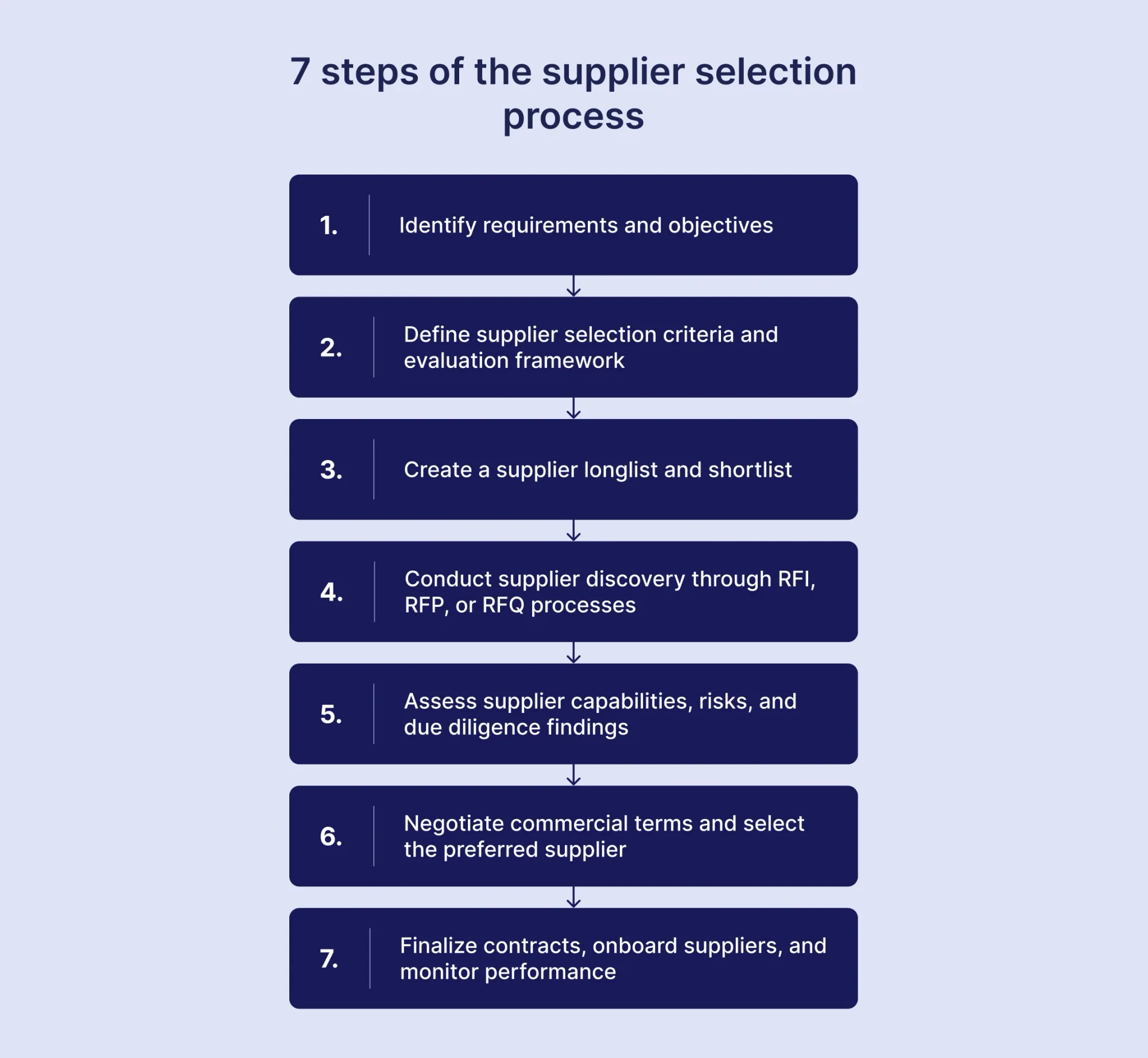
7 steps of the supplier selection process
Where supplier selection processes fail
How to identify, evaluate, and pre-qualify suppliers
How to structure the evaluation and selection process
RFI vs. RFP vs. RFQ: what's the difference?
Supplier selection methods and when to use them
How to negotiate contracts to mitigate risk
How to evaluate suppliers continuously over time
How technology automates supplier evaluation
How Precoro automates supplier evaluation and selection
How to scale your supplier selection process
Best practices for a scalable procurement process
Conclusion
FAQ
Why is supplier selection important for risk reduction and performance improvement?
Supplier selection is the earliest step in vendor management, where a company has full control before a vendor gains access to its operations and data. Once a supplier is onboarded, every subsequent problem is now shared between two companies, yours and the vendor’s. Yes, the procurement team might have saved some time during sourcing, but operations have to manage delayed deliveries, while accounts payable (AP) has to resolve invoicing errors.
A reliable, verified process will allow one to identify an unreliable, incompatible, or noncompliant vendor well before establishing any business relationship. It helps prevent the accumulation of risks and minimizes those your team is likely to face in the future.
Choosing the right supplier supports operational performance. Reliable suppliers provide quality materials at competitive prices, helping improve product quality and customer satisfaction. Performance establishes very high standards that help to set key performance indicators (KPIs) for suppliers.
What are the biggest risks associated with poor supplier selection?
Poor supplier selection creates several distinct categories of risk: operational disruption, financial insolvency, quality failure, and compliance or cybersecurity exposure. Once you identify a single risk, you’ll most likely be able to connect it to another set of vulnerabilities.
For instance, a supplier with weak planning may cause late deliveries, which may trigger rush shipping, which, in turn, will increase costs. That's exactly why you'd better not select the cheapest or the fastest one. Otherwise, it'll lead to new issues in other areas later on.
Operational disruptions often stem from poor planning, either in terms of materials, capabilities, or timing. A supplier with limited capacity will delay shipments the moment demand spikes or a machine breaks down. Even one small delay could be critical, as it can stop the entire production.
Financial risk refers to any exposure when a supplier’s financial issues begin to affect the buyer. A supplier close to insolvency may raise prices without warning, quietly shift payment terms in their favor, or, in the worst case, halt operations altogether. Losing a single-sourced supplier this way almost always costs more than qualifying a backup supplier would have cost in advance.
Any drop in quality often goes unnoticed until the production stage. If the vendor is skipping required steps, your team will have to deal with defects and additional work to fix the issue. In the worst cases, a defect reaches the end customer and becomes a recall that damages the buyer’s brand as much as the supplier’s.
A compliance violation occurs whenever there is a breach of the legal, regulatory, or contract requirements that the vendor was supposed to satisfy. It means that they may not have met the necessary certification requirements; hence, you end up handling the audit risk and reputation risk on their behalf.
Cyber and data risks arise when a supplier's security practices are weaker than the buyer's. A vendor that lacks good security practices is basically handing your company over to attackers. Any security problem at the vendor level is a security problem at your company.
Before selecting a supplier, procurement should understand where failure could affect the business. These problems aren’t limited to supplier management after onboarding. Most often, these breaches start during the evaluation process since there aren’t enough questions asked or not everything is verified properly.
| Risk area | What can go wrong | Business impact |
|---|---|---|
| Operational risk | Late deliveries, capacity issues, poor scheduling | Delayed projects, stockouts, production downtime |
| Financial risk | Supplier instability, sudden price increases, and poor payment terms | Budget pressure, emergency sourcing, cash flow issues |
| Quality risk | Defects, inconsistent service, weak quality controls | Returns, rework, warranty claims, customer complaints |
| Compliance risk | Missing certifications, expired insurance, labor, or environmental violations | Audit issues, legal exposure, reputational damage |
| Cyber and data risk | Weak security controls, poor data handling | Vendor-related data breaches or system exposure |
How does supplier performance directly affect operational and financial outcomes?
Supplier performance affects both operations and finance. It determines whether goods arrive on time, services meet expectations, invoices match terms, and budgets stay under control. Each of these factors directly affects the company’s income statement and its ability to generate sufficient profit to cover liabilities.
On the operational side, suppliers’ reliability determines whether production can continue and whether finished goods meet quality standards. Besides being a guarantee against defects that could affect the product before it reaches the end user, a good vendor also recovers well from issues that occur upstream. Any issue that affects them directly doesn’t impact you as the buyer.
Financial outcomes also depend directly on your supply chain. Hidden expenses from poorly selected vendors can significantly increase your costs. Even if a company is simply unsure of a vendor's ability to deliver, that uncertainty alone can drive up expenses by pushing it to purchase extra.
Because supplier performance shapes product quality and delivery reliability, it ultimately impacts the customer experience too. Consistent performance safeguards customer satisfaction, which, in turn, protects revenue and margin.
Why should supplier selection be a strategic, not just transactional, activity?
Supplier selection should be strategic because suppliers inherently affect business continuity and often directly impact profit. Transactional sourcing is inherently reactive. A purchase requisition arrives, and the team follows the routine: get three quotes, pick the cheapest option, and move to the next request. That cheaper vendor can then lead to much higher total cost of ownership (TCO) due to maintenance, or even to compliance issues.
Strategic sourcing strives to be proactive. High-impact vendors are treated as valuable assets that directly contribute to business growth and support any long-term goals. When you select vendors strategically, you consider factors beyond cost, such as their capacity, location, innovation opportunities, and sustainability. A vendor that satisfies each of these aspects in one way or another brings your company closer to what it wants to achieve.
What are the core principles of an effective supplier selection framework?
An effective supplier selection process provides procurement with a standard method for comparing options and justifying decisions. The process is based on three core principles: objectivity, cross-functional collaboration, and scalability. The idea behind these concepts is to ensure a fair choice of suppliers both externally and internally while minimizing any biases via data-based assessment.
Objectivity is the principle that any decision-making process must be grounded in a clear criterion and scoring system. Cross-functional collaboration is the principle that operations, finance, legal, and other necessary departments must be involved in the selection process. Scalability refers to the ability to use the same framework for purchases at any budget level.
The failure of one of these pillars jeopardizes the others. An objectively built procurement-oriented model won’t assess what really matters to the business. Vice versa, the involvement of all people without any scoring will result in only recording each individual's preferences.
Which criteria should a supplier selection framework always include?
A supplier selection framework should include cost, quality, delivery, capacity, technical capability, financial health, risk, sustainability, and relationship fit. The exact weighting should change by category, but these areas give procurement a balanced view of supplier value.
There are five key factors that must be included in every supplier selection process, regardless of what type of supplier it is:
- Financial solvency: It doesn't matter how low the initial cost is if they go bankrupt before delivering the order. Investigate their creditworthiness, cash flow, and financial situation before signing any agreement.
- Operational capacity: Even though their references look good, they may not be able to produce the required volume due to a shortage of people, machinery, or other production facilities. Make sure that they will be able to cope with your orders.
- Costs: Just because their initial offer looks low doesn't mean it will remain so; hidden costs may appear later as maintenance costs or other expenses. Calculate total costs before committing.
- Quality standards: A lower-cost product that won't pass inspection is worse than an expensive one. Make sure that they have appropriate certifications and past performance in terms of quality.
- Compliance with regulations: If the supplier violates regulations and standards, you might still face consequences. Make sure they are compliant with all necessary standards.
Note that the criticality and risk level of each supplier matter in how you evaluate them. For example, a vendor for office supplies won’t need the same level of quality or reliability as one for construction materials. Still, most supplier selection criteria fit into the groups below.
| Criteria group | What to look for | Why it matters |
|---|---|---|
| Cost and total value | Unit price, total cost of ownership, payment terms, discounts, freight, support costs | Provides a clearer picture of what things cost |
| Quality | Defect rates, certifications, inspection process, sample results, customer references | Maintains operations and safeguards the customer experience |
| Delivery and reliability | Lead times, on-time delivery, fulfillment model, and order accuracy | Determines if your volume can be delivered by the supplier on time |
| Capacity | Current output, available capacity, staffing, equipment, and scheduling discipline | Indicates whether the supplier can handle the volume |
| Technical capability | Tools, systems, engineering skills, category expertise, innovation record | Important for specific and direct materials, as well as for complicated services |
| Financial health | Liquidity, debt levels, credit history, revenue concentration, and business stability | Lowers the risk of a supplier going bankrupt |
| Compliance | Licenses, insurance, tax documents, certifications, data privacy, safety standards | Prepares you for audits and protects your legal interests |
| Risk and resilience | Business continuity plans, backup sites, geographic exposure, supplier dependencies | Cuts disruption risk |
| Sustainability | Environmental, social, and governance (ESG) policies, emissions data, and labor practices | Contributes to sustainability goals and corporate reporting |
| Service and relationship fit | Responsiveness, escalation path, account support, and collaboration style | Determines how fast problems are resolved |
How can you balance cost, quality, resilience, and sustainability criteria?
Balance competing criteria by assigning weights before supplier responses are reviewed. The TCO approach can be used to determine if the lowest offer is best, considering all hidden costs. While cost is important, it is not necessarily the primary consideration in each scenario. Cost does matter, but it doesn't mean that cost is always the main factor for each case.
Price plays a bigger role in standard, easily interchangeable categories. In those groups where components are critical for the business, their quality, reliability, and environmental sustainability matter more than the cost itself.
These compromises that you'll have to make are particularly evident if you're thinking in terms of TCO. It considers the cost of delays, defects, any rejects, rework, downtime, or additional supervision that can result when comparing suppliers. The cheapest unit price could be even higher when you include these costs.
Here is an example framework of different weighting logic you can use for specific categories.
| Category | Suggested weighting logic |
|---|---|
| Routine purchases | These items are usually low-risk and easy to replace, so assess the supplier mainly on cost efficiency and basic service reliability. |
| High-value but low-risk categories | Prioritize total cost, payment terms, contract flexibility, service quality, and account support. The spend is significant, so even small pricing or payment differences matter, but the risk of operational disruption is usually lower. |
| Critical categories | Give stronger weight to quality, production capacity, on-time delivery history, backup supply options, financial stability, and business continuity plans. A lower price won’t help with the risk of delays. |
| Regulated categories | Compliance and data security come first in this category. Suppliers need to be assessed for their ability to consistently meet industry and legal requirements. |
| Strategic suppliers | Focus on long-term performance and alignment with business goals. What should matter is whether the supplier can support the company over time. |
A simple rule: the more damage a supplier failure can cause, the less weight cost influences the decision.
What governance structures are needed to ensure consistent decision-making?
Supplier selection needs to be consistent and entails well-defined decision-making, approval procedures, stakeholder participation, escalation procedures, and documentation. Without governance, decision-makers will select suppliers based on criteria different from those used in the evaluation process.
Define decision rights with a RACI matrix
Procurement defines who owns each part of the supplier selection process. A Responsible, Accountable, Consulted, and Informed (RACI) matrix clarifies the ownership of employees in a structured table.
For example, procurement is typically Responsible manages the entire sourcing process. The business owner or department lead is held Accountable for the final supplier choice.
Legal, information technology (IT), security, or sustainability teams are Consulted when the team needs their expertise. Other affected teams, such as accounts payable, operations, or end users, are Informed once the supplier is selected so they can follow the correct process.
Set escalation rules for higher-risk suppliers
With clear governance, buyers know who approves what. A routine purchase only needs procurement sign-off, while a high-value contract can trigger additional review. Hence, the selection process is objective since the final choice isn’t based on the requester’s preference. There are many people involved who can give their views about the vendor.
Standardize supplier evaluation criteria
Establish the criteria for scoring before the suppliers respond. Criteria could include such things as price, quality, reliability of delivery, risks, compliance issues, environmental sustainability, service level, and other category-related issues.
The written scoring model allows all the evaluators to use the same criteria to compare bids, and it prevents the evaluation team from changing the scoring after.
Use a financial authority matrix
A financial authority matrix defines who can approve sourcing events, supplier awards, contracts, purchase orders (POs), and exceptions. These limits can vary by spend level, department, legal entity, supplier risk, or contract type.
In terms of supplier selection, the matrix assigns responsibility before a decision is made. To keep it effective:
- Focus first on impactful decisions, such as supplier awards, contracts, and purchase orders. Less impactful events can wait unless they block the process.
- Assign approval limits to roles rather than individuals. Any restructuring or turnover shouldn’t affect who makes the final decisions.
- Regardless of spend, escalate approvals for high-risk suppliers or single-source purchases. Their impact could reach much further than the financial stability of your company.
- Define backup approvers to avoid delays. If someone isn’t available, another employee needs to own the approval process.
- Review the matrix annually and after major organizational or policy changes.
- Embed approval thresholds into procurement workflows with the system you use. A static document simply trusts your team to follow the policies, with no guarantees, while a procurement system enforces these rules.
The table below shows how approval thresholds might scale in a mid-sized procurement organization. The exact values should reflect the company’s spend levels and risk tolerance. For instance, high-risk decisions typically must be reviewed by a cross-departmental board of managers who clearly see the risk that action would pose to their specific function.
| Sourcing decision | Category Manager | Director | VP of Procurement | CFO or Board |
|---|---|---|---|---|
| Supplier for a low-risk category | Up to $25,000 | Up to $100,000 | Up to $500,000 | Above $500,000 |
| Supplier for a new or high-risk category | Not authorized | Up to $50,000 | Up to $250,000 | Above $250,000 |
| Contract with non-standard terms | Not authorized | Recommend only | Approve | Above $250,000 |
| Purchase order release | Up to $10,000 | Up to $50,000 | Up to $250,000 | Above $250,000 |
Centralize supplier data and documentation
Finally, a shared source of information is often the main reason for choosing a supplier. The stakeholders must have the same supplier files, offers, scores, risk assessments, agreements, and approval history. Without such information, either they won’t provide any input at all, or their contribution will lack a certain background.
Platforms like Precoro build a functional data layer before you start purchasing and create the conditions for reliable decision-making. With all supplier records, spend analytics, and ownership controls gathered in one place, you get a full picture of the company’s current priorities.
Which supplier selection criteria matter most in volatile markets?
In volatile markets, supplier selection criteria particularly focus on resilience. Price is also an issue, but the lowest-priced supplier could become the most expensive supplier if they represent a huge risk.
Companies are already managing supplier risks using this approach. According to McKinsey’s 2025 Supply Chain Pulse survey, 82% of companies said recent tariff changes affected their supply chains, 45% increased inventory, 39% pursued dual sourcing, and about one-third chose nearshoring or onshoring.
Criteria that should be prioritized include:
- Financial stability: See whether the supplier has sufficient cash flow and financial strength to continue functioning in conditions of inflation and slowing market activity.
- Delivery reliability and lead-time agility: Determine whether the supplier maintains a high on-time delivery rate, has rare delays, and can be flexible regarding schedule changes.
- Capacity and operational flexibility: Assess whether the supplier can scale production up or down, handle changing order volumes, adjust minimum order quantities, or switch to alternative materials when shortages occur.
- Geographic and logistics risk: Consider where the supplier is located, which routes they depend on, and whether they offer regional distribution, nearshoring options, or backup logistics channels.
- Supply chain visibility: Audit a supplier's own supply chain, including Tier 2 and Tier 3 suppliers, subcontractors, or material dependencies.
- Total cost of ownership (TCO): Take into account the total cost of engaging with the supplier, including freight, customs, duties, warehousing, and any switching costs.
- Risk exposure and compliance: Verify the supplier’s compliance history, customs documentation accuracy, audit readiness, ESG risks, labor practices, and exposure to high-risk countries or materials.
- Responsiveness and problem-solving: Assess the response time of the supplier and willingness to communicate about delays and resolve issues if disruptions occur.
How do you clearly define requirements and evaluation criteria?
Work with stakeholders to define requirements before sourcing begins. Then translate those into measurable evaluation criteria, assign weights, and separate mandatory requirements from scored criteria.
The procurement department typically leads the process of evaluating competitive offers and selecting the supplier for any particular contract. The methods used for selection are some of the most important elements of the procurement professional’s skill set. To define requirements clearly, the team should essentially translate business needs into measurable supplier expectations. A vague requirement leads to vague supplier responses, which makes comparison difficult.
A simple statement like, “We need a supplier who will deliver cleaning supplies on time,” is too broad and leaves nothing for the sourcing team to fall back on. What is the definition of timeliness? Are other factors, such as quality or potential savings, not as important?
Remember, to produce a specific result, you must choose the correct mechanism and appropriate sourcing tools. The supplier is the fundamental resource employed by your organization to meet its requirements. If you don’t select correctly, you won’t achieve satisfactory results.
For starters, gather business and stakeholder requirements. Define what the business needs now rather than copying requirements from the previous contract. Involve procurement, finance, operations, quality, and end users to capture specifications and service levels.
Separate mandatory requirements from scored criteria. Use pass-or-fail requirements for non-negotiable conditions. Only vendors that fit these requirements should advance to the scored evaluation.
Assign clear measurements to the criteria. Establish clear objectives that include KPIs. For instance, set an acceptable defect rate, on-time delivery rate, response time, or TCO.
Select the evaluation categories. Select the most important factors for the particular item. Limit the list to avoid confusion when applying it by evaluators.
Assign weights before contacting suppliers. Give each criterion a percentage based on its importance and the category’s risk profile.
Define the scoring method. Select a scoring scale; describe what the different scores indicate; define what evidence the suppliers must provide.
Finally, validate the framework. Ensure all stakeholders are in agreement with the requirements, weights, rules for scoring, and evidence required. Do not alter the model once the proposals have been received.
While it does need a certain degree of human intuition, supplier selection should still be performed systematically and to the most objective criteria that you can create.
Why supplier requirements are often misdefined before sourcing even begins
Supplier requirements are often misdefined because planning is rushed or incomplete. Procurement may not get enough input from the people who will use the product or service, or the team may reuse outdated specifications and scoring criteria simply because the new request looks similar to a previous one. Requirement bloat is another frequent issue, in which stakeholders include too many preferences and limit the number of suppliers with that approach.
These problems can lead to vague, outdated, or overly restrictive requirements, making it harder to identify suitable suppliers. Before issuing a Request for Proposal (RFP) or Request for Quotation (RFQ), the company should confirm which requirements are mandatory, which are preferences, what would disqualify a supplier, and what evidence suppliers need to provide. In addition, the information should be verified for being up-to-date and truly reflecting the needs of the requester.
How do you translate business requirements into measurable supplier metrics?
To translate business requirements into supplier metrics, list each requirement and define what would prove that a supplier can meet it. Present it in the form of a figure, a document, or even a specific service level, which can then be evaluated by using supplier performance metrics. Each requirement should have at least one measurable indicator, so evaluators won’t rely on vague claims or personal judgment.
Let’s take a general claim as an example. The requirement of “reliable delivery” only sets a general expectation. The buyer and supplier may interpret it differently. The supplier may see reliability as eventually delivering the order, while the buyer may need delivery within a strict four-day window. Connect this SLA to specific KPIs to measure how it performs.
Below are some of the most common supplier ones, along with the metrics and evidence companies can use to evaluate them.
| Requirement | Measurable indicator |
|---|---|
| Reliable delivery |
Lead time: The time between placing an order and receiving it, such as four business days from purchase order (PO) approval to delivery. On-time delivery rate: The percentage of orders delivered by the agreed deadline. Recovery plan: The process the supplier follows when a delivery is delayed, including escalation steps and updated timelines. |
| Good quality |
Defect rate: The maximum acceptable percentage of faulty, damaged, or non-compliant goods. Sample approval: A review process where the supplier provides a sample before the company commits to a larger order. Quality certification: Formal proof that the supplier meets required quality standards, such as ISO 9001. |
| Strong support |
Response time: How quickly the supplier must acknowledge or respond to a request, issue, or complaint. Escalation process: The steps for moving urgent or unresolved issues to the right contact or decision-maker. Account ownership: The named person or team responsible for managing the relationship and resolving ongoing issues. |
| Cost control |
Total cost of ownership (TCO): The full cost of buying from the supplier, including unit price, freight, handling, payment terms, and maintenance costs where relevant. Price-change rules: Clear conditions for when and how the supplier can increase prices. Minimum order quantity: The smallest order volume the supplier will accept, which affects flexibility, storage needs, and cash flow. |
| Compliance |
Required certifications: Documents proving the supplier meets relevant industry, safety, quality, or regulatory standards. Insurance coverage: Proof that the supplier carries the required insurance for the type and level of risk involved. Audit history: Records showing whether the supplier has passed previous audits or resolved past compliance issues. |
| Business continuity |
Backup capacity: The supplier’s ability to continue production or service through alternate facilities, teams, or suppliers. Safety stock: Extra inventory held to reduce the risk of shortages or delivery disruption. Disaster recovery plan: The supplier’s documented plan for restoring operations after disruptions such as system outages, natural disasters, or supply interruptions. |
How should you weigh and prioritize competing criteria?
Weigh the criteria based on the risk, complexity, and business impact of the category. The weighting should be agreed upon before you receive supplier responses to avoid adjustments around a supplier the team prefers. There’s no universal weighting model for supplier selection, with most teams typically using a standard weighted scorecard approach. However, the criteria and percentages in that scorecard will change based on the category’s risk, complexity, and business impact.
As a general rule, selection for standard, low-risk items typically benefits more from better cost and delivery speed since these vendors are easier to replace. On the other hand, vendors that directly support critical business functions or belong to single-source categories should usually be evaluated with more weight on quality, compliance, and risk.
Here’s an example of a weighted scoring model for a high-impact category selection.
| Requirement | Criterion | Weight | Why this criterion matters |
|---|---|---|---|
| Reliable delivery | Lead time | 7% | Measures whether the supplier can deliver within the required timeframe, such as four business days from purchase order approval to delivery. |
| On-time delivery rate | 8% | Shows how consistently the supplier meets agreed delivery deadlines. | |
| Order accuracy | 5% | Checks whether orders arrive with the correct items, quantities, and documentation. | |
| Good quality | Defect rate | 10% | Measures the share of faulty, damaged, or non-compliant goods the supplier delivers. |
| Sample approval | 5% | Confirms that the supplier can meet specifications before the company commits to a larger order. | |
| Quality certification | 5% | Provides formal proof that the supplier follows recognized quality standards, such as ISO 9001. | |
| Business continuity | Backup capacity | 8% | Shows whether the supplier can continue production or service through alternate facilities, teams, or suppliers. |
| Safety stock | 5% | Reduces the risk of shortages if demand increases or supply is delayed. | |
| Disaster recovery plan | 7% | Confirms that the supplier has a documented process for restoring operations after disruption. | |
| Compliance and risk | Required certifications | 5% | Confirms that the supplier meets relevant industry, safety, regulatory, or environmental standards. |
| Insurance coverage | 5% | Shows whether the supplier has enough protection for the level of financial or operational risk involved. | |
| Audit history | 5% | Helps verify whether the supplier has passed previous audits or resolved past compliance issues. | |
| Financial health | Credit or financial stability check | 5% | Helps identify whether the supplier may face financial pressure that could affect delivery or service continuity. |
| Revenue concentration or dependency risk | 5% | Shows whether the supplier is overly dependent on one customer, facility, or revenue source. | |
| Cost control | Total cost of ownership | 5% | Looks beyond unit price to include freight, handling, payment terms, maintenance, and other related costs. |
| Price-change rules | 3% | Defines when and how the supplier can increase prices during the relationship. | |
| Minimum order quantity | 2% | Shows how much flexibility the company has when ordering and managing cash flow or storage needs. | |
| Strong support | Response time | 2% | Measures how quickly the supplier responds to requests, issues, or complaints. |
| Escalation process | 2% | Defines how urgent or unresolved issues are moved to the right contact or decision-maker. | |
| Account ownership | 1% | Confirms who is responsible for managing the relationship and resolving ongoing issues. | |
| Total | 100% |
7 steps of the supplier selection process
A complete selection process has seven steps, starting with an internal needs assessment and ending with supplier performance monitoring after the contract is signed. The process covers the work sourcing teams need to do before, during, and after evaluation: defining requirements, finding suppliers, comparing proposals, checking risks, negotiating terms, onboarding the selected supplier, and tracking whether the decision still holds up in practice.
Skipping steps usually leaves you with a poor option that will most likely cause problems later on in the process. Unless you’re working with a fully vetted supplier and a low-risk purchase, make sure you complete each step before you move into a supplier relationship.
Follow this seven-step framework to select the right vendor for your business needs.
Step 1: Identify business requirements and procurement objectives
The first step is to define what the business needs, why the purchase matters, and what outcome the supplier must support. If the requirement is unclear, every step after it won’t have enough data for a successful supplier selection process.
Procurement should define the requirement from several angles before moving on to supplier discovery:
- Business objective: The reason for the purchase and the result it should achieve.
- Scope of purchase: What the sourcing event should and should not cover.
- Users and stakeholders: The people who requested, use, fund, review, or approve the purchase.
- Operational requirements: The day-to-day conditions the supplier needs to support.
- Quality expectations: The standards the product or service must meet to be accepted.
- Commercial constraints: The budget, contract, pricing, and payment limits that shape the purchase.
- Risk and compliance requirements: The rules, protections, and controls the supplier must satisfy before selection.
By the end of this step, the company should have a clear internal brief for the sourcing event. It should highlight the item(s) that need to be acquired, the purpose behind the procurement, the parties concerned, the limitations involved, and the desired outcome. This brief essentially acts as a starting point for the rest of the selection process and reduces the chance of bias or poor fit.
Step 2: Define supplier selection criteria and evaluation framework
With requirements set, the company must choose which criteria will actually decide the outcome and how each will be weighted based on the risk profile of the category. The framework can’t be defined by procurement alone. Instead, it should consider input from relevant stakeholders, depending on the supplier category. At this stage, procurement outlines:
- Mandatory requirements: Non-negotiable conditions a supplier must meet to stay in the process.
- Scored criteria: The factors used to compare qualified suppliers.
- Weights: The percentage each criterion contributes to the final score, adjusted to the category’s risk and impact.
- Scoring rules: Clear definitions for what each score means, so evaluators aren’t relying on personal judgment.
- Required evidence: The documents, data, samples, references, or commitments suppliers must provide to support their claims.
Scoring rules define how each criterion will be evaluated and give the team an objective basis for comparing vendors. To keep things simple, you can use a 1–5 scale where 5 indicates strong, well‑verified performance and 1 reflects poor performance or risk.
For example, if the on-time delivery rate is one of the scored criteria, the scoring rules example could look like this:
| Score | Scoring rule |
|---|---|
| 5 | Supplier has proven at least 98% on-time delivery over the last 12 months. |
| 4 | Supplier has proven 95–97% on-time delivery over the last 12 months. |
| 3 | Supplier has proven 90–94% on-time delivery over the last 12 months. |
| 2 | Supplier has proven 80–89% on-time delivery or has repeated minor delays. |
| 1 | Supplier is below 80%, can’t provide delivery data, or has unresolved delivery issues. |
Step 3: Create a supplier longlist and shortlist
The third step is to identify potential suppliers and narrow the list to qualified candidates. A longlist gives procurement a broad view of the market, while a shortlist focuses the process on suppliers that meet minimum requirements.
You can build a longlist from a variety of sources, including existing supplier databases, approved vendor lists, stakeholder recommendations, industry associations, and supplier directories.
Filter the list down to suppliers that have at least some alignment with the requirements. Ensure that they serve the required location, support the required volume, possess any certification requirements, meet insurance and compliance requirements, and have experience in that category.
Pre-qualification saves time. Suppliers that clearly can’t meet the basics shouldn’t be invited into a detailed RFP process.
Step 4: Conduct supplier discovery through RFI, RFP, or RFQ processes
Next, the team must collect supplier information using the right sourcing document. A Request for Information (RFI), Request for Proposal (RFP), and Request for Quotation (RFQ) each serve a different purpose.
Use an RFI to collect general supplier information, such as capabilities, locations, capacity, certifications, experience, financial stability, and basic risk details. With this in mind, procurement can pinpoint qualified candidates before requesting detailed proposals.
Use an RFP to understand each supplier’s proposed approach to your company’s needs. It should show how the supplier would meet the business need, what solution they recommend, how they would implement it, what timeline they can support, and how they would manage risks or service expectations.
Use an RFQ to gather structured pricing information for the needed specifications and delivery terms. Procurement can compare the costs of one supplier to the other options and evaluate which works best for the company.
To make supplier responses easier to compare, use the same templates and evaluation rules for every supplier. Preferably, the process should be guided: vendors should immediately understand the evidence and answers required of them, so you don’t end up with missing information.
Before selecting an offer, every buyer should follow a structured evaluation process to ensure adequate consideration that all aspects of the organization’s needs are being optimized. Evaluating a supplier’s offer includes not only comparing its bid, but also assessing the supplier’s ability to meet the required speed and quality standards.
Evaluate offers in terms of both potential risks and benefits. Before you decide to award a contract to a specific supplier, try to focus on three key criteria: responsiveness, capability, and competitive value.
Step 5: Assess supplier capabilities, risks, and due diligence findings
Arguably, one of the most important steps in the selection process is the capacity assessment and due diligence check. Before signing anything, you should verify whether the supplier can actually deliver what they promised. At this stage, procurement should move beyond proposal review and test the supplier’s readiness.
Operational capacity analysis
One of the primary considerations in award determination will be the supplier’s physical capacity to meet your needs as promised. Obviously, you don’t want to select a supplier that could have difficulty meeting the required volume due to capacity constraints or conflicts with the scheduling of other jobs.
A simple ratio of current output to capacity can provide a valuable indication of this ability. Another good idea is to ensure that the potential supplier has the ability to properly schedule orders and keep track of current production operations to meet its customers’ commitments. Prepare to be able to benchmark all these criteria through the customer references that the supplier provides.
Technical capability determination
Another important key capability is the supplier’s technology and technical ability. Technical capability determination confirms whether the supplier has the equipment, tools, talent, certifications, and experience needed to meet the requirement.
Make sure that your potential supplier has all the necessary equipment, tools, and talent to meet your requirements. You can determine this through historical performance records and active participation in industry events. Check how many patents the company holds in comparison to its competition. Examine how often it leads the market with the introduction of new products and to what extent it is funding its research and development efforts. Don’t forget to consider all the necessary licenses, insurance, and supplier certifications.
Financial analysis
Recently, financial performance analysis has become increasingly important among most executives. Financial analysis helps to assess overall supply base risk factors and is often required in order to meet audit requirements.
Financial ratios help select and qualify suppliers based on their financial strength, leverage, and competitive advantage. To properly evaluate individual ratios, it’s crucial that they are viewed with respect to the historical performance of the supplier or the ratios of similar firms in the industry.
Compliance due diligence
Compliance due diligence checks whether the supplier’s required documents are valid, current, and relevant to the purchase. A certification, license, or insurance policy shouldn’t be accepted only because the supplier submitted it. Procurement should confirm the document’s status with the issuing body or another reliable source, especially for regulated or high-risk categories.
Add a renewal process here. Certifications and insurance policies expire, so a supplier that passed compliance checks during selection can become non-compliant later. Track the renewal date of each document and re-verify it before it expires.
Step 6: Negotiate commercial terms and select the preferred supplier
After selecting the supplier, the next step is to discuss the terms of the relationship after selection. Pay particular attention to the rationale for it. Price is still negotiated, but only alongside payment terms, service levels, price adjustment rules, continuity requirements, penalties, incentives, and termination rights. A strong evaluation process only helps if the final contract gives the company a way to enforce the standards it selected.
Step 7: Finalize contracts, onboard suppliers, and monitor performance continuously
Once a supplier has been selected, the priority is to make the supplier ready to work under the agreed terms. The contract should capture the service levels, KPI targets, and consequences for missed commitments. During onboarding, collect the information needed to activate the supplier properly, including payment, tax, compliance, and system details. A supplier management solution like Precoro helps minimize the time spent on onboarding by providing suppliers with a self-service portal.
Continuous monitoring is critical in this context. A good evaluation process won’t be of great value if it happens only at the time of renewal. The procurement department must monitor the KPIs that were used for selecting the supplier and detect underperforming areas.
Where do most supplier selection processes fail?
Most supplier selection processes fail because of unclear requirements, too much focus on the lowest price, manual administrative work, or no real monitoring after onboarding.
Unclear requirements
Some problems start before suppliers are even contacted, at the very first step of the supplier selection process. If it’s unclear what the business needs, every proposal will interpret it differently. One vendor may think faster delivery is a priority over material specifications, while your goal is to keep the integrity of a product. In the end, you have to choose between the proposals that don’t satisfy your original requirement to begin with.
Make requirements non-negotiable and define them well before starting the selection. If integrity matters more than speed, the specification and scoring model should reflect that. Stakeholders should review requirements before the RFP/RFQ goes out, since changes after responses arrive might make the decision harder.
Lowest-price bias
A low price costs the company the least resources, which is why stakeholders often focus too much on it when reviewing quotes. What they forget about is that the cheapest vendor won’t stay cheap once quality issues, delays, emergency shipping, rework, or extra management time come in.
TCO helps mitigate this. Compare suppliers by the overall cost of maintenance and additional expenses, and make cost only one part of the weighted scorecard.
Manual administrative friction
Once you’ve selected the supplier, the sourcing process might still fail, mainly because of the manual work your team has to do to onboard the vendor. If supplier information is scattered across spreadsheets, inboxes, and shared folders, both sides may end up working with incomplete or outdated details. Manual copying also increases the risk of human errors, especially when teams are rushing to get the vendor ready for use.
The risks are obvious: missing documents, inconsistent scoring, unclear ownership, and approval records that are difficult to reconstruct later. It also slows down the process because every comparison requires someone to clean up the information first.
No post-selection monitoring
Supplier selection doesn’t end once you sign the contract. The supplier may have passed the initial evaluation, but if no one is checking whether they still meet the same standards afterward, you’re exposing your organization to unnecessary risks.
This situation will become evident only later on—once the deliveries are late, quality declines, documents expire, and prices drift from those discussed before. By the time procurement notices, the issue has often been building for months.
How do you identify, evaluate suppliers, and pre-qualify the best supplier candidates?
Source suppliers from multiple channels, screen them against minimum requirements, verify their claims with evidence, and assess risk before moving them into final evaluation. With these methods, you’ll build a relevant shortlist of vendors that are capable of meeting the requirements.
Where should procurement teams source and evaluate suppliers for long-term reliability?
Procurement teams should source suppliers through both internal and external channels, then validate each option with credible evidence. If someone recommends a supplier to your team, you should still conduct due diligence to confirm they're legitimate.
Internal sources can include:
- Existing supplier records: Suppliers already in the system and the information the company has on file.
- Approved lists: Vendors that have already passed basic internal checks.
- Historical purchase data: Previous suppliers, categories purchased, and spend levels.
- Stakeholder feedback: Practical context from teams on the requirements of the projects.
- Previous sourcing events: Suppliers were evaluated before, but not selected at the time.
- Contract and performance history: Any past terms or records that can be used as a reference
External sources can include:
- Supplier directories: Suppliers grouped by category, region, certification, or industry.
- Sourcing platforms: Wider pools with structured information.
- Industry associations: Vendors with category-specific credibility or recognized market presence.
- Peer referrals: Contacts from other companies or procurement professionals with whom they have worked successfully.
- Trade shows: Direct visibility into products, capabilities, and supplier teams.
- Technical conferences: Specialized suppliers and evidence of technical expertise.
The team must ensure that the supplier is reliable long-term, so it’s important to analyze each option from several angles. Besides internal feedback, research the supplier’s reputation on the internet or ask for referral calls with clients of your type.
What due diligence questions reveal potential risks and financial health concerns early?
During due diligence, make sure to ask questions that directly provide evidence of financial stability and continuity. The answers should reveal whether the supplier can perform both under normal conditions and under pressure.
Examples of useful questions include:
- Can you share your current business continuity and disaster recovery plan? Ask for the document itself. If there’s no plan, you’re immediately exposing yourself to major risk.
- Which parts of your operation depend on a single facility, system, subcontractor, or material source? Disruptions typically start at those single points of failure, even at otherwise solid suppliers.
- How much unused capacity do you currently have compared with normal output? Near-full capacity indicates that even small volume spikes will impact lead times.
- What percentage of your annual revenue would this contract represent? If your business makes up a large share, the supplier may be under pressure to stretch capacity.
- Can you provide recent financial statements or other proof of financial stability? Get something concrete to verify any statement on their financials that they make.
- Are there any active major liabilities that could affect performance? You're checking for known issues that could disrupt operations.
- What insurance coverage do you carry for this type of work? Ask for current proof of coverage and ensure it’s not expired or too low for the contract.
- Which cybersecurity certifications or controls are currently in place? If the supplier only mentions security during the sales call, verify it before selection.
- How often do you review security and compliance controls with employees? Certifications matter, but those practices need to be enforced regularly for them to work.
If the vendor can’t share a continuity plan, give only vague revenue ranges, or claim certifications without proof, treat that as part of the evaluation. Supplier claims should be verified before they affect the score.
How can you evaluate suppliers using third-party data, references, and supply chain intelligence?
Third-party data is crucial when evaluating suppliers. Although information provided by vendors is useful, you can’t really rely solely on it to assess whether that option is the right fit for you. Combine the vendor’s responses with independent data and customer references for the best results.
Verify the supplier’s claims with independent data
Use third-party sources to confirm the information the supplier provides during evaluation. Focus on key risks or claims made to make sure the assessment doesn’t take too much of your resources. Any public financial data, sanction checks, or certification databases can directly verify the claims the vendor makes. For instance, their company might state they are financially stable, but actually have a history of payment issues in their credit report.
Assess actual performance with customer references
Request several client references from the supplier. Preferably, these clients have to have a similar company profile to yours, either in size, industry, or business need for that specific project. During these calls, ask specific questions about delivery performance, issue resolution, and any other topic that concerns you.
Ask whether the supplier met the commitments they made during sourcing. Did they deliver on time? Did they communicate early when something went wrong? Did they honor the agreed-upon pricing? Did they resolve issues without constant escalation? Finally, ask one question that says more than it seems to: Would you choose this supplier again?
Supplier risk assessment matrix
A supplier risk assessment matrix helps procurement rank supplier risks by likelihood and business impact. That score indicates the next action you should take. Use the matrix during due diligence to evaluate risks the supplier might pose after you sign the contract. Score each threat separately for every vendor since a general risk score can easily hide crucial gaps.
Learn what each likelihood and impact score means on a risk assessment matrix.
| Score | Likelihood | Impact |
|---|---|---|
| 1 | Rare: no known warning signs and unlikely in the next few years. | Minimal effect on the business. |
| 2 | Unlikely: possible, but not expected based on current evidence. | Minor delay, small cost increase, or limited internal inconvenience. |
| 3 | Possible: has happened before or could reasonably happen within 12–24 months. | Noticeable impact that needs management attention. |
| 4 | Likely: you’re aware of recent incidents or visible warning signs already exist. | Major disruption that can potentially cause financial damage or impact customer perception. |
| 5 | Very likely: already happening or expected to repeat. | Business-critical disruption: legal exposure, reputational damage, or long-term customer impact. |
Use the vendor’s scores on impact and likelihood to determine the direction you should go in during the selection process.
| Risk profile | What it means | Supplier selection action |
|---|---|---|
| High impact, high likelihood | The supplier shows warning signs, and failure would seriously affect the business. | Treat as a critical risk. If you choose to move forward, require a mitigation plan, add stronger contract protections, and prepare a backup supplier. |
| High impact, low likelihood | The risk is unlikely, but the damage would be significant if it happened. | Build a contingency plan. Confirm recovery procedures, backup capacity, and escalation steps before signing. |
| Low impact, high likelihood | The issue happens often, but the business impact is limited. | Monitor and correct the pattern. Discuss the root cause with the supplier and implement fixes to the process. |
| Low impact, low likelihood | The supplier has no major warning signs, and any likely issue would be easy to absorb. | Review regularly. Keep documentation current and reassess the supplier on the normal schedule. |
How should you structure the supplier evaluation and selection process?
Structure the process so every supplier is compared against the same requirements. Use the same scoring criteria, evidence standards, and approval rules. This approach reduces manual work for you too and makes proposals easy to compare.
Choose the right sourcing format for the decision. Use an RFP when suppliers need to propose different approaches. Use an RFQ when you have specific requirements and need to compare pricing. From there, apply the approved scorecard and verify supplier claims where needed. Add site visits, audits, or sample testing when the category carries enough risk to justify a deeper look.
What steps should a request for proposal (RFP) and RFQ process include to compare supplier choices fairly?
An RFP or RFQ should give every supplier the same requirements, deadlines, response format, communication rules, and evaluation criteria. The difference is—what procurement is evaluating: an RFP compares how suppliers solve the problem, while an RFQ compares pricing and commercial terms against a fixed specification.
RFP process
Use an RFP when suppliers need to explain how they would solve the business need.
- Build from the approved brief. Carry over the business need, scope, mandatory requirements, and evaluation priorities already defined earlier.
- Use a standard response template. Every supplier should respond in the same structure so proposals are easy to compare side by side.
- Request the proposed approach. Suppliers should lay out their solution, timeline, implementation plan, responsibilities, assumptions, and risks.
- Run one Q&A process. Collect questions through a single channel and share the relevant answers with all participants.
- Hold demos or clarification meetings if needed. Keep the agenda or question set the same for every supplier.
- Compare responses using the approved framework. Score proposals against the requirements agreed before launch.
RFQ process
Use an RFQ when the requirement is already defined, and procurement mainly needs to compare commercial terms.
- Confirm fixed specifications. Suppliers should be quoting against the same requirements.
- Use a structured pricing table. With standardized fields, you can easily compare unit cost or maintenance fees.
- Confirm required documents. Request certificates, warranties, insurance, inspection documents, or material specifications where relevant.
- Compare total cost and exceptions. Look at the full commercial picture and check whether supplier assumptions quietly change the quote.
- Record the award rationale. Document the final comparison, accepted quote, supplier exceptions, approvals, and the reason for selection.
How can scoring models help select the right supplier and reduce evaluation bias?
Scoring models reduce bias by forcing stakeholders to evaluate suppliers against agreed criteria instead of personal preference. They also create a clear audit trail for the final selection. Without a scoring model, stakeholders may naturally prioritize different factors. One will put more weight on price, while another wants quicker delivery. All of those factors matter, but you need to rank them by importance well before reviewing suppliers’ proposals.
Additionally, scorecards prevent the so-called “halo” effect, where a single strength of a supplier overshadows other factors to the point where your team might assume that the vendor is great at everything. Instead, each factor is carefully considered and objectively ranked.
A weighted scorecard records which criteria were used, how important each criterion was, how each supplier performed, and why the winning supplier was selected. The model still requires human judgment, but makes it way more disciplined.
When should site visits, audits, or sample testing be required?
A desktop review (a remote overview of the vendor’s business) may be enough for routine purchases, but not for critical suppliers. Site visits, audits, and sample testing should be required when supplier failure could create serious operational, financial, compliance, or customer risk.
Site visits should be required when supplier capacity or working conditions could affect performance. They’re especially useful when a supplier claims they can support high volumes or is already operating close to capacity. A visit lets the buyer see the facility directly and determine if the claims the vendor made are true.
Audits are warranted if the supplier must meet specific standards, the absence of which might cost the buyer finances or reputation. Ask for them when considering new manufacturing partners, critical direct materials, regulated categories, or any supplier where self-reported compliance isn’t enough. An audit checks whether the supplier’s actual processes match the standards they claim to follow, such as ISO requirements or internal quality controls. It should also be triggered when certifications can't be verified independently or when past references raise concerns.
Sample testing is recommended if you need a custom design, specific materials, or any suppliers where a written proposal can’t prove quality on its own. Test that prototype against the agreed specification before the company commits to a contract or larger order.
Make site checks, sample testing, or audits mandatory above a defined spend threshold or for any strategic supplier, depending on the category. For anyone else, use a desktop review unless a specific red flag raises the risk level.
Supplier evaluation scorecard example
A supplier evaluation scorecard is a structured method to compare suppliers against the criteria that matter most for a specific sourcing decision. It usually assigns each criterion a weight, scores each supplier on the same scale, and calculates a weighted result so the final comparison reflects business priorities rather than a single factor like price.
Vendor scorecards are commonly built around core performance areas such as quality, delivery reliability, cost, responsiveness, and compliance, with weights adjusted to match the company’s goals. Use this template to build a scorecard for your vendor network.
In the example below, Supplier B offers stronger cost performance. Supplier A still receives the higher total score, mainly because Supplier A performs better in the areas with higher business impact: quality, delivery, capacity, and compliance. The scorecard essentially prevents the lowest-price bias at the very root.
| Criteria | Weight | Supplier A score | Weighted score | Supplier B score | Weighted score |
|---|---|---|---|---|---|
| Cost and total value | 25% | 4 | 1.00 | 5 | 1.25 |
| Quality | 20% | 5 | 1.00 | 3 | 0.60 |
| Delivery and reliability | 15% | 4 | 0.60 | 3 | 0.45 |
| Operational capacity | 15% | 5 | 0.75 | 3 | 0.45 |
| Risk and compliance | 15% | 4 | 0.60 | 3 | 0.45 |
| Service and responsiveness | 10% | 3 | 0.30 | 4 | 0.40 |
| Total | 100% | 4.25 | 3.60 |
Supplier A: 4.25/5
Supplier A is the stronger overall option. Its higher scores in quality, delivery, capacity, and compliance outweigh its weaker cost score.
Supplier B: 3.60/5
Supplier B is cheaper and slightly stronger in responsiveness, but weaker in the areas that matter most for this category.
What is the difference between RFI, RFP, and RFQ in procurement?
An RFI, RFP, and RFQ are used at three different points in the sourcing process: an RFI gathers information to see what’s happening in the market, an RFP asks a shortlisted group to propose a solution, and an RFQ collects firm pricing against already defined specifications.
A Request for Information (RFI) is sent to potential suppliers to gather general information about their capabilities and approximate pricing. It's the earliest document used when you don’t yet have a clear picture of the available solutions. Its only real job is to surface who exists, what they offer, and roughly what it costs, narrowing a wide, unclear field down to a workable shortlist.
A Request for Proposal (RFP) prompts shortlisted suppliers to submit a detailed proposal explaining how they would solve a defined business problem. Send it once you’ve defined the need, but aren’t sure about the solution. This document helps compare how different suppliers would approach the same problem.
A Request for Quotation (RFQ) asks vendors to submit firm pricing and commercial terms against a fully specified set of requirements. It comes last in the sequence, once the specification is locked and there's nothing left to negotiate except price.
| Document | Stage | Purpose | Commitment level | What's compared |
|---|---|---|---|---|
| RFI | Market research | Map the supplier landscape | Purely informational | Capabilities, rough cost |
| RFP | After shortlisting | Compare proposed solutions | Non-binding proposal | Approach, timeline, pricing |
| RFQ | Specs locked | Get firm pricing | Non-binding but sets expectations for contract | Unit price, terms, and delivery |
Supplier selection methods and when to use them
Different methods fit different sourcing situations. Routine purchases may only need a quote comparison, while strategic or high-risk suppliers may require scorecards, audits, testing, or trial engagements.
Below, we compare the most common supplier evaluation methods and when each one works best.
| Evaluation method | Best use case | Advantages | Limitations | Typical procurement category |
|---|---|---|---|---|
| RFI | Early market research or supplier discovery | Helps map supplier capabilities before a formal sourcing event | Not usually enough for final supplier selection | New categories, exploratory software, consulting services |
| RFQ | Standard goods or services with clear specifications | Fast comparison and clear pricing | Can overfocus on price and miss service or risk differences | Office supplies, standard materials, industrial hardware |
| RFP | Complex categories where suppliers may offer different solutions | Compares solution approach, service, value, risk, and cost | Takes more time and requires clear scoring | Software as a Service (SaaS), logistics, construction, facilities, and professional services |
| Weighted scorecard | Final comparison across multiple criteria | Reduces bias and creates an audit trail | Depends on good criteria and fair weighting | Strategic sourcing, IT, manufacturing, high-value contracts |
| Supplier audit | High-risk, regulated, or quality-sensitive suppliers | Validates process, quality, safety, and compliance controls | Costly and time-consuming | Healthcare, food, aerospace, automotive, and critical manufacturing |
| Site visit | Capacity and operational review | Shows real operating conditions | Snapshot in time; may not reveal long-term performance | Warehousing, distribution, contract manufacturing |
| Sample testing | Physical product validation | Confirms quality before award | Doesn’t prove full-scale production capacity | Materials, components, packaging, equipment |
| Trial engagement | Service or software validation | Tests the real performance before long-term commitment | Adds time before full rollout | SaaS, maintenance, outsourcing, professional services |
How do you negotiate supplier contracts to mitigate risks and improve delivery performance?
Negotiate supplier contracts by turning the supplier’s promised performance into clear obligations, consequences, and recovery options. If quality, delivery, risk, or continuity mattered during evaluation, those priorities should appear in the contract as clear, enforceable terms.
That usually means focusing on three areas: contract clauses that protect quality, incentives and penalties that shape supplier behavior, and contingency or exit provisions that give the buyer options if the relationship stops working as planned.
What contract clauses are most effective for quality, delivery, and continuity?
The most useful contract clauses should essentially enforce any supplier expectations in clear, direct terms. For quality, delivery, and continuity, the contract should define what standard the supplier must meet, what happens if they miss it, and how the business can protect itself. Here are three practical clauses for each of those three areas.
Essential clauses for quality
Quality clauses should define the exact performance threshold the supplier must meet and the buyer’s rights if that threshold is missed. Make sure you leave the right for the buying company to reject a shipment or request a replacement if a certain level of quality isn’t met.
- Service Level Agreements (SLAs): Define the exact quality target the supplier must meet, such as a maximum defect rate or minimum uptime percentage.
- Right of inspection and rejection: Give the buyer the right to inspect goods before accepting them and reject anything that doesn’t meet the agreed standard.
- Warranty and defect liability: Make the supplier responsible for repairing or replacing faulty goods instead of leaving the buyer to cover the cost.
Essential clauses for delivery
Delivery clauses set a clear deadline and outline the consequences if the supplier misses it. The contract should also cover what happens when timing is critical or allow the buyer to cancel if the delay disrupts operations.
- Liquidated damages for delay: Sets a fixed fee that the supplier pays for each day a delivery is late.
- Time is of the essence: Makes the delivery date a core contract term, so a serious delay can give the buyer the right to cancel.
- Milestone payments: Link payment to completed delivery stages, so the supplier is paid only after meeting agreed dates or milestones.
Essential clauses for continuity
Continuity clauses should give the buyer a way to continue operating if the supplier fails to deliver. The agreement should make it possible to switch work to another provider or leave the contract quickly if the supplier can’t restore service within an agreed timeframe.
- Step-in rights: Let the buyer take over the work or bring in another provider if the supplier can’t complete it.
- Disaster recovery and business continuity: Require the supplier to maintain and test a backup plan for major disruptions.
- Termination for convenience: Let the buyer end the contract without proving supplier fault, usually with advance notice, such as 30 days.
How can you structure incentives and penalties to align supplier behavior?
You can align supplier behavior by combining incentives for strong performance with penalties for missed commitments. This structure works best when both sides are tied to clear metrics, such as on-time delivery, defect rates, service levels, cost savings, or issue-resolution time. You shouldn’t punish vendors for every mistake. Prioritize fairness above everything: reward good performance and make it clear that repeated failures have consequences.
Incentives are rewards that encourage suppliers to go beyond the minimum contract requirements. Use them when you want the supplier to invest more effort, capacity, innovation, or service quality into the relationship. Choose incentives based on the behavior you want to encourage.
Common supplier incentives include:
- Performance bonuses: Extra payment for exceeding agreed KPI targets, such as on-time-in-full delivery or defect reduction.
- Preferential volume: A larger share of future orders for suppliers that consistently perform well.
- Longer-term contracts: More stable demand for suppliers that prove reliability over time.
- Fast-track payments: Earlier invoice payment for suppliers that meet quality, delivery, or documentation standards.
- Preferred supplier status: Higher-tier recognition that may include strategic reviews, executive access, or first consideration for future projects.
- Referrals or testimonials: Formal references that help a strong supplier win non-competing business.
Penalties create consequences when supplier performance falls to meet agreed performance standards. They should be fair, measurable, and tied to the real impact of failure. A penalty for a late delivery, for example, should reflect the cost of disruption. Make them clear enough that both sides know exactly what happens when something goes wrong.
Common supplier penalties include:
- Service level credits: Automatic invoice reductions when performance falls below an agreed SLA.
- Liquidated damages: A fixed charge for missed delivery dates, late milestones, or other measurable failures.
- Chargebacks: Supplier reimbursement for costs caused by defects, rework, sorting, expedited shipping, or incorrect documentation.
- Volume allocation cuts: Shifting part of future business to a backup supplier after repeated failures.
- Mandatory audits: Additional quality or compliance audits after repeated failures, sometimes at the supplier’s cost.
Incentives and penalties should reinforce the same performance goals. For instance, a contract that only punishes missed targets encourages suppliers to do only the minimum required. There should be a balance, which often depends on the category. Strategic suppliers often respond well to incentives that encourage long-term collaboration. High-risk or single-source suppliers usually call for firmer penalties, since a failure here is much harder to absorb. Either way, rewards and consequences should tie back to the same metrics used in selection and scorecarding.
When should you include contingency and exit provisions?
Contingency and exit provisions outline what happens when a supplier relationship doesn’t succeed as planned, either because of a disruption or because it's simply time to end the contract. Any category where failure could actually hurt the business should have these clauses locked in before the contract is signed.
Include contingency provisions whenever the category is single-sourced or exposed to disruption that the buyer can't manage directly. If the supplier provides a critical component, operates in a high-risk region, or depends on fragile logistics routes, the contract should define how supply will continue if something goes wrong. Such measures can include backup supplier access, safety stock, step-in rights, disaster recovery obligations, or required notice before supply changes.
Include exit provisions in nearly every meaningful contract, but treat them as non-negotiable for any category where switching suppliers takes real time and effort. For instance, switching would mean disrupting a validated manufacturing process or temporarily losing access to a specialized service the buyer can't re-source overnight. The contract should define when the buyer can terminate, how much notice is required, what support the supplier must provide during transition, and what data, materials, or documentation must be handed over.
How do you evaluate suppliers continuously and improve supplier reliability over time?
To evaluate suppliers fairly and consistently, compare supplier performance against the promises made during selection and the terms agreed in the contract. Strong supplier management typically tracks whether delivery, quality, pricing, and issue resolution are holding up while there’s still time to correct problems.
To manage supplier performance effectively, procurement needs: the right KPIs, early-warning signals that show performance may be slipping, and a clear improvement process.
Which key performance indicators and early-warning indicators should you track?
Procurement should track both key performance indicators (KPIs) and early-warning indicators. Key performance indicators show what has already happened, while early-warning indicators show where future problems may be forming. The discipline around metrics isn’t as common as it should be: an Ernst & Young (EY) survey found that 97% of supply chain leaders struggle with their supply chain metrics.
KPIs that help monitor supplier performance and reliability over time include:
- On-time delivery: Shows whether the supplier delivers by the agreed date consistently.
- Order accuracy: Tracks whether the supplier sends the correct items, quantities, specifications, and documentation.
- Defect rate: Measures how often delivered goods or completed work fail to meet the agreed quality standard.
- Contract price compliance: Tracks whether the supplier continues to bill at the negotiated prices.
- Response time: Measures how quickly the supplier replies.
- Service-level performance: Shows whether the supplier is meeting the service commitments written into the contract.
- Corrective action closure: Tracks whether the supplier resolves agreed corrective actions by the required deadline.
- Return rate: Measures how often delivered goods are returned because they don’t meet requirements.
Early-warning indicators show where supplier performance may be weakening before the main KPIs drop. Review these signals alongside KPIs so procurement can act before problems arise. Things like slower response times, partial shipments, or unfulfilled orders indicate that a vendor is soon potentially going to drop even further in performance and are worth addressing.
Which supplier performance trends predict future disruptions?
Supplier disruptions are often preceded by small, repeated changes in performance rather than one sudden failure. The strongest warning signs are usually declining delivery reliability, rising quality issues, weaker responsiveness, growing backorders, and financial or operational stress signals.
Look out for these warning signs:
- Slower response times: The supplier starts taking longer to answer routine messages or resolve simple issues, which may point to staffing, workload, or account management problems.
- More partial shipments: Orders arrive incomplete more often, which can signal capacity limits, inventory shortages, or upstream supply issues.
- Repeated minor quality issues: Small defects keep appearing even if they aren’t severe enough to trigger a formal corrective action yet.
- Late documentation updates: Certifications, insurance documents, or audit files aren’t renewed or submitted on time.
- Frequent account manager changes: The supplier keeps changing the person responsible for the account, which can weaken communication and continuity.
- Unusual payment requests: The supplier asks for early payment, shorter payment terms, or other changes that may indicate cash-flow pressure.
- Rising backorders: More orders remain unfulfilled for longer, often before the issue becomes visible in missed delivery metrics.
- Repeated billing errors: Invoices contain recurring mistakes, which may point to weak internal controls or poor coordination between the supplier’s sales, finance, and fulfillment teams.
Monitor these trends together. If deliveries continue to be delayed, while backorders pile up, consider reaching out for a review of internal operations before the issues reach your company.
How can continuous improvement programs be structured with suppliers?
A continuous improvement program combines a shared scorecard, regular performance reviews, and action plans that go beyond simply recording missed KPIs. Your primary goal is to close performance gaps over time.
Use the same metrics tracked during supplier monitoring: delivery reliability, quality, cost control, and issue resolution. Strategic or high-risk suppliers typically need quarterly reviews, while lower-risk suppliers can be reviewed annually or when performance drops.
Each improvement plan should define the performance gap, root cause, corrective action, owner, deadline, and follow-up metric. If delivery keeps slipping, for example, the plan should identify whether the issue stems from capacity, forecasting, stock, or scheduling, and assign a specific fix.
Procurement should also examine its own role. Poor forecasts, unclear specifications, slow approvals, and inaccurate purchase orders can all contribute to supplier performance issues. When performance improves, the vendor can be rewarded with more volume, preferred status, or a role in longer-term planning. If problems repeat, stricter monitoring or a backup supplier may be necessary.
How can technology automate supplier evaluation and improve procurement processes?
Technology reduces how much of the evaluation happens manually and removes routine work from your team, so they can focus on strategic tasks like negotiation or active management of current partnerships. Connected tools can handle collecting responses, comparing vendors, verifying documents, and tracking risk, which makes the process faster and more consistent.
Let’s look at the main types of tools and methods that support supplier selection.
Which tools help automate sourcing, scoring, and due diligence?
Several types of procurement tools can automate supplier selection, depending on which part of the process needs support. Their purpose depends on where you are in the sourcing process. Here are the key solutions that can remove a significant portion of manual work from your team:
- E-sourcing platforms: Manage sourcing events in one place, from sending RFIs and RFPs to collecting responses and comparing bids.
- Supplier information management systems: Keep supplier records, onboarding documents, banking details, contacts, and certifications in one central profile.
- Supplier scorecard tools: Apply the same weighted evaluation framework to every supplier, instead of relying on spreadsheets or individual judgment.
- Supplier risk management platforms: Monitor supplier risk over time and flag issues before they affect the buyer.
- Third-party due diligence integrations: Use external data to verify supplier claims against official or independent records.
- Contract lifecycle management tools: Track contracts from draft to renewal, including approvals, obligations, deadlines, and exceptions.
- Analytics and AI workflow tools: Connect sourcing, supplier data, and contracts to spot patterns, automate checks, and surface issues faster.
| Tool category | Main purpose | Best used when |
|---|---|---|
| E-sourcing platforms | Run RFIs, RFPs, RFQs, and bid comparisons | Supplier responses need to be standardized |
| Supplier information management systems | Centralize supplier records and onboarding data | Supplier information is scattered or outdated |
| Supplier scorecard tools | Compare suppliers using weighted criteria | Multiple stakeholders or criteria are involved |
| Supplier risk management platforms | Monitor financial, compliance, cyber, environmental, social, and governance (ESG), and operational risk | Supplier failure could disrupt the business |
| Third-party due diligence integrations | Verify supplier claims with external data | Procurement needs evidence beyond supplier-submitted documents |
| Contract lifecycle management tools | Track contract terms, approvals, renewals, and obligations | Supplier risk depends on contract commitments |
| Analytics and AI workflow tools | Surface insights, automate checks, and flag exceptions | Manual review slows down sourcing or risk monitoring |
How can predictive analytics and risk scoring prevent future disruptions?
With predictive analytics and risk scoring, procurement can be proactive when it comes to supplier risk, instead of simply reacting to it. These approaches are typically backed by supplier performance data, external risk signals, and historical trends.
Risk scoring requires the team to continuously assess the supplier's risk profile rather than once at onboarding. With that in mind, you can track changes in financial health, delivery reliability, lead-time variability, and exposure to outside disruption. Once you notice a supplier with any concerning indicators, you can flag them before anything happens.
Predictive analytics in particular seems incredibly promising. According to KPMG, predictive analytics is one of the top technology trends with the most impact on procurement. It’s especially useful for inventory and demand planning. If a key supplier's lead times start becoming less predictable, procurement can shift some volume to another supplier or place orders earlier. That way, teams aren't left scrambling for alternatives only after a supplier is already late.
It also supports testing supply chain resilience ahead of disruption. Scenario modeling can show what happens if a port closes, a supplier facility goes offline, a region becomes unstable, or a logistics route becomes unavailable. Procurement can then identify weak points, such as single-source categories or suppliers without backup capacity, and prepare contingency plans in advance.
What role do collaboration platforms play in supplier performance improvement?
Collaboration platforms reduce repeated email exchanges by creating a shared place for supplier communication, documents, and transactions. They essentially make it easier to track suppliers.
Through a dedicated supplier portal, vendors can submit required documents, respond to requests, update company details, view purchase orders, confirm order information, and submit invoices. Here are the key benefits:
- Centralized communication: Supplier portals keep messages, requests, responses, and approvals in one place. Your team gets a timestamped record, which makes disputes easier to resolve.
- Self-service supplier workflows: Instead of employees having to request documents, suppliers can upload any onboarding forms or submit invoices within the platform.
- Shared performance visibility: Scorecards, delivery metrics, quality data, and corrective actions can be visible to both sides, so the vendor also clearly sees the areas they need to improve in.
- Faster issue resolution: Since every purchase is tracked in the same platform, the team can follow up directly there without resorting to countless emails.
- Better planning and forecasting: With collaboration platforms, buyers share forecasts, order changes, and production updates earlier. Suppliers can plan capacity and inventory before the change becomes urgent.
- Cleaner risk signals: When routine admin is handled in the platform, procurement gets more visibility into real performance issues and has time to actually deal with them.
How Precoro helps procurement teams automate supplier evaluation and selection processes
No matter how structured your process is, supplier selection still comes down to human judgment, which a scoring model can’t completely eliminate. But an agentic procurement and spend centralization platform like Precoro can make that judgment far more consistent and defensible, with a single source of truth for supplier records and purchasing data. It centralizes supplier documentation and automates routine tasks, so procurement can compare vendors faster and focus on negotiations and due diligence checks.
Here are the features that make Precoro a strong foundation for supplier evaluation:
- Native RFP creation: Build and send RFPs directly in Precoro, so supplier proposals land in one place and get compared on the same terms.
- Supplier Portal: Vendors upload documents, submit invoices, and respond to RFPs directly. Both sides get an accurate record of purchasing and shared space for communication.
- Supplier self-registration: New vendors fill in their own onboarding form instead of procurement forwarding questionnaires via email.
- Configurable approval workflows: Route approvals and purchase requests to the right people automatically, so a vendor can't be used before official sign-off.
- Dynamic intake forms with custom fields: Require the specs or budget codes a request actually needs before it's submitted.
- Contracts module with Contract Agent: Extracts key terms and flags missing or unfavorable clauses automatically without someone re-reading every agreement.
- Custom reporting with 150+ data points: Export supplier and spend data on demand and get a clear record that an audit actually asks for.
- Multi-entity workflows: Run separate supplier and approval workflows by business unit or legal entity, so governance rules can vary appropriately across the organization.
Remilk, a biotech startup that scaled from zero procurement process to a fully structured one, experienced the platform’s impact firsthand. Before Precoro, supplier onboarding ran on questionnaires forwarded back and forth by email, with no self-service option.
After implementation, Remilk moved new suppliers onto a self-registration form and adopted the Supplier Portal so vendors could manage their own invoices directly. The company also runs separate entities for each office to keep spend data divided.

How do you scale and evolve your supplier selection process over time?
Scale the supplier selection process once the old workflow starts showing signs of strain. For instance, if sourcing has taken longer than it should for the past few months, it's time to reconsider the resources and structure of your selection. Growth brings more spend, more locations, more suppliers, and more stakeholders, so the process needs stronger controls and better visibility than it did before.
The process should evolve based on evidence: how long sourcing takes, how often teams bypass approved suppliers, what issues appear after onboarding, and what past supplier failures reveal about weak points in the framework.
What metrics indicate your process itself needs improvement?
Your supplier selection process needs improvement when it becomes slow or easy to bypass. Track process and supplier performance metrics so procurement can see whether the issue is with a specific supplier or with the process in general.
Below, we break down key KPIs the procurement team should measure to identify when the supplier selection process has gotten worse:
- Sourcing cycle time: How long it takes to move from an approved need to supplier award or contract execution. If this metric increases, the process may have too many handoffs or unclear approvals.
- Bid response rate: How many invited suppliers submit complete responses. A declining rate can mean the RFP is too complex, the timeline is unrealistic, or the supplier pool doesn’t fit the category.
- Evaluation completion time: How long stakeholders take to review and score supplier responses. Slow scoring often points to unclear criteria or no real ownership of the decision.
- Missing supplier documents: How often supplier files are incomplete during onboarding or award review. Measure this to determine whether procurement is actively controlling vendor documentation.
- Off-contract spend: How much spend goes to suppliers outside approved contracts or selected vendor lists. Rising maverick spend usually means teams are bypassing the formal process because it’s too slow or unclear.
- Supplier issue rate after onboarding: How often new suppliers create problems shortly after selection. If issues appear early, the evaluation process may not be monitoring risks carefully.
- Contract price compliance: Whether spend with selected suppliers follows the pricing and terms agreed in the contract. If invoices regularly differ from approved terms, the selection process probably doesn’t fully align with procurement or AP.
Each metric should have a review schedule and a trigger point. For example, if sourcing cycle time rises for two quarters in a row, procurement should check where the delay is coming from. The metric only helps if it leads to an active improvement.
How can lessons from supplier failures be institutionalized?
To prevent the same issue from happening again, procurement needs to turn each supplier failure into a concrete change in the selection process and adopt it on a formal level.
Run a root cause analysis after major failures
After a serious issue (a delivery delay, compliance violation, a financial loss, etc), procurement should identify which part of the original process led to it. The team needs to find a root cause through careful analysis of performance data and review of past records. The analysis should explain why the selection or monitoring process didn’t catch the risk earlier and list improvements that help avoid it in the future.
Update the documents and systems people actually use
That lesson you’ve learned from a supplier failure is useful only if it changes something in your subsequent sourcing events. If the failure exposed a missing due diligence question, add it to the checklist. If the issue came from price focus, adjust the weighting model for that category. Every root cause analysis should end with at least one change to the core system.
Build failure history into governance and contingency planning
Supplier failures should also impact category reviews and backup planning. To prevent supply chain disruptions, you need to first understand what exactly makes it fragile. Use that logic after each failure: check whether the category needs a backup supplier, stronger contract protections, or more frequent monitoring. In the end, the company’s failure history will become the foundation for its risk matrix.
Why supplier selection processes become less effective as companies grow
As companies grow, purchasing volume and the number of entities tend to outpace the process meant to govern them. Without clear spending authority and consistent visibility across categories, different teams start making decisions independently, creating their own workflows. At this point, the selection process you’ve built at the very beginning needs to be revised.
Talent is also a factor. The same small group of experienced procurement staff can't keep reviewing every major supplier decision across every category and location. If spend increases without a corresponding increase in trained owners and better workflows, the process might become inconsistent, regardless of how well it’s documented.
Best practices for selecting suppliers and building a scalable procurement process
The best supplier selection practices reduce the amount of risk procurement has to manage later. For a scalable process, the company should focus on quick fixes that cut immediate risk, a recurring review calendar for continuous supplier monitoring, and a prioritization model for implementation.
Which quick wins reduce the highest risks in the short term?
Some supplier selection risks, such as leakage of confidential information, unapproved spend, and single sourcing, can be reduced quickly without redesigning the full process. By simply adding basic steps to the initial selection, you can immediately avoid and lower the likelihood of supplier risks.
Require NDAs before sharing sensitive sourcing information
Before issuing an RFQ or RFP that includes proprietary information, require a signed non-disclosure agreement (NDA). The NDA protects the company before suppliers receive information they could misuse or share. Add NDA execution as a required step in the sourcing checklist and don’t share any sensitive documents until the vendor signs the NDA.
Lock standard purchases into an approved catalog
For routine, repeatable items, use a pre-approved supplier catalog with negotiated prices and approved products. A locked catalog keeps routine purchases with approved suppliers and prevents unnecessary sourcing.
Create a backup path for critical suppliers
For critical or single-source categories, identify at least one alternative supplier even if you don’t plan to use them immediately. Check whether the backup supplier is qualified, what lead time they need, and what minimum volume would keep the relationship active. A backup path isn’t the same as a full dual-sourcing strategy, but it gives procurement a starting point if the primary supplier fails.
What recurring activities should be added to quarterly or annual calendars?
Supplier selection and management work better with a set schedule behind them, so the requirements agreed on at the start are actually reviewed over time. It also gives procurement a chance to catch problems before renewal or an audit.
The purpose of quarterly activities is to identify any issues in the current performance while there’s still time to correct them.
- Quarterly Business Reviews (QBR) with strategic suppliers: Review how strategic suppliers are performing against agreed expectations. Discuss KPI performance, the status of open issues, and any upcoming demand that could create delivery or capacity risks.
- Supplier performance scorecard review: Check whether supplier performance is improving, stable, or declining. Focus on the metrics that mattered most during selection.
- Spend and contract compliance review: Compare actual purchasing behavior with approved suppliers and agreed contract terms.
- Risk and compliance health check: Review whether critical suppliers still meet the company’s requirements.
- Open corrective action review: Check whether supplier improvement plans are moving forward. Each open action should have a clear owner, deadline, current status, and metric to confirm the issue was fixed.
- Critical supplier exposure review: Recheck whether the company is becoming too dependent on one supplier. Procurement should update backup plans if there’s a rising dependency.
Annual events, on the other hand, should focus on whether the overall supplier selection framework still fits the business. They’re mainly used to refresh the rules behind supplier selection to ensure they align with the company’s growth.
- Annual sourcing and category planning: Set sourcing priorities for the year based on current spend, business needs, and market risk.
- Supplier segmentation refresh: Reclassify suppliers based on how important and risky they are now.
- Evaluation criteria and scorecard review: Update selection criteria, weights, and scoring rules so they reflect current business priorities and category risks. Lessons from supplier failures or recurring performance issues should also be built into the framework.
- Delegation-of-authority and approval review: Confirm that spending limits, approval workflows, and ownership rules still match the company’s size and structure. If the business has added locations, the approval model may need to change.
- Market review and RFI planning: Reassess the supplier market and check whether better alternatives are available. Use RFIs to receive updated market intelligence or a general view of supplier capabilities.
- Contract renewal and sourcing calendar update: Map upcoming contract expirations, renewal deadlines, notice periods, and planned sourcing events across the next 12 months.
How do you prioritize implementation when resources are limited?
When resources are limited, prioritize suppliers by spend and risk. Not every supplier or category needs the same level of review. A small team should spend the most time on high-risk or high-value categories and reduce manual work for routine purchases.
A segmentation model like the Kraljic Matrix can help procurement decide where to focus first. Use it to categorize suppliers based on the supply risk and profit impact, and group purchases into strategic, leverage, bottleneck, and routine categories.
- Strategic: These categories have high business impact and high supply risk. They need the most attention because failure would be costly and difficult to absorb.
- Leverage: Suppliers in this group have high spend but lower supply risk. Since qualified suppliers are easier to find, procurement can use competitive RFQs, price benchmarking, and negotiation to identify the best option.
- Bottleneck: Such categories may have lower overall business impact, but they carry high supply risk. Even a low-cost item can stop operations if it’s difficult to replace.
- Routine: These purchases have low business impact and low supply risk. They shouldn’t absorb much procurement time and can even be automated through approved catalogs.
| Segment | Profit impact | Risk | Selection focus |
|---|---|---|---|
| Strategic | High | High | Invest the most time in relationship management, due diligence, performance reviews, risk controls, and continuity planning. |
| Leverage | High | Low | Use competitive RFQs, price benchmarking, and supplier competition to improve commercial terms. |
| Bottleneck | Low | High | Protect supply through backup options, safety stock, continuity clauses, and closer monitoring. |
| Routine | Low | Low | Automate through catalogs, approved supplier lists, standard workflows, and procurement software. |
Conclusion
Effective sourcing management begins with establishing the proper initial selection criteria and ensuring that the right supplier is chosen. A strong process should be able to connect the criteria used to choose a supplier with the contract terms and KPIs used to manage them later.
Too often, inadequate preparation and effort go into this process and deliver predictably disastrous results: the wrong supplier was chosen, or disappointing supplier performance. That’s why you should clearly understand the methods available in supplier selection and employ them professionally.
A strong selection process pays off later, when someone has to defend the decision. Clear criteria, documented evaluations, and consistent supplier data let procurement explain exactly why it chose a vendor, what risks it weighed, and how it will manage performance after onboarding.
FAQ
Strategic and high-risk suppliers should usually be reviewed quarterly or semiannually, while routine suppliers may be reviewed annually. A major issue or change in terms should trigger an immediate review. Additionally, review suppliers at a cadence that reflects the damage their failure could cause to the business.
Yes, a strategically important supplier can still justify a higher price if they protect the business from higher costs later, such as delays, quality failures, or disruptions. Don’t focus only on the initial price; evaluate it alongside the total cost of ownership and long-term fit. The cheapest supplier isn’t always the best supplier.
To avoid overdependence, businesses need to be proactive in their supplier management strategy. Before any disruption happens, they should identify single-source suppliers, create backup options for high-risk categories, and add contingency plans. Dual sourcing, safety stock, contract exit provisions, and regular supplier risk reviews can also reduce dependency.
Yes. During economic uncertainty, procurement should adjust selection criteria to reflect the risks suppliers are more likely to face. Financial stability and business continuity should usually carry more weight in the scorecard. Cost still matters, but stakeholders shouldn’t focus solely on the lowest price if the supplier is more likely to experience disruptions.
Book a demo to see how Precoro helps procurement teams automate supplier evaluation and selection processes