The Stages of Contract Lifecycle Management: A Complete Process Guide
Where does contract value actually leak? Explore our blog article covering every stage of the contract lifecycle management process and where deals actually break down.

This guide will break down every stage of the contract lifecycle process, from the first request to renewal and beyond. It will also cover how organizations are redesigning their contract management processes to move faster without giving up control.
Keep reading to find out:
What is contract lifecycle management process?
Stages of contract review and the contract lifecycle process
Step-by-step process: from request to contract signing
Designing a faster contract process
Building a smarter contract process with CLM software
Measuring and improving the contract lifecycle management process
Why reevaluate your contract lifecycle management process now
Manual contract management vs. contract lifecycle management software
Implementation roadmap
FAQ
What is the contract lifecycle management process?
The contract lifecycle management process is the structured set of activities an organization follows to create, negotiate, execute, and manage a contract from the moment it's requested until it expires, renews, or is terminated. It covers every stage of the contract lifecycle:
- Intake
- Drafting
- Negotiation
- Approval
- Signature
- Storage
- Obligation tracking
- Renewal or close-out
The contract lifecycle workflow is continuous. Each contract moves through the same general stages, but the process itself is meant to be repeatable, measurable, and improvable over time.
How does contract lifecycle management differ from simple contract storage?
Contract storage serves an important function. It identifies where the document is. The CLM process goes beyond that. It answers a much bigger set of questions, which includes:
- Who requested the agreement?
- What terms are/were negotiated?
- Who approved it?
- What obligations does/did it create?
- When does/did it renew?
- What value does/did it actually offer?
Why is the contract management process critical for modern organizations?
Contracts are the backbone of every organization. They underpin everything from vendor agreements and customer contracts to employment terms, leases, and licensing deals.
The criticality has grown over the last several years. Organizations run more supplier relationships per department and sign more software and subscription contracts than they did even five years ago. A process that was adequate with 50 active contracts often breaks down at 200. Every additional contract adds tracking burden, and at some point, the burden outpaces the team's capacity to carry it, which is exactly when things slip through.
When the contract lifecycle process is informal or manual, obligations get missed, auto-renewals sneak past finance, and legal exposure builds up.
A well-defined contract management process mitigates those risks and gives procurement, legal, and finance a shared view of each agreement.
How do speed, intelligence, and compliance intersect throughout the contract lifecycle management process?
A fast contract process that ignores risk just creates exposure more quickly. Usually, slow approval processes that take months to move a contract from request to signature delay companies' access to revenue and frustrate suppliers.
The organizations that get the contract lifecycle management process right treat speed, intelligence, and compliance as one connected system rather than three competing priorities. They use contract data, clause libraries, and approval routing. This ensures that moving faster doesn't increase financial risks.
Combined, these capabilities create a seamless process that allows contracts to move faster without compromising accuracy or governance. This results in the following:
- Reduced legal risk
- Improved operational efficiency
- Better cross-team collaboration
- Greater assurance
Which business functions benefit most from contract lifecycle management?
Contract lifecycle management offers a wide suite of advantages for organizations. Below are the main business functions that benefit the most:
Legal gets a defensible audit trail and consistent contract language.
Finance can tie contract value to actual spend and forecast renewals.
Sales and customer success rely on the same process to move deals to signature faster.
What are the stages of contract review and the contract lifecycle process?
Every contract, regardless of its type or complexity, moves through the same core stages of contract management. Let's cover the main core stages of these processes.
What are the stages of the contract lifecycle from contract request to contract renewal?
The typical contract lifecycle process passes through the following stages:
- Contract request and intake: Identify the need for a contract and collect all the information required to initiate the contract management process.
- Contract creation and authoring: Draft the contract using approved templates, standardized clauses, and relevant business requirements.
- Negotiation and redlining: Review contract terms, provide feedback, and revise the agreement until all parties reach consensus.
- Internal approval: Obtain the necessary approvals from legal, finance, compliance, and other relevant stakeholders before execution.
- Execution and signature: Finalize the agreement by obtaining signatures from all parties and making it legally binding.
- Storage and obligation management: Store contracts securely and track key obligations, deadlines, and responsibilities throughout their lifecycle.
- Performance monitoring: Monitor contract performance, compliance, and milestones to ensure the agreement delivers the expected outcomes.
- Renewal or close-out: Evaluate whether the contract should be renewed, renegotiated, or formally terminated at the end of its term.
- Amendments and audits: Manage contract modifications and maintain accurate records to support transparency, compliance, and audit requirements.
Which contract creation decisions determine downstream contract value?
Contract creation is one of the most important parts of the process, where most of a contract's eventual value or risk gets locked in. Decisions made at the start of the contract process influence how smoothly the agreement is managed later. The templates, clauses, pricing terms, and deliverables defined during drafting can affect approvals, negotiations, renewals, and potential disputes down the line.
A vague deliverables section, for example, almost always resurfaces as a dispute during the contract performance stage. That is why getting contract creation right the first time is far cheaper than renegotiating six months in.
How should the contract negotiation process and redlining be managed?
Contract negotiation should run on a single source of truth. When redlines pass back and forth over email as separate document versions, it becomes nearly impossible to know which version is current or what was actually agreed upon.
Centralized redlining keeps the negotiation process moving and creates a clean record of what changed and why.
How should organizations manage contract amendments and addenda
Organizations should manage contract amendments and addenda through a standardized, well-documented process. Every amendment should:
- Clearly reference the original contract
- Specify the clauses being modified
- Be reviewed and approved by the appropriate stakeholders before execution
Organizations can make contract changes easier to manage. All they need to do is set clear approval steps and define who can approve different types of amendments. They should also keep a record of when changes were made, why they were needed, and whether they affect upcoming renewals. Here is what a contract lifecycle management (CLM) system can do:
- Maintain document versions
- Send reminders
- Keep an audit history
What does contract execution and storage look like in the contract lifecycle process?
Once a contract is signed, it should be saved in a central system where teams can quickly find the information they need. Instead of searching through shared folders, employees should be able to see who manages the contract and when it expires. A searchable system that lets users find contracts by supplier, contract type, or expiration date makes this much easier.
How should organizations track obligations, renewal, and ongoing management?
Once a contract is signed, the real work of obligation management begins. This includes tracking deliverables, payment terms, service levels, and renewal windows.
Step-by-step contract lifecycle management process: from request to contract signing
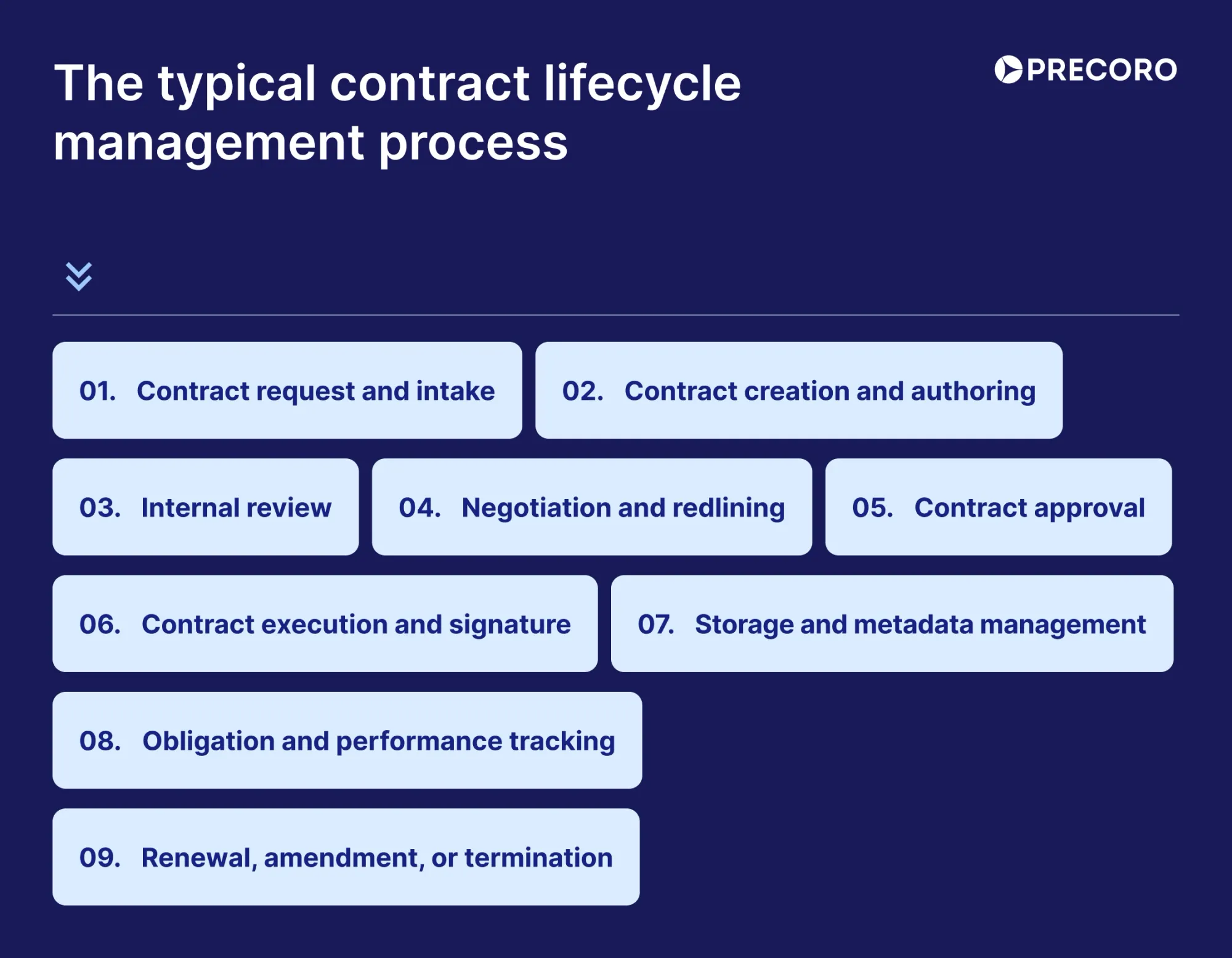
The contract lifecycle management process covers every stage a contract goes through — from the initial request and drafting to approval, execution, and ongoing management. While specific workflows vary between organizations, most contracts follow these key stages:
Contract request and intake: The process begins when a business team identifies the need for a contract. A structured intake process collects essential details, such as contract type, business requirements, involved stakeholders, and deadlines, helping teams route requests correctly from the start.
Contract creation and authoring: Teams draft the agreement using approved templates, standard clauses, and predefined guidelines. CLM systems help reduce manual work by providing access to existing contract language and ensuring consistency across agreements.
Internal review: Before sending a contract to external parties, relevant teams review the agreement to ensure it meets business, legal, financial, security, and compliance requirements.
Negotiation and redlining: Internal and external stakeholders review contract terms, suggest changes, and negotiate revisions. Version control and collaboration tools help teams track edits and avoid confusion between different contract versions.
Contract approval: Once negotiations are complete, the contract moves through the required approval workflow. Automated routing ensures that the right stakeholders review and approve the agreement based on predefined rules.
Contract execution: After final approval, all parties sign the agreement. E-signature integrations help speed up execution by reducing manual signing processes and providing a clear record of completion.
Storage and tagging: The signed contract is stored in a centralized repository with relevant metadata, such as contract type, supplier, owner, effective date, and renewal date. This makes agreements easier to find and manage.
Obligation and performance tracking: Organizations monitor key commitments, deadlines, milestones, and compliance requirements throughout the contract term. Automated reminders help prevent missed obligations and renewal dates.
Renewal, amendment, or close-out: At the end of the contract lifecycle, teams decide whether to renew, modify, or terminate the agreement. A structured close-out process ensures that contract records remain accurate and complete.
Designing a faster contract process: Process and people
Technology alone doesn't fix a slow contract process. Most delays come from issues such as unclear ownership, missing templates, and approval chains.
How can intake and routing be streamlined?
Organizations can streamline contract intake and routing by replacing manual requests with standardized digital intake forms and automated workflows.
A structured intake process ensures that every contract request captures essential information. After a request is submitted, workflow automation routes it to the appropriate teams based on predefined rules.
Centralized tracking also provides visibility into each request's status. This allows teams to identify pending approvals and prioritize urgent contracts. Standardizing intake and automating routing allows organizations to accelerate contract processing, improve collaboration, reduce administrative effort, and create a more efficient and transparent contract lifecycle.
How do templates and playbooks streamline drafting?
Pre-approved contract templates and negotiation playbooks let business teams originate standard agreements without waiting for legal for every clause. Playbooks define acceptable fallback positions for common negotiation points in advance. This allows contract authoring and redlining to move faster without escalating every minor term to outside counsel.
How can roles and RACI clarity reduce handoff delays?
A RACI (Responsible, Accountable, Consulted, Informed) matrix helps organizations define ownership at each stage of the contract process. It clarifies who is responsible for completing a task, who makes final decisions, who provides expertise or feedback, and who needs to stay updated.
Without clear role assignments, contracts often get delayed during handoffs. The problem is usually not a lack of effort, but uncertainty about ownership. For example, after a vendor contract is drafted, the procurement team may assume legal is responsible for the next review, while legal may be waiting for procurement to confirm business requirements. As a result, the contract sits idle even though both teams are involved.
A RACI matrix prevents these bottlenecks by assigning clear roles for each step. For example:
- Contract drafting: The legal team may be responsible for drafting the agreement, while the business owner is accountable for ensuring the contract meets the business’s needs.
- Security review: The IT or security team may be responsible for evaluating security requirements, while the procurement team remains accountable for moving the contract forward.
- Final approval: A department leader may be responsible for approving the agreement, while legal, finance, and compliance teams provide input prior to the decision.
How can organizations streamline approval without increasing legal risk?
Organizations can speed up contract approvals by setting different approval rules based on a contract's value and risk. Low-value, low-risk contracts can move through the process automatically, while high-value or high-risk agreements are reviewed by legal or other specialists. This approach speeds up routine contracts without reducing oversight for agreements that require closer review.
When every contract, regardless of size, goes through the same full legal review, two bad things happen at once: routine agreements get delayed, and reviewers rush through a mostly low-stakes stack, giving genuinely risky contracts less depth than they deserve.
How do change management and training support faster adoption?
A well-designed contract lifecycle process can fail if employees continue relying on emails, spreadsheets, and manual workarounds. Change management helps teams understand why the new process is being introduced, how it improves their daily work, and what actions they need to take to adopt it successfully.
Adoption challenges are rarely caused by the technology itself. They usually happen when employees are unsure about new responsibilities, don’t understand the benefits of the new process, or lack the training needed to use new workflows effectively.
Effective contract management change initiatives typically include:
- Clear communication: Explain why the process is changing, what problems it solves, and how it affects different teams.
- Role-based training: Provide training tailored to each user group, such as requesters, legal reviewers, procurement teams, and approvers.
- Process documentation: Create clear guidelines, templates, and resources so employees know how to handle common contract scenarios.
- Feedback and continuous improvement: Collect user feedback after rollout and adjust workflows to address adoption barriers.
By combining process improvements with proper training and ongoing support, organizations can reduce resistance, increase user adoption, and ensure the contract lifecycle process delivers long-term value.
Building a smarter contract process with CLM software
After the contract process is clearly defined, CLM software helps organizations handle a larger number of contracts. It replaces manual tasks and email-based communication with a single system that keeps contract information in one place.
What CLM system capabilities matter most for speed and intelligence?
A CLM system should do more than store contracts. It should help teams manage the entire process by automating routing, supporting e-signatures, organizing documents, and tracking important obligations.
When evaluating CLM solutions, organizations should also look for capabilities such as AI-assisted clause review, automated renewal reminders, and reporting tools that help identify bottlenecks before they impact business timelines.
Keep in mind that your goal isn't just to digitize contracts: it's to give every stakeholder real-time visibility into where a contract stands in the process.
How can AI and NLP improve contract language review?
NLP (natural language processing) tools make contract reviews faster by comparing agreements against approved language and identifying changes. They can also find important details, such as renewal dates and liability limits, and alert reviewers to unusual terms.
AI-assisted review tools aren’t meant to replace legal judgment. Their purpose is to help teams review routine contract language faster and identify areas that need closer attention. This gives legal teams more time to focus on negotiation and complex terms.
How does AI-powered contract discovery help manage legacy contracts?
AI-powered discovery tools can scan and extract key terms from that legacy backlog, turning an unmanageable archive into a searchable database without months of manual data entry.
A process that only manages new contracts will miss important information stored in older agreements. Contract discovery tools help organizations bring those legacy contracts into the system much faster.
What integrations are essential?
A contract management system delivers the most value when it connects with the other systems your business already uses. When CLM is integrated with other business tools, contract details can be shared automatically rather than copied between systems. This helps minimize duplicate data entry and keep records consistent. Without these connections, employees often spend time updating the same information in multiple places.
For example, a pricing change may need to be entered into the ERP (enterprise resource planning) after it's approved in the contract, or renewal dates may have to be checked manually during budget planning. While these tasks may seem minor, they add up over time, increasing administrative work and creating more opportunities for errors. If you are leading an organization and plan to reduce manual effort and keep information accurate, integrating contract management with core business systems can significantly help and save you time.
How do templates and clause libraries enable consistency?
A centralized clause library ensures every contract originating from a given contract template uses pre-approved, legally vetted language by default. This consistency reduces negotiation cycles because counterparties see standard terms up front, and it reduces risk because nobody is drafting language from scratch under deadline pressure.
There's also a compounding benefit: consistency makes every future negotiation with a repeat counterparty faster, because both sides already know which terms are truly fixed.
What should you consider when evaluating vendors and deployment models?
When you evaluate a CLM solution, it’s recommended to weigh implementation timeline, integration depth with existing procurement and finance systems, and how well the vendor supports your actual contract volume.
A contract management solution built for enterprise legal teams may be significantly more than a mid-market procurement team needs. On the other hand, a lightweight e-signature tool may lack the obligation tracking that heavier volumes require.
Which CLM capabilities continue delivering value as organizations scale?
What matters most changes as volume grows. A hundred contracts and two thousand contracts aren’t the same problem. A system that actually scales should get easier to manage as it grows, not harder. If it's the opposite, that's not scalability. It's the same inefficiency on a larger scale.
If you want to check which CLM capabilities can deliver value as organizations scale, you can experiment with a useful test. Ask what happens to the experience at ten times the current volume. A system built primarily around individual-contract workflows can start to feel unwieldy at scale. However, a system built with scale in mind keeps individual contracts easy to manage while becoming progressively more valuable as a source of aggregate insight.
How does the contract lifecycle process improve compliance and reduce risk?
A contract doesn’t stop being important after it is signed. Organizations still need to track obligations, renewal dates, approval requirements, and changes throughout the agreement period. Without a clear process, important deadlines can be missed, contract terms may be overlooked, and teams may struggle to demonstrate compliance when questions arise.
A contract lifecycle management (CLM) system helps create better visibility into these responsibilities. By storing contracts in a single central location, teams can quickly find key information, such as key obligations, expiration dates, and approval records. Automated reminders and tracking tools also help prevent missed renewals or overlooked commitments.
How can CLM enforce legal and regulatory requirements?
Built-in approval gates ensure that contracts meeting certain risk thresholds cannot bypass legal review. According to Thomson Reuters, this kind of structured governance is one of the core reasons legal and compliance teams push for formal CLM adoption in the first place.
A legal review policy that depends on memory alone isn’t a reliable policy. It only actually works when it's baked into the workflow itself, so when deadlines get tight, and everyone's cutting corners, automated routing and approval rules are still quietly making sure the high-risk contracts get the review they need, whether anyone remembers to ask for it or not.
What controls should exist for approval, redlines, and exceptions?
If someone's granting an exception to standard terms, it needs to come from the actual owner and be in writing. This is because an informal conversation doesn't hold up when a dispute surfaces two years later, and nobody can say for certain who approved what. Keep the full redline history for the same reason.
How can audit trails and versioning support compliance reviews?
A complete audit trail turns a compliance review from a scramble into a formality. Versioning prevents the common failure mode in which teams can't determine which draft is the executed, binding version of a contract. The value of an audit trail is almost entirely invisible until it's needed. Regulatory reviews often depend on an organization's ability to quickly demonstrate how a decision was made. A clear audit trail makes that process straightforward.
What role do contract data, metadata, and classification play in governance?
Without classification, a repository of ten thousand contracts is no more useful than a filing cabinet. In the opposite scenario, legal and finance can instantly pull every contract expiring next quarter or every agreement above a certain risk threshold. Classification also enables forward-looking questions, such as flagging every international contract that lacks a standard data-protection clause, rather than reacting only after an incident forces a manual review.
How do you manage contract risk and supplier due diligence?
Contract risk is not limited to the obligations written in the agreement. Organizations also need to consider factors such as a supplier’s financial health, regulatory compliance, and overall reliability. Connecting supplier due diligence and risk assessments to contract records enables teams to access relevant risk information when reviewing renewals or making decisions about ongoing relationships. This helps prevent situations where potential issues are discovered only after they have already affected the business.
This connection is often owned by two separate teams with no systematic link between contract terms and counterparty risk.
How do you measure and improve the contract lifecycle management process for the best contract outcome?
It’s hard to improve a process by measuring it. Defining the right metrics turns contract management from a reactive function into one that continuously gets faster and lower-risk.
Which KPIs measure speed, quality, and compliance?
Tracking a few key metrics helps organizations understand whether their contract management process is working effectively. Focus on areas that reveal bottlenecks and opportunities for improvement, such as:
- Contract cycle time: How long it takes to move a contract from request to signature.
- Approval bottlenecks: Which stages or stakeholders cause delays in the review and approval process?
- Template adoption: How often teams use approved standard templates instead of creating contracts from scratch.
Do signed agreements require frequent amendments?
The number of contract amendments can reveal whether the contract creation and review process is working effectively. While some amendments are expected as business needs change, a consistently high amendment rate may indicate that important details are being missed during the initial drafting and approval stages.
For example, frequent amendments may point to issues such as unclear contract requirements, insufficient stakeholder involvement, outdated templates, or rushed reviews. A contract that moves quickly through approval but requires multiple corrections later may create more work and delays over time.
Organizations should track amendment trends by looking at:
- Amendment frequency: How often signed contracts require changes after execution.
- Common amendment reasons: Whether changes are caused by pricing updates, missing clauses, scope changes, or approval gaps.
- Teams or contract types with higher amendment rates: Which processes may need additional guidance or review steps?
The goal isn’t to prevent all amendments, but to ensure contracts are accurate, complete, and aligned with business requirements before they are signed.
What dashboards and reports inform executives and legal teams?
Executives don't want to dig through individual contracts. They want the portfolio view: total spend under management, what's up for renewal soon, and where the risk is concentrated by category.
Legal and procurement need the opposite. They want to know which contracts are actually stuck right now, who they're stuck with, and how long they've been sitting there. Both views should come from the same dataset, because no one should be reconciling two separate "truths" about the same contract.
How should feedback loops and post-mortems drive iterative improvements?
After a contract cycle stalls or a renewal is missed, a short post-mortem should feed directly back into playbook updates or routing rules. Treating every bottleneck as a one-off incident, rather than a pattern to fix, is how the same delays keep recurring year after year. Small recurring delays are as important as failures, since customers may identify those as recurring patterns.
How can organizations modernize the process with Precoro?
Most procurement teams don't need a standalone, enterprise-grade CLM platform. They need contract visibility built into the same system they already use to manage purchasing and spending.
Precoro's Contract Agent brings contract management directly into the procurement workflow, as part of the Supplier Management Crew. It automatically captures contract terms, pinpoints missing data and potential risks, allows users to compare terms across supplier agreements, and reminds procurement teams when contracts are about to expire.

Why reevaluate your contract lifecycle management process now for a more effective contract strategy?
The way organizations manage contracts must evolve as businesses grow. A process that works for a small company may become inefficient as contract volumes increase, regulatory requirements become more complex, and supplier networks expand. Without the right processes in place, organizations may experience more delays, errors, and compliance risks.
What business pressures are forcing transformation?
Various business pressures are driving transformation, pushing many organizations to formalize processes that were once informal and relationship-driven.
A process that depended on one person's institutional knowledge doesn't hold up once that person changes roles. In many smaller organizations, one procurement lead simply knows, from memory, which contracts are coming up for renewal, and that knowledge works fine right up until that person takes another job.
How do regulatory changes and audit expectations affect CLM?
Regulatory requirements and audit expectations make contract visibility increasingly important. A contract management process must help organizations quickly answer basic questions:
- Which agreements are active?
- Who approved them?
- What obligations were accepted?
- Has anything changed since the contract was signed?
A well-managed CLM process creates a reliable record of contract activity. This allows them to identify obligations, track changes, and provide evidence when auditors or internal teams need it. The goal is not simply to store contracts, but to maintain sufficient context around each agreement to support ongoing compliance and informed decision-making.
Why is time-to-signature a strategic KPI?
Every day a contract sits unsigned is a day of delayed revenue, delayed cost savings, or delayed project starts. The Gartner Magic Quadrant for Contract Life Cycle Management shows a wide gap between organizations with a defined contract lifecycle process and those without. A faster process wins deals against equally capable but slower competitors and captures cost savings sooner on the procurement side.
How does poor CLM impact revenue, risk, and reputation?
Contracts don't just cost you money when they're mismanaged: they cost you trust. A supplier who waits three months for a signature starts wondering what else is slow on your end. When a customer asks about their agreement, they expect a reply. If they do not get one, they may think the company is unreliable, and that can make the next negotiation more difficult.
Manual contract management vs. contract lifecycle management software
| Stage | Manual contract management | Contract lifecycle management |
|---|---|---|
| Requests | Requests arrive through emails or verbal communication without a standardized format | Requests are submitted through a centralized intake form and automatically routed to the right teams |
| Creation | Contracts are drafted from scratch or copied from previous documents | Teams use pre-approved templates and clause libraries to create consistent agreements |
| Negotiation | Redlines are exchanged through email as separate files, making version tracking difficult | Stakeholders collaborate through centralized redlining with complete version history |
| Approval | Teams rely on manual follow-ups to collect reviews and approvals | Contracts are automatically routed based on value, risk level, and approval rules |
| Storage | Contracts are stored across shared drives, inboxes, and physical filing systems | Contracts are stored in a searchable central repository with metadata |
| Obligation tracking | Teams manually monitor deadlines using calendars or spreadsheets | Automated alerts help track key obligations, milestones, and renewal dates |
| Reporting | Reports are manually compiled and often become outdated quickly | Real-time dashboards provide visibility into cycle times, risks, and contract performance |
Implementation roadmap: Choosing a management solution and scaling up
Implementing a CLM solution requires more than selecting new software. Organizations need a structured approach to identify the right use cases, involve the right stakeholders, and gradually scale adoption across teams.
A phased implementation helps reduce disruption, address process gaps early, and ensure that the new contract management approach delivers measurable value.
How do you scope a pilot and choose initial use cases?
Start with one contract type that's high in volume but relatively low in complexity. High volume means the pilot generates enough real usage data quickly to reveal problems with the workflow. Low complexity means that if something goes wrong, the consequences are contained.
What stakeholders must be engaged for a successful rollout?
A successful CLM rollout requires involvement from the teams that create, review, approve, and manage contracts throughout their lifecycle.
Legal teams are typically central to defining contract standards and approval requirements, but they cannot drive adoption alone.
Sales teams need a process that supports faster deal execution, procurement teams need visibility into supplier agreements, and finance teams need accurate contract data for forecasting and reporting.
IT and security teams also play an important role in system integration, access controls, and data management.
Which implementation decisions have the greatest long-term impact?
Choosing a data structure is an important decision with long-term consequences. When there are well-defined rules for contract categories, ownership, and reporting requirements, searching for agreements and generating insights becomes so much easier.
The particular integrations you choose also matter. Companies should prioritize connecting CLM with CRM (customer relationship management), ERP, and e-signature platforms. This will ensure there are fewer manual updates and that the information stays consistent.
What governance and change-management practices ease scaling?
There are various practices that you can implement to ease scaling.
- Give the new process an owner: someone accountable when it breaks, not just when it launches.
- Build in a real escalation path for exceptions too, because edge cases are guaranteed, and nobody wants to invent the fix-it process in the middle of an actual problem.
- Check-ins in the first few months matter more than people expect.
A pilot's real value isn't the successful runs. It's the mess it surfaces. That mess only becomes an improvement if someone's actually reviewing it on a schedule, not hoping it gets noticed on its own.
How do you measure success and decide when to expand functionality?
Measuring CLM success requires looking beyond whether the system has been implemented. Organizations should evaluate whether it improves the speed, accuracy, and visibility of contract processes across the business.
Key metrics to track include:
- Contract cycle time: How long it takes to move contracts from request to signature.
- Approval turnaround time: How quickly contracts move through review and approval stages.
- User adoption: Whether teams are consistently using the CLM system instead of relying on email, spreadsheets, or manual processes.
- Template and workflow usage: Whether approved templates and standardized processes reduce unnecessary variation.
- Contract visibility: Whether stakeholders can quickly find agreements, track obligations, and access accurate contract data.
Once the initial implementation delivers consistent results, organizations can expand CLM functionality based on business needs. For example, teams may add automated renewal tracking, advanced reporting, AI-assisted contract review, or integrations with CRM and ERP systems when they identify clear opportunities to reduce manual work or improve decision-making.
FAQ
Not every contract needs a lawyer. Business users can handle the routine stuff on their own, as long as everyone knows exactly what they're allowed to change. However, consulting a lawyer is always recommended if anything is unclear to either side.
CLM value isn't measured by the software alone. The return comes from faster reviews, fewer missed obligations, better contract data, and less time spent on administrative tasks.
Small teams should fix the problem that's actually hurting them, not copy an enterprise setup that was built for a company ten times their size. Most of the time, that means starting simple: one place to find contracts, a basic approval workflow, a reminder before renewals sneak up.
Contracts often contain sensitive commercial terms, personal data, and regulated information. Before you choose a contract management software provider, confirm where contract data is stored, how it's encrypted, and whether the platform can meet the specific data residency requirements your industry or region imposes.
Timelines vary depending on various factors. Usually, CLM implementations take several months.
Existing agreements typically need to be migrated into the new system through a discovery and data-extraction process. When you set up a new CLM system, it's essential to consider the existing contracts, since most active contracts are old.
Ready to bring order to your contract management process? See how Precoro can help.