Purchase Order vs. Invoice: Do You Need Both?
Get to understand the key differences between purchase orders and invoices, how they work together, when each is used, common purchase order types, and best practices.

According to research by Ardent Partners in 2023, over two-thirds of invoices are linked to a purchase order, indicating that about one-third of invoices are not. While it may be tempting to assume that skipping purchase order creation speeds up the procurement process, the study highlights the drawbacks of this approach.
Invoices without purchase orders take longer to process, have more exceptions, and incur higher costs than invoices with the related POs.
Let’s examine the key differences between these documents and further explore why it’s better to use both the purchase order and the invoice for effective procurement processes.
Read more about:
What is a purchase order?
What is an invoice for goods or services?
Purchase order vs. invoice: key differences
Invoices without POs: what happens
Why use both purchase orders and invoices together?
How to implement a purchase order process step by step
How to streamline purchase orders and invoices
Frequently asked questions
How Precoro simplifies purchase order and invoice management
What is a purchase order?
A purchase order (PO) is a document issued by a buyer to a supplier or vendor to place an official request for goods or services.
Purchase orders are usually issued by department or project managers, finance or accounting department members, or operations officers. It’s also common for a large company to have a separate procurement or purchasing department that specializes in managing all procurement activities, including PO creation.
The typical procurement process looks something like this: a person within a company needs a particular item. For instance, this might be a new computer or an office chair. The individual contacts their department head and/or the designated person responsible for making orders. In small companies, this is sometimes done with an informal verbal request, while others use formal internal documents called purchase requisitions to track and approve employee requests. After the request is approved, it can be converted into a purchase order.
Once the seller accepts the purchase order, it becomes a legally binding contract. Thus, the terms and conditions listed in the purchase order must be adhered to by both parties.
POs usually include the following details:
- PO number
- Creation date
- Expected delivery date
- Buyer’s contact information
- Vendor’s contact information
- Shipping address
- Item type
- Product number, model number, or SKU (Stock Keeping Unit)
- Order quantities
- Price of products or services
- Total amount due
- Payment terms
- Buyer’s signature
How does a purchase order fit into the procurement workflow?
A purchase order in the procurement workflow serves as the bridge between an approved purchasing decision and the actual procurement of goods or services. It helps to formalize what a business intends to buy, providing both the buyer and supplier with a shared point of reference before any products are delivered or services are performed.
Usually, once a purchase request has been approved internally, the buyer issues a purchase order to the selected supplier. After the supplier accepts the PO, they proceed with delivering the order according to the agreed terms. The purchase order then serves as the reference document for the rest of the procurement process, helping teams verify deliveries, compare invoices, and maintain accurate purchasing records.
The inclusion of purchase orders in standardized procurement workflows helps create consistency across departments and reduces the risk of miscommunication. It allows procurement teams to know what has been approved and provides finance teams with a documented record to validate future invoices.
Purchase orders also give suppliers clear instructions on what they are to deliver. Overall, a purchase order helps businesses to maintain better control over their purchasing activities while making the entire purchasing and payment process more efficient.
What types of purchase orders exist? (Standard, blanket, standing, planned)
The main types of purchase orders used by businesses are standard, blanket, standing, and planned. While these purchase orders help to serve the same purpose of authorizing purchases, each of them is designed to help support different purchasing needs depending on factors such as purchasing frequency, order certainty, and long-term supplier relationships.
Standard purchase order: Standard purchase orders are used for one-time purchases where all transaction details, including the items, quantities, prices, delivery dates, and payment terms, are known before the order is placed. It is the most commonly used PO for day-to-day business procurement.
Blanket purchase order: A blanket PO is used when a business expects to make multiple purchases from the same supplier over a set period, but the exact items, quantities, or timing may vary. Instead of creating a new PO for each order, the buyer and supplier agree on general terms, pricing, and spending limits upfront, allowing purchases to be made as needed throughout the agreement.
Standing purchase order: A standing PO is used for predictable, recurring purchases of the same goods or services under fixed terms. It’s commonly used for routine expenses such as office supplies, cleaning services, or facility maintenance, where the business knows what it needs, how often it will be purchased, and the agreed pricing over a specific period.
Planned purchase order: A planned purchase order is used when a business intends to purchase goods or services but has not yet determined the exact delivery dates or quantities. It establishes the anticipated purchase details in advance, while separate release orders authorize deliveries as business requirements become more defined.
Why do businesses issue purchase orders before receiving invoices?
Businesses issue purchase orders before receiving invoices to formally authorize purchases and communicate exactly what is being ordered before a supplier delivers the requested items. This ensures that both the buyer and supplier agree on what is being purchased, how much it costs, when it will be delivered, and the terms of the transaction before any payment obligation arises.
A purchase order also guides suppliers on how to deliver the order and provides buyers with a documented record of what was authorized. Once the order has been delivered, the supplier issues an invoice based on the agreed purchase order, making it easier for the buyer to verify the transaction before processing payment.
What is an invoice for goods or services?
An invoice (also called a sales invoice) is an official payment request issued by a supplier or vendor to a buyer. Invoices are usually created by finance or accounting team members, billing coordinators, or accounts receivable specialists. In small businesses, sales or service representatives or even business owners can be responsible for issuing invoices.
Typically, after a vendor approves a purchase order, they proceed with delivering the order by picking, packing, and shipping the items to the customer's specified location. After delivery (and sometimes before), the company generates an invoice reflecting the details of the delivered order and sends it to the buyer via email, mail, or electronic invoicing. The buyer reviews the invoice, cross-references it with the corresponding purchase order, processes it for payment, and remits the payment to the vendor according to the agreed-upon terms.
It’s worth noting that, unlike a purchase order, an invoice can’t serve as a contract between two parties. Instead, it’s a one-sided business document that communicates the vendor's expectation that the buyer will pay for the goods or services provided.
A typical invoice contains the following details:
- Invoice number
- PO number
- Creation date
- Payment due date
- Buyer’s contact information
- Vendor’s contact information
- Item type
- Product number, model number, or SKU
- Quantity of goods or services
- Price of products or services
- Total amount due
- Payment terms
- Taxes (if there are any)
- Discounts (if there are any)
How does an invoice trigger payment for goods or services?
An invoice triggers payment by formally notifying the buyer that payment is due for the goods delivered or services rendered. It serves as the supplier’s official request for payment, outlining the amount owed, the payment due date, and the agreed payment terms.
Prior to the payment being approved, the buyer usually reviews the invoice to ensure it reflects the agreed purchase details and that the goods or services have been received as expected. Once the invoice has been verified, it is forwarded for approval and processed according to the organization’s accounts payable procedures.
Purchase order vs. invoice: What is the difference?
Purchase orders and invoices are similar in how they help companies manage purchasing processes and convey crucial information about vendors, buyers, and ordered items. However, a purchase order compared with an invoice has even more differences:
Purchase order vs. invoice: Purpose
The difference between a purchase order and an invoice in terms of purpose is that companies issue POs to request certain goods or services. Additionally, it serves as a contract between the buyer and the vendor, specifying the terms of the transaction. On the other hand, firms issue invoices to solicit payments for their goods and services.
Purchase order vs. invoice: Who creates and receives each document?
A buyer sends a purchase order to a supplier or a vendor. Then, the vendor or supplier sends an invoice to the buyer.
Purchase order vs. invoice: When is each document issued?
A purchase order is typically issued before the goods or services are delivered or rendered. An invoice, however, is usually generated after the delivery of goods or the completion of services, as a request for payment from the buyer under the agreed-upon terms.
Purchase order vs. invoice: Invoice number, purchase order number, and other key information
There is unique information specific to each document:
- Purchase order — shipping details and delivery date.
- Invoice — invoice number (invoices also include PO numbers, while purchase orders don’t contain invoice numbers), due date, credits or discounts, and applicable taxes added.
Purchase order vs. invoice: Legal status and business value
The legal status and business value of purchase orders and invoices differ based on the role that each document plays in the procurement process. A purchase order becomes a legally binding document once a vendor signs or acknowledges it, so both the buyer and the vendor are obliged to uphold its terms.
An invoice, on the other hand, is a document that communicates a payment request but cannot be used as a contract on its own. However, the legal enforceability of an invoice may depend on local laws and the specific terms and conditions outlined in the related agreements. Generally, invoices can be used as evidence in financial or legal disputes.
Purchase order vs. invoice: Which document creates financial risk?
Neither a purchase order nor an invoice is more financially risky than the other. The level of risk each document poses depends on how they are used throughout the procurement process and whether the appropriate controls are in place.
A purchase order can become financially risky when it contains inaccurate information, exceeds approved budgets, or commits a business to purchases that are no longer needed. An invoice, on the other hand, can become financially risky when it is approved or paid without adequate verification, increasing the possibility of overpayments, duplicate payments, pricing discrepancies, or payments for unauthorized purchases.
| Comparison | Purchase order (PO) | Invoice |
|---|---|---|
| Purpose | Used by the buyer to formally authorize and place an order for goods or services | Used by the supplier to request payment for goods delivered or services rendered |
| Created by | Buyer | Supplier or vendor |
| Sent to | Supplier or vendor | Buyer |
| Issued when | Before goods are delivered or services are performed | After goods are delivered or services are performed (or as agreed in the contract) |
| Key information | PO number, buyer and supplier details, items or services, quantities, agreed prices, delivery details, payment terms, and purchasing conditions | Invoice number, PO number (where applicable), buyer and supplier details, delivered items or services, amount due, payment due date, taxes, discounts, and payment terms |
| Legal status | Can become legally binding once accepted by the supplier, depending on the agreed terms and applicable laws | Primarily serves as a payment request and financial record. Its legal significance depends on the governing agreement and applicable laws |
| Financial risk | Commitment risk if purchases are inaccurate, exceed budgets, or become unnecessary after the PO is accepted | Payment risk if invoices are approved without proper verification, leading to overpayments, duplicate payments, pricing discrepancies, or payments for unauthorized purchases |
Purchase order, receipt, and invoice workflow from request to payment
While the purchase order, receipt, and invoice each serve a distinct purpose in the procurement process, they collectively work together to move a purchase from the initial request to the final payment. This workflow helps ensure that purchases are properly authorized, goods and services are received as expected, and payments are made only after the transaction has been reviewed.
The process usually starts with an approved purchase request, after which the buyer issues a purchase order to the supplier. After accepting the PO, the supplier delivers the requested goods or completes the agreed services. The buyer then inspects and confirms that the delivery matches the order before the supplier sends the invoice to the buyer for payment. Finally, the buyer verifies the invoice against the relevant purchasing records, resolves any discrepancies if necessary, approves the invoice, and processes payment according to the agreed terms.
| Document type | Created by | Purpose | Issued when | Sent to | Creates a financial commitment? |
|---|---|---|---|---|---|
| Purchase Request (PR) | Employee or requesting department | Request internal approval to purchase goods or services | Before any purchasing decision is approved | Internal approver or procurement team | No |
| Purchase Order (PO) | Buyer or procurement team | Formally authorizes the purchase and communicates the order to the supplier | After the purchase request is approved, but before goods or services are delivered | Supplier or vendor | Yes, once the PO is accepted by the supplier (subject to the agreed terms and applicable laws) |
| Goods Receipt (GRN) / Receiving Report | Buyer or receiving department | Confirms that the ordered goods or services have been received in the expected quantity and condition | After delivery and before invoice approval | Internal procurement or finance records | No |
| Invoice | Supplier or vendor | Requests payment for delivered goods or completed services | After goods or services have been delivered (or as agreed in the contract) | Buyer | No. It is primarily a payment request and financial record, although it may carry legal significance depending on the governing agreement and applicable laws |
What happens if you use invoices without purchase orders?
Some companies choose to skip purchase order creation to save time or simplify their purchasing process, especially when dealing with regular, low-value, or tail purchases.
However, relying solely on invoices in the purchasing process can lead to several drawbacks:
Lack of purchasing control
PO invoice processing provides a structured framework for specifying and approving purchases, ensuring that the right items are requested at the agreed-upon terms. Without this initial control, there is a higher risk of errors, inconsistencies, and misunderstandings in the purchasing process. This can result in payment delays, strained relationships with vendors, and potential legal issues.
Limited visibility into business spending
POs provide a clear record of purchases, which helps track and manage inventory levels and budgeting. The absence of purchase orders makes it challenging to have a comprehensive overview of completed and upcoming orders, leading to difficulties in effectively monitoring and controlling cash flow.
Higher invoice processing costs and slower approvals
Invoices without POs often require additional time and effort for processing and increase administrative burden, as a buyer has to determine whether the price, quantities, and the goods or services themselves correspond to what was initially requested. In addition, the absence of predefined terms and specifications can lead to more manual intervention, back-and-forth communication, and comparisons to ensure accuracy in the payment process.
Increased risk of fraud and unauthorized purchases
POs serve as a control mechanism to prevent unauthorized or fraudulent purchases. Without them, there is a higher chance of getting charged for unapproved orders or issuing payments for duplicate or even fraudulent invoices. All because there’s no prior official document containing key information such as delivery terms, prices, and quantities of ordered items to refer back to.
More complicated vendor invoicing and payment processes
The absence of a purchase order makes it difficult for the supplier to validate the agreed-upon terms, quantities, and prices. As a result, the invoicing process becomes more complex, necessitating additional communication and clarification between the supplier and the buyer.
When can you skip a purchase order?
Businesses can skip a purchase order when the cost, complexity, or nature of a purchase does not justify creating one. This is especially common with low-value purchases, emergency purchases, utility payments, one-time expenses, or recurring goods and services that are already covered by an existing contract, subscription, or long-term supplier agreement.
Some organizations also waive the purchase order requirement for categories such as travel expenses, employee reimbursements, or petty cash purchases, where alternative approval and documentation processes already exist. However, it is important that these exceptions are clearly defined in the company’s procurement policy and supported by sufficient documentation to help maintain accountability, verify invoices, and ensure compliance with internal financial controls.

Why use both purchase orders and invoices together?
Purchase orders and invoices serve different purposes, but they work best when used together. A PO defines what a company intends to buy, under what terms, and with whose approval, while an invoice confirms what the supplier is charging after the purchase. Connecting these two documents creates a more controlled procurement process, giving businesses better visibility into spending, reducing errors, and ensuring payments match approved purchases.
Better cost control and budget management
Companies effectively prevent duplicate orders and unnecessary subscriptions by creating and approving POs. They achieve this by identifying and consolidating requests for similar purchases across departments or from the same supplier, streamlining the procurement process, or even enabling volume discounts. In addition, when an invoice is received, it can be cross-checked against the corresponding purchase order to ensure that it is not a duplicate. This helps avoid unauthorized payments and ensures accurate financial management.
Complete audit trail for every purchase order and invoice
A purchase order can help you track the status of the order, from the time it is placed until it is delivered, by referencing the purchase order number. Thus, the requester and approvers from the buyer’s company can stay in the loop about their purchases.
Greater confidence in agreed pricing and terms
Purchase orders provide stability and help avoid cost overruns. They serve as proof of the agreed-upon pricing, protecting the buyer’s accounts payable in case the supplier changes the prices later. Additionally, a purchase order acts as a legally binding document between the buyer and the seller, ensuring both parties are clear on transaction terms and are obliged to adhere to them.
Improved inventory visibility and procurement accuracy
POs assist in effective inventory management by providing a clear overview of the purchases, so companies can effectively determine when they made certain orders and when they should replenish stock. As a result, purchase order management brings about reordering, prevents overstocking, and ensures timely delivery. POs also minimize losses and maintain efficient business operations by preventing duplicate orders.
Do purchase orders create more administrative work?
Those considering adding PO creation to their purchasing activities might be wondering: Isn't double the paperwork double the work? Indeed, if paperwork and processes are all done manually, any increase in tasks – whether from a more thorough workflow or due to a scaling company – can significantly add to employee workload. Regardless of how your procurement process is set up, it’s a great idea to implement an automated solution, which can address the following challenges:
- Lots of documents to manage: Growing companies face the increasing volume of paperwork, which leads to a high risk of document misplacement or loss, time-consuming retrieval and reconstruction of records, and delays or errors in both payments and reporting
- Hard to check who ordered what: When a new invoice comes in, designated people have to go through various POs trying to find the one with the corresponding PO number, or, if there’s no central storage of all purchase orders, have to go around the office trying to find the person who ordered the item(s).
- Difficulty identifying discrepancies: Team members must manually check each invoice and compare it to a related PO. When the workload is high, some discrepancies may go unnoticed, leading to payment errors and further disputes.
- Time-consuming approvals: In a manual approval process, a requester must approach each approver to have the document checked and signed. This approach can lead to delays and bottlenecks when approvers are on tight schedules, traveling, or working remotely.
How to implement a purchase order process step by step
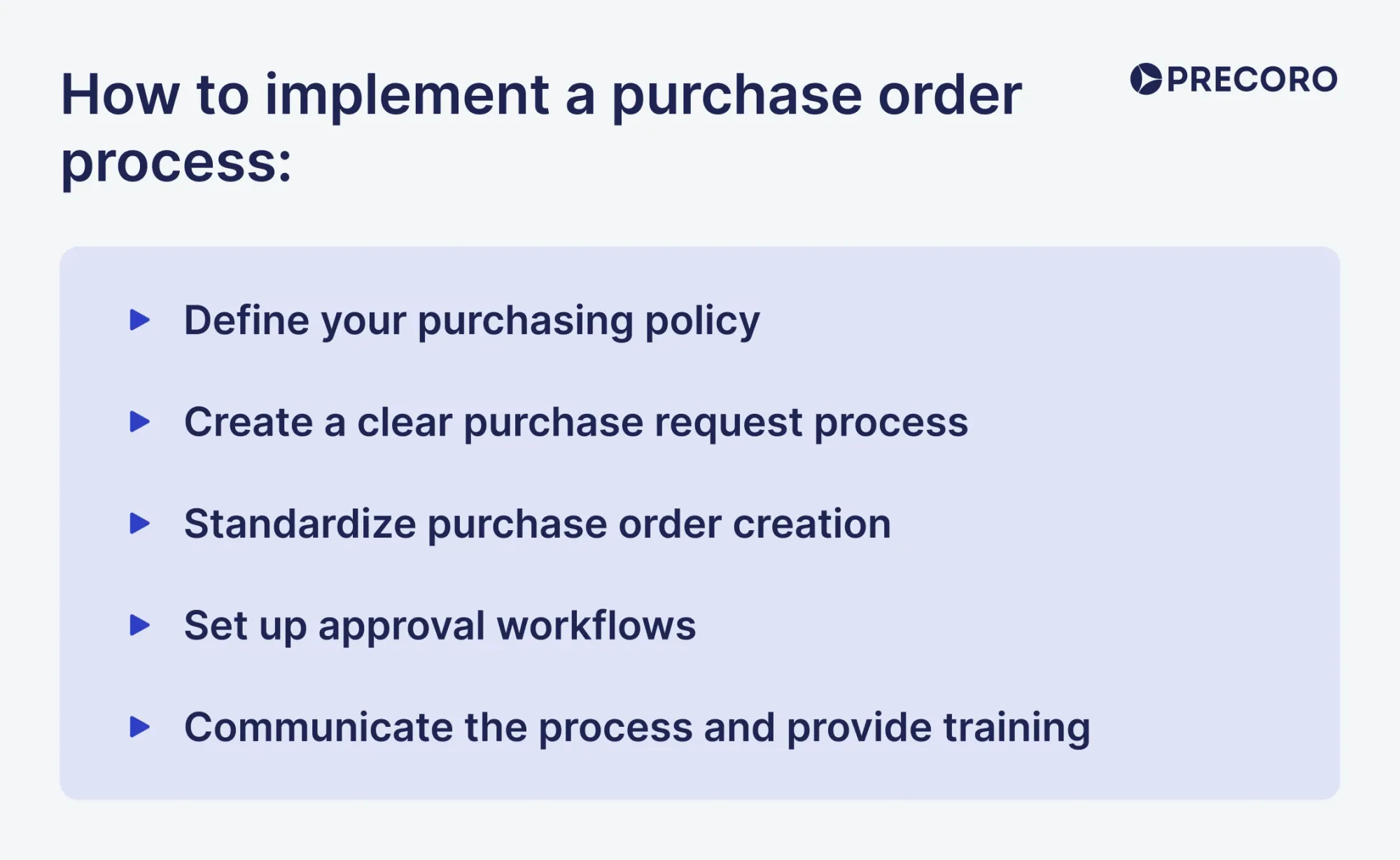
While the exact process may vary between organizations, most businesses follow this workflow when implementing a purchase order:
- Define your purchasing policy: This process involves determining when purchase orders are required, who can create them, approval thresholds, and any exceptions to the process.
- Create a standardized purchase request process: Prompt your employees to submit purchase requests with the necessary business justification before any purchase is made.
- Standardize purchase order creation: Use a consistent purchase order template or procurement software to capture key purchasing information and ensure every PO follows the same format.
- Set up approval workflows: Assign qualified approvers by department, spending limit, or purchasing category to ensure every purchase is properly authorized.
- Communicate the process and provide training: Ensure that your employees understand the purchase order workflow and that suppliers know how your business’s purchase orders should be received and delivered.
How to streamline purchase orders and invoices
The process of streamlining purchase orders and invoices requires adopting procurement software that automates manual tasks, standardizes workflows, and improves visibility throughout the procurement process. As highlighted by Procurement Tactics, there is a growing trend toward implementing technology and digitizing operations.
This data isn’t surprising, considering companies overcome the challenges associated with purchase orders and invoice management by adopting specialized purchasing software. Take Precoro as an example. It’s the agentic procurement and AP centralization platform that provides the following benefits:
Centralized purchase order and invoice repository
Precoro centralizes and helps companies manage all POs, invoices, and associated documents like receipts and contracts. This means information about purchased items, vendor details, issued payments, and purchase approval history can be quickly accessed from any place and at any time, given there’s an internet connection.
Eliminating manual errors in procurement workflows
Precoro saves companies’ time and prevents mistakes by simplifying document creation. Procurement documents are easier to complete with dynamic logic, unlimited custom fields, pre-set budgets, and catalogs that guide users through the process. The system also detects duplicate invoices and allows companies to set budget limits, ensuring purchase orders stay within approved spending thresholds.
AI-powered two-way and three-way matching
Precoro’s Matching Agent within the AP Automation Crew automatically compares procurement documents to identify discrepancies before payments are made. It checks key details such as items, quantities, and prices between purchase orders and invoices — and, when applicable, verifies them against receipts through three-way matching. If the system detects a mismatch, users are immediately notified, helping them resolve issues faster and avoid incorrect payments.
Faster purchase order and invoice approval workflows
Appointed approvers receive notifications in the system and via email when there's a document waiting for them. In addition, the system allows users to quickly filter out the documents so they can easily find pending POs and invoices. Approval workflows for each document are fully customizable and can involve multiple steps. In addition, the system allows users to quickly filter out the documents so they can easily find pending POs and invoices.
Custom reporting for procurement and accounts payable
Precoro’s AI Assistant helps teams quickly analyze procurement and accounts payable data and get actionable insights without manually reviewing reports. Users can ask questions about spending, purchase orders, invoices, budgets, suppliers, and payments to identify trends, spot potential issues, and better understand their procurement performance. By turning complex data into clear answers, the AI Assistant helps businesses make faster, more informed decisions.
FAQ
The buyer creates the purchase order to request goods or services from the vendor or supplier.
The supplier or vendor creates the invoice to request payment from the buyer for goods and services delivered.
A purchase order comes first and is created before the goods or services are provided, while the invoice is usually sent after they have been rendered.
If there are discrepancies between a PO and an invoice, it's common for the buyer's company to contact the supplier to collaboratively find a suitable solution. This may involve adjusting and reissuing the invoice, issuing a credit or debit note, or updating the PO to reflect any changes in the invoice.
A purchase order (PO) number is a unique alphanumeric identifier assigned to a specific purchase order within a company's procurement system. It serves as a reference number that helps track and identify the order's status.
A purchase order becomes a legally binding contract once the supplier or vendor accepts it.
How Precoro simplifies purchase order and invoice management
As purchasing volumes grow, managing purchase orders and invoices through emails, spreadsheets, and disconnected tools becomes slower and harder to control. Precoro brings these processes into one centralized procurement platform, where teams can manage requests, approvals, purchase orders, invoices, suppliers, and payments within a connected workflow.
By automating repetitive tasks with Precoro Crews and keeping purchasing records in one place, Precoro reduces administrative work and makes procurement processes more consistent. Procurement and finance teams can track each purchase from request to payment, maintain accurate records, and gain better visibility into spending as the business grows.
Want to see Precoro in action? Book a demo.