









 Explore Precoro's features




















A purchase order (PO) is a formal request for goods or services that becomes a legally binding document once the vendor accepts it. The document is essential for smooth procurement operations. It guides vendors while they fulfill the order and aids buyers in verifying invoices and analyzing their purchases and expenses.
However, it all would be unnecessarily complicated without one seemingly small but crucial detail — the purchase order number. Read on to learn why procurement and accounts payable teams heavily rely on the PO number system and how to create a good one.
What is a PO number?
A PO number is a unique numeric or alphanumeric reference code assigned to a purchase order. The PO number is typically located on the upper part of a purchase order, often near the document’s header for easy reference.
The buyer and the seller use it to easily monitor specific items and transactions throughout the entire order process. However, the PO number has a much wider application in procurement operations.
What information does a purchase order number encode?
A PO number is much more than a single sequence of symbols. It’s a structured identifier that carries meaningful procurement data, depending on how the organization’s numbering system is designed.
What specific information goes into the PO number is subject to change depending on the company’s methods, but most structured systems tend to include some combination of the following factors:
- Sequential identifier — a unique number that distinguishes this purchase order from all others in the system
- Date or year component — indicates when the purchase order was created (e.g., "2026" or "0126" for January 2026)
- Department or cost center code — identifies which team or business unit initiated the purchase
- Supplier or vendor code — links the PO number directly to a specific vendor record
- Project or location code — used by organizations that track spending across multiple sites or initiatives
Of course, not all PO numbers include these components all at once. A simple sequential numbering is usually enough for companies processing modest order volumes. Meanwhile, larger businesses benefit greatly from alphanumeric formats, which encode rich, detailed context directly into the identifier itself.
How is a PO number different from an invoice number and other document identifiers?
Reference codes such as invoice numbers, receipt numbers, and PO numbers help prevent myriad issues throughout the procurement process. Each code type has its specific purpose and is issued by a different party, as well:
| Document identifier | Issued by | Purpose |
|---|---|---|
| PO number | Buyer | Authorizes a purchase and tracks the order from request to fulfillment |
| Invoice number | Supplier | Requests payment for goods or services delivered |
| Receipt/GRN number | Buyer | Confirms that ordered goods have been received |
| Requisition number | Buyer (internal) | Records an internal request before a purchase order is created |
In most cases, the PO number acts as the central reference point that connects documents across the procurement cycle. During three-way matching, the invoice and receipt are matched against the original purchase order to verify that the quantities, prices, and items ordered, received, and billed are consistent.
PO number vs. invoice number
Since a purchase order and an invoice can refer to the same transaction, they often get confused with each other. The purchase order comes from the buyer, while the invoice is created and issued by the supplier. What connects them throughout the entire procurement cycle is the PO number.
The specific differences between a purchase order and an invoice are covered in the table below:
| Aspect | Purchase Order (PO) | Invoice |
|---|---|---|
| Issued by | Buyer | Supplier |
| Purpose | Authorizes and defines the purchase | Requests payment for a fulfilled order |
| Timing | Before goods or services are delivered | After goods or services are delivered |
| Reference number | PO number (buyer-assigned) | Invoice number (supplier-assigned) |
| Legal role | Becomes binding when the supplier accepts | Becomes binding when the buyer approves |
Once a supplier receives a purchase order, they are expected to reference the purchase order number on every invoice they issue. This single detail is what makes invoice matching possible: confirming that the billed items, quantities, and prices match what was authorized originally.
The invoice can be flagged as an exception if the PO number is missing or if the existing number doesn’t match any active purchase orders. Invoice exceptions like these delay the entire payment cycle, require manual intervention, and even increase the risk of paying for purchases that were never properly approved.
Why is a PO number important in the procurement process?
A PO number is not just a label for a document; it’s a digital control mechanism that keeps the purchasing activity of your company authorized, traceable, and verifiable at every stage. The absence of a reliable, organized system of PO numbers means that procurement teams lose visibility, finance teams suffer from reduced accuracy, and entire organizations lose accountability.
How does a PO number help support purchase tracking and approvals?
Every purchase order travels through a pre-defined approval workflow prior to being submitted to a vendor. The PO number is supposed to be assigned as soon as the purchase request is added to the system. This number can then be used to track the document through each approval stage: from requester to manager to finance, until it’s either approved or rejected.
A clear and searchable record of every purchase is created this way, offering information about all of the active purchases at any point in time. There is no need to chase down approvers manually every time there is a need to check the status of an order, since the PO number is the only thing necessary to locate the document and see its current state (as well as the associated approver and any actions that could be needed).
How do PO numbers prevent unauthorized spending and approval bypasses?
An organization requesting a valid PO number to be associated with every purchase creates an approval control mechanism that exists to prevent spending from happening outside of approved channels. Any purchase without a valid PO number cannot be invoiced, matched, or paid for legitimately. This motivates both vendors and internal teams to follow the official procedure from the beginning.
The controls that PO numbers enable include:
- Pre-authorization enforcement — purchases must be approved before a PO number is issued, preventing after-the-fact justification
- Budget checks — PO creation can be tied to available budget, blocking orders that would exceed approved limits
- Vendor validation — PO numbers are only generated for approved suppliers, reducing exposure to unauthorized vendors
- Audit trail creation — every PO number links a purchase to a specific requester, approver, and cost center
Which invoice exceptions can be traced back to poor PO number management?
Whenever PO numbers are missing, duplicated, or applied incorrectly, the downstream effect is at its most noticeable in accounts payable. Some of the most common types of PO number management failures include:
- No PO found: the supplier references a PO number that does not exist in the buyer's system, often because the purchase was made without proper authorization
- PO number mismatch: the invoice references a valid PO, but quantities, prices, or line items do not match what was ordered
- Duplicate PO references: the same PO number appears on multiple invoices, raising the risk of double payment.
- Closed or expired PO: an invoice arrives against a PO number that has already been fully matched and closed
Every single one of these exceptions has to be resolved manually, delaying payment and consuming AP team time that could have been spent on higher-value work instead.
Are purchase order numbers legally binding in supplier agreements?
The PO number is merely a reference number; only the purchase order it refers to is a legal document. As soon as a supplier accepts a purchase order, it becomes a binding contract between the parties, with the PO number serving as the identifier for that specific contract.
Any and all disputes over quantities, pricing, or delivery terms can be resolved by referencing the original purchase order using its PO number. It is the biggest reason why accurate record-keeping is so important for both buyers and suppliers.
Why does poor PO number management create audit and compliance risks?
Auditors use PO numbers to follow any purchase right back to its authorization point. However, this trail can break down in certain situations when PO numbers are:
- Applied inconsistently
- Assigned manually without proper controls
- Absent from certain transactions entirely
These are scenarios in which auditors cannot confirm whether the purchases were approved, budgeted, or delivered properly.
Compliance risk operates under the same logic. Regulatory frameworks and internal procurement policies typically require documented authorization for all spending exceeding a certain threshold. Organizations that are unable to produce the entire PO number trail for a given period would be subject to findings, penalties, or failed audits (even if the purchases themselves were completely legitimate).
What are the benefits of using PO numbers?
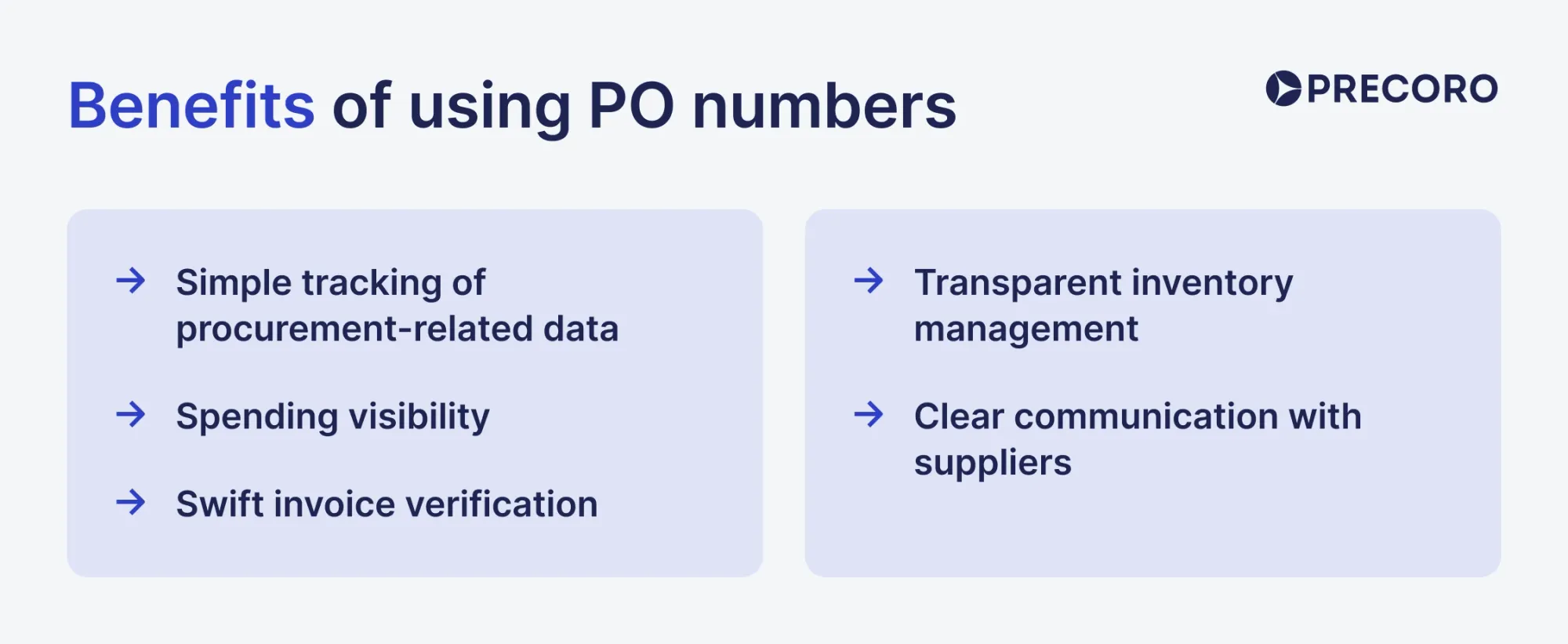
Purchase order numbers are highly important for administrative, procurement, and accounting teams for the following reasons:
How do PO numbers simplify procurement tracking and document control?
Effective record-keeping is the backbone of a well-organized business, and a unique PO number on every purchase order plays a crucial role in this process. Essentially, it makes the document easily retrievable within a database and lets employees quickly check whether the purchase order was approved, sent to the supplier, or fulfilled.
PO numbers aren’t just for the sake of present visibility; they also make tasks more convenient in the future. Picture this: you need to revisit a past purchase, maybe for auditing or simply to recall specific details. The PO number enables you to search for that historical transaction amidst the digital archives.
How do PO numbers speed up invoice verification and three-way matching?
The PO number is included not only on the purchase order but also on the sales invoice. This connection simplifies a crucial process known as "three-way matching," during which the invoice is compared to the related purchase order and receipt before payment. PO invoice processing ensures that all documents match up in terms of items, quantities, and prices, acting as a safeguard against fraudulent and duplicate invoices or full payment requests for partial delivery.
The PO number serves as a link between the documents, significantly enhancing the chances of detecting discrepancies and allowing employees to find related documents faster. Therefore, PO numbers help minimize payment-related complications and streamline invoice verification. Those are especially important benefits, considering that lengthy invoice and payment approval times are the top challenges for AP.
Why do PO numbers improve inventory traceability and incoming order visibility?
PO numbers help procurement and operations teams better track their incoming goods and available inventory. Employees can use them to check what items have been ordered and delivered based on the PO numbers of completed purchase orders.
This enhanced inventory visibility is a money-saving game-changer, too. It empowers companies to avoid unnecessary expenses by conducting a quick check to see if the required items have already been ordered or are already available in their warehouse or another office, ensuring that departments aren’t spending needlessly.
How do PO numbers improve spend visibility across every purchase transaction?
PO numbers help the finance team quickly access the necessary purchase orders and provide it with a comprehensive view of pending expenses. Thus, the company can have effective cash flow planning and set aside the funds required to cover these obligations.
Later in the procurement process, PO numbers can also be used to quickly access the needed purchase orders to verify and analyze historical spending. Businesses can use this data to identify potential cost-saving opportunities and negotiate more favorable terms with preferred suppliers.
Why do PO numbers create clearer communication with suppliers and fewer order disputes?
PO numbers streamline communication between buyers and suppliers by providing a clear reference point for all transactions. Moreover, incorporating PO numbers helps when it comes to resolving possible disputes with vendors. In case of a disagreement, both the buyer and the supplier can conveniently reference the original purchase order using the PO number.
Where does the PO number appear on procurement documents?
A PO number doesn’t live on the purchase order alone. It travels with the transaction across every document generated by the purchasing process. Knowledge of the typical location of the PO number at each stage is necessary for both buyers and suppliers, even if for different reasons.
Where should suppliers place the PO number on an invoice?
It’s common practice for suppliers to place the PO number prominently on an invoice — often in the header section, with the date and invoice number. Many buyers provide exact specifications for PO placement in their supplier guides or purchase order terms, as finding the PO on an invoice is one of the most common processing bottlenecks here.
Certain businesses go one step further and outright reject any invoice without a valid, matching PO number. They treat it as nothing more than an incomplete document (until the reference number is provided).
Where else can the PO number be found when receiving goods or services?
PO numbers can appear in different places outside of the purchase order and invoice, including:
- Packing slips (included by the supplier with the physical shipment, so receiving teams can match delivered goods to the correct order)
- Goods receipt notes (generated by the buyer upon delivery to confirm what was received against the original PO)
- Delivery confirmations (used in service-based procurement to acknowledge that work has been completed as ordered)
- Supplier contracts and blanket orders (reference the PO number when releases are drawn against a standing agreement)
- Payment remittance advice (allows suppliers to reconcile which invoices a payment covers)
What happens if the PO number is missing or incorrect on an invoice?
An invoice arriving without a PO number (or with one that doesn’t match any of the active purchase orders) is immediately marked as an exception. It cannot be processed for payment by the AP team until the issue is resolved, which often means either tracing the purchase internally to identify if there even was a PO or contacting the supplier to request a fixed invoice.
The operational impact of too many exceptions compounds quickly as time goes on. Every single PO mismatch that goes unresolved delays payment, strains supplier relationships, and consumes AP resources that could’ve been spent on routine processing instead.
Additionally, a pattern of missing PO numbers can be considered a signal of deeper process gaps in high-volume procurement environments. The potential reasons for that include purchases being made outside the system, suppliers not being briefed on buyer requirements, or internal teams ignoring the entire approval workflow.
Should PO numbers be sequential, alphanumeric, location-based, or project-based?
The most fitting PO numbering format for your organization depends on a variety of factors, such as the size of your organization, its structure, and the level of detail it needs to encode.
The ideal PO numbering format for everyone does not exist.
However, the format that works best in most cases is the one that’s consistent, scalable, and easy to reference (for both internal teams and external suppliers).
Should PO numbers follow sequential, alphanumeric, or department-based formats?
Each of these three formats (sequential, alphanumeric, department-based) includes various compromises between simplicity and information density. For example, smaller businesses tend to prioritize ease of use more often, while bigger businesses benefit greatly from formats capable of encoding plenty of context directly into the PO number.
The most notable formats for PO numbering are covered in a table below:
| Format | Example | Best for |
|---|---|---|
| Sequential | PO-00142 | Small businesses with low order volume |
| Date-prefixed | PO-20240315-001 | Companies that need chronological sorting |
| Alphanumeric | PO-FIN-2024-001 | Organizations tracking purchase orders by department or year |
| Location-based | PO-NYC-00891 | Multi-site businesses managing regional spend |
| Project-based | PO-PRJ042-003 | Project-driven organizations tracking costs by initiative |
Inconsistent formatting is always going to be worse than choosing any specific format — even if it doesn’t fit your specific business. Standardization across the organization is much more important than the suitability of your chosen format to your operational circumstances.
What are the essential components of an effective PO numbering system?
There are several common qualities that all well-designed PO numbering systems share, regardless of their format, including:
- Uniqueness. Every PO number must be distinct, with no possibility of duplication across departments, time periods, or systems
- Consistency. The same format is applied to every purchase order, without exception for certain teams or order types
- Scalability. The format accommodates growth without requiring a structural overhaul as order volumes increase
- Readability. The number is short enough to be referenced verbally and typed without error
- Searchability. The format supports fast retrieval within procurement software or document archives
Manual vs. automated PO number generation
PO number systems are as diverse as the businesses that employ them, and there’s no universal standard for how precisely to use them. What’s important is that the system adheres to a sequential pattern to provide each purchase order with a distinct and easily recognizable code. This unique code can be crafted manually or automatically using purchasing software. Let’s delve further into the approaches companies take to create the PO number system.
What are the limitations of creating PO numbers manually?
Usually, small companies with few purchases per month create their own purchase order templates and manually assign the PO numbers to them. Some businesses keep it fairly straightforward by starting at one and counting up from there. Others kick off with numbers like 001 or even 00001. For example, the first purchase order could be tagged as “PO 00001,” followed by the next as “PO 00002,” and so forth.
Some companies incorporate the date to make the number more detailed. For instance, the PO number for a purchase order sent on October 26, 2023, might look like "PO 10262023-000001." However, it’s not necessary, as the creation date is mentioned in the PO anyway.
The manual approach has several serious drawbacks that become more noticeable when a company starts processing lots of orders:
- A manual PO number system is prone to human errors and comes with the risk of duplication or misclassification of PO numbers.
- A manual approach is more time-consuming, as procurement or operations officers need to retrieve and cross-reference purchase orders to avoid number repetition.
- Manual systems lack data security and require additional time and effort to back up documents, which renders them more vulnerable to data loss.
Why is automated PO numbering more accurate and scalable than manual tracking?
As companies scale up their operations and require more supplies, manually assigning a unique code to every order becomes unreliable and time-consuming. In response to this growing challenge, many companies choose to automate their purchase order process with PO systems.
For example, with Precoro, users can utilize convenient, customizable PO templates to generate purchase orders, and the system assigns sequential PO numbers to them automatically. Additionally, Precoro’s functionality helps businesses efficiently handle other critical aspects of procurement with the following added benefits:
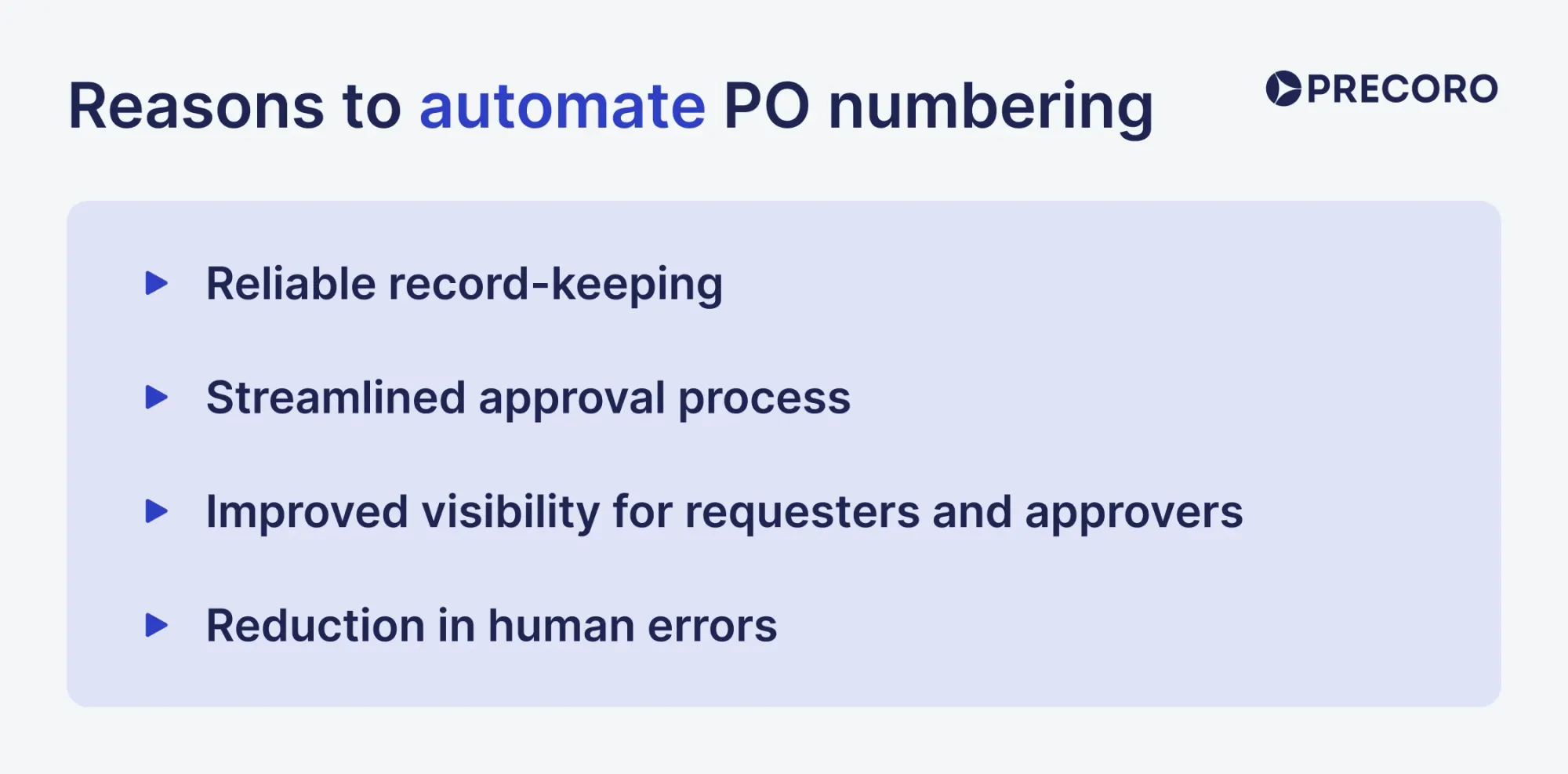
- Reliable record-keeping, which extends to purchase requisitions with requisition numbers, purchase orders, invoices, and receipts. A secure repository of procurement documents enhances spend management and makes auditing easier.
- Streamlined approval process with minimized risk of unauthorized purchases and approval bottlenecks. Each order follows a predefined approval workflow, with approvers promptly notified when a new document awaits their review.
- Improved visibility for both those making purchase requests and those approving. Users can check the order status, see the available budget, monitor inventory levels, and analyze expenses.
- Reduction in human errors like accidental duplicate PO numbers or incorrect or incomplete data entry. With fewer mistakes, financial records will be more accurate, and the ordering process will be noticeably smoother.
Moreover, PO automation helps companies save money: the average cost of processing a purchase order decreases from $107 to $32 when businesses switch to software solutions.
How do buyers and suppliers use PO numbers in their workflows?
While buyers and suppliers interact with PO numbers at different stages of the procurement cycle, both still depend on them to keep transactions accurate and on schedule. The PO number is the common link between two completely separate organizations, ensuring that everyone involved is aware of what was ordered, what was delivered, and what is due.
What role do PO numbers play in three-way matching?
Three-way matching is self-explanatory — it compares three documents (the purchase order, the goods receipt, and the supplier invoice) to confirm that all three are aligned before releasing the payment. The PO number is what links these three documents together, allowing AP teams to:
- Pull up the original order
- Verify the delivery record
- Validate the invoice
All of the above is done in the same singular workflow. If there is no consistent PO number to link these documents, the matching process would have to rely on manual document hunting instead, which dramatically increases the risk of error.
How do buyers match invoices to purchase orders using PO numbers?
Once an invoice has been received, the AP team uses the PO number from the invoice to locate the purchase order in their own system. The system can then compare the invoice line items against what was originally authorized in the purchase order:
- Quantities
- Unit prices
- Totals
If the figures do line up within the agreed margins, the invoice is then moved forward for payment approval. If the discrepancies are found instead, the invoice is held as an exception and routed for a manual review process.
The PO number remains paramount in guiding the entire process, making sure that every invoice is vetted against a specific, documented authorization instead of being processed based on trust alone.
What role does the PO number play in three-way matching and payment approval controls?
Document comparison aside, the PO number also has a direct role in approval workflows: determining the parameters for approving a payment and controlling how it gets paid.
It’s not uncommon for procurement systems to be configured to release payments automatically whenever a three-way match is confirmed. This would make the PO number an effective authorization method for the transaction without the need for manual sign-off (once matched successfully).
As for the invoices that were not able to achieve an automatic match, the PO number is what’s going to determine how the exception is routed. Approval controls that are tied to the PO number can escalate mismatches to the original requester, the relevant budget owner, or a senior approver, depending on the variance amount.
This way, manual reviewers are only needed when a decision is genuinely necessary.
Why do suppliers submit invoices with incorrect PO numbers, and how can organizations prevent it?
Process gaps on one or both sides of the transaction are a common source of incorrect PO numbers on supplier invoices. Common reasons for an incorrect PO number include:
- Suppliers referencing an old or expired PO
- A PO number that was transcribed manually and incorrectly
- Submitting invoices without any PO reference because the buyer never provided one at the time of the order
The overall frequency of such errors can be significantly reduced by performing the following actions:
- Communicating PO numbers at the point of order — ensuring every purchase confirmation sent to a supplier includes the correct PO number prominently
- Including PO requirements in supplier onboarding — setting clear expectations that invoices without a valid PO number will not be processed
- Using procurement portals — supplier-facing systems which pre-populate the correct PO number on invoice submission forms, eliminating manual entry
- Sending reminders with open POs — proactively sharing a list of open PO numbers with high-volume suppliers to reduce referencing errors
How does PO-based matching affect payment timelines?
Invoice processing becomes mostly automated once PO numbers are correctly referenced, and matching is completed without exceptions (thus improving the payment timelines as a whole). Invoices that pass the three-way matching process are capable of moving from receipt to payment approval in just a fraction of the time that manual processing needs.
The inverse is also true: every invoice exception introduces a delay, which may cost several days of back-and-forth between AP teams, the supplier, and the original requester. In high-volume environments, a substantial exception rate can create a backlog that may lead to late payment penalties and is generally considered a strain on supplier relationships.
Consistent PO number discipline is one of the most direct ways for an organization to keep its payment cycles in check.
Step-by-step PO number workflow
Knowing how PO numbers move through the procurement process helps buyers and suppliers handle their responsibilities when necessary. The workflow process described below is the generally adopted sequence that can be applied to most businesses, from the initial purchase request up to the payment.
- Purchase request is submitted — an employee identifies a need and submits a purchase requisition, specifying the required items, quantities, and estimated cost. This is the trigger that initiates the procurement process.
- Requisition is reviewed and approved — the request moves through the organization's approval workflow. Budget availability is checked, and the appropriate approvers sign off before any commitment is made to a supplier.
- Purchase order is created, and a PO number is assigned — once approved, a purchase order is generated, and a unique PO number is assigned to it. The PO number remains the reference identifier for this transaction for the remainder of the cycle.
- PO is sent to the supplier — the buyer issues the purchase order to the supplier, who uses the PO number to acknowledge the order, prepare fulfillment, and reference the transaction on all subsequent documents.
- Goods or services are delivered — the supplier fulfills the order. The buyer's receiving team checks the delivery against the purchase order and records a goods receipt, referencing the PO number to confirm what arrived.
- Supplier submits an invoice — the supplier issues an invoice which includes the original PO number, the items delivered, quantities, and the amount due.
- Three-way matching is performed — accounts payable compares the invoice to the purchase order and the goods receipt using the PO number as the linking reference. If all three documents align, the invoice is cleared for payment.
- Payment is approved and issued — the matched invoice moves through the payment approval workflow, and the supplier is paid. The PO number is marked as closed in the system once the transaction is fully settled.
All these steps rely on the PO number being present, accurate, and consistently referenced by everyone involved. If that discipline can be upheld, the entire cycle (from request to payment) can run with little to no friction while forming a complete audit trail behind it.
How can organizations validate PO numbers to prevent duplicate purchases and fraud?
Simply issuing PO numbers doesn’t address the other half of this workflow: the need for a mechanism to verify that the submitted numbers are accurate, unique, and are correctly matched before releasing any payment. Even the most well-structured PO numbering system can be exploited or undermined if it doesn’t have any active validation mechanisms in place.
Why do PO mismatches occur?
A PO mismatch is a combination of misfortunes in most cases, which is why it’s difficult to attribute the entire issue to a single source. The most common issues contributing to PO mismatching are:
- Suppliers or internal staff transcribe PO numbers incorrectly when creating invoices or purchase orders
- Suppliers invoicing against a PO number that has already been closed, partially fulfilled, or superseded
- Goods or services are being ordered informally, with an invoice arriving with no corresponding PO in the system
- PO numbers are generated in one platform that doesn’t sync correctly with the ERP (Enterprise Resource Planning) or AP (Accounts Payable) system used for invoice processing
- Different departments use different PO number formats, making automated matching unreliable
How can exceptions be resolved when PO numbers don’t match?
Once a PO mismatch has been detected, it’s important to resolve the exception before the invoice can proceed through the workflow.
There’s a consistent pattern to the PO mismatch resolution process, which usually consists of the following steps:
- Identify the discrepancy: determine whether the issue is a missing PO number, an incorrect reference, a quantity or price variance, or a closed PO
- Contact the relevant party: reach out to the supplier to request a corrected invoice, or internally to the requester to confirm whether an authorized PO exists
- Create or amend the PO if appropriate: if the purchase was legitimate but undocumented, a retroactive PO may be raised with proper approval
- Document the resolution: record the exception and how it was resolved to support audit trails and identify recurring patterns
- Release or reject the invoice: once the discrepancy is addressed, the invoice is either cleared for payment or formally rejected
Which procurement controls eliminate recurring PO-related disputes?
Exception resolution is, at its core, a reactive process. As such, the best possible approach to affecting exception rates is to implement controls capable of preventing mismatches from happening to begin with. This includes:
- Mandatory PO policy — requiring a valid PO number for all purchases above a defined threshold, with no exceptions for specific departments or order types
- Supplier communication standards — clearly documenting PO referencing requirements in supplier contracts and onboarding materials
- Automated PO number validation — configuring AP systems to reject invoices that reference invalid, duplicate, or closed PO numbers before they enter the processing queue
- Regular PO hygiene reviews — periodically closing expired or fully fulfilled POs to prevent them from being referenced on future invoices
- Segregation of duties — ensuring that the person who creates a PO is not the same person who approves the corresponding invoice
Predictability is the common link between all these controls. A policy that applies to most (but not all) purchases is going to leave itself open to the exact types of gaps that can be exploited by disputes and fraud methods.
There is no direct connection between PO system complexity and the number of disputes, either: an organization with the lowest number of PO-related disputes is rarely the one that also has the most complex environment. That being said, this kind of connection can be drawn with consistent policy implementation: companies that apply straightforward rules without exceptions and enforce them universally across all departments are much more likely to have as few disputes in the PO department as possible.
How can organizations validate PO numbers to detect duplicates and prevent fraud?
Duplicate PO numbers are known as one of the most frequent triggers of procurement fraud and overpayment. Businesses that are dependent on manual PO assignment usually don’t have any kind of systematic check that prevents the same number from being submitted more than once, which makes them extremely vulnerable to the issue of duplicate PO numbers.
Luckily, automated validation can solve this problem at its core. Procurement and AP platforms provide a consistent level of security against both deliberate manipulation and accidental duplication. These are the features that contribute the most:
- Duplicate PO reference flagging
- Invoice amount cross-checking against authorized PO values
- Expert alerts about unusual patterns
Additionally, these controls cannot be treated as optional by any business operating with large invoice volumes; they tend to be the most substantial layer of protection against substantial financial exposure for said businesses.
Automated validation addresses this issue directly.
Procurement and AP systems offer a reliable level of protection against both accidental duplication and deliberate manipulation using the following capabilities:
- Duplicate PO reference flagging
- Invoice amount cross-checking against authorized PO values
- Expert alerts about unusual patterns
Businesses operating with large invoice volumes cannot treat these controls as something optional, as they’re the biggest safeguard a company can have against significant financial exposure.
How do modern technologies change PO number handling?
The PO number handling process has changed a lot in recent years. The biggest contributor to said changes has been the advent of modern technology, forcing businesses to replace manual processes with automated ones (capable of enforcing accuracy by design).
Faster processing and fewer exceptions are just a few examples of how these changes affected the process in question, along with a procurement cycle capable of scaling without a proportional increase in the administrative burden.
How do e-procurement systems automate PO creation and matching?
With e-procurement solutions, the entire task of PO number generation becomes automated while removing the need for any manual intervention. As soon as the purchase requisition is approved, the software can generate the purchase order automatically with a unique PO number, helping businesses avoid PO duplication, missing PO numbers, and missed assignments (all of the known issues of manual numbering).
Matching works the same way here. Once the supplier invoice is received, certain actions are conducted automatically by the platform without any need for human intervention, including:
- Cross-referencing the PO number against open purchase orders
- Checking line item details
- Flagging discrepancies
The software has no need to pull up each document manually. This helps turn the PO number into a key that serves as a trigger for the entire automated workflow instead of being treated as nothing but a reference for looking up documents in a database.
How does electronic invoicing (e-invoicing) use PO numbers?
By embedding validation directly into the invoice creation pipeline, e-invoicing succeeds in improving the overall accuracy of PO numbers. There is no need to force suppliers to type in a PO number by hand anymore. E-invoicing software can replace that with a list of open POs issued by the buyer or even auto-populate the field based entirely on other information about the current transaction.
Once an invoice issued by an automated system reaches the buyer’s AP environment, it should already have a verified PO number in the necessary formatting. That way, the overall exception rates are getting significantly lower long before matching begins.
Why does poor system integration create PO matching failures and payment delays?
Many enterprises still try to run procurement, inventory, and finance tasks with individual platforms without any interoperability or integration. Unfortunately, this only turns matching failures into a structural issue whenever PO numbers in one platform cannot synchronize with the AP or ERP system in another platform.
Some of the most widespread integration failure points include:
- Delayed data sync: PO numbers created in a procurement system don’t appear in the AP system in time for invoice processing, causing valid invoices to be flagged as unmatched
- Format translation errors: PO numbers are reformatted or truncated during system transfers, breaking the reference link
- Duplicate records: poor integration creates duplicate PO entries across systems, making it impossible to determine which record is authoritative
- No real-time visibility: disconnected systems prevent AP teams from seeing the current PO status, leading to invoices being processed against already-closed orders
How do ERP systems use PO numbers to maintain procurement data integrity?
PO numbers operate as master reference points for ERP systems. They connect procurement activity with financial records throughout the company. All of the business transactions become fully traceable in properly configured ERP systems since the PO number becomes immediately linked with the relevant cost center, budget line, supplier record, and general ledger account every time a purchase order is created.
Scalable auditability is also easy to perform in ERP-based procurement environments, as there’s no need to compile evidence by hand using files, reports, and email trails anymore. What financial and compliance officers can do now is access an entire transaction history attached to any existing PO number within seconds. The interconnected nature of these environments makes all the documents, approvals, and payments extremely easy to find.
How can AI improve PO matching, validation, and exception detection?
Artificial Intelligence provides a layer of pattern recognition to PO matching that no rule-based system can offer.
In traditional matching, exact matches are needed for both approval and flagging. AI-powered systems can estimate the likelihood of a discrepancy being a genuine error vs a legitimate variance. This capability alone manages to reduce the volume of invoices necessitating human review.
The fraud detection application of AI assists with spotting exceptions that human review would not be able to find at scale. This includes:
- Supplier submitting invoices against multiple PO numbers in a pattern consistent with invoice splitting
- PO number being referenced by an entity that does not match the original vendor record
Capabilities like these are especially valuable in businesses handling large numbers of invoices every month, as the sheer volume tends to make human oversight impractical or extremely time-consuming.
How does Precoro automate PO number creation, invoice matching, and Procurement workflows?
Precoro is an agentic procurement and spend centralization platform that manages and controls the full PO lifecycle: intake, PO creation, invoice processing, payments, and everything in between. Precoro gets rid of the administrative overhead and error exposure of spreadsheet-based or disconnected procurement workflows, making it a perfect fit for mid-market businesses seeking an intuitive solution and flexible controls.
When it comes to PO number management capabilities, Precoro’s feature set can offer:
- Automatic PO number assignment — Precoro generates and assigns sequential PO numbers the moment a purchase order is created, using a consistent format configured to the organization's requirements
- Customizable PO templates — users create purchase orders with unlimited custom fields and dynamic forms that can be tailored to different purchase types
- Blanket purchase orders — purchasing managers save time on repeat purchases with blanket POs
- PunchOut catalogs — connect approved supplier catalogs to Precoro, allowing employees to shop with negotiated pricing while automatically generating purchase orders for approval
- Approval workflow management — every PO moves through a predefined approval chain, with approvers notified automatically when a document requires their action
- Budget integration — PO creation is tied to available budget in real time, preventing orders that would exceed approved spending limits from being issued in the first place
- Three-way matching automation — Precoro’s Matching agent automatically compares incoming invoices to the corresponding purchase order and goods receipt
- Reporting and spend visibility — PO numbers serve as the basis for spend analysis across suppliers, departments, and time periods, giving finance teams a complete view of committed and historical expenditure
- Multi-entity management — maintain separate PO numbering sequences, approval workflows, budgets, and reporting for each legal entity while managing procurement from a single platform
The platform scales with its client’s organization, capable of covering a business with dozens of purchase orders a month or an enterprise that works with thousands of POs in the same time frame. None of the visibility or control benefits from PO number automation diminish as order volumes grow, which is particularly important as many manual systems struggle with this exact topic.
What are the best practices for PO numbers on invoices?
The usefulness of any PO number system hinges on the habits built around it. Setting specific policies for managing PO numbers helps ensure that the system delivers consistent value instead of being a source of friction for both internal teams and suppliers.
How should organizations format and communicate PO numbers to suppliers?
Consistency and clarity should be the top priority for any PO number format. It needs to be unambiguous enough for suppliers to reference it accurately on an invoice without unnecessary confusion. Formats relying on excessively long numbers, easily confused characters, or inconsistent formatting between departments generate unnecessary transcription errors on the supplier side.
Communication is just as important as proper formatting. PO numbers need to be visible and accessible to suppliers within every single relevant touchpoint. For example:
- Include the PO number prominently on every purchase order issued, ideally in the document header alongside the date and supplier reference
- Reference the PO number in order confirmation emails so suppliers have it on record before the physical or digital document arrives
- State PO referencing requirements in supplier contracts — specifying that invoices submitted without a valid PO number will not be processed
- Provide suppliers with a self-service portal or a contact they can use to verify or retrieve PO numbers before submitting invoices
How can organizations train staff and suppliers to use PO numbers correctly?
The emphasis of internal staff training should be on two important behaviors:
- Always initiate a purchase through the proper requisition and approval workflow before committing to a supplier
- Never communicating a verbal or informal order without a corresponding PO number
Procurement teams that managed to succeed with normalizing such habits experience a significant reduction in the volume of invoices arriving without a valid PO reference.
Since organizations have less direct control over external parties, supplier training requires a more unconventional approach. The simplest, least obtrusive method is to make correct PO referencing the path of least resistance. This includes the creation of:
- Onboarding documentation that clearly explains the requirement
- Supplier portals that pre-populate PO numbers on invoice submissions
- Consistent policy of returning non-compliant invoices rather than processing them manually as a workaround
Once suppliers learn that a non-compliant invoice is going to hold the payment back, compliance will become prevalent soon.
How often should PO numbering schemes be reviewed or updated?
Once the PO numbering scheme is confirmed to be working well, there’s no need to conduct frequent revisions of it. However, it is important to review it every time an organization goes through substantial structural changes. This includes mergers, acquisitions, new ERP implementations, expansions into new regions, or even a substantial increase in procurement volume.
The primary goals of such a review include that the scheme remains:
- Unique across all entities
- Scalable for projected growth
- Compatible with any new systems being introduced
Outside of those events, an annual check as part of a larger procurement policy maintenance should be more than enough for the PO numbering strategy to remain operational.
How can companies use PO numbers for reporting, matching, and procurement visibility?
A PO number is important for tracking purchase orders, swiftly verifying invoices, streamlining payments, and analyzing spending. It’s typically placed at the top of a purchase order, ensuring visibility for both the buyer and the vendor.
The PO number system helps requesters and approvers within the company keep track of orders, verify invoices, overview pending expenses, monitor incoming inventory, and analyze historical purchases. Vendors can also include the client’s PO number on the sales invoice to streamline the payment process.
Manually assigning a PO number is common among small companies that don’t need many supplies. However, as they scale their business operations and handle a larger number of purchases, the manual approach becomes increasingly inefficient. This is primarily because it becomes more susceptible to accidental duplicate purchase order numbers, errors in data entry, and difficulties in organizing and tracking the growing volume of purchase orders.
As a result, many companies eventually opt for automated systems to streamline and increase the accuracy of their entire purchase order process. With such software, users can create purchase orders using simple templates and assign PO numbers automatically. Moreover, the best solutions have features for handling invoices, receipts, and budget management. With such modules, companies can use PO numbers to their full potential.