Procurement Management Guide: Basics, Benefits, and Best Practices
Learn everything you need to know about procurement management, from benefits and challenges to best practices and tools.

A clear approach to procurement management now matters more than ever. Nowadays, purchases are less about employees being efficient and more about them being flexible and resilient in the face of disruptions. Trade wars and geopolitical events made procurement far more demanding and pushed teams to pay closer attention to how the process is structured both internally and externally.
This guide covers what procurement management involves, how to approach it, and where the right tools make a practical difference.
What is procurement management?
Three pillars of procurement management
Key stages of the procurement process
Types of procurement strategies
Main benefits of effective procurement management
Challenges in procurement management
Best practices for successful procurement management
Best ways to improve procurement management
Reasons to digitize procurement management
Role of technology in modern procurement management
How Precoro enhances procurement management
Procurement management FAQs
What is procurement management?
Procurement management, at its core, is a complex set of structures and guidelines designed to enforce a correct course of purchasing from the company’s standpoint. Procurement itself can’t be described by just a single action of placing an order. The order typically starts with the request, requires separate approval, and is then followed by delivery, invoice, and final payment. Each of these stages calls for careful management and the right strategy.
What does procurement management actually mean?
How you manage procurement directly correlates with your understanding of procurement. Without a clear concept in your head, you’re moving the gears without knowing what any of them actually do.
Procurement is the process of acquiring the goods and services a company needs to operate. Procurement activities and needs vary by company structure and business goals, but three main types still apply across all of them:
- Direct procurement refers to any purchases needed to manufacture a product. Examples include raw materials, production equipment, or even packaging expenses. These purchases directly affect the success of production and its cost.
- Indirect procurement deals with purchasing items to support the daily running of the company. These goods aren’t directly related to manufacturing but rather to its supporting operations. Office supplies are a great example of indirect procurement: they’re essential in the company’s day-to-day, but won’t impact the production of the item it sells and won’t be included in its final cost.
- Services procurement includes sourcing services provided by people, such as a consultancy, for instance. It can be both direct and indirect: if the service impacts what the customer receives, it’s direct; if it’s more about supporting operations, it’s indirect.
The ratio of direct vs. indirect procurement heavily varies based on the industry and the niche you’re operating in. In general, indirect spend can hover anywhere between 15% and 40% of organizational spend.
No matter how your organization functions, you aim to have the highest ROI and predictability in procuring items and services. Procurement management is the strategic approach to building this organized workflow. Its goal is to enable the acquisition of high-quality goods and services from approved suppliers within a defined budget and timeframe.
As a secondary but no less important objective, it aims to regain full control over how purchases happen across the company. Procurement management should capture not just who buys, but what they buy, from whom, at what price, and under which terms. And it shouldn’t be limited to just one function: managing means overseeing key processes such as sourcing, requisitioning, ordering, expediting, inspecting, and reconciliation.
Why is procurement management critical for business success?
High-performing teams are able to generate 9 times the return on their procurement investments. Let’s see how the impact of procurement management is reflected internally:
- Your purchasing has a firm structure. An accountable approach with clear guidelines provides an essential backbone for the buying process. For instance, without proper management, employees might purchase without requesting, and invoices can arrive when no one approved the purchase in the first place. With procurement management, however, they’re routed directly to approvers, who, in turn, are responsible for orders in their specific category or team.
- Every purchase is visible. Procurement management with properly assigned roles and a centralized system to support it gives you visibility across the entire spend. You should be able to see who buys what and at what cost across your organization. Having that overview also opens the door for easier duplicate or maverick spend identification.
- You gain leverage over spend. With procurement management, your spend doesn’t control the purchases in the next quarter—you do. A centralized overview alone helps compare suppliers and combine purchases from the same one across several locations. Your team can spot an opening for negotiation if the purchase volume justifies a lower price, for instance. Add the structure from procurement management, and you have an enforced process that works for you.
These internal shifts aren’t the only reasons why you should manage procurement. The world procurement operates in has changed, from rapid automation to risks in areas that once seemed stable:
- AI adoption is the new normal. The deployment rate of AI in the procurement sector has grown to 43%. Companies that are still relying on paper-based purchasing are falling behind both in a competitive and an operational sense. However, before implementing AI, remember that it’s only as precise as the structure behind it. If procurement isn’t managed properly, isn’t centralized, and doesn’t have clear guardrails, automation will most likely fail.
- Risk expanded beyond supply disruptions. Disruptions are still one of the main fears companies have to face. The current geopolitical climate, however, presents other risks that can be as damaging as or even far more damaging than disruptions. Cybersecurity is one of the biggest concerns, followed by trade wars, recession, and the impact of AI. Each new supplier introduces potential risks, and procurement’s job is to handle and appropriately mitigate them.
- ESG is execution-focused. Reports are no longer enough: companies must prove how they source and what impact their production has on the environment. With the EU Deforestation Regulation and California Climate Corporate Data Accountability Act coming into effect, organizations should be able to disclose their emissions and sourcing practices. That part requires clear, structured data, something that can’t be achieved without proper procurement management.
- Business structures become more complex. In 2025 alone, 485 family businesses engaged in the M&A activity. Despite turbulent conditions, companies are growing, whether it’s through expansion or consolidation. Each change adds a layer of supply chain processes that require structure and guardrails. If unmanaged, that purchasing can quickly fragment and lead to losses.
- Cost pressure leaves no room for mistakes. With unstable inflation and rising prices, companies have two options: either keep the processes ad hoc and suffer the damage, or structure and manage them properly.
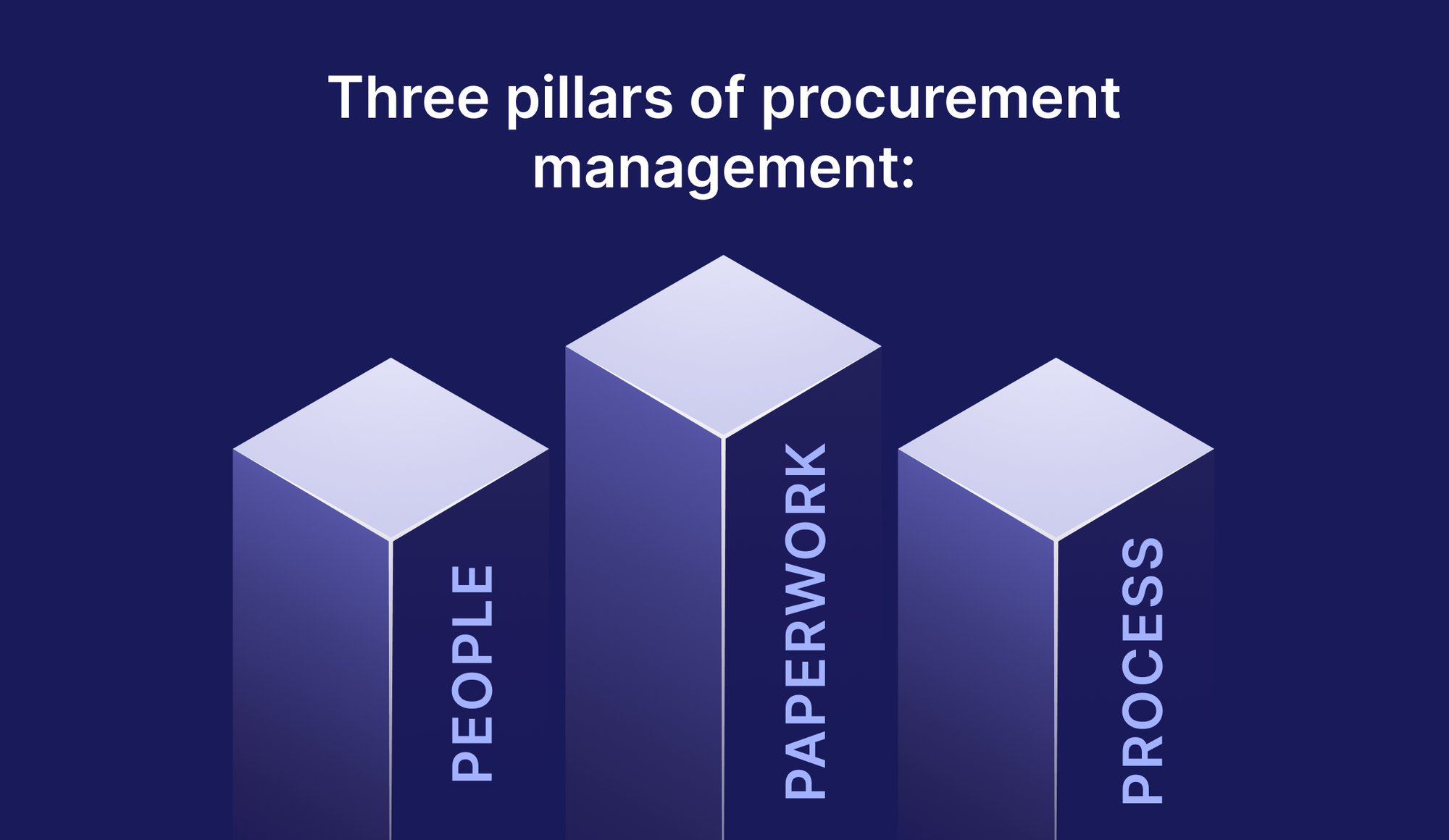
Three pillars of procurement management
There are three pillars of a procurement management strategy: process, people, and paperwork, known as the 3Ps framework. If you plan to build a structured approach for your purchasing, consider all three.
1st pillar: Process
Processes are the core of the management strategy that keep the entire function moving. They’re established workflows your team follows during any procurement action, from submitting a request to confirming order delivery or paying for it.
Processes aren’t limited to your organization: external stakeholders like suppliers are involved in them too, whether that's through onboarding or regular performance reviews. Done right, processes make sure time and money go where they should, and that business goals are met without unnecessary waste.
2nd pillar: People
No process can be executed without decision-makers behind it—the people, both internal and external stakeholders. These can include:
- Procurement professionals who design the process, manage suppliers, and control purchasing
- Department heads and budget owners (IT, operations, marketing, etc.) who define needs and approve spend
- Finance and accounting teams that oversee cash flow
- Legal and compliance teams that review contracts and ensure regulations are met
- Suppliers and vendors who deliver goods and services
For this pillar, assemble a team of professionals who will put their best efforts into bringing the designed procurement strategy to life. Ensure everyone involved is qualified and aligned on what you’d like to achieve. Roles, responsibilities, and permissions should be clearly defined, presented in writing, and mutually agreed upon.
3rd pillar: Paperwork
Although commonly known as paperwork, the third pillar would be more aptly described as documentation. The other pillars, people and processes, heavily rely on it as they have to be carefully documented to provide complete transparency. These records should be accessible without an employee having to sort through hundreds of folders for the right report.
The paperwork itself has been slowly fizzling out, with businesses shifting to automated and AI-driven procurement solutions that can both reduce manual work and provide deeper visibility into spend. For instance, with regular paperwork, to compare spend in several categories from the last quarter, you need to manually review several documents. AI procurement software like Precoro compiles these figures in a single dashboard and provides quick insights with an AI assistant.
What are the key stages of the procurement process?
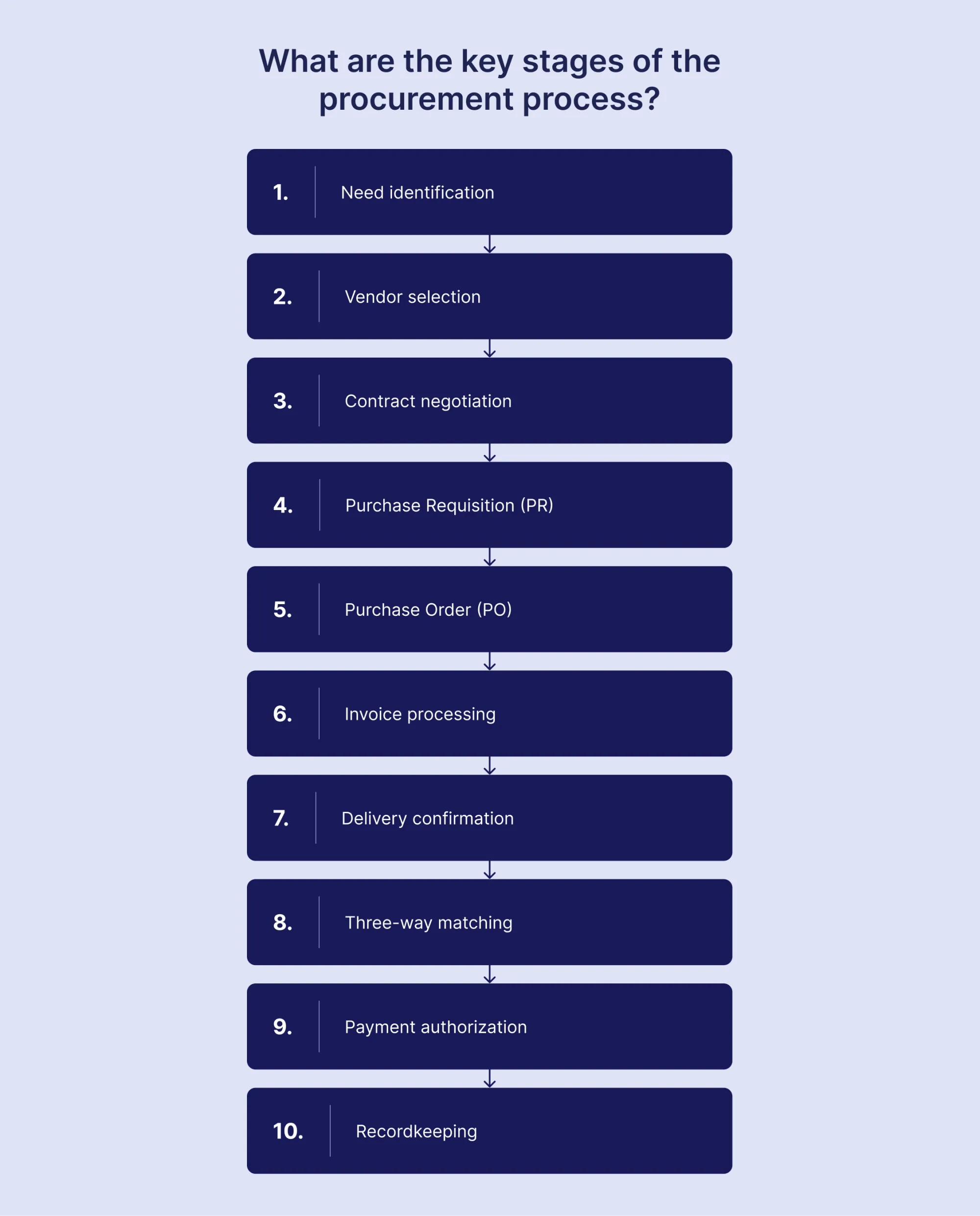
A well-developed process determines the success of procurement operations. Every organization runs differently, and no two procurement processes will look the same. However, there are common milestones most teams can start with and adapt to fit their own structure.
1. Needs recognition and alignment with the business goals
To request a purchase, you need to know exactly what the company requires at this moment and how critical it is. Determine which products or services the company needs and how they will help to achieve business goals.
Don’t just list items—approach this with thorough research. Specify the project these needs belong to, whether it’s current, urgent, or for future operations. Then specify exactly what’s needed and set a realistic timeframe for receipt that would still work for your goals. Lastly, assign roles to responsible employees at each stage of the purchase process.
2. Vendor research, evaluation, and selection
To find the right vendor or supplier, you can either review your existing supplier network or research new vendors. After you’ve narrowed down your options to select vendors, you can begin a more formal sourcing process by sending an RFP or an RFQ.
An RFP helps when you need a broader solution and want to compare vendors across capabilities and services. An RFQ works better when the scope is already clear, and the main goal is to compare pricing and commercial terms.
Consider the quality-to-price ratio, delivery terms, and the supplier’s ability to support your business over time. Depending on your operating model, flexibility matters as well, especially if you need a supplier that can adapt to market shifts or is willing to renegotiate terms.
3. Contract negotiation with selected suppliers
After you’ve settled on a supplier, it’s time to negotiate an agreement that works for both parties. It usually starts with receiving bids from several suppliers. Parties enter negotiations during which all requirements and expectations should be communicated, agreed upon, and written down. The terms are documented and finally formalized in a legally binding contract.
4. Purchase requisition issuance and approval (if relevant)
Based on the organization's size, number of departments, and type or thresholds for purchases, the company's workflow may include purchase requisition as a separate step. If employees see the need for the product or service, they can request a purchase in the company’s name. It gets approved, and only then is a purchase order issued.
Companies might not use PRs and let employees issue POs directly or even purchase immediately with corporate cards. This is typical for certain non-critical categories like office supplies or travel spend, or purchases under a certain threshold.
5. Purchase order issuance and approval
Once the request is approved, the company needs to communicate these needs to the vendor, which is done via the purchase order. This document includes product or service specifications, exact price, delivery, and payment terms, and must be confirmed by both parties—the buyer and the seller.
6. Invoice approval
Once the purchase order is confirmed, the supplier issues an invoice. The responsible employee, usually in the AP team, should check, confirm, and match it with the purchase order before recording it in the accounting system. If needed, changes may be requested. Depending on the agreed payment terms (transactions can be prepaid or postpaid), invoice processing may happen either before delivery or after it.
7. Delivery confirmation and audit
The vendor will deliver the products or services according to the contract and purchase order terms. The buying side should be prepared to receive a delivery, document, confirm, and process it promptly, so that the required products or services are put to use in time.
8. Three-way matching
To align procurement and accounts payable, teams conduct a three-way match, cross-referencing the purchase order, receipt, and invoice. If there are any discrepancies, documents are sent back for adjustments. Once the receiving team identifies any defects, it can also request either a replacement or an alternative suitable solution.
9. Payment authorization
When three-way matching is confirmed as successful, the buyer pays the seller, and the purchasing transaction is completed. Payment authorization usually includes a final review of the invoice amount, due date, payment terms, tax details, and banking information before the invoice is approved for payment. A final approval from a procurement manager may also be required for high-value payments.
10. Recordkeeping
Records of the transaction and vendor performance should be archived for several reasons. They create an audit trail that the business may need later. They also make reorders faster, since having a previous transaction as a reference is much quicker than starting from scratch. And over time, that data becomes the foundation for analyzing how procurement processes are working and whether the team is hitting its KPIs.
What types of procurement strategies exist?
A procurement strategy is a long-term plan that defines how the company buys the goods and services it needs. It sets clear priorities around what to purchase, which vendors to use, when to buy, and under which terms, so procurement decisions go hand in hand with business goals. The strategy also establishes the rules behind those decisions, such as supplier standards, budget limits, and compliance requirements.
Learn more about what exactly a procurement strategy entails.
Such big decisions often require trade-offs and depend on the way your company operates. Do you sacrifice cost, control, resilience, or efficiency? The procurement strategies below reflect the most common ways businesses balance those priorities.
What is strategic sourcing, and when should you use it?
Strategic sourcing is a forward-looking, structured approach to supplier selection that maximizes the value of purchasing decisions by analyzing spend and market trends. Unlike traditional sourcing, which often focuses on finding the lowest price, it prioritizes total cost of ownership (maintenance, cost over time, support, training, etc.)
One of the main strengths of strategic sourcing is its focus on business priorities. It aligns purchasing decisions with long-term company goals and also accounts for the risk that the supplier can cause problems down the line.
To determine the best option, strategic sourcing looks at multiple factors that go far beyond the company’s internal processes:
- Spend analysis: Shows what the company buys and where you can consolidate opportunities.
- Market research: Helps procurement understand supplier options, pricing trends, market conditions, and external risks.
- RFx comparisons: RFPs and RFQs are used to compare suppliers based on price, capabilities, and commercial terms.
- Contract design: Sets the commercial and legal framework of the supplier relationship, including pricing, service expectations, payment terms, and risk allocation.
- Supplier relationship management: Focuses on how the company works with suppliers after selection and what costs, whether time- or money-wise, can be expected there.
- Risk management: Helps identify any exposure related to supplier dependency or market volatility.
Strategic sourcing is useful when the purchase is significant enough to warrant deeper analysis, which typically happens in one of a few situations:
- The purchase has a direct impact on production or customer experience, where a quick supplier comparison isn't enough.
- The total cost matters more than the unit price, since maintenance and defects can make a cheaper option far more expensive over time.
- The purchase recurs often enough that consolidating volume could unlock better terms or a stronger supplier relationship.
How does centralized procurement differ from decentralized procurement?
Centralized procurement is the procurement structure in which one team or function manages purchasing for the entire company. In contrast, decentralized procurement means individual business units or departments manage some or all of their purchasing. Companies also often resort to a hybrid or center-led approach, where a centralized team is responsible for critical decisions and governance structure, while local teams can make their own decisions within those defined rules.
The model used can differ depending on whether it’s direct or indirect procurement. For direct procurement, companies prefer a centralized model, with 75% already using it. Indirect procurement can get more fragmented with on-the-ground needs, so it’s more evenly split: 55% decentralize indirect purchases, while 45% rely on a centralized team.
The main difference between these two models is in their distribution of control. In a centralized model, supplier decisions, policies, contracts, and often approvals come from the center, a single team that oversees all spend. In a decentralized model, local teams have more authority to choose suppliers and approve them based on their needs.
Centralization is the best option if you need complete visibility of organizational spend across teams and entities. That way, the central team sees the entire picture, can compare spend across the company, and consolidate purchases where possible. The strategy benefits, too, since it relies on complete data rather than just select departments.
Decentralization, on the other hand, offers more room for on-the-ground decisions. Not every situation requires approval from a higher-up. If given more freedom to make their own decisions, local teams can respond faster to urgent needs and make decisions that actually reflect customer demand or regulations, which a central team might not always see.
Both models also have their trade-offs. If each purchase is standardized, centralization can significantly slow the purchasing process and even disrupt operations. In turn, with too much room for decision-making, a decentralized structure can make it harder to spot saving opportunities or lead to duplicate buying due to communication silos.
For most companies with multiple entities, hybrid procurement is the most realistic setup. A central team can handle major purchases, while local teams purchase what they need within guardrails. Procurement software is especially useful here. Precoro offers a centralized dashboard with complete visibility of spend, while still allowing role-level access, approval workflows, and budgets for separate entities.

| Criteria | Centralized procurement | Decentralized procurement |
|---|---|---|
| Decision-making | One central team manages spend. | Local teams manage their own purchases. |
| Spend visibility | Full company-wide view. | Fragmented across teams. |
| Decision speed | Slower due to approvals. | Faster for local needs. |
| Supplier choice | Standardized: preferred vendors only. | Flexible: teams pick what works locally. |
| Cost impact | Lower costs: bulk buying and stronger negotiation. | Higher costs: fragmented demand and price variance. |
| Consistency | High: same process, pricing, and terms. | Low: different teams, different rules. |
| Flexibility | Limited: exceptions require approval. | High: each team has the freedom to make decisions. |
| Main drawback | Can slow operations. | Can lead to duplicate or off-contract spend. |
When should you consider global vs. local sourcing?
Global sourcing is a procurement strategy in which companies primarily buy goods or services from suppliers abroad. Companies usually choose it to access lower costs or materials and technologies unavailable in their home country. In some cases, global sourcing opens the door to broader supplier markets or a larger production capacity.
Local sourcing refers to a strategic approach of purchasing from suppliers in the same country where the business operates. The lead time is typically shorter, it’s easier to coordinate delivery and operations with each other, and exposure to risks, such as delays, is also lower.
Similar to the centralization vs. decentralization debate, businesses don’t rely on a single approach of sourcing but use a mix of both. They often dual-source and have a backup local supplier for items typically delivered from abroad.
The choice between global and local sourcing ultimately comes down to what you’re willing to trade off: cost, lead time, or supplier capability. Choose global sourcing when lower cost or supplier expertise outweighs longer lead times and higher risk, and choose local sourcing when speed and supply continuity matter more.
However, don’t treat this as an “either-or” decision. Supplier diversification, a trend that continues to grow since 2025, is key here. Build a flexible, multi-regional network, where specialized categories are sourced from global suppliers, while local teams handle critical purchases.
What are the advantages of single vs. multiple sourcing?
Single sourcing is a procurement strategy where a company buys a product, material, or service from one supplier, even though other options exist. For instance, a company decides to source all of its equipment from a single supplier instead of five because of a long-term partnership or better contract terms.
Multiple sourcing refers to an approach where the same demand can be sourced from several suppliers instead of just one. It’s the core principle of supplier diversification. A textbook example of multi-sourcing would be that of Procter & Gamble, which previously relied on one provider for their IT services, but distributed them between several vendors.
Note: Single sourcing shouldn’t be confused with sole sourcing, which is a scenario in which a business resorts to using a single supplier because there are no alternative options. In single sourcing, other options exist, but one option is more preferable.
Single sourcing has the following advantages:
- Leverage in negotiation. Your company as a client becomes more valuable to the supplier, who handles most of the volume. In return, you have stronger grounds to negotiate lower prices or better terms.
- Straightforward supplier management. One supplier means one main point of contact and one set of performance expectations. There’s less coordination involved, and communication, in general, is much simpler.
- Less overhead. The entire vendor lifecycle can be quite time-consuming. You spend a lot of time on administrative tasks like onboarding, contract review, and follow-ups, spread across multiple vendors. With one supplier, you do this process once.
- Consistent quality standards. A single supplier will deliver predictable results with the expected quality. Multiple suppliers might use different production practices, which will make the quality of your product inconsistent. This factor is especially important for categories where a certain quality is expected.
- A deeper partnership. A supplier you’ve worked with long-term is usually more willing to invest in the relationship. They’re way more open to solving any issues or rethinking sourcing strategies. They can even provide fresh input on your product.
Solely relying on single sourcing also has its trade-offs:
- Higher dependency on one supplier. There’s no backup if that supplier suddenly delays shipment or goes bankrupt. Any issue immediately affects your entire supply for that item or service.
- Lower flexibility. The capabilities of your product only go as far as the capacity of that single supplier. If you find yourself in need of urgent changes, they might be more difficult to implement since only that vendor handles this purchase category.
- Weaker benchmarking. Unless you consciously keep an eye on market pricing and service levels, you might get a skewed picture of what the goods actually cost or how they perform.
- Less competitive pressure. When a supplier knows they’re the sole provider, they might be less inclined to improve terms or offer better pricing.
- Switching becomes harder over time. The deeper the integration with the vendor, the more costly and complex it becomes to change suppliers if needed.
If your main priority is to ensure consistency across the supply chain or minimize administrative work, single sourcing is the way to go. However, if flexibility is key, consider turning to dual or multiple sourcing.
| Advantages | Trade-offs |
|---|---|
| Stronger negotiation position | Greater supplier dependency |
| Easier supplier management | Less room for quick changes |
| Less administrative load | Weaker benchmarking |
| Stable output | Less competitive pressure |
| Stronger long-term collaboration | Difficulty switching over time |
Since we’ve reviewed how single sourcing could help you strengthen your supply chain, let’s explore what multiple sourcing can offer:
- Risk reduction. The risk isn’t concentrated in a single supplier. If one vendor runs into issues, the company still has other suppliers in place, so the damage is smaller.
- Supply continuity. Having more than one supplier can help companies keep up with demand and reduce lost revenue from shortages. For instance, if an item suddenly spikes in demand, procurement can shift that volume across several vendors rather than piling it on a single one.
- Stronger price benchmarking. With multiple suppliers, you have a diverse view of market pricing. You can compare quotes and avoid overpaying over time by negotiating better terms.
- More competitive tension. In this scenario, suppliers know they’re not the only option, so you, as the buyer, have an upper hand. With smart procurement management, you can promote competition among providers and save on costs.
- Access to specialized capabilities. One supplier may be strong on price, and another on technical expertise or product quality. Multi-sourcing gets you the best of both worlds: each supplier covers what they’re best at.
Challenges you might face with multiple suppliers include:
- Fragmented demand. Each supplier handles a smaller share of the overall demand, which means there’s less chance of consolidation or bulk discounts.
- Hard to forecast and allocate. Your team has to decide how much volume goes to each supplier for every procurement management plan. A poorly designed split of purchases might cause shortages or delays.
- Ongoing supplier comparison. To get the most out of multi-sourcing, you need to actively compare pricing and service levels between vendors. Which one delivers the fastest and can cover price spikes? Which one has a better price but a longer lead time? You always have to account for these factors when working with several vendors.
- Standardization challenges. Vendors might use different materials and processes, or, on an administrative level, even have different documentation standards. Address these differences beforehand, or you risk inconsistency both in product and in reporting.
- Control overhead. Each additional supplier adds another contract and a set of data you have to maintain. If procurement doesn’t have a single source of truth for these details, employees might not even be aware who to purchase from, and spend can quickly fragment.
Multiple sourcing is a great way to reinforce your supply chain with backup options and specialized expertise. However, if the main goal is consistency, you need more discipline across the supply chain, which is where strong procurement management comes into play.
| Advantages | Trade-offs |
|---|---|
| Risk reduction | Fragmented demand |
| Supply continuity | Complex forecasting and allocation |
| Price benchmarking | Ongoing supplier monitoring |
| More competitive tension | Standardization challenges |
| Specialized capabilities access | Control overhead |
How to choose between single vs. multiple sourcing
In general, multiple sourcing has been considered best practice in the current geopolitical climate. The risks are at an all-time high, and being flexible automatically translates into your company being resilient. However, single sourcing still has its place, especially in more stable and low-value categories (cleaning supplies, packaging, office materials, for instance). The goal there is to maximize agreement value and keep supply consistent.
Multiple sourcing is useful if a supply disruption could seriously affect the business. Assess the risk level for each category: any high-risk ones (e.g., raw materials, specialized components) usually need multiple suppliers.
How can just-in-time procurement benefit your business?
Just-in-time procurement is an inventory optimization strategy where goods or services are bought only when they’re actually needed. Instead of a large stock on hand, the company only requests and orders any materials or components when operations require them. It’s a counterpart to the just-in-case procurement that stockpiles an extra buffer of materials to protect from supply disruptions.
A common issue with JIC procurement is that it uses funds to purchase inventory that essentially sits on the shelves and doesn’t actively provide value. With the JIT method, on the other hand, you purchase closer to the actual demand, so that money can be put to more strategic use.
However, it’s important to note that just-in-time procurement is built on accurate demand forecasts. If the demand spikes and the forecast didn’t show that, your company risks stockouts and loses profit from potential customers. Your vendor relations matter too: JIT implies that the vendor can deliver requested goods or services just in time for production.
JIT procurement offers several concrete benefits:
- Lower inventory costs. Excess inventory takes up space, has to be transported, and carefully handled, all of which costs both money and resources. The less stock you have, the lower the cost for storage and overhead.
- Stronger cash flow. The business spends money only when the need arises. Fast-moving companies need every dollar, so using it only in times of need keeps the cash flow moving.
- Less waste. If you don’t use it, extra inventory can quickly be damaged, expire, go obsolete, or even become simply unnecessary. Any perishables or quick-changing seasonal categories will become losses if you buy more than you need.
- Better process discipline. JIT requires tighter coordination between procurement, operations, and suppliers. That pressure forces the business to improve current routines, which, in turn, strengthens the entire purchase process.
- Better use of space. Excess stock consumes warehouse space that can be used for purposes you need now.
These benefits don’t automatically make just-in-time procurement better, but they highlight what you can improve in your current procurement strategy. The business essentially needs to keep only the necessary stock and build a reliable supply chain that doesn’t require an additional buffer.
What are the main benefits of effective procurement management?
You can deal with procurement on the go—that’s the reactive strategy that many companies live by. However, it's quite a short-sighted approach that's not sustainable in the long run. Strategic procurement management, on the other hand, has undeniable benefits.
How does procurement management control and reduce costs?
Well-managed procurement directly correlates with the degree of control you have over purchasing, which, in turn, helps save costs. For instance, with clear demand data, enforced internal guardrails, and consolidated orders, you already have a major leverage over competitors who don’t manage their procurement. Numbers prove that: 96% of top procurement teams met or exceeded their cost savings.
Procurement management moves control upstream to prevent issues earlier in the process, not at the invoice or payment stage. Clear budget limits and a guided intake process make sure you get the amounts checked before the money is committed. The biggest savings come from any consolidation opportunities: volume discounts with a lower price per unit, organized purchases across teams in the same delivery window.
Can procurement management improve supplier relationships?
Improved vendor relations are one of the biggest positive outcomes you can get if you effectively manage procurement. With clearly laid out procurement processes, communication becomes clear, and expectations are defined for both sides. Additionally, the team plans purchases in advance rather than relying on ad-hoc purchasing.
Risks usually linked to supplier relations also drop, in part due to centralization and standardization, the key principles of procurement management. They reduce silos between suppliers and internal teams, so everyone clearly knows where they stand and what each party needs. Procurement essentially makes supplier management an ongoing process rather than a series of isolated transactions. Teams can forecast demand more accurately, track performance, enforce agreed terms, and resolve issues earlier.
What role does procurement play in risk mitigation?
The procurement team has a direct impact on risk mitigation mainly because they deal with third-party relationships, one of the biggest risk categories. Every supplier can expose your company to various risks, from disruptions to cybersecurity issues. Each of these threats has to be prevented with clear incentives in mind. Supply continuity is high on the priority list, and procurement management’s job is to ensure that.
Teams have to put structure around how suppliers are selected and managed throughout the contract lifecycle. They can do that either through automated enforced controls with contract management systems like Precoro or through personal check-ins and ongoing performance reviews.
How does procurement management ensure quality and compliance?
With managed procurement, you get a clear set of processes and structure. That structure, in turn, makes sure compliance and quality standards stay in line and don’t depend entirely on luck. In fact, the latter is far more common than you’d think: 79% of companies tend to skip compliance checks if they trust a customer or supplier. In other words, informal relationships still override processes in most cases.
This scenario shouldn’t happen in effective procurement management. A managed procurement process creates the time and structure to do basic verification properly. Teams can define what they need, vet suppliers, compare options, check contract terms, and keep a record of what was approved and why. Procurement focuses on whether suppliers can deliver reliably and whether the business is measuring that performance.
Effective procurement management helps achieve that by standardizing supplier checks, contract terms, approval paths, and document trails. It also strengthens internal controls, which matter because procurement carries inherent compliance risk.
What impact does procurement have on cash flow management?
Procurement controls two major levers of working capital: how much cash gets tied up in inventory and when cash leaves the business through supplier payments. It also controls when exactly money moves towards one of the categories. Buy too early or too often—money is committed to unnecessary spend that stays on the shelf. Buy too late, and you’re dealing with delays.
There are three key ways in which procurement protects cash flow:
- Negotiates terms that put the business in a better financial position.
- Uses demand and lead-time information to plan inventory without unnecessary excess.
- Prevents spend leakage through approved suppliers and clear workflows with visibility into all available orders.
Effective procurement management provides you with predictable cash flows and fewer mistakes or mismatches in AP. Badly handled procurement, on the other hand, just by the nature of its processes, forces the company to carry more stock than needed and frequently deal with upcharges, penalty fees, or overpriced supplies.
How can procurement give you a competitive advantage?
Effective procurement management can be beneficial beyond your internal processes. With careful planning, you can put yourself several steps ahead of your competitor’s structure and market standing. Here are several ways in which procurement can do that:
- Faster response to demand shifts. Effective procurement can shift its category or redistribute spend with minimal damage in case of any disruptions. Such a quick reaction puts them in a better position than slower companies, which take longer to adjust and lose profit while doing so.
- Better pricing discipline. Procurement enforces controls that immediately carry savings and guide employees through the correct way to purchase. Consolidation across entities, bulk pricing terms, and pre-approved catalogs all help make sure your cost to serve is lower than your competitors', who rely on fragmented purchasing.
- More reliable supply. Even if the supply chain stalls for some reason, a good procurement process should have embedded backup options and monitoring measures that secure critical supplies. While others are still trying to find materials, the company can keep delivering what customers need.
- Stronger cash flow. Your business is in a stronger position when you purchase with more control given by procurement. When orders are properly timed, and you don’t have an excess of stock, you have more cash available to invest, expand, or protect margins during turbulent times.
- Access to supplier capabilities earlier. Procurement is often the first function to see supplier changes, capacity shifts, new commercial models, and emerging product options. When it works well, the business gets earlier access to better terms and capabilities than competitors who treat procurement purely as admin.
What challenges do organizations face in procurement management?
Good procurement management should also expose current gaps in your process, which might become challenging as you try to balance them. Any rapid switch from reactive purchasing to a mature, managed workflow exposes these gaps and makes them harder to ignore. That doesn’t automatically speak of failure. You’re simply dealing with friction that’s typical for a fast-growing, maturing company.
How do you manage supplier risk and dependency?
Perhaps the biggest challenge in procurement management is balancing efficiency and resilience. You need to learn to deal with trade-offs. For instance, single sourcing might give you a better deal, but you’re risking being overdependent on that vendor. Follow the next steps to prevent gaps in your supply chain.
- Know where you are exposed.
List the suppliers that matter most, what you buy from them, how hard those items are to replace, how long replacement would take, and what would happen if that supplier unexpectedly failed. Find any dependencies—those typically present the biggest risks. Any overreliance on one supplier or a critical material requires a separate mitigation plan.
- Rank suppliers by business impact.
Allocate your resources wisely. Even if the supplier is high-risk, you shouldn’t immediately work on mitigating the risks associated with them. Focus on those that can affect the business the most, such as providers of critical materials, logistics vendors that support the entire supply chain, outsourcing firms that provide maintenance for servers, etc. If either one of these suddenly fails, essential parts of operations could halt entirely and cost thousands in losses.
Categorize suppliers based on criticality and risk level with the Kraljic matrix. Split vendors into four groups: critical items, which need close supplier management; leverage items, where you can push for better terms; bottleneck items, where backup options matter; and non-critical items, which are routine purchases best handled with simple processes.
- Track a defined list of warning signs every month.
Watch lead times, on-time delivery, fill rate, quality issues, sudden price jumps, invoice disputes, financial stress, ownership changes, and repeated missed commitments. A supplier rarely fails out of nowhere, so monitor for any changes in their performance.
- Enforce controls directly in the buying process.
Procurement policies are necessary and need to be distributed. But at the end of the day, most employees won’t check them before making a purchase. First, centralize your procurement in an automated software that’s intuitive and easy for each employee to understand.
This system is going to be your one source of truth for purchasing. Then, look for ways to enforce controls before the invoice stage. Add additional approvals for certain thresholds, enable alerts for renewals, or notices about overspend. Such simple features mean your team doesn’t think about that themselves, but is completely guided through the process.
- Review supplier dependence at the category level.
You can have ten suppliers for the same materials and still be dependent if they’re all located in the same region or travel through the same route. Consider their location, route, financial history, and general supply market trends that could disrupt the delivery.
- Create a mitigation plan for critical suppliers.
For critical suppliers, decide in advance who makes the call if they fail, which customers or sites get priority, and how much stock you need to cover for them. This plan should be clear and detailed since it will most likely be used under pressure.
What are common compliance and regulatory challenges?
With additional entities and a growing structure, procurement becomes more demanding. Teams are pressured by internal and external regulations and have to face gaps in their controls to meet these requirements.
Here’s what issues you can expect in terms of compliance:
- Maverick spend: A complicated procurement process can lead teams to buy outside approved policies and leave you with a sudden invoice for a non-negotiated price.
- Poor contract visibility: The procurement team can easily miss obligations or renewals if their agreements are stored in different systems without any ownership.
- Frequent regulatory changes: Regulations are getting stricter as the geopolitical and environmental climate changes. Teams might struggle to keep up with them without a clear structure.
- Cybersecurity threats: Cyber incidents, which have nearly doubled, expose sensitive data and put you at risk of fraud and data breaches.
- Supplier compliance risk: Each supplier carries its own set of risks and challenges your team should be prepared to deal with, on top of their own regulations.
How can you overcome limited visibility in the supply chain?
Procurement performance directly correlates to the level of visibility you have. Too low and your team easily misses the warning signs. Too much for the wrong employee, and the reports get muddled with unnecessary data. The biggest culprit is fragmented data scattered across tools that not everyone has access to. Such silos disconnect one team from another during the entire procurement management process and block them from seeing crucial information.
One of the first things procurement managers strive for is to gain more visibility into what and how you purchase. Centralization is key here: by adding all data into one place, you’re creating a single source of truth that every team can use without silos.
What causes maverick spending, and how do you prevent it?
Maverick spend becomes more visible once procurement is managed, but not necessarily easier to eliminate. It’s often caused by a mismatch between formal processes and how your team actually works. For instance, if employees need urgent purchases but the official process requires several approval steps from HQ, they most likely will bypass it. That workflow is simply disconnected from the reality on the ground and needs to be adjusted for such cases.
Another reason is poor access to approved suppliers. If the search for the right vendor alone takes hours, employees will often go with the supplier they already know or the fastest option available. The policy is there, but compliant buying takes more effort than an off-contract one. Find a system that gives everyone involved easy access to suppliers and item catalogs.
Additionally, consider whether your centralization is too rigid. A single process for every entity doesn’t account for the specifics of each team’s purchasing needs. For example, a warehouse and a construction site will need different thresholds and approval speeds. Employees shouldn’t work around the process to get what they need.
How do you handle price volatility and market fluctuations?
Procurement teams now operate under constant cost pressure and market uncertainty. Procurement management clears up the fog and pushes each market risk to the surface. Volatility or disruptions alone aren’t the biggest challenge—they’re expected and in a lot of cases, inevitable. The company’s reaction here matters a lot more.
Procurement has to plan around each disruption to support the structure built with management. Forecasts have to be precise, the supplier base should be diversified, and every risk must be weighed for impact. The team also needs a way to track who buys what, from which supplier, and at what price, so it can catch sudden increases before they spread across the business. Without these measures, you’re exposing yourself to more damage and risk losing footing among competitors.
What communication barriers exist between stakeholders?
Procurement involves an entire network of stakeholders, from requesters and department heads to suppliers and leadership, and aligning them is a constant challenge. The reasons why communication between stakeholders might fail include:
- Different systems. Procurement and other departments often keep information in separate tools, so nobody has the full picture at the same time.
- No clear owner. People don’t know who should approve, update, or follow up, so requests stall.
- Different priorities. Operations care about speed, finance cares about control, procurement cares about policy, and legal cares about risk. If nobody aligns those priorities early, conflict shows up later.
- Unclear processes. Employees don’t always know which steps to follow, when to involve procurement, or what counts as an exception.
- Informal communication channels. Decisions get buried in threads, and people miss updates, approvals, or changes.
- No real-time data. By the time one team gets the information, the supplier price has changed, the budget has moved, or the order has already been placed.
These barriers boil down to the lack of a shared procurement process with enough context and clear ownership. Once it’s developed, inform each stakeholder about its key steps and assign required permissions and ownership depending on the role.
Why is the lack of transparency a challenge in procurement management?
Teams can’t control what they can’t track. Even with procurement processes in place, your employees aren’t getting the level of transparency they need if data is incomplete or not easily accessible. That lack of transparency also means they don’t have enough context to make an informed decision.
Additionally, without a clear view of procurement across every entity, any off-contract or non-compliant spend can quickly slip past your guardrails and remain unnoticed until the month-end close. Transparency matters to suppliers as well: centralized, clear data translates into fair performance evaluations and vendor selection practices.
Procurement management itself depends on transparency to work effectively. Any controls automatically weaken, and risks increase if you don’t have a complete overview of who’s purchasing what, from where, and for what cost.
Why do procurement processes become inefficient even when managed?
Sometimes workflows that look good on paper are completely unusable in practice. Yes, procurement management introduces structure, but, in a way, it can also introduce complexity. A badly designed process that wasn’t cleared with teams on the ground can slow down your purchasing. Overmanagement is possible and can box your team into boundaries that don’t work for them.
The solution is to design the process that has clearly defined roles and automated routine steps, but still provides enough room for teams to function properly. It should also be made clear to everyone involved, either with training sessions or guidebooks. Every step needs to be intuitive and guided, so teams can focus on the actual work instead of trying to figure out the process.
What are the best practices for successful procurement management?
To develop a strong procurement management policy, you need to build a set of methods that work best for your company. These measures should be directly embedded into the process since they’re only effective if used regularly.
How do you develop a comprehensive procurement strategy?
Procurement strategy is the baseline that your team will rely on when managing procurement. Every purchase should in some way align with the company's goals and contribute to its objectives for that period, so it’s important to think it through.
Build the groundwork with an in-depth analysis of the current state of your company’s purchasing. Review what the company buys and how the process works. Focus specifically on the spots where it breaks down. Any regular occurrence of duplicates, missed savings, or steps that slow the team down should be noted down and considered in your strategy.
Next, align procurement with business goals. Discuss with stakeholders what the company needs from procurement now and in the next few years. Then check if current workflows and supplier network support those goals or work against them.
Continue strengthening your strategy with external research and study the market. No strategy is fully complete if it simply ignores the environment in which it operates. Examine the trends in your industry, the state of your competitors, any potential disruptions on the horizon, and sourcing strategies. This information can help you determine demand in the near future and spot potential risks far before you’ve been affected by them.
Turn theory into practice with measurable goals. Set targets with numbers, owners, and deadlines. For instance, “Save more” is vague and non-committal. A better example would be, “Cut maverick spend by 20% in two quarters by enforcing approved suppliers.” You give a clear goal with a figure, a timeline, and a method for completing it.
Follow up these objectives with practical procurement policies. Set clear rules for approvals, budget thresholds, purchase types, and exceptions. Consult with stakeholders from other departments—procurement can’t build a working strategy without the input from teams closer to the ground. The policy itself should be easy to access and regularly updated.
Support the strategy with the right software. If requests, approvals, POs, invoices, and budgets sit across email and spreadsheets, the strategy will break. A centralized system gives procurement control, better data, and a consistent process across the business.
What should you look for when building strong supplier partnerships?
The biggest mistake companies make when it comes to suppliers is treating every partnership as transactional. Cost is important, but if you plan to work long-term with a vendor, you need to look beyond price. Consider their reliability and the ability to solve problems together over time. With joint collaboration between buyers and suppliers, quality issues can be solved 40-60% faster. Strong partnerships can also bring in new, innovative ideas for your product. The time-to-market is shortened by 30-40% simply because the teams on both sides contribute.
To determine whether the supplier can support future ventures, ask them directly and review their responses. Additionally, you can request customer reference calls and determine whether that vendor works for you based on their feedback. Plus, assess the vendor’s location and capabilities to see if they can support your upcoming projects.
The best partnerships also need structure. Set up a single point of contact for the supplier and clear channels of communication, so any conversations won’t be scattered between inboxes. Precoro, for example, offers a self-service Supplier Portal where vendors can communicate with your team and submit invoices. Arrange regular check-ins where you can align on strategic objectives and communicate regarding any issues.
How can you implement standardized procurement processes?
Identify which parts of the purchasing process your team has to repeat most often. For instance, if employees send a lot of requests in different formats and with missing information, it’s time for a standardized template. Often have to set up suppliers from scratch? Consider a solution where vendors can register through a standardized form.
Set one clear workflow for each of those steps, define who owns each decision, and use standard forms, approval thresholds, supplier rules, and document templates across teams. Put approved catalogs and supplier lists in the process itself, so compliant buying is easier than off-contract purchasing. It’s best to handle this digitally, because the standardization rules can then be applied automatically instead of relying on each employee to remember them.
Then adjust the process where needed. Keep the main rules and controls the same across the company, but allow entity-specific changes only where they’re necessary. Make sure users know the exact steps they need to follow. Track exceptions and review weak spots like approval delays or off-contract purchases. Standardization works best when the process is clear, and the system makes it easy to follow.
What KPIs should you track to measure procurement performance?
Procurement generates a lot of data, which can all be used to improve its performance. The KPIs below help track what exactly impacts the efficiency of your procurement management:
- Purchase order cycle time: How long it takes to convert a request into an approved purchase order. Use it to spot approval delays.
- Spend under management: How much of the company's spending goes through approved procurement processes. It can be used to determine how much of the purchasing the procurement team actually controls.
- Off-contract spend: How much money bypasses the approved process. Helpful for spotting policy leaks and unused supplier contracts.
- Cost savings: How much procurement reduces spend through negotiation, consolidation, or other measures. Use it to evaluate the effectiveness of cost-saving measures.
- Supplier lead time: How long suppliers take to deliver after an order is placed. Helps plan delivery schedules and identify risk among suppliers.
- On-time delivery rate: How often suppliers deliver by the agreed date. Often used in performance management to determine whether a supplier is reliable.
- Invoice exception rate: How many invoices fail matching or pass approval checks. Use to find blind spots in AP processes.
These numbers matter only if you act on them. Check them regularly, compare them over time, and use them to fix the issues that slow procurement down.
How do you conduct effective spend analysis?
Perhaps the biggest mistake is to analyze all spend at once without a clear understanding of what exactly you want to achieve. Start small and focus on category or entity-level data, depending on what you need. Follow the next steps to build an effective spend analysis framework:
- Set one clear goal first.
Decide what you want to find out before you dig into data. Generally, teams expect answers to these three questions from a spend analysis: how much do we spend, with which suppliers, and are we getting what was promised. Adjust your objectives from there to cost savings, faster delivery, etc. - Choose the right data sources.
Find where the relevant spend data is stored across your business. Useful sources often include your accounting system, general ledger, bank and card data, spreadsheets, ERP, payroll, expense tools, and procurement software. - Centralize data in one place.
Bring the spend data together in one database, spreadsheet, or system before you try to analyze it. If records stay scattered across departments or formats, the picture will stay incomplete. - Clean and standardize the data.
Spend analysis depends on usable data. Fix any inconsistencies that might skew the final analysis, such as duplicate supplier names, missing fields, inconsistent categories, and messy formats. - Consolidate spend.
Group the data based on the question you need to answer, whether that is by supplier, category, contract, location, or department. A complete view makes it easier to spot any weak controls or duplicates. - Track the KPIs that match the goal.
Use metrics that help answer the question you started with. Examples include savings, cost avoidance, maverick spend, contract compliance, requisition-to-order time, supplier lead time, or contribution to the total spend. - Act on your findings.
Use the results to renegotiate contracts, consolidate suppliers, update budgets, improve approval flows, or tighten controls where money leaks. A report on its own doesn’t improve procurement.
What role does cross-functional collaboration play in procurement?
Collaboration between departments directly protects your company from silos and ties your purchasing to actual business needs. Even if your procurement is centralized and handled by a single team, that team still needs input from finance on budgets and cash impact, from operations on urgency and real demand, from legal on contract terms and risk, and from IT or security. The decisions the procurement team is making are then actively informed by all sides, not just from the purchasing perspective.
Cross-functional collaboration should happen early in the process to avoid clashing priorities. The teams preferably should have a shared system where they can see available stock, request purchases from pre-approved suppliers, and submit requests.
How can you ensure continuous improvement in procurement?
Review performance on a fixed schedule and tie it to clear KPIs. Track important metrics and compare results over time to find where the process breaks down or where suppliers underperform.
Additionally, instead of fixing issues on a case-by-case basis, target your processes. Most problems indicate that something isn’t working in the current workflow. For instance, if you’ve noticed an approval delay, consider setting up approval SLAs. Hold regular reviews with stakeholders to stay updated on their needs, and keep the process current as priorities change.
What are the best ways to improve procurement management?
There’s always room for improvement, especially in an environment where costs shift fast, and supply chain disruptions keep piling up. Procurement management doesn’t rely on a single fix, but there are some foundational practices you can use to improve it.
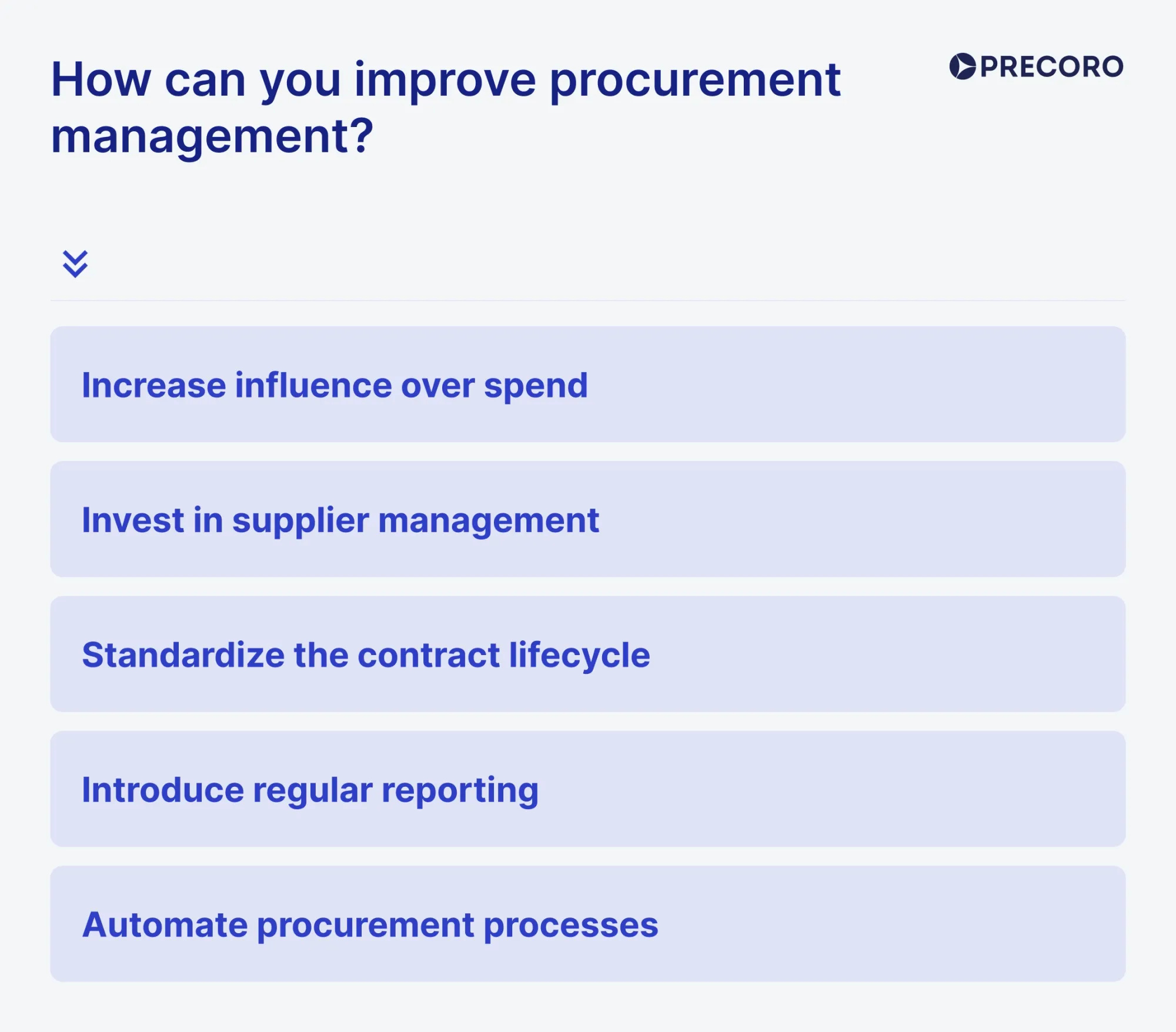
How can you gain more influence over spend?
The biggest cause of losing control over spend lies in maverick purchases from unapproved suppliers. To prevent employees from bypassing the existing processes, procurement managers can introduce a user-friendly cataloging system for contracted vendors and their products. It's also a good idea to specify how to act when a certain item isn't available in the internal catalog.
You can also add purchasing and approval workflows that must be strictly followed. It should be clear to every employee involved in purchasing what their roles and responsibilities are. In practice, that means the business needs clear intake rules, defined approval paths, and visibility into who buys what, from which supplier, and at what price.
Why invest in supplier management?
Suppliers and vendors are critical business partners that offer products and services needed for the business to meet its goals. Managing suppliers isn’t only about contracting and registering them, even though these steps are also fundamental.
Long-term productive relationships with vendors begin with you treating them as business partners. Buyers and sellers depend on each other, as one succeeds only when the other does. Therefore, it's in everyone's best interest to cooperate. When entering business relationships with the vendor, intentions should be clear, and communication should be honest. At the same time, any agreement should be put down in writing and legally certified, leaving no room for interpretation.
All this effort comes back to the company in the form of several benefits. On a more interpersonal level, you build a stronger connection between two companies with a layer of trust and respect. You essentially secure a trusted and reliable business partner. Besides that, cooperative spend management presents a new outside opinion from a vendor who closely works with materials and services related to your product.
How can you bring more structure to the contract lifecycle?
Drafting a contract can be smoother and less risky with predefined templates and formalized language. During negotiations, contract drafters can quickly recognize deviations from the standard template and decide whether to submit the draft for approval or insist on further changes.
Companies also move their contract management from an email-based manual workflow to a centralized and automated process with digital solutions. A single system already guarantees that the storage is standardized, while automation of repetitive parts, such as contract drafting or renewal alerts, makes the team’s work easier.
Why is regular reporting important?
There’s no better way to judge procurement performance than with real data. Regular reporting shows what is actually happening across purchasing and gives managers the facts they need to adjust workflows and quickly respond to issues.
Data is also essential for stakeholders who need to evaluate results and make informed decisions. Good reporting turns procurement from an administrative function into a decision-making mechanism. It shows where costs rise, where suppliers underperform, where approvals slow down, and where spend leaks out of policy. The procurement team analyzes that data and makes informed decisions that align with the business goals.
When does it make sense to automate procurement processes?
Finding procurement software that fits your company's needs is an important step toward maximizing the potential of the purchasing team. Automated solutions take a significant load of time-consuming tasks off the employees' hands, minimizing human errors and maximizing process efficiency.
Automation makes the most sense when manual work hinders the procurement’s day-to-day operations. Once you notice that invoices and POs take days to process, it’s time to rethink your approach to these steps of the procurement process. Additionally, if your team already has clear rules and workflows in place, automation can make them more efficient. However, it’s important to remember that automation doesn’t replace procurement management. It purely automates it and redirects the time used for manual tasks to more strategic objectives.
Reasons to digitize procurement management
Procurement departments are expected to digitize 70% of their processes by 2027. That plan is already underway, with more and more companies switching from manual purchasing to intuitive automated solutions. If your team is still unsure, a digital procurement centralization and automation software means you:
- Get a clear view of every purchase
Digital systems bring requests, orders, invoices, suppliers, and reports into one place. Procurement and finance get a full picture of what the company buys, from whom, and at what cost. Compared to traditional spreadsheets, all data is available to you in a single click, without needing to search for it.
- Standardize workflows and enforce them
Your established workflows can be reflected in the procurement software and easily enforced without follow-ups. Each step is assigned to a clearly defined owner, and every user has all the information they need available to them. Employees are held accountable, and non-compliant orders are much easier to spot.
- Reduce routine admin work
Managing requisitions, purchase orders, invoice approvals, and records manually takes time that adds up and creates more room for errors and follow-ups that shouldn't be necessary. Procurement software takes that load off the team and keeps routine work moving without constant intervention.
- Improve data access and reporting
Good procurement decisions depend on current, reliable information. A digital system gives teams instant access to spend reports, document history, and supplier data in one place. With that information, they can easily evaluate performance and give stakeholders something concrete to work with.
What role does technology play in modern procurement management?
With technology, procurement turns from a mostly manual function into a faster, more visible, and more scalable operating model. It gives teams one place to both track spend and plan for future demand. Procurement’s scope has also expanded: besides cost, teams now balance resilience, supplier performance, and compliance, all with AI-driven support.
What is e-procurement and how does it work?
E-procurement is the use of digital systems to manage procurement activities instead of emails, spreadsheets, paper approvals, and disconnected tools. It typically covers the entire procure-to-pay cycle, including supplier management and AP processing, inside one controlled workflow.
Each step of procurement is reflected in a shared digital process. Employees submit requests, the system routes them for approval, approved requests turn into purchase orders, and finance can match orders, receipts, and invoices before payment. Each purchase is recorded in the system, so at the end of the transaction, your team gets a complete audit trail from request to payment.
How can procurement management software streamline operations?
Procurement management software keeps the whole purchase path in one place. A request comes in and gets approved, the order goes out, the receipt is recorded, and the invoice stays tied to all of it. People don’t have to dig through inboxes or ask three different teams what happened to one purchase. Each purchase goes through a clear set of steps and is recorded in the system.
It also makes the rules easier to follow. Approval paths can depend on the amount, team, project, or budget, and the system checks those rules before a purchase moves forward. Procurement and finance get a cleaner record and a much clearer picture of where money goes across each business entity.
What are the benefits of automated procurement workflows?
Automated procurement workflows are often associated with speed first, which is fair enough since they help process purchases faster. However, the benefits go far beyond that:
- Fewer manual errors. Automation replaces the need for manual entry in repetitive steps that can easily be replaced by OCR tools or auto-fill solutions. The output is more accurate, the team has to handle fewer mistakes, and gets its time back for work that actually impacts your strategy.
- Better compliance. Approval rules, supplier restrictions, and contract terms can be built into the workflow before a purchase goes through. Upfront controls stop off-contract buying right out of the gate, while procurement policies are enforced without follow-ups.
- Stronger spend control. Procurement and finance work from one connected record instead of separate documents. A centralized and automated environment makes it easier to monitor spend and notice issues before they grow.
- More productive teams. Automation takes over routine processing tasks, so procurement and AP can spend more time on work that needs human judgment. Supplier management and strategy discussions get more attention.
- Lower risk. Linked records show who approved a purchase and under which terms. Since the history of each purchase is already there, internal reviews and audits are much easier to handle.
How is artificial intelligence transforming procurement?
Artificial intelligence has rapidly transformed the role of procurement from purely paperwork and recordkeeping towards judgment. Now that AI handles a lot of low-value work that used to eat up hours for your team, such as document capture and basic request drafting, the procurement team can focus on the strategy itself. AI can help with that, too, by answering questions based on large data sets.
AI can flag risk earlier, forecast demand with more precision, spot price patterns, and show where supplier or market changes may hit cost or supply. Procurement teams have all the insight they need to prevent a disruption before it affects the company on a bigger scale. AI doesn’t remove human judgment, but it does give teams better data and more room for work that actually needs human review.
What is blockchain's role in procurement transparency?
Blockchain has grown prominent over the past few years as a new solution to improve trust and traceability in procurement. Blockchain in itself is a shared digital ledger that records transactions in a way that is hard to alter, which is useful when multiple parties need to verify the same information. The global blockchain procurement market is expected to grow at 87% CAGR between 2024 and 2030.
As of right now, it still remains a relatively niche technology compared to cloud-based procurement software. Its role in procurement boils down to several specific use cases. Its main value is creating a record of transactions and events that multiple parties can reference and is difficult to alter. Broader transparency still depends on whether participants provide accurate data in the first place.
Blockchain isn’t a substitute for procurement management. It doesn’t solve poor data collection practices or inaccurate forecasts. But it can help in high-scrutiny categories that require stronger proof of origin, handling, or movement across the supply chain. For most companies, better visibility comes first from standardized processes and connected systems, not from blockchain alone.
How do cloud-based procurement solutions compare to on-premise systems?
Cloud-based procurement management systems are usually easier to roll out for companies with multiple entities or a wide network of suppliers. They’re much easier to scale: you can add users, easily update workflows, and access current data without the internal IT work that on-premise systems often require. The maintenance is completely on the vendor side, while the buying company pays on a subscription or a power user basis.
On-premise systems, on the other hand, work well for organizations with strict internal requirements or security regulations. Sometimes, the company’s workflows are so specific that it’s easier to develop an on-premise procurement solution. However, such systems usually take more effort to maintain and change both financially and in terms of labor resources. The upfront cost is also larger since the company has to purchase hardware to maintain it.
Procurement frequently changes, so workflows often have to be updated together with the business. On-premise software is less practical in this situation because changes take a lot of additional time and effort to implement. Cloud systems are usually better suited to that pace of change, while on-premise systems give companies more direct control.
What features should you prioritize when choosing procurement software?
When choosing procurement software, focus first on the features that let you control spending and run the process without gaps. The tool should essentially build on your existing workflow and guide your employees through it.
The features high on the priority list include:
- Customizable approval workflows that match your policy
- End-to-end purchase workflow from request to final payment
- Custom reports for complete visibility into who buys what, from which supplier, at what price, and under which contract or budget
- Supplier management for centralized supplier data storage
- Contract support with renewal alerts and linked documents
- PunchOuts and item catalogs to focus buying on approved suppliers at agreed prices
- ERP or accounting integration for easy two-way sync between systems
- AI for repetitive and routine work, such as data capture and 3-way matching
- Easy configuration without additional help from your IT team
Your new software doesn’t necessarily need to include all the features you’d like it to have. Focus on the essentials, such as enforced control and end-to-end visibility, and cover these gaps. Nice extras that improve the process but aren’t vital can wait.
How Precoro contributes to a high-performing procurement management process
A strong procurement process depends on control before a purchase moves forward, clear budget checks, and a full record of what happened from request to invoice. Precoro provides these benefits in one system, so teams don’t have to piece the process together across separate tools.
One connected procurement flow
Precoro covers purchase requisitions, POs, service orders, receipts, invoices, expenses, budgets, inventory, and reports in one place. Each document stays linked to the next step, which helps teams follow a purchase from the first request to the final invoice or payment record.
Better control with approval workflows and budget checks
Approval routes in Precoro can follow company rules by amount, department, location, project, legal entity, and custom fields. If the purchase exceeds the budget limit, the system automatically flags it and blocks it from proceeding.
PunchOut catalogs for approved spend
PunchOut catalogs in Precoro let employees shop directly from approved supplier websites while staying within the company’s procurement process. The selected items come back into Precoro as a purchase request or PO draft, so you don’t have to enter anything manually.
Clear supplier and document history
Supplier records, purchase documents, receipts, invoices, attachments, comments, and revision history stay inside the same system. When a question comes up, the team can check the document trail or, better yet, ask a personal AI Assistant and receive an in-depth data-driven answer.
Better fit for multi-entity companies
With Precoro, multi-entity companies can manage different branches or subsidiaries in one account instead of splitting them across separate systems. Teams can set access, budgets, and document controls by entity, while finance keeps a centralized view of all purchases in the company.
AI where it matters
Precoro uses AI in the parts of the process that usually take the most manual work. It can pull invoice data with AI-powered OCR, extract expense details from receipt photos, and create requests from supplier quotes, so employees spend less time filling out documents by hand. AI Assistant is here to help if you have any questions about your spend.
Procurement management FAQs
In small companies, procurement is usually simple and often handled by finance or operations without a dedicated team. In mid-size companies, the process should be more structured as more departments buy independently and finance needs better control over approvals, suppliers, and budgets. In enterprise companies, procurement often has to support multiple entities, so the focus shifts to standardization, compliance, supplier governance, and system integration.
The biggest risks include off-contract buying, weak approval control, poor supplier oversight, bad data, fraud exposure, and low spend visibility. The best way to reduce those risks is to enforce approval rules before purchases happen, control supplier access, check budgets early, and keep documents connected in one system with clear audit trails and reporting.
Implementation time depends on the company size, workflow complexity, number of entities, data migration, and integrations. A mid-size company with a standard setup can often go live in 2-8 weeks, while a more complex rollout usually takes longer.
See how Precoro supports every step of a high-performing procurement process. Book a personalized demo.