









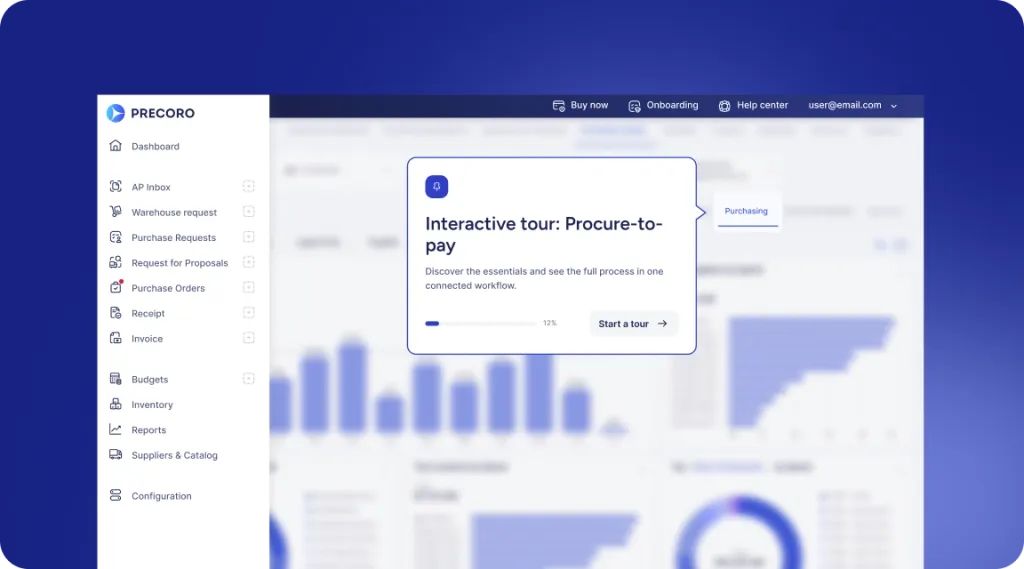
 Explore Precoro's features


















If your procurement or accounts payable team spends its week matching invoices to purchase orders, chasing supplier documents during onboarding, checking vendors for new risks, and tracking contract renewal dates, you already know the problem: the work follows the same steps every time, but it’s slow, and it’s the first thing to fall behind when volume grows. AI agents can take over much of it. The real questions are which parts to hand over and how to do it without losing control.
Agentic procurement lets software agents plan and complete buying tasks, including assessing multi-vendor bid responses and executing end-to-end purchase order workflows, within limits set by the company.
To start safely, pick one bounded workflow and let agents prepare, monitor, and draft. Keep payments, contract signatures, and strategic negotiations with people. That way, you cut manual work without losing the audit trail.
This guide covers where agents add value first, how they differ from traditional automation, which decisions should stay with people, and how to run a first pilot. It also includes an illustrative model that shows how matching tolerance and human review gates change the workload.
Where agentic procurement can create value fast
The fastest value comes from repetitive, rule-bound work that’s easy to check afterward: vendor onboarding, three-way matching, contract data extraction, and continuous risk monitoring.
Start with workflows where existing processes leave clear gaps. For example, quarterly supplier reviews may miss important risk events between review dates. Continuous monitoring can help teams detect these changes sooner.
| Use case | Why it works | Typical autonomy | Metric to track |
|---|---|---|---|
| Vendor onboarding | Structured, repetitive, verifiable | High, except bank details | Days to onboard |
| Risk monitoring | Continuous scans catch what periodic reviews miss | High to watch, none to act | Hours from event to alert |
| Purchase order and invoice matching | Clear rules and clear exceptions | Medium | Touchless rate |
| Extraction of contract data | Makes obligations and renewal dates searchable | High (read-only) | Contracts with complete metadata |
| Tail-spend renewals | Low value, low strategic risk | Medium, with caps | Savings vs. prior price |
The table above shows where to start and what to measure. The one below shows what results are on record for these use cases so far. Most come from vendors or single customer cases, and one is a modeled example, so treat them as signals to test against your own baseline, not as benchmarks.
| Use case | Result | Label |
|---|---|---|
| Invoice matching | 88.9% touchless in the illustrative model (see below); 92% reported in the separate Deloitte case. | Modeled example, not measured agent performance; Deloitte result is an externally reported case study. |
| Vendor onboarding | 35 to 4 days in pharma | Reported (vendor) |
| Contract approval | 45 to 12 days, draft to approval | Reported (vendor) |
| Duplicate and out-of-policy spend | $80,000+ in duplicate licenses and auto-renewals removed. $25,000 of requests declined in six months. | Reported (vendor-authored customer cases) |
| Risk monitoring | No independent outcome found. Measure hours from event to alert. | Gap |
💡Tip: Pick the first use case by asking which one can be baselined within a week. A result without a baseline won’t tell you much.
Documented customer implementations
| Source | Population | Reported result | Metric definition and caveat |
|---|---|---|---|
| Deloitte case study | One client, invoice processing | 92% touchless; processing time down 50% to 75% on average (a single invoice could previously take up to 30 minutes); invoice-processing FTEs down 50% | “Touchless” isn’t defined; Deloitte provides the product (Zora AI) |
| Walmart Canada and Pactum pilot, 2021 (Harvard PON, EY) | 89 suppliers of goods used in Walmart stores, such as shopping carts, three months | 64% reached agreement; 11 days on average; 1.5% savings on negotiated spend; payment terms extended by an average of 35 days | Pilot only; savings measured on negotiated spend |
| Walmart expanded program, as of late 2022 (same sources) | Suppliers in the US, Chile, and South Africa | 68% agreement; 3% average savings | Expanded program; population and category mix differ from the pilot |
| Ramp customer case studies | Two customers | One declined $25,000 of out-of-policy requests in six months across 11 PO programs; another automated 26 hours a month and removed $80,000+ in duplicate licenses and auto-renewals | Vendor-authored stories |
| IBM: Coca-Cola Europacific Partners | One enterprise | $40+ million in overall business benefits, including $5 million a year in cost savings and avoidance from AI-powered analytics | Whole-program figure; only $5M/year is attributed to AI analytics, and it isn’t an agent use case. |
Vendor-reported claims
| Source | Claim | What is missing |
|---|---|---|
| Zycus | Contract draft-to-approval from 45 to 12 days; pharma vendor onboarding from 35 to 4 days; 50% of transactions touchless; typical RFP and bid-evaluation cycles of 8 to 10 weeks; “up to 80% faster” sourcing cycles | Baselines, population, and method |
| Precoro (Xero listing) | 78% shorter purchase cycle time; 80% cut in accounts payable workload | Baselines, population, and method |
AI agents in procurement vs. traditional automation
Traditional automation follows fixed "If-This-Then-That" rules that people write, such as sending invoices over $10,000 to a manager for approval and highlighting price variances of more than 5% against a purchase order.
An agent's work starts from a goal, such as finding the lowest-cost vendor who can deliver within three days and comparing unallocated vendor statements against pending invoices.
Agents can select the steps needed to achieve a goal, such as checking supplier databases and validating tax IDs. They can also work with different types of information, including email attachments and unexpected supplier price changes. This flexibility requires additional oversight.
| Factor | Traditional automation (workflows, robotic process automation) | AI agents |
|---|---|---|
| Logic | Fixed rules written by humans | Works toward a goal and picks its own steps |
| Messy inputs (e.g., emails and news) | Struggles or fails | Reads and interprets them |
| Exceptions | Sent to a person | Investigates, proposes a fix, or escalates |
| Predictability | High | Lower; guardrails and testing are required |
| Setup effort | Rule mapping | Setting goals, tools, limits, and approval points |
| Best fit | Stable, high-volume steps | Variable, document-heavy work |
💡Tip: Don’t replace rules that already work with agents, such as hardcoded two-factor authorization steps and strict general ledger account code mapping. Keep rule-based automation for approval routing and tolerance checks, such as 5% price variance limits on purchase orders and exact-match line item quantity verifications.
The scenario comparisons below show how matching rules, tolerance settings, and human review gates affect modeled workload and financial exposure. The model doesn’t establish the incremental performance benefit of AI agents over tolerance-enabled conventional automation.
Illustrative model: invoice matching, review gates, and labor assumptions
The illustrative scenario uses 2,000 synthetic invoices worth $11.2 million in total spend across 150 vendor profiles. An agent-assisted setup with a 2% match tolerance and mandatory human review for bank-detail changes and duplicate records processes 88.9% of invoices without manual intervention. That represents 1,778 touchless invoices and 222 invoices requiring review.
A separate no-gates scenario assumes 177 invoices require review. That leaves 1,823 invoices, or 91.2%, without manual review. Compared with the gated scenario, that is 45 fewer reviews and a 2.25-percentage-point increase in the modeled touchless rate. These are arithmetic comparisons between scenario inputs, not observed agent outcomes.
How tolerance and review gates change the illustrative model: The following comparison uses a consistent population of 2,000 synthetic invoices. Touchless invoices and invoices requiring human review add up to 2,000 in every scenario.
| Scenario | Invoices not requiring review | Modeled touchless rate | Invoices requiring review | Assumed review hours |
|---|---|---|---|---|
| Manual review | 0 | 0.0% | 2,000 | 200 |
| Exact-match rules | 1,401 | 70.05% | 599 | 39.9 |
| Agent-assisted, 2% tolerance, gates on | 1,778 | 88.9% | 222 | 14.8 |
| Agent-assisted, 2% tolerance, gates off | 1,823 | 91.2% | 177 | 11.8 |
The model doesn’t include a tolerance-enabled, rules-only baseline tested under the same conditions as the agent-assisted scenario. Therefore, it doesn’t measure the incremental benefit of using an AI agent over conventional automation with tolerance-based matching. Don’t treat the difference between the exact-match and agent-assisted figures as the performance improvement attributable to AI agents.
Review hours are calculated using an assumed 4 minutes per invoice requiring review. Manual review assumes 6 minutes per invoice. The lower figure assumes the agent hands reviewers a prepared exception summary, so they check one flagged issue instead of the whole invoice. If your reviewers can’t rely on those summaries, use the same review time for both, which shrinks the modeled savings.
For example, 222 reviews at 4 minutes each equal 14.8 hours. The exact-match scenario uses 599 reviews, equal to approximately 39.9 hours at the same four-minute assumption.
These figures show how review assumptions affect workload. They don’t mean an AI agent achieved these touchless rates.
Under the stated review-time assumptions, reducing reviews from 222 to 177 saves 45 reviews. At 4 minutes per review, that equals 3 hours. At an assumed labor rate of $55 per hour, the modeled labor value is $165. The 64 risk-category flags in the no-gates scenario are a separate risk measure. Don’t add them to the review count.
Tolerance and gate settings (agent-assisted)
| Setting | Touchless rate | Human reviews | Overbilling let through | Risk-category flags without gate checks | Review time saved vs. 2% (4 min each, $55/hour) |
|---|---|---|---|---|---|
| 2% tolerance, gates on | 88.9% | 222 | $0 | 0 | n/a |
| 5% tolerance, gates on | 90.4% | 193 | $9,129 (18.3%) | 0 | about $106 |
| 10% tolerance, gates on | 93.6% | 128 | $29,213 (58.5%) | 0 | about $345 |
| 2% tolerance, no bank or duplicate gate | 91.2% | 177 | $0 | 64 modeled risk-category flags (unique invoice count unknown) | 3 hours and $165 saved versus the gated scenario |
💡Tip: Rules can also match within a tolerance. Before paying for an agent, ask what it adds beyond that. Real additions include reading emailed PDFs and explaining exceptions, such as summarizing why a vendor added unapproved freight surcharges and identifying partial shipments splitting across purchase orders. Tolerance alone isn’t a real addition.
How an AI workforce procurement model changes procurement professionals’ roles
As agents take on routine preparation tasks, procurement professionals can spend more time reviewing exceptions, making decisions, and managing supplier relationships. Agents prepare the work, while employees retain responsibility for decisions that require human judgment.
In practice, a buyer who used to chase certificates of insurance now reviews the exceptions the agent can’t resolve. A category manager who spent days building bid comparisons now spends that time questioning the assumptions behind them.
Still, an AI workforce for procurement needs owners. Each agent should have a named person who sets its limits, reviews its results, and owns the fixes.
💡Tip: A one-page “job description” for every agent can help organize the process. Include the goal, the systems it uses, what it must avoid, the owner, and the person it escalates to.
In Deloitte's reported client implementation, invoice-processing full-time equivalents (FTEs) were reduced by 50%, with resources redirected to higher-value tasks. The illustrative model in this article also shows that procurement teams must continue to review exceptions and maintain human oversight of high-risk transactions.
| Field | Invoice-matching agent |
|---|---|
| Goal | Match invoices to approved purchase orders and receipts. Use a summary for exceptions. |
| Systems | Purchasing platform (read, draft invoices). No payment access. |
| Limits | Auto-pass within the agreed tolerance. Don’t change bank details. |
| Owner | Accounts payable manager. Backup named. |
| Escalates to | Buyer for price variances and finance lead for suspected fraud. |
Where AI agents fit across the procurement process
Agents work best on the document-heavy handoffs between steps.
Here’s where an agent drafts and where a person decides.
| Stage | What agents can do | What humans keep | Evidence strength |
|---|---|---|---|
| Sourcing | Shortlist vendors, draft requests for proposal or quote, normalize bids | Criteria, weights, award | Vendor-reported only |
| Contracting | Extract clauses, compare to a playbook, draft redlines | Final terms, signature | Vendor-reported |
| Purchasing | Create purchase orders, route approvals | Policy exceptions | Customer cases |
| Receiving and invoicing | Match purchase order, receipt, and invoice | Disputes, payment release | Illustrative model; separately reported Deloitte case |
| Monitoring | Watch news, filings, and scorecards | Response decisions | Weakest |
Purchase approval authorizes the company to commit funds. Payment release authorizes the actual transfer of money. An agent may prepare a payment batch, but an authorized human should approve and release it. Bank-detail changes require separate verification and approval.
Strategic sourcing and supplier discovery
Agents screen vendor databases, past bids, certifications, and market news against defined criteria, broadening the search and narrowing the shortlist. A person makes the choice.
According to IBM’s “AI Agents in Procurement,” agents can weigh history, performance metrics, financial stability, and market conditions when evaluating vendors, and flag suppliers that pose geopolitical or financial risk.
Example (hypothetical): A category manager for corrugated packaging asks an agent to screen about 200 candidates on International Organization for Standardization (ISO) certification, delivery region, capacity, and financial signals, such as credit risk ratings and working capital ratios. The agent returns a shortlist of eight suppliers, with the reasons for each pick.
💡Tip: Set the criteria yourself, give them to the agent, and require evidence for each ranking.
Back test (proposed):
Choose 10 closed sourcing events where you know the winner, such as historical requests for proposals for corrugated packaging suppliers and completed sourcing tenders for regional logistics providers. Give the agent the original criteria so it can build a shortlist.
Record (1) whether the actual winner is on the list, (2) whether the evidence link for each criterion checks out, and (3) analyst hours saved.
Suggested pass marks: the winner appears in at least 8 of 10 lists, and at least 95% of evidence links check out.
If you can’t find independent, published recall rates for vendor discovery, your back test is your evidence.
How AI agents for procurement support RFPs, RFQs, and each sourcing event
Agents can create a draft for a request for proposal (RFP) or a request for quote (RFQ) using your requirements and answer routine bidder questions. They can also build a comparison sheet from the replies and highlight missing items.
An RFP is a document a government, business, or organization uses to announce a new project and invite contractors or vendors to submit their bids.
Companies use a request for quote to ask select suppliers and contractors for project- or task-based price estimates.
Example (hypothetical): 15 quotes arrive as PDFs and spreadsheets. The agent extracts unit price, lead time, payment terms (such as net 30 and a 10% advance deposit), and exclusions (such as installation fees and shipping taxes). Then it puts everything into one table and highlights the two bids that left out freight.
💡Tip: Normalize units, such as kilograms vs. pounds and liters vs. gallons, and currency. Do the same with delivery terms, such as free on board (FOB) and delivered duty paid (DDP).
Only then compare totals. Mismatched assumptions, such as missing warranty coverage or different shipping timelines, are what make the “cheapest bid” look cheaper than it is.
Test (proposed):
Take five closed RFQs featuring bids in mixed PDF and Excel formats. Have the agent build the comparison sheet and compare it with your analyst’s sheet field by field based on unit price, currency, lead time, payment terms, and exclusions.
Count errors by type. Unit and currency mismatches and missed exclusions, including freight, are the costliest.
Purchase order and procure-to-pay workflows
Agents can turn approved requisitions into purchase orders, route approvals, and match orders, receipts, and invoices. Then they send only the mismatches to a person.
Humans should remain responsible for payment releases and bank-detail changes, such as updating a vendor’s routing information and verifying new wire-transfer instructions.
The illustrative model shows that removing bank-detail and duplicate-invoice review gates can reduce manual work but increases exposure to high-risk transactions. In practice, retain these controls unless equivalent safeguards have been validated.
Contract management and supplier management
Agents can extract dates, obligations, and price clauses from contracts, such as service level agreements (SLAs), annual volume commitments, price escalation caps, and volume-based discount tiers.
They can also compare terms with your playbook, such as liability cap limitations and governing law jurisdiction. Agents can also draft first-pass redlines, such as striking auto-renewal clauses and adjusting payment terms from net 30 to net 60.
Agents can also track expiring vendor documents. Today, most of this is preparation work.
Missed obligations can include failing to meet agreed service level agreements and missing milestone delivery deadlines. Unfavorable renewals can include auto-renewing at higher price rates and missing notice windows to terminate underperforming contracts.
💡Tip: Ask the agent to create a renewal calendar with notice deadlines. It’s low-risk, read-only work that can show value in the first week.
Test (proposed):
Take 50 contracts with dates verified by hand. Have the agent extract the end date, notice period, renewal type, and price cap, and compare the results.
Record accuracy per field. See how often low-confidence flags caught the errors.
Proposed starting criterion: at least 98% accuracy on end date and notice period after human review of flagged fields. It addresses the risk of a missed notice deadline. Set your own bar based on what a missed deadline costs you.
What changes when AI agents start acting, not just assisting?
An AI agent's wrong answer can mislead a user. A wrong action from an AI agent can change a record, send a supplier email, or trigger a financial workflow. So, before deployment, decide which tasks an agent may recommend, draft, or execute, and which actions require human approval.
Illustrative financial model based on stated assumptions:
Population: 2,000 synthetic invoices.
Extraction: A 3% extraction-error rate means 60 errors. If 70% are flagged, 18 remain unflagged, or 0.9% of all invoices.
Critical exceptions (illustrative): The model includes 30 bank-detail-change flags and 34 duplicate-invoice flags, totaling 64 risk-category flags. Some invoices may fall into both categories, so the number of unique high-risk invoices can’t be determined without the underlying data.
Overbilling scenario: $49,943 in seeded overbilling; a 5% tolerance lets $9,129 pass, while a 10% tolerance lets $29,213 pass. These are modeled amounts, not observed losses.
Review-time illustration: 2,000 invoices reviewed manually at 6 minutes each require 200 hours. With the two human gates in place, 222 exceptions reviewed at 4 minutes each require 14.8 hours, a reduction of 185.2 hours compared with the manual baseline. Without the gates, 177 reviews require 11.8 hours, a reduction of 188.2 hours.
Removing the gates therefore saves an additional 3 hours. These calculations exclude quality checks, oversight, integration, software costs, corrections, and rework.
According to the Supply & Demand Chain Executive, a dashboard describes a situation and waits for a human. An agent monitors, investigates, and, in some configurations, acts.
Set separate limits for each task, such as spending authorization caps and human sign-off for high-risk vendors, contract negotiation, and onboarding.
Don't lump them into one “agent project.” That’s how unauthorized contract commitments and unreviewed vendor payments slip through.
Before an agent acts, put a price on each extra point of automation: what risk does it leave unchecked?
Autonomous supplier negotiation and supplier relationship management
Agents can negotiate low-value repeat buys within tight limits, such as a 6% maximum discount and no more than 15 days of lead-time flexibility.
People should lead strategic negotiations, such as multi-year enterprise agreements and exclusive single-source partnerships, because these require judgment about leverage, timing, and relationships.
💡Tip: Give negotiating agents a written walk-away price, a list of concessions they may make, and a rule to stop and escalate when the other side asks for something outside scope. Tell vendors when they’re dealing with an agent.
Walmart’s early Canadian pilot with Pactum reached agreements with 64% of participating suppliers, achieved average savings of 1.5% on negotiated spend, and extended payment terms by an average of 35 days.
The later expanded program showed a 68% agreement rate and 3% average savings. These figures describe different stages and scopes, not one combined result.
The pilot and expanded figures come from Harvard’s Program on Negotiation, which summarizes a 2022 HBR case study co-written by Walmart employees. The payment-terms figure comes from EY. Treat both as case-study results, not universal benchmarks.
Test:
Run the agent in shadow mode on 20 closed tail-spend deals. Compare its counteroffers with the real outcomes. Check how often it stayed inside your price limits and concession list. Concessions outside the list should happen zero times.
Human-in-the-loop controls for high-risk decisions
Each task should have an autonomy level: suggest, draft, act with approval, or act and report. The riskier the action, the lower the level.
| Task | Agent may | Human must | Example trigger for escalation |
|---|---|---|---|
| Risk monitoring | Scan, investigate, alert | Decide the response | Alerts on a critical vendor |
| Onboarding documents | Request, extract, validate | Confirm bank details | Banking changes |
| Purchase order creation | Create under a specific limit | Approve above the limit | Over threshold or new vendor |
| Invoice matching | Match and pass within tolerance | Review mismatches | Variance beyond tolerance |
| Tail-spend negotiation | Counter within limits | Approve the outcome | Request outside scope |
| Strategic negotiation | Prepare briefs and benchmarks | Lead the talks | Always |
| Suspending or replacing a vendor | Recommend with evidence | Decide and act | Always |
| Payment release | Prepare the batch | Approve and release | Always |
The “Tolerance and gate settings” table in the illustrative model section shows the review-time and labor-value differences between the tolerance scenarios. It isn’t a record of measured agent performance.
The no-gates scenario is a separate control comparison, not another tolerance level. At 2% tolerance, removing the gates avoids 45 reviews and saves 3 hours, worth $165 at the assumed hourly rate. Weigh the 64 modeled risk-category flags separately when evaluating that trade-off.
Rule: Raise a tolerance if the review time saved exceeds the leakage you would accept. Before go-live, test whether the same trade-off holds on your own invoices.
Supplier performance, compliance, and risk management
Agents can check continuously instead of relying on periodic sampling. They can read news, credit signals, filings, and shipment information. Then, agents compare this information with your vendor master and send change-related alerts.
According to McKinsey's 2024 Global Supply Chain Leader Survey, nine in ten respondents reported experiencing supply chain challenges in 2024. The survey included 88 supply chain leaders across different industries and geographies.
Agents can also surface hidden dependencies, such as several “diversified” vendors dependent upon one component maker.
For continuous compliance monitoring, agents check regulatory databases, sanctions lists, and news feeds against your vendor master on a set schedule.
To prevent alert fatigue, set a minimum relevance threshold. Each raw hit should pass a second check that confirms it’s really about your vendor before it becomes a high-priority alert for the category manager.
💡Tip: Make sure alerts arrive with their evidence, so a category manager can verify them quickly instead of rebuilding the trail.
Measure two things: alert precision (actionable alerts divided by all alerts) and lead time (hours between a public event and your alert).
Replay 12 months of known supplier incidents. Record the alerts the agent would have raised and how early.
A proposed starting threshold is 60% alert precision, though it isn’t an industry standard. Set the threshold based on the cost of missed risks, alert volume, and reviewers’ capacity. Then, measure it during the pilot.
What AI procurement needs beyond generative AI
Generative AI writes and summarizes. Agents need more than a chat model: clean data, system connections, narrow permissions, and logging.
Agents add tools, such as enterprise resource planning API integrations and database query connectors, as well as memory, so they can act and ask. API stands for application programming interface, which is a connection between computers or between computer programs.
Agents also add rules. Rules can include requiring multi-factor approval for orders over $10,000 and using mandatory compliance checks before sending emails.
AI-assisted invoice matching may combine optical character recognition (OCR), document-understanding tools, and validation rules to extract and check information from supplier invoices. The exact technology and processing steps depend on the platform.
In an AI-assisted workflow, the system can compare extracted invoice line items against approved purchase orders using structured data, such as item descriptions, quantities, and prices.
If the extracted information is incomplete or uncertain, or the invoice fails the configured matching checks, it should be flagged for human review rather than processed automatically.
In the illustrative model, a 3% extraction-error rate across 2,000 invoices means 60 extraction errors. If the system flags 70% of those errors, 30% remain unflagged: 18 silent errors, or 0.9% of all invoices.
This is a calculation based on stated assumptions, not a measured result from a verified run. Some errors may slip past confidence flags, so keep downstream purchase-order, receipt, price-tolerance, and critical-field checks.
Extraction confidence isn’t the only control.
How procurement AI connects with procurement platforms and ERP systems
Procurement agents can connect to enterprise resource planning (ERP) and purchasing systems through supported APIs or connectors. For example, an integration may use REST APIs to retrieve purchase order details and webhooks to receive notifications about system events.
To protect procurement data, agents should use dedicated identities with permissions limited to their assigned tasks. Depending on the platform, access may be controlled through OAuth 2.0 scopes or other supported authentication and authorization mechanisms.
Connections can also use prebuilt connectors, such as SAP Integration Suite packages and Coupa procurement connectors. Finally, agents can use tool-calling standards, such as OpenAI function calling and the Model Context Protocol (MCP).
According to IBM, agents can connect with databases, application programming interfaces, enterprise resource planning systems, procurement platforms, and supplier portals.
Integration checklist
- The agent uses its own service account, not a person’s login.
- Access starts read-only. Write access comes later, for drafts.
- Every logged action has a timestamp and a request ID.
- A test environment exists. The agent can be switched off in one step.
Precoro's API covers POs, invoices, receipts, payments, requisitions, suppliers, contracts, products/items, and more.
Run five integration tests before agents write data:
- Read parity: the agent reads 200 historical purchase orders and its values match the system on every field.
- Permission test: the agent’s account can’t approve or pay.
- Failure test: an API timeout triggers retries, then escalates to a person.
- Replay test: the same event sent twice causes one action.
- Rollback: you can switch the agent off in one step.
How procurement data powers AI systems
Agents are only as reliable as the records they read, including the vendor master, item catalog, contracts, and purchase order and invoice history.
According to Supply & Demand Chain Executive, an agent inherits every duplicate and stale field you have and works faster than an analyst would.
Fix the common problems first: duplicate vendor IDs, uncategorized spending, contracts without an end date, and prices stored in free text.
Scorecard:
| Check | How to measure | Suggested threshold |
|---|---|---|
| Duplicate vendors | Duplicate records ÷ total vendor records | Under 2% |
| Categorized spend | Categorized spend ÷ total spend | At least 90% |
| Contracts with end dates | Contracts with verified end and notice dates ÷ active contracts | At least 95% |
| Invoice-to-PO coverage | Invoices with valid purchase references ÷ invoices requiring purchase orders | At least 80% |
| Bank-detail controls | Actual bank-detail changes with complete verification and audit records ÷ all completed changes | 100% |
Where AI in procurement depends on strong procurement systems
Artificial intelligence in procurement depends on strong procurement systems because agents can’t enforce rules your systems lack.
If you keep approvals, budgets, and purchase rules in email and spreadsheets, an agent doesn't have anything to follow or log.
Agents get their operating rules from procurement software that stores budgets and approval matrices, such as tier-based spending limit hierarchies and department-level manager sign-off workflows.
Skipping this step is risky. According to Gartner, more than 40% of agentic AI projects could be canceled by the end of 2027 because of growing costs, vague value, and weak risk controls.
Takeaway:
Configuration sets the outcome: in the illustrative model, raising the tolerance from 2% to 10% moved leakage from $0 to $29,213 without changing the agent. Precoro’s Matching Agent searches approved purchase orders from the same supplier. If your purchase orders aren’t approved in the system, an agent has nothing to match against. If approvals are still in email, fix that first.
Building an AI workforce for procurement without losing control
Control comes from five things: a named owner for each AI procurement agent, written limits (such as maximum transaction amounts and restricted vendor onboarding lists), approval gates, complete logs, and a kill switch.
Approval gates can include human sign-off for invoice discrepancies and legal review for non-standard contract clauses. Logs should include an audit trail of agent actions and timestamped records of API calls.
Autonomy register:
| Agent | Task | Autonomy level | Limit | Owner |
|---|---|---|---|---|
| Invoice matcher | Match invoices to purchase orders | Act and report | 2% tolerance; no bank changes | Accounts payable manager |
| Renewal calendar | Extract dates and notice periods | Read-only | None | Contract owner |
| RFQ normalizer | Build bid comparisons | Draft | Human sign-off before award | Category manager |
Where procurement leaders should keep human approval
Human approval is especially important for high-risk financial decisions, contractual commitments, changes to supplier records, and actions that are difficult to reverse.
- New vendor bank details, including SWIFT codes and routing numbers, or changes to these details
- Payments above your threshold
- Contract signature and non-standard terms, such as uncapped liability clauses and custom indemnification provisions
- Suspending, replacing, or terminating a vendor
- Awards in strategic categories, such as core raw material suppliers and enterprise cloud infrastructure providers
- Exceptions to policy
- Use of personal or regulated data
💡Tip: Define approval thresholds using specific amounts. For example, purchase orders above $2,500 may require budget-owner approval, while lower-value orders from approved suppliers can follow a pre-authorized workflow. This is an illustrative threshold, not a universal standard. Review approval limits quarterly and adjust agent autonomy only when testing and audit results support the change.
Example:
In the illustrative model, retaining the bank-detail and duplicate-invoice review gates results in 222 human reviews, compared with 177 reviews without them. That is a difference of 45 reviews, or three hours at four minutes per review. At an assumed labor rate of $55 per hour, the additional modeled review cost is $165. The 30 bank-detail-change flags and 34 duplicate-invoice flags represent separate risk categories and shouldn’t be counted as 64 additional reviews.
Compare that with the value of a single misdirected payment.
How to audit AI agent decisions across the procurement process
Log every action with its input, data sources (such as past vendor invoices and approved purchase orders), reasoning summary, tools used (such as a PDF parser or an ERP lookup), output, and approver. Next, sample the log weekly during the pilot.
According to Supply & Demand Chain Executive, a key readiness question is whether a category manager can see the agent’s full reasoning trail and verify it in under 15 minutes.
Minimum audit-log fields
- Date, time, and agent name
- Task and the request that triggered it
- Data and documents read
- Action taken or recommended
- Confidence or exception flag
- Approver name and decision
Sample record:
| Field | Example |
|---|---|
| Agent and task | Invoice matcher; match INV-10482 |
| Inputs read | Invoice PDF, PO 5521, receipt R-884 |
| Extraction confidence | 0.93 |
| Rule applied | Total within 2% tolerance; variance +0.8% |
| Action | Auto-passed |
| Approver | None required within policy |
| Exception flags | None |
When a sample contains zero observed errors, the statistical “rule of three” estimates an approximate 95% upper bound on the underlying error rate as 3 divided by the sample size.
For example, zero errors in 150 reviewed decisions suggests an upper bound of about 2%. Zero in 300 suggests about 1%.
This doesn’t prove the future error rate is zero, and the estimate assumes a suitable sample. Sample auto-passed items weekly and review 100% of overrides.
Security, privacy, and legal risks in AI procurement
The main risks are manipulated inputs, such as prompt injection attacks and tampered invoice PDF uploads, and over-broad permissions, such as unrestricted administrative database access and unmetered payment execution authority.
Other risks include data leaks (such as exposed pricing models or confidential bidder details), fraud, biased vendor selection, and unclear accountability.
- Prompt injection: A vendor document or email can hide instructions guiding an agent. Treat all external text as untrusted.
- Excess permissions: An agent that can create a vendor and approve a payment defeats separation of duties, which keeps the same user from both creating suppliers and issuing payments.
- Data protection: Pricing, contracts, and vendor contacts may be sensitive or personal. Check how privacy rules such as the General Data Protection Regulation (GDPR) apply before agents process this data. The GDPR is the European Union’s data privacy law.
- Regulation: Check whether your use complies with rules such as the EU AI Act. The AI Act is the EU’s legal framework for AI, with rules based on how risky an AI use is.
- Accountability: In your contracts with AI vendors, spell out who’s responsible when an agent makes a costly error. Have your legal team review these terms.
| Test | Expected result |
|---|---|
| Invoice PDF with hidden text telling the agent to approve payment | Ignored and flagged |
| Email from a lookalike domain requesting a bank change | Routed to a person; no automatic update |
| Duplicate invoice with a changed number | Caught by the duplicate check |
| Request outside the agent’s permissions | Denied and logged |
| Vendor document with personal data sent to an external model | Blocked or redacted per policy |
How to implement agentic procurement step by step
Implementing agentic AI in procurement starts with creating a workflow and checking your data and systems, such as your ERP and vendor master records.
Next, connect agents with narrow permissions, such as read-only access to purchase orders and restricted draft creation rights.
Then add approval gates, such as mandatory manager sign-off for quotes over $5,000 and human review before sending emails to suppliers.
Finally, measure results. Then, scale one workflow at a time.
Suggested eight-week plan:
Weeks 1 and 2: baseline and readiness; week 3: read-only parity test; weeks 4 and 5: shadow mode; weeks 6 and 7: approval mode; week 8: go or no-go review against pass marks set in week 1.
Step 1: Choose high-value procurement workflows
Choose one or two workflows that are high-volume, full of rework, cheap to get wrong, and backed by decent data.
Score candidates from 1 to 5 on volume, rework, cost of an error, and data readiness. Vendor onboarding and invoice matching usually score well. Strategic negotiation usually doesn’t.
💡Tip: Favor processes that fail by design, such as quarterly checks that miss events between reviews.
| Workflow | Volume | Rework | Cheap to get wrong | Data readiness | Total |
|---|---|---|---|---|---|
| Invoice matching | 5 | 4 | 4 | 3 | 16 |
| Vendor onboarding | 3 | 4 | 3 | 4 | 14 |
| RFQ normalization | 2 | 4 | 3 | 2 | 11 |
| Strategic negotiation | 1 | 2 | 1 | 2 | 6 |
Step 2: Assess procurement data and procurement systems readiness
If a new analyst couldn’t work reliably using your current records, an agent can’t either. Fix the basics first: data quality, governance, and systems with solid API access.
Readiness checklist
- Duplicate vendor records are merged. Each vendor has one ID.
- Procurement spend is categorized consistently.
- Contracts are stored in one place with start, end, and notice dates.
- Approval rules and budgets are stored in the system.
- The target workflow is based on a written process and has a named owner.
- Your platform exposes APIs or connectors for the data the agent needs.
First, capture invoices per month, the share needing rework, and average minutes per invoice. Then, run the data scorecard above. Without a baseline, you can’t trust later results.
Step 3: Connect AI agents to procurement platforms and ERP systems
To connect procurement AI agents to procurement platforms and ERP systems, start with read-only access, then drafts, and finally limited writes. Use a dedicated service account and a test environment.
Stage 1 lets the agent read records and reports. Stage 2 lets the agent draft records that a person reviews and submits. Stage 3 lets the agent act on narrow, low-risk tasks, such as creating a purchase order below a set limit for an existing vendor.
💡Tip: Review a few weeks of logs before moving to the next stage.
Stage 1 passes when the agent reads 200 historical records and matches the system on every field.
Stage 2 passes when draft quality meets a pre-agreed maximum human-correction rate. A higher correction rate is a warning, not a success criterion.
Set the limit before testing and track correction severity and frequency.
A proposed Stage 3 gate is four consecutive weeks of clean logs. However, that period alone can’t prove that future risk is zero.
Combine it with a sufficiently large audit sample, zero critical policy breaches, acceptable correction rates, and a tested rollback procedure.
Step 4: Pilot AI agents with clear approval gates
First, run the agent in shadow mode, where it works alongside a person, without making changes. Next, run the agent in approval mode, where a person approves each action.
According to IBM, you should pilot specific processes, such as invoice matching and RFQ draft generation, starting with use cases where agents can deliver immediate value, such as routine purchase order creation and extracting line items from vendor quotes.
Before the pilot starts, write stop rules. For instance, pause the agent if the error rate exceeds an agreed level or if it takes any action outside its limits.
Before testing, define thresholds as proposed starting criteria, not universal standards. Base them on error costs and your team’s review capacity.
Proposed starting examples, not proven industry standards, might include 98% accuracy for contract-date extraction, 60% precision for risk alerts, 95% agreement with human decisions, and four consecutive clean weeks before considering a higher autonomy level. Test these thresholds and adjust them for the workflow.
Example: Take a four-week onboarding pilot. Weeks 1 and 2 run in shadow mode. During weeks 3 and 4, the agent requests and validates documents. A buyer approves the records before they enter the ERP system.
In shadow mode, compare the agent’s proposed decisions with decisions made by qualified reviewers.
Separately track critical false approvals, such as passing invoices with changed bank details, duplicate invoices, or unauthorized suppliers.
Require zero critical false approvals in the test set, review every critical case, and investigate every disagreement.
Set a maximum human-correction rate in advance for each workflow. Exceeding it means the pilot hasn’t passed.
In the illustrative scenario, 88.9% touchless processing would leave 222 of 2,000 invoices for review. This is a planning assumption, not a forecast.
Step 5: Measure cost, cycle time, supplier performance, and risk
At four minutes per review, the gated scenario calculates 185.2 fewer review hours than the 200-hour manual baseline. At $55 per hour, that equals approximately $10,186 in illustrative gross labor value per 2,000 invoices. The no-gates scenario calculates 188.2 fewer review hours, or approximately $10,351.
Removing the gates therefore adds $165 in modeled gross labor value. These are calculations based on assumed review times and labor rates, not verified financial savings. Actual ROI must also account for software, integration, oversight, correction, rework, and leakage costs.
💡Tip: Count savings you can trace to invoices, and report avoided costs separately. IBM’s case study on Coca-Cola Europacific Partners reports more than $40 million in overall business benefits, including $5 million a year in cost savings and avoidance from AI-powered analytics.
| Metric | Illustrative model | Reported | Your baseline |
|---|---|---|---|
| Touchless rate | 88.9% | 92% (Deloitte case) | Fill in |
| Review hours per 2,000 invoices | 14.8 vs. 200 manual | Processing time down 50% to 75% (Deloitte) | Fill in |
| Overbilling let through | $0 at 2% tolerance | Not reported | Fill in |
| Risk-category flags unchecked | 0 with gates on | Not reported | Fill in |
Step 6: Scale AI agents across procurement and supply chain operations
Add one workflow at a time. Register every agent. Review agents’ autonomy level quarterly.
According to IBM, you should prepare employees with training and clear communication, since job-security concerns can make them resist the technology. Share pilot results openly, including the failures, such as misinterpreting non-standard invoice formats and flagging valid supplier bids as duplicate entries.
Agent register fields: Name, owner, task, systems touched, autonomy level, approval thresholds, and last review date.
Raise an agent’s autonomy by one level after four consecutive weeks with an override rate under 5%, zero policy breaches, and a clean audit sample. Add one workflow at a time.
How Precoro can support agentic procurement without giving up purchasing control
Agents are safer and more efficient when they work inside a system that already enforces approvals, budgets, and purchase orders. The agentic procurement and AP centralization platform Precoro is built around smooth intake, standardized purchasing, fast invoice processing, and proactive spend control.
Precoro offers AI Crews, which combine Document Processing, AI agents, and AI Assistant capabilities to take over the repetitive tasks across the intake-to-pay cycle:
- Intake Crew: the Intake Agent turns a quick request message into a complete purchase request matched to your catalog, contracts, and policy. Quote Processing turns an uploaded supplier quote into a purchase request draft.
- Purchasing Crew: PO Processing extracts purchase order data into a structured document, and Receipt Processing turns files into receipts linked to the supplier, PO, and line items. The Approval Agent and Purchasing Agent are coming soon.
- AP Automation Crew: Invoice Processing turns emailed or uploaded invoices into pre-filled drafts, and the AI Agent for Invoice Extraction handles non-standard formats like raw text, links, and spreadsheets. The Matching Agent finds the right purchase order for each invoice, even when details are missing or inconsistent. Expense Processing fills in expenses from receipt photos, and Credit Note Processing drafts credit notes that match the original invoice. The Payment Agent is coming soon.
- Supplier Management Crew: the Contract Agent extracts key contract data and alerts you before contracts expire, and AI Assistant rates suppliers on reliability, delivery timing, and price consistency.
- Spend Intelligence Crew: AI Assistant breaks down spend, shows where the process is stalling, forecasts cash outflow, and flags anomalies, duplicates, and mismatches.
Connecting AI-driven workflows with procurement data, approvals, and purchase orders
Let agents prepare work in the same queues people use. This way, every draft can follow the same rules, such as enforcing preferred supplier list checks and validating budget code allocations.
Purchase requests prepared by AI agents should follow the same budget checks and approval rules as requests created by employees. Agents should work within restricted permissions and never bypass required human approvals.
For example, an agent such as Precoro’s Intake Agent turns an employee’s quick message into a purchase request already matched to your catalog, contracts, and policy. From there, the request goes through your usual approval route, becomes a purchase order once it’s approved, and is later matched to the supplier’s invoice.
Documented workflow:
- A supplier invoice arrives in the AP Inbox, where Precoro extracts the invoice data.
- When AI-enhanced invoice matching is enabled, Precoro searches approved purchase orders from the same supplier and compares relevant document details and line items.
- If matching requirements are satisfied, Precoro can create the invoice automatically. If AI matching can’t match every item on the invoice, Precoro doesn’t create it automatically.
- An assigned user can review, edit, and confirm the invoice. Depending on the account configuration, eligible PO-backed invoices may instead be confirmed automatically.
- Configured invoice approval workflows and discrepancy-matching controls determine the next steps.
Test:
Run 100 past invoices through the flow. Record the share created automatically, the number matched to the wrong purchase order (the target is zero), and minutes per invoice against your baseline.
Keeping human oversight across procurement systems and supplier management
Give the agent a limited role and each gate a human approver. The platform’s audit trail shows who approved what.
Store contract records (such as signed master service agreements and amendments), vendor documents (such as tax compliance certificates and proof of liability insurance), and approval history in one place.
This way, reviewers can quickly check an agent’s work against the source. Keep the agent’s role restricted so it can’t approve its own requests.
Map each control to something documented. Approvals cover many document types, including invoices and new supplier orders. Roles limit what users see, and admins can restrict logins to approved IP addresses.
Contracts track total, spent, and remaining amounts, and users receive a notification when spending exceeds the contract amount.
Ask before the pilot: “Do AI-created invoices follow the same approval path?” “What confidence threshold sends an invoice to a person?” “Which fields does the audit log record for AI actions?”
What agentic procurement means for procurement and supply chain management
Routine work shrinks and judgment work grows, but only if you deliberately redirect the time agents free up.
Example:
The model calculates 185.2 fewer review hours per 2,000 invoices than the manual-review assumption. But 222 exceptions still need a person.
The value depends on where those hours go, so decide that before launch.
More automation, more strategic work, or both?
Both, if you plan for it. Automation frees hours only when it’s clear where those hours go.
| Pros | Cons |
|---|---|
| 88.9% of invoices touchless and 92.6% fewer modeled review hours (14.8 vs. 200) | 11% of invoices (222 of 2,000) still need a person |
| A 92% touchless rate reported in one Deloitte case | A 5% tolerance let through 18% of seeded overbilling |
| Removed $80,000+ in duplicate licenses and auto-renewals in one vendor-reported customer case | Removing two gates leaves 64 risk-category flags unchecked |
| Frees time for category strategy | Gartner predicts over 40% of agentic AI projects will be canceled by the end of 2027 |
💡Tip: Write a time-dividend plan. For example, of the 185 hours freed, put a share into supplier reviews and category plans. Then, track whether it happened. The share is yours to set.
How procurement professionals’ skills will change
Procurement professionals' skills will shift toward judgment, starting with writing clear instructions, such as defining step-by-step quote extraction rules and specifying standard invoice validation criteria.
Five skills matter most:
- Instruction writing: turning policy into rules an agent can follow, such as requiring three competitive bids for purchases over $10,000 and rejecting quotes with delivery times exceeding 30 days.
- Evidence review: checking an agent’s sources quickly, such as verifying cross-referenced invoice line items against original purchase orders and confirming extracted tax identification numbers against uploaded vendor certificates.
- AI data literacy: spotting bad records, such as duplicated vendor entries with slight name variations and missing general ledger account codes on approved purchase requisitions, before they spread.
- Negotiation and relationship skills: the work agents do least well.
- Risk judgment: deciding when an alert needs action.
Training should prepare reviewers to:
Set a tolerance with the “Tolerance and gate settings” table. Decide from an exception summary in under four minutes. Spot a poisoned vendor document. Maintain the autonomy register.
A proposed training criterion is that reviewers correctly identify at least 95% of seeded test cases before live use.
Define critical test cases separately and require correct handling of every critical case. Don’t let an aggregate score hide a dangerous miss.
How AI agents could reshape supplier management and supply chain management
Agents can give you deeper, faster visibility into vendors and their suppliers and speed up onboarding. Automated exchanges between buyers’ and sellers’ agents are also starting to emerge.
If vendors use their agents, your agents may start talking to theirs. Decide what such exchanges may cover, whether the agent must identify itself, and how conversations are logged.
According to Harvard’s Program on Negotiation, 83% of Walmart suppliers that closed deals with the chatbot spoke favorably about the experience.
Treat this as a single-case result. Don’t combine it with other supplier-preference figures unless the source, population, and measurement method are verified.
Whatever the numbers, measure supplier satisfaction and dispute rates in your own pilot.
Conclusion
Agentic procurement can reduce routine work across supplier onboarding, invoice matching, contract monitoring, and purchasing. But automation alone won’t improve outcomes.
It’s essential to use reliable data, clear permissions, audit trails, and human approval for high-risk decisions. Start with one bounded workflow, establish a baseline, and test performance before expanding autonomy.
The goal is measurable efficiency without giving up financial control, security, or accountability.
