16 min read
How to Write a Procurement Policy People Will Follow: Bonus Template Included
Set clear purchasing rules with a practical procurement policy guide. Discover best practices and use a simple template to create your own.

Just like every role comes with clear expectations, every purchase should follow a certain set of rules. Giving employees free rein to buy whatever, whenever, although tempting, isn’t a sustainable procurement policy. The issues will rear their heads soon enough: one employee orders through email, another contacts suppliers directly, and a third one prefers a completely different supplier.
Disorganized purchasing, where no one knows for sure how to buy or from whom, is never a good sign. In the best-case scenario, employees would contact their supervisor and ask for a clear procurement policy for each purchase. In the worst-case scenario, they’d just shrug it off and buy from their preferred supplier, bypassing the established workflow.
Learn what procurement policy is, what challenges you’ll encounter without one, its non-negotiables and guidelines, and the best practices for writing it. Then put the theory into action with a simple template you can customize for your operations.
Read on to find out:
What is a procurement policy?
Challenges you’ll encounter without a strong policy
Procurement policy non-negotiables vs. Guidelines
How to write an effective procurement policy: Best practices
Simple procurement policy template
Frequently asked questions about procurement policy
Enforce your procurement policy with Precoro
What is a procurement policy?
A procurement policy is a set of structured rules that defines how employees purchase goods or services. It’s essentially a guide for your procurement strategy. While the strategy outlines how each purchase contributes to overall company goals, the policy details the exact procurement procedures, roles, and objectives of the day-to-day process. What you see in the policy is set in stone—the company clearly states, “That’s how we’re going to purchase.”
The policy shouldn’t be an old PDF file that you read once during onboarding and then forget about. The company should draft a procurement policy sample that summarizes all the information for reference. Still, the policy itself must reflect how your people work and be actively integrated into the actual workflows.
For example, just writing down that every PO over $30,000 has to be approved by the procurement director isn’t enough. Someone can easily slip and forget to send the PO for approval. Instead, use procurement software that enforces this approval step and doesn’t complete the document without it.
What is a procurement procedure?
A procurement procedure is the step-by-step process employees follow when making a purchase. A procurement policy sets the rules, but the procedure explains how exactly those rules are carried out. Procurement policy and procedures go hand in hand, since the latter are essentially the practical reflection of the former. A standard procurement procedure usually covers basic steps of the purchasing process, such as requisition, vendor selection, contract execution, and invoice processing.
Challenges you’ll encounter without a strong policy
The truth is simple—no procurement policy means there are no guardrails against non-compliance. But even if you have an existing policy, the quality of it matters more than you think. A weak, vague statement that doesn’t clarify responsibilities is just pure filler that might pass a once-over from an auditor but will prove useless in day-to-day workflows.
Let’s break down the key challenges companies might face without an effective procurement policy and how having one can actually help.
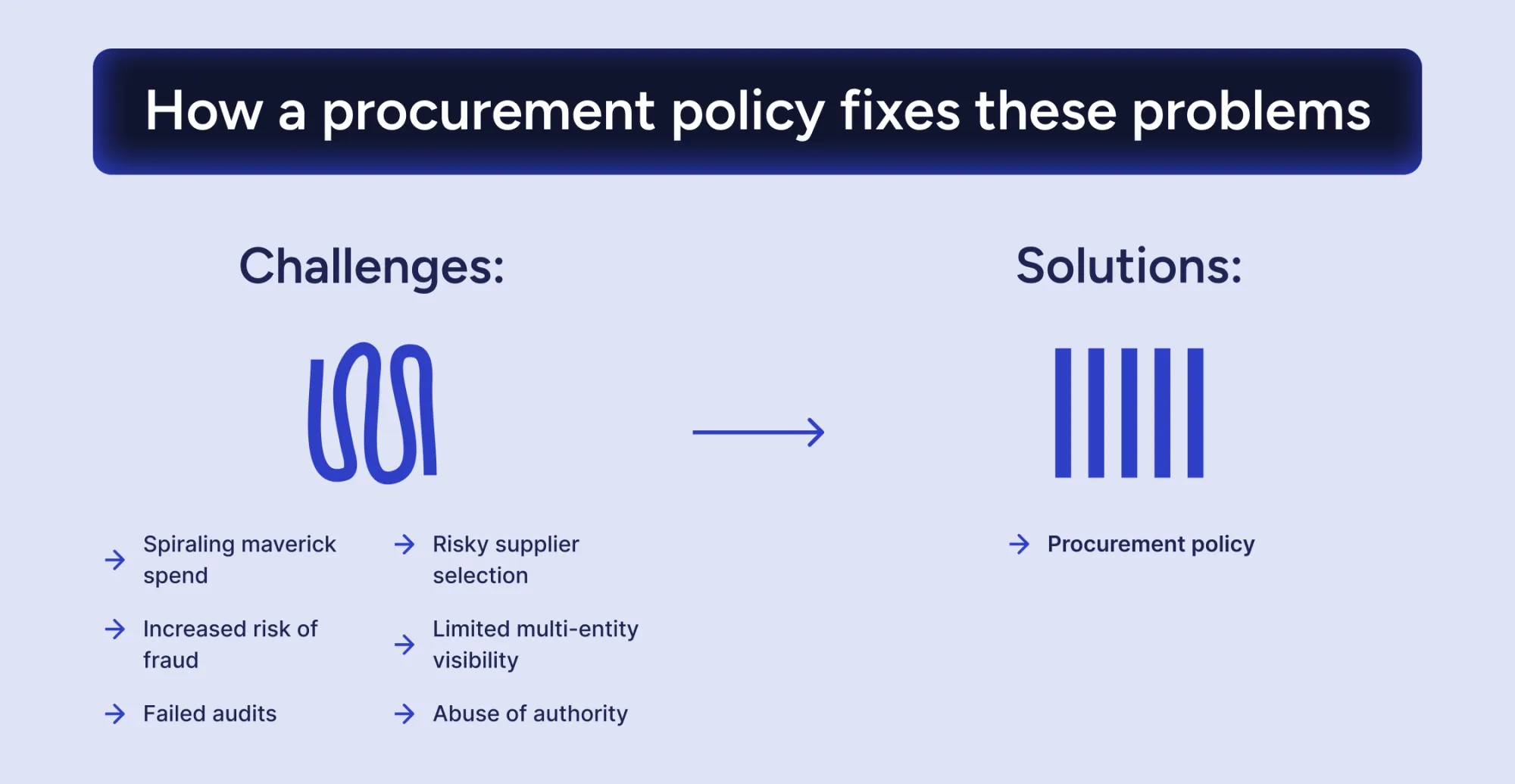
Spiraling maverick spend
Together with contract non-compliance, maverick spend is the main cause of spend leakages. When employees buy off-contract, you lose out on all the negotiation leverage you’ve developed with your trusted suppliers. Without a policy, a single transaction may snowball into thousands in non-compliant spend that a) loses you money and b) creates unnecessary risk that could’ve easily been avoided.
Increased risk of fraud and abuse of authority
Lack of internal controls accounts for one-third of all fraud cases. Any conflicts of interest or unethical transactions can easily slip through without defined purchasing rules. For example, a manager can favor a supplier without a valid reason or approve a purchase solely on their own. And without a procurement card policy, employees can easily misuse company funds for personal spending.
Failed audits
A procurement policy provides a single source of truth; without it, employees might approach purchasing differently. Some attach supporting documents, others don’t. Some are very studious about approvals, others rely on informal or even verbal sign-offs. Ultimately, you’re left with an inconsistent audit trail full of gaps and missing documents that won’t withstand any review.
Risky supplier selection
Employees often choose suppliers based on convenience rather than due diligence, which exposes the company to a multitude of supply chain risks, including poor performance, unethical practices, or delivery delays. You can prevent this by outlining clear vendor selection practices in the policy and then reinforcing them with software like Precoro that limits purchases to pre-approved suppliers.
Limited multi-entity visibility
The same fragmented purchasing you see between teams in a single organization is far more harmful on a bigger scale when multiple entities buy independently. Here, a single policy isn’t enough. You need to have clear guidelines for each location. Without a consolidated view of spend, you risk duplicate purchases and missed volume discounts.
How a procurement policy fixes these problems
By itself, it doesn’t. But the mere existence of a policy that employees know about already sets the precedent that “These are the suppliers we use, this is how we buy, and here are the tools to do it right.” Employees are made aware of the proper course of action and any repercussions they may face if they don’t follow it.
At first glance, it’s just a structure, but with controlled oversight and procurement software that enforces these rules, you get a compliance system that works on its own with minimum input from you.

Procurement policy non-negotiables vs. Guidelines
Every procurement policy contains two types of rules: those that must be followed and those that help employees but don’t have to be adhered to a T. To clearly differentiate between the two, we’ll refer to these categories as “non-negotiables” and “guidelines,” respectively. Both non-negotiables and guidelines will differ depending on the company and its objectives.
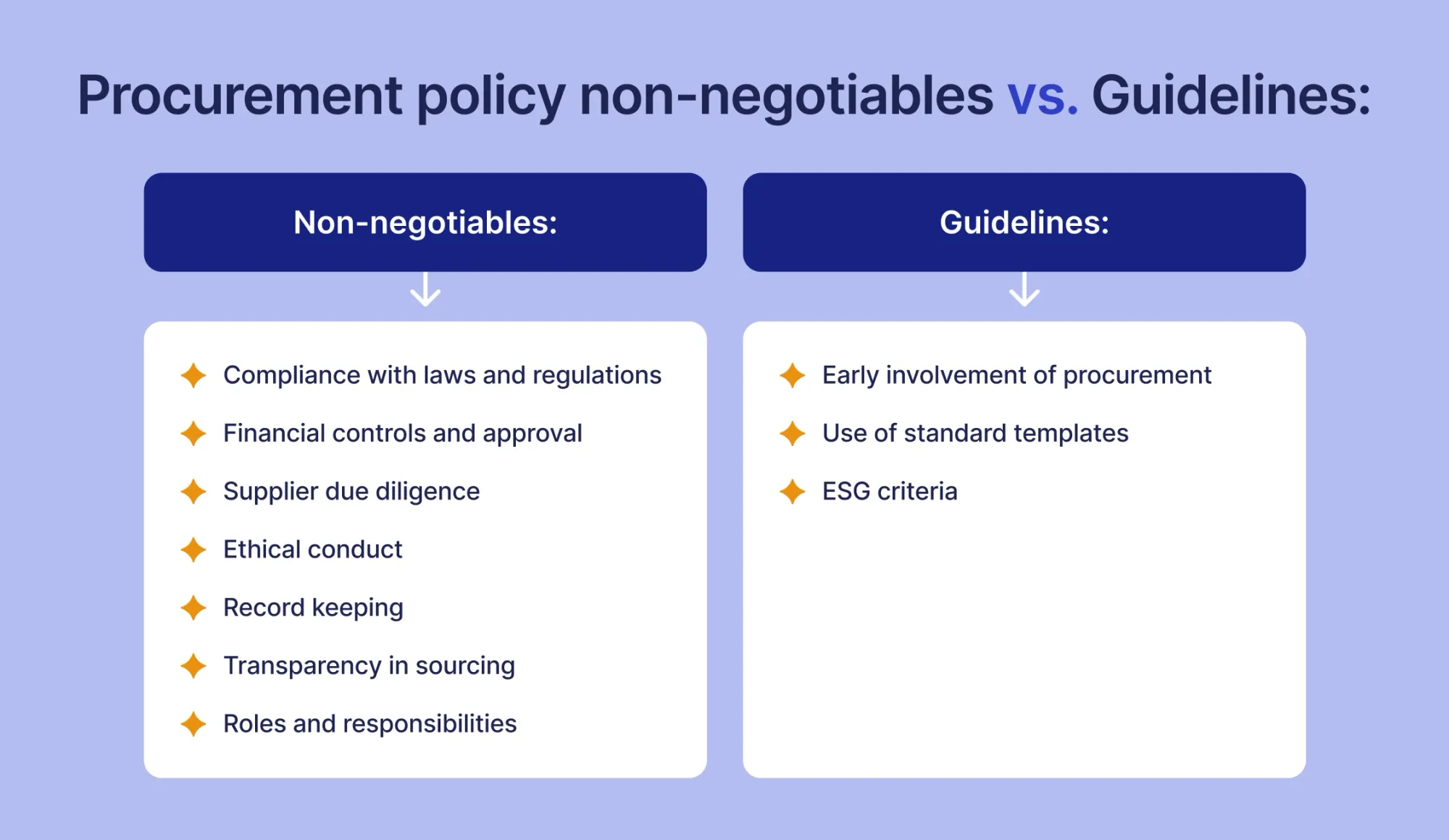
Non-negotiables
Non-negotiables are the mandatory rules your company sets to protect the business and ensure compliance. They aren’t open to interpretation and should be followed by everyone, with very few exceptions. Things like a procurement card policy or mandatory approval workflows fall under this category.
The repercussions for not adhering to these rules are severe both for employees and the company itself: employees can be fired or fined, while companies can face reputational and financial damage, not to mention regulatory penalties.
Points that should be made non-negotiable in the procurement policy include:
- Compliance with laws and regulations. A procurement policy must reflect current tax laws, audit regulations, and mandatory e-invoicing frameworks. For example, over 80 countries have already implemented e-invoicing mandates. If your policy doesn’t enforce this, the company is essentially vulnerable. And it’s not just about finance: any health and safety, anti-corruption, and environmental regulations that apply should be mentioned, especially if you’re aiming for a sustainable procurement policy.
- Financial controls and approvals. A good document defines who approves what based on the spend amount, so that no one can make large purchases without prior approval. If your teams use company cards, include a procurement card policy that outlines who gets access, what can be purchased, and what limits apply.
- Supplier due diligence. Before paying any supplier, you need to know who you’re dealing with. Policies must require vetting suppliers for financial health, legal and regulatory compliance, and reputation checks.
- Ethical conduct. Every procurement policy must clarify what's unacceptable and what principles one should follow. Here, the company outlines its stance on issues such as human rights, fair treatment of workers, sustainability, and transparency. It shows how the company takes responsibility for its actions.
- Record keeping. If a purchase isn’t documented, it didn’t happen. A good policy must require storing purchase orders, quotes, approvals, and invoices for a set number of years (typically 7–10). Additionally, the company should outline how it protects the procurement data: where it’s stored, for how long, and who can access it.
- Transparency in sourcing. Even if not legally required, competitive quotes and transparent supplier selection have become the standard in procurement under CSR. It shows that the company chooses suppliers fairly. If there are exceptions, like urgent purchases, the policy should list them and the reasoning behind them.
- Roles and responsibilities. A procurement policy must state who’s in charge of what: who requests, who approves, who negotiates contracts, and who ensures policy compliance.
Guidelines
Procurement policy guidelines are flexible recommendations based on best company practices. Employees have some flexibility and can rely on their judgment and the context of the situation. Guidelines typically use language like “should” or “may” instead of “must/shall” required for non-negotiables.
- Early involvement of procurement. It’s not a requirement and definitely one of those context-dependent situations. The procurement team can help align purchasing with budgets and secure better terms. It’s just good practice to involve them for key suppliers or high-volume purchases, especially if you're aiming to meet sustainability goals in a green procurement policy.
- Use of standard templates. Most companies rely on standard templates for RFQs, RFPs, intake forms, and purchase orders to catch every detail. It’s not realistic to enforce them for every scenario, so the policy can recommend using templates wherever possible and leave room for exceptions. Procurement software is especially useful here: you can set standard templates for most transactions, but also enable custom fields to capture additional details.
- ESG criteria. ESG and regulatory demands are predicted to have a major impact on strategic sourcing in the next 3-5 years. Besides cost and risk, businesses now consider environmental and ethical factors during sourcing. These expectations will only grow over the years, so including them in a sustainable procurement policy early on sets you ahead.
How to write an effective procurement policy: Best practices
Procurement policies aren’t easy to write since there are so many factors to consider. Here’s how to draft an effective policy that every employee will understand.
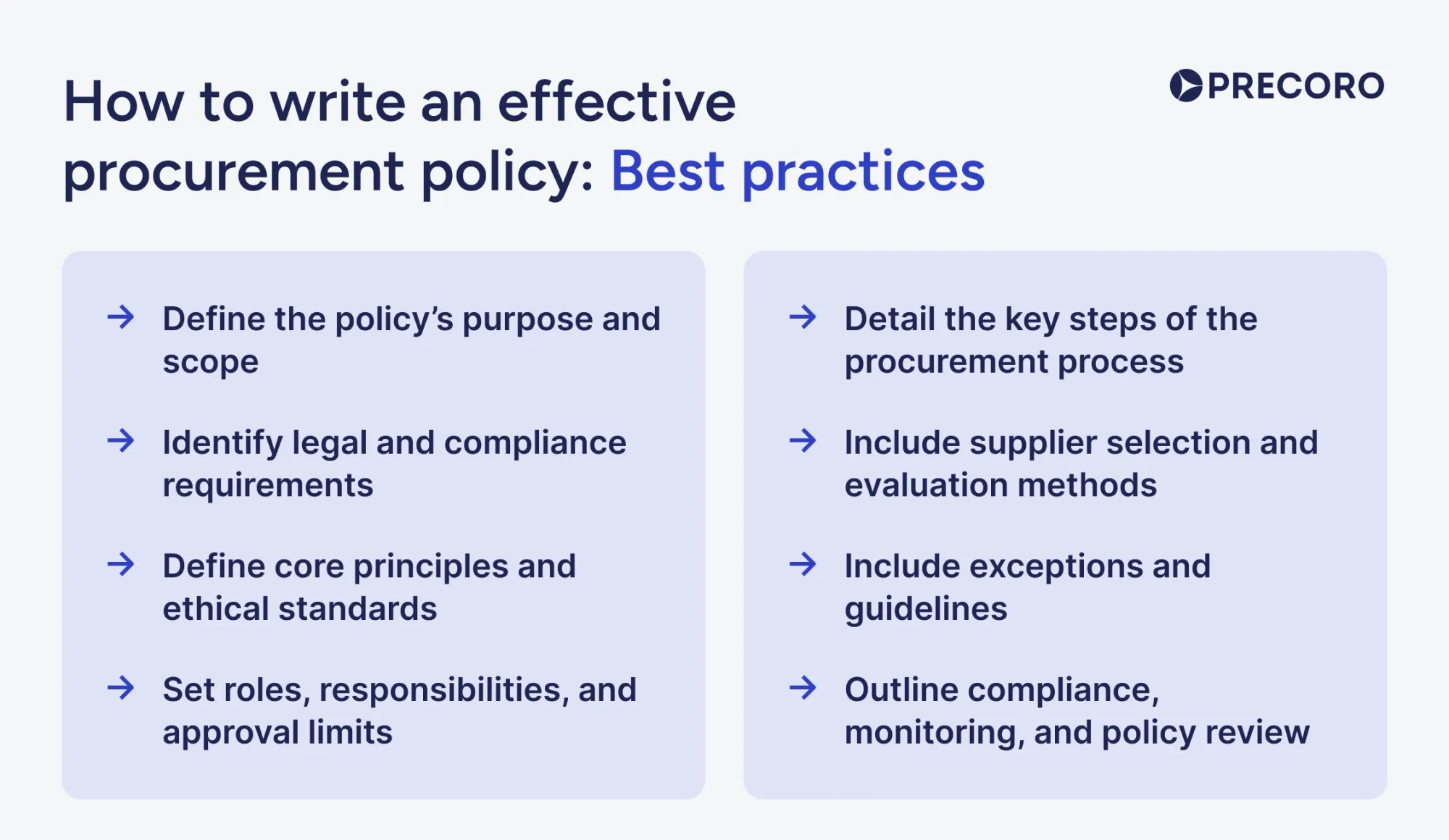
1. Define the policy’s purpose and scope
Clearly state why this policy exists. To minimize risks? Ensure legal compliance across multiple countries or departments? Then, explain the scope: who this policy applies to and which purchases it affects. If there are any exceptions (e.g., renting of properties, investments), list them as well to cover all bases.
Keep the purpose short and specific. Vague statements like “improve procurement” leave too much room for interpretation and little to no understanding of the company’s objectives. Phrases that reflect what you want to achieve, like “meet legal requirements in all operating countries” or “ensure purchasing aligns with principles,” provide a clearer picture.
2. Identify legal and compliance requirements
Before setting rules, understand what your policy must comply with. These can include tax laws, VAT regulations, e-invoicing mandates, ESG reporting, and ethical sourcing laws. Work with finance, legal, and compliance teams to document all relevant obligations. If sustainability is part of your company’s goals, a green procurement policy should also be addressed.
3. Define core principles and ethical standards
In this section, the company outlines what standards of purchasing it strives to achieve. It serves as a code of conduct that reflects the company’s values. Procurement policy examples include transparent and fair procurement practices, timely delivery, and competitive sourcing.
4. Set roles, responsibilities, and approval limits
List who is allowed to do what. Who can request a purchase? Who approves it? Who handles contracts or selects vendors? Use clear spend thresholds for approvals (e.g., “Managers can approve up to $5,000” or “Procurement director has to be involved for purchases over $100,000”). Also, separate duties so that the requester can’t approve their own purchase.
5. Detail the key steps of the procurement process
This section summarizes all procurement policy procedures. Here, you outline exactly how each step of purchasing works at your company. Include requisition, approval, supplier selection, PO issuance, goods receipt, invoice processing, and payment. Use plain language that’s easy for any employee to understand.
6. Include supplier selection and evaluation methods
Clarify how new vendors get approved, what documents are needed, and whether there are preferred or single-source suppliers. Also define how vendors are selected, whether it’s through competitive bidding or direct selection, and when each of the methods applies.
Clearly state the number of people involved in the sourcing process and set spend thresholds that require extra approvals. If you work with critical or high-risk vendors, explain how due diligence should be performed. For example, some companies verify if suppliers are mentioned in any sanctions lists.
7. Include exceptions and guidelines
Define when an exception can be made (for example, in emergencies) and how it should be documented. Use clear, firm language for non-negotiables so there’s no room for confusion. At the same time, include helpful guidelines, like favoring suppliers that comply with the sustainable procurement policy.
8. Outline compliance, monitoring, and policy review
State how the policy will be enforced, how often it will be reviewed, and who owns it. Assign ownership to procurement leadership. Procurement policy news can impact how often your policy should be reviewed. Specify how compliance will be monitored and set a date for a review to update procedures in case any regulations change.
Simple procurement policy template
You don’t need a 50-page document for your first policy to control spend. What matters is that it’s actually used by your teams. Below is a procurement policy template that can go a long way. You can customize it based on your regulatory obligations, goals, and size. All the statements made in this template are purely a procurement policy example.
Procurement Policy
Use the sections below to view or hide each part of the procurement policy template.
Purpose
This policy outlines the guidelines for purchasing goods and services by [Company]. Its goal is to ensure purchasing is consistent, transparent, compliant with regulations, and aligned with our business goals.
Scope
This policy applies to all employees, contractors, departments, and subsidiaries involved in procurement activities. It covers all purchases related to goods, services, subscriptions, consulting, and software.
Definitions
- Procurement: The end-to-end process of acquiring goods or services.
- Approved supplier: A vendor reviewed and authorized by the procurement team.
- Competitive bidding: Comparing supplier proposals to select the best option.
- Emergency purchase: A time-sensitive purchase to prevent operational disruption.
- Conflict of interest: When personal interests may influence purchasing decisions.
Core principles
- Transparency: Decisions must be traceable and justified.
- Fairness: All suppliers are treated equally.
- Value for money: Purchases aim for the optimal balance of cost and quality.
- Ethics: Employees may not benefit personally from procurement decisions.
- Sustainability: Environmental and social impact is considered where feasible.
Roles & responsibilities
- Requesters: Submit purchase requests with complete details.
- Approvers: Authorize purchases based on spending limits.
- Procurement: Sources vendors, manages bidding, ensures compliance.
- Finance: Confirms budgets and aligns purchases with financial controls.
- Accounts Payable: Matches invoices to POs and processes payments.
Procurement procedures
- Requisition: Submitted through [Procurement System] with item details and documentation.
- Approval: Routed based on amount and workflow.
- Vendor selection: From approved list or competitive bids.
- PO creation: Must be issued before ordering unless exempt.
- Receipt: Confirm delivery and quality before invoice approval.
- Invoice match: Must include a valid PO and match order + receipt.
- Payment: AP processes according to agreed terms.
Spend thresholds & approval workflows
Approval levels depend on purchase value and category. These controls must always be followed.
Supplier due diligence
[Company] works only with suppliers who demonstrate the legal, financial, and professional ability to complete their work responsibly.
Policy review
This policy is reviewed periodically [TIMEFRAME] or as required by Procurement and Finance.
Frequently asked questions about procurement policy
A procurement policy includes the rules your company expects everyone to follow when buying goods or services. It outlines the purpose of the policy, who it applies to, what counts as an approved supplier, what ethical and compliance standards must be met, and who is responsible at each stage of the process.
A procurement policy matters because without one, purchasing becomes inconsistent and, frankly, risky. Companies suffer from more maverick spend, a greater risk of fraud instances, and weaker control over budgets or contracts. A clear procurement policy template makes the entire process transparent, creates a clear audit trail, and ensures the company aligns with regulations.
First, clarify what the company wants it to achieve: better spend control, stronger compliance, or more consistent buying across locations. From there, document how purchasing works today, decide on the rules you want to standardize, assign responsibilities, and establish approval workflows and spend limits. If your goal is to establish a sustainable procurement policy, outline compliance with relevant environmental and sustainability regulations.
A procurement policy can establish the rules, but it can’t enforce them. If employees are set on sticking to the old ways, there’s no guarantee the policy will be adopted. You need the right tools for that. The policy also can’t compensate for missing data, inconsistent supplier relations, or systems that can’t support multi-entity management. Without the right technology in place, even a well-written green procurement policy will fall short.
People follow the policy when it actually makes the process easy and transparent. If a workaround is quicker than the compliant method, then the company should rethink how it handles that specific step. Look at the everyday workflows and build the policy around them, not the other way around.
Enforce your procurement policy with Precoro
Any procurement policy is only as strong as the processes and the tools behind it. Writing down rules isn’t enough; you need to actually enforce them. Precoro helps embed the practices you establish into the day-to-day procurement operations. See how the platform can make procurement policies and procedures a default for your team:
Approval workflows that mirror your policy
Precoro lets you build approval workflows that follow your exact rules, whether it’s by document type, product category, or legal entity. Approvals are routed automatically to the right people, and you can set SLAs to prevent any delays.
Catalogs and PunchOuts
With Precoro’s catalogs and PunchOut integrations, employees shop from the right suppliers by default. They only see approved vendors and items with the correct pricing, so there’s no room for off-contract purchases.
Real-time budget control
Precoro performs budget checks the moment a request or purchase order is created, not after the fact. If a purchase exceeds the budget, or it nears its limit, the system alerts the user.
Guided intake forms
You can tailor request forms with custom fields, so teams enter exactly the data your policy requires. Control what information employees must provide, like department, location, or item category, and ensure that all requests include the right details from the start.
Automated three-way matching
Precoro compares the invoice to the PO and the receipt automatically. If something doesn’t line up, the platform flags it right away so you can fix it before approving the payment. Additionally, Precoro’s AI-powered OCR extracts data directly from the invoice and adds it to the system, so there’s no need to enter details by hand.
Role-based access and audit trails
Every action in Precoro is logged, timestamped, and tied to a specific user. Role-based permissions ensure employees only see and do what their role allows.
Multi-entity visibility and reporting
Precoro consolidates purchasing across branches, locations, and subsidiaries in interactive dashboards and custom reports, so you can see who buys what at any time.
Turn your procurement policy into an enforced process.
See Precoro in action.