









 Explore Precoro's features



















Most procurement teams don’t struggle because they lack tools. They struggle because buying has turned into a maze.
An employee needs a service, software, or a new supplier, and suddenly they’re guessing: “Which system do I use? Who needs to approve this? Do I need to involve legal? Is there a preferred vendor?” The result is familiar: emails instead of requests, late approvals, urgent exceptions, and invoices showing up before anyone agreed on the terms.
Procurement orchestration is a response to that reality. It doesn’t introduce more processes or expect employees to “think like procurement.” Instead, it works in the background to coordinate existing people, policies, and systems so each request automatically flows along the right path.
This guide to procurement orchestration breaks down what orchestration actually is (and what it isn’t), why it’s becoming critical now, and how to turn fragmented buying into a connected, end-to-end process.
What is procurement orchestration?
Procurement orchestration is the “connective tissue” that coordinates the full request-to-buy journey. As a result, a purchase doesn’t depend on an employee knowing which tool to use, which form to fill out, or which team to contact. Instead, orchestration automatically directs each request through the right path based on what’s being bought, the value, the risk level, and the organization’s policies.
At its core, procurement orchestration aligns three things:
- People: Requesters, budget owners, procurement, legal, finance, IT.
- Policies: Approval thresholds, preferred suppliers, category rules, budget controls, compliance requirements.
- Systems: ERP, P2P, sourcing tools, contract management, risk platforms, AP automation.
The goal is simple: every request follows the right steps, in the right order, with the right controls.
Here’s how procurement orchestration differs from traditional procurement.
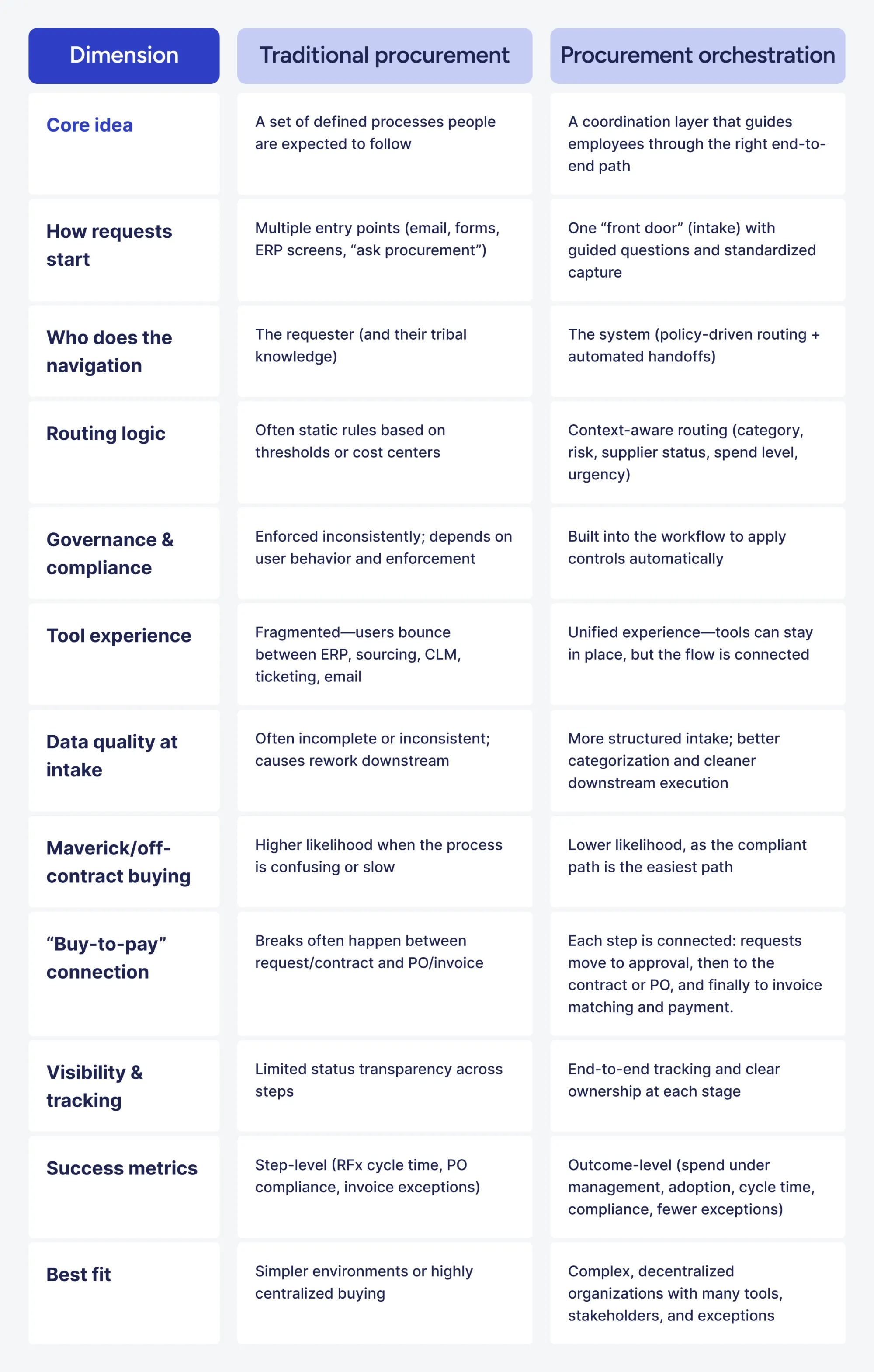
Intake vs. orchestration: Front door vs. traffic control
A practical way to think about the difference between procurement intake and orchestration is this:
Intake is the front door.
Intake is a portal, form, or chatbot where requests and a guided buying experience start. It captures the basics (what’s needed, when, estimated value, supplier preference, business purpose) and makes it easy for employees to ask for help or buy the right thing.
Orchestration is the traffic control tower.
Once the request comes in, orchestration determines what happens next and routes it accordingly across workflows, teams, and tools. It “decides the path” and coordinates execution end-to-end.
In other words, intake collects requests, and orchestration ensures they follow the right process.
Why procurement orchestration matters now
Procurement has been getting more complex, not less. Most organizations now operate with more tools, stakeholders, approval steps, and compliance requirements than ever before. At the same time, a growing share of spend happens outside standard channels because employees are under pressure to move fast and don’t always know the right way to buy.
The result is a familiar pattern: low adoption of procurement tools, limited visibility into what’s being bought and why, inconsistent controls, and downstream pain in finance, legal, and AP. Orchestration emerges as a response to this reality.
The market for procurement orchestration platforms is booming, expected to grow nearly 14% a year through 2033 and hit around $12.9B. That shows just how much organizations want a connected end-to-end control over their buying.
Orchestration matters now because two broader shifts are accelerating the need for coordination:
AI is entering procurement workflows.
Automation, decision support, and increasingly agent-like capabilities can move work faster, but only if a clear system defines paths forward: when humans should step in and how every decision can be audited. Without orchestration, AI just amplifies fragmentation. AI in procurement orchestration provides a safe, scalable way to execute end-to-end procurement workflows.
The business is demanding tighter control and faster outcomes at the same time.
Organizations are under pressure to manage costs, reduce leakage, and shorten cycle times, often with lean teams and decentralized buying authority. Traditional, manual processes can’t keep up with that reality. Procurement orchestration helps by applying the right level of control to each request:
- Simple, low-risk purchases move quickly.
- Higher-risk or higher-value purchases get the reviews they need.
- Ownership is clear at every step.
The strategic value of procurement orchestration
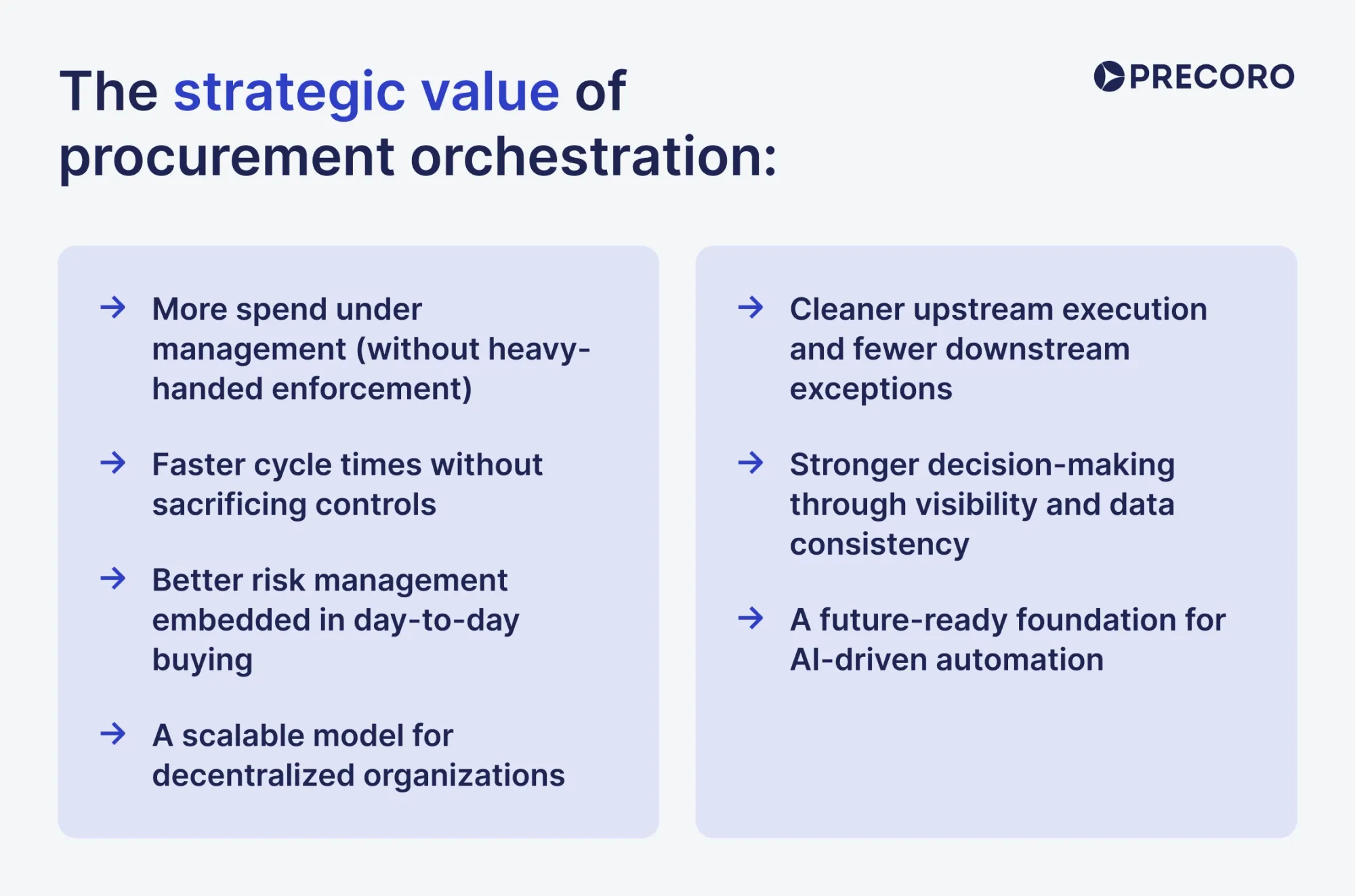
Procurement orchestration isn’t just a workflow improvement. Done well, it becomes a strategic capability that helps companies control spend, manage risk, and move faster without adding friction or headcount. The value comes from turning procurement from a set of disconnected steps into a coordinated operating system.
Below are the main ways the procurement orchestration layer delivers strategic impact.
More spend under management (without heavy-handed enforcement)
Maverick spend (purchases made outside preferred channels) remains one of procurement’s biggest challenges. Employees often bypass the system because the process is unclear, slow, or frustrating. Orchestration tackles this automatically:
- A single intake point makes it obvious where to start.
- Guided buying directs users to preferred suppliers and catalogs.
- Exceptions are routed for proper review rather than skipped.
The result is more spend under management, fewer duplicates, stronger supplier leverage, and more consistent pricing, all without turning procurement into a policing function.
Faster cycle times without sacrificing controls
Organizations often feel stuck between speed and control. Adding approvals slows work down, but skipping them increases risk and cost. The procurement orchestration layer resolves this by applying the right level of governance to each request:
- Low-risk, low-value purchases can be fast-tracked.
- Higher-risk or higher-value requests trigger deeper reviews.
- Parallel approvals (for example, budget, legal, IT/security) reduce bottlenecks.
Strategically, procurement acts as a speed enabler that safeguards compliance and audit readiness.
Better risk management embedded in day-to-day buying
Risk doesn’t only come from large suppliers. It also appears in everyday purchases, when organizations bring on unknown vendors without proper checks, sign contracts with unfavorable terms, purchase software without a security review, and contract services without a clear scope of work.
Procurement orchestration makes risk controls part of the normal flow:
- New suppliers go through a structured onboarding.
- Category-specific reviews (legal, security, compliance) are triggered automatically.
- Contracts and approvals are completed before work begins.
Strategically, orchestration reduces urgent escalations, contractual disputes, and compliance gaps and leaves behind clean, reliable audit trails.
Cleaner upstream execution and fewer downstream exceptions
A lot of AP headaches start upstream: invoices arrive without POs, contracts don’t match the scope, supplier details are incomplete, and approvals happen after the fact.
Orchestration strengthens the request-to-pay process by making sure every necessary document is completed before the invoice comes in:
- The request is categorized and approved appropriately.
- The contract (if needed) is executed.
- The PO (if required) is created correctly.
- Invoice reconciliation becomes more reliable.
For long-term impact, the procurement orchestration layer reduces exception handling and frees finance and procurement teams from low-value firefighting.
A scalable model for decentralized organizations
Most growing organizations become decentralized: they gain more teams, locations, budgets, and autonomy. Traditional procurement models struggle because they require either heavy central control, which is slow and unpopular, or loose guidelines, which are inconsistent and risky.
Orchestration supports a “federated” approach:
- Centralized policies and preferred channels.
- Local flexibility where it makes sense.
- Consistent routing, governance, and tracking across business units.
Strategically, predictive procurement orchestration makes processes scalable: you can standardize buying without forcing every team into one rigid process.
Stronger decision-making through visibility and data consistency
Procurement insights are only as good as the data behind them. When requests start in email, approvals happen in chat, and invoices arrive late, visibility suffers. Procurement orchestration improves data quality at the source:
- Structured intake captures consistent information.
- Spend is categorized earlier and more accurately.
- Approvals, exceptions, and decisions are recorded reliably.
This clarity allows teams to see where maverick spend is happening, which categories are slowing down approvals, where duplication exists, and which policies create unnecessary friction.
A future-ready foundation for AI-driven automation
As procurement teams adopt more automation (and increasingly AI-driven capabilities), coordination becomes more important, not less. Automating one step at a time can create more fragmentation unless there is a clear end-to-end “command layer” that governs what happens next.
Orchestration provides that foundation:
- Consistent workflows for AI agents or automated steps.
- Clear controls and escalation paths.
- Traceable, auditable decision-making.
Strategically, AI in procurement orchestration lets the team adopt automation safely, without losing control, and extra exceptions.
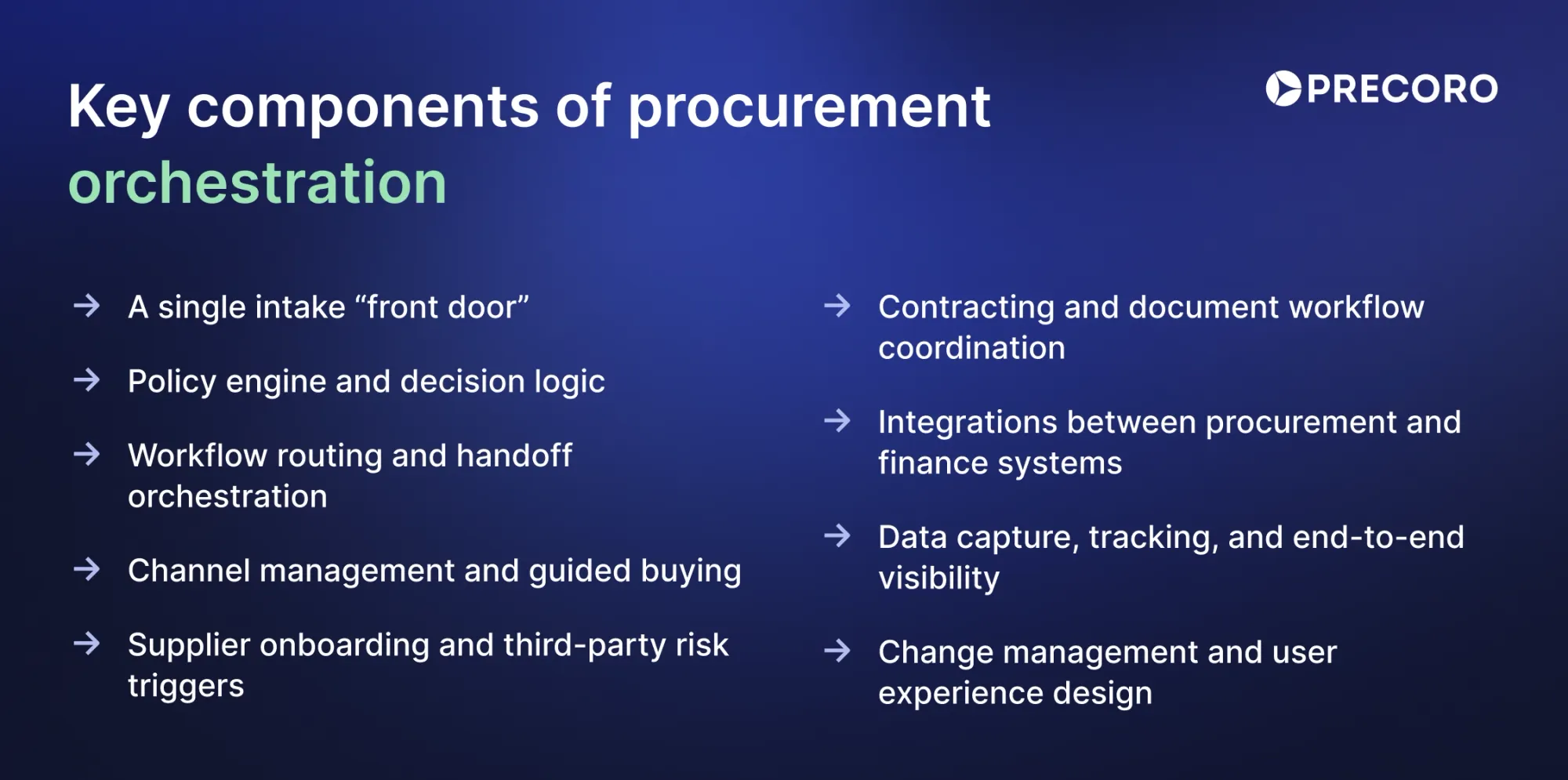
Key components of procurement orchestration
Procurement orchestration is most effective when it structures the entire buying journey without forcing employees to become procurement experts. This simplicity is possible because orchestration is built on a set of interconnected components that guide requests behind the scenes.
Some are user-facing and help employees submit requests correctly and confidently, while others operate in the background and handle routing, integrations, controls, and tracking. Together, these components transform the request-to-pay process into a seamless, end-to-end flow.
1) A single intake “front door”
Procurement orchestration starts with intake, the entry point where requests either become structured and compliant or turn into email chaos.
A strong intake layer provides:
- One place to submit requests (portal, form, guided buying, chatbot, or ticket-style intake).
- Prompts to capture essential details (category, value, urgency, supplier info, business purpose).
- Guidance that directs users to the simplest compliant path (catalog items, preferred suppliers, self-service options).
Intake is how orchestration gets clean data and high adoption. If people skip the front door, orchestration can’t do its job.
2) Policy engine and decision logic
At the core of procurement orchestration is a policy engine that determines the next step for each request. It handles rules such as:
- Approval thresholds and delegation of authority.
- Category-specific requirements (e.g., security review for software or legal review for contracts).
- Preferred supplier rules and off-contract exception handling.
- Budget or cost center validation.
- Compliance checks (regulatory, data privacy, or ESG, where applicable).
Without decision logic, orchestration is just a generic workflow. With it, every request automatically follows the right path.
3) Workflow routing and handoff orchestration
Procurement involves multiple workflows depending on category, risk, region, and spend level. Orchestration ensures each step is coordinated and handoffs are clear.
Key capabilities include:
- Automated routing to the right approvers.
- Parallel reviews to reduce cycle time.
- Exception paths and escalation rules for urgent requests, missing info, or policy overrides.
- SLA tracking and ownership clarity.
Most delays happen because ownership is unclear. Orchestration reduces “who’s next?” confusion.
4) Channel management and guided buying
A major promise of the procurement orchestration layer is that it doesn’t treat every purchase the same. It helps route demand to the correct buying channel:
- Catalogs or PunchOuts for standard goods.
- Preferred suppliers for repeatable services.
- Sourcing events (RFQ/RFP) for competitive or high-value buys.
- Spot buy flows for one-off purchases with guardrails.
- Contract workflows for anything requiring legal terms.
After all, channel management turns policy into action without slowing the business.
5) Supplier onboarding and third-party risk triggers
Many procurement risks appear with new vendors. Typically, orchestration doesn’t treat supplier onboarding and risk checks as separate administrative tasks. Instead, it integrates them directly into one buying flow.
It includes:
- Collecting vendor details, including tax and banking information.
- Triggering risk checks (financial, sanctions, insurance, security questionnaires, privacy, or DPA requirements).
- Ensuring supplier approval before contract signature or PO/invoice processing.
These measures prevent late-stage surprises and reduce the likelihood of paying suppliers who haven’t been properly vetted.
6) Contracting and document workflow coordination
In categories such as services and software, procurement orchestration often coordinates contract-related work. Rather than replacing contract management, it ensures the right documents get created and approved at the right time.
Common elements include:
- Template selection by category and risk (NDA, MSA, SOW).
- Required clause checks or review triggers.
- Signature routing and status tracking.
- A link between final agreements and purchase records.
Remember that many compliance issues happen when work begins before terms are agreed upon or when the final contract is hard to find later.
7) Integration layer across procurement and finance systems
Procurement orchestration only works when it can link all the steps across the systems that execute them. Without these connections, even the best workflow logic can break down, creating gaps, duplicate effort, or lost approvals. Typical integration points include:
- ERP or P2P systems for requisitions, purchase orders, goods receipt, and invoice matching.
- Sourcing tools, such as RFx platforms, bidding systems, and supplier quote management.
- Contract lifecycle management (CLM) for contracts, clause libraries, and approval workflows.
- Supplier management and risk platforms for onboarding, compliance, financial checks, and monitoring.
- AP automation and payment systems to ensure seamless processing from PO to payment.
- Identity and access management for secure approvals, role-based access, and audit trails.
Orchestration serves as a coordination layer that connects your existing systems instead of replacing them. Strong integrations make the P2P process seamless and turn theory into a reliable operating model.
8) Data capture, tracking, and end-to-end visibility
A major value driver of procurement orchestration is transparency. When stakeholders can see where a request is, who is responsible for the next step, and what is causing delays, decisions become faster, errors drop, and accountability improves.
Key capabilities include:
- Unified request timeline tracks the full journey from intake through approvals, sourcing or contracting, purchase order, and invoice.
- Status dashboards provide real-time updates for procurement teams, budget owners, and business stakeholders.
- Audit-ready logs capture all approvals, exceptions, and policy overrides to ensure compliance and simplify reviews.
- Actionable analytics highlight bottlenecks, adoption patterns, spend leakage, cycle times, and process inefficiencies.
Visibility turns procurement from a “black box” into a measurable, accountable operation. Teams can spot delays before they escalate, identify where policy or process improvements are needed, and use real data to drive efficiency across the request-to-pay process.
9) Change management and user experience design (often overlooked)
Change management and user experience aren’t technical components, but they function like them. After all, even the best orchestration system fails without proper user adoption. That’s why a smooth, intuitive experience is a priority.
Key elements include:
- Intuitive requester experiences: Minimize form fields, offer guided prompts, and make it obvious what to do next.
- Embedded policy guidance: Communicate rules and approvals within the workflow itself, so users don’t have to hunt through documents or manuals.
- Training and enablement: Ensure targeted onboarding for frequent requesters, plus ongoing support for new processes or tools.
- Feedback and continuous improvement loops: Monitor drop-offs, exceptions, and repeated errors to refine processes, interfaces, and guidance.
Procurement orchestration designed only for governance carries a risk of low adoption and frustrated users. By focusing on the human experience, procurement can achieve compliance naturally and make the system feel easy and supportive instead of bureaucratic.
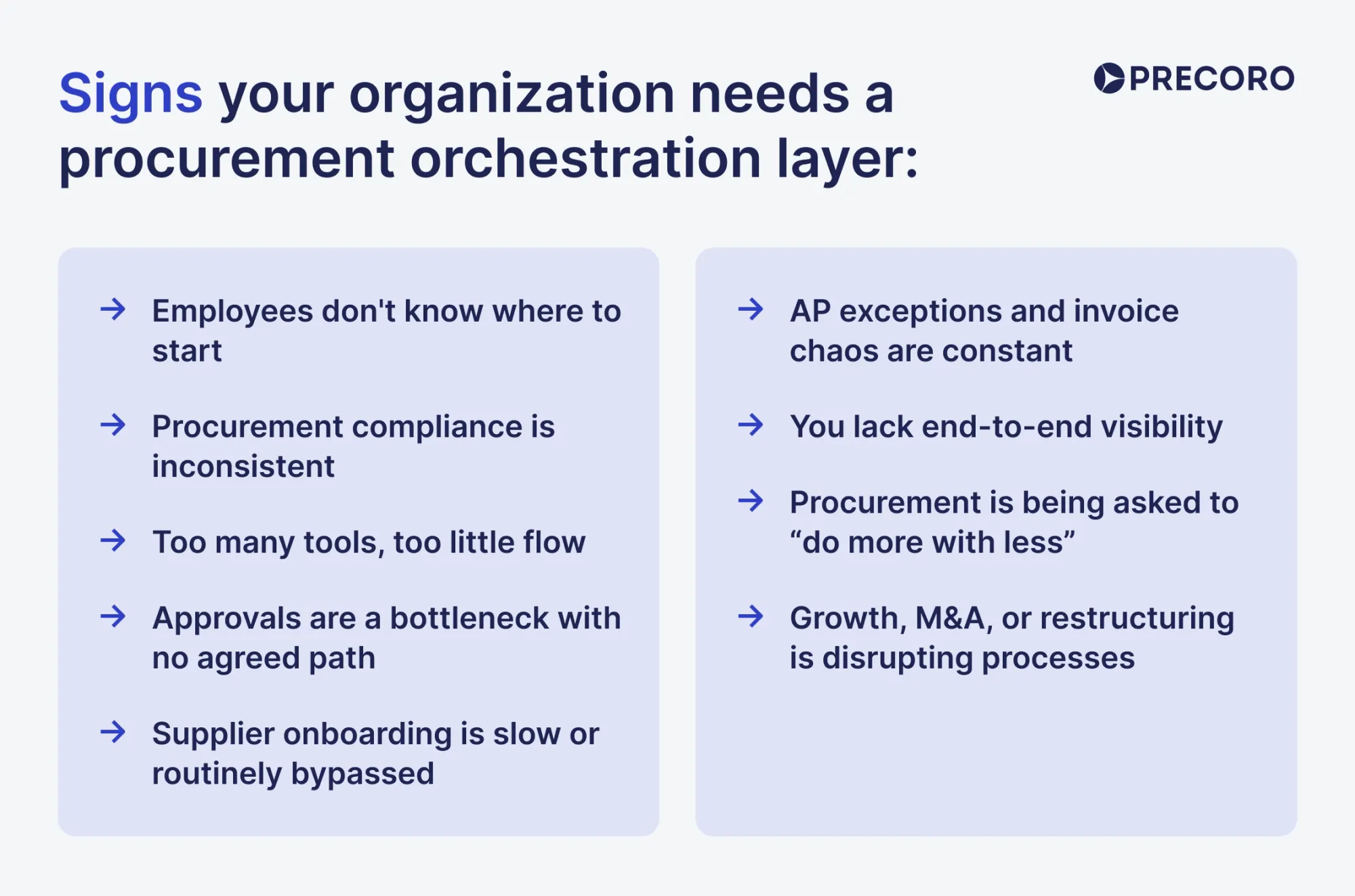
Signs your organization needs a procurement orchestration layer
Procurement orchestration becomes valuable when buying is no longer “one process in one system,” but a mix of tools, stakeholders, and exceptions—and the business is paying the price in leakage, delays, and risk. If several of the signals below appear consistently, it’s a clear sign that you need a procurement orchestration layer to unify and automate your workflows.
Employees don’t know where to start (procurement becomes a help desk)
A classic red flag: procurement has become an inbox. Employees ask by email how to buy, submit incomplete requests, and use different forms or channels for similar purchases across teams.
If the process relies on tribal knowledge, it won’t scale. An orchestration layer gives everyone a single front door and consistent routing so requests are handled predictably.
Procurement compliance is inconsistent
When employees bypass procurement, it’s rarely about disliking governance. Usually, the compliant path is unclear or slow.
Red flags include:
- Frequent off-contract purchases in categories that should be standardized (IT, marketing, facilities, MRO).
- Multiple suppliers are used for the same need (supplier sprawl).
- Large price differences for identical SKUs or similar services.
- “We already bought it—can you approve and pay for it now?” requests.
Predictive procurement orchestration guides users to approved channels, flags exceptions for easy handling, and helps minimize maverick spend.
Too many tools, too little flow (the “stack without a system” problem)
Many organizations have invested in procurement tech, but still run the process through email and spreadsheets.
Signs include:
- Users have to jump between systems to complete a single purchase.
- Handoffs break between sourcing, contracting, purchase orders, and invoices.
- Procurement spends time chasing document statuses rather than managing suppliers or savings.
- The same data gets re-entered multiple times.
An orchestration layer doesn’t necessarily replace your existing tools. It connects them into a coherent end-to-end experience.
Approvals are a bottleneck, and no one agrees on the “right” path
When purchase cycle times vary widely, the root cause is usually unclear routing, not a lack of effort. Without a clear process, approvals get stuck, work is duplicated, and both business and procurement teams get frustrated.
Common symptoms:
- Approvals stall because ownership isn’t clearly defined.
- The business feels procurement “slows everything down.”
- Procurement struggles with requests that arrive late or miss critical information.
- Approvals happen one after another instead of in parallel, creating unnecessary delays.
Orchestration introduces consistent decision logic (based on category, value, risk) and can support parallel reviews, so governance doesn’t automatically mean delay.
Supplier onboarding is slow or gets bypassed
When vendor setup takes too long, the business finds workarounds. That’s when risk and payment issues multiply.
Red flags include:
- “Urgent vendor setup” requests show up every week.
- AP receives invoices from suppliers not in the system.
- Incomplete banking or tax details lead to payment delays.
- Suppliers start work before risk checks are completed.
The procurement orchestration layer can route new supplier requests through onboarding and risk checks automatically with clear status tracking.
AP exceptions and invoice chaos are constant
When accounts payable is swamped with exceptions, the problem usually starts upstream (at the point of request, approval, or procurement execution).
Common signs:
- Frequent non-PO invoices, or POs generated only after the invoice arrives.
- Low 2-way or 3-way match rates due to missing, incorrect, or inconsistent data.
- Disputes over what was approved versus what was delivered.
- Finger-pointing between procurement and finance over process gaps.
Orchestration improves the request-to-pay connection: it ensures approvals, contracts, and POs are created correctly before the invoice arrives.
You lack end-to-end visibility (you can’t answer basic questions)
If you can’t confidently answer questions like:
- “Where is this request right now?”
- “Who is the blocker?”
- “How long do requests take by category?”
- “Which policies create the most exceptions?”
…then your processes are fragmented.
Procurement intake and orchestration provide unified tracking and an audit trail across functions and tools.
Procurement is being asked to “do more with less”
When headcount is flat, but complexity rises, the real lever is not harder work, but better coordination.
If procurement is expected to:
- Increase spend under management.
- Improve compliance and risk controls.
- Accelerate cycle times.
- Support more stakeholders and categories.
…without extra people, orchestration becomes a practical way to scale.
Growth, M&a, or restructuring is making processes inconsistent
Complexity spikes when you expand into new regions, add business units, or integrate acquired companies.
Signals include:
- Different approval chains and tools across business units.
- Inconsistent supplier lists and contract standards.
- Fragmented policies and no single intake path.
- Stalled integration efforts due to unharmonized processes.
Orchestration can provide one front door and consistent governance, even if different back-end systems remain in place for now.
Quick self-check: When orchestration is likely worth exploring
You’re a strong candidate for a procurement orchestration layer if you have two or more of the following at scale:
- Decentralized buying with inconsistent processes.
- Multiple procurement systems with broken handoffs.
- High services or software spend with recurring risk or compliance gaps.
- Frequent invoice exceptions or high non-PO volume.
- Weak visibility into request statuses and bottlenecks.
- Complaints about procurement speed or frustration with late or incomplete requests.
If procurement feels like a set of disconnected lanes, orchestration becomes the traffic-control layer that turns it into a coordinated, end-to-end system.
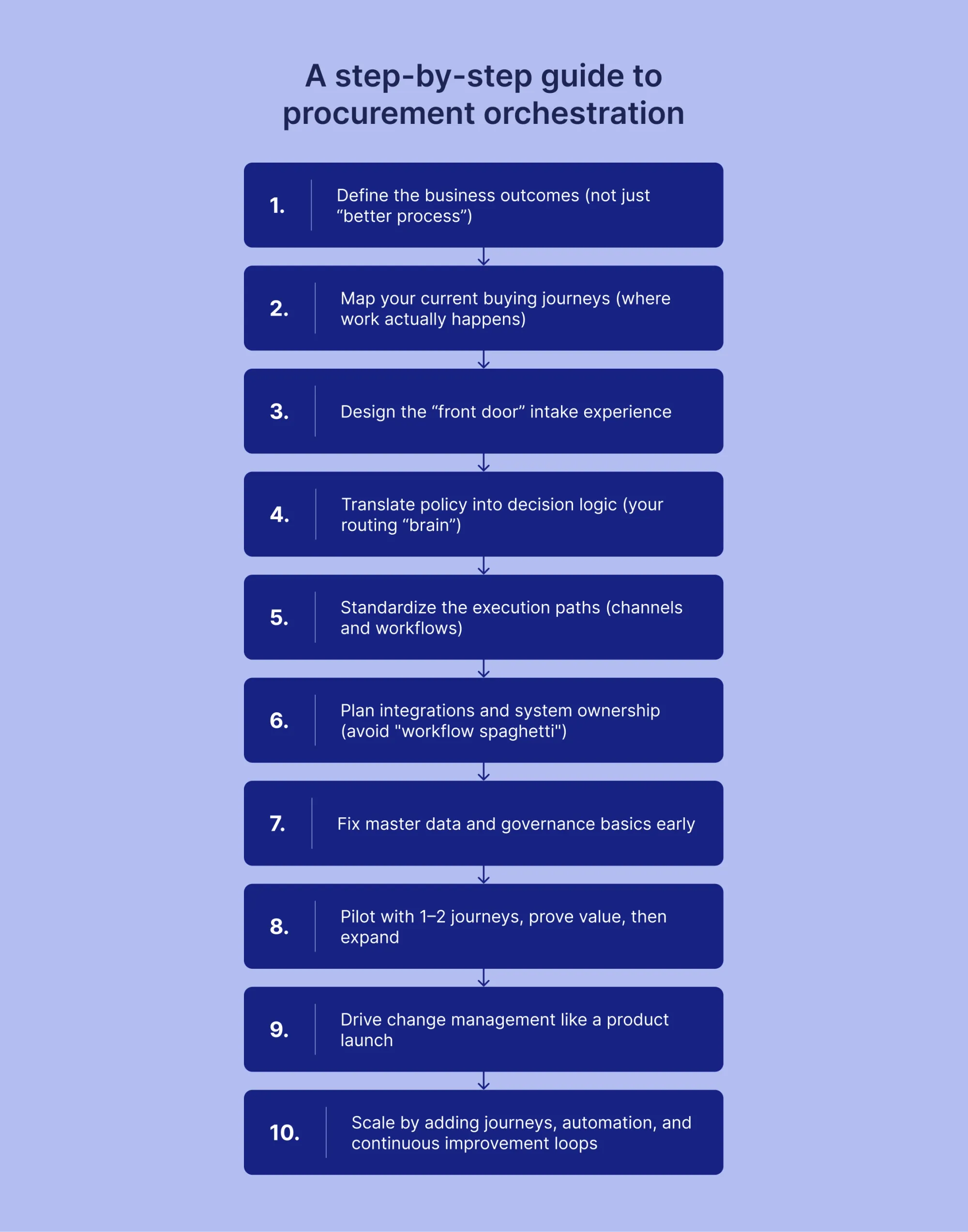
A step-by-step guide to procurement orchestration
Implementing procurement orchestration is less about installing “one more tool” and more about designing a connected operating flow across intake, approvals, sourcing, contracting, supplier onboarding, purchasing, and accounts payable.
The best implementations follow a phased approach: start with the highest-friction buying journeys, standardize the decision logic, connect the systems, then scale. Below is a practical, step-by-step guide to procurement orchestration implementation.
1) Define the business outcomes (not just “better process”)
Before touching systems, clarify success with three to five measurable outcomes and focus on real impact, not vague efficiency.
Typical goals include:
- Increasing spend under management by reducing maverick or off-contract buying.
- Shortening cycle times from request to purchase order or contract.
- Reducing invoice exceptions, such as non-PO invoices or poor match rates.
- Strengthening compliance and third-party risk governance.
💡Tip!
Capture a baseline for each outcome. For example, note current cycle times by purchase category, track the percentage of non-PO invoices, or list the top reasons for exceptions. This step makes it much easier to quantify improvements later and demonstrate the real value of procurement orchestration.
2) Map your current buying journeys (where work actually happens)
Once outcomes are defined, turn your attention to the actual flow of work. Document the most common request types and follow them end-to-end—not just what the policy says should happen, but what happens in practice. That’s how you ensure that automation targets real pain points, not theoretical processes.
Focus on six to ten high-volume or high-friction journeys that have the most operational impact. Examples might include:
- Standard goods via product catalogs or PunchOuts.
- Low-value one-off purchases (“spot buys”).
- Service engagements, such as consultants or agencies.
- Software and SaaS purchases that require security or privacy reviews.
- New supplier onboarding requests.
- Contract renewals or expansions.
For each journey, capture the full landscape: the entry points (email, ERP, chat, forms, or even “walk-ups”), every handoff along the way, bottlenecks and rework loops, areas where requests bypass procurement entirely, and where finance or AP experiences pain downstream.
This mapping exposes the real implementation scope and ensures you don’t automate a broken process. When teams see the workflow in context, they can prioritize interventions that will actually improve outcomes rather than shifting inefficiencies elsewhere.
3) Design the “front door” intake experience
The success of procurement orchestration often hinges on how requesters first interact with the system. If intake is confusing or slow, adoption stalls, and users revert to email or informal channels. The goal is to make the intake experience so intuitive that requesters can complete it without needing deep procurement knowledge.
A strong intake starts with one obvious entry point—whether a portal, a guided form, or a chat interface—so users don’t have to guess where to begin. Questions should be minimal upfront, with follow-ups triggered intelligently only when necessary.
Request categories should be simple and specific so users can classify their needs correctly. Finally, requesters need visibility into the process: they should know who has to approve the request, its current status, and the next steps. As a rule of thumb, if a typical request takes more than a couple of minutes to submit, people will abandon it in favor of email or other workarounds.
In practice, tools like Precoro make intake much more actionable. Its intake‑to‑procure approach brings all purchase requests into guided flows, so employees submit them with the right context from the start and avoid endless back‑and‑forth emails.
Templates with custom fields and dynamic forms ensure only relevant information is captured, while automatic routing sends each request to the right approvers based on your rules and enforces Approval SLAs to keep requests moving on time. Precoro also provides real‑time visibility into request status, so you can actually see when bottlenecks occur and where handoffs take longer than they should.
4) Translate policy into decision logic (your routing “brain”)
Once intake is defined, the next step is to convert procurement policy into explicit, actionable rules. Procurement orchestration only works when requests are routed consistently, and that requires a clear translation of policy into “if/then” logic.
For example:
- If it’s software, then an IT/security and a privacy review are required.
- If it’s a new supplier, then onboarding and risk checks are triggered.
- If services exceed the threshold, then procurement, legal, and an SOW are involved.
- If it’s low-risk and under the threshold, then auto-approval or fast-tracking applies.
Beyond routing, you also need to define approval thresholds, delegation rules, exception paths, and escalation procedures. This way, you can ensure that urgent buys, overrides, or retroactive invoices flow smoothly without workflow breakage.
💡Tip!
Start with the 80% of cases that drive the most volume and friction, rather than trying to encode every edge case from day one. This approach allows the system to generate real value quickly, while more complex scenarios can be added iteratively.
5) Standardize the execution paths (channels and workflows)
After the intake and routing logic are in place, define “good” execution for each request type. Decide on preferred channels, standard flows, and consistent handling rules so procurement orchestration doesn’t just move work—it shapes behavior.
For example:
- Standard goods are sourced from item catalogs or PunchOuts.
- Repeatable services use a preferred supplier directory.
- Higher-value purchases follow RFQ/RFP or competitive quote flows.
- Services or software requiring terms go through a contract workflow.
Ensure new suppliers follow an onboarding process, and purchase order rules reflect category and risk considerations. This is the point where orchestration becomes predictable. It reduces friction, prevents mistakes, and encourages users to adopt the system because it’s simply easy to use.
6) Plan integrations and system ownership (avoid “workflow spaghetti”)
Most organizations already rely on multiple systems—ERP or P2P platforms, sourcing tools, contract lifecycle management (CLM), supplier onboarding and risk solutions, and AP automation. Procurement orchestration succeeds when these systems connect seamlessly.
Start with a simple integration plan: identify which system serves as the source of truth for suppliers, contracts, POs, and invoices. Decide what needs to sync automatically versus what can remain as a handoff or reference link, and clarify where approvals are captured to satisfy auditing requirements. The goal is to create a clear, traceable flow of work across systems without introducing unnecessary complexity.
Precoro makes this step much easier. With native integrations to ERP, accounting, and payment systems, the platform centralizes procurement activities while connecting to the tools your teams already rely on. As a result, data syncs across platforms without manual re-entry, and you have a complete audit trail for every purchase and expense.
7) Fix master data and governance basics early
Even the most sophisticated procurement orchestration can’t compensate for broken foundations. Before automating workflows, prioritize the basics, such as clean supplier master data, consistent onboarding, and top-level category taxonomy. Clear ownership is critical: define who updates routing logic, approves policy changes, and maintains standards over time.
Additionally, standardize intake fields for reporting purposes, including cost center, business purpose, and risk flags, so each request can be accurately tracked and analyzed.
💡Tip!
You don’t need perfect data to get started; what matters is “good enough” data that supports consistent routing, decision-making, and reporting. By addressing these fundamentals early, you reduce exceptions, rework, and frustration later in the orchestration rollout.
8) Pilot with 1–2 journeys, prove value, then expand
Rather than trying to automate everything at once, start with a small, focused pilot. Select procurement journeys that are painful enough to show clear improvement, common enough to matter, and bounded enough to implement quickly.
Strong candidates for pilots include software or SaaS purchases (which often involve high friction and multiple review steps), new supplier onboarding (a cross-functional process with measurable steps), or services engagements that require SOW approvals and contracting.
Define success metrics up front to track progress and build credibility:
- Adoption rate (requests going through intake).
- Cycle time reduction.
- Reduction in exceptions (non-PO invoices, missing docs).
- Requester satisfaction (simple survey).
With tangible results at hand, you can build a foundation for learning and iteration before expanding orchestration further.
9) Drive change management like a product launch
Procurement orchestration isn’t something you simply install—it’s something people adopt, and adoption requires deliberate effort. Think of it like launching a new product internally.
First, create short, practical guides for the most common request types to help users quickly learn how to submit requests. Build alignment across stakeholders, including legal, IT, security, finance, and department heads, so everyone understands their role in supporting the new workflows.
Training is essential: focus on regular requesters and the most active admins, and make sure they understand which requests get fast-tracked versus those that require additional review. Always communicate the “why” in business terms—emphasize benefits, such as faster approvals, fewer surprises, and smoother execution.
A helpful mindset is to treat internal users like customers: if the experience is intuitive and valuable, compliance and proper usage follow naturally.
10) Scale by adding journeys, automation, and continuous improvement loops
Once the pilot delivers results, expand orchestration gradually in waves—not all at once. Begin by adding new categories and request types. Refine routing logic and approval rules based on data collected during the pilot. Also, examine bottlenecks, exceptions, and cycle times for adjustments.
Prioritize measuring system performance continuously to identify the top two or three pain points each quarter and implement fixes. Over time, this approach turns orchestration into a living system, in which policies, workflows, and guidance adapt to real usage patterns.
AI in procurement orchestration
AI is increasingly becoming the “intelligence layer” inside procurement orchestration. It helps the system understand requests, decide the right path, and execute routine work across procurement, finance, legal, and IT.
In practice, AI strengthens orchestration in two ways:
- Better decisions at intake and routing (understanding what the user needs and what policy requires).
- More automation in execution (moving work forward across tools and stakeholders with fewer manual handoffs).
Enterprise software is shifting from simple embedded assistants toward more task-specific agents that can handle end-to-end work. This approach aligns directly with orchestration’s goal: coordinated workflows across systems.
However, not all AI in procurement orchestration is the same. A helpful way to frame maturity is:
- Assistive AI (copilot) helps procurement managers do tasks faster (summarize, draft, extract, and recommend).
- Task-specific agents can carry out defined end-to-end tasks with guardrails (for example, route a request, collect missing info, or initiate an onboarding workflow).
- Collaborative agents communicate and coordinate with each other or across applications to execute complex processes.
That said, Gartner warns that AI labeled as an “agent” isn’t always ready to act independently—a risk they call “agentwashing”.
AI can create real value, but procurement is a governed function, so the risks are not theoretical. They include:
- Hallucinations or incorrect recommendations (wrong category or wrong policy path).
- Opaque decision-making (hard to audit why a request was routed a certain way).
- Data privacy and security risks if sensitive information is fed into models without proper controls.
- Over-automation where exceptions require judgment (for example, strategic supplier selection or complex contracting).
How to implement AI in procurement orchestration
Increasing AI autonomy makes guardrails, approvals, and traceability more important than ever. High-performing teams typically implement AI in procurement orchestration gradually, using a layered approach instead of attempting a big-bang rollout:
1. Start with intelligent intake
How this stage adds value: AI can be used to understand incoming requests, classify them accurately, and capture structured information directly from users. It can automatically route requests through the right workflow, reducing guesswork and ensuring compliance from the very start. With a clean, well-structured intake, downstream processes become more reliable and predictable.
2. Add controlled automation for repeatable tasks
How this stage adds value: AI can handle clearly defined activities, such as drafting purchase orders, initiating onboarding workflows, or scheduling approvals. The key is to keep automation controlled and auditable, so exceptions are caught, and humans remain in the loop.
3. Expand to cross-functional agent workflows
How this stage adds value: After mastering repeatable tasks, organizations can expand AI into cross-functional agent workflows. At this point, AI coordinates multi-step processes that span procurement, finance, legal, and IT, ensuring that each activity follows predefined rules and remains traceable. By treating AI as a workflow orchestrator rather than an independent decision-maker, organizations can manage complexity without sacrificing governance or transparency.
4. Continuously measure and optimize
How this stage adds value: Сontinuous measurement and optimization are critical. Teams should track adoption rates, cycle times, exception volumes, compliance, and user satisfaction to identify areas for refinement. The insights from this data enable organizations to adjust decision rules and fine-tune routing processes without disrupting existing workflows.
This approach aligns with a broader trend: organizations increasingly need people who can “choreograph” AI components across functions and systems, not just deploy one model in isolation.
Procurement orchestration in a nutshell
Don’t take procurement orchestration as just another system or process that adds pressure and headaches. It’s a connective layer that turns fragmented buying into a smooth, predictable journey. By coordinating intake, approvals, sourcing, contracts, supplier checks, and PO-to-invoice steps, it helps organizations reduce maverick spend, speed up cycle times, and improve compliance.
The real power comes from making the right path the easiest path: guided buying, clear decision logic, integrated systems, and actionable data all work together to keep purchases on track. If buying feels chaotic, slow, or risky, procurement orchestration provides a practical, scalable solution. It turns complexity into clarity, chaos into coordination, and fragmented steps into a system that works.