









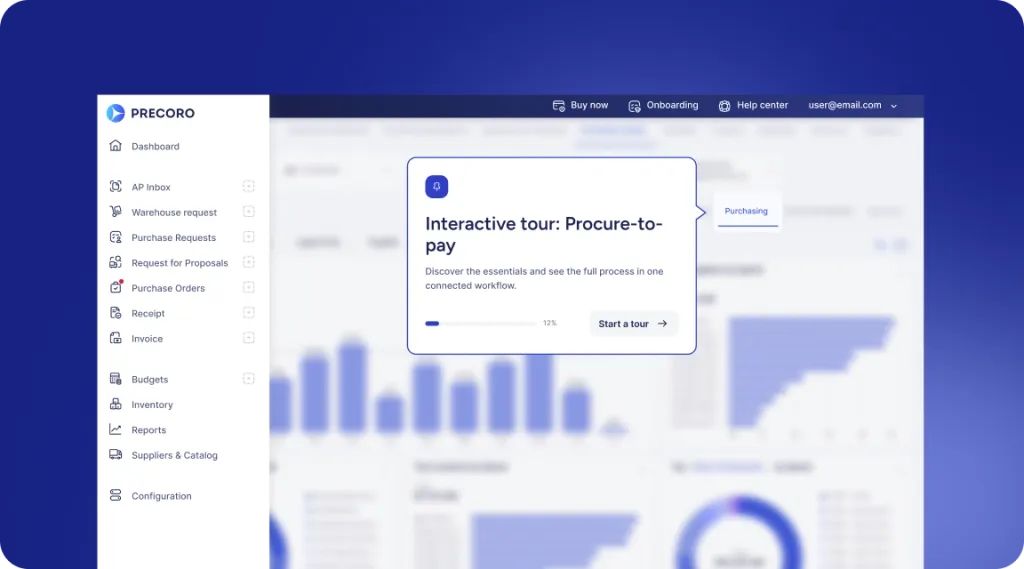
 Explore Precoro's features



















Non-PO invoice processing is the review, coding, and approval of supplier invoices without an associated purchase order. Finance must establish what was purchased, whether it was received, who owns the expense, and which approvals apply. The first decision is whether the missing PO reflects an allowed exemption or a purchase that bypassed policy.
An invoice arrives for a repair nobody in finance knew about. The supplier wants payment, the site manager says the work was urgent, and there’s no purchase order to check. Approving it immediately leaves questions unanswered. Passing it between departments doesn't resolve them either.
A defined non-PO process gives each question an owner. It also separates two decisions: whether the invoice is valid and how to handle any failure to follow purchasing policy.
This guide provides a workflow you can adapt to your company's approval limits, purchasing rules, and accounting requirements.
What is a non-PO invoice?
A non-PO invoice is a supplier invoice that has no associated purchase order (PO). That means accounts payable (AP) can't rely on a PO to confirm what was originally agreed.
Other evidence may still exist. A signed lease, approved quotation, or service agreement can explain what the organization agreed to buy. A missing PO doesn't automatically mean nobody authorized the expense.
The practical difference is what evidence the reviewer has to work with.
| Review question | Invoice with a PO | Non-PO invoice |
|---|---|---|
| What was ordered? | Review the approved PO and relevant agreement | Establish the scope through a contract, quotation, or other evidence |
| Was it received? | Check receiving records or service acceptance, where applicable | Obtain delivery evidence or confirmation from the responsible person |
| Who owns the expense? | Use the purchasing record to identify the requester and budget | Identify the requester, department, and budget owner |
| Which approval route applies? | Follow the configured PO and invoice rules | Check the non-PO policy and any exception requirements |
For the broader document-matching process, see the guide to PO invoice processing.
When is a non-PO invoice a legitimate exception?
A non-PO invoice is a permitted exception when the transaction meets your organization's documented rules. The expense category alone doesn't establish whether a PO was required.
Three situations need different treatment.
Policy-approved non-PO expenses
Your policy might allow certain rent, utility, or statutory payments without a PO. An invoice within that exemption can follow the standard non-PO route, provided its supporting evidence and approvals are complete.
Recurring spend still needs review. For a utility bill, confirm the account, location, billing period, and responsible budget. For a subscription, check that the agreement remains relevant and the invoiced period hasn’t already been paid.
Emergency purchases
An emergency repair may require work before the normal purchasing process can finish. Your policy should define who can authorize that action, what evidence must follow, and who approves the exception.
The word “urgent” isn't enough on its own. Record what happened, why the normal route couldn't be followed, and who authorized the response. Where no prior authorization exists, say so explicitly.
Purchases that bypassed policy
If a PO was required but never raised, record the breach and send it to the designated exception approver. Don't silently treat it as an approved exemption.
Invoice validity and policy compliance are separate questions. Confirming that work was completed doesn't demonstrate that the requester had authority to commission it. Equally, a policy breach doesn't by itself cancel the organization's contractual payment obligations. If an obligation is disputed, refer it to your legal team or another designated advisor.
What evidence should finance collect before approval?
Finance needs enough evidence to establish the transaction, its business owner, and the proposed payment. Use a consistent checklist so approvers can spot gaps without piecing the purchase together from email threads.
Before routing the invoice, collect:
- Supplier identity, invoice number, invoice date, amount, currency, and payment terms.
- The business purpose and the person who requested the purchase.
- The relevant quotation, contract, lease, or other evidence of agreed scope and price.
- Delivery confirmation or service acceptance, where applicable.
- Any prior authorization and the reason no PO exists.
- The budget owner and proposed accounting allocation.
- Supporting correspondence, corrections, and exception decisions.
Keep three questions distinct: Was the price agreed? Was the supply received? Was the purchase authorized? A supplier's invoice is a payment request; it doesn't answer these questions on its own.
For services, acceptance evidence should identify the work and the person confirming completion. “Looks fine” tells the reviewer very little. “Facilities confirms that the cooling unit repair at the east site was completed on October 14” gives the reviewer something specific to assess.
For an agreed advance payment, receipt evidence may not yet exist. Review the payment milestone against the contract and applicable approval rules instead of recording delivery that hasn't happened.
Checking a contract and completion evidence isn't three-way PO matching. Describe the checks actually performed so the record doesn't suggest a missing document was reviewed.
How does the non-PO invoice approval process work?
A workable non-PO invoice approval workflow moves from registration through validation, ownership, coding, and approval to a controlled payment handoff. Each step needs a responsible person and a defined result.
1. Receive and register the invoice
AP records the invoice through the designated intake channel. Capture the receipt date, supplier, invoice reference, amount, and due date, then assign someone to move it forward.
Registering the invoice only confirms it's been received. It doesn't mean finance has accepted it as accurate or approved payment.
Keep the original document accessible. If a corrected invoice arrives later, link it to the original so reviewers can see what changed.
2. Check whether a relevant PO already exists
Before classifying the invoice as non-PO, search the purchasing records and ask the requester whether an order exists. The supplier may simply have omitted the reference.
If a valid PO covers the transaction, verify the connection and return the invoice to the normal PO process. Don't attach an unrelated order just to fill a required field.
If no PO exists, record that result and continue through the non-PO route.
3. Validate the supplier and check for duplicates
AP checks supplier information against the organization's approved records and follows the onboarding procedure if the supplier is new.
Review potential duplicates using the available invoice history. An invoice number is useful, but reviewers should also consider supplier, amount, currency, service period, and previous payments. A resent attachment or slightly altered reference shouldn't lead to a second payment.
Treat unexpected payment-detail changes as a separate verification issue. The FBI's business email compromise guidance recommends verifying changes to account numbers or payment procedures and using independently sourced contact details when a request is suspicious.
4. Identify the requester and budget owner
The requester explains why the purchase happened and supplies the relevant records. The budget owner confirms responsibility for the expense and reviews it within their delegated authority.
These roles may belong to different people. An employee might arrange a repair while the facilities manager owns the budget. AP coordinates the review; it shouldn't have to guess who can confirm that the work was necessary and completed.
If ownership is unclear, assign an investigation owner and escalation date. Keep the invoice visible in the unresolved queue rather than forwarding it indefinitely.
5. Classify the reason and collect the evidence
Determine whether the invoice relates to a permitted exemption, an emergency, or a policy breach. Use consistent reason codes so finance can analyze patterns later.
The requester provides the evidence on the checklist, and AP identifies anything missing. If the invoice goes on hold, the hold reason should state the document or decision needed, the responsible person, and the next review date.
For a breach, start the exception review. Don't backdate a PO or approval to make it appear that authorization preceded the purchase. Any later documentation should show what actually happened and when.
6. Assign expense coding and review the budget
The person responsible under your accounting process assigns the general ledger account, cost center, project, and legal entity where relevant. The general ledger account classifies the transaction in the accounting records; a cost center identifies the responsible organizational unit. Finance should also check whether the purchase should be recorded as an asset or prepayment rather than expensed right away.
Make sure the allocation reflects what was actually bought. For shared services, document the basis for splitting the cost between teams or projects rather than assigning the full amount to whichever budget is easiest to use.
The budget owner then reviews the remaining budget. If the spend exceeds their authority or available budget, follow the escalation rule. An after-the-fact check can inform the current decision, but it can't replace the budget control that should have happened before the purchase.
7. Obtain invoice and exception approvals
Route the completed record to the required approvers. Their decision should cover the invoice amount, evidence, coding, and any conditions affecting payment release.
Where purchasing policy was breached, obtain the designated exception decision as well. A budget owner's confirmation of service completion doesn't automatically replace that decision.
Set up or document a backup approver for when the usual approver is away. No one should approve their own purchase where policy requires independent review. Smaller teams should add a second reviewer rather than leave the conflict unresolved.
For a rejected or returned invoice, record the reason and next action. Send corrected information back through the required approval steps instead of relying on an earlier approval of different details. Assign someone to notify the supplier and resolve the underlying claim—an internal rejection doesn't cancel an amount owed.
8. Hand the approved invoice to the payment process
AP passes the approved invoice to the payment process, with any holds or conditions clearly visible. Invoice approval and payment authorization are separate decisions, even if the same platform handles both.
The payment team follows the applicable release controls. AP then records the payment reference or reconciles the payment status through the accounting process.
Keep unresolved invoice information available to accounting for period-end review. A payment hold shouldn't hide a potential liability or stop the team from deciding how to account for it.
For guidance on the wider approval structure, see how to design an invoice approval workflow.
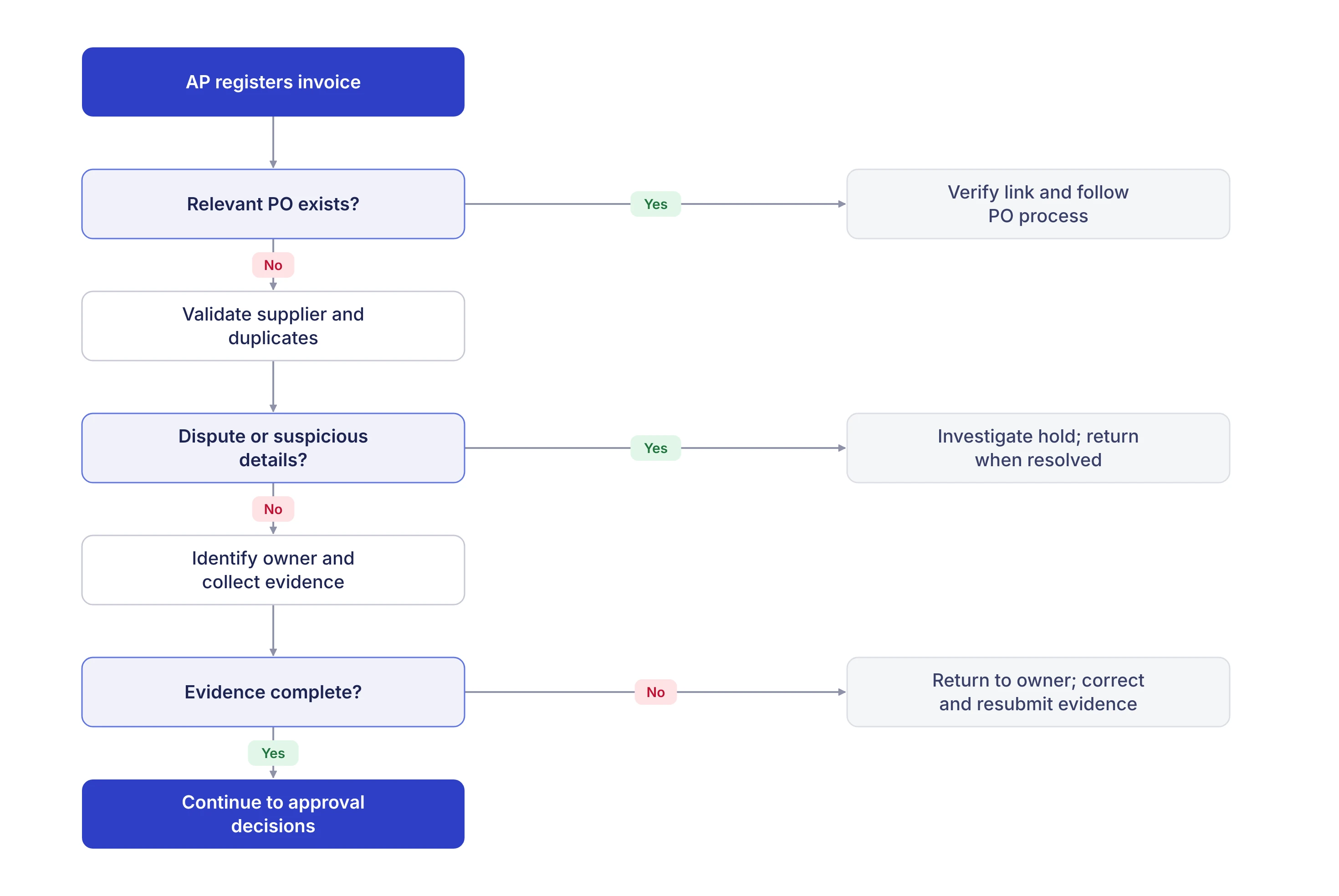
Non-PO invoice approval flowchart
This flowchart shows the decision route. The steps above explain who's responsible and what evidence each stage needs.
Validation and evidence
Approval decisions and payment handoff
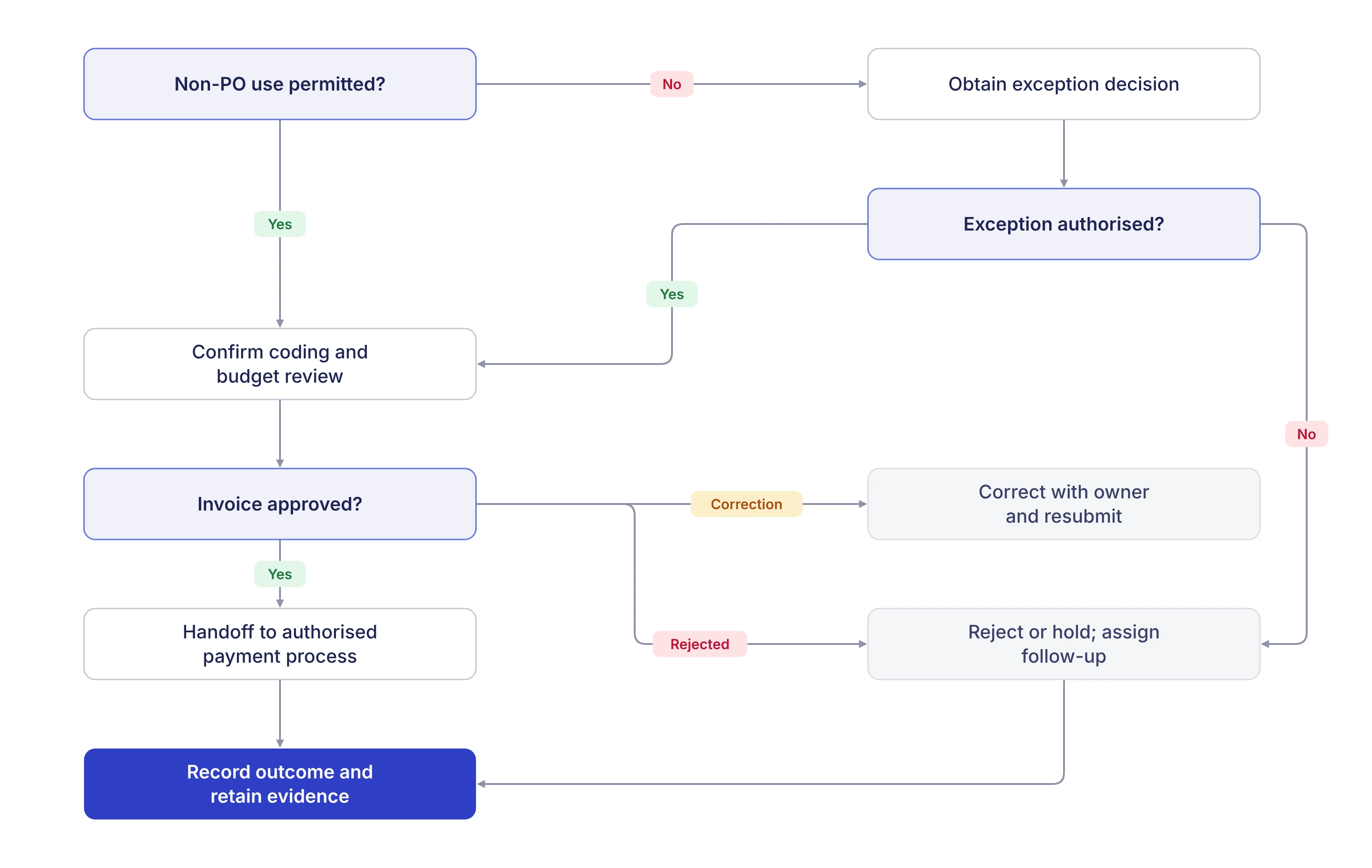
Unresolved holds still need follow-up. Keeping the record on hold doesn't close the investigation or settle whether payment is owed.
How should finance handle non-PO invoice exceptions?
Give each exception a recorded reason, an accountable owner, and a condition for moving forward. Urgency raises the escalation priority, but it doesn't replace missing evidence.
| Situation | Responsible role | Next action |
|---|---|---|
| Nobody recognizes the purchase | AP investigation owner and relevant department | Establish the business connection before routing for approval |
| Contract or completion evidence is missing | Requester or service owner | Supply the missing evidence; AP records the hold and follow-up |
| Price or service delivery is disputed | Business owner and supplier contact | Document the disputed amount and obtain a correction, credit, or agreed resolution |
| Payment is urgent | Designated finance approver | Use the expedited review route and record why it was needed |
| A required PO was never raised | Procurement or designated exception approver | Decide the exception and record the purchasing breach |
| Bank details changed unexpectedly | Supplier-master or payment-control owner | Verify through an independently established contact channel |
| Invoice information is incorrect | Supplier contact and AP | Obtain a corrected document and preserve the version history |
If only part of an invoice is disputed, escalate the question of whether the undisputed portion can be paid under the agreement and internal controls. Don't silently change the invoice total or assume partial payment resolves the dispute.
Likewise, “no PO, no pay” needs defined scope and exceptions. The slogan alone isn't a substitute for reviewing the transaction, supplier agreement, and applicable obligations.
What does controlled non-PO approval look like in practice?
The same missing document can lead to different approval routes. These hypothetical examples illustrate the process; the amounts aren't recommended thresholds or customer results.
Example one: A permitted utility invoice
A utility supplier sends a $1,200 monthly bill for a regional office. In this example, company policy explicitly permits utility invoices without a PO.
AP confirms the supplier, account, site, and billing period, then checks for a duplicate. The facilities coordinator verifies that the account belongs to the office and looks into any unexpected change in charges.
The invoice is allocated to that site's utilities account and cost center. The authorized budget owner approves it, and AP sends the record to the payment process. The retained evidence includes the bill, account confirmation, coding, and approval.
No purchasing-breach approval is required because the transaction falls within the stated exemption. A different company's policy could require a PO for the same expense.
Example two: An emergency repair outside the normal process
A site manager commissions a $4,800 cooling-system repair and sends finance the invoice after completion. Company policy requires a PO, but allows a designated finance leader to review emergency exceptions.
The manager supplies the engineer's quotation, service report, completion confirmation, and an explanation of why the repair was urgent. AP validates the supplier and checks the charges and invoice history.
The budget owner confirms the allocation and business purpose. The designated exception approver separately reviews why the purchasing route was bypassed. The invoice moves to payment only after both decisions are recorded.
If nobody had emergency authority or the evidence is still incomplete, the invoice stays escalated. A completed repair doesn't settle every approval question on its own. Procurement also checks whether a maintenance agreement could keep similar emergencies from bypassing the process in the future.
How can companies reduce avoidable non-PO invoices?
Separate approved exemptions from preventable purchasing failures, then fix what's causing the preventable ones. A combined non-PO total doesn't tell finance which problem to fix.
Use reason codes such as approved exemption, emergency purchase, missing PO reference, purchasing breach, and ownership unresolved. Analyze repeat patterns by supplier, department, and expense category.
If employees repeatedly buy before raising a request, investigate the intake process and approval delays. If suppliers omit existing PO references, give them clearer invoicing instructions. For predictable spend, consider whether a blanket order or another approved purchasing arrangement fits your policy and system.
Useful measures include:
- Avoidable non-PO share: invoices classified as preventable breaches divided by all supplier invoices in the same period.
- Approval turnaround: elapsed time from receipt to final invoice approval for invoices approved in the reporting period, with hold time reported separately. Report pending invoices alongside this measure so they don't disappear from the picture.
- Unresolved exception age: time outstanding for invoices awaiting evidence or a decision.
- Repeat breaches: recurring incidents by department, supplier, or category.
Define whether each measure uses invoice count or value and keep the denominator consistent. Report legitimate exemptions separately so a reduction target doesn't encourage misleading reclassification.
How can Precoro support non-PO invoice approvals?
Precoro's standalone invoice documentation describes how to create invoices without a PO, add supporting attachments, and send confirmed documents through the company's configured approval workflow. It also covers revision history and an optional warning for duplicate supplier invoice or credit-note numbers.
If you book a demo, bring a realistic non-PO scenario with its evidence and required approvals. Ask the team to show how your organization would record the non-PO reason, handle missing information, and distinguish normal approval from exception review. Confirm which requirements the software handles through configuration and which depend on your internal procedures.
Automation can move a documented process forward, but the organization still needs to define who can approve the expense and what evidence they require.
Explore Precoro's invoice approval software to see how your non-PO invoice process could work with your approval structure.
