









 Explore Precoro's features


















In an industry that values efficient spend control and reliable supplier collaboration, SAP Ariba stands as a well-established source-to-pay (procurement process from supplier sourcing through final payment) platform built to handle large and complex purchasing operations. Its SAP integrations can reduce integration requirements for organizations already using SAP ERP or finance products.
SAP Ariba provides broad enterprise procurement functionality, but its scope may exceed the requirements of some organizations. To be the right match, a solution has to align with the company’s size, budget, existing systems, procurement processes, and specific requirements.
Several procurement platforms serve companies of different sizes, technology environments, and business needs, so it’s important to evaluate your options to find the right fit.
In this article, we will go over some of the leading SAP Ariba alternatives as of 2026, reviewing their main advantages, pricing, potential shortcomings, and the types of businesses they are best suited for.
What is SAP Ariba?
SAP Ariba is a cloud-based source-to-pay (S2P) platform that helps businesses manage their procurement processes, including sourcing, purchasing, invoicing, and payment. The platform combines these processes into one connected system, providing procurement teams with greater visibility and control over how the business spends money.
The procurement activities that SAP Ariba supports include strategic sourcing (the process of evaluating suppliers and optimizing bids), supplier lifecycle (supplier management process from onboarding to offboarding), performance management, contract management, procure-to-pay (purchasing process from request to payment, excluding supplier sourcing), spend analysis, and invoice processing. It also connects buyers and suppliers via the SAP Business Network, giving the company access to a wide ecosystem.
For organizations managing high supplier volumes, multiple procurement workflows, and enterprise-scale purchasing, SAP Ariba offers capabilities tailored to complex source-to-pay operations.
What are the main advantages of SAP Ariba?
The main advantages of SAP Ariba include its broad source-to-pay functionality, automation capabilities, strong supplier management, large supplier network access, analytics features, and integration with the SAP ecosystem.
End-to-end source-to-pay management: SAP Ariba brings sourcing, supplier management, purchasing, invoicing, and other procurement activities into one platform. This provides procurement teams with a connected view of the entire purchasing process.
Strong supplier management: The platform helps organizations manage their supplier information, relationships, performance, and related procurement activities in one place. Supplier-management capabilities become more relevant when procurement teams manage large supplier bases across multiple categories, regions, or business units.
Access to a large supplier network: Through the SAP Business Network, SAP Ariba allows buyers to connect with a broad ecosystem of suppliers. With this level of access, the platform makes it easier for user organizations to discover suppliers, collaborate with existing ones, and manage their transactions electronically.
Integration with the SAP ecosystem: SAP Ariba allows organizations already using SAP to connect procurement to other SAP business systems. This capability helps to reduce data silos and create a more connected flow between procurement, finance, and other business processes.
Procurement visibility and spend control: The platform has data and analytics features that help procurement teams to understand where money is being spent, monitor purchasing activity, and identify opportunities to control costs. These capabilities are particularly relevant to organizations managing spend across multiple departments, categories, and suppliers.
Automation of procurement processes: SAP Ariba automates several repetitive procurement tasks, including purchase requests, approvals, purchase orders (POs), invoicing, and related workflows.
When should you consider an alternative to SAP Ariba?
You should consider SAP Ariba alternatives if the platform doesn’t fully align with your procurement needs, budget, existing systems, or operational requirements. Just as we mentioned earlier in this article, while SAP Ariba offers broad source-to-pay capabilities, another platform may be a better fit in areas such as pricing, implementation, integrations, flexibility, or ease of use.
The procurement strategy of every business is unique because no two businesses have exactly the same size, operations, objectives, or purchasing requirements. While a large organization may need advanced supplier management, complex approval workflows, and detailed spend controls, a smaller or mid-sized business may be looking for a simpler solution that handles purchasing approvals and invoicing without any unnecessary complexity.
The same thing applies to integrations and budget. A company, for example, that is already using SAP may benefit from Ariba’s connection to the SAP ecosystem, while another business may need a platform that works naturally with its existing ERP (Enterprise Resource Planning) and finance systems.
Pricing is another important factor that can influence a business’s choice of procurement platform, especially when a business needs specific procurement capabilities but doesn’t have the budget or need for a broader enterprise platform.
AI capabilities are also worth considering. Research on AI across the source-to-pay process highlights data quality, application programming interfaces (APIs), and organizational readiness as important factors for successful AI adoption. In cases where these factors don’t align with a business’s requirements, an alternative procurement solution may be a better fit, avoiding the need to pay for or manage capabilities it does not need.
How did we evaluate the best SAP Ariba competitors and alternatives?
We evaluated our list of SAP Ariba competitors and alternatives based on how well they met the practical requirements of different businesses, including their procurement capabilities, ease of use, integrations, pricing, scalability, and overall fit.
This approach compares each platform on both functionality and organizational fit.
SAP Ariba user reviews
"Streamlined Procurement and Supplier Communication with SAP Ariba
What do you like best about SAP Ariba?
I use SAP Ariba as my primary method for making purchase requests, as well as tracking those requests until they are either approved or converted into orders. Previously, we dealt with numerous requests via email, which would often lead to confusion. Using SAP Ariba allows me to view precisely where a given request is located within the approval chain and who still has yet to approve it.
Most of what I perform as part of my job involves verifying the accuracy of supplier information, selecting items from catalogs, and verifying that appropriate budgets are established prior to submitting the actual request. I appreciate having all of this information recorded in one central location. For example, if someone inquires about a certain order dating back 2 months, I am able to quickly locate that order without having to search through multiple emails.
I don’t explore SAP Ariba; I simply utilize it as part of my everyday purchasing responsibilities, and have subsequently become accustomed to how it operates.
What do you dislike about SAP Ariba?
The menus were visually overwhelming at first. I didn't know where to actually find the things I needed for basic operations. For example, in order to edit requests after they're submitted, you may have to click multiple times before making the necessary changes or updates. If you update the supplier catalog and want to see those changes immediately, they may not show up right away, which can result in delays when you have to confirm a price significantly.” — Nijat I.
"SAP Ariba: A Comprehensive, Reliable Procurement Hub
What do you like best about SAP Ariba?
What I like best about SAP Ariba is its ability to serve as a comprehensive and reliable procurement platform. It combines powerful database management with streamlined processes, giving our department a single official system to handle sourcing, supplier collaboration, and contract management. This not only improves efficiency and transparency but also ensures consistency across all procurement activities. The performance of the platform is very fast.
What do you dislike about SAP Ariba?
One challenge with SAP Ariba is that the interface can feel complex and not very intuitive, which can slow adoption for new users. In addition, some workflows require several steps and could be streamlined to make the overall process more efficient, and integration with other systems can be time‑consuming.” — Ahmad J.
"Streamlined Source-to-Pay Process with SAP Ariba
My overall experience has been excellent. Through Best Online Career's SAP Ariba online training, I gained hands-on skills in requisitioning, purchase orders, invoice handling, and supplier collaboration. The training bridged the gap between theory and real-time business use cases, which made me confident in applying Ariba in live projects. The course was structured, interactive, and supported with 24/7 server access.
Pros
SAP Ariba simplifies procurement processes with seamless integration into SAP ERP. The guided buying experience, supplier collaboration, and contract management features help save time and reduce manual paperwork. During training, real-time project scenarios and practical exercises made the concepts easier to understand.
Cons
The user interface can feel overwhelming for beginners, and the initial setup has a learning curve. Some navigation paths could be more intuitive, but once familiar, the system is very powerful.” — Eoma C.
What are the best SAP Ariba alternatives in 2026?
Is Precoro a good alternative to SAP Ariba?
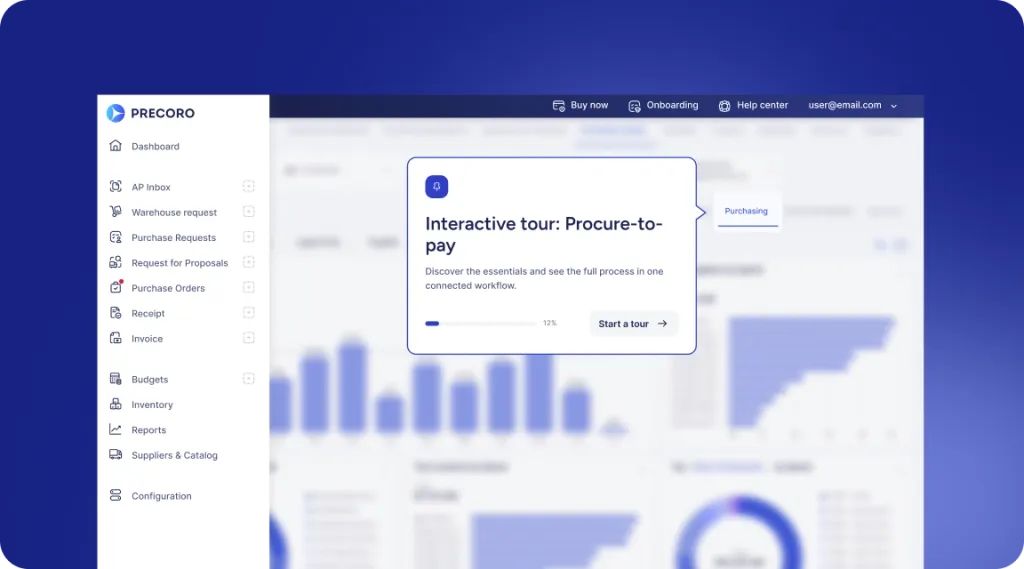
Precoro is a strong SAP Ariba alternative for mid-sized organizations that need purchasing and AP automation without the complexity of a broader enterprise source-to-pay suite. It combines purchase requests, POs, invoices, payments, budgets, supplier management, and analytics into one system, providing organizations with greater visibility and control over their procurement activities.
The platform is particularly useful for businesses that need to bring purchasing activities across their different departments, projects, locations, or entities into one centralized workflow. Precoro also supports customizable approval workflows, budget controls, supplier onboarding, contract management, inventory, and integrations with accounting and ERP systems, allowing businesses to configure the platform around their existing procurement processes.
Customer score:
- G2: 4.7/5.0 from 222 reviews, checked October 2026.
- Capterra: 4.8/5.0 from 255 reviews, checked October 2026.
Key advantages:
- Precoro allows businesses to create approval workflows based on factors such as department, location, spending limits, supplier, and other custom criteria.
- The platform has tools for supplier onboarding, supplier information management, and RFPs (requests for proposals). It also supports contracts and supplier collaboration through its Supplier portal.
- Precoro allows businesses to set budgets and monitor available, reserved, and used funds in real time. It is also capable of blocking purchases that exceed the defined budget limits.
- Precoro helps businesses connect their procurement activities with the systems they already use through its capability to integrate with ERP, accounting, communication, marketplace, and reporting tools.
- Precoro uses AI Crews to take over the repetitive manual tasks across intake, purchasing, accounts payable, supplier management, and spend analytics.
Potential shortcomings:
- Precoro is designed to centralize procurement and accounts payable rather than replace a company's ERP or accounting system. Companies looking for an all-in-one financial management solution may therefore need additional software.
- Businesses may need to invest time in initial configuration to use Precoro to its full potential.
Pricing at the time of writing:
Precoro offers a tier-based pricing plan with different levels of procurement and accounts payable functionality to accommodate the needs of different businesses:
- Core Plan: Starts at USD $499/month (billed annually) and includes procurement features such as purchase requests, purchase orders, approvals, budgets, supplier management, and reporting.
- Automation Plan: Starts at USD $999/month (billed annually) and includes the core plan features along with e-invoicing, PunchOuts, and broad AI capabilities.
- Enterprise Plan: In this plan, Precoro provides custom pricing (billed annually) for businesses that require unlimited users, advanced admin controls, and regional server selection.
Best for:
Based on the capabilities and pricing reviewed in October 2026, Precoro is most relevant to mid-sized organizations seeking centralized procurement and AP workflows across multiple departments, entities, or locations.
How does Coupa compare with SAP Ariba?
Coupa is a great SAP Ariba alternative for large organizations that want to control and optimize their spending across procurement, expenses, invoicing, payments, sourcing, and supplier management. Its focus as a platform extends beyond purchasing, as it provides businesses with a complete view of how money is spent across different areas of the organization.
The platform is optimized for organizations that need to manage their complex spending processes at scale. Coupa also provides access to the Coupa Supplier Network, which connects its users with suppliers, thereby helping businesses to better manage purchasing and supplier interactions as part of their broader spend management strategy.
Customer score:
- Capterra: 4.0/5.0 from 134 reviews, checked October, 2026.
- G2: 4.2/5.0 from 570 reviews, checked October 2026.
Key advantages:
- Coupa provides AI-powered tools that help organizations automate their procurement processes and use spend data to make better purchasing decisions.
- Supports strategic sourcing with capabilities that help businesses accurately evaluate suppliers, optimize bids, and consider different financial and business considerations.
- Coupa supports both direct and indirect spend management, allowing organizations to manage spending on products used to deliver their offerings (direct spend) and those needed to run the business (indirect spend).
- The platform connects buyers and suppliers through its Supplier Portal and broader business network, which supports effective supplier onboarding, sourcing events, purchase orders, invoices, and other transactions.
- Coupa has integrations and an app marketplace that allows businesses to connect the platform with other systems and extend its functionality.
Potential shortcomings:
- Coupa can have a steep learning curve, especially when configuring the platform and its more complex workflows.
- Coupa’s broad range of features can make it more difficult for organizations to configure and manage the platform according to their specific procurement requirements.
- Businesses may need additional integrations or configurations to connect Coupa with some of their existing business systems.
Pricing at the time of writing:
Coupa uses custom pricing for its Business spend management platform, with the final cost depending on the products and capabilities that a business requires. Coupa does not publicly list a standard price for its business platform, so organizations need to contact Coupa for a quote. The subscription fees are billed annually and in advance according to the customer’s order agreement.
Best for:
Based on the capabilities and pricing reviewed in October 2026, Coupa is best for mid-sized to large organizations that need a platform for managing complex procurement and business spend processes across multiple areas of the organization.
How does Ivalua compare with SAP Ariba?
Ivalua is a cloud-based spend management platform that is optimized for mid- to large-sized organizations seeking to manage their procurement, sourcing, supplier relationships, contracts, and other spend-related processes from a unified platform. It’s designed to give businesses greater control over their spending while providing visibility across different procurement activities and supplier relationships.
The platform supports organizations with complex procurement requirements by allowing them to configure workflows and processes around their specific business needs. Ivalua also provides capabilities for managing supplier information and performance, sourcing activities, contracts, purchasing, and invoices across the procurement lifecycle.
Customer score:
- Capterra: 3.8/5.0 from 6 reviews, checked October, 2026.
- G2: 4.3/5.0 from 107 reviews, checked October 2026.
Key advantages:
- Ivalua allows businesses to configure procurement workflows around their specific processes using its no-code and low-code configuration capabilities.
- Ivalua provides real-time visibility into spend, suppliers, contracts, and purchasing activities through its centralized data model and analytics capabilities.
- The platform supports supplier management with capabilities for supplier onboarding, supplier performance, risk management, collaboration, and supplier data management.
- Uses AI to automate procurement activities and support tasks across sourcing, purchasing, contracts, invoicing, and supplier management.
- Has pre-built connectors and integration tools that allow businesses to connect the platform with ERP and other enterprise systems.
Potential shortcomings:
- Ivalua can require significant implementation effort, especially for organizations with complex procurement processes and multiple stakeholders.
- Businesses may need major configuration to adapt Ivalua to highly specific procurement requirements, which can increase implementation time and costs.
- Integrating Ivalua with existing ERP systems and migrating data can present additional challenges, particularly in complex IT environments.
Pricing at the time of writing:
Ivalua uses custom pricing, with the cost depending on factors such as the modules and scope of deployment required. The company does not publish standard prices on its website, so businesses need to contact Ivalua to discuss their requirements and pricing.
Best for:
Based on the capabilities and pricing reviewed in October 2026, Ivalua is best for mid-sized to large organizations with complex procurement operations that need a highly configurable platform to manage sourcing, supplier relationships, contracts, purchasing, and accounts payable (AP).
How does GEP SMART compare with SAP Ariba?
GEP SMART is an AI-powered SAP Ariba alternative that helps mid- and large-sized organizations manage both direct and indirect spend across the source-to-pay lifecycle. It functions as a single complete platform that provides capabilities such as spend analysis, sourcing, contract management, supplier management, procure-to-pay, savings tracking, and invoicing.
The platform is designed to support organizations with complex procurement operations, especially those that need to manage their procurement across different categories, suppliers, and business processes. GEP SMART also supports procurement teams with AI-powered automation, configurable workflows, and integrations with existing ERP and finance systems.
Customer score:
- Capterra: 4.6/5.0 from 7 reviews, checked October, 2026.
- G2: 4.3/5.0 from 27 reviews, checked October 2026.
Key advantages:
- GEP SMART uses AI-powered spend analysis to help organizations identify spending patterns, uncover savings opportunities, and improve procurement decisions.
- The platform provides savings tracking capabilities that allow procurement teams to monitor cost-saving initiatives and measure their financial impact in real time.
- GEP SMART supports sourcing activities by helping businesses identify, evaluate, and qualify suppliers while managing sourcing events.
- GEP SMART uses AI and automation to handle repetitive tasks across source-to-pay processes, including purchase order processing and invoice management.
- GEP SMART is capable of integrating with major ERP and finance systems, making it possible for businesses to connect procurement activities with their existing enterprise systems.
Potential shortcomings:
- GEP SMART implementation can require significant planning and resources, particularly when integrating legacy ERP systems and migrating supplier data.
- Businesses may need additional configuration when their existing procurement processes are highly customized or differ across business units.
- The overall cost of implementing GEP SMART can extend beyond the subscription to include integration, data preparation, training, and change management.
Pricing at the time of writing:
GEP SMART uses custom pricing where organizations receive a tailored quote based on factors such as their size, procurement requirements, selected capabilities, and implementation scope.
Best for:
Based on the capabilities and pricing reviewed in October 2026, GEP SMART is optimized for mid-sized to large organizations with complex procurement operations that need to manage direct and indirect spend, sourcing, supplier contracts, and procure-to-pay processes through a platform.
How does JAGGAER compare with SAP Ariba?
JAGGAER is a cloud-based SAP Ariba alternative that is designed to help mid- to large-sized organizations manage their procurement across sourcing, contracts, purchasing, invoicing, payments, and supplier relationships. Its platform, JAGGAER One, combines these processes while also supporting both direct and indirect spend.
JAGGAER is especially focused on organizations with complex procurement requirements and offers industry-specific capabilities across higher education, healthcare, and the public sector.
Customer score:
- Capterra: 4.1/5.0 from 21 reviews, checked October 2026.
- G2: 4.1/5.0 from 86 reviews, checked October 2026.
Key advantages:
- JAGGAER supports both direct and indirect spend management, which allows organizations to manage different spend categories through a single platform.
- Provides AI-powered sourcing capabilities that help procurement teams identify suitable suppliers, evaluate bids, and optimize sourcing decisions.
- JAGGAER supports configurable approval workflows that can route purchases based on factors like value, commodity, business unit, and cost center.
- JAGGAER supports supplier onboarding and collaboration through supplier catalogs, purchase orders (POs), advance shipping notices, and invoices.
- Integrates with ERP systems and several other business applications.
Potential shortcomings:
- JAGGAER’s wide range of capabilities can make it harder for businesses to determine which modules and features they actually need when setting up the platform.
- JAGGAER might require businesses to invest time in training procurement teams to take full advantage of JAGGAER’s broader functionality.
Pricing at the time of writing:
JAGGAER uses a custom pricing model. Organizations interested in the platform need to contact JAGGAER to discuss their procurement requirements and determine the pricing for the solutions they need.
Best for:
Based on the capabilities and pricing reviewed in October 2026, JAGGAER is best for mid-sized to large organizations with complex procurement needs, especially those in industries such as higher education, healthcare, manufacturing, and the public sector that require specialized procurement capabilities.
How does Oracle Fusion Cloud Procurement compare with SAP Ariba?
Oracle Fusion Cloud Procurement is a strong SAP Ariba alternative for large organizations that want to effectively manage the entire source-to-settle process, sourcing, purchasing, supplier management, contracts, and procure-to-pay. It functions as part of the wider Oracle Fusion Cloud Applications ecosystem, which allows procurement processes to work alongside other business functions within Oracle’s cloud platform.
The platform provides organizations with the tools to manage requisitions, purchase orders (POs), supplier qualification, sourcing events, procurement contracts, and supplier collaboration. Oracle Fusion Cloud Procurement also supports self-service purchasing and automated procurement workflows, which help businesses enforce purchasing policies and negotiate supplier terms throughout the procurement process.
Customer score:
- Capterra: 4.2/5.0 from 5 reviews, checked October, 2026.
- G2: 4.1/5.0 from 38 reviews, checked October 2026.
Key advantages:
- Oracle Fusion Cloud Procurement automates procurement processes while helping organizations enforce purchasing policies and negotiated supplier terms throughout the procure-to-pay process.
- The platform provides self-service capabilities that allow employees to search catalogs and submit requisitions through guided procurement processes.
- Oracle Fusion Cloud Procurement supports supplier qualification through configurable questionnaires and qualification rules, which helps organizations assess suppliers against their specific requirements.
- The platform provides sourcing capabilities that help procurement teams manage negotiations while using supplier responses to support their purchasing decisions.
- Oracle Fusion Cloud Procurement provides a supplier portal where suppliers can manage activities such as registration, profile information, catalogs, orders, shipments, and invoices.
Potential shortcomings:
- Organizations integrating Oracle Fusion Cloud Procurement with external systems may need to configure integration users, roles, and other technical components to establish the connection.
- Oracle Fusion Cloud Procurement’s setup process can be complex as it requires organizations to configure areas such as company structures, procurement functions, user access, and approval workflows.
Pricing at the time of writing:
According to the Oracle Fusion Cloud Service global price list, Oracle Fusion Procurement Cloud Service is priced at USD $625 per hosted named user, with a minimum purchase of 10 users. The Oracle Fusion Procurement Self Service is priced at USD $8 per hosted named user, with a minimum purchase of 100 users.
Best for:
Based on the capabilities and pricing reviewed in October 2026, Oracle Fusion Cloud Procurement is best for large organizations that need a procurement solution and already use or plan to use other Oracle Fusion Cloud applications across their business.
How does Zycus compare with SAP Ariba?
Zycus is an AI-powered source-to-pay SAP Ariba alternative that helps mid- to large-sized enterprises manage their procurement from the initial request through sourcing, contracting, purchasing, supplier management, and accounts payable. Its Merlin Agentic Platform uses AI agents to automate tasks and coordinate procurement workflows across these processes with human oversight where appropriate.
The platform takes an agentic approach to procurement with tools such as Merlin Intake for capturing and routing procurement requests, Merlin Autonomous Sourcing and Negotiations for sourcing activities, and Merlin Analytics Agent for procurement insights.
Customer score:
- Capterra: 4.0/5.0 from 3 reviews, checked October, 2026.
- G2: 3.7/5.0 from 16 reviews, checked October 2026.
Key advantages:
- Zycus uses AI agents to automate procurement tasks across sourcing, contracting, supplier management, purchasing, and accounts payable.
- Merlin Intake allows employees to submit procurement requests through a centralized intake process and automatically routes requests to the appropriate workflows.
- Zycus provides autonomous sourcing and negotiation capabilities that can help procurement teams automate parts of supplier discovery, sourcing events, and negotiations.
- It uses AI-powered analytics to help procurement teams analyze spend, identify opportunities, and make data-driven procurement decisions.
- Zycus supports supplier management with capabilities for supplier onboarding, information management, performance monitoring, and risk management.
Potential shortcomings:
- Zycus’s broad use of AI and automation may require organizations to spend time configuring workflows and defining where human approval is needed.
- Businesses with procurement processes that differ significantly from Zycus’s standard workflow may require additional configuration to adapt the platform to their requirements.
- Organizations adopting Zycus may need to invest in training to help procurement teams understand and effectively use its wider range of AI-powered features.
Pricing at the time of writing:
Zycus doesn’t publicly list fixed pricing for its source-to-pay platform. Instead, the cost is determined based on the scope of the solution an organization needs, including the procurement processes it wants to manage and the Zycus capabilities it intends to use. Interested businesses need to contact Zycus to discuss their requirements and receive pricing information for their specific deployment.
Best for:
Based on the capabilities and pricing reviewed in October 2026, Zycus is best for mid-sized to large enterprises that want to use AI and automation to manage source-to-pay processes across sourcing, contracting, supplier management, purchasing, and accounts payable.
How does Workday Strategic Sourcing compare with SAP Ariba?
Workday Strategic Sourcing is an SAP Ariba alternative platform that helps mid- to large-sized organizations manage their sourcing projects, supplier relationships, and contracts in one environment. It supports activities such as sourcing project intake, RFx events (including requests for proposals (RFPs), requests for quotations (RFQs), and requests for information (RFIs)), supplier selection, negotiations, contract management, and savings tracking. This allows procurement teams to manage the entire sourcing process from the initial sourcing request stage through to the resulting contract.
The platform also uses Workday’s AI capabilities to automate routine sourcing activities, while providing insights from contracts and supplier data.
Customer score:
- Capterra: 4.8/5.0 from 4 reviews, checked October, 2026.
- G2: 4.5/5.0 from 35 reviews, checked October 2026.
Key advantages:
- Workday Strategic Sourcing uses AI-powered analysis to summarize supplier responses and compare bids, which helps procurement teams evaluate suppliers more efficiently.
- Workday Strategic Sourcing supports RFx events, reverse auctions (a bidding process where suppliers compete by lowering their prices), and public bidding, which gives procurement teams different ways to run competitive sourcing activities.
- The platform provides supplier management tools for onboarding, performance tracking, risk management, and supplier data collection.
- Workday Strategic Sourcing allows procurement teams to track the projected and realized savings against their targets, helping them to measure the financial impact of sourcing projects.
- Workday Strategic Sourcing can integrate well with finance and procurement systems, allowing organizations to connect strategic sourcing activities with their existing business processes.
Potential shortcomings:
- Workday Strategic Sourcing is primarily focused on sourcing and contracting, so businesses looking for a broader standalone source-to-pay platform may need additional Workday procurement capabilities.
- Organizations that are using Workday Strategic Sourcing alongside Workday Financial Management need to configure integrations to transfer sourcing and supplier data between the systems.
- Businesses with highly specific sourcing processes may need additional configuration to match their existing workflows.
Pricing at the time of writing:
Workday Strategic Sourcing uses a custom-pricing model. Interested businesses need to contact Workday to discuss their requirements and receive a customized quote.
Best for:
Based on the capabilities and pricing reviewed in October 2026, Workday Strategic Sourcing is best suited for mid-sized to large organizations that need structured sourcing, supplier management, and contract management in one platform.
How do the best SAP Ariba alternatives compare?
| Platform | Best for | Key advantages | Potential shortcomings | Pricing |
|---|---|---|---|---|
| Precoro | Mid-sized businesses with multiple business units | Custom approval workflows, proactive spend controls, supplier management, AP automation, integrations, centralized procurement, AI Crews. | Some ERP/accounting integrations may require more configuration. Advanced reporting and PunchOut options are more limited. | Core: from USD $499/month billed annually. Automation: from USD $999/month billed annually. Enterprise: custom pricing. |
| Coupa | Mid-sized to large organizations | Business spend management, AI-powered procurement, strategic sourcing, direct and indirect spend, supplier network. | Can be complex for smaller businesses. Its broad functionality may require more configuration and management. | Custom pricing based on business requirements. |
| Ivalua | Mid-sized to large organizations with complex procurement | Highly configurable workflows, source-to-pay management, supplier management, spend visibility, AI, integrations. | Complex implementations may require significant configuration, data migration, and integration work. | Custom pricing. Contact Ivalua for a quote. |
| GEP SMART | Mid-sized to large organizations | AI-powered spend analysis, sourcing, supplier management, savings tracking, procure-to-pay, integrations. | Implementation can require significant planning and resources. The platform may offer more functionality than smaller businesses need. | Custom pricing based on requirements and implementation scope. |
| JAGGAER | Mid-sized to large organizations with specialized needs | Direct and indirect spend, AI-powered sourcing, supplier management, configurable workflows, industry-specific capabilities. | Its extensive functionality can be more than organizations with simpler procurement requirements need. | Custom pricing. Contact JAGGAER for pricing. |
| Oracle Fusion Cloud Procurement | Large organizations using Oracle | Procurement automation, self-service purchasing, supplier qualification, sourcing, supplier portal, Oracle ecosystem integration. | Some procurement functions require configuration. Setup can take time across company structures, users, and workflows. | Oracle list price: USD $625 per hosted named user, minimum 10 users. Self Service: USD $8 per hosted named user, minimum 100 users. |
| Zycus | Mid-sized to large enterprises | AI agents, procurement intake, autonomous sourcing and negotiation, analytics, source-to-pay management, supplier management. | Broad AI and source-to-pay capabilities may require configuration and training. Smaller organizations may not need the full platform. | Custom pricing based on the scope and capabilities required. |
| Workday Strategic Sourcing | Mid-sized to large organizations | AI-powered bid analysis, RFX events, reverse auctions, supplier management, contract management, savings tracking. | Mainly focuses on sourcing and contracting. Additional Workday products may be needed for complete source-to-pay management. | Custom pricing. Contact Workday for a quote. |
Which SAP Ariba alternatives should you choose?
SAP Ariba is a strong procurement platform, but having more features does not always mean having the right solution for your business. The best choice depends on what your business needs from its procurement system.
If you are considering replacing SAP Ariba, it's important that you look closely at your procurement processes, budget, existing systems, and the level of complexity your team can manage. The right alternative should solve your current challenges without adding unnecessary complexity.
The alternative platforms covered in this article provide different options for businesses with different requirements. Comparing those differences can help you find a procurement solution that fits your organization today and can continue to support it as your needs change.
How to choose an SAP Ariba alternative
- Define which Ariba modules you actually need to replace.
- Map your approval and supplier workflows.
- Identify ERP/accounting integration requirements.
- Compare total implementation cost, not subscription price alone.
- Test complex workflows before migration.
- Plan supplier and historical data migration.
Key takeaways
- SAP Ariba is designed for broad enterprise source-to-pay requirements, especially in SAP-centric environments.
- Precoro is positioned toward mid-sized organizations seeking centralized procurement and AP automation across departments, projects, and legal entities.
- Coupa, Ivalua, GEP SMART, JAGGAER, and Zycus provide broader enterprise procurement alternatives.
- Oracle Fusion Cloud Procurement is especially relevant to organizations using Oracle applications.
- Workday Strategic Sourcing is primarily an alternative for sourcing and contract-management requirements.
- Compare integrations, implementation effort, workflow complexity, and total cost before migrating.