Why Cloud-Based Accounts Payable Is Reshaping Modern Finance Operations
Curious about why and how cloud-based accounts payable is changing finance operations? Read our recent article and explore.

For finance teams looking for faster approval routing, real-time visibility, and less manual work, an accounts payable automation solution is the go-to. Companies run their entire accounts payable platform in the cloud, where the vendor handles updates and scaling as invoice volumes grow, instead of installing software on their own servers or processing paper invoices manually.
Accounts payable (AP) was once considered a back-office cost center, and performance was mainly measured by the absence of complaints. Today, it’s viewed increasingly as a source of strategic data, including cash position, vendor performance, and organizational risk.
This shift came as the technology supporting AP evolved to meet broader business needs. Organizations are looking to cloud AP to replace the cost, delay, and limited visibility of on-premises systems with faster deployment, predictable subscription pricing, and access from anywhere. Now, let’s compare that to on-premises AP and see why this is top of mind for finance leaders.
Keep reading to find out:
Accounts payable cloud platforms and their role in modern finance
Efficiency and productivity improvements from cloud-based AP
Real-time AP workflow management for distributed teams
The shift to scalable cloud operating models
Cost reduction and cash visibility
Stronger controls, compliance, and security
The role of automation and AI in AP
AP cloud technology in the wider finance tech stack
How Precoro supports cloud-based AP and procurement
Measuring the success of a cloud AP deployment
FAQ
Accounts payable cloud platforms and their role in modern finance
Accounts payable has evolved from a back-office function focused on processing invoices into a strategic part of financial operations. Today, AP data helps finance teams improve cash flow forecasting, evaluate supplier performance, strengthen financial controls, and make more informed spending decisions.
As AP’s role has expanded, the technology supporting it has evolved as well. Cloud-based AP platforms offer finance teams the flexibility, automation, and real-time visibility that traditional on-premises systems often lack. To understand why more organizations are moving to the cloud, let's compare cloud and on-premises AP across the areas that matter most to modern finance teams.
Key differences between cloud-based AP and traditional on-premises AP
As more finance teams adopt cloud-based solutions, staying on-premises is becoming the exception rather than the rule. With an on-premises AP system, businesses purchase, install, and maintain the hardware and software themselves. This typically involves upfront capital investment, ongoing support from an internal IT team, and limited access outside the office network.
That’s changing with cloud-based accounts payable. The provider delivers the system, updates, and software as a subscription service accessible from anywhere with an internet connection.
Some other differences include:
- Deployment speed (weeks versus months)
- Cost structure (predictable subscription versus concentrated upfront spend)
- Maintenance ownership (vendor versus internal IT)
- Accessibility (any device versus office-network-only).
There may be reasons for some organizations to stay on-premises
(e.g., strict data-residency requirements or existing in-house IT infrastructure), but for most, the flexibility of cloud AP's wins out.
Growing finance leadership interest in cloud-based accounts payable
CFOs (Chief Financial Officers) and controllers are taking a fresh look at AP infrastructure, viewing it as a single package that affects cash flow, vendor relationships, and audit readiness.
As finance teams are asked to do more with less headcount, cloud-based accounts payable software supports higher invoice volumes without a corresponding increase in staff. This is especially valuable during growth, both for small businesses and large organizations.
Expectations have changed as well. Finance leaders are used to having real-time dashboards across the business and no longer accept accounts payable as a function that relies on paper documents and spreadsheets. At the same time, boards and investors expect continuous visibility into financial performance rather than periodic updates. Cloud AP platforms make this level of transparency and reporting possible.
A comparison of cloud-based accounts payable software and on-premises AP software across cost, security, and scalability
| Factor | Cloud-based AP software | On-premises AP software |
|---|---|---|
| Upfront cost | Low | High |
| Maintenance | Handled by the provider | Managed in-house |
| Accessibility | Accessible from any internet-connected device, anywhere | Typically limited to on-site access or VPN (virtual private network) |
| Scalability | Scales with invoice volumes and entities without requiring a new software platform | Often requires additional hardware, infrastructure, or licenses to scale |
| Security | Provider-managed encryption, monitoring, and security certifications | The organization is responsible for security controls and monitoring |
| Implementation time | Usually weeks | Often months |
Efficiency and productivity improvements enabled by cloud-based accounts payable
The most immediate win from moving to the cloud is faster payment processing. Tasks such as matching invoices to purchase orders, chasing an approver, and re-keying data that used to take hours happen automatically. But the benefits go beyond speed; they change the team's workload, helping streamline the entire AP workflow and freeing up hours from repetitive tasks to focus on exception handling and analysis.
Manual tasks eliminated through cloud-based accounts payable automation software
Cloud-based accounts payable automation software removes the most repetitive parts of the job: manual data entry from paper or PDF invoices, physical document routing, and manually updated spreadsheets. Optical character recognition combined with rule-based coding captures and categorizes invoice data automatically, assigning GL (general ledger) codes and routing invoices without requiring human retyping.
The persistence of approval bottlenecks after AP automation
Automating data capture doesn’t automatically eliminate approval delays. Invoices can still get bottlenecked if the approval hierarchies are not set up correctly, if there is no escalation rule for an absent approver, or if there are too many sign-offs required for low-dollar invoices. Digitizing a bad workflow is a faster version of the same bad process.
Cloud platforms offer configurable thresholds, automatic reminders, and escalation paths. But they only make sense if someone has set them up right. Organizations that re-engineer the approval logic during migration, rather than simply replicate the old way of doing things, get much better results.
Reductions in invoice processing time and manual work following cloud AP migration
Organizations that move from manual or on-premises AP to end-to-end automated capture and routing often see processing times reduced from days to hours, and sometimes to minutes. The reduction is realized by eliminating handoffs between the mailroom, clerk, approver, and accounting.
The system “learns” vendor formats and coding patterns, which also decreases the rate of manual touches over time. At the start of a migration, a significant percentage of invoices might still require manual review, only because the platform hasn't seen enough examples from a particular vendor to automatically identify their invoice format.
The degree of improvement largely depends on how manual the initial process is. A company moving from paper invoices and physical routing sees a more dramatic drop than one migrating from an existing but clunky digital system. In either scenario, the pattern holds: less time per invoice, and a lot less time lost to invoices simply waiting in someone's queue.
Workflow automation and approval workflows as drivers of faster processing time
Workflow automation is the single biggest lever for cycle time compression in a cloud-based accounts payable platform. Routing rules for invoices by amount, vendor, or department make sure the right approver sees the invoice immediately, without having to manually forward an email or walk a paper folder down the hall. And that immediacy alone is often the single biggest time saver in a migration.
Risk-based routing takes this a step further and matches the level of scrutiny to the size of the risk. A small repeated invoice from an approved vendor might just go right through with just a low-level sign-off process. But a big single invoice from a new vendor will trigger a more detailed, multi-step review. It’s easy to do in the cloud but hard to do consistently by hand, because a manual process will tend to over-scrutinize everything.
| Factor | Manual approval | Automated approval |
|---|---|---|
| Routing | Manually forwarded by email or in person | Automatically routed based on amount, vendor, department, or other predefined rules |
| Speed | May be delayed due to manual handoffs and follow-ups | Immediate routing and notifications |
| Escalation | Requires someone to notice delays and follow up manually | Automatic reminders and escalation paths |
| Consistency | Varies depending on employee actions and individual situations | The same approval rules are applied consistently every time |
Real-time AP workflow management for AP teams and distributed organizations
AP workflow management in real time is essential for distributed teams: all team members see the same invoice status, review and authorization queue, and dashboard, regardless of their location. An approver in one time zone and an AP clerk in another can work on the same invoice simultaneously without waiting for the other to catch up or send an update.
This is especially the case for organizations that have grown via acquisition and now have multiple entities that used to run their own AP processes with their own conventions, spreadsheets, and informal rules on who approves what. Instead of someone manually consolidating separate reports at month-end, a cloud-based accounts payable platform streamlines reporting and provides finance leadership with a single, real-time view across all those entities.
Platforms like Precoro's AP automation software are built specifically to give multi-entity organizations that kind of consolidated view without extra manual work.
The shift from manual AP processes to scalable cloud operating models
Moving to the cloud isn't just a technology swap. It’s a change in how the entire AP function is designed to operate. A manual process is built around individual effort:
- One person keying in data
- One person chasing an approval
- One person reconciling a spreadsheet at month-end
Instead, a cloud-based accounts payable operating model relies on configurable workflows, approval rules, spending thresholds, and integrations that scale with the business. Whether a company processes 100 invoices a month or 10,000, the system continues to operate efficiently. The following sections explore what this shift looks like in practice.
How manual AP limits scalable growth and creates manual data challenges
Manual AP doesn't scale linearly. Doubling the volume of invoices usually means doubling the hours spent on entry and reconciliation, because each new invoice takes roughly the same amount of manual handling as those that came before it.
Even worse, the higher the volume, the higher the chance of data-entry errors, duplicate payments, or missing due dates. An employee who is rushed or has too much to do is more likely to make errors at high volume than at a manageable volume.
A company that wants to double its revenue often needs its finance operations to keep pace, but a manual process forces a choice between hiring proportionally more AP staff or accepting declining process quality as volume rises.
Neither option is appealing, which is part of why fast-growing companies are often among the earliest adopters of accounts payable cloud software.
The importance of ease of use for accelerating AP adoption across departments
Choosing a cloud-based AP platform with a simple, intuitive interface is important because:
- It drives user adoption
AP platforms aren’t only used by finance teams, but also by managers, department heads, and executives. If the system is unintuitive, these users are less likely to interact with it properly. - Accelerates approvals
Because the approval screens are mobile-friendly, managers and executives can review and approve invoices without delay. - Reduces informal workarounds
If the platform is clunky, employees might approve invoices by email, send documents on to other people outside the system, or have someone else act on their behalf. - It protects visibility and control
An effective AP system consolidates invoices, approvals, and comments. It helps finance teams track progress, identify delays, and keep control of the process. - It reinforces the audit trail
Once sign-off processes are done in the system, it all gets logged. Automation supports compliance, accountability, and better internal controls.
A cloud AP platform only has value when people actually use it correctly. Companies will gain the full advantage of rule-based automation by investing in a user-friendly system and correct onboarding.
Remote access as a foundation for distributed approvers and finance teams
Browser-based access makes distributed approval chains practical, not just theoretical. An executive can approve an invoice from the phone between meetings. An AP clerk working from home can process invoices without a VPN or a company laptop. This lifted constraint is a major reason that remote and hybrid finance teams have fueled so much cloud AP adoption over the past several years.
Remote access also changes the way organizations consider hiring for AP roles. Without the constraints of a specific office location, businesses can build finance teams based on talent, not geography, and bring in contractors or part-time specialists for the busy season without provisioning hardware or VPN access. Cloud AP offers flexibility that only increases as an organization grows.
How scalable cloud platforms support expanding financial operations
As a company adds subsidiaries, currencies, or business units, an accounts payable cloud platform absorbs that complexity through configuration rather than new infrastructure. You can usually add new entities and approval hierarchies to the existing system without a hardware refresh, new server, or new licensing negotiation.
The biggest advantage becomes clear during periods of rapid change, such as mergers, international expansion, or sudden growth in headcount. Organizations using on-premises systems often discover too late that their infrastructure cannot support their new scale, forcing them into rushed and expensive upgrades under pressure. With a cloud platform, this challenge is largely avoided because the provider manages the underlying infrastructure and can scale resources to meet changing business needs.
Invoice lifecycle visibility, invoice status tracking, and accountability
Cloud AP systems give all stakeholders one place to see the status of an invoice. That visibility leads to accountability. You know exactly who is holding up an invoice and when it’s going to be paid. There is no more ambiguity of "where is this invoice right now?" that you had in a manual or email-based process.
This type of lifecycle tracking also results in positive changes in vendor relationships. Instead of a supplier having to ring up and ask about a late payment and get a vague answer, an AP team with full lifecycle visibility can tell them exactly where the invoice is and when payment can be expected.
The transition from legacy AP infrastructure to modern online platforms
Moving off of legacy, on-premises AP infrastructure is often less about replacing broken software and more about removing a ceiling on growth. Most legacy systems weren't built to support multi-entity operations, remote teams, or real-time reporting, and retrofitting them to do so is almost always more costly and more risky than simply transitioning to a modern cloud-based accounts payable platform.
The transition itself tends to go more smoothly than finance teams anticipate, especially if the new platform is designed to integrate with existing accounting or ERP (enterprise resource planning) systems rather than replace them. Precoro's overview of AP automation walks through what such a migration typically entails, including how quickly organizations tend to see measurable results after go-live.
Cost reduction and cash visibility through cloud-based accounts payable
Cost is usually the first thing finance leadership asks about when evaluating a move to the cloud, but it's rarely the only benefit that emerges after migration. Aside from the direct cost savings, cloud-based accounts payable also improves efficiency and accuracy and provides finance teams with a level of cash visibility that manual processes simply can't match, which proves just as important for day-to-day decision-making.
How cloud-based AP solutions reduce costs across finance operations
Cost savings come from several directions at once:
- Eliminate paper, postage, and physical document storage
- Reducing manual processing and re-keying of data hours
- Avoiding the capital expense of servers and in-house IT maintenance that on-premises systems require
All of these can quickly add up over a full fiscal year, especially for organizations processing a high volume of invoices.
There’s also a cost dimension that is easy to overlook: the cost of errors. Duplicate payments, missed early-payment discounts, and late-payment penalties all represent money unnecessarily lost by the business. Cloud platforms help reduce these costs through automated matching, payment reminders, and controls that prevent errors before they occur.
The impact of real-time visibility on cash forecasting
Finance teams can forecast cash positions with far greater confidence once outstanding liabilities and payment schedules are updated in real time, rather than waiting for data to filter in through end-of-month reconciliation. Confidence is particularly critical when a company is operating with lean working capital or planning around a discrete cash event such as a loan covenant test, a major planned purchase, or a seasonal downturn in revenue.
Real-time visibility also reduces the feedback loop between a decision and its cash impact. With a finance team that has visibility into what is committed and what is flexible at any time, decisions on which payments to prioritize can be made faster and better informed.
Why visibility often delivers more value than automation alone
Automated processing can speed up accounts payable, but visibility is what makes it more strategic. Invoice processing automation reduces manual work, minimizes repetitive tasks, and helps teams move documents through the system more efficiently.
The real value is when finance leaders can see clearly what is owed, to whom, when payments are due, and how future commitments impact cash flow. Such visibility allows CFOs and finance teams to be more proactive in managing working capital, to negotiate for better payment timing, to take advantage of early payment discounts, and to avoid unnecessary cash pressure.
If the data is scattered or difficult to access, poor decisions will be made, and automating every step of invoice processing won’t help. This is why successful cloud AP deployments see dashboards, reporting, and real-time insights as core features.
Hidden ROI drivers beyond direct cost savings
Cloud-based accounts payable can deliver a host of less obvious, but highly valuable, returns. They include:
- Fewer duplicate payments
- Stronger vendor relationships
- Faster month-end close
- Reduced fraud exposure through built-in approval controls
A major advantage is payment consistency. When vendors get paid on time and in full, trust is built. Vendors are more likely to give better terms, faster responses to requests, and priority on orders during supply shortages to a company that pays its bills on time. That kind of advantage may not appear immediately on an ROI spreadsheet but can be of real operational value.
A faster month-end close is another underappreciated return. Instead of processing invoice data in batches, when it updates continuously, accounting teams spend less time reconciling AP records before closing the books. This shortens the close cycle and lets finance staff focus on analysis, forecasting, and strategic financial planning earlier.
The importance of real-time liability visibility for CFOs
For CFOs, having a clear and current view of outstanding liabilities isn’t just an operational convenience. It’s essential for effective financial leadership. Decisions related to covenant compliance, board reporting, cash management, and capital allocation all depend on accurate and timely accounts payable data.
When liability data lags by several days or weeks, finance leaders may be forced to make decisions based on outdated information. A CFO reporting to a board, lender, or investor needs to be able to trust that the numbers being presented are the current financial position of the company, not the position shown post the last manual reconciliation.
It’s particularly important during financial stress, rapid growth, supply disruption, or changing market conditions. In these moments, stale AP data can create a false sense of confidence and lead to bad cash decisions. With real-time visibility, CFOs can act confidently, without hesitation, communicate clearly, and allocate capital with more control.
Stronger controls, compliance, and security through cloud-based accounts payable
Control and compliance concerns are often the reason a cloud AP migration gets approved at the executive level, even when efficiency was the original pitch. A cloud-based accounts payable platform doesn't just move invoices faster. It creates a structured, auditable record of every decision taken along the way.
Audit trails and policy compliance through cloud AP
Every action in a cloud AP system is timestamped and logged automatically, replacing the manual record-keeping that audits used to require and cutting the time spent assembling documentation ahead of an audit. This type of constant, automated logging supports the monitoring principles discussed in COSO’s (Committee of Sponsoring Organizations of the Treadway Commission's) Internal Control framework, one of the most common standards for building financial controls.
This is significant as fractured records, missing sign-off workflow trails, and documentation spread across emails, spreadsheets, or folders often slow down preparation for an audit. A cloud AP platform provides finance teams with a clear record of who approved what, when changes were made, and if each invoice went through the required approval process. It also makes the audit process more transparent, more organized, and less reliant on last-minute document collection.
AP policy compliance also becomes easier to enforce consistently. Instead of relying on employees to remember and follow procurement or sign-off workflow policy, a cloud platform can simply prevent an invoice from moving forward until it meets the required conditions.
Regulatory risk mitigation for multi-jurisdiction organizations
Organizations operating across states or countries face varying tax, reporting, and data residency rules, and manually tracking them all is a significant ongoing burden. Accounts payable cloud platforms with configurable compliance settings can help standardize controls across entities without having to enforce policy manually in each location. That’s because rules can be built once and automatically applied wherever they’re relevant.
This is especially helpful for companies that have many subsidiaries, branches, or finance teams in various locations. The organization can establish a more consistent AP process across the business rather than having each location interpret and apply compliance requirements separately. You have the ability to centrally set up approval rules, documentation needs for tax purposes, invoice validation steps, and reporting workflows, but also the ability to allow for local flexibility.
This is increasingly important as the spread of e-invoicing mandates around the world is forcing the adoption of structured invoice formats that comply with government standards in more and more jurisdictions. A platform that natively handles these formats removes a compliance risk that would otherwise be entirely up to the finance team to track by hand.
The role of automation and AI in modern accounts payable
AI (artificial intelligence) has moved from an experimental add-on to a core part of what makes modern cloud-based accounts payable software effective. The distinction worth understanding is that AI and automation solve different problems: automation handles predictable, rules-based work, while AI handles the messier, more variable parts of AP that used to require human judgment.
AI-powered invoice capture, invoice automation, and data extraction
These three capabilities are often discussed together, but each one performs a different function that helps make accounts payable faster, more accurate, and easier to control.
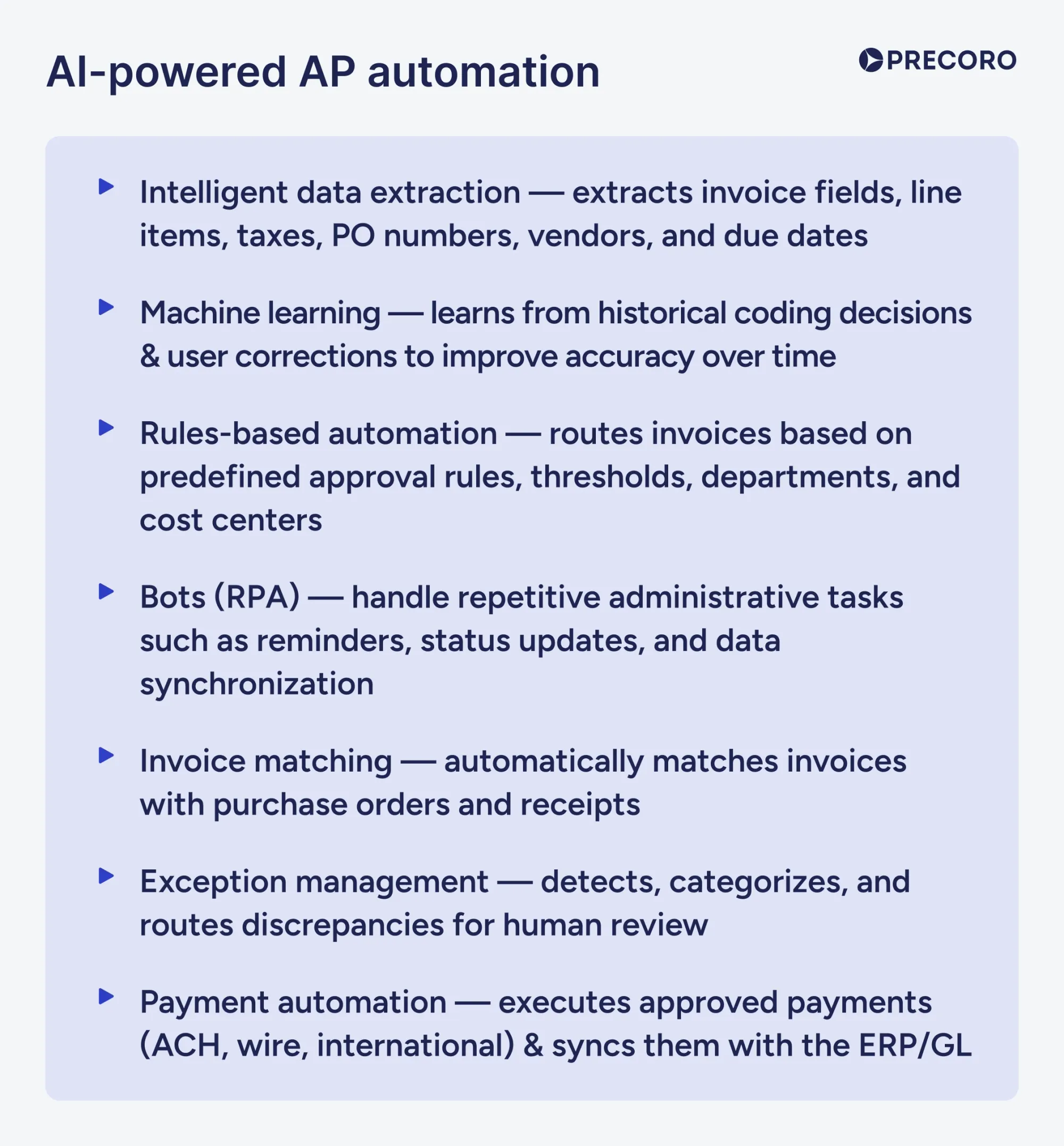
The first step in the AP process is invoice capture. AI-powered capture is more than optical character recognition. The largest contributor is machine learning, which identifies vendor-specific invoice formats and extracts the key information from each document. Instead of treating each invoice as a new file, the system begins to understand how a particular supplier processes its invoices.
For example, Precoro uses Intelligent AP Automation to accurately capture invoice data even from complex or non-standard formats, including multi-page invoices and documents with lengthy tables.

Data extraction determines how useful the captured invoice actually becomes. The platform doesn’t just “read” the invoice; it extracts critical data points like vendor name, invoice number, due date, tax amount, purchase order number, line-item descriptions, quantities, and prices.
Invoice automation is what puts invoice data to work. When the information is captured and extracted, the system can use it to route the invoice through the correct workflow. This could be matching an invoice to a purchase order and routing it to the appropriate approver, flagging exceptions, and preparing it for payment.
Precoro's overview of AI in accounts payable explains how this kind of capture works alongside other AI capabilities, including anomaly detection and payment prioritization, to provide a fuller picture of what “AI-powered AP” actually means in practice rather than as a marketing term.
Using machine learning to reduce exceptions and manual touchpoints
Machine learning models trained on historical coding decisions can auto-categorize invoices with high accuracy, thus limiting the number of invoices that need to be manually reviewed over time. The model learns very well from each human correction, so accuracy tends to improve the longer a system has been in use rather than remaining static.
This matters because exceptions are where most AP labor still concentrates, even after machine-driven processing is in place. Reducing the exception rate by even a modest percentage can free up a meaningful share of the AP team's time, since exceptions typically take far longer to resolve than a clean, automatically matched invoice.
How rules-based automation and bots complement AI workflows
Not every accounts payable task should rely on machine learning. Many AP activities are rule-based, i.e., they adhere to a clear rule and don’t require judgment. For example, invoices can be routed based on a dollar threshold or a cost center. These are places where rules-based automation works very well.
Bots also take on a second layer of work: repetitive, structured tasks that would otherwise eat up the AP team’s time. For instance, a bot can check whether the invoice fields are complete, send reminders to approvers, update the invoice status, or transfer data between integrated systems.
A good cloud-based AP system intelligently combines these approaches: rules for clear, repeatable decisions; bots for repetitive admin work; and AI for tasks that require pattern recognition, prediction, or judgment.
Exception management as the true measure of AP automation success
The real value of an AP automation deployment is not in how quickly it can process "clean" invoices but in how well the system can identify and handle the exceptions where manual effort is still required. Even if a platform is 95% accurate and only 5% inaccurate, those exceptions can still create a significant burden for the AP team, because they require the most time to resolve and carry the highest risk if handled incorrectly.
If you’re a business evaluating AP automation vendors, focus on how the platform surfaces, categorizes, and routes exceptions, not just how well it processes routine invoices, which is a far less meaningful measure of real-world value.
End-to-end automated invoice processing in modern accounts payable systems
The goal of a modern accounts payable cloud deployment is to create a workflow that runs from receipt of invoice to payment with as few manual touchpoints as possible. Ideally, when an invoice enters the system, it can be captured, matched, approved, scheduled for payment, and synced back to the general ledger automatically at every stage. This cuts down on double data entry, reduces manual handoffs, and provides finance teams with a more accurate picture of liabilities as they move through the AP process.
Bill payment execution is often the final step in that workflow. If the invoice sign-off process happens in one system but payment must still be initiated manually through a separate banking portal, the process remains only partially automated. Precoro's payment automation, for instance, lets approved invoices trigger ACH or wire payments directly, with the transaction synced back to the accounting system automatically and without a separate banking portal step.
Accounts payable cloud technology as part of the wider finance technology stack
An accounts payable cloud platform rarely delivers its full value in isolation. Its impact depends heavily on how well it connects to the rest of a company's finance and procurement systems.
Integration between cloud AP systems, ERP systems, and accounting software
Bidirectional integration with ERP and accounting systems is essential for keeping financial records accurate across the entire accounts payable process. A one-way data push isn’t sufficient as AP activity doesn’t occur in a vacuum. Invoice approval hierarchy, payment status, vendor records, purchase orders, and accounting entries must be synchronized across systems.
When an invoice is approved and paid in the AP platform, the status should automatically change in the accounting system. At the same time, the ERP or accounting platform changes should be fed back into the AP system.
When evaluating cloud-based accounts payable software, companies should consider which ERP and accounting systems the platform integrates with, how often data is synchronized, and whether the integration supports complete AP workflows or only basic data exchange. For example, Precoro supports synchronization of the full procure-to-pay document flow with NetSuite, Xero, and QuickBooks.
The growing convergence of procurement and accounts payable solutions
With purchase ordering, receiving, and invoicing all part of the procure-to-pay cycle, procurement and AP are increasingly being managed as a single workflow rather than as separate systems. In the past, these functions were often in completely different software, so when an invoice would come in, AP teams would have to manually hunt for purchase order information.
This convergence also gives procurement teams earlier visibility into spend commitments, since a purchase request already exists in the same system the invoice will eventually land in, rather than being tracked separately until the invoice appears.
How integration improves the accounts payable process and financial reporting
Tight integration between procurement, AP, and accounting systems reduces duplicate data entry and reconciliation errors, improving accuracy and speed of financial reporting. With platforms linked, information is automatically shared. So finance teams don't need to manually re-enter invoice details, update payment statuses, or cross-check records in different systems to see which is accurate.
It also cuts down on the time it takes to close the books each month. With more complete and more current information, accounting teams can work with cleaner data instead of waiting for missing invoice data, unresolved purchase order matches, or delayed AP updates.
When procurement, AP, and accounting data are all in connected systems, financial reporting reflects a more accurate picture of the business.
How Precoro supports cloud-based accounts payable and procurement workflows
Precoro is the agentic procurement and spend centralization platform that helps organizations to manage the entire procure-to-pay process with more visibility and control. The platform merges purchase orders, approvals, invoice processing, payments, and spend control into one system.
When these records are stored in different tools, teams often spend time verifying details, resolving discrepancies, and confirming that the proper approvals are in place. The unified platform makes that process more efficient by keeping related information connected from the beginning.
Consolidating purchase orders, sign-off workflows, and invoice matching into one workflow gives finance teams access to more accurate, real-time spend data to help them make better decisions around budgets, cash flow, and vendor payments.
Precoro’s AP automation roadmap resources also outline the typical order in which organizations pursue a broader transformation, beginning with clean invoice capture, then moving on to standardize coding and matching, and finally achieving full end-to-end automated AP operations.
Measuring the success of an accounts payable cloud deployment
Migration to cloud-based accounts payable doesn’t end once the system is live. It needs to be measured against clear benchmarks to confirm it is actually delivering the improvements it promised. And without that measurement step, it’s easy for a deployment to underperform quietly, with everyone assuming it’s working because the old paper process is gone.
Key performance indicators for cloud-based AP initiatives
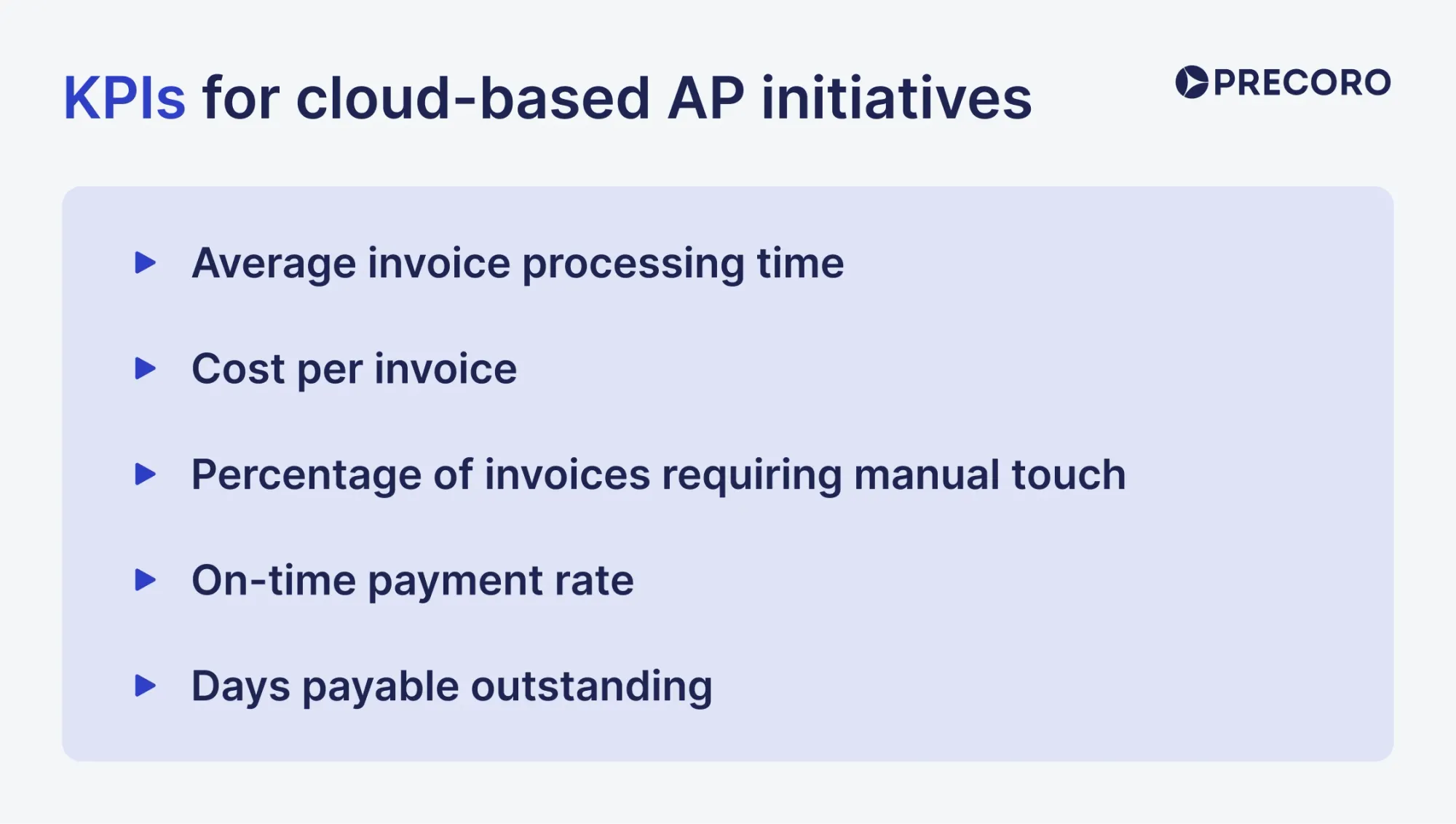
Common KPIs for measuring the impact of accounts payable cloud migration include:
- Average invoice processing time calculates the time it takes to process an invoice from receipt through approval chains or payment. Faster processing times typically mean more efficient AP workflows.
- Cost per invoice tracks the average cost of processing each invoice. It helps to quantify the savings from less manual work, fewer errors, and faster approvals.
- The percentage of invoices requiring manual touch reports how many invoice handling processes still require human review. A lower percentage means more automation and fewer exceptions.
- On-time payment rate shows the company’s ability to pay vendors on the due date that has been agreed upon. Good for vendor relations: early payment discounts and no late fees.
- Days payable outstanding (DPO) measures the time the company takes to pay suppliers on average. DPO helps finance teams understand cash flow, working capital, and when payments will be made.
Tracking user adoption and satisfaction
Adoption metrics, such as how many approvers use the mobile approval workflow and how many invoice routing processes skip the automated workflow altogether, reveal whether the system is delivering value or being quietly worked around. A highly automated system that nobody actually uses is worth far less than a simpler system that is widely adopted and consistently used across departments.
Frequent check-ins with the system users can also reveal friction points that raw usage metrics might miss, such as a clunky mobile experience, difficult notification settings, or a workflow step that consistently causes delays.
Benchmarking approaches for continuous improvement
Finance teams can assess whether the cloud AP platform is delivering the expected benefits by comparing current performance against pre-migration baselines and, where available, industry benchmarks. It also helps to identify where further configuration, training, or process changes may still be required.
For example, if invoice processing times have improved but the percentage of invoices requiring manual review remains high, it may not be due to automation. It could indicate unclear coding rules, poor PO (purchase order) matching, missing vendor data, or approval workflows that need tweaking. Likewise, if on-time payment rates continue to fall short of their targets, finance teams may need to probe approval delays, payment scheduling, or integration issues with accounting and banking systems.
Cloud AP deployments are rarely “done” in any meaningful sense. High performers keep adjusting approval chains thresholds, exception rules, vendor workflows, reporting dashboards, and ERP integrations long after go-live.
FAQs
Cloud-based AP automation improves cash flow by giving finance teams real-time visibility into upcoming liabilities. Features like automated approval workflows and early payment discount tracking help teams capture savings without rushing decisions, while dynamic scheduling tools let you delay non-urgent payments to preserve working capital.
Most finance teams don’t need to replace their accounting system; they can extend its capabilities with AP automation software. The two systems are designed to work together: AP automation platforms integrate with existing accounting systems to automatically sync data, enabling faster and more accurate AP workflows without disrupting the financial systems teams already rely on.
Centralizing invoice management across multiple entities and business units starts with a cloud-based AP platform that consolidates all invoices. Instead of each business unit tracking invoices in separate spreadsheets or siloed tools, everything flows through one centralized platform, giving finance leaders full visibility into liabilities across the organization.
See how Precoro turns AP into a real-time, audit-ready process. Book a demo and walk through your own invoice workflow with our team.