How Does the Corporate Procurement Process Work?
Corporate procurement is the complete, end-to-end process that large companies use to acquire suppliers, manage contracts, and control spend.

What is corporate procurement, and why does it matter?
Corporate procurement is a structured process by which large organizations acquire the goods, services, and resources they require to operate and grow. It covers functions like supplier selection, contract management, and spend oversight, directly shaping both operational efficiency and financial performance of an organization.
What corporate procurement is and why it matters
Main types of corporate procurement
How to build effective procurement strategy
Corporate procurement lifecycle steps
How technology transforms procurement
How to manage supplier relationships and risk
Compliance, governance, and ethics in procurement
How to measure and improve procurement perfomance
Common procurement challenges and solutions
The future of corporate procurement
How to improve your procurement function today
How Precoro improves the procurement process
FAQ
How does corporate purchasing differ from corporate procurement?
Corporate purchasing is the transactional act of purchasing: issuing purchase orders, receiving goods, and processing payments.
Corporate procurement refers to the broader discipline around the purchasing process that is also responsible for managing and controlling transactions.
The procurement process includes strategic sourcing, supplier relationship management, policy enforcement, and spend analysis. Purchasing is only one component of procurement, which is why they cannot be treated as synonyms.
Organizations that fail to differentiate corporate purchasing vs. procurement typically lack the strategic oversight that procurement is designed to provide in the first place.
What distinguishes corporate procurement from small-scale purchasing?
The differences between corporate procurement and small-scale purchasing are mostly organizational, not merely a matter of different purchasing volumes. Small-scale purchasing doesn’t require formal governance mechanisms to operate under, but corporate procurement does.
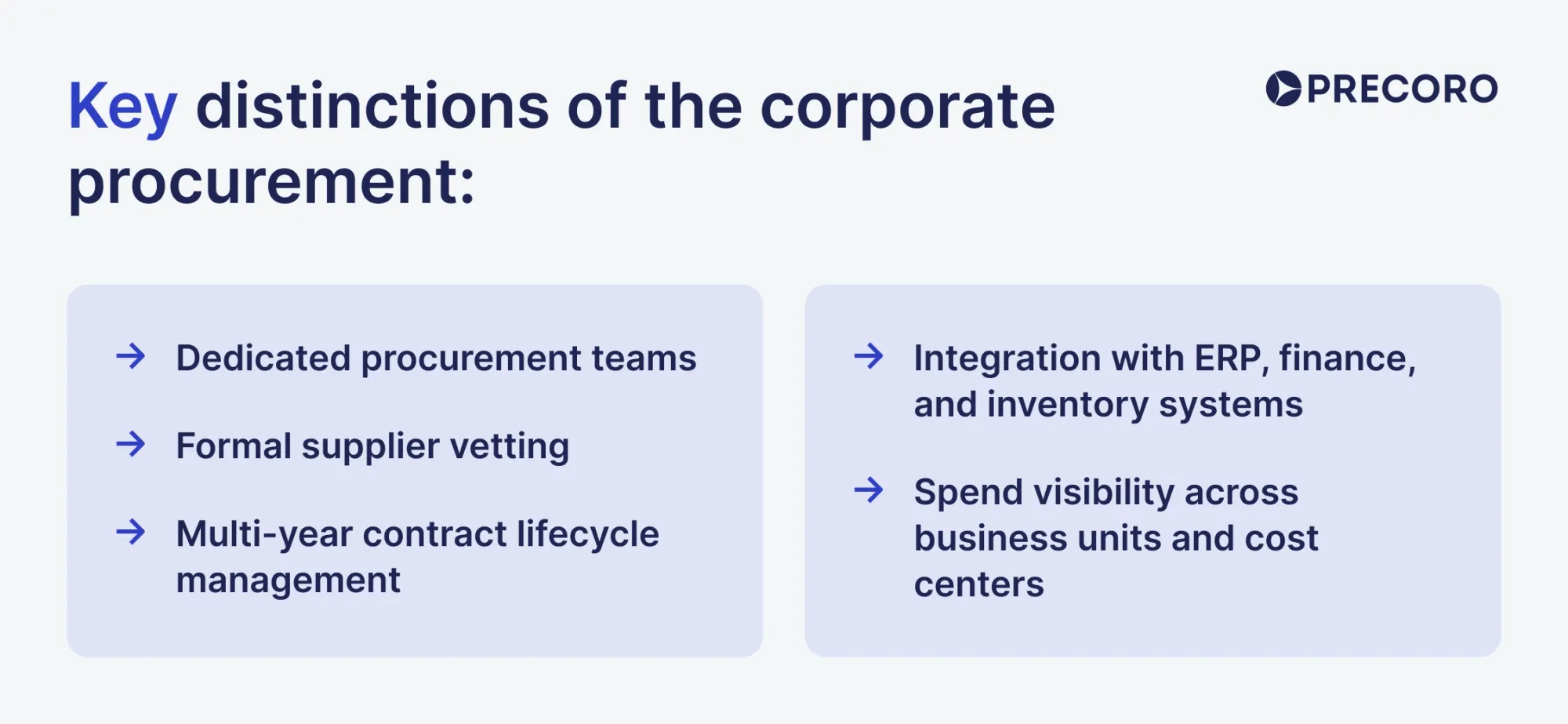
Key distinctions include:
- Dedicated procurement teams with defined roles, approval hierarchies, and category ownership.
- Formal supplier vetting processes, including Requests for Proposal (RFP), scorecards, and compliance checks.
- Contract lifecycle management across multi-year agreements and complex terms.
- System integration with Enterprise Resource Planning (ERP), finance, and inventory platforms.
- Spend visibility across business units, geographies, and cost centers.
Whenever these structures are absent, organizations that grow past a certain size experience the negative effects firsthand. The issues include duplicated vendor contracts, uncontrolled spend, compliance gaps, and supply disruptions (those that formal procurement governance was specifically designed to prevent).
What strategic goals does procurement support in large organizations?
Procurement operates as an organizational tool for goals that extend far beyond cost reduction. Strategic procurement helps connect supplier decisions and business outcomes by overseeing the conditions under which goods and services enter the organization: who supplies them, at what terms, under what standards, and with what visibility.
These parameters allow procurement to have a sizable influence on competitiveness, resilience, and innovation rather than merely managing transactions.
The procurement process supports a range of strategic goals, including:
- Reducing the total cost of ownership across categories
- Securing supply continuity for critical goods and services
- Building supplier relationships that enable co-development and faster time-to-market
- Enforcing ESG (Environmental, Social, and Governance) and compliance standards across the supply base
- Providing spend data that informs financial planning and executive decision-making
How does procurement affect risk, compliance, and cost control?
Procurement is positioned squarely between the three operational priorities that large organizations manage continuously. The table below outlines how exactly the corporate procurement strategy influences these areas.
| Area | Procurement's role | Without governance |
|---|---|---|
| Risk | Supplier vetting, contract safeguards, source diversification | Unvetted vendors, supply disruptions, concentration risk |
| Compliance | Policy enforcement, audit trails, regulatory compliance | Maverick spend, audit failures, legal exposure |
| Cost control | Spend visibility, negotiated terms, contract enforcement | Budget overruns, duplicate spend, missed savings |
These three areas overlap a lot more than they might seem at first glance. Compliance failures frequently create unplanned costs, both of which can be traced back to unaddressed risk gaps — be it missing contract controls, unvetted suppliers, or spend that bypassed procurement entirely.
Strong governance across all three areas turns procurement into a dependable part of operations, rather than a reactive function focused only on cutting costs.
What are the main types of corporate procurement?
Corporate procurement isn’t a single uniform activity: it can cover fundamentally distinct spend categories, with each category requiring its own sourcing strategies, supplier management approaches, and internal controls. Being aware of these differences is the basis for creating a proper procurement strategy.
The four primary procurement types are compared below:
| Type | Definition | Examples |
|---|---|---|
| Direct procurement | Goods and materials used directly in production or final product | Raw materials, components, packaging, manufacturing equipment |
| Indirect procurement | Goods and services that support operations but aren’t part of the product | IT, facilities, marketing, office supplies, travel |
| Services procurement | External labor and expertise, often contract-based | Consulting, staffing, outsourced processes, professional services |
| Capital procurement | Long-term assets recorded on the balance sheet and depreciated | Machinery, infrastructure, buildings, vehicles, large equipment |
Direct, indirect, services, and capital procurement differ not only in what is purchased but in how procurement manages them:
- Direct procurement is closely tied to production schedules and product quality — supply continuity and specification compliance are the primary risks.
- Indirect procurement covers a broader and more fragmented spend base, making visibility and policy compliance the central management challenges.
- Services procurement introduces additional complexity around statement of work definition, milestone verification, and contractor management that goods-based procurement does not require.
- Capital procurement involves the highest individual spend commitments and the longest asset lifecycles: approval processes are more rigorous, financial accounting treatment differs, and asset performance must be tracked long after the purchase is complete.
The vast majority of enterprise procurement departments use all four approaches at the same time, and that's precisely why category management structures must exist at scale. Each form of procurement requires unique strategies, supplier relationships, and measurement parameters in order to maximize the overall value.
How is an effective procurement strategy built?
Procurement strategy refers to a set of objectives that govern how the organization’s spending patterns align with its broader business goals. The lack of a deliberate strategy makes it so that procurement defaults to reactive purchasing, increasing costs, risks, and overall operational fragility.
What are the key components of a procurement strategy?
A procurement strategy creates the foundation and framework that guides all sourcing decisions, supplier relationships, and spending commitments the organization makes. Strategic procurement isn’t something that can be derived solely from policy documents — it’s created using interconnected components that each address a specific operational need.
Core components include:
- Spend visibility — a clear picture of what is being spent, with whom, and across which categories.
- Category management — structured oversight of spend categories with a dedicated sourcing strategy in each category.
- Supplier segmentation — classification of suppliers by spend, risk, and strategic value to prioritize relationship investment.
- Sourcing methodology — defined approaches for how goods and services are competitively sourced or negotiated.
- Contract governance — standardized processes for contract creation, approval, storage, and compliance monitoring.
- Performance measurement — KPIs and review cycles that track procurement outcomes against business objectives.
- Risk management framework — proactive identification and mitigation of supply chain and supplier risks.
Together, these components form a procurement strategy that is auditable, scalable, and aligned with organizational priorities.
Which procurement methods are most effective in corporate purchasing environments?
The most fitting purchasing approach depends on the nature of the purchase, the supplier market, and the level of risk involved. Companies generally maintain a portfolio of purchasing approaches and apply them based on category strategy and business context. Here are the most common examples:
| Method | Best used for | Key advantage |
|---|---|---|
| Competitive bidding (RFP/RFQ) | High-value spend with multiple suppliers | Drives price competition and supplier accountability |
| Sole sourcing | Proprietary items or urgent needs | Fast decisions when no alternatives exist |
| Framework agreements | Recurring purchases across teams | Pre-set terms reduce cycle time |
| Reverse auctions | Standardized, commoditized goods | Pushes prices down through live competition |
| Preferred supplier programs | Strategic, long-term partnerships | Improves collaboration and unlocks volume value |
| Spot buying | Low-value, one-off purchases | Quick and flexible for non-strategic spend |
There is no single method that absolutely dominates corporate procurement. The best approach is to always assign methods by category instead of attempting to default to one approach across all spend.
How can procurement strategies align with stakeholder expectations and business objectives?
Proper alignment of the procurement strategy begins with realizing that stakeholders in different units (finance, operational, legal, business) all carry their own priorities in terms of cost, speed, compliance, and quality, respectively. Effective procurement is where each of these priorities is treated as an input to the overall strategy design instead of being considered an obstacle to deal with afterward.
The alignment process includes integrating procurement into cross-functional planning cycles early enough to influence decisions instead of executing them.
Procurement teams that are involved in budget planning, product development timelines, and market expansion discussions early on are immediately positioned to source proactively (reducing costs and lead time as a result). Regular communication cadences with the key stakeholders — not only at the time of contract renewal — help sustain this alignment as time goes on.
How should spend analysis and category management be conducted?
Spend analysis is the process of gathering, cleansing, and categorizing expenditure information to expose anomalies, inefficiencies, and potential cost savings. This process creates the foundation upon which category management is created. Category strategies are only as robust as the data they are built upon; poor spend data forces these strategies to rely on speculation instead of using hard evidence.
The standard process for spend analysis includes combining data from ERPs, purchase order management systems, and accounts payable systems, then segmenting the data by supplier, category, business unit, and time period. The result is a spend cube revealing where money is spent and where there is potential value in consolidation, renegotiation, or alternative sourcing.
Category management takes that analysis and applies a structured strategy to each spend area. The process generally follows these steps:
- Define category scope — establish boundaries, stakeholders, and spend volume.
- Analyze the market — assess supplier landscape, pricing benchmarks, and risk factors.
- Develop a category strategy — determine sourcing approach, target suppliers, and savings levers.
- Execute and negotiate — run sourcing events, negotiate favorable contracts, and onboard suppliers.
- Monitor and review — track performance against category KPIs and refresh strategy periodically.
How can procurement align with organizational objectives and stakeholders?
Creating alignment is one challenge; maintaining it over time is another. While the previous section focused on building alignment through integrated planning, this one looks at the organizational setup needed to sustain it.
Sustainable procurement alignment happens when procurement has a clear mandate from leadership, defined accountability for results, and a formal role in planning. It shouldn’t operate as a service function that simply reacts to requests, but as a function that shapes how needs are sourced and fulfilled.
This strategic function requires procurement leaders who can clearly communicate value to executives and board-level stakeholders in financial and operational terms, connecting sourcing decisions to real business impact.
What steps make up the corporate procurement lifecycle?
The corporate procurement lifecycle refers to an end-to-end sequence of activities, during which an organization:
- Identifies a need
- Sources a supplier
- Executes a contract
- Manages delivery and performance
Each step of the procurement process builds upon the previous one, so any weaknesses or inconsistencies early on can create significant downstream risk and inefficiency.
What does a standardized procurement workflow look like across goods and services?
A standardized procurement workflow establishes the structure that ensures consistent and auditable outcomes regardless of category, business unit, or geography. The specific stages of the process may vary depending on organization or purchase type, but the core procurement process still has a recognizable pattern to it:
- Needs identification — a business unit identifies a requirement and submits a purchase requisition.
- Requisition approval — the request is reviewed and approved through defined authorization levels.
- Sourcing and tendering — procurement identifies potential suppliers and runs a competitive selection process.
- Supplier selection — suppliers are evaluated, and a preferred vendor is chosen based on defined criteria.
- Contract creation and approval — terms are negotiated, documented, and approved by relevant stakeholders.
- Purchase order issuance — a formal PO is raised and sent to the supplier.
- Delivery and receipt — goods or services are delivered, and receipt is confirmed.
- Invoice reconciliation — the invoice is matched against the PO, and receipt before payment is released.
- Supplier performance review — post-award performance is tracked against contracted terms and KPIs.
A sequence like this applies across most goods and services. However, service procurement might have less emphasis on physical delivery and more on milestone verification and output quality.
How do needs identification and requisitioning work?
Needs identification is the trigger for the whole procurement process. It’s initiated when a business unit determines that a certain good or service is required to meet an operational or strategic objective. The identified need is then formalized into a purchase requisition — an internal document that captures the requirement, as well as its estimated cost, preferred timeline, and requesting department.
Once formalized, the document is routed via a predefined approval workflow, ensuring that the spend is authorized, budgeted, and aligned with procurement policy before any supplier engagement is initiated. Organizations with mature procurement functions use system-driven requisition workflows capable of enforcing compliance automatically, reducing approval bottlenecks, and minimizing maverick spending.
How are sourcing, tendering, and supplier selection executed?
Sourcing, tendering, and supplier selection are three sequential tasks that ultimately determine the supplier responsible for fulfilling a particular requirement and under what terms. Each step serves a specific function in the overall procurement process:
| Stage | Purpose | Key activities |
|---|---|---|
| Sourcing | Identify and qualify potential suppliers | Market research, supplier longlist, capability assessment |
| Tendering | Collect and compare competitive offers | RFP/RFQ/ITT issuance, bid management, clarification rounds |
| Supplier selection | Select the best-fit supplier | Scoring, stakeholder review, award decision |
Effective sourcing starts with a good understanding of the requirements and the supplier market. Tendering documentation has to specify evaluation criteria upfront, preventing scope creep and ensuring that selection decisions are defensible.
How does contract creation, approval, and management occur?
After the supplier has been selected, the procurement process moves on to contract creation — drafting a formal agreement between parties that outlines the commercial terms, requirements, deliverables, and timing, along with the performance and risk management elements. Contract creation often uses templates where possible, and the contracts themselves are also normally checked by lawyers when it comes to any high-value items or complex terms of agreement.
The approval process routes the draft of a contract through the pre-defined stakeholders (such as procurement, legal, finance, and a relevant business unit) before execution. System-managed approval workflows help reduce turnaround time while maintaining a complete audit trail.
Contract management starts from the point of execution and covers the ongoing oversight of supplier performance. This process entails keeping records of crucial dates, such as the review and termination window, managing supplier performance against defined contract KPIs, managing amendments and changes, and verifying that suppliers deliver to the terms and conditions of the contract throughout its term. Contract management systems help automate a majority of these steps and provide visibility over existing agreements.
How are purchase orders, delivery, and invoice reconciliation handled?
Once the contract is signed, the transaction stage of the procurement cycle begins. The three main steps below are closely tied to each other and, if using an integrated procurement system, are mostly automated:
- Purchase order issuance — a PO is generated from the approved requisition and contract terms, formally committing the organization to the purchase and notifying the supplier.
- Delivery and goods receipt — the supplier fulfills the order, and the receiving team confirms delivery against the PO, recording any discrepancies in quantity or quality.
- Invoice reconciliation (three-way matching) — the supplier's invoice is matched against the original PO and the goods receipt note before payment is approved; discrepancies trigger a resolution workflow rather than automatic payment.
Three-way matching as a control mechanism prevents overpayment, duplicate invoicing, and payment for goods or services that weren’t received as specified. Companies that succeed in automating this step save processing time while dramatically reducing their error rates.
How is supplier performance and post-award management maintained?
Post-award management is the part of the procurement process that ultimately validates whether contracted value has actually been realized.
Supplier performance is tracked by comparing regular reviews and agreed KPIs that tend to cover delivery, reliability, quality, responsiveness, and commercial compliance. Scorecards are used as the means of formalizing these assessments and providing suppliers with structured feedback.
Performance reviews for strategic suppliers are performed at least quarterly or more frequently, serving as the basis for relationship development, issue escalation, and contract renewal decisions. Organizations neglecting post-award management tend to find that supplier performance degrades substantially over time without consequence, eroding the value initially delivered via sourcing and negotiation.
How can procurement activities be structured for consistency and scalability?
Consistency and scalability in procurement come from standardizing processes, documentation, approval workflows, and data structures. When procurement activities are clearly defined in playbooks, supported by system-driven workflows, and guided by clear policies, teams can execute them reliably across business units, regions, and categories without needing central oversight for every transaction.
In practice, this means:
- Creating and maintaining a library of standard contract templates
- Configuring procurement solutions for automatic approval threshold enforcement
- Defining category-specific sourcing playbooks to guide teams through repeatable decisions
Scalability is only possible when such a foundation exists under it. Organizations trying to grow procurement volume without standardized structures in place encounter both compounding inefficiency and compliance risk as transaction complexity grows.
How can technology transform corporate procurement?
Technology doesn’t replace human judgment in procurement. It strengthens it by removing time-consuming manual work that gets in the way. With the right procurement tools in place, organizations gain a level of control, visibility, and efficiency that manual processes can’t deliver at scale.
What procurement technologies are most impactful (eProcurement, SRM, P2P)?
The landscape of corporate procurement systems covers a range of options, with each option addressing a distinct set of process needs. Being able to identify what each category does and understand how the different types relate to each other is the foundation of a solid technology strategy.
| Technology | Primary function | Key capabilities |
|---|---|---|
| eProcurement | Digitizes the end-to-end purchasing process | Requisitioning, approval workflows, supplier catalogues, PO management |
| Source-to-Contract (S2C) | Manages sourcing and contracting activities | RFx management, supplier evaluation, contract creation and storage |
| Procure-to-Pay (P2P) | Connects purchasing with payment | PO issuance, goods receipt, invoice matching, payment processing |
| Supplier Relationship Management (SRM) | Manages supplier data and performance | Supplier onboarding, scorecards, risk monitoring, collaboration tools |
| Spend analytics | Provides visibility into spending patterns | Spend classification, trend analysis, savings tracking, reporting |
| Contract Lifecycle Management (CLM) | Manages contracts from creation to renewal | Templates, approval workflows, obligation tracking, alerts |
No organization tries to implement every type of procurement technology at once. Instead, investments are driven by the biggest process gaps and what can realistically be integrated with existing systems.
How does automation reduce cycle times and errors?
Automation removes repeatable, rule-based handoffs from procurement activities, thus reducing cycle times and errors. Purchase requisition routing, approval notifications, PO generation, three-way matching, and invoice processing all follow specific logic, which is what makes them ideal automation candidates.
Once these processes become system-driven instead of being managed manually, approval cycles that used to take days can now be completed in hours, and matching errors are caught automatically long before the payment stage, too.
The impact becomes significant at high transaction volumes. Organizations that automate core P2P processes typically reduce the cost per invoice, speed up payment cycles (making it easier to capture early payment discounts), and lower error rates, leading to fewer supplier disputes and audit issues.
How can data analytics and AI improve decision-making and forecasting?
Spend analytics allows procurement teams to move from reactive reporting to proactive decision-making. The ability to classify and analyze historical expenditure data allows procurement to perform certain tasks that are difficult or impossible to do reliably without structured data, including:
- Identify consolidation opportunities.
- Flag maverick spend.
- Benchmark supplier pricing.
- Track savings realization.
The procurement process becomes measurable rather than implied, changing both the way category strategies are developed and the way reporting to executives is handled.
Artificial intelligence takes all this a step further, introducing predictive and prescriptive capabilities. Where analytics are describing what has happened, AI models can:
- Forecast demand patterns.
- Flag suppliers that exhibit early risk indicators.
- Recommend sourcing strategies based on market conditions.
- Identify contract terms that have historically led to disputes or overruns.
The difference shows up in practice: analytics answers the questions procurement teams already know to ask, while AI surfaces insights they might not think to look for. That said, both depend on data quality: if the data is incomplete or poorly structured, even advanced AI will produce unreliable results.
What is the role of procurement systems and procurement platforms in corporate environments?
While individual procurement tools meet the business needs on a process level, the purpose of procurement platforms is mostly organizational. These platforms operate as integrated environments through which all procurement activities can be connected, governed, and measured in the same place.
In corporate settings, a procurement platform isn’t just a software-specific decision, but also an organizational choice that defines how procurement data flows, how process compliance is enforced, and how procurement connects to adjacent systems (ERP, finance, supply chain management).
Properly integrated platforms remove data silos that undermine visibility and reporting, providing the audit trail that compliance and governance requirements often demand.

How can organizations increase visibility across procurement workflows and supply chain operations?
Visibility into procurement means having a real-time understanding of where all ongoing transactions, commitments, and supplier relationships are right now — and the ability to act upon this information in time to influence the outcome. Procurement visibility is gained through system integration, data standardization, and real-time reporting; it isn’t a manual consolidation that occurs on a periodic basis.
Key dimensions of visibility into procurement include:
- Spend visibility — where money is being committed, by whom, and against which budgets.
- Process visibility — where requisitions, approvals, and orders are in their respective workflows.
- Supplier visibility — current performance status, open orders, and active risk flags.
- Contract visibility — which contracts are active, approaching renewal, or at risk of non-compliance.
- Supply chain visibility — lead times, delivery status, and upstream supply risk across critical categories.
Organizations without proper visibility in any of these areas manage procurement reactively, meaning they respond to issues only when they have already started influencing operations or budgets.
Which procurement activities should be automated first for maximum impact?
Automation sequencing should be driven by the transaction volumes and process error rates, as well as process complexity. It shouldn’t be based solely on which processes are easier to automate. High-return automation activities tend to be the ones combining high volume and rules-based logic, as follows:
| Activity | Why automate first |
|---|---|
| Invoice processing and three-way matching | High volume, error-prone process that directly impacts payment accuracy and supplier relationships |
| Purchase requisition and approval routing | Removes bottlenecks, enforces policy, and speeds up purchasing cycles |
| PO generation | Eliminates manual errors and ensures consistent application of contract terms |
| Supplier onboarding | Standardizes data collection and reduces compliance risk from incomplete vendor records |
| Contract alerts and renewals | Prevents value leakage from auto-renewals and missed renegotiation windows |
Lower-volume, judgment-heavy activities, such as complex sourcing decisions and supplier negotiations, aren’t suited for full automation. They’re better addressed later, once earlier automation efforts have built enough data and visibility to support better decision-making.
How should organizations manage supplier relationships and risk?
Supplier relationships and supplier risk aren’t two separate competencies — they are merely two sides of the same organizational capability. When relationships weaken, visibility into risk declines, and so does the ability to respond when conditions change.
How can supplier performance be tracked across the supply chain?
Supplier performance tracking cannot exist without a structured system that identifies what is being monitored, how frequently, and against what baseline. If such a framework isn’t defined, supplier performance management simply defaults to reactive complaint handling instead of offering proactive oversight.
Effective tracking mechanisms include:
- Scorecards — standardized templates that assess suppliers across delivery, quality, responsiveness, and commercial compliance on a regular cycle.
- KPI dashboards — real-time or near-real-time visibility into supplier metrics pulled from procurement and ERP systems.
- Milestone tracking — for project-based or service suppliers, progress against agreed deliverables and timelines.
- Incident logging — a formal record of quality failures, delivery shortfalls, and disputes, which feeds into periodic review conversations.
- Benchmarking — comparison of supplier performance against market standards or alternative suppliers to contextualize results.
The accountability conditions under which supplier behavior improves over time are created by consistently collected and reviewed performance data during structured supplier meetings.
What criteria should be used for supplier evaluation and segmentation?
Supplier evaluation and segmentation have their own unique purposes in the overall procurement process. While evaluation criteria are used during sourcing to find the most fitting supplier, segmentation is applied to the existing supply base to figure out how much strategic attention each supplier requires.
| Activity | Purpose | Key criteria |
|---|---|---|
| Supplier evaluation | Select the best-fit supplier for a specific requirement | Price, technical capability, financial stability, compliance, references, delivery reliability |
| Supplier segmentation | Classify suppliers by strategic importance | Spend volume, supply criticality, switching cost, innovation potential, relationship depth, risk exposure |
Supplier segmentation usually creates a hierarchical model of the relationship (for example, separated into strategic, preferred, and transactional). Each supplier category has its own level of commitment/investment, monitoring frequency, and development effort applied to it. Investing the same level of attention into all suppliers, irrespective of their strategic importance, is how organizations waste a large portion of their procurement capacity on low-impact relationships.
How can organizations monitor and mitigate supplier risk?
Supplier risk takes many forms and exists across multiple dimensions, necessitating a different monitoring approach depending on the context. Financial, operational, geopolitical, reputational, and compliance risks all need to be factored in during the entire procurement process.
Key supplier risk categories and monitoring approaches include:
- Financial risk — monitored through credit ratings, financial statement review, and payment behavior indicators.
- Operational risk — tracked via delivery performance data, capacity utilization, and business continuity assessments.
- Geopolitical risk — assessed through country risk indices and monitoring of regulatory or political developments in supplier locations.
- Reputational and ESG risk — identified through media monitoring, audit programs, and third-party risk intelligence platforms.
- Concentration risk — measured by the proportion of spend or supply volume dependent on a single supplier or region.
Most effective risk mitigation strategies include a combination of proactive supplier diversification, contractual safeguards (step-in rights, force majeure clauses), and maintaining qualified alternative suppliers for critical categories. Risk mitigation is, by nature, not a one-time activity — it has to be continuously re-evaluated as supply markets, geopolitical conditions, and organizational requirements evolve.
How can collaboration and innovation with suppliers be fostered?
Supplier collaboration expands the procurement relationship beyond contract compliance, turning it into a setup where both sides work toward shared goals. When strategic suppliers are treated as partners rather than vendors, they are more likely to share market insights, suggest process improvements, and prioritize your needs during periods of high demand or shortage.
Building this kind of collaboration requires intentional investment, such as joint business reviews, shared performance targets, and involving suppliers early in process redesign or product development. When procurement also creates structured channels for suppliers to contribute ideas, and those ideas are actively reviewed and implemented, real innovation can emerge from the relationship.
Companies that limit supplier interaction to contract negotiation and performance reviews miss out on the commercial and operational value that strong buyer–supplier relationships can deliver.
How should organizations manage supplier relationships during supply chain disruption?
Supply chain disruption tests the supplier relationship quality in ways that regular operational conditions cannot provide. Suppliers are far more likely to share information about their problems early on when their relationship with a business is strong and well-managed. This kind of mutual dependency also offers more leverage for organizations when it comes to negotiations — on lead times, allocation priority, or payment terms — compared with purely transactional relationships.
Effective disruption management involves:
- Activating business continuity plans — triggering pre-agreed protocols with critical suppliers for alternative sourcing, adjusted lead times, or safety stock release.
- Increasing communication frequency — moving from periodic reviews to regular direct contact with key supplier contacts to maintain situational awareness.
- Prioritizing critical supply categories — focusing procurement resources on securing supply for the highest-impact categories first.
- Qualifying alternative suppliers rapidly — accelerating the onboarding of pre-identified backup suppliers, where primary supply is compromised.
- Documenting decisions and deviations — maintaining a clear record of procurement decisions made during disruption for audit and post-event review purposes.
Recovery planning should start before the disruption is fully resolved. Waiting for conditions to stabilize before reassessing the supply base means organizations risk returning to normal with the same weaknesses that made them vulnerable in the first place.
How do compliance, governance, and ethics fit into procurement?
Governance, compliance, and ethics all play their own part in procurement integrity. Governance refers to the systems and processes through which procurement operates. Compliance relates to whether these systems meet the standards imposed by policy or law. Ethics refer to the expected behavioral standards where rules alone are not enough.
What internal controls and policies are essential for procurement governance?
Even strong procurement governance won’t work if the underlying internal controls are weak. When controls are poorly designed, inconsistently applied, or not monitored, they create space for rogue spend, fraud, and compliance issues — no matter how well the policies are written.
Essential internal controls and policies include:
- Segregation of duties — separating requisition, approval, and payment functions to prevent any single individual from controlling an entire transaction.
- Approval authority matrices — clearly defined spending thresholds that determine which roles can authorize purchases at each value level.
- Preferred supplier policies — requirements to source from approved vendors unless a documented exception is justified.
- Competitive tendering thresholds — mandatory RFP or RFQ processes above defined spend levels to ensure value for money.
- Conflict of interest declarations — policies requiring procurement staff and approvers to disclose relationships with suppliers.
- Purchase order mandates — requirements that all purchases above a minimum value are backed by a formal PO before commitment.
- Contract compliance monitoring — processes that verify purchases are made against contracted terms rather than off-contract at higher prices.
System-enforced controls are inherently more reliable than those that depend on manual compliance. That’s why configuring a procurement platform is a governance decision in itself.
How should regulatory compliance and audit readiness be ensured?
A key part of regulatory compliance in procurement is knowing which external obligations apply to the purchasing activity — and constructing processes that consistently, not sporadically, meet those obligations.
Rules and regulations differ from industry to industry, region to region, and across different spend categories. At the same time, they frequently include bribery and corruption legislation, regulations around supplier data handling, trade compliance, and sanctions checking, as well as sector-specific procurement rules (for public sector or highly-regulated organizations).
Procurement compliance relies on policy documentation, staff training, system controls, and frequent internal reviews, not just infrequent remediation activities after an audit reveals some sort of gap.
Audit readiness is its own distinct discipline that is also related to regulatory compliance to a degree.
An audit-ready procurement function means that a record of each sourcing event, approval, contract, PO, and payment is present and complete, organized in such a way that an auditor could reconstruct the purchase process for a particular transaction with minimal intervention from the procurement function. This includes:
- Actively enforced document retention policies
- System-generated audit trails that indicate when and who authorized what
- The internal auditing process that finds and fixes compliance breaks before auditors do
Organizations that treat audit readiness as an ongoing effort instead of a one-time event tend to be a lot more successful when it comes to performing under scrutiny while also managing to resolve issues faster.
How can ethical sourcing and sustainability be integrated into procurement decisions?
Ethical sourcing looks beyond price and delivery performance — at the conditions under which goods and services are produced. The decisions associated with ethical procurement account for labor practices, human rights compliance, environmental impact, and business integrity across the supply chain. It’s applied not only at the first-tier supplier level but also deeper into the supply base (where visibility is often lower and risks are higher).
Integration into procurement decisions happens through several mechanisms:
- Supplier codes of conduct — formal documents which set out the ethical, labor, and environmental standards suppliers are required to meet as a condition of doing business.
- ESG criteria in supplier evaluation — inclusion of sustainability and ethics scoring alongside commercial and technical criteria during sourcing and supplier selection.
- Third-party audits and certifications — independent verification of supplier compliance with ethical and environmental standards, particularly for high-risk categories or geographies.
- Sustainability targets in contracts — contractual commitments from suppliers on carbon reduction, responsible sourcing, or waste management with defined reporting obligations.
- Supplier development programs — active support for suppliers that fall short of standards to improve rather than simply being delisted.
Organizations developing genuine ethical sourcing capability do so for not only compliance reasons, but also strategic ones, including:
- Stronger supplier relationships
- Improved supply chain resilience
- Better access to capital from ESG-focused investors
- Stronger brand positioning with customers for whom supply chain integrity is a purchasing consideration
The additional urgency for such measures is driven by external pressure, including supply chain due diligence legislation, investor ESG scrutiny, and customer expectations. Together, these factors are turning what was once a voluntary commitment into a formal compliance requirement. As a result, procurement functions that lack these capabilities are increasingly exposed to both regulatory and reputational risk.
How should procurement performance be measured and improved?
Measurement is what turns procurement activity into measurable value. Even a well-designed procurement process can’t show its impact or identify gaps if it lacks clear metrics, regular review cycles, and structured improvement programs.
What key performance indicators (KPIs) matter most for corporate procurement?
Procurement KPIs should encompass the complete spectrum of procurement activity. This includes not only cost savings (the most common metric and also the least complete by itself), but also efficiency, compliance, supplier performance, and strategic value — all of which should be present in any balanced KPI framework.
Below you’ll find examples of KPIs that are most relevant to corporate procurement, along with short explanations of what they are supposed to measure.
| Performance dimension | KPI | What it measures |
|---|---|---|
| Cost | Savings vs. target | Actual savings delivered against planned targets |
| Cost | Cost avoidance | Spend increases prevented through proactive procurement actions |
| Cost | Price variance | Difference between contracted price and actual purchase price |
| Efficiency | PO cycle time | Time from requisition approval to PO issuance |
| Efficiency | Invoice processing time | Time from invoice receipt to payment approval |
| Efficiency | Contract cycle time | Time from negotiation start to contract execution |
| Compliance | PO compliance rate | Share of purchases backed by an approved PO |
| Compliance | Contract compliance rate | Share of spend with contracted suppliers and terms |
| Compliance | Maverick spend rate | Spend that bypasses procurement processes |
| Supplier performance | On-time delivery rate | Orders delivered on or before agreed date |
| Supplier performance | Defect rate | Frequency of quality issues per supplier |
| Supplier performance | Supplier responsiveness | Average response time to requests and issues |
| Strategic value | Supplier innovation | Adopted supplier-led improvements and initiatives |
| Strategic value | Spend under management | Share of total spend actively managed by procurement |
Every organization that only reports cost savings to its leadership is presenting an incomplete picture of procurement performance, which typically undervalues the function as a result.
How can benchmarking and continuous improvement programs be implemented?
Benchmarking offers a reference point to procurement that internal data alone cannot offer. A comparison between a company’s KPI performance and data from industry peers, sector averages, or best-in-class organizations helps procurement leaders figure out whether performance gaps reflect internal process problems or overall market conditions. This distinction then determines the best improvement actions.
Procurement research organizations, industry bodies, and consulting benchmarks all provide this kind of data for benchmarking, and it’s also important to remember how the most useful benchmarks are conducted at the category and process level.
Continuous improvement programs turn the findings received from benchmarking and internal analyses into structured action. Effective continuous improvement programs have a formal review frequency (usually quarterly) when performance is reviewed relative to key indicators, the drivers of poor performance are investigated, and improvement initiatives are selected, assigned, and prioritized.
Tracking findings to completion is what distinguishes continuous improvement from a periodic review cycle. Performance improvement initiatives that are captured, owned, and reviewed against specific metrics yield consistent gains over time. In contrast, initiatives that are identified but left to self-manage often reappear on the next review agenda without meaningful differences.
How can change management and training improve procurement outcomes?
Effective change management ensures procurement transformations deliver their intended value by making sure people using the new processes are prepared, engaged, and aligned with the reasons behind the change.
Without this foundation, many improvement initiatives stall. Business units may see new procurement controls as added bureaucracy rather than protection, or employees may fall back on old workarounds when changes aren’t clearly explained or properly supported.
The goal of change management in procurement is to address this directly, by clearly explaining why changes are happening, involving stakeholders in shaping them where possible, and reducing resistance through engagement rather than enforcement.
Effective change management in procurement involves:
- Securing visible leadership sponsorship
- Defining clear roles and accountabilities for new processes before they go live
- Establishing feedback channels that allow frontline users to raise issues without those issues becoming blockers to adoption
Training is a part of change management efforts, not a substitute for it. Employees who know how to perform the new process technically but don’t understand why it exists will find workarounds that undermine the intended outcome. And the same could be said for the ones who have unresolved concerns about how new processes affect their work.
Adoption and sustained behavioral change are much more prevalent in procurement training programs that combine process instructions with context (exploring the compliance, financial, and operational rationale behind procurement requirements).
What are common challenges, and how can they be overcome?
The majority of procurement functions encounter the same challenges regardless of their industry or organizational size. The obstacles themselves are predictable, which also makes them solvable with the correct structural and strategic approaches.
What organizational silos and stakeholder conflicts hinder procurement?
One of the most long-standing challenges for effective procurement is organizational silos. They appear in the following situations:
- When business units make purchasing decisions independently
- When procurement is excluded from early-stage planning
- When competing departmental priorities override the procurement policy
The result is fragmented spending, inconsistent supplier relationships, and reduced leverage for negotiations — all of which undermine the total value the procurement is designed to deliver.
Common manifestations of procurement silos include:
- Maverick spend — business units purchasing outside approved channels to avoid procurement timelines or controls.
- Late engagement — procurement brought in after supplier selection or budget commitment, limiting its ability to influence outcomes.
- Competing KPIs — business unit incentives that reward speed or local cost reduction in ways that conflict with procurement's organizational targets.
- Shadow procurement — informal purchasing relationships managed directly by operational teams without procurement visibility.
Overcoming organizational silos requires not just communication but intervention. Procurement functions that are embedded in business unit planning, backed by visible leadership mandates, and measured against outcomes aligned with broader organizational goals are far better equipped to operate across departmental boundaries.
How can legacy systems and data quality issues be addressed?
Legacy systems present a particularly unique challenge. Those are rarely designed for visibility, integration, or automation that modern procurement needs. Replacing such systems at once is an incredibly impractical option in the short term, which is why a phased approach is the preferred option for most cases.
A phased approach involves layering procurement platforms and integration tools on top of existing infrastructure while progressively moving data and processes toward more modern and capable systems.
Data quality is also an important consideration. Poor data quality — incomplete supplier records, inconsistent spend classification, duplicate vendor entries — defeats the purpose of every procurement initiative that requires accurate information.
Whenever the data isn’t clean enough, spend analysis, supplier segmentation, and KPI reporting all produce unreliable outputs. An issue of data quality requires a dedicated cleansing effort at the outset, combined with preventing data degradation over time via governance rules.
Data standards, system validation controls, and clear ownership of master data are the mechanisms that sustain quality after the initial cleanup is complete.
How can procurement teams scale and adapt to market volatility?
Hiring more staff isn’t the only option when there is a need to scale procurement capacity. Other options include designing processes and systems that can handle increasing transaction volume without a proportional increase in headcount:
- Automation handles repeatable tasks.
- Category management structures distribute strategic responsibility.
- Clear escalation paths prevent bottlenecks at the center.
Market volatility, on the other hand, requires a different type of adaptability. Procurement teams that respond well to volatility keep qualified supplier alternatives in mind, continuously monitor the state of supply markets, and participate in periodic scenario-planning exercises to gauge exposure across different critical categories.
What does the future of corporate procurement look like?
The requirements and expectations from procurement functions are already being reshaped by digital transformation, AI adoption, and supply chain volatility. The organizations that will lead in procurement over the next decade are those that are investing in systems, capabilities, and talent that future demands require.
How will digital transformation shape procurement in the next 5–10 years?
Digital transformation will turn procurement from a process-driven function into a data-driven one. Decisions that depend on analyst judgment and periodic reporting today are going to be increasingly informed by real-time data, predictive models, and AI-generated recommendations.
Even the procurement process itself is going to become more autonomous in its transactional elements, which is going to allow procurement professionals to focus more of their efforts on strategy, supplier relationships, and risk management.
Key developments that are expected over the next 5–10 years include:
- Autonomous procurement — AI-driven systems that handle routine sourcing, PO generation, and invoice processing without human initiation.
- Real-time spend visibility — live dashboards that reflect committed and actual spend across all categories and business units simultaneously.
- Predictive risk management — AI models that flag supplier and supply chain risks before they materialize based on external data signals.
- Platform consolidation — reduction of fragmented point solutions in favor of integrated procurement platforms that cover S2C, P2P, and SRM in a single environment.
- Sustainability tracking at scale — automated collection and reporting of supplier ESG data embedded directly into procurement workflows.
- Deeper ERP integration — procurement and finance systems that share data in real time, eliminating reconciliation delays and improving financial forecasting accuracy.
What emerging risks and opportunities should procurement leaders anticipate?
Forces that currently reshape procurement are creating both risks and opportunities. Procurement leaders capable of identifying emerging risks early on can create mitigation strategies before the predicted disruption occurs. In the meantime, those who can identify opportunities beforehand can move toward grasping them faster than their competitors, who still operate using legacy methods and approaches.
In the table below, you’ll find several examples of specific areas that fit the abovementioned description.
| Area | Emerging risk | Emerging opportunity |
|---|---|---|
| AI and automation | Over-reliance on automated decisions with limited human oversight | Lower processing costs and faster cycle times in high-volume work |
| Geopolitics | Supply chain fragmentation from trade shifts and regional conflict | Near-shoring and supplier diversification reduce concentration risk |
| Sustainability regulation | Rising compliance burden from supply chain due diligence laws | Early compliance builds future-ready supplier networks |
| Talent | Widening skills gap in data-driven and strategic procurement | Stronger talent attraction from adjacent business functions |
| Cyber security | Increased exposure via supplier networks and system integrations | Procurement security investment becomes a competitive advantage |
| Market volatility | Ongoing supply disruption from climate, conflict, and economic instability | Flexible sourcing strategies enable growth during shortages |
How can organizations prepare procurement talent for future demands?
Procurement talents of the next decade are going to need a set of skills that differ dramatically from what has been the industry standard for years. Technical procurement knowledge will still matter, but it won’t be enough on its own.
Future professionals will need to be comfortable working with data — understanding analytics, using AI tools, and turning datasets into practical insights. They’ll also need stronger commercial thinking, better stakeholder influence, and the ability to work across functions where procurement plays a strategic role rather than just a transactional one.
Building toward that kind of profile requires deliberate investment across several interconnected fields:
- Evaluating current team skills against future role requirements to identify where development is most urgent.
- Building data literacy and commercial skills alongside procurement fundamentals rather than treating them as separate training tracks.
- Exposing procurement staff to finance, operations, and supply chain functions to broaden their commercial perspective.
- Screening for data fluency, analytical thinking, and commercial acumen alongside procurement process knowledge.
These activities operate as a joined-up talent strategy, not a selection of separate initiatives. Companies that view any of these items in isolation are only going to close individual gaps instead of developing the procurement function necessary for future needs. Companies that invest in these capabilities now will enjoy substantial benefits over those that deem talent development an issue for the future.
How can organizations get started or improve their procurement function today?
The previous sections have covered procurement strategy, process, technology, and talent in depth. In this one, we try to make this implementation come to life, helping you find where to start, how to prioritize, and which frameworks to choose to assist in reaching the desired goals.
What quick wins can deliver immediate procurement value
Quick wins are important because they build credibility for procurement improvement programs early on. When stakeholders see tangible results quickly, they’re more likely to trust the initiative and continue supporting longer-term transformation efforts.
Ideally, these wins should be easy to implement while still delivering clear, measurable value. Here are a few examples:
| Quick win | What it involves | Why it delivers fast value |
|---|---|---|
| Spend analysis | Classify spend by supplier, category, and business unit | Reveals consolidation opportunities, maverick spend, and duplicates |
| Supplier consolidation | Reduce supplier base in high-spend categories | Increases volume leverage and simplifies supplier management |
| PO compliance drive | Enforce PO usage above defined spend thresholds | Reduces maverick spend and improves audit readiness |
| Contract visibility | Centralize active contracts with key dates and values | Prevents auto-renewals and highlights renegotiation opportunities |
| Payment term standardization | Align supplier payment terms across categories | Improves cash flow predictability and enables early payment discounts |
| Preferred supplier lists | Formalize approved suppliers for recurring spend categories | Reduces sourcing time and consolidates spend under negotiated pricing |
How should organizations prioritize long-term investments in people, process, and technology?
Long-term procurement investments must follow a strict logical sequence: clarity before technology and foundations before complexity. After all, automating a broken or undefined process simply “locks in” inefficiency at scale. Moreover, attempting advanced features before mastering the fundamentals creates a fragile system prone to failure.
The following table highlights how investment priority should be approached across each dimension.
| Investment area | Foundation first | Then build toward |
|---|---|---|
| People | Core procurement skills, policy knowledge, category fundamentals | Data literacy, commercial acumen, supplier management, strategic sourcing |
| Process | Standardized requisition, sourcing, contracting, and P2P workflows | Category management maturity, continuous improvement, cross-functional integration |
| Technology | eProcurement or P2P system for requisitions, POs, and invoice processing | Spend analytics, AI sourcing tools, CLM, SRM, ERP integration |
Investment decisions across all three areas should be reviewed together, not in isolation. A technology investment that outpaces process maturity or team capability will underdeliver. Procurement transformation that advances people, process, and technology in alignment produces compounding returns that sequential investment cannot offer.
What resources and frameworks can guide procurement transformation?
There are a number of existing frameworks and professional bodies that offer structured guidance for procurement improvement. Organizations don’t have to think their procurement transformation process through from scratch — these resources offer maturity models, best practices, and professional development pathways that procurement leaders can work off of directly.
Key resources include:
- Chartered Institute of Procurement and Supply (CIPS) — the leading professional body for procurement and supply chain, offering globally recognized qualifications, maturity assessments, and best practice guidance.
- Institute for Supply Management (ISM) — a US-based professional association that provides research, certifications, and procurement performance benchmarks.
- Procurement maturity models — structured assessment frameworks that evaluate procurement capability across dimensions such as process, technology, talent, and governance, producing a roadmap from current to target state.
- Gartner Procurement Research — analyst coverage of procurement technology, trends, and benchmarking data, which procurement leaders use to inform investment decisions.
- World Commerce and Contracting (WorldCC) — focused specifically on contract management and commercial capability, providing frameworks and benchmarks for contracting maturity.
- The Hackett Group — procurement benchmarking and best practice research that allows organizations to compare performance against world-class peers.
No single framework can cover every possible dimension of procurement transformation. The best approach is to use a maturity model to establish the current state, professional body standards to define best practice targets, and benchmarking data to prioritize where improvement efforts will deliver the greatest return.
How can Precoro improve the procurement process?
Precoro is a procurement centralization and automation platform that helps mid-sized companies control purchases before money is committed.
Instead of managing requests in emails, approvals in Slack, POs in spreadsheets, and invoices in the ERP, Precoro brings the whole purchasing process into one system. As a result, both procurement and finance can see what’s being bought, who approved it, which budget it affects, and whether it follows company policy.
The main value is simple: Precoro gives you structure, visibility, and control without the heavy rollout of enterprise procurement systems. It’s built for companies that need to standardize procurement across teams, departments, locations, or entities, but don’t want a complex platform that takes months to configure.
With Precoro, you can:
- Stop scattered purchasing. Employees submit purchase requests in one place instead of sending emails, messages, or spreadsheet rows to different approvers.
- Control approvals before spend happens. Requests are routed through configurable approval workflows based on department, location, budget, amount, supplier, or custom rules.
- Turn approved requests into purchase orders. POs are created from approved requisitions, which reduces manual entry and keeps purchasing data consistent.
- Catch invoice issues before payment. Precoro automatically performs three-way matching to spot price, quantity, or delivery discrepancies before the invoice is paid.
- Track budgets in real time. Teams can see committed and actual spend before budgets are exceeded, not weeks later during reporting.
- See spend across the business. Dashboards show spending by supplier, category, department, location, entity, and other business dimensions, so teams can find cost leaks and savings opportunities faster.
- Manage suppliers and contracts centrally. Supplier records, documents, renewal dates, catalogs, and compliance information stay in one place instead of being scattered across files and inboxes.
- Keep clean data flowing into finance. Precoro connects with ERP and accounting systems such as NetSuite, QuickBooks, and Xero, so approved procurement data can sync into the financial system without duplicate manual work.
The result is a procurement process that’s easier for management to control and easier for employees to follow. Procurement gets cleaner requests, finance gets earlier visibility into committed spend, AP gets better invoice context, and business teams get a faster way to buy what they need without bypassing policy. Request a demo to see how the platform can help with specific procurement challenges.
FAQ
As organizations scale across regions, corporate purchasing shifts from centralized control toward a hybrid model: global procurement strategies and supplier standards are set centrally, while regional teams manage local execution and supplier relationships. The procurement process must account for varying regulatory environments, currency exposure, lead time differences, and supplier market conditions across each region.
The typical and most ubiquitous hidden inefficiencies include maverick spend, contract leakage, and manual approval backlogs, which cannot be identified without formal spend analysis and workflow mapping. Auditing combined spend and process flow usually leads to extensive findings of savings opportunities and compliance issues missed by regular reporting.
Integration is most successful when it follows a phased approach, connecting procurement and ERP systems incrementally rather than through a single cutover that risks operational disruption. Data mapping, user acceptance testing, and parallel running periods are the mechanisms that ensure that procurement transactions flow correctly into finance systems before legacy processes are fully retired. Change management is equally important: finance and procurement teams that are trained on new data flows and system interactions before go-live adopt integrated workflows faster and generate fewer reconciliation issues in the transition period.
Transparency minimizes risk, as it places procurement activities under the scrutiny of the people and systems that oversee the approval processes, compliance checks, and performance review; approvals and compliance are only meaningful if there is data available to perform. Transparency in procurement also influences the behavior of suppliers, as suppliers that participate in monitored, documented supplier relationships will be less likely to fail in delivering what was contracted.
Resilient procurement processes are based on diversified supply bases, flexible sourcing methods, and constant monitoring of the market — as opposed to being optimized for efficiency under stable conditions alone. Companies that implement scenario planning, keep pre-qualified alternate suppliers in their networks, and maintain strategic safety stock in critical categories will be able to react to disruption without rebuilding their supply base from the ground up each time.
See how Precoro can support your procurement goals. Book a demo today.