Blanket PO: A Guide to Blanket Purchase Orders
Learn what a blanket purchase order is, how blanket POs work, their benefits, risks, best practices, and how to manage recurring purchases efficiently.

When a company needs office supplies or a certain product for a one-time event, a standard purchase order is an ideal option. However, mid-sized and large organizations often make recurring purchases in categories such as office supplies, maintenance materials, and recurring services. Reordering the same thing from the same supplier means repeating the same cycle: multiple purchase orders, a new round of approvals, and a lot of paperwork for every single purchase order.
Planket PO removes this repetition, allowing companies to schedule multiple deliveries of their desired product over a certain period. In simple terms, it lets a buyer make repeated purchases from one supplier under pre-agreed terms instead of creating a new order every time.
This blog article will cover what it is, how it differs from a standard PO (purchase order), and help you identify which option suits your needs.
What is a blanket purchase order?
Why use blanket POs?
When should you use a blanket PO?
How to create an effective blanket PO?
How are blanket POs managed day-to-day?
Blanket POs for lean inventory and just-in-time delivery
How to negotiate blanket POs with suppliers
How to measure the success of blanket POs
Common pitfalls and how to avoid them
Blanket order example: creation to final invoice
How to implement blanket POs in your organization
How Precoro automates blanket PO management
FAQ
What is a blanket purchase order?
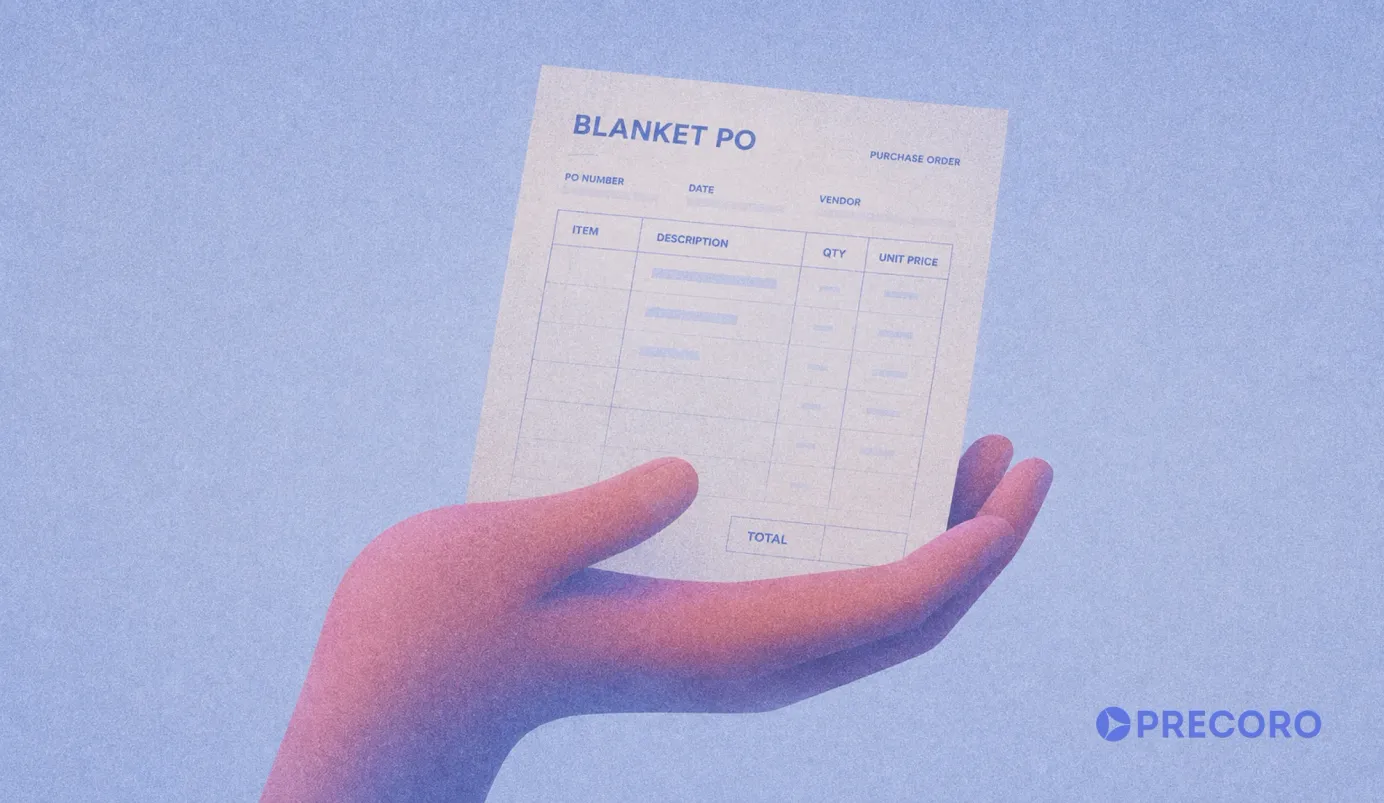
A blanket purchase order is a purchasing arrangement used for repeated purchases from the same supplier over a defined period.
Blanket POs are one of several arrangements that can support longer-term supplier relationships. However, these arrangements differ in how they define quantities, delivery schedules, items, and purchasing commitments, which is why the terms often need clarification.
Those differences matter most when demand changes or a supplier underperforms, as each arrangement comes with different obligations. To clear up the confusion, let’s look at what a blanket PO is and how it differs from a standard purchase order.
What is the basic definition of a blanket purchase order?
A blanket purchase order, also known as a standing purchase order, BPO (blanket purchase order), or open PO, is a long-term contract that allows companies to buy the same goods multiple times over a specific designated period, with pre-negotiated prices. This reduces the manual work, as there is no need to issue a new purchase order every time.
A blanket PO is generally suitable for companies that have predictable, ongoing needs, such as office supplies and raw materials. It typically includes a maximum spending limit and a pre-defined validity period.
How does a blanket PO differ from a standard purchase order?
A blanket PO differs from a standard purchase order in the following ways:
- Duration: Standard purchase orders are best for one-time use and are created to fulfill a specific order. A blanket purchase PO, on the other hand, is designed for recurring purchases, valid for a specific period of time.
- Qualities and deliveries: For a standard PO, everything is fixed, while for the blanket purchase order management, it’s flexible, and qualities and delivery dates can change based on the company’s needs.
- Administrative burden: In the case of the standard purchase order, there is a lot of paperwork and administrative burden, as someone needs to create a new purchase order. BPO simplifies this process, removing the need to create a new purchase order every single time.
- Supplier relationship and terms: A standard PO offers a shorter-term commitment because the relationship may stop if there are no future needs. A standing purchase order requires a long-term relationship with the supplier.
- Risk management: Standard POs reduce certain forecasting and long-term commitment risks because each PO addresses a defined purchase. Blanket POs, instead, pose some risks, such as stockpiling goods or missing out on better deals.
What is a blanket PO release or call-off order?
A blanket PO by itself doesn’t authorize a shipment. It sets the terms, but nothing ships until the buyer says so.
When departments need certain products or services that are covered by the blanket PO, they submit a release order. These releases reference the blanket PO number and specify terms such as quantities, delivery dates, and shipping locations.
Blanket PO vs. planned PO vs. contract purchase agreement: What’s the difference?
While these three terms are used interchangeably, they aren’t the same.
Planned PO, unlike the blanket PO, isn’t flexible. It specifies the items, their qualities, prices, and delivery dates.
A contract purchase agreement is the complete opposite. It contains no items and no quantities at all. It only specifies payment terms, delivery terms, warranties, liability, dispute resolution, and discount structure.
The following table thoroughly covers how blanket POs, planned POs, and contract purchase agreements differ from each other.
| Feature | Blanket PO | Planned PO | Contract |
|---|---|---|---|
| Best suited for | Recurring requirements | Forecasted long-term requirements | Long-term supplier relationships |
| Goods/services known | Yes | Yes | Not necessarily |
| Quantity known | Flexible | Yes | No |
| Delivery schedule known | Usually flexible | Tentative | No |
| Purpose | Set commercial terms for repeated purchases | Commit to future supply while scheduling releases | Establish contractual terms later referenced by orders |
What problems are blanket POs designed to solve?
Blanket POs reduce repetitive approvals, duplicate data entry, repeated supplier negotiations, and fragmented recurring spend.
Generally, a blanket PO makes sense when purchasing is recurring and reasonably predictable, even if exact quantities or timing vary. Blanket PO addresses the following issues:
- Repetitive administrative work;
- Inconsistent pricing across repeated orders;
- Fragmented spending with the same supplier;
- Slow ordering of routine requirements;
- Limited visibility into expected annual demand;
- Difficulty consolidating purchasing volume;
- Repeated supplier negotiations.
When did blanket POs become common in procurement?
There is no specific date when blanket POs became common in procurement. However, the concept was developed after long-standing practices were used to simplify repetitive buying. As businesses grew and began ordering the same goods or services from trusted suppliers on a recurring basis, procurement teams needed a way to avoid issuing a new purchase order every single time. As a result, the blanket PO was developed.
Why use blanket POs?
The core difference between a blanket and a regular purchase order comes down to repetition. Standard POs are created fresh for every transaction, while blanket POs are set up once and drawn against repeatedly. Companies use blanket POs to reduce purchasing administration, standardize recurring purchases, and negotiate terms in advance.
What are the main benefits of using blanket purchase orders?
Blanket PO offers a wide suite of benefits that make it worth considering. Let’s cover the main benefits.
- Operational efficiency: Teams can easily request the designated products and services without repeat approval cycles or paperwork.
- Cost savings: Buyers can use their expected purchase volume to negotiate lower prices or volume discounts upfront.
- Better vendor relationship: A longer-term arrangement can improve supplier planning and relationship continuity, although priority treatment depends on the supplier and contract terms.
- Reduced recurring purchasing administration: Once everything is set up, there is no need to worry about the rest of the week. You will receive the products or services as long as there is still money in the account.
- Reduced administrative burden: Standard purchase orders cost the organization between $50 and $100 per PO. Blanket POs significantly reduce this burden as companies consolidate multiple invoices or orders into a single agreement.
- Pre-agreed pricing: Pricing is the same for the entire duration of the agreement, which protects against market fluctuations and inflation.
- Faster ordering and delivery: Once a blanket PO is established, release orders can be processed.
- Better inventory management.When supplier reliability and lead times support it, scheduled releases may help organizations operate with lower inventory levels.
- Better budgeting and forecasting: Blanket POs provide predictable costs over extended periods, enabling more accurate budgeting and financial forecasting.
How do blanket POs help with cost control and budgeting?
A blanket arrangement can establish a maximum authorized value for a defined contract period, allowing procurement and finance to monitor consumption against that ceiling. That visibility helps finance identify abnormal spending before the agreement is exhausted.
Digital controls strengthen the approach further. Precoro's spend management software centralizes purchasing and invoice data, supports approval workflows, and provides real-time budget visibility.
Why use a blanket PO instead of multiple individual purchase orders?
Issuing the same order multiple times does not improve control. Instead, it results in more time spent on procurement. Besides, requiring a completely separate purchase order process for every routine replenishment may add administrative burden rather than control.
Blanket PO solves this issue. Using BPO instead of multiple individual purchase orders allows for fewer repetitive transactions, while preserving visibility and accountability.
Can blanket POs improve supplier relationships, and how?
The benefits of a blanket PO go beyond just cost control and agreements. It improves supplier relationships, especially if the contract is for a longer period of time. It strengthens the partnership between the two sides and fosters trust and mutual commitment.
What are the potential risks or downsides of blanket POs?
While BPO offers a lot of advantages, they also come with a few downsides, which are as follows:
- Less flexibility to switch suppliers: Since Blanket BPO is a long-term contract, companies choose one vendor and collaborate with them throughout the entire process.
- Risk over commitment: Some agreements include minimum purchase commitments that companies should meet regardless of their market conditions. Even if demand decreases, they should fulfill their financial requirements.
- Missing market price decreases: During the pre-negotiation process, the prices are usually also discussed. This means that companies that already have long-term contracts may miss market price decreases.
- Requires ongoing monitoring and oversight: Blanket POs need consistent oversight to ensure spending, supplier performance, and contract compliance remain on track. Regular reviews and variance checks help identify issues early and confirm that both parties are meeting the agreed terms.
- Reduced supplier performance complacency: Long-term agreements can reduce suppliers' motivation to improve service levels or seek cost reductions.
When should you use a blanket PO?
Not every recurring purchase justifies a standing agreement.
Use it when:
- Purchases recur
- Supplier/category is stable
- Terms can be negotiated in advance
- Total demand is reasonably forecastable
- Individual delivery timing can vary
Avoid it when:
- Purchases are genuinely one-off
- Specifications change frequently
- Pricing is extremely volatile
- Supplier performance is uncertain
- Demand cannot be reasonably estimated
Which purchasing scenarios are best suited for blanket POs?
Usually, the strongest candidates for BPOs are recurring, relatively stable purchasing categories. Typical examples include:
- Office and cleaning supplies
- Packaging
- MRO (maintenance, repair, and operation) materials
- Consumables
- Fuel or lubricants
- Printing
- Temporary staffing
- Recurring professional services
- IT (information technology) support
- Maintenance
- Facilities services
- Regularly purchased production components
How do usage patterns and predictability influence the decision?
Blanket POs work best when total demand is reasonably predictable, but individual order quantities or delivery dates vary. However, if overall demand is difficult to forecast, a long-term commitment can create a risk of overcommitting to quantities the company may not need.
Recurring requirement + reasonably predictable total demand + uncertain timing = strong blanket PO candidate.
It’s essential that companies examine historical consumption data before signing a long-term contract with any supplier.
At what volume or frequency does a blanket PO become advantageous?
There is no universal transaction threshold where a blanket PO becomes advantageous. Organizations can set their own criteria for using BPO based on volume, frequency, spend category, or purchasing risk.
Imagine that one routine PO requires 40 minutes. If there are 150 to 200 similar POs annually, that will take ≈ 133 hours of administrative work. In this case, using a blanket PO is highly advantageous, as it reduces unnecessary paperwork.
Are there industries or product types where blanket POs are inappropriate?
Blanket POs aren’t inherently unsuitable for specific industries. What matters more is the type of purchase. They provide less value when prices change rapidly, requirements vary significantly between orders, or purchases aren’t frequent enough to justify a long-term arrangement:
- Volatile-priced commodities: This includes products such as energy, agricultural inputs, precious and base metals, and freight.
- Rapidly changing technology: This includes laptops and mobile devices. Long-term agreements mean the companies may buy devices from last year at last year’s prices, which is not advantageous for either side.
- Highly engineered or bespoke items: This includes specialized professional services. Every purchase has different specs, and there's nothing repetitive to consolidate. Therefore, it is not appropriate to use blanket POs.
- Low-frequency or low-value purchasing: Categories where companies buy the same thing twice a year. Setting up and administering the agreement costs more than they save.
How to create an effective blanket PO?
Creating an effective blanket PO starts at the pre-negotiation period, where the content, structure, and contract terms are thoroughly discussed. In the following sections, we will cover everything: what information is included and how to set everything up.
What information must be included in a blanket PO?
- Comprehensive blanket PO includes the following:
- PO number for tracking
- Issue date and delivery date
- Complete contract information from both sides
- Detailed description of the goods or services
- Unit price and quantity
- Payment conditions and terms
- Shipping methods and delivery instructions
- Quality specifications
- Contract duration
- Multiple delivery schedules
- Maximum and minimum number of order quantities
- Total cost for the entire duration of the contract
How should quantities, pricing, and delivery schedules be structured?
When structuring quantities, pricing, and delivery schedules, it’s essential to avoid false precision. To structure the quantity, it’s recommended to identify the following:
- Forecast quantity: What the buyer expects to consume.
- Committed quantity: What the buyer is legally obligated to purchase.
- Maximum quantity/value: What cannot be exceeded without amendment.
The pricing structure should also reflect the category. Possible approaches include fixed unit prices, tiered volume prices, indexed prices, price-review windows, and capped annual increases.
Delivery terms should explain lead time, call-off procedure, delivery location, minimum order quantities, emergency orders, and supplier confirmation requirements.
What contract terms and legal clauses should be considered?
Commercial terms should be reviewed with legal counsel based on jurisdiction and category risk. Typical provisions include:
- Scope
- Specifications
- Pricing and taxes
- Delivery
- Inspection and acceptance
- Warranties and confidentiality
- Data protection
- Insurance
- Intellectual property
- Indemnification
- Limitation of liability
- Regulatory compliance
- Termination
- Dispute resolution
How can you set effective thresholds, expiration dates, and renewal options?
A blanket PO should have clear limits to ensure that there is no uncontrolled spending affecting the financial health of the company. Therefore, setting effective thresholds, expiration dates, and renewal options is a must.
Start by setting a maximum spend or quantity threshold. Identify historical purchasing data, expected demand, and an approved budget, which will reflect a realistic budget.
An effective blanket purchase order needs to have a defined validity period. Expiration dates help prevent outdated pricing, inactive supplier agreements, and forgotten open commitments from remaining in the system indefinitely.
As a control practice, organizations should review performance, demand, pricing, and risk before renewal rather than renewing without review. Before extending the agreement, procurement should review:
- Actual spend and utilization
- Supplier performance
- Current market pricing
- Changes in demand or specifications
- Compliance with agreed terms
- Whether the original supplier still offers competitive value
How are blanket POs managed day-to-day?
A blanket PO process is thorough, and it doesn't run itself. Releases have to be issued and tracked, spending should be monitored against the agreement's limits, and supplier performance checked against terms that were set months earlier.
In short, a standing PO simplifies repeat purchasing while keeping defined limits, pricing, and supplier terms in place.
How do requisitions, releases, and call-offs work under a blanket PO?
There is no universal workflow, and usually, specific steps depend on the system. The major principle is that users should not create disconnected purchases simply because a blanket PO exists.
A requisition is an internal request, not an order. It goes through approval before a purchase is made. A release is the actual order placed against the agreement. It specifies quantity, delivery date, and location, inherits price and terms from the parent document, and reduces the remaining authorized value.
What systems and tools can simplify blanket PO management?
When companies collaborate with one specific vendor, and there are a limited number of agreements, spreadsheets can be a great option. Rarely is this the case, though, because once the complexity increases, companies tend to rely on purchase management tools that offer the following:
- Requisitions
- Approval workflows
- POs
- Invoices
- Receipts
- Budgets
- Supplier records
- Audit trails
- Reporting
If you are looking for an option that connects your purchasing records in one place, Precoro's purchase order software is a good choice for mid-sized companies, especially those working across multiple entities.
How should inventory and demand be tracked against a blanket PO?
When agreements are signed, procurement teams should always monitor the following:
- Ordered quantity
- Received quantity
- Consumed quantity
- Available inventory
- Forecasted demand
- Remaining PO capacity
Failing to monitor these can lead to the following scenarios
- Companies may consume the PO faster than expected and reach the blanket PO’s approved spending or quantity limit.
- Companies can buy more than needed and have substantial unused capacity because actual demand fell below the original forecast.
Who in the organization should own and manage blanket POs?
There is no single person who is responsible for the entire management of blanket POs. Each department within the company is responsible for a specific function.
- The procurement team should own supplier negotiations, commercial structure, renewal, and overall compliance.
- The requesting department owns demand accuracy and business justification.
- Finance owns budget alignment and accounting controls.
- Accounts payable validates invoices and payment requirements.
- The legal team supports contractual terms where necessary.
- Operations teams confirm receipt and consumption of physical products.
How do blanket POs support lean inventory and just-in-time delivery?
Blanket purchasing can support lean inventory when it separates commercial commitment from physical delivery. It’s recommended that, in the pre-negotiations, both parties discuss the annual relationship and request small deliveries based on their needs.
Instead of receiving six months of inventory simply to secure a volume price, the buyer negotiates the annual relationship while requesting smaller deliveries as needed.
How to negotiate blanket purchase orders with suppliers?
Blanket PO negotiations should define pricing, forecast versus committed volume, service levels, delivery flexibility, renewal conditions, and termination rights.
What negotiation strategies work best for blanket PO pricing and terms?
When negotiating for the blanket PO, the aim should not just be the unit price, but the total value of the supplier relationship. Here are the key strategies that work best for blanket PO pricing and terms.
- Use historical spend and demand data
- Negotiate volume-based pricing tier
- Separate forecasted volume from committed volume
- Negotiate more than price
- Secure service-level commitments
- Build flexibility into the agreement
- Define renewal and termination conditions upfront
How can you balance supplier flexibility with firm commitments?
A blanket purchase order should give suppliers enough predictability to plan capacity and inventory while allowing the buyer to adjust purchases when actual demand changes. The key is to clearly separate what is forecasted from what is contractually committed.
Useful approaches include:
- Separate forecasts from guaranteed volumes: Provide suppliers with expected annual or quarterly demand for planning purposes.
- Set minimum and maximum purchase levels: A minimum commitment gives the supplier greater certainty, while a maximum limit protects the buyer from uncontrolled spending.
- Use rolling forecasts: Provide updated demand forecasts monthly or quarterly.
- Allow flexibility within agreed ranges: The agreement can permit quantities to increase or decrease by a defined percentage without requiring renegotiation.
- Define lead times for changes: Specify how much notice the buyer must provide when changing quantities, delivery dates, or product mix. Larger changes may require longer notice.
- Use volume-based pricing instead of rigid commitments: Suppliers can offer different price tiers based on actual cumulative purchases, allowing the buyer to benefit from higher volumes without guaranteeing unrealistic demand.
- Agree on capacity reservations where supply is critical: If availability is essential, the supplier may reserve a certain level of production or inventory capacity in exchange for a minimum purchasing commitment.
- Define consequences for major shortfalls or increases: The blanket PO should explain what happens if actual demand falls significantly below forecasts or exceeds agreed limits, including possible price adjustments, renegotiation, or additional approvals.
What performance metrics and SLAs should be included?
The agreement should define measurable supplier expectations wherever performance matters. Relevant metrics include:
- On-time delivery rate
- Complete delivery rate
- Defect rate
- Order accuracy
- Lead time
- Invoice accuracy
- Service response time
- Issue-resolution time
- Fill rate
- Emergency-order performance
How can you handle disputes, changes, and cancellations?
To help you handle disputes, changes, and cancellations, it is essential to establish a change process before changes happen. The agreement should identify:
- Who may request a change?
- Who can approve it?
- Which changes require written amendments?
- How much notice is required?
- What happens to outstanding releases?
- Which cancellation charges apply?
- How are disputes escalated?
How should price changes and volume shortfalls be handled mid-agreement?
When such issues arise, don’t leave them undefined. The agreement can specify a review mechanism for scenarios, such as price changes, including:
- Fixed price for six months
- Review every quarter
- Adjustment linked to a published index
- Supplier documentation required for increases
- Maximum adjustment percentage
- Buyer termination right if the increase exceeds a threshold
Volume shortfalls require equal clarity. If the expected volume is non-binding, say so. If a minimum purchase commitment exists, state the remedy if actual demand falls short. This protects both buyer and supplier from discovering halfway through the contract period that they interpreted the forecast differently.
How to measure the success of blanket POs?
Blanket POs are usually judged on the rate that was negotiated, which is only part of the picture. Measure blanket PO performance using savings, transaction reduction, cycle time, contract utilization, forecast accuracy, and supplier performance.
What KPIs and metrics indicate blanket PO effectiveness?
Useful KPIs (key performance indicators) include:
- Blanket PO utilization rate: Spend through eligible blanket arrangements ÷ total eligible spend.
- Value utilization rate: Actual spend ÷ authorized blanket value.
- PO reduction rate: Reduction in separately created POs compared with the previous process.
- Cycle time: Time from approved requirement to supplier order.
- Price compliance: Percentage of transactions following contracted pricing.
- Supplier performance: Delivery, quality, accuracy, and SLA results.
- Off-contract spend: Purchases made outside approved agreements despite eligible coverage.
How can cost savings and process efficiencies be quantified?
The value of a blanket PO should be measured across both direct purchasing savings and administrative efficiency. Comparing performance before and after implementation helps procurement determine whether the arrangement is actually reducing cost and effort.
Key measures include:
- Price savings: Compare the negotiated blanket PO price with previous purchase prices or current market rates.
- Volume discounts and rebates: Track savings generated through consolidated purchasing, tiered pricing, or supplier rebates.
- Reduction in PO processing costs: Estimate how many separate purchase orders were avoided and multiply that by the average internal cost of creating, approving, and processing a PO.
- Lower transaction volume: Compare the number of individual POs, approvals, and supplier communications required before and after introducing the blanket purchase order.
- Shorter procurement cycle times: Measure the time from purchase request to supplier order. Faster processing can reduce delays and free procurement teams to focus on higher-value activities.
- Lower invoice-processing effort: Track whether fewer exceptions, pricing discrepancies, or approval delays occur because commercial terms have already been agreed.
- Reduced emergency purchasing: Measures decrease in rush orders, expedited shipping fees, and one-off purchases made outside negotiated agreements caused by poor planning.
- Improved contract utilization: Compare actual spend under the blanket PO with the approved value to determine whether negotiated terms are being fully used.
What supplier performance indicators matter for blanket agreements?
Supplier performance should be monitored throughout the life of a blanket purchase order, especially because the agreement often covers repeated purchases over an extended period. The most useful indicators are those that show whether the supplier is consistently meeting agreed expectations.
Key supplier performance indicators include:
- On-time delivery rate: Measures the percentage of orders delivered by the agreed date.
- Order fulfillment rate: Tracks whether the supplier delivers the full quantity requested without shortages or backorders.
- Quality acceptance rate: Measures the percentage of delivered goods or services accepted without defects, rework, or complaints.
- Lead-time performance: Compares actual delivery times with the lead times established in the agreement.
- Price compliance: Checks whether invoices and releases follow the pricing agreed under the blanket PO.
- Invoice accuracy: Measures how often invoices match agreed quantities, prices, taxes, and other commercial terms.
- Order accuracy: Tracks incorrect items, quantities, specifications, or delivery locations.
- Responsiveness: Measures how quickly the supplier responds to requests, questions, changes, and urgent issues.
- Issue-resolution time: Tracks how quickly problems such as shortages, defects, delays, or invoice discrepancies are resolved.
- SLA compliance: Measures performance against any service-level commitments included in the agreement.
How are blanket POs treated in accounting and spend reporting?
Exact accounting treatment depends on the organization's accounting framework, ERP configuration, and whether encumbrance or commitment accounting is used.
Long-term procurement documents may therefore appear in commitment reporting even though actual accounting entries are driven by receipts, invoices, or other events.
For management reporting, track at least:
Approved value → released/ordered value → received value → invoiced value → paid value → remaining value.
When should a blanket PO be renewed, renegotiated, or terminated?
Different conditions affect the company’s decision whether to renew, renegotiate, or terminate the contract.
Renewal happens when demand remains relevant, supplier performance is strong, commercial terms remain competitive, and the agreement continues to create administrative value.
Renegotiation takes place when volumes change materially, market prices shift, specifications change, new suppliers become attractive, performance weakens, or organizational requirements change.
Termination happens when the business no longer needs the category, the supplier repeatedly fails, the risk becomes unacceptable, or the arrangement no longer provides competitive value.
What are common pitfalls, and how can you avoid them?
Blanket POs simplify recurring purchases, but that flexibility can create problems when controls are too loose. Here are the most common pitfalls to watch for and how to prevent them.
Why do blanket POs sometimes lead to overspending or stockouts?
Many common pitfalls trace back to the same underlying blanket PO risks: unclear limits, weak oversight, and assumptions about supplier availability. Blanket POs lead to overspending or stockouts since simplified ordering can make excessive consumption harder to detect. If employees treat an open PO as unlimited authorization, actual expenditure may rise faster than forecast.
Stockouts occur for the opposite reason. It happens because purchasing teams assume the supplier arrangement guarantees availability without monitoring inventory, demand, or lead times.
How can you prevent poor supplier performance under blanket agreements?
Here are the recommended steps to consider to prevent poor supplier performance under a blanket agreement.
- Do not let preferred-supplier status become permanent immunity from competition.
- Use supplier scorecards, performance reviews, corrective-action processes, benchmarking, and formal renewal reviews”
- Where supply continuity matters, consider maintaining an approved secondary source even if most volume goes to the primary supplier.
- A long-term commercial relationship should increase accountability, not reduce it.
What internal control weaknesses commonly affect blanket POs?
Typical weaknesses include:
- Excessive user access
- Vague category scope
- Missing receipts or manual tracking
- Expired agreements remaining active
- Supplier bank detail changes without verification
- Uncontrolled PO amendments
Another major weakness is allowing invoices to consume the agreement without checking whether the underlying goods or services were actually authorized and received.
Invoice matching can help address that problem. Precoro's 3-way matching functionality connects POs, receipts, and invoices and flags discrepancies for review.

How should blanket POs be controlled and audited at scale?
At scale, companies should define it as reviewing transactions that trigger risk rules rather than manually reviewing every transaction.
They should configure reports for:
- Unusually large releases
- Rapid consumption
- Invoices near or above limits
- Purchases outside approved categories
- Transactions just below approval thresholds
- Expired agreements
- Repeated supplier changes
- Duplicate invoices
- Abnormal price changes
- Missing receipts
How can automation and policy changes reduce risk?
The risks associated with blanket POs can be reduced by combining clear procurement policies with automated controls. Policies define how blanket agreements should be used, while automation helps ensure those rules are consistently followed.
Key measures include:
- Set clear approval thresholds
- Restrict authorized users
- Automate spend-limit controls
- Use expiration and renewal alerts
- Require purchases to remain within scope
- Automate approval workflows
- Use invoice matching
- Monitor exceptions automatically
- Maintain a complete audit trail
- Schedule periodic policy reviews
The strongest control environment combines well-defined rules with automated enforcement. This reduces reliance on manual checks while improving visibility, accountability, and compliance across the purchase order process.
Blanket order example: How does it work from creation to final invoice?
A blanket order is created with an agreement. As needs arise, the buyer issues releases against it, the supplier delivers the goods or services, and invoices are matched to the blanket order. The process continues until the order expires or its value is fully used, after which the final invoice is reconciled, and the order is closed.
How do manufacturing companies use blanket POs for MRO and components?
Manufacturing companies often use blanket POs for frequently purchased MRO supplies and production components where demand is recurring but exact quantities or delivery dates are difficult to predict.
Typical applications include:
- MRO supplies
- Production components
- Scheduled or demand-based releases
- Pre-negotiated pricing
- Inventory replenishment
- Emergency maintenance needs
- Supplier consolidation
- Just-in-time delivery
For example, a plant that expects to use approximately 50,000 bearings during the year could establish a blanket PO for the expected annual requirement and release smaller quantities each month based on actual production and maintenance demand.
This approach helps manufacturers reduce repetitive purchasing work while maintaining better control over pricing, supplier performance, inventory, and supply continuity.
How are blanket POs applied in services, IT, and facilities management?
In IT and facilities management, blanket POs are commonly used for recurring services and supplies where the exact timing or volume of demand is difficult to predict.
For example:
- IT: technical support, system maintenance, cybersecurity services, software development, and hardware repairs.
- Facilities: HVAC (heating, ventilation, and air conditioning) maintenance, electrical and plumbing work, cleaning, security, landscaping, and general repairs.
- Urgent or recurring needs: pre-agreed suppliers, rates, and terms allow teams to request services quickly without creating a new PO every time.
The blanket purchase order sets the overall spending limit, approved services, pricing, and contract period, while individual work orders or requests are issued as needs arise. This gives teams flexibility while keeping recurring spend under control.
What lessons can be learned from case studies of success and failure?
Successful arrangements generally share three characteristics:
- Visibility. Everyone knows what has been consumed and what remains.
- Governance. Users understand what is and is not permitted.
- Supplier accountability. Performance is measured instead of assumed.
Common failure factors include the opposite: forgotten agreements, unclear limits, inaccurate demand, weak invoice controls, and no renewal review.
Are there examples of small businesses effectively using blanket POs?
Yes. Many small businesses effectively use blanket POs. The principle is the same, but at a smaller scale. The principle is equally useful at a smaller scale.
Consider the following example. A local construction company may establish a blanket PO with a building-supply vendor for regularly used materials such as fasteners, safety equipment, and basic tools.
The economics are smaller than in a multinational company, but the benefit is the same: reducing repetitive administration while maintaining control.
How to implement blanket POs in your organization?
Rolling out blanket POs requires more than negotiating terms with suppliers. Companies need to identify suitable purchases, set clear controls, and establish processes for using and monitoring each agreement.
What steps are needed to roll out a blanket PO program?
Consider the following steps to roll out a blanket PO program.
1. Analyze purchase history.
2. Quantify the opportunity.
3. Define eligibility criteria.
4. Select suppliers.
5. Negotiate terms.
6. Configure controls.
7. Train users.
8. Monitor performance.
9. Review before renewal.
How should policies, training, and governance be established?
A blanket PO policy should answer practical questions employees encounter.
- Who can create one?
- Who can approve it?
- Which suppliers qualify?
- What is the maximum duration?
- Who can buy against it?
- Can users change quantities?
- What happens when the limit is reached?
- What requires a separate PO?
- How are exceptions handled?
- Who reviews the agreement before renewal?
What technology integrations and process changes are required?
The most useful integrations connect procurement with accounting, ERP, inventory, and financial reporting.
Without integration, employees may control the PO in one system while invoices, supplier balances, inventory, and budgets live elsewhere.
That creates reconciliation work.
Precoro integrates with accounting and ERP platforms and offers an API (application programming interface) for custom workflows. These integrations transfer purchasing documents such as POs, invoices, and receipts between procurement and financial systems.
Precoro also supports PunchOut integrations, allowing employees to shop directly in supplier catalogs while automatically bringing selected items, prices, and product details back into Precoro for approval. This reduces manual data entry while keeping purchases within established procurement controls.
How can pilot programs and phased rollouts reduce implementation risk?
For a first implementation, a limited pilot can reduce the risk of rollout.
Choose a category with:
- Enough transactions to produce measurable benefits
- Relatively stable pricing
- An established supplier
- Manageable risk
- Clear historical spend
Then do the following steps:
- Run the pilot for several months.
- Measure PO reduction, cycle time, price compliance, supplier performance, user adoption, invoice exceptions, and remaining-value accuracy.
- Use those findings to refine the policy before expanding the program.
How Does Precoro Automate Blanket PO Management?
Precoro helps replace manually tracked blanket purchasing with a connected digital workflow.
In Precoro, companies can create a blanket PO based on a predetermined total amount. The organization approves the overall amount without having to specify item lines at PO creation. Invoices can subsequently be associated with the arrangement as purchases take place. Precoro's step-by-step blanket PO creation guide explains the workflow.
Precoro connects purchasing with approval workflows, purchase requisitions, invoices, receipts, budgets, supplier information, and inventory. It works on top of ERPs as a user-friendly procurement control layer.
For invoice control, organizations can also use Precoro's invoice approval and matching functionality to connect purchase records with receipts and invoices before payment.
FAQ
The invoice should be flagged and held for review rather than processed automatically. The buyer can then amend the blanket order, approve additional funds, or reject the excess amount according to internal controls.
Delivery dates should be set through individual releases or call-offs based on actual demand, with agreed lead times defined in the blanket purchase order. If pricing is fixed for the contract period, the agreement should clearly state the price validity period and specify how any exceptional price adjustments must be reviewed and approved.
Yes, supplier discounts can change during an active blanket purchase order if the agreement clearly defines the conditions for adjustment, such as volume thresholds or pricing reviews. Any change should follow the agreed approval and documentation process to avoid disputes or inconsistent pricing.
A blanket order reduces administrative work by eliminating the need to create and approve a new PO for every recurring purchase. Approval controls remain in place through predefined spending limits, authorized users, release thresholds, and exception workflows for purchases that fall outside the agreed terms.
Supply chain teams should review available alternatives, assess the operational and cost impact, and require approval before accepting substitutions. The blanket purchase order should also define escalation, replacement, and supplier-notification procedures for delays or discontinued items.
Running blanket POs across five locations in five spreadsheets?
Book a demo and see how Precoro consolidates them into one system.