Coupa Software Competitors and Alternatives in 2026
Coupa is ideal for large, complicated buyers, but sometimes you need something different. Here are eight alternatives, who they're best suited for, and the key things to watch out for.

Coupa has been a go-to spend management solution for years, and it also went private in an $8 billion deal with Thoma Bravo in 2023. Despite its long tenure, some of its current clients have begun to wonder whether it’s still the best at what it does. A few businesses outgrew the setup effort required to switch from Coupa, and others may have received a renewal quote that prompted them to look into potential Coupa alternatives on the market.
The market itself is a mixed bag, though. Large businesses still have solutions like SAP Ariba and Oracle. Mid-market companies would find much greater value in more focused options, such as Precoro or Zip, in the meantime. At the end of the day, the choice between all these solutions comes down to the size of your organization and the complexity of your processes.
Keep reading to learn about eight noteworthy Coupa competitors as of October 2026, along with their advantages, shortcomings, pricing models, and customer reviews. The pricing, in particular, will be shared according to what each company offers to the public.
What is Coupa
Coupa's key advantages
Why look for a Coupa alternative
When your requirements differ
How we evaluate Coupa alternatives
Coupa user reviews
Best Coupa alternatives
Conclusion
FAQ
Key takeaways
- Coupa suits large, complex buyers, while most switching begins when the current design stops fitting.
- SAP Ariba, Ivalua, JAGGAER, and GEP all target the same range of large-scale suppliers.
- Precoro and Zycus work more in favor of mid-sized buyers; Zip works with most company sizes.
- Challenging setup seems to be a recurring issue for enterprise suites; reporting limitations are common for smaller tools.
- Many vendors quote per deal, recommending shortlisting with real approval rules where possible.
What is Coupa?
Coupa is a well-known business spend management platform handling what you buy and how you pay for it. It was founded back in 2006 by Dave Stephens and Noah Eisner, with its headquarters being in Foster City, California. Following an acquisition, Thoma Bravo took Coupa private in February 2023, and Leagh Turner became CEO of the company in November of the same year.
At its core, Coupa was always about procurement and invoicing. It did expand over time to include travel, expenses, treasury, and supply chain design, made possible largely by acquisitions — like the deal with LLamasoft in 2020. The platform's user base includes many prominent large enterprise clients, such as BNP Paribas and Caterpillar.
Coupa's key advantages
A big reason why many companies love Coupa is its data: over $10 trillion in community-generated spend, courtesy of 10+ million buyers and suppliers. All this data powers its price benchmarks and the AI features that we’ll discuss later on. Each buyer can compare a quoted price against what comparable companies pay.
Coupa’s breadth is also worth mentioning. There are four modules that the platform consists of:
- Source-to-contract
- Procure-to-order
- Invoice-to-pay
- Direct spend management
Businesses that use these modules in combination don’t need to hunt down distinct solutions for tasks like sourcing, purchasing, or payment. The spend module, acquired from LLamasoft, is often considered the rarest of the four modules due to its unique supply chain design tools, which few procurement-first vendors offer.
Agentic AI is Coupa’s most recent bet, with more than 20 persona-based Navi agents that are generally available already and are up and running in over 350 production environments. This year, Coupa also made a few acquisitions, such as Rossum for invoice document processing and Tonkean for request intake and orchestration.
Other factors about Coupa include:
- Connectivity with up to 160 ERP systems, with pre-built extensions for some of these in their App Marketplace.
- Navi Agent Studio has been generally available since May 2026 as a platform for building entire agents without coding knowledge.
- Coupa Catalyst offers engineers to customers who aim to implement the AI tools but may not have the internal capabilities to do so on their own.
- Scoutbee was also acquired by Coupa last autumn, bringing its supplier discovery tools into the overall package.
- Gartner named Coupa a Leader in the 2026 Magic Quadrant for Accounts Payable Application for the second year in a row.
Why look for a Coupa alternative?
Coupa is perfectly suitable for enterprise-grade complex companies. However, if you’re a smaller organization with less complexity or if your ERP system already covers some of the aspects of spend management, you might begin considering either switching from Coupa to an alternative or considering a Coupa competitor in the first place.
When your procurement, spend management, integration, or budget requirements differ
It's tempting to always reach for the obvious market leader when you're selecting software for future use. If the biggest, the best, the most well-known names in the industry are using the product, it must be the best option, right? A lot of shortlists start with market leaders because of this. Coupa is increasingly being seen in the same light when it comes to spend management, backed by major customers and analyst recognition.
That’s not always the best approach, though. Some buyers simply need less, for one. A team attempting to get purchase orders and approvals under control doesn’t really need supply chain modeling capabilities or sourcing events. Alternatively, an accounts payable (AP) department rarely needs anything more than invoice capturing/matching capabilities.
Both examples cover situations where Coupa’s suite offers more than these companies need, with every extra module adding to the total configuration effort and the payment amount. There’s nothing wrong with wanting less from a spend management solution.
Speaking of cost, it’s another trigger that bears mentioning. With Coupa quoting each deal individually, pricing the platform using only public information becomes extremely difficult. Meanwhile, implementation is scoped separately, making even the first year difficult to forecast, and the renewals become even harder.
How we evaluate Coupa software competitors and alternatives
The eight vendors below might range from light, purpose-built tools to enterprise suites, but we’ve analyzed them using the same format so that you can see at a glance how each one compares to others.
Each new solution opens with a brief introduction and ends with information on who will benefit most from the tool. The middle section offers all kinds of useful information, as well, like customer reviews, advantages, shortcomings, and pricing data.
Customer scores are the ratings each software has on G2 and Capterra as of September 2026, with both aggregators using a five-point scale. A score based on several hundred reviews tends to be more reliable than one based on just a dozen, which is why we also include the total number of customer reviews, too.
Advantages and shortcomings point out the common themes taken from reviews on those platforms. Pricing covers public information on the cost of each platform, noting instances where a vendor has no public pricing.
All solutions in this article were assessed using the same set of criteria and the same review aggregation platforms, including Precoro, the publisher of this guide.
Coupa user reviews
- Sergi F. — Capterra — “Honestly, my feelings on Coupa are a bit of a mixed bag, but mostly positive in the end. We moved from a messy system of emails and spreadsheets, so having everything in one place is a huge relief. I finally know who is spending what before the bill actually arrives, which makes my job way easier. That said, getting there wasn't fun. The implementation took longer than we expected, and getting our non-techy staff to actually use it correctly was a struggle. It’s not something you "pick up" in an afternoon. But now that we are over the hump, I can’t imagine going back to the old way. It works, but you have to be patient with it.”
- Felipe Z. — G2 — “I like the simple and intuitive management of purchase orders in Coupa and its history for performing specific searches. The integration with Slack and email for notifications is a great help to stay on top of updates. I also found that the initial setup was very simple.”
Best Coupa alternatives
Below we have listed eight options, all covered in the same way, plus a handy table for a quick scan of the basic capabilities of each software. The large enterprise suites work better for buyers operating complex procurement workflows. Teams with narrower needs and less headcount might find more use in more focused tools, in comparison. The order of these solutions in the article isn’t a ranking, either.
| Software | Primary focus | G2 / Capterra | Best fit |
|---|---|---|---|
| Precoro | Centralized procurement and spend control, from request to payment | 4.7 (222) / 4.8 (255) |
Mid-size companies with spending spread across teams or subsidiaries |
| SAP Ariba | Enterprise procurement and contract management | 4.1 (797) / 3.8 (89) |
Large enterprises with complex supplier networks and compliance needs |
| Ivalua | Source-to-pay and spend management | 4.3 (106) / 3.8 (6) |
Large, multi-region enterprises with the resources for a long implementation |
| JAGGAER | Enterprise procurement and supplier collaboration | 4.1 (86) / 4.1 (21) |
Large enterprises wanting standardized, compliant global procurement |
| Oracle Fusion Cloud Procurement | Source-to-settle procurement | 4.1 (38) / 4.2 (5) |
Organizations wanting procurement tied into Oracle’s finance tools |
| GEP SMART | Source-to-pay with AI-powered spend analytics | 4.3 (27) / 4.6 (7) |
Large multinational enterprises |
| Zycus | Source-to-pay with AI invoice processing | 3.6 (13) / 4.0 (3) |
Mid-size organizations wanting source-to-pay automation |
| Zip | Procurement intake and approval orchestration | 4.4 (22) / 4.7 (32) |
Companies that require one front door for all purchase requests |
Precoro
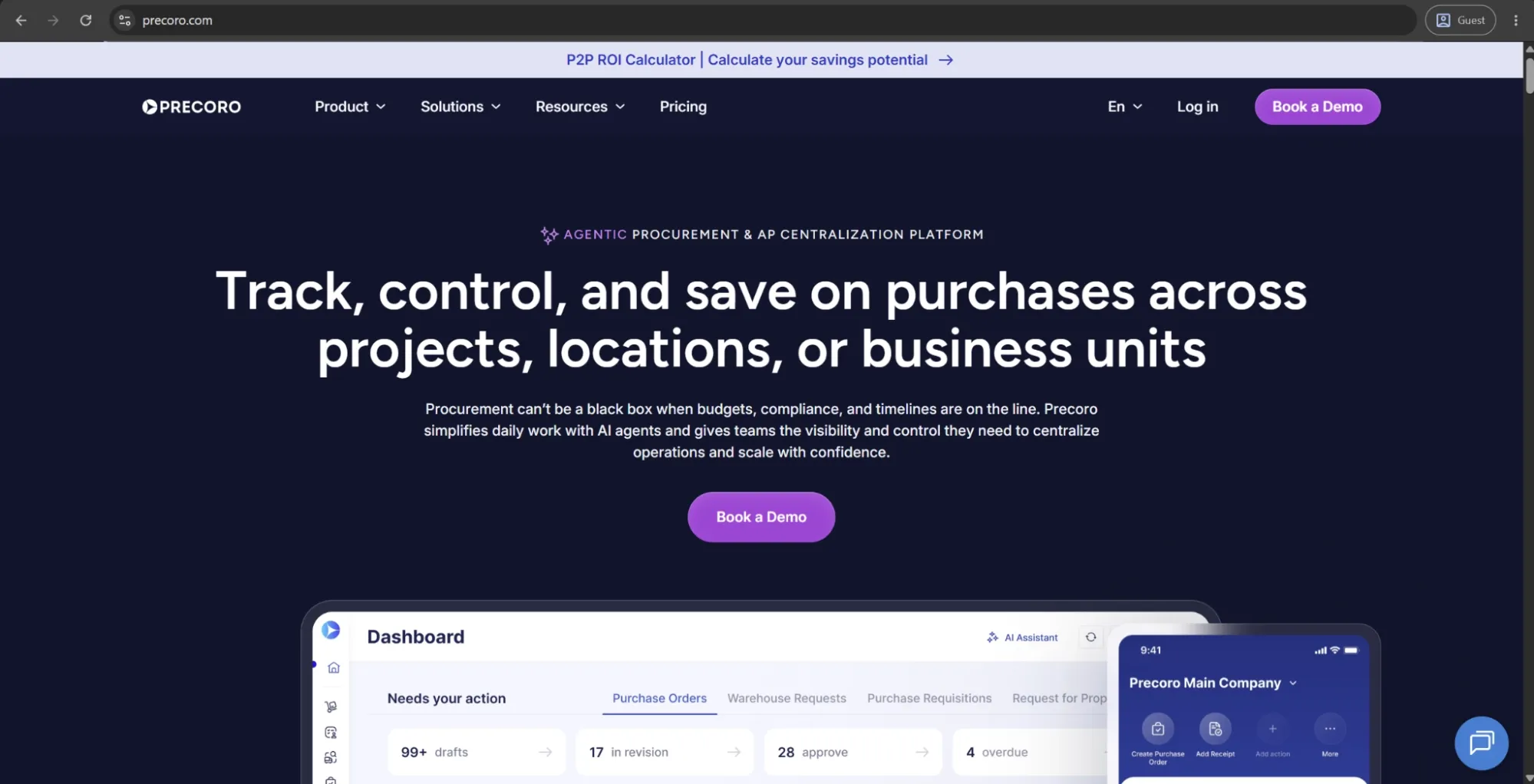
Precoro is an agentic procurement and accounts payable (AP) centralization platform that helps growing companies gain full visibility into spend, standardize purchasing processes, and prevent spend leakage.
Founded in 2015, Precoro has evolved from a purchase order tool into a platform that connects the entire procurement and AP process, from purchase requests and v purchase orders to supplier management, budgets, receipts, invoices, and payments.
Precoro also offers AI Crews to handle routine work and free your team to focus on strategy and high-value decisions. There are five crews: Intake, Purchasing, AP Automation, Supplier Management, and Spend Intelligence. They combine AI agents, an AI Assistant, and Document Processing. All five crews work from the same records, and you can override any AI decision.
What are the customer ratings of Precoro?
- G2 — 4.7/5 points based on 222 customer reviews
- Capterra — 4.8/5 points based on 255 customer reviews
What are the key advantages of Precoro?
- Easy to get the hang of, even for people new to purchasing.
- Customizable approval routing with budget tracking and spend visibility in one seamless workflow.
- Responsive onboarding support that allows some users to go live in a matter of weeks.
- Built for multi-entity companies to help standardize procurement across subsidiaries and locations.
- Precoro doesn’t replace your ERP or accounting system. It works alongside it and integrates with NetSuite, QuickBooks Online, Xero, Sage Intacct, Microsoft Dynamics 365 Business Central, and others.
What are the potential shortcomings of Precoro?
- Precoro is fast to deploy, but complex setups with multiple entities, approval rules, integrations, catalogs, and legacy processes still require configuration.
- Precoro covers procurement and AP, but you’ll still need an ERP or accounting system for GL, payroll, manufacturing, and broader financial management.
- Companies requiring advanced sourcing, supplier risk intelligence, or complex category management may need additional tools.
What do the customer reviews of Precoro say?
- Anthony S. — Capterra — “Previously, we were a ControlHub customer and with CH abruptly getting shut down, we moved over to Precoro. Overall, the experience was fairly smooth. We went from signing the contract to go-live in 15 days. Integrations are easy to setup, the implementation consultant [sensitive content hidden] helped us get bulk data imported into our account in time for go-live and made sure our go-live was a success.”
- Verified user in higher education — G2 — “I really appreciate how Precoro allows us to manage all purchasing functions in one centralized system. We no longer need Excel spreadsheets or manual processing, which has significantly streamlined our workflow.”
What is the pricing of Precoro?
Precoro’s pricing model offers simplicity and consistency in three separate tiers:
- Core starts at $499/month, billed annually. It offers the essential feature set for beginners, including automated approvals, three-way matching, spend management, vendor management, reporting analytics, and multiple integrations.
- Automation begins at $999/month, billed annually. Adds AI-powered AP automation, SSO support, real-time budget tracking, and several procurement capabilities.
- Enterprise doesn’t have a specific public cost associated with it, offering an expanded Automation tier with more integrations, advanced admin controls, enterprise-grade data protection, and no user limit in the environment.
What types of businesses is Precoro designed for?
Precoro is built for growing mid-size companies, usually with 500 to 10,000 employees, where people buy across many locations, projects, departments, or subsidiaries, while finance and procurement are run centrally. It works well for construction, logistics, manufacturing, retail, wholesale, and healthcare companies, and for businesses that grow through acquisitions and need to bring new entities under the same purchasing rules quickly. Each entity keeps its own budgets, approval workflows, and permissions inside one account, and implementation usually takes 2–8 weeks.

SAP Ariba
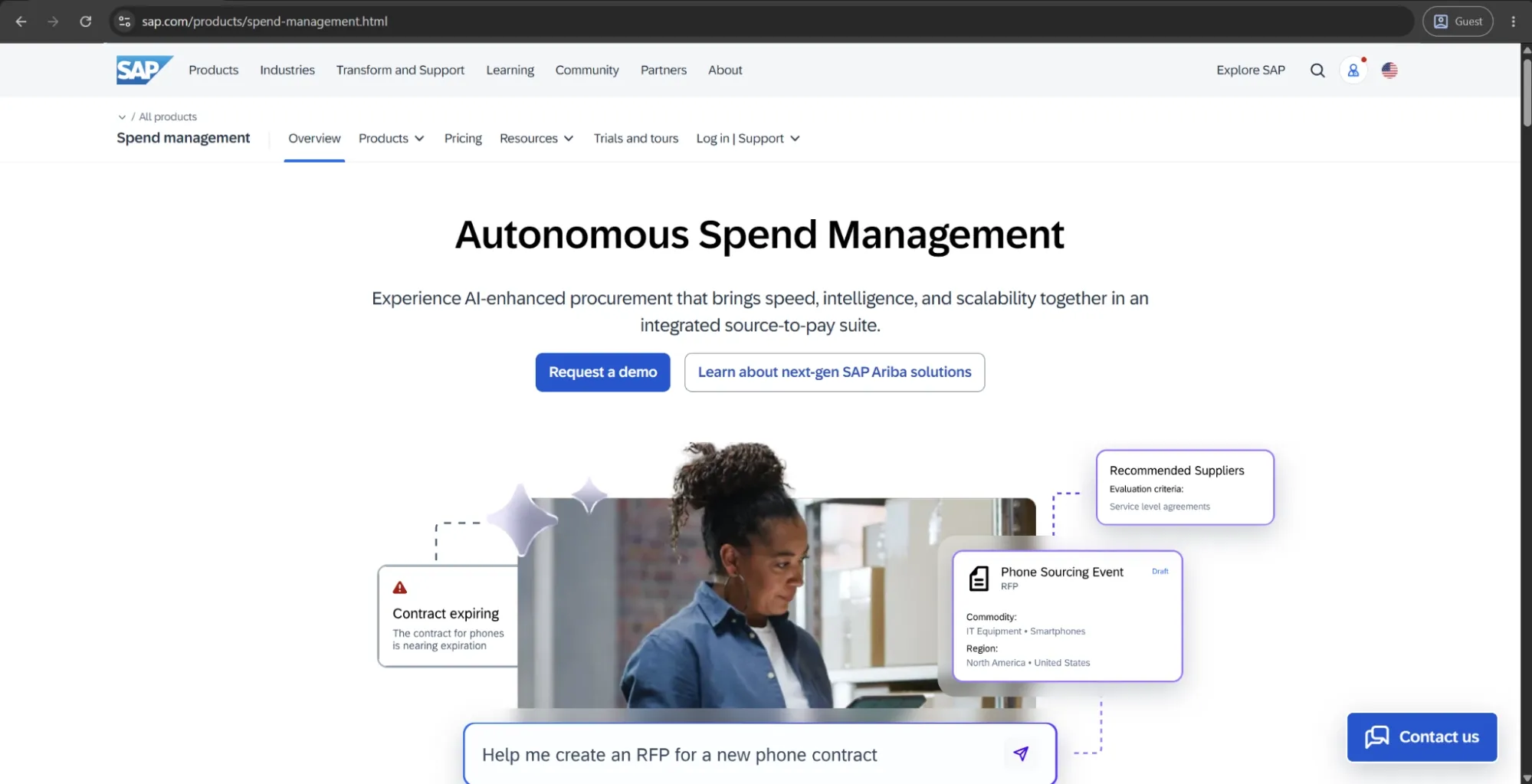
SAP Ariba is a cloud procurement suite built for large enterprises. SAP bought Ariba in 2012 for about $4.3 billion and has since built its procurement and contract management tools into the wider SAP ecosystem.
A big part of its appeal is SAP Business Network, which SAP says connects more than 5 million buyers and suppliers. If your company already runs on SAP, Ariba is usually the easiest fit, because many of your suppliers may already be on the network, and your procurement data lives in the same ecosystem as your finance data.
What are the customer ratings of SAP Ariba?
What are the key advantages of SAP Ariba?
- Enterprise-level control capabilities for organizations with strict compliance tracking and audit requirements.
- Centralized procurement with spend visibility and supplier collaboration.
What are the potential shortcomings of SAP Ariba?
- Demanding learning curve requiring hours of practice before becoming comfortable with the software.
- Somewhat outdated interface that gathers a lot of complaints about its ease of use.
- Time-consuming and cumbersome setup process before the system is ready to launch.
- Mixed reviews about the quality and responsiveness of customer support.
What do the customer reviews of SAP Ariba say?
- Emma B. — Capterra — “My overall experience with SAP Ariba is a positive one. I had some teething issues getting set up and logged in, but now that has been resolved, it is very easy and intuitive to use. It is easy to navigate through tasks and provides a document trial for financial records.”
- Jeet S. — G2 — “It provides transparency and scalability into compliance, supplier risk and sustainability management. It also enhances buyers, supplier, and user experience by bringing in a digital transformation to the supply chain. Easy to use both from end-user and admin point of view."
What is the pricing of SAP Ariba?
There’s no public pricing for SAP Ariba on the official website.
What types of businesses is SAP Ariba designed for?
SAP Ariba is built for large enterprises with complex supplier networks and strict compliance requirements, especially companies that already run on SAP. It's usually a weaker fit for mid-size companies that need to get purchasing under control quickly. Reviewers often say implementation takes a lot of time and resources, and that frontline teams find the system hard to learn. That matters when the people placing orders work at job sites, warehouses, or branch locations, not at a desk in procurement.
Ivalua
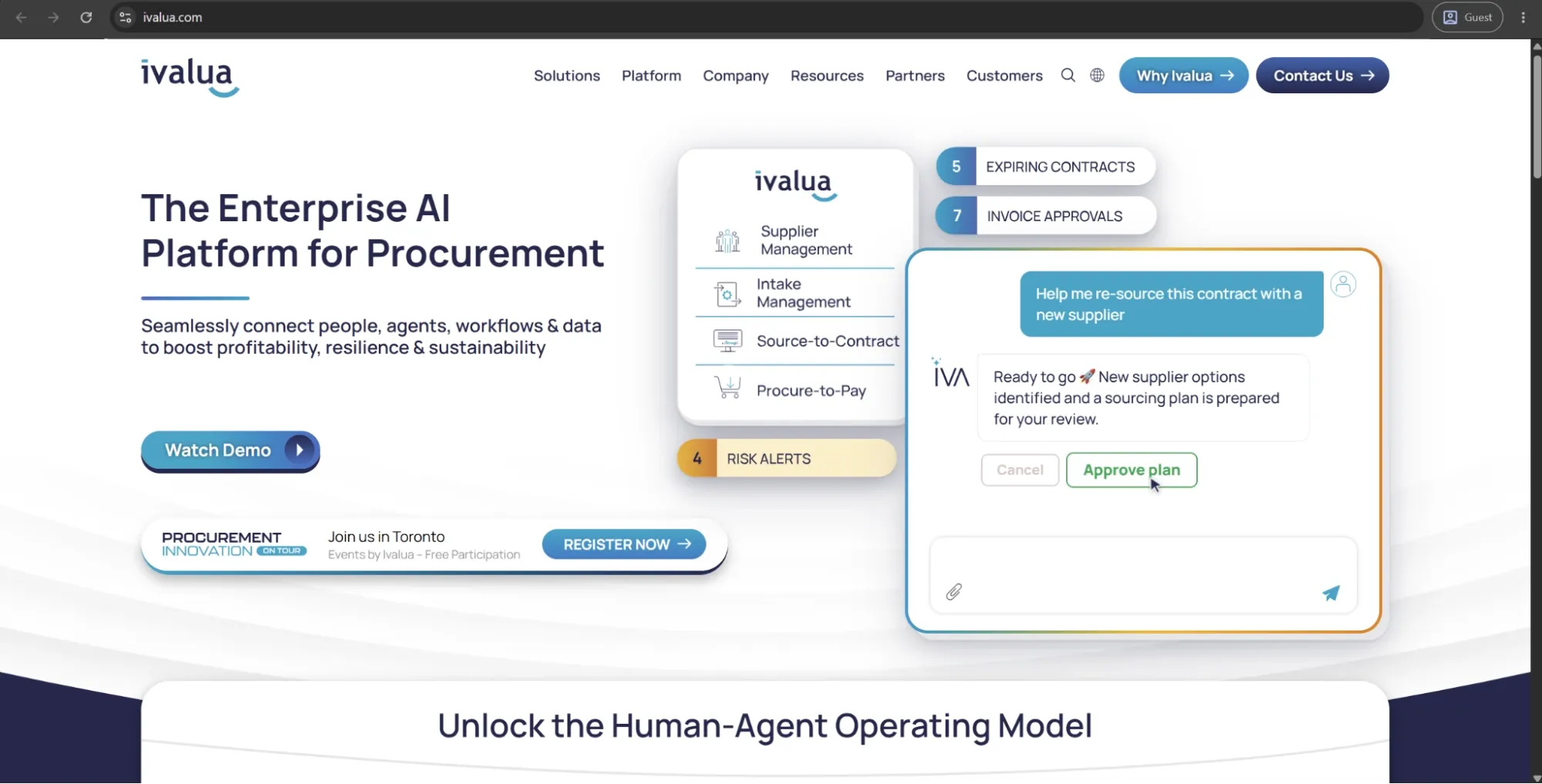
Ivalua helps industry leaders such as IKEA and Volkswagen take control of their spend. Its product touches every aspect of the source-to-pay supply chain, from sourcing and contracts to ordering and payment, all on one platform. It's unique in its highly customizable, low-code approach to creating workflows and adapting processes, as well as introducing a user-friendly AI feature called IVA.
What are the customer ratings of Ivalua?
What are the key advantages of Ivalua?
- Workflows and processes that can be customized without significant custom development.
- Powerful procurement and contract management features are great for complex businesses.
- Support for multi-region procurement operations with global sourcing.
What are the potential shortcomings of Ivalua?
- High implementation complexity demanding a lot of time and resources to spare.
- Regular performance issues include lags and bugs after updates.
What do the customer reviews of Ivalua say?
- Gabriele R. — G2— “I really like Ivalua for having good overview pages, which makes it easy to manage tasks. The integration with SAP ECC is also very helpful for our operations. I appreciate the possibility to configure processes, as it allows us to tailor the platform to our needs. Having all functionalities in one platform is a big advantage, as it simplifies our workflows by having everything centralized.”
- Giada O. — G2 — “I like the intuitivity of the system and the fact that admins have a lot of possibilities to improve the system according to the organization needs. For quality processes, we were able to add closure statuses at process closure, which made the solution feasible for automotive use. We were able to upload data from SAP into tables to populate performance scorecards and automate risk and performance scorecard generation.”
What is the pricing of Ivalua?
Ivalua doesn’t publicly disclose pricing on its website.
What types of businesses is Ivalua designed for?
Ivalua is built for large, multi-region enterprises that want one highly configurable platform for the whole source-to-pay process, from sourcing and contracts to supplier management and invoicing. That flexibility takes time to set up: one reviewer said their implementation took a full year. For mid-size companies whose main goal is controlling everyday purchasing across locations or projects, Ivalua's scope often goes beyond what they need, and the setup effort can delay results by months.
JAGGAER
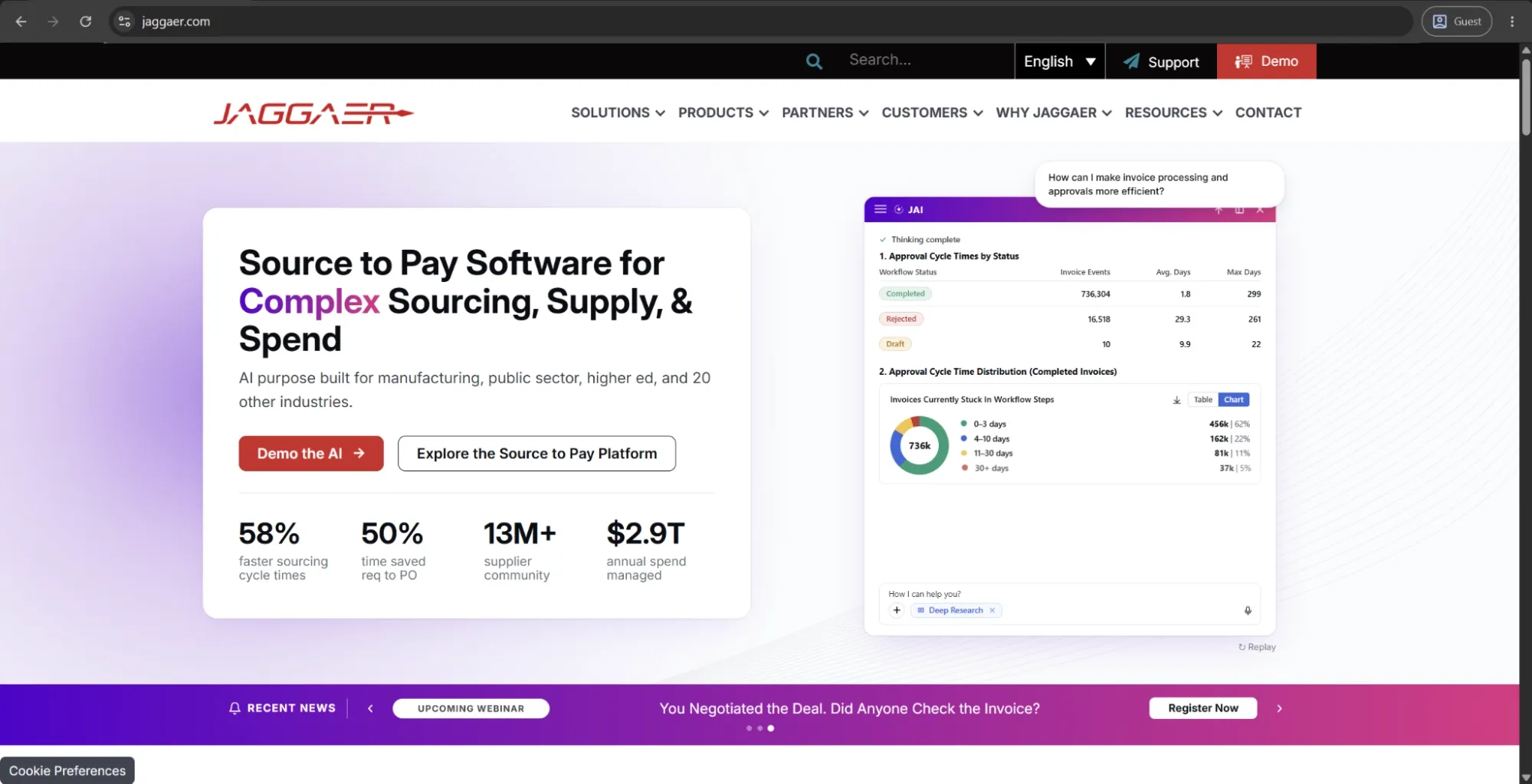
JAGGAER claims to have over 1,400 enterprises running its platform in 38 different industries. It helps companies buy, sell, source, contract, invoice, and pay for everything, both direct and indirect. The JAGGAER Link connector can tie the platform to more than 40 ERP systems so your existing finance technology can stay in place.
What are the customer ratings of JAGGAER?
What are the key advantages of JAGGAER?
- End-to-end global procurement capabilities with efficient standardization measures.
- Valuable quality control and compliance management features.
What are the potential shortcomings of JAGGAER?
- The user interface is often perceived as outdated and clunky.
- Overall setup complexity demands substantial effort to get the entire platform up and running.
- Separate segments of the platform have issues when it comes to data flow and module integration.
What do the customer reviews of JAGGAER say?
- Monica A. — Capterra — “Secure, resourceful and reliable software. I highly recommend JAGGAER eProcurement.”
- Rabea E. — G2 — “I find it great that when introducing multiple modules, they can communicate with each other and map end-to-end processes, which increases acceptance within the company. Jaggaer is significantly easier to use as an admin and super flexible in design, especially in the JD SRM and JI modules. JD SRM is helpful for supplier onboarding and offers a 360-degree view of suppliers. The JI module offers many customization options.”
What is the pricing of JAGGAER?
Jaggaer doesn’t provide public pricing on its website.
What types of businesses is JAGGAER designed for?
JAGGAER is built for large organizations that need to manage both direct spend (raw materials and components) and indirect spend (everyday business purchases) on one platform. It's especially common in manufacturing, higher education, and the public sector, where complex supplier requirements and strict compliance rules are the norm. However, reviewers often describe the interface as dated and the implementation as demanding. If adoption is a risk, an older, complex interface makes that risk bigger.
Oracle Fusion Cloud Procurement
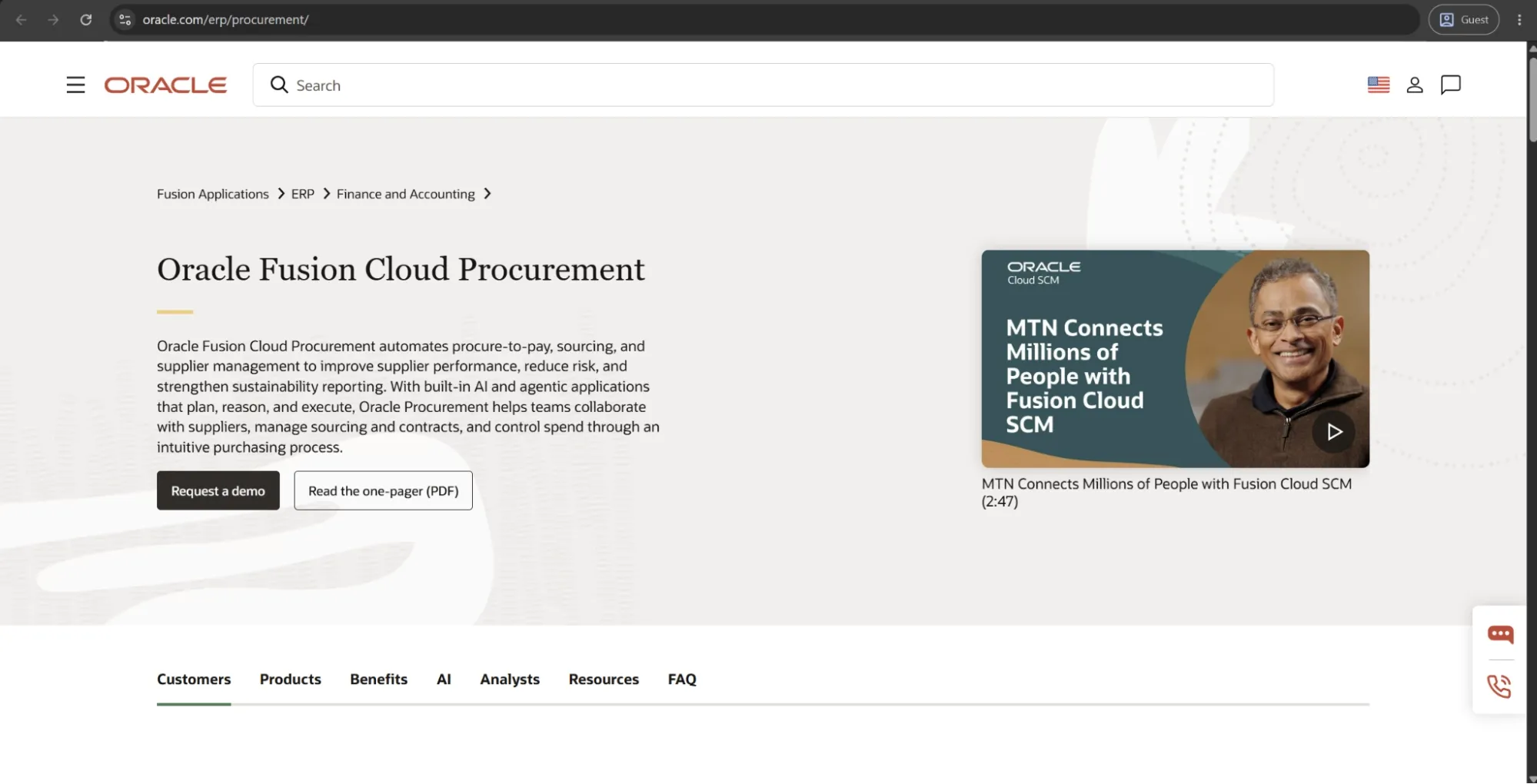
Procurement module is part of the application suite that is Oracle Fusion Cloud. It works alongside sourcing, contracts, supplier management, sustainability, and others. Oracle also has dedicated AI agents in its environment, like a Procurement Policy Advisor, along with a tool that turns supplier quotes into purchase requisitions.
What are the customer ratings of Fusion Cloud Procurement?
What are the key advantages of Fusion Cloud Procurement?
- Integrated procurement and finance capabilities.
- Extensive standardization capabilities, particularly in the field of procurement.
- Expense tracking benefits from intuitive data management, while approvals are easily collaborated on.
What are the potential shortcomings of Fusion Cloud Procurement?
- Lackluster reporting capabilities sometimes prevent users from getting clear calculations natively.
- Consistent complaints about slow response times.
- The necessity to bring in specialized technical resources to achieve timely and complete implementation.
- Rigid and unfriendly user interface.
What do the customer reviews of Fusion Cloud Procurement say?
- Amit G. — G2 — “The best thing about Oracle Fusion Cloud Financials is its comprehensive core financial processes. It brings together automated, real-time financial reporting and advanced analytics in a single, scalable cloud platform.”
- Vikram K. — G2 — “On cloud, continuous updates and improvement, AI, ML, integrations, easy to use. Great analytics and reports”
What is the pricing of Fusion Cloud Procurement?
Oracle’s pricing approach only gives its potential clients a choice between contacting sales, requesting a demo, and taking a product tour.
What types of businesses is Fusion Cloud Procurement designed for?
Oracle Fusion Cloud Procurement is part of Oracle Fusion Cloud ERP, so it's most often chosen by companies that already run Oracle for finance and supply chain. For those companies, the main advantage is that purchasing, invoices, and accounting stay in one system. For everyone else, it's a harder sell. Setup usually needs Oracle-experienced consultants or in-house specialists, and reviewers often say the interface isn't intuitive for occasional users.
GEP SMART

In 2026, GEP began consolidating its software, including GEP SMART and GEP NEXXE, under one AI-native platform called GEP Quantum Intelligence. It covers the full source-to-pay process, from intake and sourcing to contracts and payments, plus supply chain management. GEP describes it as a network of specialized AI agents for tasks like intake, contract redlining, negotiation, and invoice reconciliation.
What are the customer ratings of GEP SMART?
What are the key advantages of GEP SMART?
- Source-to-pay coverage for large enterprises across multiple nations.
- Extensive automation capabilities.
- AI-powered spend analysis helps make smarter buying decisions.
- Seamless integration with ERP systems.
- 24/7 customer support is always available to help accelerate operational efficiency in some way.
What are the potential shortcomings of GEP SMART?
- Customization capabilities that could’ve adapted the platform for a specific company’s needs are limited.
- The high cost of the solution makes it unsustainable for small businesses.
What do the customer reviews of GEP SMART say?
- Shreyas M. — G2— “As a user I could say it is a very good tool for procurement and supply chain, it combines many functions into single platform which makes it more efficient to use. Their Ai features are very much helpful which provide more insights for better decision making, even support and tranning are available to help with using the tool”
- Abhishek J. — G2 — “The first thing is it's easily accessible and everyone gets to have the same view of the database. Tracking and visibility is really good and help desk of GEP smart is really good”
What is the pricing of GEP SMART?
GEP doesn’t use standard pricing packages in its licensing approach; requesting a personalized quote is the only option.
What types of businesses is GEP SMART designed for?
GEP Quantum Intelligence is built for large multinational enterprises that want one AI-driven platform for sourcing, contracts, procurement, payments, and supply chain. It works best for companies with mature procurement teams that will actually use that whole scope. For example, they run regular sourcing events, manage complex contracts, and plan supply across regions. Mid-size companies whose main goal is to control everyday purchasing across locations or projects will likely pay for, and have to roll out, much more of the platform than they need.
Zycus
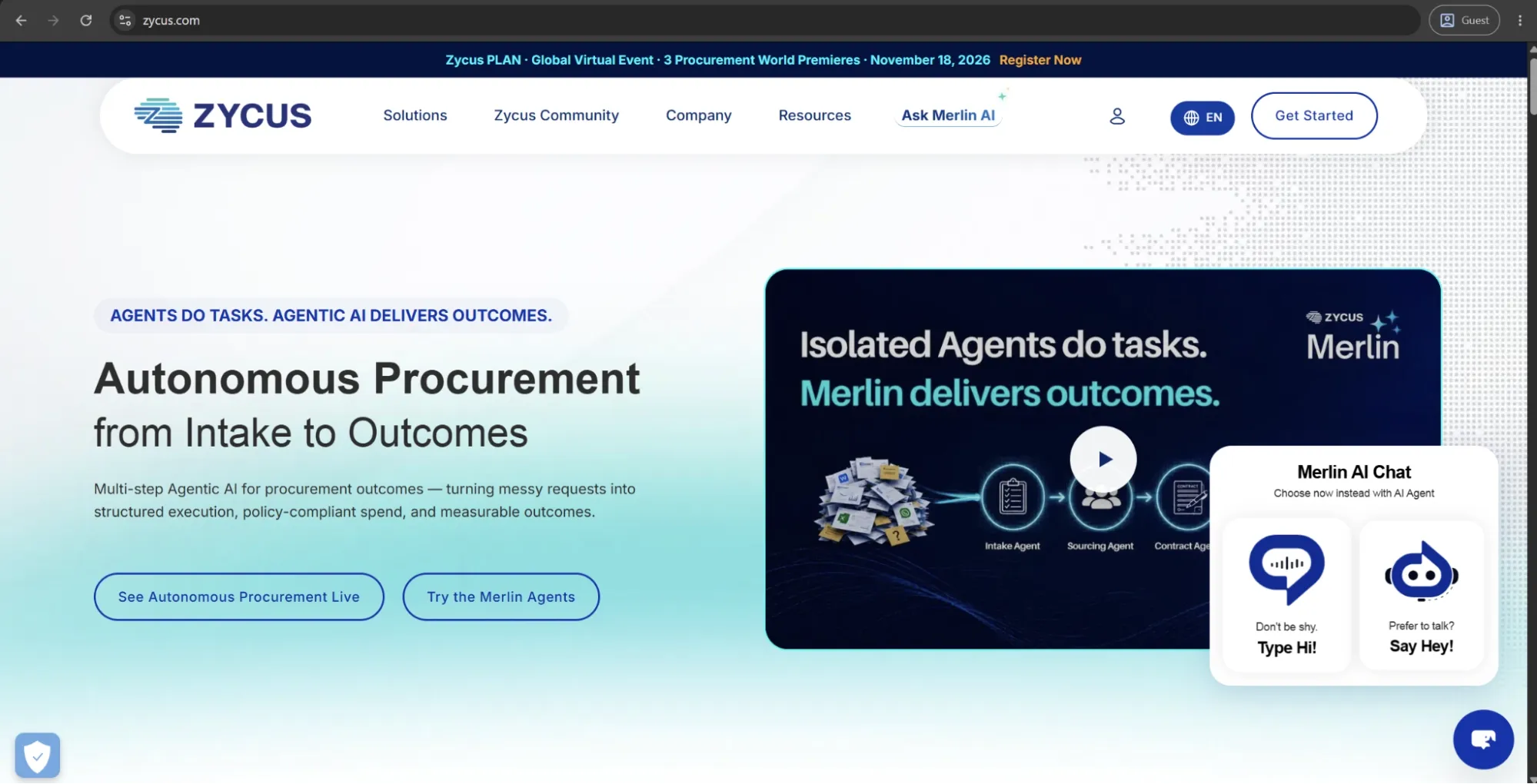
Zycus markets itself as an autonomous procurement solution run by an agentic AI platform named Merlin. It has all the key source-to-pay modules such as e-procurement, e-invoicing, sourcing, and contract management.
The company says more than 500 enterprises use the platform, including Vistaprint and Porsche, and its customer page highlights Global 1000 companies in industries like manufacturing, healthcare, energy, and oil and gas.
What are the customer ratings of Zycus?
What are the key advantages of Zycus?
- Procurement automation tools simplify the entire workflow while keeping it efficient.
- AI-powered capabilities for invoice extraction and spend classification.
What are the potential shortcomings of Zycus?
- Limited integration options with no API access.
- Early implementation phases are consistently described as tedious and time-consuming.
- Supplier management module reports are problematic to a certain range of users.
What do the customer reviews of Zycus say?
- Shashi D. — G2 — “The best part in Zycus Source to Pay is the solution that's provided or exhibited for better performance.”
What is the pricing of Zycus?
Zycus doesn’t offer any specific pricing information publicly on its website.
What types of businesses is Zycus designed for?
Zycus works well for a mid-sized company that needs source-to-pay automation with moderate needs in integration and customization. At the same time, businesses that look for modern integrations or easy implementation would most likely be frustrated with Zycus’s limitations.
Zip
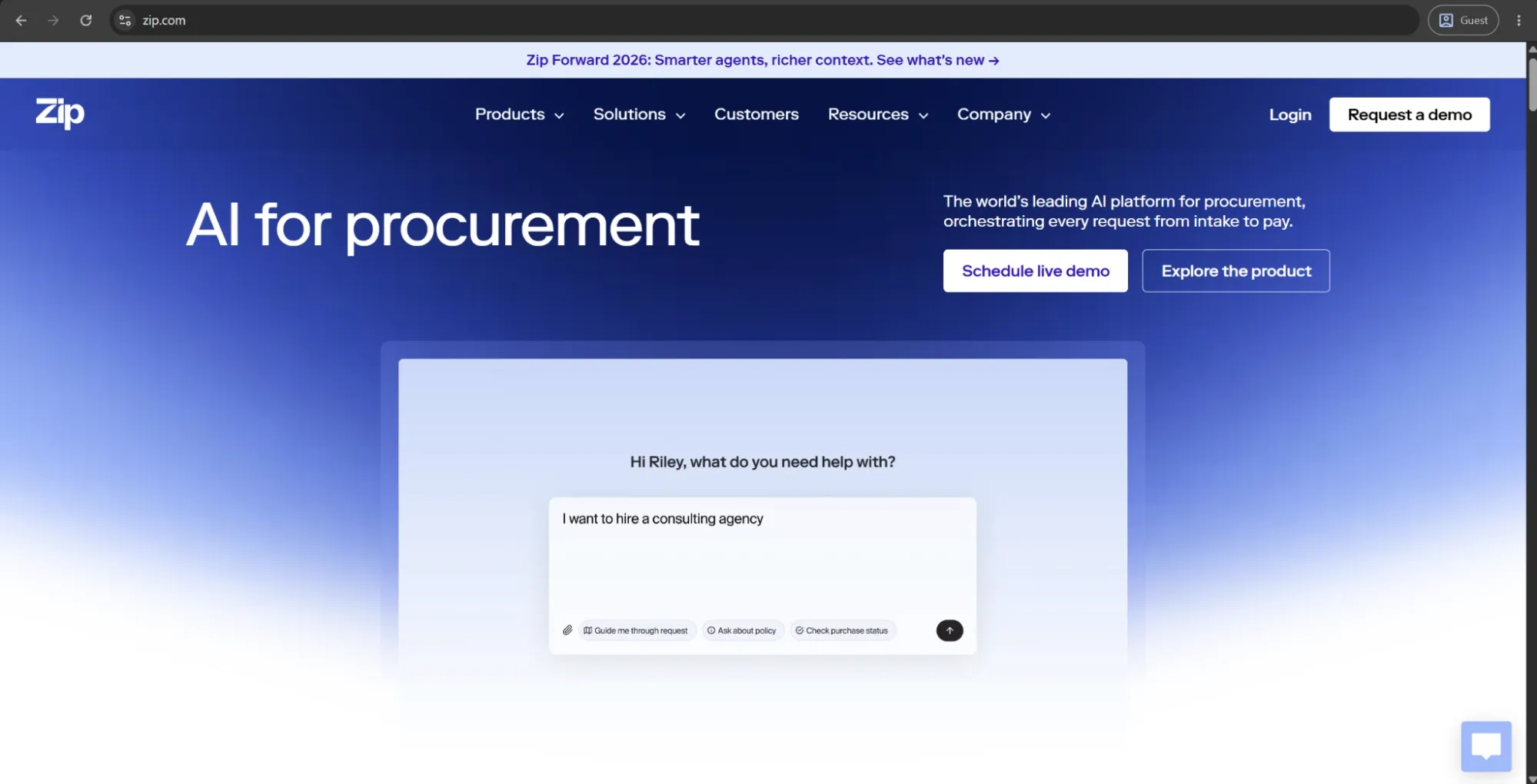
Zip was created with intake in mind. Every purchase request enters via one front door and then moves along approval workflows configurable without coding. Behind that are the vendor management capabilities with spend insights. The platform also connects easily to systems like Workday or NetSuite.
What are the customer ratings of Zip?
What are the key advantages of Zip?
- Easy-to-use, intuitive interface that users consistently praise.
- No-code workflow setup for conditional approval routing.
- Short implementation timeframe, with some companies going live within a few weeks.
- Responsive support experience with periodic check-ins with dedicated account teams.
What are the potential shortcomings of Zip?
- Filtering and reporting capabilities seem inconsistent and challenging to work with.
- ERP connections seem to have some integration bugs and are generally quite complex.
- Zip is focused primarily on the US client base, with lackluster support for non-Western markets.
- Features like mass coding or split billing are absent.
What do the customer reviews of Zip say?
- Matt G. — Capterra — “I think for companies first implementing a procurement software, this is a decent solution. However, this system has a lot of issues with overall functionality that still need to fix. Lots of bandaids in place by Zip that are in place keep breaking.”
- Samantha G. — G2 — “I highly value the visibility and transparency it provides for our buyers and approvers throughout the process. The system is fairly easy to learn, and most objects are intuitive to use. Customer support is also incredible—I feel like an important customer, with attention and help coming from multiple areas of their organization.”
What is the pricing of Zip?
There isn’t any pricing information that Zip reveals publicly.
What types of businesses is Zip designed for?
Zip is a great option for almost any size of company looking for a single front door for purchase requests and approvals. If your team is big on flexible reporting, though, the simplicity of Zip’s features might feel a little restrictive. The overall customer support experience also seems to get worse for every non-US client compared to those located in the United States.
Conclusion
Coupa is still a strong choice for large companies with complex, global spend. But it isn't the right fit for every business, and the eight alternatives here take different approaches.
If you need full source-to-pay depth at enterprise scale, look at SAP Ariba, Ivalua, JAGGAER, GEP Quantum Intelligence, and Zycus. They cover sourcing, contracts, supplier management, and payments, and they're built for large, multi-region organizations. Expect a bigger investment and a longer rollout, especially with Ariba and Ivalua.
If your company already runs on SAP or Oracle, Ariba or Oracle Fusion Cloud Procurement keeps purchasing in the same ecosystem as your finance data.
If you want one front door that connects the tools you already use, Zip covers intake-to-pay and connects to your existing ERP, contract, and risk systems.
If you're a growing mid-size company that buys across locations, projects, or subsidiaries, Precoro gives central finance control over spend before money goes out, with implementation in weeks instead of months.
Two questions are usually enough to narrow the scope of your search:
- How many implementation resources can you expend?
- How much does the company depend on deep reporting and unusual approval rules?
Pricing alone won’t settle the matter. Most of these vendors have personalized pricing quotes, making initial evaluation quite difficult. The best bet is to shortlist two or three options from this list and test them against your most problematic approval paths.
FAQ
Nothing exports automatically; it all depends on what you export and when. Export documents in CSV are available for transactions, including POs and invoices. There's also a separate export pipeline for supplier records. The purchase order export documentation has no mention of approval history, so it's best to confirm in writing how that history will be delivered. Plan a cutover date for open orders and pending invoices — this way, each one is either closed out in Coupa or simply recreated in the new system.
Test-drive with real rules before signing. Create a list of your most troublesome approval paths (with exceptions) and ask each vendor to configure them live in a trial or a sandbox. Keep in mind that a vendor configuring the path or the necessity to use custom code would mean that either of these would be an additional cost at some point.
If your suppliers use the Coupa Supplier Portal, they'll need to create a new account elsewhere. Export and clean your supplier records before asking a vendor how it invites new suppliers.
Outgrowing Coupa's setup or rethinking a renewal quote? Book a Precoro demo and walk through your most complex approval paths across entities with our team.