
Intake Management in Procurement Orchestration: Best Practices, AI & Modern Workflows
Learn how to turn intake management into a strategic advantage with structured procurement requests, reduced cycle times, and improved compliance within a modern orchestration workflow.

Sourcing or approval is rarely the problem in a procurement process delay. More often than not, the process stops at the front door, where the purchase request sits in an inbox until it’s misread, rejected, and sent back for additional information before the work can even start.
Intake management solves this “first-mile” problem, turning messy, unstructured requests into the neat data needed by the process.
That foundation of structured data becomes even more important with procurement orchestration tools taking on more of the heavy lifting. Automated routing, AI-driven risk scoring, and faster approvals all require you to feed clean data into the system as a prerequisite in modern procurement.
In this article, we aim to cover how intake occurs, where AI plays a role, and what businesses should consider when reviewing intake management systems.
What is intake management?
How intake management transforms procurement workflows
Manual procurement intake vs. structured intake management
How AI enhances intake management
Capabilities that support effective intake management
Traditional procurement intake vs. AI-powered intake management
How intake orchestration improves stakeholder collaboration
How to prioritize procurement requests
Measurable business benefits of intake management
Common challenges and risks in intake management
How to evaluate intake management solutions
Key takeaways
FAQ
What is intake management in the context of procurement orchestration?
Intake management is the process of capturing, validating, and routing all procurement requests before they enter either the sourcing or approval workflows.
From the perspective of a procurement orchestration platform, intake management is the system’s “front door” to the entire process. All new purchase requests, vendor questions, and service requirements tied to broader procurement needs have to come in through intake management before any of the downstream systems or procurement activities can act on them.
If the intake management is done right, it can turn unstructured requests into clean, actionable information.
How does intake management differ from traditional purchase request handling?
Nearly all common purchase request forms are funneled through email threads, shared spreadsheets, or forms into a single procurement inbox for a human to manually read, categorize, and forward them.
The success of this approach depends on requesters knowing who to contact and providing all the necessary information upfront. In practice, this is difficult to achieve consistently because it relies heavily on human judgment and attention to detail.
Intake management aims to replace that methodology with a structured intake process built on a rule-based entry point to ensure consistency in how requests come in and how they are handled thereafter.
Most of the major differences between these two approaches are presented in a table below:
| Aspect | Traditional request processing | Intake management |
|---|---|---|
| Request submission | Requests arrive through email, chat, or paper forms | Requests are submitted through a standardized digital intake form |
| Request routing | Procurement admins manually review, triage, and forward requests | Requests are automatically routed based on category, value, or risk |
| Data quality | Information is often incomplete or inconsistent at submission | Required fields and validation rules ensure complete submissions |
| Visibility | Request status is limited to whoever manages the inbox or tracking sheet | Procurement teams and stakeholders have centralized visibility into requests |
What are the key components of an effective intake process?
A good intake process isn’t a checklist, but a system of multiple elements working in conjunction rather than independently. These core elements include:
- A standardized intake form that captures request type, budget, urgency, and business justification
- Validation rules that catch missing or inconsistent data before submission
- Automated routing logic that sends requests to the correct approver or category owner
- Visibility and tracking so requesters and stakeholders can see request status without follow-up emails
- Integration hooks into ERP, sourcing, or contract systems in order to help approved requests move forward without re-entry
How does data validation improve procurement intake quality?
Data validation helps ensure the quality of intake by catching incomplete or inconsistent submissions at the entry point, rather than after a request has already moved into sourcing or approval. Validation capabilities can range from setting required fields to flagging budget mismatches to checking whether a requested vendor is on the list of approved suppliers.
This check alone can reduce the back-and-forth that is usually a major reason procurement cycles slow down. With data validation, requesters can correct errors immediately rather than only after a reviewer catches them days later.
Why is intake management critical to procurement orchestration success?
Procurement orchestration needs clean, structured data flowing between systems in order to function properly; intake is usually where that data gets structured. If intake is weak, every downstream process inherits the same kinds of gaps and inconsistencies, which become noticeable in approvals, sourcing, and contract generation.
On the other hand, strong intake management creates the audit trail procurement teams need for compliance and spend visibility purposes. If there is no consistent entry point, organizations are going to struggle answering even the most basic questions, such as:
- How many requests came through in a given quarter?
- Where are requests getting stuck?
- Which departments submit the most requests?
- How long does it take to move a request from submission to approval?
- What types of purchases are driving the most demand?
- How much potential spend is currently tied up in open requests?
Without this visibility, organizations cannot get the accurate reporting and insights that orchestration platforms are designed to provide.
Should procurement intake be centralized or decentralized?
The correct choice between a centralized and a decentralized model is going to depend on a number of factors:
- Organizational size
- Complexity
- How much category-specific knowledge (tied to broader category management practices) is necessary for different business units
Some of the differences between these approaches are presented below:
| Aspect | Centralized intake | Decentralized intake |
|---|---|---|
| Process structure | Single point of entry with a consistent request process | Multiple entry points tailored to business unit needs |
| Policy enforcement | Easier to enforce procurement policies and compliance requirements | More difficult to ensure consistent policy adherence across teams |
| Team flexibility | Can create bottlenecks when request volumes increase | Faster for teams with specialized, recurring purchasing needs |
| Data consistency | Provides cleaner data and simpler reporting and auditing | Higher risk of inconsistent data and shadow procurement processes |
| Spend visibility | Makes it easier to consolidate spend data and maintain visibility | Makes it harder to achieve a complete view of organizational spend |
That being said, most businesses use a hybrid approach: a centralized intake system with multiple decentralized entry points feeding into it. This preserves a single source of truth while still allowing different business units to accommodate their specific request types and requirements.
How should procurement intake forms be designed?
Properly-designed intake forms aim for clear intake guidance alongside completeness and ease of use. Key design principles of intake forms include:
- Conditional logic, showing only the fields relevant to the request type instead of one long generic form
- Plain-language field labels that don’t assume procurement expertise from the requester
- Required fields limited to what is truly necessary for routing and approval decisions
- Built-in guidance or examples for fields prone to vague answers, such as business justification
- Mobile-friendly formatting, since many requesters submit from outside a desktop workflow
What procurement requests should go through intake management?
Most organizations are routing the following information through intake management:
- New purchase requests
- Vendor onboarding requests
- Contract renewals or amendments
- Service requests tied to existing suppliers
- Ad hoc or one-off purchases outside standing contracts
Some organizations also route requests below a low-dollar threshold via a separate, lightweight path to avoid adding more overhead than the request’s value justifies. However, where that threshold sits is usually a policy decision rather than a system limitation.
How can effective intake management transform procurement workflows?
Aside from capturing requests, intake management also fundamentally changes the way work gets done within procurement. Proper intake design helps streamline intake, compress cycle times, remove manual handoffs, and offer managers the level of visibility they had to chase down manually before.
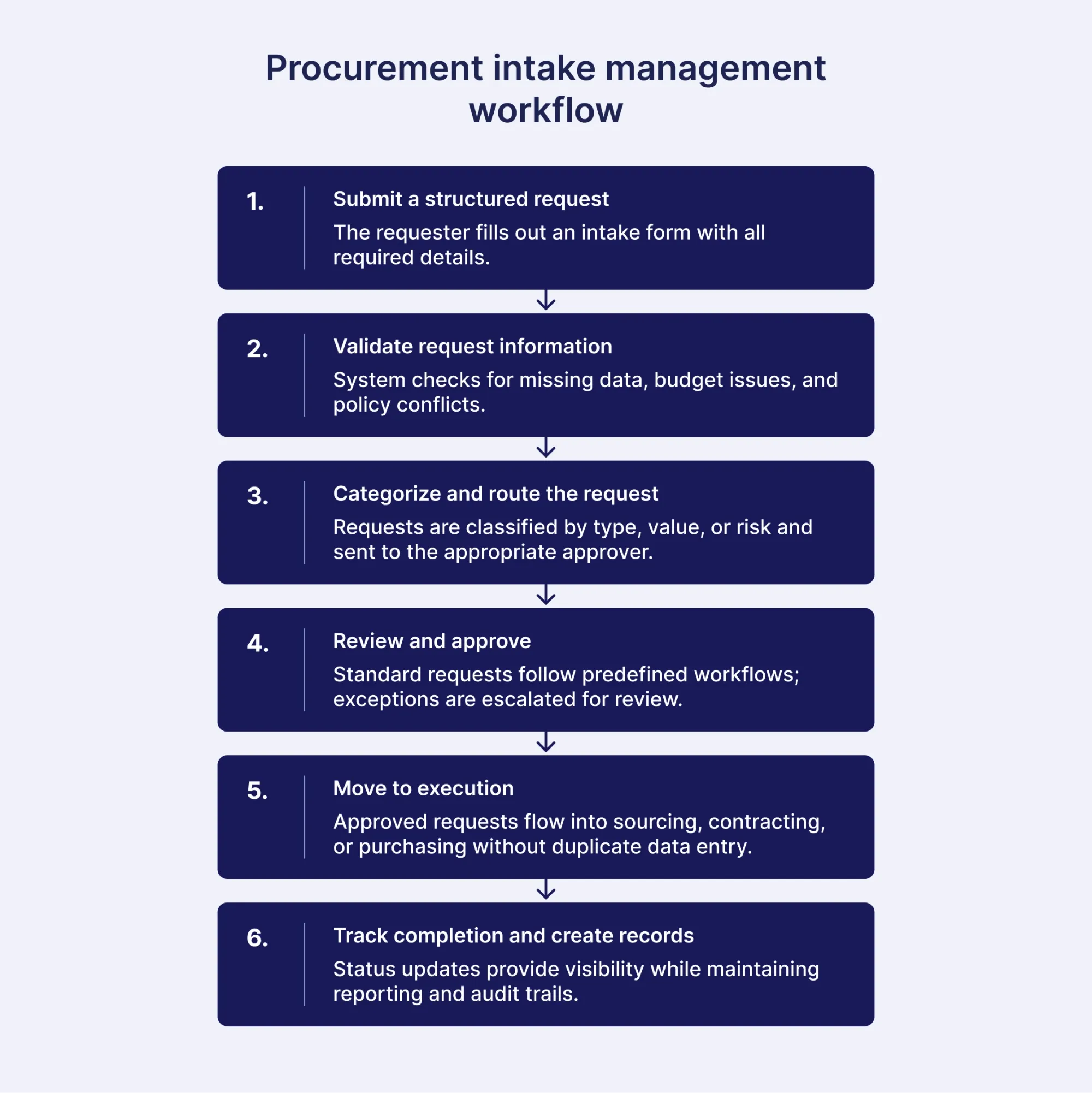
Procurement intake management workflow
Regardless of the platform in question, a mature procurement intake process tends to follow a consistent sequence of actions, as presented below:
- The requester completes a structured intake form instead of sending an email or a message
- The system analyzes the form for missing fields, budget conflicts, or policy violations before the request can be accepted
- The request is categorized by type, value, or risk before getting routed to the correct approver or category manager
- Depending on the prior data, all requests are separated into standard and flagged; standard requests move through predefined approval chains, while flagged exceptions are escalated for human review
- Approved requests can be passed into sourcing, contracting, or direct fulfillment with no need to enter the data again
- The request status updates to note down its completion, feeding both reporting and audit records
The benefit of all the above steps is that they remove the human element, where requests used to require a person to read, interpret, and direct.
Which manual tasks can be automated or eliminated?
By implementing intake management, many repetitive, low-judgment tasks can be handled automatically, dramatically increasing the time available to staff. Of course, not all these tasks disappear — some exceptions and oddballs will always require human judgment. Yet, the routine workload that competes for this limited, subjective resource (judgment time) is substantially reduced either way.
The table below showcases some of the aforementioned tasks in a manual environment and also how they are getting changed with intake management:
| Manual task | Automated replacement |
|---|---|
| Reading and categorizing incoming requests | Rules-based or AI-powered classification at submission |
| Chasing missing information from requesters | Form validation that blocks incomplete submissions |
| Manually forwarding requests to approvers | Automated routing based on category, value, or department |
| Re-entering approved request data into ERP | Direct system integration and automated data handoff |
| Tracking request status through email follow-ups | Real-time dashboards visible to all stakeholders |
How does standardized intake improve compliance and auditability?
Since standardized intake routes every request through the exact same required fields and approval logic, compliance rules are getting applied on a consistent basis instead of relying on a person who processes the request in question. It’s a particularly important distinction for environments where there have been differences in policy application depending on the reviewer.
Standardization also creates a complete record of every request, decision, and approval. That way, every time an audit occurs, procurement teams would be able to provide a full audit trail without the need to reconstruct it from scratch using scattered emails or spreadsheets (which tends to be the more time-consuming element of an audit response).

Where do procurement intake bottlenecks typically occur?
Intake bottlenecks often form around handoff points instead of within one specific step.
Requests tend to stall between submission and initial review, especially when routing logic is misclassifying a request, and it lands with the wrong approver. Another common stall point happens at the approval phase itself, especially when a chain needs sign-off from someone who is either unavailable in general or unaware that there is a request waiting for them.
Bottlenecks can also surface where intake interfaces with external systems. If the ERP or sourcing integration hasn't been fully completed, you will have some approval requests pending in the queue to be re-keyed manually. This defeats the whole purpose of the speed benefit that you had earlier in the approval cycle.
To find such bottlenecks, you'd need to inspect time-in-stage (not just cycle time), as an average might not reveal the fact that there's one point in the process that's significantly behind everything else.
Manual procurement intake vs. structured intake management
The difference between the manual approach and the structured intake is probably the most obvious when you compare both ways of doing things on the same set of requirements. The manual intake is adequate at low volume, but all of its flaws really start to compound when the organization expands (and so does the volume of requests and categories).
| Criteria | Manual intake | Structured intake |
|---|---|---|
| Entry point | Requests arrive through email, chat, or shared spreadsheets | Requests are submitted through standardized digital forms |
| Data consistency | Information quality varies depending on the requester and reviewer | Required fields and validation rules ensure consistent data collection |
| Routing | Manual routing depends on staff availability and knowledge | Automated routing follows predefined rules |
| Visibility | Request status is limited to whoever manages the request | Stakeholders have centralized, real-time status visibility |
| Scalability | Efficiency decreases as request volume grows | Maintains consistency as request volumes increase |
| Audit trail | Records must be reconstructed from scattered sources | Complete, timestamped records are captured automatically |
| Time to first action | Responses may take hours or days depending on workload | Validation and routing happen almost instantly |
Audit readiness and scalability are the two fields where the disparity between these approaches becomes most obvious.
It’s important to realize that while a manual process is acceptable for 50 requests per month, it would rarely pass for 500 requests per month. Not because the policy changed in the underlying process, but simply because tracking that kind of volume with a high degree of consistency without any structure to help isn’t something a human can do to begin with.
A structured intake process still requires human decision-making, but it ensures the process doesn’t depend on one person remembering every step or being available at all times.
In what ways does AI enhance intake management for procurement?
Artificial Intelligence (AI) provides a layer of judgment to intake that rule-based automation cannot achieve by itself; this addition is at its most noticeable when it comes to classification, prediction, and language understanding. AI doesn’t need to replace the pre-existing structured workflow, since it can operate within it just as efficiently, making each individual step faster and more accurate.
How can AI classify and route requests automatically?
AI classification models can analyze the contents of every intake request (including all free-text fields) and assign it to the appropriate category or approval path, with no human interaction necessary. It’s a particularly useful approach for requests that don’t fit into a drop-down menu, with the requester describing their need in their own words rather than resorting to one of the predefined options.
There are many different signals that AI models use to classify and route requests, such as:
- Request description text, parsed for keywords and intent
- Requested dollar amount, compared against category or approval thresholds
- Requesting department or cost center, mapped to relevant category owners
- Historical routing patterns, learned from how similar past requests were handled
- Vendor or product references, matched against existing supplier or catalog data
Can AI predict supplier suitability or risk at the intake stage?
AI models can flag potential supplier risk at intake (supporting broader risk management efforts) by cross-referencing a requested vendor against factors such as historical performance data, financial health indicators, compliance records, and known risk databases. A risk flag can surface before a request even reaches sourcing, which is much earlier than raising the same flag once a contract is already in motion.
Suitability predictions work in a similar manner — comparing a new request with past successful engagements with similar suppliers or categories. As these predictions are probabilistic rather than definitive, they work best as a prioritization signal for human reviewers, not as a direct mechanism for approval or rejection.
Where should AI make decisions, and where should humans stay in control?
The general pattern for distributing decisions between AI and humans is to leave AI to handle high-volume, pattern-based tasks but keep humans working with decisions that carry financial, legal, or relationship weight:
| Task | Owner | Why |
|---|---|---|
| Classifying the request category | AI | High-volume task with low ambiguity and clear historical patterns |
| Routing to the approver | AI | Rules-based decisions that rarely require human judgment |
| Flagging supplier risk | AI + human | AI identifies potential risks, while humans evaluate context and decide on the next action |
| Approving high-value or exception requests | Human | Requires business judgment and consideration of factors AI cannot fully assess |
| Final vendor selection | Human | Involves relationships, negotiations, and strategic considerations |
What role does natural language processing play in intake forms and requests?
Natural Language Processing (NLP) assists intake forms with interpreting unstructured input instead of forcing every requester to follow a list of rigid drop-downs and fixed fields. It’s a very important capability for businesses with high variety in request types without a single form structure to fit everything at once.
NLP capabilities that are commonly applied at intake include:
- Intent extraction from free-text description fields, identifying what the requester actually needs
- Entity recognition, pulling out vendor names, product references, or dollar amounts from unstructured text
- Auto-population of structured fields based on a plain-language request
- Sentiment or urgency detection, flagging requests that indicate time-sensitivity, even if not explicitly marked urgent
What capabilities support effective intake management?
Not every aspect of artificial intelligence or automation provides the same amount of value across management platforms. Some are direct remedies to very common high-frequency points of friction; others are far less frequent and situational in their application.
Which AI features deliver the most business value (e.g., classification, recommendation, anomaly detection)?
The specific business value of each feature differs from one case to the next, with common examples being:
| AI feature | Business value |
|---|---|
| Automated classification | Reduces manual triage time and routing errors |
| Recommendation engines | Suggests preferred suppliers or contract options during intake |
| Anomaly detection | Flags unusual requests, pricing patterns, or supplier behavior for review |
| Predictive risk scoring | Identifies supplier or compliance risks before sourcing begins |
| Natural language processing | Allows requesters to submit free-text requests without relying on rigid form structures |
Among all of these areas, classification and anomaly detection will likely provide the most immediate demonstrable ROI since the value proposition is for issues that affect the majority of all requests rather than edge cases. However, that level of historically validated data has to be present and reliable before any recommendation engine is turned on or any predictive scoring function is launched.
How important are integrations with ERP, SRM, and e-sourcing platforms?
Intake management is an entry point — not an endpoint. Its value varies greatly depending on what happens after a request is approved.
Approved requests would still have to be re-entered manually if there is no proper integration into ERP, supplier management and relationship (SRM), or e-sourcing platforms. Strong integrations also allow intake to pull data outward instead of only pushing it forward. A well-integrated system can check budget availability against ERP data or confirm where a supplier stands in SRM records at the moment a request is being submitted.
What security and data governance practices are essential?
Due to the nature of intake systems, governance is a core requirement for most of those, not just an afterthought. These systems handle sensitive data like budget figures, vendor information, and personal data tied to service requests, making them subject to certain data governance practices:
- Role-based access controls, limiting who can view or edit specific request data
- Data encryption, both in transit and at rest
- Audit logging, capturing who accessed or modified a request and when
- Data retention policies, defining how long request records are kept and when they are purged
- Clear model governance, documenting how AI classification or scoring decisions are made and reviewed
Traditional procurement intake vs. AI-powered intake management
The previous comparison focused more on the differences between manual and structured intake management, while this one isolates what AI-related capabilities add to a pre-existing structured intake system. The differences are quite vast and varied:
| Criteria | Traditional automated intake | AI-powered intake |
|---|---|---|
| Request classification | Manual or limited to predefined rules | Learns from historical patterns to improve classification accuracy |
| Handling free-text requests | Requires structured fields and predefined formats | Uses natural language processing to interpret unstructured input |
| Risk and supplier flagging | Depends on manual review, if performed at all | Automatically identifies potential risks and flags them at submission |
| Routing accuracy over time | Relies on static rules that require manual updates | Improves as models learn from outcomes and request patterns |
| Anomaly detection | Depends on individual reviewer attention and expertise | Automatically detects unusual patterns consistently across requests |
The key distinction is that traditional intake processes tend to plateau rather than simply fail. Rule-based routing remains effective for known request types, but AI-powered intake can also adapt to new patterns and edge cases as they emerge.
How does intake orchestration improve stakeholder collaboration and decision-making?
Intake orchestration gives procurement, requesters, and approvers a single view of the status of each request, compared to siloed visibility from email-centric processes. At this point, the intake stage becomes a collaboration among departments rather than simply a data-entry process.
What workflows can streamline approvals and exceptions?
Effective orchestration tends to separate requests into certain paths that are different enough from each other and are based on risk and complexity. It’s a much better approach than attempting to force every request through the exact same approval chain. The three primary orchestration paths are:
- Standard path — low-risk, low-value requests move through automated or single-step approval
- Escalation path — requests exceeding a value or risk threshold route to additional approvers automatically
- Exception path — requests that fail validation or fall outside normal categories route to a dedicated reviewer rather than stalling in a queue
Splitting these paths keeps simpler requests from getting stuck behind more complicated ones. It also prevents more complex requests from moving too quickly through the system, which can only really handle simple ones.
How can role-based routing and dynamic approvals reduce cycle time?
What role-based routing accomplishes is to route each request to the exact person or team who should handle it, instead of putting all the requests in one enormous inbox for a person to manage by hand. That difference alone gets rid of some of the typically very significant portion of the delay.
Dynamic approvals go a step further, altering the approval chain according to request attributes (for example, automatically routing for compliance review if a new supplier is part of the request).
As a result, the approval path favors the actual request rather than applying a uniform chain regardless of complexity. It leads to shorter cycle times for most requests that don’t need to pass through all review layers.
How do dashboards and alerts help procurement managers make faster decisions?
Dashboards and alerts provide managers with the information needed to intervene before a request can turn into a bottleneck. The consequences of discovering delays after the fact are massive and scale with the business size. Common features of a properly configured dashboard include:
- Real-time status views, showing every open request and its current stage
- Aging alerts, flagging requests that have sat in a stage beyond a defined time threshold
- Volume and trend charts, showing request patterns by category, department, or time period
- Exception queues, surfacing flagged requests that require manual attention
- Approver workload views, identifying bottlenecks tied to a specific person or team
How should organizations prioritize procurement requests?
Not all requests deserve the same degree of urgency, and treating them as if they do can cause high-priority requests to sit behind routine ones. Effective prioritization uses a consistent set of criteria for intake management purposes instead of leaving urgency to whoever happens to review the request first.
Common factors that can be used to prioritize requests are numerous and can include:
- Dollar value, since higher-value requests often carry more financial and contractual risk
- Business impact or urgency, distinguishing requests tied to active operations from discretionary purchases
- Supplier risk profile, prioritizing requests involving new or previously flagged vendors for closer review
- Category complexity, giving simpler, well-understood categories a faster default path
- Requester-stated deadline, weighed against the historical accuracy of similar deadline claims
Being able to apply these criteria consistently requires them to be built into the intake system itself instead of being left to individual judgment during the review.
Whenever prioritization logic sits in the workflow, high-priority requests surface automatically instead of relying on someone to be able to recognize the matter of urgency in a populated queue.
What are the measurable business benefits of effective intake management?
Ultimately, the value of intake management manifests in metrics that leadership tracks outside of procurement — such as cycle time, cost savings, and risk exposure. These benefits also tend to compound on each other, with faster and cleaner intake contributing to every downstream process that determines overall cost and speed.
How does faster intake reduce time-to-contract and cycle times?
Time-to-contract is a measurement of the entire process from initial request to signed agreement, with intake sitting at the very beginning of that timeline.
Every single day that a request spends waiting for its classification, routing, or missing information is getting added to the total cycle time, regardless of how efficient sourcing or contracting is downstream.
However, because intake delays compound, even small upfront reductions yield substantial cycle-time savings overall. A request that now reaches the right person for approval within one day instead of four is now effectively three days ahead for all subsequent tasks as well.
Can AI-driven intake improve supplier diversity, cost savings, and risk mitigation?
Benefits of AI-powered intake may vary, yet they can all be described as having a similar impact for the better:
| Benefit area | How intake contributes |
|---|---|
| Supplier diversity | Recommendation engines surface qualified and diverse suppliers when a need arises instead of relying only on traditional vendor choices |
| Cost savings | Shorter lead times and better market visibility improve negotiation power, pricing decisions, and contract outcomes |
| Risk mitigation | Automated supplier and compliance checks at intake help identify risks before requests move into sourcing and contracting |
Each of these benefits depends on the quality of the data fed into the models. Organizations with inconsistent historical data tend to see these gains appear more slowly than the improvements to cycle times (which appear almost immediately).
What ROI and KPIs should organizations track?
At the business-outcomes level, the most relevant metrics are always going to be related to cost, risk, and contract speed instead of internal workflow throughput. The metrics in question include:
- Time-to-contract, tracked from initial request to signed agreement
- Cost savings captured, measured against prior negotiated rates or budget baselines
- Supplier diversity spend percentage, tracked against organizational targets
- Risk incidents avoided or flagged pre-contract, such as compliance issues caught before execution
- Maverick spend reduction, measuring purchases made outside approved intake and sourcing channels
What are the common challenges and risks in modern intake management?
No intake system can eliminate the risk in its entirety, no matter how well-designed it is. The challenges that persist for most cases tend to fall into three primary categories relevant to procurement management: data and model quality, organizational change, and technical dependency.
How do data quality and model bias impact AI performance?
AI models that were trained using incomplete or historically biased intake data inherit the same issues of said data. For example, a classification model trained using mostly the requests from a single department may misroute or misclassify requests from departments that have different request patterns or naming conventions.
Bias can also creep in, not even through what the data consists of, but what it does not contain. If certain supplier types were historically underrepresented in previous requests, a recommendation engine trained on that data will keep recommending the same familiar vendors, regardless of whether other options on the market are better.
You can’t consider any of these hypothetical edge cases, and fixing them generally requires intentionally auditing training data — not simply monitoring model output once it’s deployed.
What change management issues arise when moving from manual intake to automated orchestration?
Changing from manual to automated intake influences the way staff work on a daily basis; the resistance to change management is often less about the technology itself and more about the disruption to previously established habits, such as:
- Loss of informal control, where staff who previously managed requests through personal relationships now work within standardized rules
- Distrust of automated routing, particularly when early misclassifications go unaddressed
- Unclear ownership, when it isn’t obvious who is responsible for a request, and once automation handles the initial steps
- Training gaps, where staff are expected to use a new system without adequate onboarding
- Requester pushback, when a more structured form feels like added friction compared to sending a quick email
How can organizations mitigate integration and vendor lock-in risks?
In most situations, integration risk builds up as time goes on and doesn’t appear all at once.
A specific system might work well in isolation and also create problems if it doesn’t have a clean connection to existing ERP, SRM, or e-sourcing platforms. In situations like these, manual workarounds are being created, undercutting the efficiency gains of automated intake management.
Vendor lock-in, on the other hand, is all about a different kind of risk — the one that’s less tied to daily operations and more to long-term flexibility. Businesses reduce this exposure by avoiding proprietary data structures and prioritizing platforms with open APIs and standard data export formats.
Contractual terms are also important here. Organizations would have a much more practical path out if their contracts had clear data ownership clauses and defined exit provisions that were all negotiated before implementation.
How should organizations evaluate intake management solutions?
When considering intake management software, companies should strive to look past feature lists and toward other factors:
- How does the vendor’s AI actually make decisions?Understand whether AI recommendations are explainable, what data they rely on, and where human review is required.
- How quickly can value be proven?Assess implementation timelines, time to first measurable improvements, and whether the solution can address immediate pain points without a lengthy rollout.
- What happens if the relationship doesn’t work out?Review data ownership, export capabilities, contract terms, and how easily the organization can transition away if needed.
- Can it support different request types and business units?Evaluate whether the system can handle various procurement scenarios, from simple purchases to complex sourcing or contract requests.
- How flexible are workflows and approval rules?Check whether teams can adjust routing logic, approval chains, and required information as policies and organizational structures change.
- How does it integrate with existing systems?Consider integrations with ERP, purchasing, contract management, finance, and supplier systems to avoid duplicate data entry.
- How does the vendor approach security and governance?Evaluate data protection, access controls, audit logs, and compliance requirements.
What questions should procurement leaders ask vendors about AI explainability and model governance?
Vendors should be able to address specific direct questions on how their intake solution models work and not just the results they claim to have:
- How does the model explain a specific classification or risk score, and can that explanation be surfaced to a reviewer in plain language?
- What data was the model trained on, and does the vendor disclose known limitations or gaps in that data?
- How often is the model retrained or updated, and what oversight exists over those updates?
- Can a human override a model's decision, and is that override logged and reviewed?
- What happens when the model is wrong, including how errors get identified, corrected, and prevented from recurring?
If the vendor in question is incapable of answering such questions (or answers only in marketing language), they warrant closer scrutiny before a contract is signed.
How can pilot projects be structured to prove value quickly?
A useful pilot starts with a deliberately limited scope. Instead of testing an intake platform across the entire organization at once, successful pilots typically focus on a single business unit, request type, or procurement category. They also begin with a clear and measurable baseline.
Establishing a baseline is essential because improvement can only be proven through comparison. Without data on the current process — such as average request cycle time, approval delays, or manual error rates — there is no reliable way to measure the pilot’s impact.
The pilot should also run long enough to capture a meaningful volume of requests. In most cases, a 60–90 day period provides enough data to identify trends and evaluate results, while shorter periods risk producing conclusions based on an insufficient sample size.
What contractual and SLA considerations matter most for procurement orchestration tools?
Some contract terms matter more in the long run than the initial feature comparison because they determine how much flexibility the organization retains after signing. These include:
| Consideration | Why it matters |
|---|---|
| Data ownership | Determines whether the organization retains full rights to its request and supplier data |
| Uptime guarantees | Directly affects intake availability for time-sensitive requests |
| Support response times | Impacts how quickly issues are resolved before they create request backlogs |
| Exit and data portability terms | Determines how easily the organization can migrate if the platform no longer meets expectations |
| Model update transparency | Ensures the organization is informed before significant changes to classification or scoring logic |
Key takeaways
- Intake management standardizes procurement requests
- Structured intake reduces manual work
- AI improves routing, classification, and risk detection
- ERP integration eliminates duplicate entry
- Strong governance improves compliance
- Measure success using cycle time, audit readiness, and request quality
Frequently asked questions
Yes, this is generally available on most intake management solutions through the use of conditional logic and role-based rules. There is no need for different systems, either, as users can apply different required fields, approval chains, or category structures based on a particular business unit, all within the same system.
Rollout timeframes vary, depending on the level of organizational complexity and the number of systems to be integrated. Still, the majority typically takes anywhere from two to six months to complete as of 2026. The most limited implementations for a focused pilot of a single department or team can roll out in as little as four to six weeks; a full, enterprise rollout encompassing numerous ERP/SRM integrations may take considerably longer.
Yes, intake management is usually positioned as a layer in front of an existing ERP rather than replacing it. The vast majority of systems will integrate with standard ERPs, receive and validate requests at the intake point, and feed them nicely into ERPs to execute processes.
Stop losing days to messy intake before a request even reaches approval.
Book a demo to see how Precoro standardizes procurement intake, routes requests automatically, and gives you full visibility from request to contract.