26 min read
Localization in Accounts Payable: Global AP Management Guide
Explore how to implement localization in accounts payable without losing tax and compliance control in a multi-entity and multi-currency procurement.

The dream of globalization often hits a wall in the accounts payable department. In a simple scenario, for a company headquartered in New York with subsidiaries in Germany and Singapore, the AP function is not one function — it is three, with an obligation to consolidate into one.
Each entity files its own tax returns, operates its own bank accounts, manages its own vendor relationships, and may have its own ERP instance or chart of accounts. The headquarters function needs to see all of this as a unified picture, normalized into the reporting currency, without waiting until month-end close.
In much more complex situations, the company is dealing with 20+ countries simultaneously. That's where AP localization becomes global financial governance.
Yet many accounts payable automation tools take “localization” wrong, simply translating the “Approve” button into Spanish or German. But for mid-sized multi-entity companies, bare translation won’t work. To avoid the trap of multi-entity accounts payable challenges, CFOs must prioritize governing financial flows across legal, fiscal, and operational boundaries simultaneously, ensuring centralized data visibility — all of which can be achieved without heroic effort.
- Localization in accounts payable ≠ translation; it’s global financial governance.
- Multi-entity operations require centralized visibility and local compliance.
- Currency fluctuations, VAT/GST variations, and cultural differences impact P&L.
- Manual processes create high risk for errors, fraud, and inefficiencies.
- For AP localization, prioritize tools that automate multi-currency, multi-entity, and regulatory compliance workflows.
This guide covers the challenges of AP localization, global e-invoicing mandates, a step-by-step guide to implementing AP localization into your workflow, and, most importantly, an overview of how Precoro can help you address AP localization and global accounts payable management.
Read more about:
What is localization in accounts payable?
Challenges of accounts payable localization
Types of localization management approaches used in accounts payable
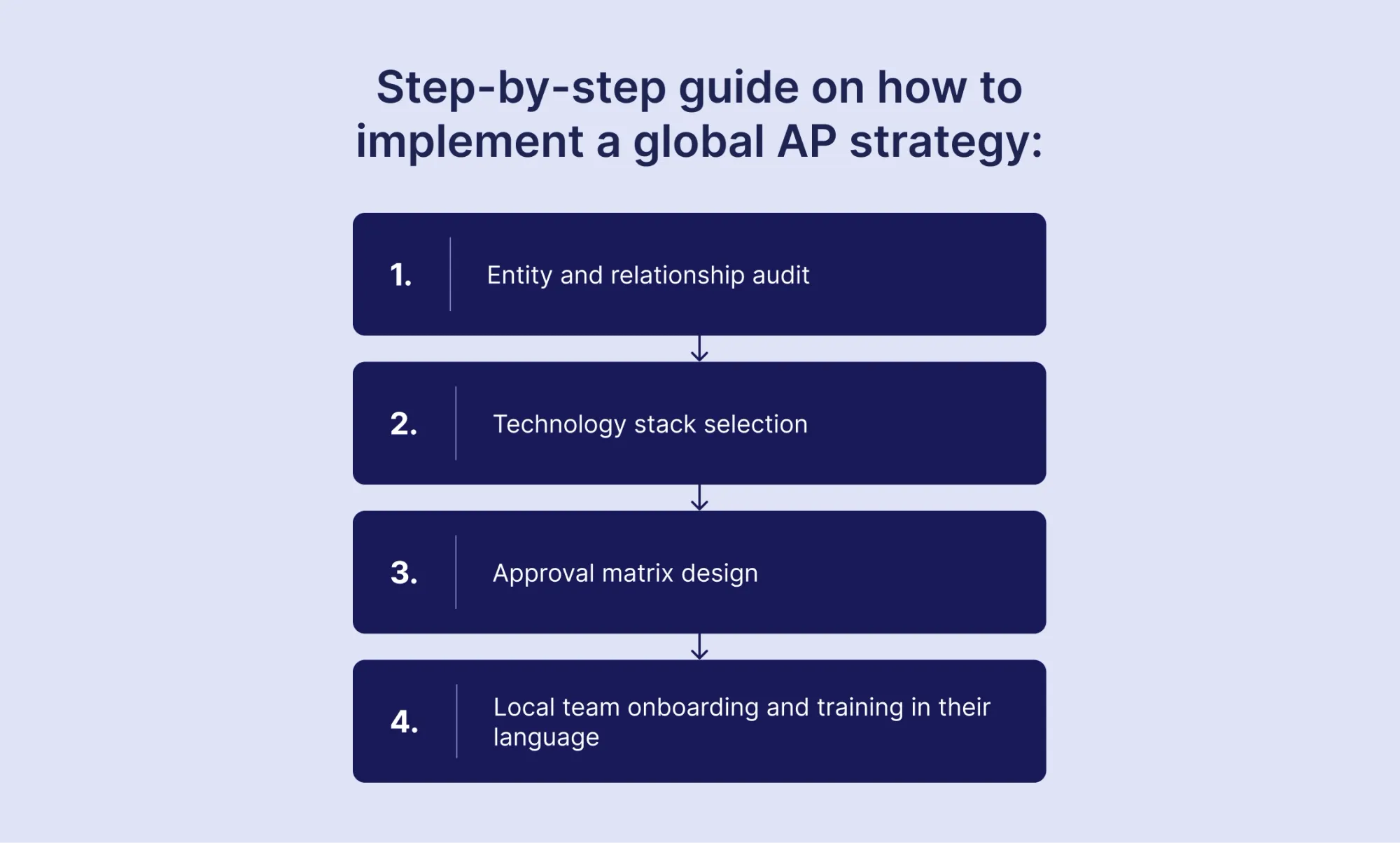
Step-by-step guide on how to implement a global AP strategy
The hidden dangers of manual AP localization management
Trends of accounts payable localization
How does Precoro support accounts payable localization?
Global e-invoicing mandates: A snapshot
You can’t scale globally with local spreadsheets
Frequently asked questions about accounts payable localization
What is localization in accounts payable?
Localization in accounts payable (AP) is the process of adapting financial workflows to meet the specific legal, regulatory, and operational requirements of a particular country or region. For enterprises operating across borders, this process becomes more complex with each new market entry.
What is the difference between the translation and localization of accounts payable?
Think of it this way: translation changes the language, localization changes the system.
Translation is purely linguistic — you're swapping words from one language to another. If your AP software says "Invoice," translation turns it into "Factura" for a Spanish-speaking market. That's it. The underlying process, fields, and rules stay exactly the same.
Localization goes deeper. It means rebuilding or adapting your AP workflow to fit how business and law actually work in a specific country. Different countries have radically different requirements — Brazil's NF-e electronic invoicing mandate, Italy's SDI system, India's GST framework — and none of those can be solved by just translating text. You need new fields, validation rules, document formats, and compliance workflows.
| Feature | Translation | Localization |
|---|---|---|
| Scope | Linguistic (Words & text) | Holistic (Legal, Cultural, Functional) |
| Goal | Readability | Compliance and operational accuracy |
| Example | Changing "Invoice" to "Factura" | Adding a field for a "Tax ID" required by local law |
| Risk | Minor confusion | Audit failures, fines, and rejected payments |
The trap companies fall into: they pay for translation, assume they're ready to operate abroad, then get hit with fines or rejected payments because the process was never adapted — only the words were.
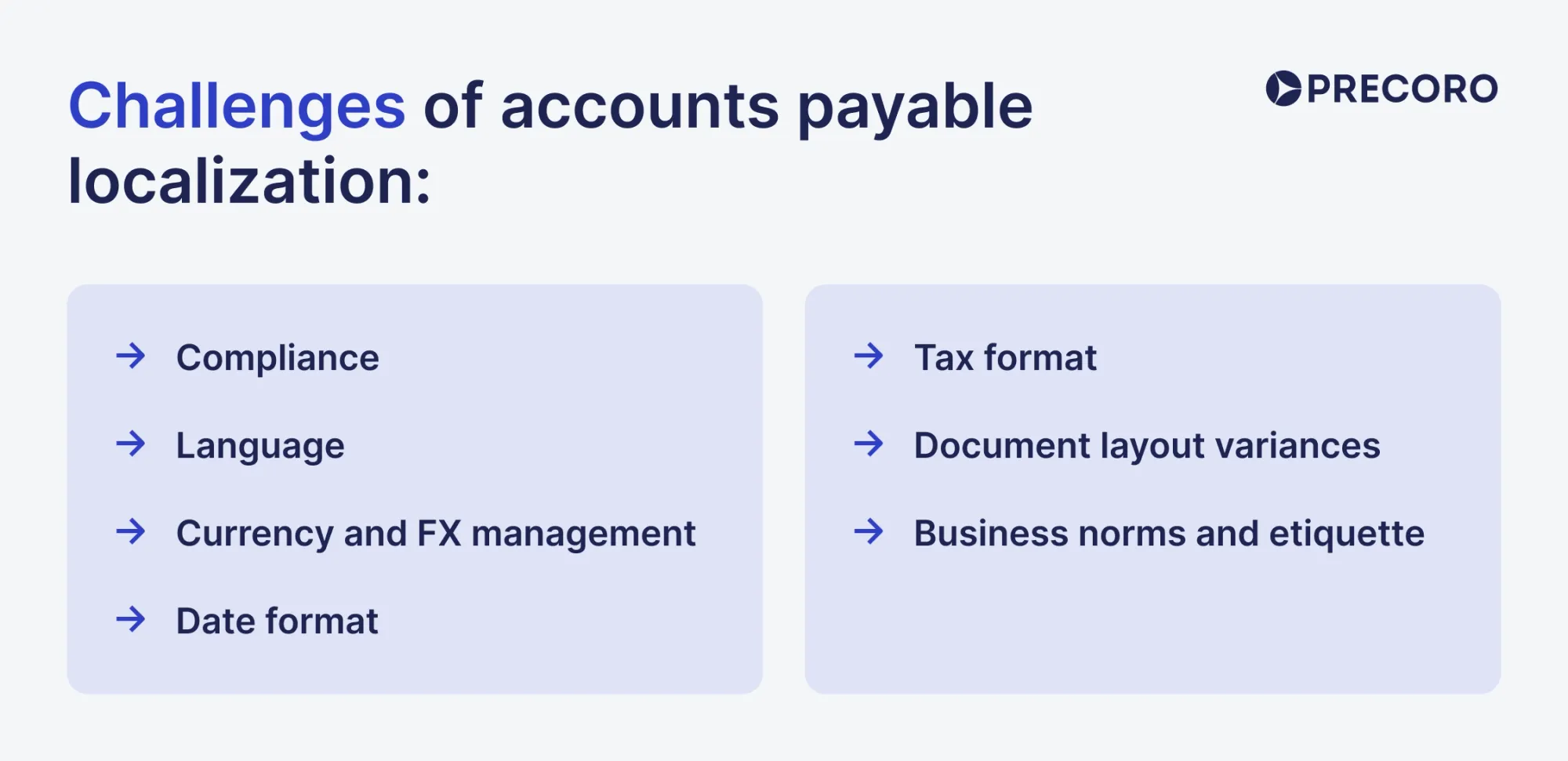
Challenges of accounts payable localization
Global growth shouldn't mean global chaos. Yet, for many CFOs, localization friction is the silent killer of standardized accounts payable (AP). Here are the most common AP localization challenges, which might make your spend in Singapore less clear than your spend in Seattle.
Compliance
Global AP teams must navigate a patchwork of local regulations (e.g., EU VAT compliance for international AP, US 1099 reporting, Brazil's Nota Fiscal). Still, manual processes lead to inconsistent data capture, missing validations, and non-compliant postings, exposing companies to audits, fines, and vendor disputes.
Why you should care: Non-compliance in accounts payable (AP) can trigger late payment penalties averaging $500–$2,500 per occurrence.
Language
Invoices arrive in diverse languages (e.g., Mandarin invoices for EU buyers, Arabic PDFs from Middle East suppliers), forcing manual translation or guesswork, which introduces errors in amount recognition, vendor details, and tax codes during processing.
Why you should care: Bilingual employees spend an average of 4 hours per week acting as unofficial translators. The time spent on this task costs businesses roughly $7,500 per worker annually in lost productivity from their primary roles.
Currency and FX management
Global AP workflows trigger multiple FX translations, e.g., a CNY invoice approved in EUR but paid in USD, requiring spot rates at receipt/approval/payment, gain/loss postings, and local bank routing to avoid spreads eating up 2-5% of the value.
Key requirements for currency management in global AP:
- Automatic FX rate integration: Live or daily exchange rates (FX) pulled from a reliable source (ECB, Bloomberg) and applied at invoice receipt, approval, and payment.
- Dual-currency display: The original invoice amount in transaction currency, alongside the functional currency equivalent for approval workflows.
- FX gain/loss capture: Automatic calculation of the difference between the rate at invoice date and the rate at payment date, posted to the correct GL account.
- Multi-currency bank account management: IBAN/SWIFT routing for payments in local currency, without requiring manual bank selection.
| Currency scenario | Manual AP error | Automated AP result |
|---|---|---|
| EUR invoice, USD functional currency | Converted using month-end rate regardless of invoice date | Converted at receipt date; FX difference booked at payment |
| Multi-currency consolidated report | Controller manually re-rates each spreadsheet line | System applies entity FX rules; consolidation automatic |
| Early payment discount (FX) | Discount calculated in original currency; FX ignored | Discount and FX impact calculated together; net benefit shown |
| Invoice disputed months later | Original FX rate lost or inconsistently archived | Audit trail preserves original rate and payment rate |
Date format
Date format inconsistencies across global invoice processing create chaos in due date interpretation, as teams in different locales parse dates differently (e.g., MM/DD vs DD/MM), leading to systematic early or late payments.
| Date on invoice | System locale | Interpreted due date | Business impact |
|---|---|---|---|
| 05/12/2026 | US (MM/DD) | May 12, 2026 | Correct if vendor intended MM/DD |
| 05/12/2026 | UK (DD/MM) | December 5, 2026 | Paid 7 months early (cash flow drain) |
| 2026.05.12 | ISO (YYYY.MM.DD) | May 12, 2026 | Success: The global standard for AP automation |
Why you should care: Late payments damage trust and strain vendor relationships. Paying too early, on the other hand, reduces your working capital and limits cash flow flexibility.
Tax format
VAT numbers vary significantly across countries; it might have DE123456789 in Germany versus ES12345678 in Spain, while North American entities utilize EINs or Canadian Business Numbers. Each requires distinct validation logic.
Why you should care: Incorrect formatting triggers immediate audits and results in rejected filings. If your system fails to validate these unique strings, you risk significant tax penalties, delayed cross-border shipments, and strained vendor relationships due to payment holds.
Document layout variances
Invoice structures are globally inconsistent. Japanese layouts typically place totals in the header, whereas European standards place them in the footer. These structural shifts break traditional template-based OCR systems.
Why you should care: Rigid templates break easily — causing errors, manual rework, higher costs, slower processing, and missed discounts. Moreover, this inconsistency forces your team back into manual data entry, which skyrockets your cost-per-invoice and creates massive bottlenecks.
Business norms and etiquette
The final pillar is frequently dismissed as "soft" and often causes serious financial problems. Commercial norms around payment terms, vendor communication, and dispute resolution differ materially between markets.
Why you should care: Ignoring local business etiquette can break supply chains and even trigger legal disputes. In Germany, missing a Skonto discount signals financial incompetence; in Japan or Southeast Asia, prioritizing strict contracts over relationships can get your company blacklisted. These “soft” missteps quickly become hard costs — late fees, lost discounts, and expensive emergency supplier replacements.
Types of localization management approaches used in accounts payable
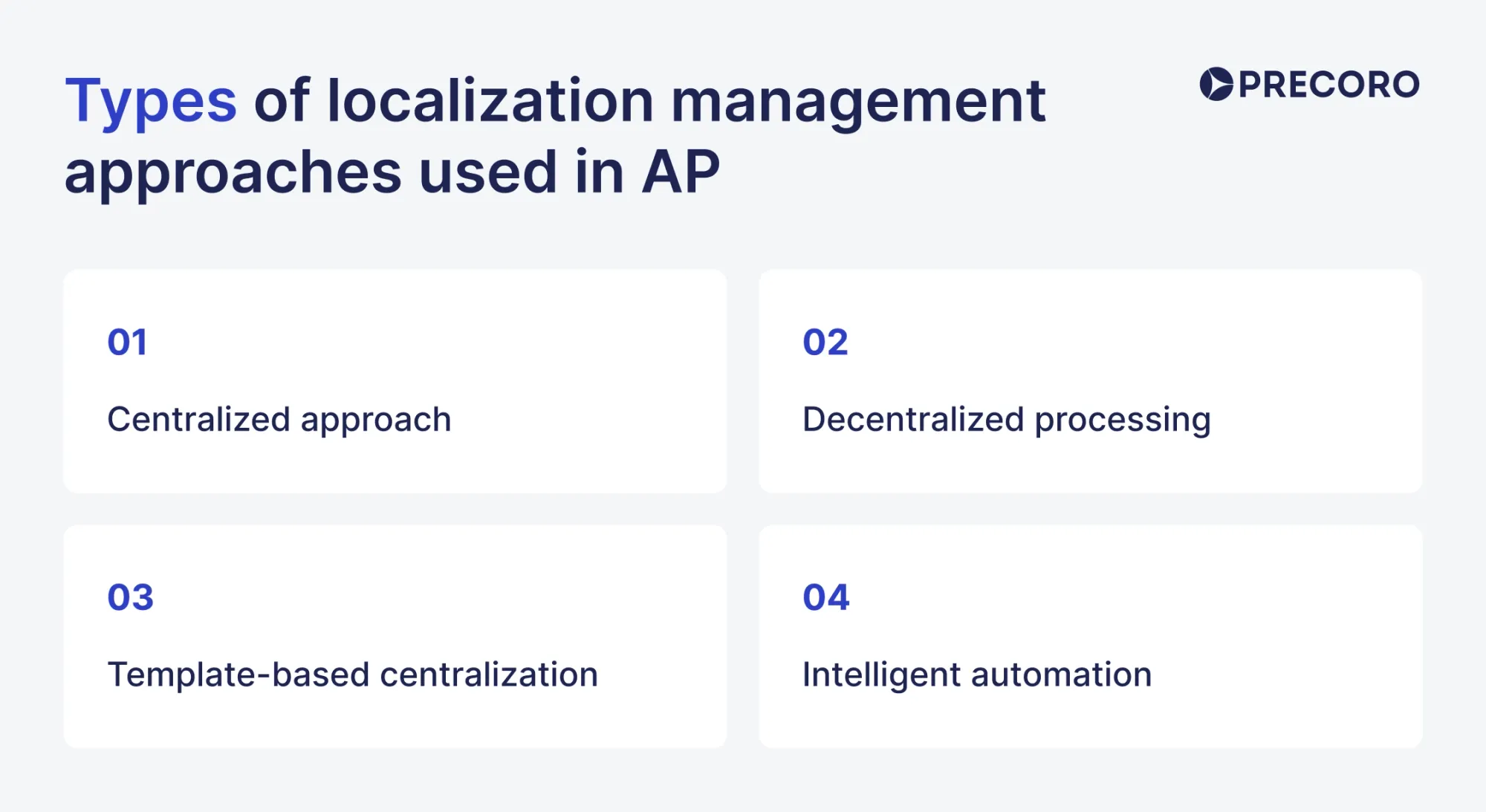
There are basically four key localization management approaches in accounts payable that businesses follow, depending on their needs and maturity:
1. Centralized approach
How it works: Headquarters enforces a single, uniform AP process across all global entities via one ERP system (e.g., SAP or Oracle), managed from a central Shared Service Center serving multiple countries.
Pros
- High visibility into cash flow and operations.
- Lower headcount costs through economies of scale.
- Standardized reporting for audits and forecasting.
Cons
- Struggles with last-mile compliance due to rigid rules clashing with local laws (e.g., unique e-invoicing portals).
- Local teams often bypass the system for flexibility.
Best for: Large multinationals with mature ERP systems.
2. Decentralized processing
How it works: Each country or region manages its own AP using local staff, systems, and processes tailored to specific rules, such as Italy's SDI submissions or varying tax formats.
Pros
- Local expertise ensures full compliance with regional requirements.
- Quick adaptation to unique, on-the-ground regulatory changes.
Cons
- Creates processing silos and duplicated efforts.
- Increases overall costs and blocks global visibility.
- Hinders cross-border standardization and benchmarking.
Best for: Firms with highly unique local mandates where central teams lack nuance.
3. Template-based centralization
How it works: The shared service center creates a unique template for each country's document types, languages, and fields, standardizing data extraction.
Pros
- Balances standardization with some localization flexibility.
- Enables centralized control over processing.
Cons
- Requires maintaining hundreds or thousands of templates.
- Each new vendor or format change needs manual updates.
- Fails to scale efficiently for high-volume, multi-country operations.
Best for: Moderate-volume regions with manageable variant numbers.
4. Intelligent automation
How it works: AI-powered systems automatically recognize and adapt to diverse document formats, languages, taxes, and regional rules, embedding country-specific logic (e.g., SDI polling) into a global engine for straight-through processing without manual setup.
Pros
- Replaces template maintenance with adaptive processing.
- Handles new formats automatically without reconfiguration.
- Scales across regions and standardizes outputs despite input variations.
- Reduces ongoing IT dependency.
Cons
- Requires initial investment in AI technology.
- Needs change management for staff adoption.
Best for: Growing multinationals seeking scalable, future-proof AP workflows.
Step-by-step guide on how to implement a global AP strategy
Transitioning from a fragmented, multi-country manual AP to a unified global P2P platform requires a structured approach. The following framework reflects the implementation approach that consistently delivers the fastest time-to-value and the fewest post-go-live disruptions.
Step 1: Entity and relationship audit
Before selecting or configuring any technology, map the current state comprehensively. The output of this audit should include:
- All legal entities, their jurisdictions, functional currencies, and bank accounts (including IBAN/SWIFT details).
- All active vendor relationships by entity, including vendor tax registration numbers and preferred payment methods.
- All current invoice volumes by entity and document type (PDF, structured XML, paper, e-invoice).
- All current approval workflows, including who approves what, at what threshold, and across which time zones.
- All regulatory obligations by jurisdiction (e-invoicing mandates, record-keeping requirements, VAT registration status).
Step 2: Technology stack selection
Your tech stack for the global P2P process should meet the following minimum requirements:
| Capability | Minimum requirement | Best-in-class standard |
|---|---|---|
| Multi-entity support | Separate entity environments with role-based access | Consolidated real-time dashboards with drill-down to the entity level |
| Multi-currency | Manual exchange rate entry | Automated daily FX rate feeds; dual-currency storage; FX gain/loss booking |
| Invoice capture | Template-based OCR with manual correction | AI extraction with language detection; no templates required |
| Tax configuration | Manual tax code entry per invoice | Country-specific tax rule engine with automatic classification |
| e-Invoicing compliance | Manual download from government portals | Native API integration with SDI, KSeF, ZATCA, and other mandate systems |
| Approval workflows | Sequential email-based approvals | Configurable matrix approval with time-zone awareness and mobile access |
| ERP integration | CSV export/import | Real-time bidirectional API sync with SAP, Oracle, NetSuite, etc. |
| Audit trail | System log accessible to admins | Full SOX-compliant audit trail; immutable record accessible to auditors |
Step 3: Approval matrix design
Global approval workflows must account for variables that don’t exist in single-entity operations and define approval matrices that respect time zones and local hierarchies.
- Time zone gaps: Approval SLAs should be set in working hours, not calendar hours, and automated escalation should occur after a defined period of inactivity.
- Currency thresholds: An approval threshold of $10,000 should apply to any invoice equal to $10,000 in the entity's functional currency — not just to invoices denominated in USD.
- Local hierarchy: Some jurisdictions require local management sign-off for regulatory or corporate governance reasons, independent of the global approval matrix.
- Intercompany transactions: Invoices between related entities require a different approval logic that prevents circular approval conflicts.
Step 4: Local team onboarding and training in their language
The highest-risk phase of any global AP implementation isn’t the technical deployment — it’s the behavioral change required of local teams. Effective onboarding for a global AP rollout includes:
- Training materials in the local language, not just English.
- Local super users who are trained first and serve as the first line of support for their colleagues.
- Country-specific process guides that map local practices (e.g., handling Skonto discounts in Germany, or processing CFDI invoices in Mexico) to system workflows.
- A parallel-run period during which both the new system and the legacy process are run simultaneously, with discrepancies reconciled daily.
The hidden dangers of manual AP localization management
What appears to be minor operational friction in manual localization management often results in high downstream costs. When you clearly see that impact, you can quantify the ROI from cross-border AP automation software.
Financial impact
Processing costs are one of the most immediate impacts. Research from the Institute of Finance & Management (IOFM) shows that manually processing an invoice can cost up to $16, while automated processing can reduce that cost to as little as $3 per invoice. Over hundreds or thousands of invoices, that gap significantly increases operational expenses.
Delays caused by localization issues also lead to late payments. When invoices aren’t processed on time, companies risk penalty fees and strained supplier relationships. These indirect costs often extend beyond the immediate financial charge.
In addition, manual handling makes it difficult to capture early payment discounts. Many suppliers offer terms such as “2/10 net 30,” meaning the buyer can deduct 2% if payment is made within 10 days instead of paying the full amount within 30 days. Slow approval workflows often cause companies to miss these savings opportunities.
From a financial perspective, manual localization management raises costs, reduces available discounts, and weakens efficiency.
Operational challenges
Manual localization management creates operational strain that extends far beyond cost concerns. It limits agility, slows expansion, and prevents finance teams from operating at their full potential.
First of all, it becomes harder to scale when entering new markets. Each additional language, format, or regulatory requirement adds complexity to already manual workflows. Instead of scaling smoothly, processes become bottlenecked, slowing growth and making it more resource-intensive than necessary.
At the same time, valuable finance talent is busy with repetitive, low-value administrative tasks. Rather than focusing on forecasting, analysis, and strategic decision-making, professionals spend time correcting formats, validating data, and managing exceptions. This misallocation of expertise reduces overall organizational effectiveness.
Manual handling also increases the likelihood of errors. Small inconsistencies in data entry, translation, or formatting can cascade through downstream systems, affecting reporting accuracy, international payment reconciliation, and compliance. These errors are often costly to identify and correct after the fact.
Collectively, these operational challenges hinder efficiency, constrain scalability, and weaken the strategic impact of your AP function.
Strategic disadvantages
Month-end close cycles often stretch longer than necessary when invoices require manual review, translation, or correction. Each delay compounds across regions, pushing back reporting timelines and limiting leadership’s ability to act on timely financial data.
Manual processes also reduce visibility. When data is handled inconsistently across markets, it becomes difficult to consolidate and analyze global spending patterns. Without standardized, real-time insight, finance teams struggle to identify trends, control costs, or make informed strategic decisions.
Compliance exposure increases as well. Country-specific tax rules, formatting standards, and documentation requirements leave little room for error. Manual handling raises the risk of mistakes that can trigger audit findings, penalties, or reputational damage.
Finally, supplier relationships suffer. Delayed payments, recurring corrections, and inconsistent communication create friction with vendors. Over time, it can weaken partnerships, reduce negotiating leverage, and impact service quality.
Ultimately, ineffective localization management limits financial agility, transparency, and control — placing the organization at a strategic disadvantage.
Trends of accounts payable localization
Driven by technological innovation, regulatory change, and the growing strategic importance of financial operations, several key trends are redefining how AP functions operate across global organizations. Here are some of the most significant trends to watch:
- Agentic AI: AI is becoming a foundational part of AP operations, moving from pilot phase to fixture. It helps AP teams proactively manage risk, scale efficiently, and contribute strategically to the business.
- Global invoicing compliance: Compliance with global invoicing mandates is becoming a continuous task requiring real-time auditing.
- Cash intelligence: AP data is crucial for forecasting and cash flow management. The year of "data cleansing" is here to stay, and the death of checks is a significant trend to consider.
- Strategic hub role: AP is evolving into a strategic hub, contributing to enterprise planning and becoming a financial operations command center.
- Professional AP manager: The rise of the professional AP manager is a significant development, with leadership roles defined by strategic thinking and cross-functional collaboration.
These trends reflect the maturation of the AP function and its growing importance in modern finance organizations. As AP teams navigate economic volatility and shifting trade policies, they are becoming stewards of financial data and partners to the CFO’s office.
How does Precoro support accounts payable localization?
Precoro has built its AP automation platform with global realities in mind, layering localization support at every major stage of the payables lifecycle. Watch how it works in practice:
Multilingual OCR: Reading invoices the way suppliers write them
The most immediate localization challenge in accounts payable is the invoice itself. Suppliers around the world issue invoices in their native languages, and expecting every vendor to switch to English is neither practical nor realistic.
Precoro addresses this pain point with OCR powered by Google AI, which automatically extracts invoice data from attachments.
Precoro’s OCR capabilities can process files in:
- JPEG
- PNG
- TIFF formats up to 25MB
The system then accommodates the wide variety of invoice formats suppliers use across different markets. The AP Inbox serves as a centralized hub for all these documents, whether they arrive via a dedicated Precoro inbox email address, direct upload, or API.
As a result, a team managing supplier relationships in Stockholm, Tel Aviv, and Tokyo can funnel all their invoice intake through a single automated channel, with language-specific recognition handled automatically in the background via 3-way matching.
Precoro OCR supports text recognition for 10 languages:
- English,
- French (Français),
- Spanish (Español),
- Bulgarian (Български),
- German (Deutsch),
- Norwegian (Norsk),
- Swedish (Svenska),
- Hebrew (עברית),
- Japanese (日本語),
- Traditional Chinese (繁體中文).
This language coverage spans Western Europe, Scandinavia, the Middle East, and East Asia. So teams worldwide can operate across regions and receive supplier invoices that are automatically scanned, parsed, and converted into structured draft invoices in Precoro — no manual re-keying of data from foreign-language documents.
Structured e-invoicing for regulatory compliance
Beyond language, AP localization prioritizes compliance with legally mandated e-invoicing requirements.
What e-invoicing is: invoices exchanged in a standardized electronic format to give governments better transaction visibility and improve tax compliance. They’re designed for machines and often don’t have a nice “human” layout unless rendered to a viewable PDF.
How Precoro addresses this challenge: Precoro can recognize and extract structured e-invoice data and generate a rendered PDF preview so AP can review it in a familiar way.
E-invoicing support is currently implemented for:
- Mexico — CFDI
- Belgium — Peppol BIS 3.0
- Germany — ZUGFeRD, XRechnung, Peppol
- France — Factur-X, CII XML, UBL 2.1
Each of these formats has its own technical specification and compliance requirements:
- Mexico's CFDI is a government-mandated XML format required for all commercial transactions.
- Germany's XRechnung is the national standard for B2G (business-to-government) invoicing; ZUGFeRD embeds structured XML data within a PDF.
- Peppol is the pan-European access point network used by Belgium and increasingly adopted across the EU.
E-invoices are processed similarly to PDF invoices scanned with OCR. Once uploaded, the attachment receives a Processing status. Precoro uses a custom algorithm to extract the data, and the attachment moves to Draft status. From there, the invoice proceeds through the same workflow as regular OCR attachments — AI-powered PO matching, auto-creation, or manual review. Since e-invoices are designed for machine reading, Precoro generates a PDF rendering of the extracted data to help AP staff easily review the details.
This unified handling is significant for localization: whether an invoice arrives as a German XRechnung XML file or a scanned Spanish PDF, it enters the same AP Inbox queue and moves through the same approval and matching workflow.
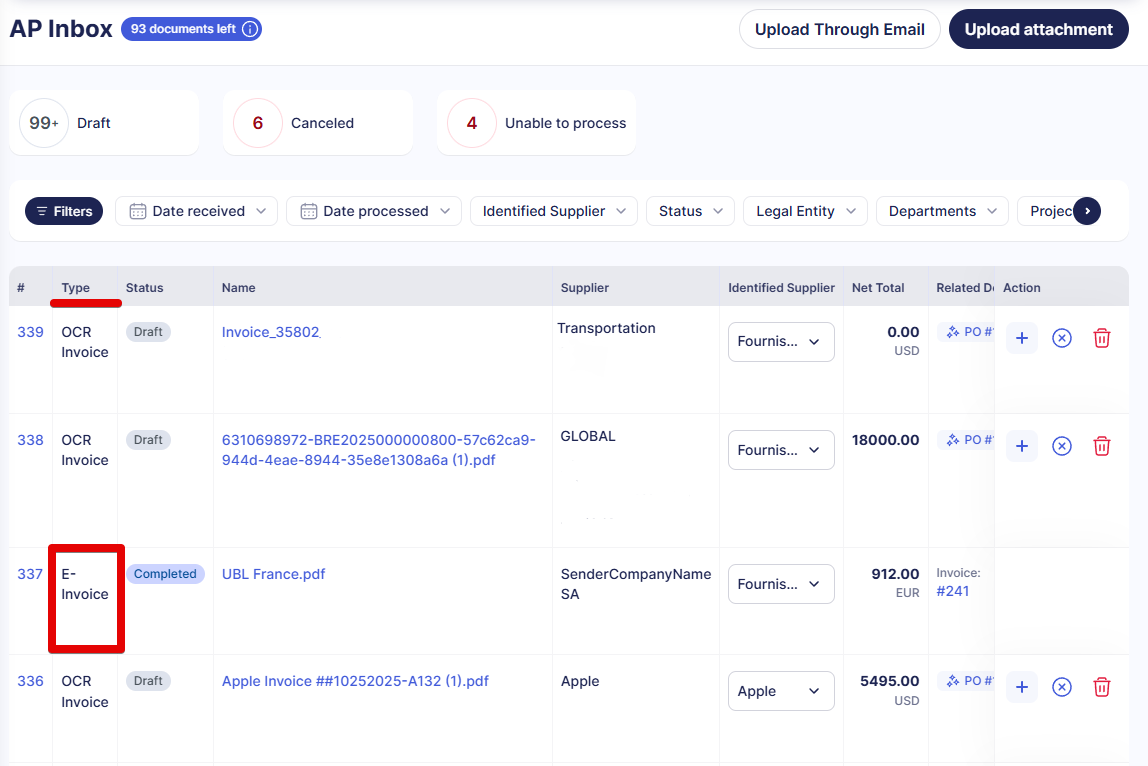
Teams don't need to manage separate tools or processes for each document format or country of origin.
Multi-currency and multi-entity management
Language and invoice format are only two dimensions of localization. Finance operations spanning multiple countries also involve multiple currencies, different tax structures (VAT, GST, withholding taxes), and distinct legal entities with their own approval hierarchies and budget controls.
Precoro addresses this challenge through multi-entity and multi-location controls, with separate workflows, budgets, currencies, and tax settings for each entity.
This functionality means a company operating subsidiaries in Germany, the US, and Mexico doesn’t need to run three separate procurement systems; it can manage all three from a single Precoro account, with each entity maintaining its own configuration.
In Precoro, users can switch between legal entities or locations within a single account. The platform supports a centralized supplier database that prevents duplicates and conflicting information, while allowing each location to add local-specific details — such as branch contacts or local tax IDs — without overwriting the global record.

This balance between global standardization and local flexibility is essential for AP teams that need consistent group-level reporting while respecting jurisdictional differences at the entity level.
Interface accessibility
Precoro supports English, French, German, and Spanish as interface languages, allowing AP staff in different countries to navigate the system in their preferred language.
This multilingual support reduces friction for onboarding teams across markets and ensures that approval workflows, budget controls, and invoice reviews are accessible to users who may not be fluent in English.
Robust data compliance
Precoro's privacy compliance program aligns with leading data protection frameworks, including the General Data Protection Regulation (GDPR), the UK GDPR, the California Consumer Privacy Act (CCPA), and the Health Insurance Portability and Accountability Act (HIPAA).
For AP teams operating under strict data governance rules in the EU, this regional infrastructure is a meaningful part of the localization story.
Bonus: Public product roadmap opened for your suggestions
For companies in countries not yet covered by Precoro's e-invoice processing, the platform offers a public product roadmap where customers can submit and upvote requests for new country-specific e-invoicing support. This transparent development model means that localization is not a static feature set but an actively evolving capability shaped by real customer demand.
With all these features taken together, Precoro's approach to AP localization is layered and practical:
- Multilingual OCR addresses the document-capture challenge for teams managing international suppliers.
- Country-specific e-invoicing formats keep companies compliant with emerging digital tax mandates across the EU and Latin America.
- Multi-entity and multi-currency controls let global finance teams operate under a unified system while respecting local rules.
- Regional server infrastructure, GDPR alignment, and a multilingual interface ensure the platform is fit for international deployment.
For mid-market and enterprise finance teams managing accounts payable across borders, these capabilities collectively reduce the friction that typically makes global AP operations complex and error-prone.
Global e-invoicing mandates: A snapshot
Although e-invoicing has been mandatory since 2015, domestic adoption remains limited. Of the approximately 19 million invoices processed annually by federal government agencies, only about 40% are submitted and processed electronically. These numbers highlight significant compliance gaps and ongoing implementation challenges.
This slow uptake stands in contrast to the broader global trend. Governments worldwide are accelerating the shift toward mandatory e-invoicing to enhance tax transparency and combat fraud. According to KPMG, 55 countries have implemented or are planning e-invoicing mandates, and by 2030, real-time reporting is expected to become standard practice across most jurisdictions.
| Country / Region | Mandate / Change | Timeline & Scope |
|---|---|---|
| Poland | Mandatory B2B e-invoicing via structured XML through KSeF platform | Large taxpayers from 1 Feb 2026; all companies by April 2026 |
| France | Phased rollout of mandatory structured e-invoicing and e-reporting (B2B → B2C) | Large & mid-sized companies from Sept 2026; SMEs later |
| Germany | Mandatory acceptance, then issuance of structured e-invoices (EN 16931; XRechnung / UBL) | Receiving mandatory 2025; issuing from 2027; full compliance by 2028 |
| UAE | B2B & B2G e-invoicing via OpenPeppol network | Mandatory from 1 Jan 2027 for companies with revenue ≥ AED 50M |
| Malaysia | Phased rollout based on turnover; structured format & tax authority integration required | Implemented Aug 2024; further phases Jan & July 2026 |
| South Africa | Planned mandatory e-invoicing as part of tax reporting reform | Full implementation targeted by 2028 |
You can’t scale globally with local spreadsheets
Spreadsheets work fine for a single office. But as your business expands across countries, currencies, and entities, they become the bottleneck. Data lives in silos. Invoice reconciliation takes weeks. Compliance gaps go unnoticed until they become costly mistakes. There's no visibility into global spend — just a fragmented collection of files managed in isolation by local teams. Scaling globally requires centralized systems.
You need processes standardized enough to consolidate into a coherent global picture. At the same time, your compliance frameworks must be granular enough to satisfy local regulators in every jurisdiction you operate in, and data visibility fast enough to support decision-making rather than just record-keeping.
Global AP localization — real localization, not translation — is a foundational piece of that infrastructure. It means having systems that automatically enforce local tax logic, workflows that route approvals correctly across time zones and entity hierarchies, and a consolidated view that gives your CFO and board an accurate picture of global spending in real time.
That's exactly what Precoro provides. Our multi-entity, multi-currency procure-to-pay platform gives HQ teams robust governance while equipping regional teams with locally compliant, customized tools.
Ready to make it happen? Centralize global spending without sacrificing local compliance — book a demo to see multi-entity and multi-currency at scale.
Frequently asked questions about accounts payable localization
It means adapting your entire AP process — not just the language — to meet the legal, tax, and operational requirements of a specific country. AP localization includes things like invoice formats, mandatory tax fields, electronic invoicing rules, currency handling, and payment methods that are standard or required in that market.
Because laws don't care about language — they care about compliance. Many countries have strict rules about how invoices must be structured, what information they must contain, and how they must be submitted. A translated invoice that doesn't meet those requirements will be rejected, and your company could face fines or audit failures.
E-invoicing refers to the structured electronic exchange of invoice data, often through government-mandated platforms or clearance models. Countries like Mexico (CFDI), Brazil (NF-e), Italy (SDI), and India (IRP) require invoices to be validated or transmitted through a government system before they are legally recognized. Your AP system must support these country-specific formats and workflows.
Basically, the biggest challenge hides in highly regulated markets, such as Italy’s SDI e-invoicing, Brazil’s NF-e XML, France’s mandatory legal mentions, and Germany’s USt-ID validation requirements. Moreover, global firms that manage 50+ formats, languages, currencies, and regulatory frameworks manually might increase costs, delay payments, and create compliance and supplier risks.
Several things typically need to change. Invoice formats and numbering systems often follow local legal standards. Tax identification fields vary — what's called a VAT number in Europe might be a CNPJ in Brazil or a GSTIN in India. Payment terms and methods differ, too, since some countries rely on bank transfers, while others use specific platforms. Archiving rules also vary, as many countries require invoices to be stored for 7–10 years in a specific format.
In the best case, you'll face operational headaches — vendors won't accept your documents, or your finance team won't be able to process local invoices correctly. In the worst case, you'll be operating illegally. Penalties can include rejected tax filings, fines, and, in some countries, suspension of your ability to do business.
Not necessarily. Many modern ERP and AP platforms — like Precoro, SAP, or Coupa — have localization modules built in for major markets. The key is making sure those modules are properly configured and kept up to date as local laws change, rather than building entirely separate systems from scratch.
Start with a compliance gap analysis, and compare your current system with the target country's legal requirements. Then prioritize the non-negotiables (e-invoicing mandates, mandatory tax fields, legal invoice formats) before addressing operational preferences. Working with a local tax advisor or a partner who specializes in that market will save you significant time and risk.
See Precoro in action to simplify and standardize accounts payable globally.